Putting Inferentialism and the Suppositional
Theory of Conditionals to the Test
Inaugural-Dissertation zur
Erlangung der Doktorwürde
der Wirtschafts- und Verhaltenswissenschaftlichen Fakultät der Albert-Ludwigs-Universität Freiburg. i. Br.
vorgelegt von Niels Skovgaard Olsen
geboren am 30.07.1985 in Køge, DK
Tag der mündlichen Prüfung:
22. September 2017
Referenten:
Prof. Dr. Karl Christoph Klauer
Prof. Dr. Andrea Kiesel
i
TABLE OF CONTENTS
Acknowledgement ... iii Summary ... v Zusammenfassung ... vii 1. Introduction ... 1The Suppositional Theory of Conditionals...2
The Psychological Evidence ...5
Inferentialism ... 11
Putting the Two Theories to the Test ... 11
References ... 13
2. The Relevance Effect and Conditionals ... 17
Introduction ... 19
The Current Experiment... 30
Discussion ... 41
Conclusion... 46
References ... 46
Appendix ... 51
Supplementary Materials ... 52
3. Relevance and Reason Relations ... 61
Introduction ... 63 Experiment 1 ... 64 Experiment 2 ... 69 General Discussion ... 76 References ... 79 Supplementary Materials ... 82
4. Relevance Differently Affects the Truth, Acceptability, and Probability Evaluations of ‘And’, ‘But’, ‘Therefore’, and ‘If Then’ ... 87
Introduction ... 89
Experiment 1 ... 99
Experiment 2 ... 113
ii
References ... 127
Appendix ... 132
5. General Discussion ... 135
Relevance and Conditionals: A Synopsis ... 136
Semantic and Pragmatic Factors ... 139
Argument for Semantic Defect ... 147
References ... 150
6. Curriculum Vitae ... 153
iii
ACKNOWLEDGEMENT
A number of people deserve my complete gratitude for the completion of this dissertation. First of all, I thank Wolfgang Spohn for his generousness in allowing me to complete a second PhD while working as a PostDoc in philosophy on a grant given to
him within the DFG Scherpunktprogramm, New Frameworks of Rationality. Second, I
am very grateful for the open-mindedness of Karl Christoph Klauer in accepting an unexperienced philosopher to work empirically in his lab and for all the great advice and knowledge that he has shared in the process. I am also very grateful for the fruitful collaboration with Henrik Singmann and David Kellen – both of whom have taught me invaluable data-analyses skills and contributed with great friendship. Thirdly, I want to thank my colleagues at the Department of Socialpsychology and Methodology at the University of Freiburg for welcoming me into their working group, and to the scientific assistants (esp. Hannes Krahl) for helping me out with the hard
work of conducting experiments. Fourthly, I want to thank my great colleagues at New
Frameworks of Rationality for collaborations and good times. A special thanks goes to
Markus Knauff, who has always been supportive of my research throughout the years. Fifthly, I want to thank John MarFarlane and Ulrike Hahn for productive and generous research visits at Berkeley University, Munich Center for Mathematical Philosophy, and Birkbeck University. Sixthly, I want to thank Igor Douven, Karolina Krzyżanowska, David Over, Shira Elqayam, Peter Collins, and Nicole Cruz for many good discussions over the years. But the biggest thanks goes to my parents, Niels Viggo Skovgaard Olsen and Anne Grete Skovgaard Olsen, and my brother, Jens Skovgaard Svane – to whom this dissertation is dedicated. Without their support and love I would never have been so audacious as to attempt a second dissertation within a new discipline.
v
SUMMARY
This dissertation is devoted to empirically contrasting the Suppositional Theory of conditionals, which holds that indicative conditionals serve the purpose of engaging in hypothetical thought, and Inferentialism, which holds that indicative conditionals express reason relations. Throughout a series of experiments, probabilistic and truth-conditional variants of Inferentialism are investigated using new stimulus materials, which manipulate previously overlooked relevance conditions. These studies are some of the first published studies to directly investigate the central claims of Inferentialism empirically.
In contrast, the Suppositional Theory of conditionals has an impressive track record through more than a decade of intensive testing. The evidence for the Suppositional Theory encompasses three sources. Firstly, direct investigations of the probability of indicative conditionals, which substantiate “the Equation” (P(if A, then C) = P(C|A)). Secondly, the pattern of results known as “the defective truth table” effect, which corroborates the de Finetti truth table. And thirdly, indirect evidence from the uncertain and-to-if inference task.
Through four studies each of these sources of evidence are scrutinized anew under the application of novel stimulus materials that factorially combine all permutations of prior and relevance levels of two conjoined sentences. The results indicate that the Equation only holds under positive relevance (P(C|A) – P(C|¬A) > 0) for indicative conditionals. In the case of irrelevance (P(C|A) – P(C|¬A) = 0), or negative relevance (P(C|A) – P(C|¬A) < 0), the strong relationship between P(if A, then C) and P(C|A) is disrupted. This finding suggests that participants tend to view natural language conditionals as defective under irrelevance and negative relevance (Chapter 2). Furthermore, most of the participants turn out only to be probabilistically coherent
vi
above chance levels for the uncertain and-to-if inference in the positive relevance condition, when applying the Equation (Chapter 3). Finally, the results on the truth table task indicate that the de Finetti truth table is at most descriptive for about a third of the participants (Chapter 4).
Conversely, strong evidence for a probabilistic implementation of Inferentialism could be obtained from assessments of P(if A, then C) across relevance levels (Chapter 2) and the participants’ performance on the uncertain-and-to-if inference task (Chapter 3). Yet the results from the truth table task suggest that these findings could not be extended to truth-conditional Inferentialism (Chapter 4). On the contrary, strong dissociations could be found between the presence of an effect of the reason relation reading on the probability and acceptability evaluations of indicative conditionals (and connate sentences), and the lack of an effect of the reason relation reading on the truth evaluation of the same sentences. A bird’s eye view on these surprising results is taken in the final chapter and it is discussed which perspectives these results open up for future research.
vii
ZUSAMMENFASSUNG
Diese Abhandlung widmet sich der empirischen Gegenüberstellung der nellen Theorie der Konditionalsätze und dem Inferentialismus. Laut der suppositio-nellen Theorie liegt die Hauptfunktion indikativer Konditionalsätzen darin, hypothe-tischem Denken zu veranlassen, während der Inferentialismus behauptet, dass sie Begründungsrelationen ausdrücken. Anhand einer Reihe von Experimenten werden probabilistische und wahrheitsbasierte Varianten des Inferentialismus mit neuen Stimulusmaterialien untersucht, die zuvor übersehene Relevanzbedingungen manipulieren. Die in dieser Abhandlung vorgestellten Studien gehören zu den ersten Veröffentlichungen, die die zentralen Aussagen des Inferentialismus auf direkte Weise empirisch überprüfen.
Im Gegensatz dazu weist die suppositionelle Theorie durch mehr als ein Jahrzehnt intensiver Tests eine beeindruckende Erfolgsbilanz auf. Die Befunde für die suppositionelle Theorie setzten sich aus drei Quellen zusammen. Erstens, direkte Untersuchungen der Wahrscheinlichkeit indikativer Konditionalsätze, welche die Gültigkeit von „the Equation“ (P(wenn A, dann C) = P(C|A)) bestätigen. Zweitens, ein
Ergebnismuster, das als „defekte Wahrheitstabelle“ bezeichnet wird und die de Finetti Wahrheitstabelle belegt. Drittens, indirektes Beweismaterial durch ungewisse „and-to-if“ Schlussfolgerungen.
Durch vier Studien wird jede dieser Beweisquellen erneut überprüft. Dazu werden neue Stimulusmaterialien angewandt, die alle Permutationen von A-priori-Wahrscheinlichkeiten und Relevanzbedingungen zweier miteinander verbundener Sätze faktoriell kombinieren. Die Ergebnisse weisen darauf hin, dass „the Equation“ für indikative Konditionalsätze lediglich unter positiver Relevanz (P(C|A) - P(C|¬A) > 0) gilt. Im Fall von Irrelevanz (P(C|A) - P(C|¬A) = 0) oder negativer Relevanz (P(C|A) - P(C|¬A)
viii
< 0) wird die starke Beziehung zwischen P(wenn A, dann C) und P(C|A) unterbrochen. Der Grund dafür dürfte sein, dass TeilnehmerInnen dazu tendieren, Konditionalsätze in natürlicher Sprache unter diesen Bedingungen als defekt zu betrachten (2. Kapitel). Weiterhin erweisen sich nur bei der positiven Relevanz-bedingung die meisten TeilnehmerInnen als probabilistisch kohärenter als das Zufallsniveau für ungewisse „and-to-if“ Schlussfolgerungen, wenn die „Equation“ als gültig vorausgesetzt wird (3. Kapitel). Letztendlich deuten die Ergebnisse der Wahrheitstabellen-Aufgaben darauf hin, dass die de Finetti Wahrheitstabelle die Antworten von höchstens ein Drittel der Teilnehmer beschreibt (4. Kapitel).
Anderseits lassen sich überzeugende Belege für die probabilistische Variante des Inferentialismus sowohl der Bewertung von P(wenn A, dann C) unter Relevanzbedingungen (2. Kapitel) als auch der Performanz der Teilnehmer in der ungewissen „and-to-if“ Schlussfolgerungen unter Relevanzbedingungen (3. Kapitel) erbringen. Im Gegensatz dazu sprechen die Ergebnisse der Wahrheitstabellen-Aufgabe eher gegen die wahrheitsbasierte Variante des Inferentialismus (4. Kapitel). Vielmehr deutet das Ergebnismuster darauf hin, dass starke Dissoziationen zwischen dem Einfluss von Relevanzbedingungen auf Einschätzungen von Wahrscheinlichkeiten und dem fehlenden Einfluss derselben auf Wahrheitsbeurteilungen gefunden werden können. Während der wahrgenommene Begründungszusammenhang von Anteze-denz und Konsequent die Zuschreibung von Wahrscheinlichkeiten indikativer Konditionalsätze (sowie verwandter Sätze) stark beeinflusst, wurde kaum Einfluss auf Wahrheitsbeurteilungen derselben Sätze gefunden. Im abschließenden Kapitel werden diese überraschenden Ergebnisse von einem höheren Blickwinkel aus betrachtet und mögliche Erweiterungen für zukünftige Forschung erörtert.
1
1. INTRODUCTION
Conditionals continue to receive much attention in psychology, philosophy, linguistics, and computer science (Bennett, 2003; Douven, 2015; Nickerson 2015). Indeed the literature on conditionals is so vast that it is difficult for researchers to keep track of its many branches within a single discipline and nearly impossible to keep track of it across disciplines. Part of the reason is that as much as researchers agree on the centrality of conditionals for understanding human reasoning and argumentation, as much do they disagree over how exactly to understand their semantic content (Edgington, 2014), pragmatics, computational models (Oaksford and Chater, 2010), and logical principles (Arlo-Costa, 2007).
In adding to this literature, the present dissertation selects a somewhat narrow scope by focusing on the empirical content of two theories of indicative conditionals in contemporary philosophy and psychology of reasoning. On the one hand, the
Suppositional Theory of conditionals which was originally imported to the psychology
of reasoning from formal epistemology. On the other, Inferentialism which is based on an old idea in philosophy that conditionals can be viewed as condensed arguments. While the Suppositional Theory of conditionals has established an impressive track record through more than a decade of intensive empirical testing (Over and Evans, 2003; Evans and Over, 2004; Over and Cruz, forthcoming), the empirical testing of the more recent introduction of Inferentialism into the psychology of reasoning (Spohn, 2013; Olsen, 2014; Douven 2015; Krzyżanowska, 2015; Skovgaard-Olsen 2015, 2016) still represents uncharted territory. Indeed, one of the main goals of the present dissertation is exactly to embark on the empirical investigation of Inferentialism through a series of experiments outlined in Chapters 2-4. Like Douven, Elqayam,
2
Singmann, Over, and Wijnbergen-Huitink (forthcoming), these studies represent some of the first attempts to investigate the psychological merits of Inferentialism directly.
Before presenting the studies themselves, this introduction will briefly cover some of the theoretical background for the Suppositional Theory of conditionals, outline some of the existing empirical results corroborating the theory, and identify three experimental paradigms that will set the frame for the rest of the dissertation.
The Suppositional Theory of Conditionals
In a famous footnote, Ramsey (1929/1990) suggested that two interlocutors could settle their argument over a conditional ‘if A, then C’ by hypothetically adding A to their stock of beliefs and arguing over C on that basis. As outlined in Arlo-Costa (2007), this little footnote outlining, what was later to become “the Ramsey test”, has inspired at least three opposing research programs in logics:
• The AGM belief-revision theory that only works with qualitative
all-or-nothing beliefs and characterizes updating behavior under revision and contraction of belief states through eight axioms. The AGM theory was originally formulated with the goal of formulating a conditional logic based on principles of belief revision until Gärdenfoss proved a triviality theorem showing that the theory was not suitable for this intended purpose. Within AGM theory, the Ramsey test can be stated as follows:
B supports A > B iff B * A supports B
for 'B' representing a belief set, 'A > B' representing a conditional, and 'B * A' representing the revision of 'B' by A (Rott, 2017).
• The Stalnaker-Lewis possible worlds semantics of conditionals that
supplies an influential account of the truth conditions of counterfactuals, according to which a counterfactual (i.e. ‘if A had been the case, then C would have occurred’) is true iff the consequent is true in all the closest
3
possible world(-s) in which the antecedent is true. In Stalnaker's notation, this idea is made precise by introducing the idea of a selection function, f(A, w), which selects the closest world (or the set of closest worlds) to w in which A is true. The conditional, 'A > C', is then true iff the selected A-world(s) is a subset of the set of worlds in which C is true, [C] (Égré and Cozic, 2016).
• The probabilistic semantics of indicative conditionals of Adams (1975),
which in its original form denies that indicative conditionals have truth conditions, and subscribes to either P(if A, then C) = P(C|A) or acc(if A, then C) = acc(C|A), for ‘if A, then C’ referring to simple conditionals (which exclude nestings of conditionals). Here acc(if A, then C) stands for the acceptability of the conditional. Often this version of Adams’ thesis is preferred, because it is unclear whether P(if A, then C) can still be interpreted as a probability in light of the so-called triviality results, as we will see in Chapter 2 (Bradley, 2007; Douven, 2015).
Through the influence of the writings of Edgington (1995) and Bennett (2003), the psychological hypothesis that the probability of indicative conditionals is evaluated as a conditional probability found its way into the psychological literature (Evans and Over, 2004), where it goes by the name “the Equation”. In the psychological literature, it is assumed that the Ramsey test is implemented by treating the false antecedent cases as irrelevant and assessing the ratio of A&C and A&non-C cases (Oberauer, Geiger, Fischer, and Weidenfeld, 2007). However, the exact mental processes involved in carrying out the Ramsey test still remain unknown (Over, Hadjichristidis, Evans, Handley, and Sloman, 2007).
Since Adams (1975) denied that indicative conditionals possess truth conditions, he was faced with the challenge of providing an alternative account of the validity of argument schemes involving conditionals. The solution he came up with was to
introduce the notion of p-validity. An inference is p-valid, iff the uncertainty of the
4
for all probability distributions (with the uncertainty of a proposition, p, defined as 1 – P(p)): [1-P(A1)] + [1-P(A2)]+…+[1-P(Ai)] ≥ 1 – P(B). The notion of p-validity generalizes
the classical notion of deductive validity—according to which an argument schema is valid iff there does not exist a model in which all the premises are true and the conclusion is false (Garmut, 1991)—to the notion that a valid inference cannot take us from premises that have a high probability to a conclusion that has a low probability. Adams observed that this latter property of probability preservation from the premises to the conclusion was one that classically valid inferences had and introduced his more general notion of p-validity to deal with both the cases where the premises are uncertain and the cases in which conditionals feature as conclusions (Edgington, 2014).
In the psychology of reasoning, the Suppositional Theory of conditionals endorsing these views is often advanced in explicit opposition to analyses of indicative
conditionals in terms of the material implication (⊃),1 which has been widely accepted
earlier in the psychology of reasoning. Since the material implication is logically equivalent to the disjunction ‘not-A or C’ it has introduction rules, which are appropriate for a disjunction. In classical logic a disjunction can always be inferred from either of its disjuncts (an inference rule known as “disjunction-introduction”). Consequently, if the natural language indicative conditional has the truth conditions of the disjunction ‘not-A or C’, then it should be possible to both infer ‘If A, then C’ from ‘not-A’ and to infer ‘if A, then C’ from ‘C’. In Chapter 2, we will explain why these argument schemes, which are also known as the paradoxes of the material implication, are usually rejected.
In contrast, the paradoxes of the material implication are not valid based on p
-validity, which is usually seen as a decisive advantage of the account. In addition, the following argument schemes would have been valid based on the material implication
but are no longer valid based on p-validity. This too is seen as an advantage of p
1 The material implication is logically equivalent to ‘not-A or C’ and ‘not(A and non-C)’ and is thus true in all other cells of the truth table than the A and not-C cell.
5
validity, since all of these argument schemes have well-known counterexamples discussed in the philosophical literature (Bennett, 2003: ch. 9):
Strengthening of the antecedent: if A, C ∴if A and B, C Contraposition: if A, C ∴if ∼C,∼A Transitivity: if A, B; if B, C ∴if A, C
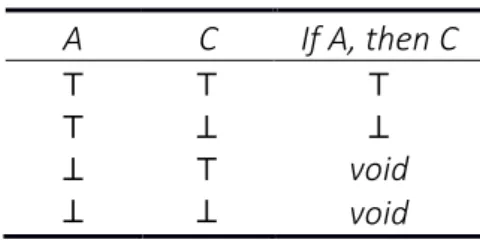
However, instead of following Adams (1975) in holding that indicative conditionals lack truth conditions, the proponents of the Suppositional Theory of conditionals in the psychology of reasoning usually take the de Finetti truth table as supplementing the Ramsey test (Evans and Over, 2004):
Table 1. De Finetti Truth Table
The Psychological Evidence
On the Suppositional Theory of conditionals, the word ‘if’ owes its distinctive character to its role in hypothetical thought by engaging the imagination to simulate possibilities (Evans and Over, 2004; Evans, 2007). For more than a decade of research, the Suppositional Theory of conditionals has become a widely accepted theory in the
A C If A, then C ⊤ ⊤ ⊥ ⊥ ⊤ ⊥ ⊤ ⊥ ⊤ ⊥ void void Note. ‘⊤’ = True, ‘⊥’ = False
6
psychology of reasoning and has been gaining grounds over against the mental model theory, which remains a popular theory of other types of reasoning like spatial reasoning (Johnson-Laird, 2008). The mental model theory used to adopt the material implication reading of indicative conditionals (Johnson-Laird and Byrne, 2002), but has recently been modified in response to persistent criticism to eschew a commitment to the material implication, however (Johnson-Laird, Khemlani, and Goodwin, 2015).
To prepare the grounds for the empirical studies reported in Chapters 2-4, the following two sections introduce some of the empirical evidence that has been accumulating for the Suppositional Theory of conditionals through this decade of empirical research. We will here focus on the classical truth table task and the more recent “probabilistic truth table task” (in Chapter 3 the uncertain and-to-if inference task is also discussed). For although the Wason selection task (where the participants are asked to select the cards needed to find out whether a conditional rule is true or false) and the conditional inference task (investigating the argument schemes MP, MT, AC, and DA) belong to some of the most studied tasks, these tasks do not produce separate predictions for the material implication and the Suppositional Theory of conditionals.2
The Probabilistic Truth Table Task
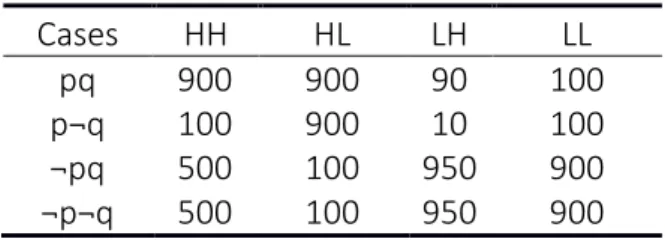
In Oberauer and Wilhelm (2003) the participants were presented with a distribution of
2000 playing cards with colored letters on them, which crossed frequency of pq and
the ratio of pq to p¬q across four conditions, as shown in Table 2.
2 Or I should say, at least this was the stance taken in Evans, Handley, Neilens, and Over (2007). In Baratgin, Over, and Politzer (2013) new predictions are made for the Suppositional Theory of conditionals in the Wason selection task that mimick the predictions made in Oaksford and Chater (2007).
7
Table 2.Frequency Distribution from Oberauer & Wilhelm (2003)
For this experimental design, the Equation predicts that the participants’ assessment of, say, P(if there is an A on a card, then it is red) are sensitive only to the ratio of pq to p¬q. The material implication predicts that the assessment only depends
on the relative frequency of p¬q. Yet, a conjunctive interpretation predicts that the
probability assignment is only sensitive to the relative frequency of pq. Using this
paradigm, Oberauer and Wilhelm (2003) found that the majority of the participants conformed to the Equation and that a minority of the participants followed the conjunctive interpretation. Moreover, in other similar experiments with frequency distributions and abstract stimulus materials (e.g. Evans, Handley, and Over, 2003), the participants generally judge P(if p, then q) as P(q|p). A minority judge P(if p, then q) as P(p,q) and judgments as P(¬p or q) rarely occur.
In Evans, Handley, Neilens, and Over (2007) and Oberauer et al. (2007) individual
variation in the conjunctive and the conditional probability responses was
investigated. In Evans et al. (2007) it was found that 58% of the participants provided a
conditional probability response and that 38% provided a conjunctive probability response (with the rest remaining unclassified), and that the participants providing the conditional probability response generally exhibited a higher level of cognitive ability.
In Oberauer et al. (2007) it was found that 70% of the participants could be classified
as providing conditional probability responses with 18% of the participants providing conjunctive probability responses.
Cases HH HL LH LL pq p¬q ¬pq ¬p¬q 900 100 500 500 900 900 100 100 90 10 950 950 100 100 900 900
Note. ‘HH’, high frequency of pq, high P(q|p). ‘HL’ high freuquency of pq, low P(q|p). ‘LH’ low frequency of pq, high P(q|p). ‘LL’ low frequency of pq, low P(q|p).
8
The minority conjunctive-probability-response is puzzling since it seems to indicate a failure to engage with hypothetical thought, as Evans and Over (2004) point out. But it is compatible with mental model theory, which assumes that there are various levels of depth in the processing of indicative conditionals, where only creating a mental model of the A&C cell counts as the shallowest level of processing (Byrne and
Johnson-Laird, 2002). Because Over et al. (2007) did not find a tendency to produce a
conjunctive probability response pattern with realistic stimulus materials, Evans et al.
(2007) speculate that the conjunctive response pattern may arise due to a combination of abstract stimulus materials and lower cognitive ability.
“Defective Truth Tables”
It has long been known that there is a tendency to treat the false antecedent cells in a truth table task as irrelevant for the truth value of indicative conditionals, when the participants are given a ternary response option. At a time when the material implication was the accepted model, this response pattern was dubbed ‘the defective truth table’. Later it has been reinterpreted as indicative of the de Finetti truth table (Evans and Over, 2004).
In the following, Baratgin, Over, and Politzer (2013) will be discussed as an illustration of the empirical evidence corroborating the de Finetti truth table. In their
study, Baratgin et al. (2013) not only investigate the truth evaluations of indicative
conditionals (‘If A then C’) but also of conditional bets (‘I bet that if A then C’). In the Bayesian tradition, subjective degrees of beliefs as measured by probability assignments are operationalized by betting quotients, where the participants have to make decisions about their relative preferences of betting on events described by pair of propositions. In the Bayesian literature on indicative conditionals going back to Ramsey and de Finetti, the indicative conditional is often compared to conditional bets. This comparision is meant to convey the idea that just as a conditional bet is rendered void, if the antecedent turns out to be false, so indicative conditionals possess an indeterminate truth value in the false antecedent cells of their truth tables.
9
Or as Baratgin et al. (2013: 309) put it: “When A turns out to be false, no indicative
assertion or bet is made”.
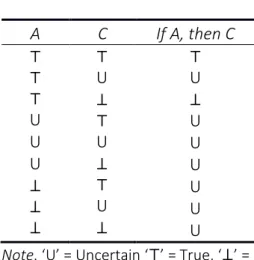
Using deductive instructions where A and C were treated as certain, Politzer, Over, and Baratgin (2010) tested the 2x2 de Finetti table (see Table 1) both for indicative conditionals and conditional bets by asking the participants to make ternary truth evaluations, or win/lose evaluations, for every cell of the truth table. The results of their study were found to support Table 1. However, often in the so-called new Paradigm of psychology of reasoning, probabilistic instructions (where the premises are treated as uncertain and the response format is one of degrees of belief) are preferred over deductive instructions (where the premises are treated as certain and the participants are asked to make categorical judgments, Singmann and Klauer, 2011). For this reason, Baratgin et al. (2013) decided to replicate Politzer et al.’s (2010) results for the relation between indicative conditionals and conditional bets using the following 3x3 de Finetti table (see Table 3), where A and C are allowed to be uncertain:
Table 3. De Finetti Truth Table
To introduce the uncertainty manipulation, the participants were presented with photos of two opaque boxes containing black/white and round/square chips. Occasionally, a chip from the top box would drop into the bottom box and the participants were presented with a photograph of how the chips looked as they
A C If A, then C ⊤ ⊤ ⊤ U U U ⊥ ⊥ ⊥ ⊤ U ⊥ ⊤ U ⊥ ⊤ U ⊥ ⊤ U ⊥ U U U U U U
Note. ‘U’ = Uncertain ‘⊤’ = True, ‘⊥’ = False
10
passed the empty space between the two boxes. These photographs could in turn be taken by cameras with different filters. As a result, under one condition the black/white chips might look grey (in which case the color of the chip would be indeterminate) or the shape might be indiscernible. Consequently, the participants could either be presented with information that conclusively confirm which color or shape the chips had while they passed from the top box to the bottom box (corresponding to the ⊤ and ⊥ cells of Table 3). Alternatively, the participants might be left in a state of uncertainty with respect to these attributes due to the blurring of the filters (corresponding to the U cells of Table 3).
The participants were instructed that two children would be playing with a game containing these two boxes, where one of the children would pick a chip at random from the top box and let it drop down into the lower box and the second child had to guess which chip it was. As part of this game, the second child would then make conditional assertions (e.g. “If the chip is round, then it is white”) or conditional bets (e.g. “I bet that if the chip is round, then it is white”). The task of the participants was to give a ternary response about whether the conditional assertion was certainly true/false or neither nor, or the conditional bet had been certainly won/lost or neither nor, for each of the nine truth table cells in Table 3.
The results showed that there were no significant differences between the participants’ responses to indicative conditionals and conditional bets and that when the 2x2 cells were considered for indicative conditionals, 38.6% agreed with the de Finetti truth table, 35.6% responded according to the conjunction, and 13.9% responded according to the material implication. Considering the remaining five cells of the 3x3 tables, more than half of the participants were classified as following the de Finetti truth table. The rest were classified according to other three-valued truth tables known in the literature. Again these results provide support for the de Finetti 2x2 and 3x3 truth tables and for the parallel between indicative conditionals and conditional bets, which in turn corroborates the Suppositional Theory of conditionals.
11
Inferentialism
In the chapters to come we will go more into details with Inferentialism, or the relevance approach to conditionals, as it was called in Skovgaard-Olsen (2016).
Inferentialism holds that indicative conditionals express inferential relations, or reason relations (defined in Chaper 2). On the strong reading, Inferentialism makes reason relations part of the truth conditions of indicative conditionals ("truth conditional Inferentialism") and rejects the validity of 'A∧C ⊨ if A, then C’ (Douven, 2015; Krzyżanowska, 2015). Truth-conditional Inferentialism rejects the validity of this argument scheme, because the indicative conditional is viewed as expressing a reason relation and the mere truth of A and C does not ensure that they are inferentially connected. Rejecting the validity of the and-to-inference is a distinguishing feature of this approach, since and-to-if inferences are trivially valid on the material implication account and on accounts of conditionals that are inspired by the Ramsey test (Douven, 2015).
In Chapter 4, truth-conditional Inferentialism is tested directly by introducing a relevance manipulation into the truth table task. In Chapters 2-3, a weaker probabilistic implementation of Inferentialism is investigated by measuring the participants’ probability assignments to indicative conditionals and their reasoning on the uncertain-and-to-if inference task to investigate whether the participants view indicative conditionals as defective when they fail to express a reason relation.
Putting the Two Theories to the Test
To contrast Inferentialism and the Suppositional Theory experimentally, the following paradigms were selected: (1) assessments of P(if A, then C) and the classical truth table task, because they are among the most frequently cited sources of evidence for the Suppositional Theory in the literature, and (2) the uncertain-and-to-if inference, because and-to-if inferences have been identified as diagnostic for deciding between Inferentialism and the Suppositional Theory.
12
The general idea behind these experiments is to test how robust the Suppositional Theory is under extreme conditions. To make an analogy: for a researcher interested in examining rationality, it makes sense to study cases of irrationality to investigate the boundary conditions and limitations of human rationality. For a researcher interested in studying text comprehension, and how the participants make sense of a string of connected passages, it is a valuable research strategy to study cases where participants are challenged and experience difficulties in deciphering the meaning of concatenated strings of words. Similarly, for researchers interested in studying relevance, and our use of conditionals to express reason relations, it is a sound research strategy to systematically investigate cases where relevance and reason relations break down. In Chapters 2-4, a series of experiments are conducted that did exactly this. Because most published studies prior to their publication tended to use stimulus materials where the antecedent is probability raising for the consequent for realistic stimulus materials (positive relevance), a central motive behind conducting these experiments was to create conditions that allow for violations of positive relevance. In each case, the goal was to investigate whether the patterns we find for positive relevance generalize to the pathological cases, where the antecedent lowers the probability of the consequent (negative relevance), or leaves it unchanged (irrelevance).
In Chapter 2, an experiment is reported that employed this research strategy for investigations of P(if A, then C) and Acc(if A, then C). In Chapter 3 an experiment is reported that employed it for the uncertain and-to-if inference task. And, finally, in Chapter 4 experiments are reported that employed it for the truth evaluation, probability and acceptability evaluations for conditionals and related connectives.
13
References
Adams, E. W. (1975). The Logic of Conditionals. Dordrecht: D. Reidel.
Arlo-Costa, Horacio (2007). The Logic of Conditionals. The Stanford Encyclopedia of
Philosophy (spring 2016 Edition), Edward N. Zalta (ed.). URL =
<http://plato.stanford.edu/archives/fall2016/entries/logic-conditionals/>. Baratgin, J., Over. D. E., Politzer, G. (2013). Uncertainty and the de Finetti
tables.Thinking & Reasoning, 19(3), 308-28.
Bennett, J. (2003). A Philosophical Guide to Conditionals. Oxford: Oxford University
Press.
Bradley, R. (2007). A Defence of the Ramsey Test. Mind, 116 (461), 1-21.
Douven, I. (2015). The Epistemology of Indicative Conditionals: Formal and Empirical
Approaches. Cambridge: Cambridge University Press.
Douven, I., Elqayam, S., Singmann, H., Over, D., &Wijnbergen-Huitink, J. V. (in press).
Conditionals and inferential connections.
Edgington, D. (1995). On Conditionals.Mind, 104, 235-327.
--- (2014 ). Indicative Conditionals. The Stanford Encyclopedia of Philosophy
(Winter 2014 Edition), Edward N. Zalta (ed.), URL =
<https://plato.stanford.edu/archives/win2014/entries/conditionals/>. Égré, P. and Cozic, M. (2016). Conditionals. In: Aloni, M. and Dekker, P. (ed.), The
Cambridge Handbook of Formal Semantics. Cambridge: Cambridge University
Press, 490-524.
Evans, J. St. B. T. (2007). Hypothetical Thinking: Dual Processes in Reasoning and
Judgment. New York: Psychology Press.
Evans, J. St. B. T., Handley, S. J., Neilens, H., and Over, D. E. (2007). Thinking about conditionals: A study of individual differences. Memory & Cognition, 35(7), 1772-84.
14
Evans, J. St. B. T., Handley, S. J., and Over, D. E. (2003). Conditionals and conditional
probabilities. Journal of Experimental Psychology: Learning, Memory, and
Cognition, 29, 321-35.
Evans, J. St. B. T. & Over, D. (2004). If. Oxford: Oxford University Press.
Johnson-Laird, P. N. (2008). How we Reason. Oxford: Oxford University Press.
Johnson-Laird, P. N., & Byrne, R. M. J. (2002). Conditionals: A theory of meaning,
pragmatics, and inference. Psychological Review, 109, 646–678.
Johnson-Laird, P. N., Khemlani, S. S., & Goodwin, G. P. (2015). Logic, probability, and
Human reasoning.Trends in Cognitive Science, 19, 201–214.
Krzyżanowska, K. (2015). Between ‘‘If” and ‘‘Then”: Towards an empirically informed
philosophy of conditionals. PhD dissertation, Groningen University.<http:// karolinakrzyzanowska.com/pdfs/krzyzanowska-phd-final.pdf>.
Nickerson, R. S. (2015). Conditional Reasoning.The Unruly Syntactics, Semantics,
Thematics, and Pragmatics of “if”. Oxford: Oxford University Press.
Oaksford, M. and Chater, Nick (2007). Bayesian Rationality: The Probabilistic Approach
to Human Reasoning. Oxford: Oxford University Press.
Oaksford, M. and Chater, N. (eds.) (2010). Cognition and Conditionals: Probability and
Logic in Human Reasoning. Oxford: Oxford University Press.
Oberauer, K., Geiger, S. M., Fischer, K., and Weidenfeld, A. (2007). Two meanings of „if“? Individual differences in the interpretation of conditionals. The Quarterly
Journal of Experimental Psychology, 60(6), 790-819.
Oberauer, K. and Wilhelm, O. (2003). The meaning(s) of conditionals—conditional
probabilities, mental models, and personal utilities. Journal of Experimental
Psychology: Learning, Memory, and Cognition, 29, 680-93.
Olsen, N. S. (2014). Making ranking theory useful for psychology of reasoning. PhD
dissertation, University of Konstanz. <http://kops.uni-konstanz.de/handle/
15
Over, D. E. and Cruz, N. (forthcoming). Probabilistic accounts of conditional reasoning.
To appear in: Linden J. Ball and Valerie A. Thompson (Eds.), International
Handbook of Thinking and Reasoning. Hove, Sussex: Psychology Press.
Over, D. E., Hadjichristidis, C., Evans, J. S. B. T., Handley, S. J., & Sloman, S. A. (2007). The probability of causal conditionals. Cognitive Psychology, 54(1), 62–97. Over. D. E., and Evans, J. St. B. T. (2003). The Probability of Conditionals: The
Psychological Evidence. Mind & Language, 18(4), 340-58.
Politzer, G., Over, D. E., and Baratgin, J. (2010). Betting on conditionals. Thinking & Reasoning, 16, 172-97.
Ramsey, F.P. (1929). General Propositions and Causality. In: H. A. Mellor (eds.), F.
Ramsey: Philosophical Papers, Cambridge: Cambridge University Press, 1990.
Rott, H. (2017). Preservation and Postulation: Lessons from the New Debate on the Ramsey Test. Mind.
Singmann, H. and Klauer, K. C. (2011). Deductive and inductive conditional inferences: Two modes of reasoning. Thinking & Reasoning, 17(3), 247-81.
Skovgaard-Olsen, N. (2015). Ranking theory and conditional reasoning. Cognitive
Science, 1-33.
--- (2016). Motivating the Relevance Approach to Conditionals. Mind &
Language, 31(5), 555-79.
Spohn, W. (2013). A ranking-theoretic approach to conditionals. Cognitive Science,
17
2. THE RELEVANCE EFFECT AND
CONDITIONALS
3
Niels Skovgaard-Olsen
University of Konstanz and Albert-Ludwigs-Universität Freiburg Henrik Singmann
University of Zürich Karl Christoph Klauer
Albert-Ludwigs-Universität Freiburg
Skovgaard-Olsen, N., Singmann, H., Klauer, K. C. (2016). The Relevance Effect and Conditionals. Cognition, 150, 26-36. This work was supported by grants to Wolfgang Spohn and Karl Christoph Klauer from the Deutsche Forschungsgemeinschaft (DFG) as part of the priority program “New Frameworks of Rationality” (SPP 1516).
Supplementary materials including all data and analysis scripts are available at:
https://osf.io/j4swp/
3 We are very grateful to Wolfgang Spohn, Igor Douven, David Over, Nicole Cruz, Shira Elqayam, Seth Yalcin, and the audiences of talks at ‘Gießener Abendgespräche Kognition und Gehirn’ (University of Gießen), ‘What if’ (University of Konstanz), and ‘Working Group in the History and Philosophy of Logic, Mathematics, and Science’ (UC Berkeley) for valuable discussions. Moreover, careful comments from the reviewers of Cognition substantially improved the manuscript.
18
Abstract
More than a decade of research has found strong evidence for P(if A, then C) = P(C|A) (“the Equation”). We argue, however, that this hypothesis provides an overly simplified picture due to its inability to account for relevance. We manipulated relevance in the evaluation of the probability and acceptability of indicative conditionals and found that relevance moderates the effect of P(C|A). This corroborates the Default and Penalty Hypothesis put forward in this paper. Finally, the probability and acceptability of concessive conditionals (“Even if A, then still C”) were investigated and it was found that the Equation provides a better account of concessive conditionals than of indicatives across relevance manipulations.
Keywords: Indicative conditionals, the New Paradigm, relevance, reasons, concessive conditionals, the Equation.
19
Introduction
In philosophy, there is a widely shared consensus that Stalnaker’s Hypothesis is wrong and that Adams’ Thesis is correct, due to formal problems affecting the former but not the latter – known as the triviality results.
STALNAKER’S HYPOTHESIS: P(if A, then C) = P(C|A) for all probability distributions where P(A) > 0 and ‘If A, then C’ expresses a proposition.
ADAMS’ THESIS: Acc(if A, then C) = P(C|A) for all simple conditionals (i.e. conditionals whose antecedent and consequent clauses are not themselves conditionals), where ‘Acc(if A, then C)’ denotes the degree of acceptability of ‘If A, then C’.4 TRIVIALITY RESULTS: Lewis’ triviality results show that there is no proposition whose probability is equal to P(C|A) for all probability distributions without the latter being subject to trivializing features such as that P(C|A) collapses to P(C) or that positive probabilities can only be assigned to two pairwise incompatible propositions (Bennett, 2003: Ch. 5; Woods, 1997: Ch. 4, p. 114–8).
In psychology, there has been a tendency to endorse a thesis very similar to Stalnaker’s hypothesis, known as the Equation, which avoids the problems affecting the former by either denying that conditionals express propositions altogether or by endorsing three-valued de Finetti truth tables (Table 1):
Table 1. De Finetti Truth Table
THE EQUATION:P(if A, then C) = P(C|A), but ‘If A, then C’ does not express a classical proposition. (Bennett, 2003; Evans & Over, 2004; Oaksford &Chater, 2007)
4 One of the reviewers pointed out that Adams later abandoned this position in Adams (1998). To sidestep such exegetical issues we use the phrase ‘Adams’ Thesis’ to denote the position attributed to him in the literature based on his earlier work.
A C If A, then C ⊤ ⊤ ⊥ ⊥ ⊤ ⊥ ⊤ ⊥ ⊤ ⊥ void void
20
At present, the theories united under the heading ‘the New Paradigm of Reasoning’, which endorse the Equation, have branched out in different directions. To name just a few, in Baratgin, Politzer, and Over (2013) and Politzer, Over, and Baratgin (2010), the Equation is studied in relation to three-valued de Finetti truth tables in general and its relation to conditional bets is emphasized. In Pfeifer and Kleiter (2011) and Pfeifer (2013), the Equation is endorsed on the basis of a coherence-based probability logic that works with intervals of imprecise probabilities. However, what matters for our purposes is not so much the exact theory in which the Equation is embedded but rather the general commitment to the Equation. As it stands, over a decade of empirical research has found strong evidence in favor of the Equation and a recent study has begun to challenge Adams’ Thesis, as nicely outlined in Douven (2015b: Ch. 3, 4).
In contrast, a basic intuition that has emerged repeatedly throughout the history of philosophy is that in conditionals like ‘If it rains, then the match will be cancelled’ the antecedent and the consequent should somehow be connected or relevant for one another as one aspect of the conditionals’ meaning (for references see Skovgaard-Olsen, 2016; Krzyżanowska, 2015; Douven, 2015b). This intuition is especially salient when we observe examples in which the relevance expectation is violated, as in conditionals such as ‘If blood is red, then Oxford is in England’, for which the truth-value of the antecedent leaves the truth-value of the consequent unaffected. However, surprisingly this intuitive idea is not preserved in any of the theories of conditionals currently endorsed in the psychology of reasoning, as we shall see.
The Paradoxes of the Material Implication
Before the Equation became popular in the psychology of reasoning (Evans & Over, 2004; Oaksford &Chater, 2007; Pfeifer, 2013), the dominant theory was mental model theory, which is based on the material implication analysis of natural language
21
conditionals (Johnson-Laird & Byrne, 2002).5 Since the material implication is always
true except in cases when its antecedent is true and its consequent is false, the theory validates the following argument-schemes that are known to give rise to nonsensical results once natural language content is substituted:
¬A
∴ if A, C C
∴ if A, C [1]
With no restrictions on the relationship between the antecedent and the
consequent, any conditional could be inferred from a false antecedent or a true
consequent, no matter how odd. Hence, from the true premise ‘It is not the case that Europe has been ruled by France since Napoleon’ the conditional ‘If Europe has been ruled by France since Napoleon, then the sun emits light’ could be inferred. And from the true premise ‘The sun emits light’, the conditional ‘If Europe has been ruled by France since Napoleon, then the sun emits light’, or indeed ‘If Europe was liberated from occupation by Napoleon’s France, then the sun emits light’ could be inferred. Unsurprisingly, participants in psychological experiments tend to find such inferences odd as well (Pfeifer & Kleiter, 2011). Of course, this fact has not escaped the proponents of mental model theory. In accounting for the oddness of such inferences, they exploit the logical equivalence of the material implication with ‘¬A v C’ and argue that the reason why we are reluctant to endorse the valid argument schemes in [1] is due to the problem with endorsing the following equally valid argument schemes:
¬A
∴ ¬A vC C
∴ ¬A vC [2]
Since more possibilities are excluded by the premises than by the conclusions in [2], information is lost in the conclusion, and according to Johnson-Laird and Byrne
5 As one of the reviewers pointed out, mental model theory has recently been revised so as to avoid being committed to the material implication analysis of the natural language conditional in Johnson-Laird, Khemlani, and Goodwin (2015). However, we here restrict our focus to the previous version of the theory.
22
(2002; Byrne and Johnson-Laird (2009)) this is really the source of our intuitive problems with [1]. However, in the absence of a prior theoretical commitment to the logical equivalence of natural language conditionals to disjunctions, a much more straightforward diagnosis of the oddness of [1] runs as follows. The problem is not so
much that fewer possibilities are excluded by the conclusion than by the premises, but
rather that different conditions are imposed by the premises and the respective conclusions. The premises are silent on the relationship between A and C and impose conditions on a set of possible worlds by being factual propositions; the conclusions impose constraints on epistemic states (i.e., that A is epistemically relevant for C).
In contrast, the probabilistic approaches that are currently replacing the mental model theory under the heading ‘the New Paradigm of Reasoning’ endorse the Equation and reject [1]. Purportedly this is because the premises do not probabilistically constrain the conclusion when the latter is interpreted as a conditional probability as long as 0 < P(premise) < 1 (Bennett, 2003, p. 139; Evans & Over, 2004; Oaksford & Chater, 2007; Pfeifer & Kleiter, 2011). However, as argued in Skovgaard-Olsen (2016), it can be claimed that these theories reject [1] for the wrong reasons. The most obvious diagnosis of the oddness of [1] remains that no restrictions on the relevance of A for C are introduced by the premises, whereas indicative conditionals fit for the speech act of assertions seem to require A to be relevant for C. Yet these probabilistic approaches within the New Paradigm of Reasoning are unable to account for this. According to the latter, indicative conditionals should be seen as a linguistic device by which the participants activate a mental algorithm known as the Ramsey test, which consists in temporarily adding the antecedent to their knowledge-base and evaluating the consequent under its supposition (Evans & Over, 2004; Oaksford & Chater, 2007; Pfeifer, 2013). As such, indicative conditionals can have a high probability of being true as long as P(C) is high, even if the antecedent is irrelevant for the consequent. Accordingly, none of the main contenders in
23
contemporary psychological accounts of conditional reasoning are willing to make
relevance part of the core meaning of natural language conditionals.6
P(If A, then C) and Relevance
The next surprise is that until quite recently,7 when the role of relevance in the
interpretation of conditionals was empirically investigated it was either found that no support could be provided (Oberauer, Weidenfeld, & Fischer, 2007; Singmann, Klauer, & Over, 2014), or that it was only weakly supported by the data (Over, Hadjichristidis, Evans, Handley, & Sloman, 2007). So perhaps relevance should be set aside for our theories of conditionals after all. In these studies, relevance was operationalized in terms of the ∆p rule, which is well-known from the psychological literature on causation, where ∆p > 0 has been taken to be a necessary, but not sufficient, condition for inferring causality (Cheng, 1997).
THE ∆PRULE: ∆p = P(C|A) – P(C|¬A)
As P(C|A) is already occupied as a predictor of P(if A, then C) by the Equation,
Over et al. (2007) and Singmann et al. (2014) try to obtain an orthogonal predictor for
the relevance approach by using P(C|¬A). The evidence clearly favored P(C|A) as a predictor. However, as Spohn (2013: 1092) observes, the ∆p of the stimulus material
used in Over et al. (2007) ranged from .23 to .32 and it would thus seem that a fairer
test of the relevance approach would cover the whole spectrum of positive relevance,
irrelevance, and negative relevance:8
6 However, it should be noted that Over & Evans (2003) did entertain the possibility that relevance could characterize a subgroup of conditionals (i.e. causal conditionals). Yet this idea was later rejected in Over et al. (2007).
7 An exception is Douven, Elqayam, Singmann, Over, and Wijnbergen-Huitink (forthcoming). In this study it was found in a novel experimental task that the participants used clues about the inferential relations between A and C in evaluating the conditionals used in that task.
8 In these definitions we follow Spohn (2012: Ch. 6, 2013). Importantly, this notion of relevance is different from the notion of relevance as introduced by Sperber and Wilson (1986) in that it does not attribute a role to processing costs as negatively correlated with
24 POSITIVE RELEVANCE:∆p > 0
IRRELEVANCE:∆p = 0
NEGATIVE RELEVANCE:∆p < 0
To be sure, Oberauer et al. (2007) did include ∆p = 0 conditions. But in contrast
to Over et al. (2007), they did not use realistic stimulus material that would enable the
participants to form their own relevance expectations based on their background knowledge. Instead they supplied the participants with frequency information about a deck of cards relating properties in artificial relations. Accordingly, it is unclear whether a failure to take relevance into account in their study is due to: (a) the independence of the participants’ assessment of P(if A, then C) with respect to relevance assessments, or (b) the participants’ failure to incorporate novel frequency information about artificial stimuli into their degrees of belief in conditionals. Hence, one goal of the present study was to use realistic stimuli that activate the participants’ background knowledge while measuring P(if A, then C) across systematic manipulations along the relevance dimension.
A further issue is that it is not entirely obvious what the relationship between P(if A, then C) and relevance should be on the relevance approach to conditionals. There are more options available than simply considering ∆p as a predictor of P(if A, then C). Indeed, in Douven (2015a) and Olsen (2014: Ch. 3; see also Skovgaard-Olsen, 2015) it is suggested that an alternative could also provide a solution to the unsolved problem of where the participant’s conditional probabilities come from, if we do not want to assume that they are calculated from unconditional probabilities using the Kolmogorov ratio definition (i.e. P(C|A) = P(C&A)/P(A)). Reference to the Ramsey test can only be part of the solution, because it does not in itself tell us which psychological mechanisms are involved in determining P(C) once A has been added as a supposition
to the participants’ knowledge base, as recognized by Over et al. (2007):
perceived relevance. In Skovgaard-Olsen, Singmann, and Klauer (draft), there is further discussion of how they relate to other popular ideas in the psychological literature, such as the dual processing framework and Sperber and Wilson’s relevance theory.
25
Explaining how the Ramsey test is actually implemented—by means of deduction, induction, heuristics, causal models, and other processes—is a major challenge, in our view, in the psychology of reasoning (p. 63).
Douven’s (2015a) suggestion is that once A has been added to the knowledge base, assessments of the strength of arguments from A to C (given background knowledge) are used in determining P(C) in performing the Ramsey test. Olsen’s (2014: Ch. 3) suggestion is that heuristic assessments of the extent to which A is a predictor of C are used.
A third possibility, which we propose in this paper, is the Default and Penalty
Hypothesis. The Default and Penalty Hypothesis holds that in evaluating either P(if A,
then C) or Acc(if A, then C) the participants evaluate whether A is a sufficient reason for C. Applying the explication of the reason relation given in Spohn (2012: Ch. 6), this requires two things: (i) evaluating whether positive relevance is fulfilled, and (ii) evaluating P(C|A). The default assumption is that positive relevance is given, so the participants jump directly to evaluating P(C|A), which explains the existing evidence for the Equation. However, once the default assumption of positive relevance is violated, the violation of the participants’ expectations will disrupt the equality between P(C|A) and both P(if A, then C) and Acc(if A, then C).
How exactly this disruption takes place is a matter for further research. Conceptually, the idea is that the negative surprise of the lack of positive relevance makes the participants apply a simple penalty to P(if A, C) or Acc(if A, C) (amounting to a main effect of the relevance condition). However, the discovery that A is not a reason for C may also lead the participants to rely less on P(C|A) (amounting to an interaction between the effect of P(C|A) and the relevance condition), since P(C|A) is used to assess the sufficiency and strength of the reason relation.
The Default and Penalty Hypothesis can be motivated by the observation that we use conditionals to display and discuss the inferential relations we are prepared to use in arguments (Fogelin, 1967, Brandom, 2010: 44–8, 104). Processing conditionals accordingly makes us expect an inferential relation to be displayed and so we expect
26
there to be a relationship of epistemic relevance between A and C. However, this default assumption can, of course, be overridden. Perhaps one way of accounting for so-called non-interference conditionals, where there is no apparent connection between A and C, is to say that they are exactly like cases in which the context indicates that this default assumption is to be set aside (Skovgaard-Olsen, 2016). That is to say, in these special cases relationships between sentences can be displayed that are so absurd in the first place that a rhetorical point is made either of the absurdity of the antecedent (e.g. ‘If you can lift that, then I am a monkey’s uncle’) or of the fact that the consequent is endorsed come what may (e.g. ‘If it snows in July, the government will fall’). However, such non-interference conditionals are the exception and the default assumption is one of the positive relevance of the antecedent for the consequent.
One virtue of the last two possibilities for relating P(If A, then C) to the relevance approach is that each offers an explanation for the substantial body of evidence found in favor of the Equation. According to Douven (2015a) and Olsen’s (2014: Ch. 3) suggestions, inferential relations and predictor relationships, respectively, play a role in determining P(C|A), which in turn is used in determining P(if A, then C). According to the Default and Penalty Hypothesis, upon processing the
antecedent with realistic materials9 and the conditional form, the participants will by
default assume the positive relevance of the antecedent for the consequent. Hence, as
9 As this indicates, we formulate the Default and Penalty Hypothesis in the first instance as a psychological hypothesis concerning the processing of realistic material implementing a more general relevance approach to conditionals. How the theory extends to the processing of abstract material is an open issue. But one issue is clearly that as the stimulus material blocks the participants’ ability to make relevance expectations on the basis of their background knowledge, they can only rely on the information provided by the experimenters. Accordingly, since false antecedent cases fail to supply the participants with useful information for assessing whether A is a sufficient reason for C, evaluation of the conditional under these circumstances may provoke a presupposition failure. In the literature on presupposition failures in general, it is thought that they either make the afflicted sentence false or truth-valueless (Heim and Kratzer, 1998: Ch. 4, 6). Perhaps this accounts for the effect known as ‘the defective truth table’ in the literature, which has been taken as evidence for de Finetti truth table (Evans and Over, 2004). (We owe parts of this argument to discussions with Seth Yalcin.)
27
long as we are primarily investigating positive relevance stimulus material then participants should jump directly to the second step and evaluate P(if A, then C) solely on the basis of P(C|A). But as soon as this tacit assumption of positive relevance is violated, then we can experimentally distinguish the Default and Penalty Hypothesis from the Equation. One of the goals of the present study is to test this hypothesis.
Relevance and the Core Meaning of Conditionals
As current probabilistic theories of reasoning do not make relevance, or inferential relations, part of the core meaning of conditionals, they have to treat it as a pragmatic component that is introduced by contextual factors. One option is to attribute the expectancy of the antecedent’s relevance to the consequent to an implicature that
arises due to Gricean norms of non-misleading discourse.10 However, as Douven
(2015a) points out, it is not entirely obvious how exactly the pragmatic mechanism is supposed to work.
Moreover, if this pragmatic explanation were true, we would only expect to find
an effect of relevance manipulations on the acceptability of utterances in
conversational contexts, as Gricean maxims in the first instance apply to
conversational contexts.11 In contrast, studies investigating P(If A, then C) have been
used by proponents of the Ramsey test and the Equation to arbitrate between conflicting accounts of the core meaning of conditionals (Over & Evans, 2003). Hence, we should not expect to find a relevance effect on P(If A, then C), if the latter quantity is an indicator of semantic content and expectations of relevance are to be excluded from the semantic analysis. On the contrary, if relevance expectations are part of the
10 To be sure, Grice also has a maxim to the effect that one should make one’s contributions to the conversation relevant (with an unspecified notion of relevance). However, it should be noted that the latter maxim applies to the level of whole speech acts, whereas when we talk about relevance in relation to conditionals, we are dealing with an internal relation between the antecedent and the consequent in one sentence.
11 The reason for this qualification is that Douven (2010) has made a case for the claim that Gricean maxims of conversation not only apply to conversational contexts but also to individual reasoning.
28
core meaning of conditionals, then we should expect to find a relevance effect in both the P(if A, then C) and Acc(if A, then C) conditions.
It is more difficult to say how evidence of a relevance effect on P(If A, then C) would affect the mental model theory. This is because the theory has been formulated in such a way that the core meaning of conditionals is only investigated directly using abstract stimulus materials. When realistic stimulus materials are applied, the theory allows for both pragmatic and semantic modulation (Johnson-Laird & Byrne, 2002). In mental model theory, it is assumed that there are different levels of processing conditionals. In the most superficial mode, indicative conditionals are thought to be processed as conjunctions by constructing a mental model of the first cell of the truth table for the material implication, where both the antecedent and the consequent are true (while adding a mental footnote in the form of an ellipsis representing that there are further implicit models that would be consistent with the truth of the conditional, which distinguishes its mental-model representation from that of a conjunction):
A C …
Pragmatic modulation is thought to occur when contextual factors modify the mental models constructed of the truth table cells in which the conditional is true. Semantic modulation occurs when the content of the antecedent and the consequent modifies the mental models constructed of the truth table cells in which the conditional is true. In both cases, this can take the form of adding information to the models, preventing the construction of models, or by aiding the participant in replacing the mental footnote with an explicit representation of all the cases in which the conditional is true.
However, as it stands the mental model theory has not been formulated in such a manner as to generate the general expectation that the antecedent should be epistemically relevant for the consequent once natural language content is used. As
29
such, it too would be faced with the explanatory challenge of how to account for a relevance effect on P(If A, then C) without relying on ad hoc principles.
Concessive Conditionals
As outlined above, previous studies that do not include a systematic comparison between positive relevance, negative relevance, and irrelevance based on realistic materials have not found a relevance effect on P(if A, then C). Yet Douven and Verbrugge (2012) did find that the categorical acceptance of indicative conditionals requires the antecedent to provide evidential support for the consequent as a necessary condition, in addition to high conditional probabilities. Moreover, they also found that the evidential support relation could be used to differentiate between the acceptability of indicative conditionals and concessive conditionals such as ‘Even if it rains, then Michael will still go outside for a smoke’. Accordingly, a further goal of the present study is to investigate whether these findings can be extended from the case of categorical acceptability to quantitative degrees of acceptability.
In Skovgaard-Olsen (2016), it is suggested that concessive conditionals could be used to deny that A is a sufficient reason against C in contexts where there is a presupposition of A being a reason against C. This can occur either because the
speaker denies that A is a sufficient reason against C or because the speaker denies
that A is a reason against C—perhaps because A is taken to be irrelevant for or indeed
to constitute a reason for C by the speaker. So whereas the Default and Penalty
Hypothesis makes us predict that the participants will find indicative conditionals defective in the negative relevance and irrelevance conditions, in general there should be nothing defective about the use of concessive conditionals here. The exception, of course, is when P(C|A) = low and A is indeed a sufficient reason against C.
We can distinguish two versions of this hypothesis about concessive conditionals. In one version the concessive conditional simply expresses a denial of A as a good objection against C, if A were true (i.e. P(C|A) ≠ low). In another version, the concessive conditional expresses an unconditional commitment to C and the
30
assumption that the degree of justification for C would be stable with respect to the truth of A (i.e. P(C) = high and P(C|A) ≠ low). On this latter proposal, the unconditional commitment to C distinguishes concessive conditionals from indicative conditionals. In
the case of the indicative conditional, ‘If A, then C’, we adopt a conditional
commitment to C under the supposition that A is true, because A is viewed as a
sufficient reason for C. In the case of the concessive ‘Even if A, then (still) C’, we retain
an unconditional commitment to C even if A is true, because it is denied that A is a
good objection against C. For both of these proposals, it might seem a bit redundant to deny that A is a good objection against C when it is obvious that A is either irrelevant or positively relevant for C. But strictly speaking one would not be committing an epistemic error in doing so, because it is true after all that C would not be undermined by the truth of A, if A raises the probability of C (∆p > 0) or leaves it unchanged (∆p = 0).
Igor Douven (personal communication, September, 2015) notes in relation to the second version of the hypothesis about concessive conditionals that it may actually fit the non-interference conditionals we encountered above (e.g. ‘If it snows in July, the government will fall’) better than concessive conditionals. In the case of non-interference, substitution of ‘whether or not’, ‘regardless of whether’, and sometimes ‘even if’ for ‘if’ makes little difference to their assertability (Douven, 2015b: 11). Accordingly, it should be possible to test whether the participants are interpreting a given concessive as a non-interference conditional by testing their sensitivity to such substitutions. In our experiment below, we will, however, only test the first version of the hypothesis about concessive conditionals, which is more clearly distinguished from non-interference conditionals.
The Current Experiment
A general lesson to take from the discussion above is that if we want to make progress on the issue of whether expectations of epistemic relevance should be included in the
31
core meaning of indicative conditionals, then we should use realistic stimulus material that allows the participants to form expectations about relevance. We should then systematically violate those expectations through manipulations of relevance that also implement conditions of negative relevance and irrelevance. We did this in our experiment. As discussed above, we predict that in the case of indicative conditionals we find an effect of the relevance condition: for positive relevance (PO) the Equation holds, whereas for irrelevance (IR) and negative relevance (NE) it does not hold. In contrast, for concessive conditionals we predict no such effect. Here the Equation is expected to hold throughout, for all three relevance conditions.
Method
Participants
The experiment was conducted over the Internet to obtain a large and demographi-cally diverse sample. A total of 577 people took part in the experiment. The participants were sampled through the Internet platform www.Crowdflower.com from the USA, the UK, and Australia and were paid a small amount of money for their participation.
The following exclusion criteria were used: not having English as native language, failing to answer two simple SAT comprehension questions correctly in a warm-up phase, completing the task in less than 160 seconds or in more than 3600 seconds, and answering ‘not seriously at all’ to the question of how seriously they would take their participation at the beginning of the study. The final sample consisted of 348 participants: 94 were assigned to the P(if A, then C) condition, 89 to the Acc(if A, then C) condition, 78 to the P(Even if A, then still C) condition, and 87 to the Acc(Even if A, then still C) group (see below). The mean age was 37.2 years, ranging from 17 to 72 years; 39.4 % of the participants were male; 57.8 % indicated that the highest level of education that they had completed was an undergraduate degree or higher.
32
Design
The experiment implemented a mixed design. There were two factors that were varied within participants: relevance (with three levels: PO, NE, IR), and priors (with four levels: HH, HL, LH, LL, meaning, for example, that P(A) = high and P(C) = low for HL). The prior manipulation had the goal of increasing the spread of the conditional probability of the consequent given the antecedent. This ensured a robust estimation of the relationship with the dependent variables. Two further factors were varied between parti