The Current State of Field Experiences in
K-12 Online Learning Programs in the U.S.
Kathryn Kennedy Georgia Southern University
USA
[email protected] Leanna Archambault Arizona State University
USA
Abstract: This study provides a status report on the state of field experiences in K-12 online learning programs in the United States. After developing a survey instrument, teacher education programs and K-12 online learning programs were surveyed to find out what they are doing to help prepare pre-service teachers for K-12 online learning environments. While teachers are currently coming from the traditional classroom to teach in K-12 online settings, as the demand for K-12 online teachers increases, it is likely that more educators will be recruited directly from
undergraduate programs. Colleges of education would benefit from addressing the growing need to prepare future K-12 online teachers, and the current study highlights the importance of continued research in this area. Important ramifications exist for the field of K-12 online learning as well as for programs of teacher education who are, whether it is realized or not, preparing tomorrow’s educators for fully online, hybrid, and blended classrooms.
Introduction
Traditional school field experiences are a key part of teacher professional development (Feiman-Nemser, 2001). Research has suggested that field experiences in K-12 online learning programs are important as well (Compton & Davis, 2010; Compton, Davis, & Mackey, 2009; Davis, Compton, & Mackey, 2009). Literature exists that documents pre-service teachers’ experiences in their traditional school field experiences (Freese, 1999; Mule, 2006). Unfortunately, only one study has been published that explores a virtual school field experience (Compton & Mackey, 2010; Compton et al., 2009). Understanding how pre-service teachers experience their virtual school field experiences is important to educational research because it is vital to contextualize how field experiences translate in K-12 online learning programs. It also informs teacher educators and policy makers about the importance of offering diverse learning opportunities for future teachers as well as giving teachers the chance to learn what it is like to teach online. This paper provides a brief history of field experiences in K-12 online learning programs, reports on the current state of these experiences in the United States, and offers insight into where we go from here as researchers and practitioners in the preparation of teachers for online instruction.
Standards for Preparing Teachers for Online Instruction
To prepare teachers to be qualified to teach in hybrid, blended, and fully online K-12 programs, standards were created by many organizations to ensure quality online teacher preparation practices. Included in these are the International Society for Technology in Education’s (ISTE) National Educational Technology Standards for Teachers (NETS-T) (ISTE, 2008), the Southern Regional Education Board’s (SREB) Essential Principles for High-quality Online Teaching (SREB, 2006), the National Education Association’s (NEA) Guide to Teaching Online Courses (NEA, 2006), and the International Association for K12 Online Learning’s (iNACOL) National Standards
for Quality Online Teaching (iNACOL, 2008). The ISTE NETS-T, originally released in 2000, are intended for teachers in traditional brick and mortar classrooms and have been adopted in all 50 states in addition to being used to help guide the education policy in other countries as well (ISTE, 2007). iNACOL’s National Standards for Quality Online Teaching (2008), which were informed by a range of effective practices and research sources (Ferdig, Cavanaugh, DiPietro, Black, Mulkey, & Dawson, 2009), have been adopted by states like Utah, Georgia, and Wisconsin. A cross reference of these standards has been published, which outlines the differences and similarities between the various sets of standards (Kennedy, 2010).
Sharing various similarities and differences, these standards ensure a quality learning experience for students who are taught by online teachers. The standards indicate what future teachers need to be able to do in order to promote meaningful learning in online, blended, and hybrid learning environments. Professional standards emphasize the importance of teacher professional development to help ensure the quality and consistency of instruction in K-12 online education (iNACOL, 2008). Despite the standards and research regarding teacher preparation for online instruction, few teacher education programs have addressed the need to prepare online educators. By 2011, estimates predict over eight million students will use some form of online learning (whether in full-time or supplemental programs) (Greaves Group & Hayes Connection, 2006). Based on the current and projected numbers of K-12 online learners, there is a critical need for pre-service teachers to undergo a
developmental experience that prepares them to teach in an online setting, whether it is for a virtual school setting that offers fully-online instruction or a brick and mortar setting that offers blended and/or hybrid learning
experiences.
History of Virtual School Field experiences
Teacher education programs typically require pre-service teachers to participate in field experiences (Cattley, 2007). There are many models and structures of field experiences; examples of these include observational learning (Koran, Snow, & McDonald, 1971), internships (Gardner & Henry, 1968), microteaching (Allen & Eve, 1968), field experiences (Aiken & Day, 1999; Buck, Morsink, Griffin, Hines, & Lenk, 1992; Harlin, 1999; Joyce, Yarger, Howey, Harbeck, & Kluwin, 1977; Moore, 1979; Wiggins & Follo, 1999; Zeichner, 1984), self-evaluations (Beijaard, Verloop, & Vermunt, 2000), reflections (Hatton & Smith, 1995), immersions (Wiggins, Follo, & Eberly, 2007), and mentoring (Ballantyne & Hansford, 1995). While these field experiences traditionally occurred in face-to-face, brick and mortar classrooms, a few programs have begun to push for and offer field experiences in virtual schools.
As early as 2003, researchers began voicing their concerns regarding the need for teacher education programs to be responsible for preparing pre-service teachers to teach online (Irvine, Mappin & Code, 2003). Yet, almost a decade later, current national and state teacher certifications only recognize internship credit for traditional, brick and mortar schools and do not include K-12 online learning programs. Despite this, iNACOL and its many
constituents across the country have moved towards a “new vision of the future of education” (Davis & Rose, 2007, p. v). One of the crucial developments centers on providing pre-service teachers a chance to learn to be quality, effective online instructors via professional development and powerful mentoring experiences.
To establish concern for teacher training in online instruction at a national level, a FIPSE (Fund for the Improvement of Post Secondary Education) grant was awarded to the Iowa State University (ISU) to start Teacher Education Goes Into Virtual Schooling, or TEGIVS (Davis, Roblyer, Charania, Ferdig, Harms, Compton, & Cho, 2007). In a 2009 presentation at the Society for Information Technology and Teacher Education (2009), Davis, Compton, and Mackey (2009) questioned, “How can it [field experience with a Virtual School Teacher] be done?” The ISU research team pushes for education policies’ acknowledgement of the need for field experiences in K-12 online learning programs. And in 2009, Compton, Davis, and Mackey reported on a virtual school field experience that they conducted in 2007. This field experience represented collaboration between ISU and Iowa Learning Online.
The field experience in Iowa matched two service teachers with one virtual school teacher. The pre-service teachers were enrolled in a one-credit course that allowed them to work with the virtual school teacher via guided observation and with the online K-12 students via virtual interactions. The pre-service teachers used reflection journals, discussion forums, and interviews to reflect on their practicum experience. Through the study and their involvement in the virtual school field experience, the pre-service teachers experienced a growth of understanding about virtual schooling and formed new personal theories regarding K-12 online learning.
In addition to ISU, the University of Central Florida (UCF) began offering their pre-service teachers virtual school field experiences in 2009. This program involves a seven-week long experience that UCF pre-service
teachers participate in with the Florida Virtual School. While no research has resulted from this program as of yet, the chair of the Teaching and Learning Principles department at the UCF College of Education commented, “We want to be thinking ahead of where the education industry is now. This program will give our students an edge, because they will not only know how to teach a traditional class, they will know how to do it virtually” (UCF, 2009, p. 1).
The University of Florida (UF) also worked with the Florida Virtual School to offer their pre-service teachers virtual school field experiences starting in spring 2009. The UF program, at the time, was a four-week long
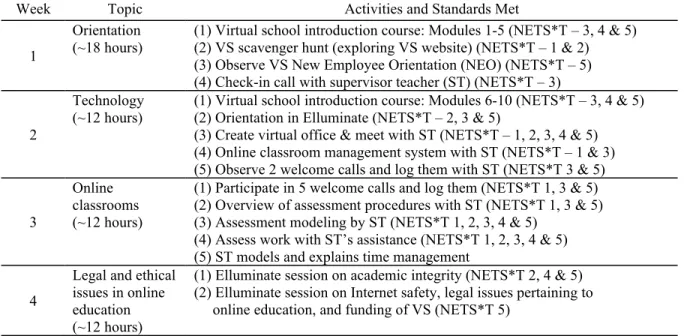
experience in which service teachers are matched with virtual school teachers in a one-to-one format. The pre-service teachers were given access to their supervisor teacher’s course. An outline of this experience is shared in the table below, and research documenting that experience is forthcoming (Kennedy, Cavanaugh, & Dawson, 2010).
Table 1: Week-by-week breakdown of the Virtual School (VS) Practicum
Surveying the Field: What New Models Exist for Field Experiences in K-12 Online
Learning Programs?
The research question for the current study was “What models of field experiences exist to help prepare pre-service teachers for K-12 online learning environments”? with the goal of exploring what other K-12 online learning programs and teacher education programs were doing in terms of offering field experiences in K-12 online learning to pre-service teachers. Using Dillman’s Tailored Method Design (2010), two survey instruments were created based on prior research in the field (Archambault & Crippen, 2009). The first survey was geared toward teacher education programs, specifically to field experience office personnel and faculty, while the other was geared toward K-12 online learning programs. The surveys included both closed- and open-ended items regarding a variety of areas including how placements are determined, how supervision is handled, the amount of time the pre-service teachers are required to spend in the online environment, the types of daily and intermittent tasks the pre-service teachers are required to do as part of their teaching (i.e. discussion facilitation, grading, creating new content, communicating with students, holding webinars or other synchronous learning events, etc.).
The surveys were created in Survey Monkey, an online survey tool. Once developed, the surveys were sent to three expert reviewers, and based on the experts’ suggestions, the items were revised for consistency of terminology, specificity of questions and responses, and additional items that should be included. While the expert review was being conducted, the researchers created a database of the names, titles, and email addresses of field experience contacts at all teacher education programs that were listed on the National Council for Accreditation of Teacher Education (NCATE) and the American Association of Colleges of Teacher Education (AACTE) accreditation web
Week Topic Activities and Standards Met
1
Orientation
(~18 hours) (1) Virtual school introduction course: Modules 1-5 (NETS*T – 3, 4 & 5) (2) VS scavenger hunt (exploring VS website) (NETS*T – 1 & 2) (3) Observe VS New Employee Orientation (NEO) (NETS*T – 5) (4) Check-in call with supervisor teacher (ST) (NETS*T – 3) 2
Technology
(~12 hours) (1) Virtual school introduction course: Modules 6-10 (NETS*T – 3, 4 & 5) (2) Orientation in Elluminate (NETS*T – 2, 3 & 5) (3) Create virtual office & meet with ST (NETS*T – 1, 2, 3, 4 & 5) (4) Online classroom management system with ST (NETS*T – 1 & 3) (5) Observe 2 welcome calls and log them with ST (NETS*T 3 & 5) 3
Online classrooms (~12 hours)
(1) Participate in 5 welcome calls and log them (NETS*T 1, 3 & 5) (2) Overview of assessment procedures with ST (NETS*T 1, 3 & 5) (3) Assessment modeling by ST (NETS*T 1, 2, 3, 4 & 5)
(4) Assess work with ST’s assistance (NETS*T 1, 2, 3, 4 & 5) (5) ST models and explains time management
4
Legal and ethical issues in online education (~12 hours)
(1) Elluminate session on academic integrity (NETS*T 2, 4 & 5) (2) Elluminate session on Internet safety, legal issues pertaining to online education, and funding of VS (NETS*T 5)
pages. Within these teacher education programs, the researchers tried to find at least two to three contacts via the university/college websites. This was done to help ensure that every institution was represented in the results. Once compiled, the list of contacts for the teacher education program survey included 1525 possible respondents.
Implementing Dillman’s Tailored Method Design for deployment. The researchers first sent out notification emails to the potential responders. This helped to deal with bounced email addresses due to typographical error, in addition to allowing for potential respondents to notify the researcher to contact another person who could better describe program plans. Three days later, the survey link was sent out. The researchers followed up via email with three subsequent reminders.
For the survey targeting K-12 online learning programs, the researchers asked the Vice President of the International Association for K-12 Online Learning (iNACOL), to send the link to the entire iNACOL membership, which is made up of practitioner representatives from K-12 online learning programs throughout the United States. In addition, the survey was posted on Virtual School Meanderings, a blog maintained by Michael Barbour of Wayne State University, and on the iNACOL forums.
The purpose of gathering such data was to document the current practices of implementing field experiences in K-12 online learning programs and teacher education programs throughout the United States. The surveys were open during the months of January and February 2011. Once the surveys closed, data were analyzed using descriptive statistics for closed items, and open-coding for open-ended responses in order to identify critical concepts and themes (Strauss & Corbin, 1998).
Results
A total of 522 responses for the teacher education program survey were gathered. This represented a 34% response rate, which is considered acceptable for web-based surveys (Manfreda, Bosnjak, Berzelak, Haas, & Vehovar, 2008; Shih & Fan, 2008). For the K-12 online learning program survey, 242 responses were collected. However, a response rate is unknown due to the distribution of an open link to the targeted population via blog posting and list serv subscriptions. Specific results from each survey are shared in the sections below.
K-12 Online Learning Program Survey
All states except for South Dakota were represented in the K-12 online learning program survey data. The majority of respondents were either administrators (24.7%) or teachers (72.6%). While respondents represented all levels of K-12 education, the majority (84.2%) served a 9th through 12th grade population. These schools were either
state-level virtual schools (34.1%), cyber charters (31%) or district-level virtual schools (27.6%). Most offered courses in an 80-100% online format (81.2%), while some offered blended (8.3%) or web-facilitated (10.5%). While the majority of virtual schools (143, 61.9%) did not offer any kind of field experience placement for pre-service teachers, 88 (38.1%) reported that they have a field experience component as part of their program...A significant percentage of respondents (28%) represented a single state-led virtual school located in the southeastern United States. As such, the results of this study are not meant to be representative of all online programs, but rather, descriptive of types of field experience partnerships that are currently underway.
Of those reporting virtual school field experiences, 59% had them for between one and three years (59%). Only 23.1% have offered them for longer than that, and some were just starting out with less than one year (17.9%). Someone at the virtual school most often does supervision in these experiences, whether it is a cooperating teacher or a supervisor, as well as a coordinator from the teacher education program, such as an internship coordinator or course instructor. The experiences typically last between eight and 16 weeks where the pre-service teachers are required to spend up to eight hours a week in the K-12 online learning environment. In some cases, these times go up to 16-20 hours per week. Pre-service teachers are responsible for discussion facilitation (83.3%), grading students’ work (91.7%), creating new course content (33.3%), communicating with students (95.8%), holding webinars (62.5%), learning about the virtual school (95.8%), understanding academic honesty (87.5%), communicating with parents (87.5%), and communicating with colleagues (83.3%). Depending on the states’ requirements, pre-service teachers are required to do background checks (81%). Some pre-service teachers are also asked to sign non-disclosure documents.
In terms of matching pre-service teacher with cooperating teacher, most schools do this according to subject/content area (94.7%) while some also use grade-specific criteria (42.1%). Not one of the K-12 online learning programs uses a matching inventory to set up the mentor-mentee pairs. Most of the communication that
occurs between the cooperating teacher and pre-service teacher is done via phone (95.7%), email (95.7%), and virtual meetings (via Wimba, Elluminate, Skype, or Google Talk) with some programs implementing face-to-face meetings (69.6%) and the use of Web 2.0 tools (i.e., Facebook, Wiki, Blog, Twitter) (56.5%).
For those schools indicating they did not offer field experiences for pre-service teachers in their K-12 online learning program, they were asked if they think their schools should offer these experiences. To this, 76.5% said yes, and 23.5% said no. However, only a minority (8.5%) reported that they were in the process of creating such
placements.
Teacher Education Program Survey
All states except for Maine were represented in the teacher education program survey data. The majority of the respondents held various roles including placement coordinators (31.8%), professors at varying levels of tenure (assistant – 24.9%, associate – 25.8%, full – 19.6%), graduate coordinators (6.2%), undergraduate coordinators (6.9%), and administrative (dean, associate dean, assistant dean) (12.5%). Individuals often had more than one role. Respondents came from schools with mostly 0-5,000 students (52.6%), followed by those from schools with 5,000-10,000 enrollments (20%), 5,000-10,000-20,000 (16%), and 20,000-30,000 (6.3%). The remaining were from schools with over 30,000 student enrollments. When asked if their teacher education program offered their pre-service teachers field experience placements in K-12 online learning programs, 404 (78.7%) reported that their programs did not, but 109 (21.3%) indicated they did. However, in examining responses, including actual descriptions of the virtual school field experience, only 31 (5.9%) offered clear indicators of what was required of students. Of these, 51.9% said that they partnered with a K-12 online learning program in the same state as their teacher education program while 48.1% said that they partnered with a program that was located in another state. The responding teacher education programs reported partnering mostly with online learning programs that offer K-12th grade curriculum (54%), with
18.9% at the 9-12 grade level, 8% with grades 6-12, 10.8% with grades K-8, and 8% with grades K-5. When asked how long they have been offering such experiences, most have only just begun in the last year (35.6%) or have been offering them for 5+ years (33.3%), while others have been operating for 1-3 years (20%) or 3-5 years (11.1%). These experiences are required parts of the teacher preparatory programs in 47.3% of the cases. Only 54% of respondents said that their state recognized/accepted a field experience in a K-12 online learning program towards teacher certification.
In terms of how the experience is set up, there is typically a course instructor assigned to the experience that represents the university (63%). In some cases, there is also an internship coordinator (25.9%), supervisor (44.4%) and a cooperating teacher at the K-12 online learning program (59.3%). The experiences range in length from 0-4 weeks (41.4%), 4-8 weeks (6.9%), 8-12 weeks (17.2%), 12-16 weeks (27.6%), or 16+ (6.9%). Most programs reported their pre-service teachers having to spend 0-4 hours per week (53.8%) in the K-12 online learning
environment while others spend 4-8 hours (23.1%), 8-12 hours (15.4%), 12-16 hours (3.8%), or 16-20 hours (3.8%). The activities performed by the pre-service teachers in these experiences include facilitating class discussion forums (52.2%), creating new course content (43.5%), communicating with students (47.8%), holding webinars (8.7%), delivering synchronous instruction (39.1%), evaluating students’ work (65.2%), tracking student progress (69.6%), completing required paperwork (69.6%), communicating with parent/learning coach (34.8%), attending professional development sessions (39.1%), attending faculty meetings (26.1%), responding to student/parent questions (26.1%), and participating in extra-curricular activities (i.e. clubs, sports, events, etc.) (17.4%).
Assessment of pre-service teachers in these experiences occurred via journals (8%), logs (12%), reflections (12%), essays (8%), observations (48%), and/or log-in/tracking data (12%). Matching pre-service teacher with cooperating teacher occurred via subject-specific (86.4%) and/or grade-specific (63.6%) means. A matching inventory was used to match pre-service teacher with cooperating teacher in only 6.7% of the cases. Pre-service teachers and cooperating teachers communicated with one another via email (73.1%), phone (57.7%), face-to-face (88.5%), virtual meetings (Wimba, Elluminate, Skype, Google Talk) (34.6%), and/or Web 2.0 tools (Facebook, Wiki, Blog, Twitter) (23.1%). When asked whether cooperating teachers received mentor training, 54.2% said yes, and 45.8% said no. The standards used for preparing these experiences included the International Society for Technology in Education (ISTE) (62.5%), the Southern Regional Education Board (SREB) (31.3%), and the National Education Association (NEA) (31.3%). Not one program reported having used the International Association for K-12 Online Learning, however, these standards were based on SREB’s standards.
For those who do not offer these experiences, they were asked if they feel their program should offer pre-service teachers field experiences in K-12 online learning programs. 48.9% said yes while 51.1% said no. When
asked if their teacher education program was currently planning such an experience, 13% indicated yes while 87% reported that they were not.
Implications and Recommendations
Only a small minority of teacher education programs are addressing the need to prepare educators for settings other than the traditional, brick and mortar classroom. The current study has important implications for the field of K-12 online education and its teachers, in addition to teacher education programs who are, preparing the future generations of teachers for an ever-growing and expanding field of K-12 online learning in all its forms, including blended, hybrid, and fully online environments. Although this may not be a goal of many teacher education programs currently, it is becoming an increasing reality. Following current trends, in six years, 10% of all high school classes will be offered online, and by 2019, this figure will increase to 50% (Christensen, Horn, & Johnson, 2008). This is happening for a variety of social, economical, and political reasons including the need to offer courses at lower costs, the opportunity to offer quality courses beyond a limited geographical area, and the ability to
individualize content to meet student needs.
From existing research, data support that the vast majority of online teachers are coming from traditional classrooms, 36% are working in the field part-time, and many teach both face-to-face and online (Archambault & Crippen, 2009). While many virtual schools require a minimum number of years teaching in a traditional classroom prior to teaching online, the vast majority of virtual teachers do not have prior experience in teaching in an online environment. It remains to be seen if teachers who taught in a traditional classroom are better equipped than those entering directly from college. It is possible that teachers who have a solid foundation of their content and
pedagogical knowledge from a traditional setting may have an easier transition to the online classroom, but without any type of field experience in K-12 online learning programs, these teachers are faced with all of the challenges and demands of online education. This is a consideration that virtual schools and other K-12 online learning programs will continue to make during their hiring processes.
While teachers are currently coming from the traditional classroom to teach in online settings, as the demand for online teachers increases, more educators will be recruited directly from undergraduate programs. It is
questionable whether or not the knowledge and skills learned in a single integrating-technology-into-education course substitutes well for methods or field experience, let alone classroom teaching (Pope, Hare & Howard, 2002). In addition, teacher education programs are increasingly revising undergraduate programs and doing away with such technology courses. Because the integration of technology is unavoidable within the online classroom, it needs to be addressed within the context of content and pedagogy throughout the entire teacher education program. Colleges of education would benefit from addressing this growing need, and the current study highlights the importance of continued research in this area.
References
Aiken, I. P., & Day, B. D. (1999). Early field experiences in preservice teacher education: Research and student perspectives. Action in Teacher Education, 21(3), 7-12.
Allen, D. W., & Eve, A. W. (1968). Microteaching. Theory into Practice, 7(5), 181-185.
Archambault, L.M. & Crippen, K.J. (2009). K-12 distance educators at work: Who’s teaching online across the United States. Journal of Research on Technology in Education, 41(4), 363-391.
Ballantyne, R., & Hansford, B. (1995). Mentoring beginning teachers: A qualitative analysis of process and outcomes. Educational Review, 47(3), 297-308.
Beijaard, D., Verloop, N., & Vermunt, J. D. (2000). Teachers’ perceptions of professional identity: An exploratory study from a personal knowledge perspective. Teacher and Teacher Education, 16(7), 749-764.
Buck, G., Morsink, C., Griffin, C, Hines, T., & Lenk, L. (1992). Preservice training: The role of field-based experiences in the preparation of effective special educators. Teacher Education and Special Education, 15(2), 108-123.
Cattley, G. (2007). Emergence of professional identity for the pre-service teacher. International Education Journal, 8(2), 337-347.
Compton, L., & Davis, N. (2010). The impact of and the key elements from a successful virtual early field
experience: Lessons learned from a case study. Contemporary Issues in Technology and Teacher Education, 10(3), 309-337.
Compton, L., Davis, N. E., & Mackey, J. (2009). Field experience in virtual schooling - To be there virtually. Journal of Technology and Teacher Education, 17(4), 459-477.
Christensen, C. M., Horn, M. B., & Johnson, C. W. (2008). Disrupting class: How disruptive innovation will change the way the world learns. New York: McGraw-Hill.
Davis, N. E., Compton, L., & Mackey, J. (2009, March). Field experience with a virtual school's teacher: How can it be done? Paper presented at the Annual Meeting of the Society for Information Technology and Teacher Education, Charleston, SC.
Davis, N. E., & Rose, R. (2007). Professional development for virtual schooling and online learning. International Association for K-12 Online Learning. Retrieved from
http://www.nacol.org/docs/NACOL_PDforVSandOlnLrng.pdf
Dillman, D. A. (2010). Email and Internet surveys: The tailored design method (2nd ed.). New York: Wiley.
Feiman-Nemser, S. (2001). From preparation to practice: Designing a continuum to strengthen and sustain teaching. Teachers College Record, 103(6), 1013-1055.
Ferdig, R., Cavanaugh, C., DiPietro, M., Black, E., Mulkey, J., & Dawson, K. (2009). Virtual schooling standards and best practices for teacher education. Journal of Technology and Teacher Education, 17(4), 479-503.
Freese, A. R. (1999). The role of reflection on preservice teachers’ development in the context of a professional development school. Teaching and Teacher Education, 15(8), 895-909.
Gardner, H., & Henry, M. A. (1968). Designing effective internships in teacher education. Journal of Teacher Education, 19(2), 177-186.
Greaves Group & Hayes Connection. (2006). America’s digital schools 2006: A five-year forecast: Mobilizing the curriculum. Retrieved from http://www.ads2006.net/ads2006/pdf/ADS2006KF.pdf
Harlin, R. P. (1999). Developing future professionals: Influences of literacy coursework and field experiences. Reading Research and Instruction, 38(4), 351-370.
Hatton, N., & Smith, D. (1995). Reflection in teacher education: Towards definition and implementation. Teaching and Teacher Education, 11(1), 33-49.
International Association for K-12 Online Learning (iNACOL). (2008). National Standards for Quality Online Teaching. Retrieved from
http://www.inacol.org/resources/nationalstandards/NACOL%20Standards%20Quality%20Online%20Teaching.pdf
International Society for Technology in Education (ISTE). (2008). National Educational Technology Standards (NETS*T) and Performance Indicators for Teachers. Retrieved from
International Society for Technology in Education (ISTE). (2007). 2006-2007 ISTE Annual Report. Retrieved from
http://www.iste.org/Content/NavigationMenu/AboutISTE/AnnualReports2/ISTE-2006-2007-Annual-Report.pdf
Irvine, V., Mappin, D., & Code, J. (2003). Preparing teachers to teach online: The role of faculties of education. In D. Lassner & C. McNaught (Eds.), Proceedings of World Conference on Educational Multimedia, Hypermedia and Telecommunications (pp. 1978-1981). Chesapeake, VA: AACE.
Joyce, B., Yarger, S. J., Howey, K., Harbeck, K., & Kluwin, T. (1977). Reflection on preservice education: Impressions from the national survey. Journal of Teacher Education, 28(5), 14-37.
Kennedy, K. (2010). Cross-reference of online teaching standards and the development of quality teachers for 21st century learning environments. Distance Learning: A Magazine for Leaders, 7(2), 21-28.
Kennedy, K., Cavanaugh, C., & Dawson, K. (2010). Pre-service teachers’ experience in a virtual school. Manuscript submitted for publication. 36 pages.
Koran, M. L., Snow, R. E., & McDonald, F. J. (1971). Teacher aptitude and observational learning of a teaching skill. Journal of Educational Psychology, 62(3), 219-228.
Manfreda, K. L., Bosnjak, M., Berzelak, J., Hass, I., & Vehovar, V. (2008). Web surveys versus other survey modes: a meta-analysis comparing response rate. International Journal of Market Research, 50(1), 79–104. Moore, C. (1979). National survey queries early clinical experiences. ATE Newsletter, 12, 3.
Mule, L. (2006). Preservice teachers’ inquiry in a professional development school context: Implications for the practicum. Teaching and Teacher Education, 22(2), 205-218.
National Education Association. (2006). NEA Guide to Teaching Online Courses. Retrieved from http://www.nea.org/home/30103.htm
Shih, T., & Fan, X. (2008). Comparing response rates from Web and mail surveys: a meta-analysis. Field Methods, 20(3), 249–271.
Southern Regional Educational Board. (2006). SREB essential principles of high-quality online teaching: Guidelines for evaluating K-12 online teachers. Retrieved from
http://www.sreb.org/programs/edtech/pubs/PDF/Essential_Principles.pdf
Strauss, A. L., & Corbin, J. (1998). Basics of qualitative research: Techniques and procedures for developing grounded theory (2nd ed.). London: Sage.
University of Central Florida Newsroom (UCF). (2009). Florida Virtual School and UCF team up for first-of-its-kind program. Retrieved from
http://news.ucf.edu/UCFnews/index?page=article&id=00240041040e40a1d011ebaca5f3e007d90&subject_id=0024
004102975ad83011b2b83251c0c35
Wiggins, R. A., & Follo, E. J. (1999). Development of knowledge, attitudes, and commitment to teach diverse student populations. Journal of Teacher Education, 50(2), 94-105.
Wiggins, R. A., Follo, E. J., & Eberly, M. B. (2007). The impact of a field immersion program on pre-service teachers’ attitudes toward teaching in culturally diverse classrooms. Teaching and Teacher Education, 23(5), 653-663.
Zeichner, K. M. (1984). The ecology of field experience: Toward an understanding of the role of field experiences in teacher development. Paper presented at the Annual Meeting of the Association of Teacher Educators, New Orleans.