This is a peer-reviewed, post-print (final draft post-refereeing) version of the following published document, Copyright:© Emerald Publishing Limited 2018 Published by Emerald Publishing Limited Citation:Sefiani, Yassine and Davies, Barry J and Bown, Robin and Kite, Neilson and Vrontis, Demetris and Tsoukatos, Evangelos (2018) Performance of SMEs in Tangier: the interface of networking and 'wasta'. EuroMed Journal of Business, 13 (1). pp. 20-43. ISSN 1450-2194 Yassine Sefiani, Barry J Davies, Robin Bown, Neilson Kite, "Performance of SMEs in Tangier: the interface of networking and 'wasta'", EuroMed Journal of Business, https://doi.org/10.1108/EMJB-06-2016-0016 and is licensed under All Rights Reserved license:
Sefiani, Yassine and Davies, Barry J and Bown, Robin and Kite, Neilson and Vrontis, Demetris and Tsoukatos, Evangelos (2018) Performance of SMEs in Tangier: the interface of networking and 'wasta'. EuroMed Journal of Business, 13 (1). pp. 20-43. ISSN 1450-2194
Official URL: https://doi.org/10.1108/emjb-06-2016-0016 DOI: http://dx.doi.org/10.1108/emjb-06-2016-0016 EPrint URI: http://eprints.glos.ac.uk/id/eprint/5523
Disclaimer
The University of Gloucestershire has obtained warranties from all depositors as to their title in the material deposited and as to their right to deposit such material.
The University of Gloucestershire makes no representation or warranties of commercial utility, title, or fitness for a particular purpose or any other warranty, express or implied in respect of any material deposited. The University of Gloucestershire makes no representation that the use of the materials will not infringe any patent, copyright, trademark or other property or proprietary rights.
The University of Gloucestershire accepts no liability for any infringement of intellectual property rights in any material deposited but will remove such material from public view pending investigation in the event of an allegation of any such infringement.
PERFORMANCE OF SME
S
IN TANGIER:
THE
INTERFACE OF NETWORKING AND
‘
WASTA
’
Yassine Sefiani
Prince Mohammad Bin Fahd University, Al-Khobar, Saudi Arabia Business School, University of Gloucestershire, Cheltenham, UK
Barry J. Davies
Business School, University of Gloucestershire, Cheltenham, UK, and
Robin Bown and Neilson Kite
University of Gloucestershire, Cheltenham, UK
ABSTRACT
Purpose - The aim of this study is to investigate the impact of networking on business
performance by uncovering particular and significant methods of pursuing business connections, for small and medium enterprises (SMEs) in Tangier.
Prior Work - The significance of networking and its impact on the performance of SMEs was
revealed in a number of studies. Whilst these studies provide important insights about networking, it can be noted that there are potentially significant differences in the concept of networking in the Arab business world about which relatively little is known.
Approach - A two-stage design, which incorporated both quantitative and qualitative
approaches, was employed in this study. Approaches were employed in succession with the findings from the quantitative phase informing the qualitative phase. Initially, a paper and online survey questionnaire was administered to a population of 365 industrial SMEs to gain some insights on the perceptions of owner-managers of the impact of networking on business performance. Following the quantitative phase, fifteen in-depth face-to-face semi-structured interviews were conducted with selected owner-managers of SMEs, forming a judgmental selection, to explore their experiences, beliefs, and attitudes with respect to networking factor.
Results - Both quantitative and qualitative phases of the study found that networking was a
significant factor in influencing the success of SMEs. The concept of ‘wasta’, the Arabic word for connections, emerged from the qualitative phase. Findings show that using ‘wasta’, through politico-business networks is important since it enables access to current information that is crucial for the success of SMEs. The concept of ‘wasta’ was also mentioned in relation to financial resources and suppliers. Findings revealed that strong relationships with suppliers enable firms to get financial resources in the form of trade credits. Furthermore, the relationship between ‘wasta’ and human resources was also revealed. Findings showed that owner-managers use their network relations through ‘wasta’ in order to recruit their staff.
Implications - The findings of this study add to the understanding of networking in Arabic
countries with the importance of ‘wasta’ in an economy that functions on relationships. The findings of this study could therefore be useful to international managers to assist their intercultural effectiveness by adjusting to culture-specific networking in Tangier.
Originality / Value - This study is among those few studies located in the Middle East North
Africa (MENA) region that explore the performance of SMEs from the perceptions of owner-managers themselves, and not based on aggregate or economic data. It supports previous findings of several studies and contributes additional evidence that suggests the significance of ‘wasta’ and its impact on SME success.
INTRODUCTION
The important contribution of a vibrant small and medium enterprises (SMEs) sector in the national economic and social development of a country has been widely recognized(e.g. Birch, 1989; Storey, 1994; The European Commission, 2011; Stenholm et al., 2012). In view of its increasing importance, performance of small and medium enterprises (SMEs) has been of interest to many researchers, international organizations, and policy makers, at least since the Bolton report (1971), and therefore has become the subject of a great deal of analysis. Attention to the SME sector has heightened because of the globalizing economy and the increasingly severe competition that is inherent in this development. Specifically, researchers have shown interest on the variables associated with firm performance. Among these variables, networking has been identified as a key factor that influences business performance (Shane &Cable, 2002; Okten & Osil, 2004). In a rapidly changing and hostile environment, owner-managers of SMEs are required to engage in the process of building strong relationships and to interact vigorously and efficiently with internal as well as external members to maximize business performance. Whilst a considerable number of studies have been published on the role of networking on business performance, few of them focused on the Arab World (Ahmad & Xavier, 2011; Ahmad, 2011a, 2012). This could be explained by the political instability surrounding the region or the lack of economic progress in many of the Arab countries (Hutchings & Weir, 2006a; Abosag & Lee, 2013). As a consequence, insufficient attention has been devoted to researching and better understanding the way business is carried out in the Arab context (Hutchings & Weir, 2006b; Khakhar & Rammal; 2013). On this account, several researchers have found that the appreciation of networking in the Arab World is important and recommended further study to explore this factor (Berger et al., 2015). Addressing the relative dearth of research into small business performance in the Arab world, the following study seeks to develop a clearer understanding of the influence of networking on business performance, as perceived by local owner-managers of small manufacturing businesses in Tangier in Morocco.
BACKGROUND
SMEs in Morocco play a pivotal role in the development of the country. The importance of SMEs is evidenced by their high presence in the economic structure of the country. According to The United Nations Economic Commission for Africa (UNECA) (2008), 93% of all Moroccan industrial firms are SMEs and account for 38% of production, 38% of investment, 31% of exports, and 45% of all jobs. Within Morocco, the city of Tangier has a highly strategic geographical position, enjoys a special tax status, and contains zones that have the status of free economic zones. Located in the Tangier-Tétouan region in the extreme north-west of Morocco, the city of Tangier is
Morocco’s second industrial centre after Casablanca and the first industrial city in the Tangier-Tétouan region. After decades of neglect, Tangier did not regain attention from the government until 1999. The Moroccan government has engaged since then in developing the economy of the city by seeking to create an enabling business environment for large as well as small and medium companies. Manufacturing SMEs in Tangier account for over half of the total firms in the Tangier-Tétouan region and contribute to 83% of employment (Ministry of Industry, Commerce, and New Technologies: MICNT, 2007). However, despite their value in the regional economy, their contribution to the industrial value added remains limited with respect to the national economy. Recent available data from the MICNT showed that the contribution of the Tangier-Tétouan region to the industrial value added was only 7% in 2010 compared to 49% in the Greater Casablanca region (MICNT, 2011).This does not reflect the potential of the SME sector especially after the recent significant economic developments in the Tangier-Tétouan region.
Recent economic developments in the Tangier-Tétouan region, and particularly in the city of Tangier, have been considerable. Among the recent biggest developments are: the Tanger-Med port which is one of the largest ports in Africa and on the
Mediterranean, and a series of ‘free zones’. By virtue of these developments, the strategic position of the city manifested in its proximity to Europe, its special tax status, and the economic free zones, several local and international investments have been attracted to the city in the last 10 years, which have transformed the region into a competitive hub for international trade. SMEs in Tangier have been vulnerable to these
business environment challenges which could have an impact on their performance. As argued by Man & Lau (2005), SMEs are more likely than larger firms to be affected by changes in their internal and external environment which are often unplanned for. Thus, an important issue arises concerning the ability of small and medium firms to cope in a very challenging environment through the use of networking. In an attempt to address this issue, as mentioned above, the present study has been undertaken with the aim of developing a clearer understanding of the impact of networking on the performance of SMEs in Tangier. To achieve this aim, the following objectives were set:
- To investigate opinions of local owner-managers about networking in relation to business success.
- To examine differences between owner-managers of ‘successful’ and ‘less successful’ SMEs in relation to networking
- To explore the experiences of SME owner-managers of the perceived networking factor for business ‘success’ in Tangier.
LITERATURE REVIEW
In the small business literature, the concept of success remains a topic of debate (Gorgievski et al., 2011). This is despite the evidence that the ‘success’ of small firms has been subject to a great deal of research. However, there is no general agreement in the literature on what is meant by the success of a firm. Indeed, a myriad of perspectives, ranging from mere survival to the achievement of certain levels of performance, exist about such a concept in the entrepreneurship literature. Very often,
the terms ‘success’, ‘survival’, ‘growth’ are very closely linked and sometimes used
interchangeably. Besides the multi-dimensional aspect of success, variables that contribute to the success of SMEs are not unanimously agreed upon by researchers. While some analysts suggested that the dynamics of the success of businesses remain a black box (Dockel & Ligthelm, 2005; Ligthelm, 2010), others argued that the success of enterprises is a function of both external and internal factors (McCline et al., 2000; Guzman & Santos, 2001; Markman & Baron, 2003).
Among the success factors that have been of great interest to researchers, entrepreneurs, and policy makers alike is the networking factor (Chung et al., 2015; Chen, Chang, & Lee, 2015; De Hoyos-Ruperto et al., 2013). Various definitions about networking and the concept of network exist in the literature. For example, Iacobucci
(1996, p. xiii) stated: ‘Colloquially, networking is a verb used to describe the initiation
and sustenance of interpersonal connections for the rather Machiavellian purpose of
tapping those relationships later for commercial gain ’. Very often, networks are also of-ten defined as relationships between different actors (Aldrich & Zimmer, 1986; Gulati, 1998; Ireland et al., 2001). Carson et al. (1995, p. 201) describe networking in small
firms as: ‘... an activity in which the entrepreneurially oriented SME owners build and manage personal relationships with particular individuals in their surroundings’. Owner-managers of SMEs are highly dependent on their networks because from these they can obtain resources and get critical support for the development and growth of a business (Dodd & Patra, 2002; Jenssen & Greve, 2002; Harris & Wheeler, 2005). Resources that can be obtained through networking include information about business opportunities, innovation, referrals, business linkages, shared costs, networks of business partners, professionals, technicians, specialists, generalised consultants, the supply chain, potential contractors, bankers, distributors, clients, customer linkages, suppliers, sector-based trade associations, professional memberships, chambers of commerce, institutional ties as well as networks of collaboration and coordination (Zhao & Aram, 1995; Ritter & Gemunden, 2004; Ramsden & Bennett, 2005; Li & Ferreira, 2006; Batjargal, 2006).This is consistent with the resource dependency theory (Barringer & Harrison, 2000), which suggested that entrepreneurs use their social relations to get the resources they need to support their business (Hansen, 2001; Jenssen, 2001). However, it should be highlighted that the use of these networks can be difficult for SMEs due to the specific characteristics of these firms, which often inhibit the leverage of the resources needed for the organization to create new opportunities.
The literature about small firm networking tends to categorize networks into two types: formal networks in which owner-managers of firms participate beyond their individual scope with other organisations – for example, industry bodies, employers’ organisations; and informal networks where cooperation is manifested in the use of personal connections such as: family, friends, and acquaintances (Low & MacMillan,
1988; Jack & Robson, 2002; Dodd & Patra, 2002; Markman & Baron, 2003; Hite, 2005; Sequeira & Rasheed, 2006). In the view of Ibarra (1993), these two types of networks are also classified as strong and weak ties. Whilst weak ties tend to be more superficial and lacking in emotional investment (Dubini & Aldrich, 1991), strong ties, on the other hand, are concerned with close, stable, and binding relationships.
The particular category of ‘social networks’ utilising web-based platforms has recently also come to the fore. As Franco, Haase and Pereira (2016) observed, ‘new opportunities and benefits have been opened up to firms and the population in general, given the ease of communication and the speed with which information is spread.’ (p 3). In their study of 86 firms in Portugal, they were able to identify five factors their respondents associated with social network use: identification of opportunities, sharing of information, communication and innovation, cost reduction and marketing. They concluded that ‘SMEs should therefore see social networks as facilitating work, as a means to reduce costs and possibly expand their business’ (p 10). In this regard, the potential benefits closely reflect those associated with network engagement more generally. The core difference between the structure and make-up of web-based social networks seems to rest on their mediated, impersonal basis, which is later overlain by the personal.
Networks of SMEs are especially based on personal relationships, where the small
companies’ networks overlap with entrepreneurs’ networks (Biggiereo, 2001). Small firms networking research tends to embrace Granovetter’s (1985) account of the role of
concrete personal relations that include ‘strong ties’ to family and close friends as well as ‘weak ties’ to individuals’ acquaintances (Shaw 1997). Whilst strong ties are a
natural part of an entrepreneur’s network and often consist of relations as family, close friends and relatives, and have greater motivation to be of assistance, and are often more available (Granovetter, 1983; Rost, 2011), the strength of weak ties is that they enable the individual to reach actively and purposively outside of his or her immediate close social circle and to draw upon information, advice and assistance from a large and diverse pool (Granovetter, 1973, 1985). However, Rost (2011) argued that weak ties are only beneficial if actors occupy a more central network position.
The significant impact of networking on the performance of SMEs has been highlighted in several studies (Ramadani, Dana, Gërguri-Rashiti, & Ratten, 2016;
Wincent et al., 2009; Watson, 2007; Zaheer & Bell, 2005; Florin et al., 2003). The network theory suggests that there is a positive association between networking and various aspects of firm performance. Evidence suggests that the ability of owners to gain access to resources not under their control in a cost effective way through networking can influence the success of business ventures (Watson, 2006), as networks provide value to its members by allowing them to gain access to the social resources that are embedded within the network(Seibert, Kraimer, Liden, 2001).Furthermore, using networks can potentially increase a firm’s chances of
‘survival’, as argued by Julien (1993), that this form of cooperation can facilitate the achievement of economies of scale in small firms without producing the diseconomies caused by large size. A positive association with networking and firm growth has also been documented in the literature. Donckels & Lambrecht (1995) found that network development, particularly at the national and international level, was positively associated with firm growth. In a longitudinal study conducted by Watson (2007) on Australian firms, findings indicated a significant positive relationship between networking (particularly with formal networks such as external accountants) and business growth.
The use of social networking, on web-based platforms has also been considered in relation to growth. Vásquez & Escamilla (2014) examined social network usage by SMEs as a marketing tool. Their research amongst Mexican firms demonstrated the existence of an expertise gap, which impeded effective usage – nevertheless, they concluded that potential benefits for SMEs were considerable. Their view reinforces the prior work of Trusov, Bucklin and Pauwels (2009) who drew attention to the power of social networks as tools in the support of word of mouth activity.Though still sporadic, it seems clear that current evidence points to the potential usefulness of social networks alongside traditional formal and informal networking.
Linked to networking, the concept of social capital has been highlighted in several studies (Burt, 1992; Nahapiet & Ghoshal, 1998; Adler & Kwon, 2002; Yu & Junshu, 2013; Clarke et al., 2016). Located within the structure of relations between and
amongst actors, social capital represents resources embedded in social relations that allow individuals and/or communities to achieve desired goals (Coleman, 1988). Applying the concept of social capital to a broader range of social phenomena, including relations inside and outside the family (Coleman, 1988), relations within and beyond the firm (Burt, 1992), the organization-market interface (Baker, 1990), and public life in contemporary societies (Putnam, 1993, 1995), social capital is considered
as a productive resource that facilitates actions, ranging from an individual’s
occupational attainement (e.g. Marsden & Hurlbert, 1988; Lin & Dumin, 1986; Lin, Ensel, & Vaughn, 1981) to a firm’s business operations (Baker, 1990; Coleman, 1990; Burt, 1992). A dominant perspective in social capital research emphasizes three dimensions: “structural” dimension of social capital, consisting of network connections(Besser & Miller, 2010; Casson & Della Giusta, 2007; Stam & Elfring, 2014, Gargiulo & Benassi, 2000), “relational” dimension, referring to assets that are rooted in these relationships such as trust, reciprocity, obligations and expectations (Granovetter, 1985, 2005; Adler, 2001; Adler & Kwon, 2002);and a “cognitive” dimension, relating to attitudes toward trust (Nahapiet & Ghoshal, 1998). However, this perspective must be examined more closely and interpreted with caution when a country context is taken into consideration. The development timeline of the country context and the role of societal norms and values that may rather support the status quo for social actors of a particular society clearly need to be considered (Galaskiewicz, 2007).
Small firms networking is increasingly becoming an important ingredient for success. However, even though a plethora of research has investigated the impact of networking on the performance of SMEs in Western literature, only few studies have considered the role of networking and its impact on the performance of SMEs in the Arab world (Berger et al., 2015). It should be noted that some form of networking exists in any culture. A growing body of the literature has investigated the mechanism of networking in various cultures such as guanxi in China (Lo, 2012; Bedford, 2011; Luo, 2007; Hutchings & Weir, 2006; Yeung & Teng, 1996), blat in Russia (Michailova & Worm, 2003; McCarthy et al., 2012), compadsrazgo in Chile (Chandra & Silva, 2012), Boon Koon in Thailand (Pimpa, 2008); Juggad in India (Ardichvili et al., 2012; Gupta & Singh, 2013), kankei in Japan (Usunier, 2000), and ‘wasta’ in Arab countries (Al-Khatib et al., 2002; Hutchings & Weir, 2006; Tlaiss & Kauser, 2011).The focus of this study is on the Moroccan context, which is a Muslim and Arab country. Networking in
Morocco works in a different way than it does in Western countries due to the different cultural influences. Similar to other Islamic and Arab countries, the family is the foundation and the backbone of the social structure in Morocco (Barakat, 1993; Hutchings & Weir, 2006). This creates a social network that provides assistance in times of need or hardship. Hutchings & Weir (2006a, b) argued that Muslim societies are wholly networked and all business activities revolve around these networks. Business owner-managers place a greater importance on establishing friendships and developing close relationships with those with whom they conduct business. Hutchings & Weir (2006a, b) expounded that the key to achieve business success in Arab countries is a knowledge and understanding of the interpersonal networks that pervade the business and social life of Arabs, especially ‘wasta’, which is developedprior to transacting business. ‘Wasta’ entails a network of interpersonal connections rooted in the family and kinship. ‘Wasta’ is the Arabic word for “connections or pull” and is a significant factor in decision making in Arabic society (Hutchings & Weir, 2006: 278). Historically, ‘wasta’ was used to manage relations between families and tribes in the Arab world through the use of an intermediary, often called the shaykh, who would be summoned to be the intercession or the ‘wasta’ between the conflicting parties (Cunningham &Sarayrah, 1993). In business context, ‘wasta’ has evolved as one of the key networking tools that can be used by Arab owner-managers of SMEs to secure markets contracts, grab opportunities, and increase their chance of success. Luo (2007) argued that this is in total contrast with the Western practice that emphasises the immediate transaction itself, and thus relies on enforcement of contracts and rules and not the relationship (Luo, 2007; Hooker, 2009; Berger & Herstein, 2012). The latter may only develop later as a separate function to the business transaction (Hutchings & Weir, 2006).
Although the argument of Luo (2007) and other authors (Hooker, 2009; Berger & Herstein, 2012) seems to be plausible, it can be argued that ‘wasta’ principle may fit in
other contexts and link to the ‘leverage’ concept that exists in the Western literature. Leverage can occur in many different ways for an SME. The conventional definition is a financial one which stipulates that leverage is any technique to multiply gains and losses. However, leverage can be manifested in other forms. In reality, there are myriad
ways in which a business can capitalise on others’ resources to accelerate and extend
expertise of Tesco’s 100% owned subsidiary DunnHumby, a customer insight firm, that supports international operations from market entry through in country expansion, to capitalise on ICT facilities to offer the right product at the right time to the right customers in the right place at an attractive price through the introduction of loyalty cards – a simple idea that leveraged huge growth and market share benefit. Another example relates to both M&S and Oxfam that have leveraged market advantage through co-operating in clothes recycling – enhancing Oxfam’s retail offer and M&S’ ethical market positioning.On a smaller scale, SMEs leverage the financial capital and business experience of business angels to accelerate growth. They might also
capitalise on someone else’s brand to resell what they know their customers want,or
they can capitalise on their suppliers’ assets to reach markets that might otherwise not
have been accessible. Therefore, if one accepts that ‘leverage’ is the capitalisation on
others’ assets to bring tangible benefit to both or several parties, then ‘wasta’ fits well into this definition. In the Arabic sense, the assets include the network of people who will use their connections, influence and facilities to help you develop your own business. Because reciprocation is a fundamental part of the ‘wasta’ principle, all parties to the network will, in one way or another, stand to gain. ‘Wasta’ does not necessarily expect immediate payback but is a form of investment that may yield dividends at some future date.
‘Wasta’ may also link with the concept of guanxi in China. Guanxi, literally means
‘relationship’ but also refers to a wider set of interpersonal connections that facilitate favour between people on a dyadic basis (Yang, 2002).Just like its Arabic counterpart
‘wasta’, guanxi stresses the importance of a social network of personal relationships that involve family and kinship ties. Guanxi’s impact on business success has been recently debated. While some researchers still defend the increasing importance of guanxi in influencing business success (Yeung & Teng, 1996; Luo, 2007), others have
argued that the guanxi’s impact is decreasing due to other factors such as:
globalisation, information accessibility, and regulations (Guthrie, 2002; Clegg et al., 2007).
It is important to note that the use of ‘wasta’ could have positive as well as negative connotations. In a more traditional sense, good ‘wasta’ refers to a form of intercession or mediation though it may also refer to seeking benefits from the
government (Hutchings & Weir, 2006). A negative ‘wasta’, on the other hand, refers to the use of ‘wasta’ for personal gains, i.e., through corruption. However, it should be clarified that this should not be confused with the exchange of gifts as is a common practice in the Arab region and is often a mark of respect, rather than an attempt to corrupt and influence the behavior. Hutchings & Weir (2006) argued that too much criticism may be considered a sign of naivety, whereas too much acceptance and understanding may be taken as an adverse sign (Hutchings & Weir, 2006).
RESEARCH METHODOLOGY
The study used a sequential two-stage design strategy whose logic became emergent during the course of the research – in other words, the two-stage designwhich encompassed both quantitative and qualitative approaches developed as the research went along. Having critically reviewed the literature systematically and built the theoretical framework, the study then followed the tradition used in entrepreneurship research by adopting a quantitative approach (Curran & Blackburn, 2001; Grant & Perren, 2002; Ahl, 2003; Lewis et al., 2007) to gain general understanding of the impact of networking on the success of SMEs in Tangier. Although there has been some movement away from purely quantitative approaches, attention to qualitative methods has generally been limited (José et al., 2012; Berger & Kuckertz, 2016). Berger & Kuckertz (2016) argued that the field of entrepreneurship is riddled with complexity and that mixed-methods design (MMDs) open new doors to explore different aspects of complexity in this field. In this study, although results found from the adoption of the quantitative approach were important, they were however inconclusive since constructs used in the survey, derived from the literature, were imposed on
respondents. This did not allow enough understanding of participants’ personal view of
the influence of the network factor on business success. Due to the inconclusive nature of the quantitative survey, it was decided to conduct further research using a qualitative strategy. The qualitative approach was carried out at this second stage to illuminate the quantitative findings and potentially enhance our understanding of the networking factor. Furthermore, the mixed methods approach was used to avoid common method bias that could affect the results of this research study. It is argued here that the two-method approach not only compensates for the limitations of one two-method with the
strengths of another, but also provides integrated evidence that can lend confidence to the results of the study.
QUANTITATIVE PHASE
Part of a larger paper and online surveyquestionnaire that was administered to a population of 365 manufacturing SMEs toseek opinions of owner-managers about several factors influencing business performance,initial perceptions of owner-managers,in relation to the impact of the specific factor of networking on business performance were identified.The population of interest was clearly defined based on the official definition of SMEs in Morocco which uses the factor of number of employees. The latter was chosen in accordance with the argument of Child (1973) who argued that employment is an adequate criterion for the measurement of the size of an
organisation, because it is above all human beings who are ‘organized’. Therefore, the study considered enterprises with a headcount between 10 and 200 employees as SMEs. Moreover, the population was drawn from the official website of the MICNT
www.mcinet.gov.ma, the AZIT directory 2010 as well as its official website
www.azit.ma, and the website of the Tangier free zone www.tfz.ma.The distribution of
the questionnaire was done in two phases: The ‘drop and collect’ phase and the online
phase. In total, 88 fully completed questionnaires were returned, providing a net response rate of 24.11%. It should be made clear that this study is not unusual in terms of difficulty experienced in obtaining responses from SME owner-managers, as other researchers have reported similar problems. Reid et al. (1999) suggest that a major difficulty in any research that involves surveying small businesses is achieving an adequate response rate, with many studies reporting rates as low as 10%.
QUALITATIVE PHASE
The 88 owner-managers who completed the questionnaire in the quantitative
phase of the study were the ‘population’ for the qualitative phase. From those who indicated that they would be willing to participate in future research, judgment was usedfor the selection of particular SME owners from this population. The selection criteria were: sector, location, and gender. These three factors were used to avoid structural bias in the construction of what was a small selection. As for the sample size,
Kvale (1996) suggested that new interviews might be conducted until a point of saturation, where further interviews yield little new knowledge. In this phase, the saturation was achieved when fifteen interviews were completed. The cut-off point was not predetermined, but emerged from the research process and concurrent data analysis (Babbie, 2010). In conducting the interviews, an open-ended flexible approach to interviewing, which is strongly recommended by Patton (1990), Bogdan & Biklen (2007), and Hammersley & Atkinson (2007), was used. This approach was useful and did result in new emerging issues to be explored and helped in achieving the third objective of the study.
QUANTITATIVE RESULTS
Reliability & Validity
The reliability and validity of the questionnaire was evaluated by calculating the
Cronbach’s alpha score. Findings show the networking variable was reliable with internal consistency value of .89. The non-response bias was tested by comparing responses from the first mailings of the survey questionnaire and those from the subsequent reminders to determine any significant differences. This approach is based on the argument of Rogelberg & Luong (1998) that late respondents would have been non-respondents if the survey deadline was observed. Therefore, as suggested by Miller & Smith (1983), late respondents can be used as substitutes for non-respondents. In this phase of the study, a number of 53 replies were received after the first mailings of the survey questionnaire, whereas, a balance of 35 was received after the subsequent reminders were sent out. Consequently, the non-parametric Mann-Whitney U Test was conducted to determine whether there were significant differences in the response ratings between the two groups. Findings indicated that there were no significant differences between early respondents and late respondents in terms of their perceptions with regards to the impact of networking on business success.
Descriptive Statistics
Descriptive statistics, in the form of frequency distributions, were used to describe basic features of the data and to achieve the first objective of the study. Table 1 presents the frequency distributions to describe the respondents’ profile:
Table 1: Demographic characteristics of the respondents
Characteristics of respondents Frequency % Cum %
Gender Male 86 98 98 Female 2 2 100 Age 25-45 60 68 68 > 45 28 32 100 Education
Upper secondary level 7 8 8
Diploma 21 24 32
Bachelor degree 39 44 76
Master degree 15 17 93
Doctorate 6 7 100
Did any of your parents own a business?
Yes 58 66 66 No 30 34 100 Years of experience < 2 years 12 14 14 2-5 years 2 2 16 6-10 years 50 57 73 11-20 years 7 8 81 > 20 years 17 19 100
Experience relevant to the business
Yes 67 76 76
No 21 24 100
Total 88 100 100
Source: Data analysis
The following observations are derived from table 1:
Out of the 88 respondents, male entrepreneurs outnumbered the female ones at 98%, whereas female entrepreneurs were under-represented at 2%.
Out of 88 respondents, more than half (68%) of the respondents were between the age of 25 and 45, while 32% were more than 45 years old. Moreover, no respondents aged between the age range of 18-24 were found.
More than half of respondents (68%) had a higher qualification (Bachelor, Master and Doctorate degree); while a substantial number (24%) had a diploma. Of the respondents, 8% had an upper secondary level.
The majority of respondents (66%) came from parents who did own a business. All respondents claimed to have previous work experience, of which more than
half (67%) had between 2 and 20 years of experience. A substantial number
(19%) had more than 20 years’ experience and only 14% had less than 2 years’
experience. Of the respondents, three quarters (76%) of respondents had experience relevant to the business, whereas, a small number (14%) claimed that their experience was not relevant to their business.
Table 2 presents the frequency distributions to describe the demographic characteristics of the businesses in the sample:
Table 2: Demographic characteristics of the businesses
Business characteristics Frequency % Cum %
Legal status of the business
Private Limited Company 74 84 84
Public Limited Company 8 9 93
Sole Trader 6 7 100
Activity of the business
Textile & leather industry 53 60 60
Chemical industry 20 23 83
Electrical & electronic industry 8 9 92
Food processing industry 5 6 98
Metal & engineering industry 2 2 100
Location of the business
Industrial Zone 40 46 46
New Medina 31 35 81
Suburb 9 10 91
Old Medina 8 9 100
Age of the business
3-5 years 8 9 9 > 5 years 80 91 100 Number of employees 11-50 49 56 56 51-100 21 24 80 101-200 18 20 100 Annual turnover 0-500.000 11 13 13 500.001-1.000.000 20 23 36 1.000.001-75.000.000 48 54 90 > 75.000.000 9 10 100 Total 88 100 100
Source: Data analysis
The following observations are derived from table 2:
The majority of the businesses (84%) were constituted as private limited companies, while only a small number were constituted as public limited companies and sole traders with percentages of 9% and 7% respectively.
More than half of the businesses (60%) were in the textile and leather industries. A substantial number (23%) was in the chemical industry and only small
numbers (9%, 6%, and 2%) were in the electrical & electronic, food processing and metal & engineering industries respectively.
Almost half of businesses (46%) were located in the industrial zone, over a third (35%) in the new medina, 10% in the suburb and 9% in the old medina.
Approximately all businesses (91%) have been in operation for more than 5 years, while only 8 businesses (9%) have been in operation between 3 and 5 years.
Over half of the businesses (56%) employ between 11 and 50 employees. The remaining percentage was shared on nearly an equal basis with 24% of businesses employing between 51 and 100 employees, and 20% of those employing between 101 and 200 employees.
Three quarters of the businesses (77%) reported that their annual turnover was between 500.001 DH and 75.000.000 DH. Of the respondents, only 10% reported that their annual turnover is more than 75.000.000 DH and 13% had an annual turnover under 500.000 DH.
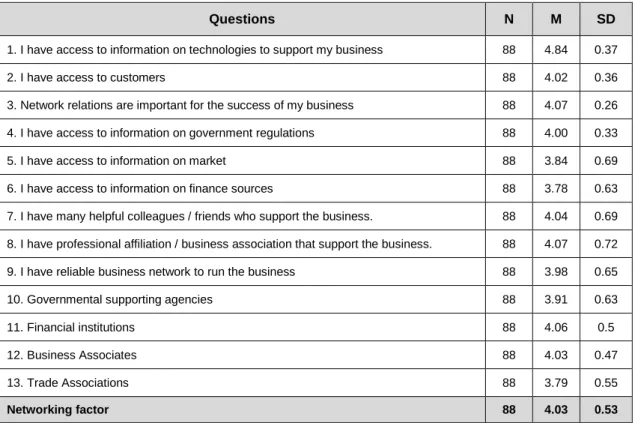
As for the networking factor, which is the theme of this study, it should be noted here that the questionnaire used in the quantitative phase is part of a larger survey questionnaire that sought opinions of owner-managers about several factors influencing business performance. For the purposes of this study, only results of responses to questions about networking are presented. Using a five-point likert scale, thirteen questions were used to obtain data for the networking variable. Table 3 presents the mean scores with standard deviations results obtained from owner-managers of SMEs:
Table 3: Descriptive statistics for the networking factor
Source: Data analysis
From the descriptive statistics shown in table 3, findings showed that networking was widely considered by participants to have a pivotal impact on the success of SMEs in Tangier. Owner-managers of SMEs viewed networking a very important factor that influences the success of their enterprises with a mean score of 4.03.
Factor Analysis
In this study, the exploratory factor analysis was carried out in order to find relationships or factors where variables are maximally correlated with one another and minimally correlated with other variables; and then group the variables accordingly. A principal component analysis (PCA) was conducted on 48 items of the survey instrument with orthogonal rotation (varimax). The Kaiser-Meyer-Olkin (KMO) measure verified the sampling adequacy for the analysis, KMO = .65, which is above the
acceptable limit recommended by Kaiser (1974). Bartlett’s test of sphericity was highly
significant at < 0.05, suggesting large correlations between items for PCA. An initial analysis was run to obtain eigenvalues for each component in the data. Fourteen
components had eigenvalues over Kaiser’s criterion of 1 and in combination explained
Questions N M SD
1. I have access to information on technologies to support my business 88 4.84 0.37 2. I have access to customers 88 4.02 0.36 3. Network relations are important for the success of my business 88 4.07 0.26 4. I have access to information on government regulations 88 4.00 0.33 5. I have access to information on market 88 3.84 0.69 6. I have access to information on finance sources 88 3.78 0.63 7. I have many helpful colleagues / friends who support the business. 88 4.04 0.69 8. I have professional affiliation / business association that support the business. 88 4.07 0.72 9. I have reliable business network to run the business 88 3.98 0.65
10. Governmental supporting agencies 88 3.91 0.63
11. Financial institutions 88 4.06 0.5
12. Business Associates 88 4.03 0.47
13. Trade Associations 88 3.79 0.55
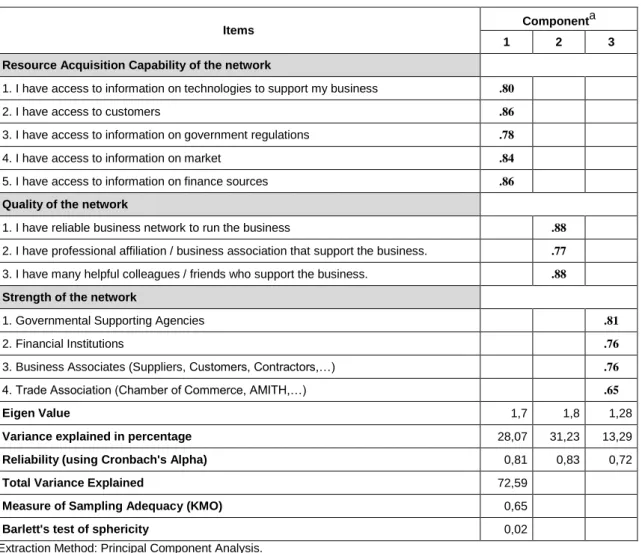
72.59 % of the variance. The matrix confirmed all the research constructs with the emergence of some different themes under the specific construct ‘Networking’ which are: resource acquisition capability of the network, quality of the network, and strength of the network (see table 4).
Table 4: Rotated Component Matrix
Items Component
a
1 2 3
Resource Acquisition Capability of the network
1. I have access to information on technologies to support my business .80 2. I have access to customers .86 3. I have access to information on government regulations .78 4. I have access to information on market .84 5. I have access to information on finance sources .86
Quality of the network
1. I have reliable business network to run the business .88 2. I have professional affiliation / business association that support the business. .77 3. I have many helpful colleagues / friends who support the business. .88
Strength of the network
1. Governmental Supporting Agencies .81
2. Financial Institutions .76
3. Business Associates (Suppliers, Customers, Contractors,…) .76
4. Trade Association (Chamber of Commerce, AMITH,…) .65
Eigen Value 1,7 1,8 1,28
Variance explained in percentage 28,07 31,23 13,29
Reliability (using Cronbach's Alpha) 0,81 0,83 0,72
Total Variance Explained 72,59
Measure of Sampling Adequacy (KMO) 0,65
Barlett's test of sphericity 0,02
Extraction Method: Principal Component Analysis. Rotation Method: Varimax with Kaiser Normalization. a. Rotation converged in 8 iterations.
Source: Data analysis
Regression Analysis
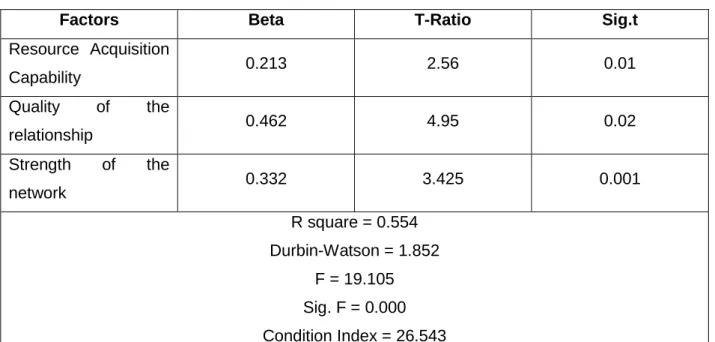
Multiple regression analysis was used to determine whether the independent variables which are: resource capability of the network, quality of the network, and strength of the network, have any significant effect on business performance. The following equation was used:
Y (business performance) = βo +β1 (RAC) + β2 (QR) + β3 (SN) + ε Where :
RAC = Resource acquisition capability of the network, QR= Quality of the relationship in the network, SN = Strength of the network
Results of the analysis are shown in table 5
Table 5: Results of the regression analysis
Factors Beta T-Ratio Sig.t
Resource Acquisition Capability 0.213 2.56 0.01 Quality of the relationship 0.462 4.95 0.02 Strength of the network 0.332 3.425 0.001 R square = 0.554 Durbin-Watson = 1.852 F = 19.105 Sig. F = 0.000 Condition Index = 26.543
Source: Data analysis
Findings of the study revealed that all the factors of networking are positively and significantly related with business performance of medium sized enterprises. This is consistent with other studies (Tooksoon & Mudor, 2012; Tooksoon & Mohamed, 2010 Sahakijpicharn, 2007).
Hypotheses Testing
The second objective of this research study was to examine differences between owner-managers of successful and less successful SMEs in relation to the networking factor. Given the complexity associated with evaluating the performance of smaller firms, and the difficulty in obtaining data on their financial performance, Haber & Reichel (2005) recommended the use of multiple measures of performance. Thus, both financial and non-financial measures were used to categorise whether SMEs fell into the successful or less successful group. The financial measure included the turnover while the personal satisfaction variable was used as a non-financial success indicator.
To achieve the second objective of the study, mean scores were calculated for both successful and less successful SMEs. Moreover, Mann Whitney U test was used to test the null hypothesis, developed from the literature review, which was concerned with testing whether there are differences between successful and less successful entrepreneurs in relation to the self-reported access to networking..
Table 6 shows the results for both successful and less successful firms:
Table 6: Mean scores
Questions
Less successful Successful
N M SD N M SD
3a. I have access to information on technologies to
support my business 33 4.18 1.36 55 4.84 0.37
3d.I have access to customers 33 2.7 1.18 55 4.02 0.36 Network relations are important for the
success of my business 33 4.09 0.29 55 4.07 0.26
3e.I have access to information on government
regulations 33 3.48 1.12 55 4.00 0.33
3g. I have access to information on market 33 3.18 1.21 55 3.84 0.69
3k. I have access to information on finance sources 33 3.21 1.11 55 3.78 0.63 I have many helpful family connections/ friends
who support the business. 33 3.58 0.94 55 4.04 0.69 I have professional affiliation / business
association that support the business. 33 2.73 0.98 55 4.07 0.72 I have reliable business network to run the
business 33 3.48 0.94 55 3.98 0.65
Governmental supporting agencies 33 3.91 0.63 55 3.75 0.80
Financial institutions 33 4.06 0.5 55 3.89 0.66
Business Associates 33 4.03 0.47 55 3.82 0.88
Trade Associations 33 3.79 0.55 55 3.76 0.69
Networking factor 33 3.57 0.86 55 3.98 0.59
From the table, it can be observed that both successful and less successful respondents consider networking important for the success of their businesses. The mean scores were nearly the same for both groups with a mean score of 4.07 for successful businesses and 4.09 for less successful ones. While successful respondents agreed that they have access to friends/ family that can support their businesses (Mean score: 4.04) and also agreed that they have a professional affiliation (Mean score: 4.07), the less successful businesses indicated their disagreement about the professional affiliation (Mean score: 2.73) and showed a neutral opinion about the help of friend and family (Mean score: 3.58).
Table 7 shows the results of Mann Whitney U test in relation to the networking factor.
Table 7: Results of the Mann-Withney U test
Variable Mann Whitney U Statistic Mean Rank (Less successful) Mean Rank
(Successful) Z value Significance
Access to network 390 28.82 53.91 -4.986 .000
Source: Data analysis
It is clear from the table that contrary to what was hypothesised, the finding linked to the null hypothesis unraveled significant differences between the successful and less successful firms. Successful firms reported more access to networking than their less successful counterparts. Results of the Mann-Whitney test indicated large differences in mean ranks of the two groups (Successful = 54, Less successful = 29) and a p value of .000 which is less than the statistical significant level of 5%. On the grounds of these findings, the null hypothesis was rejected.
QUALITATIVE RESULTS
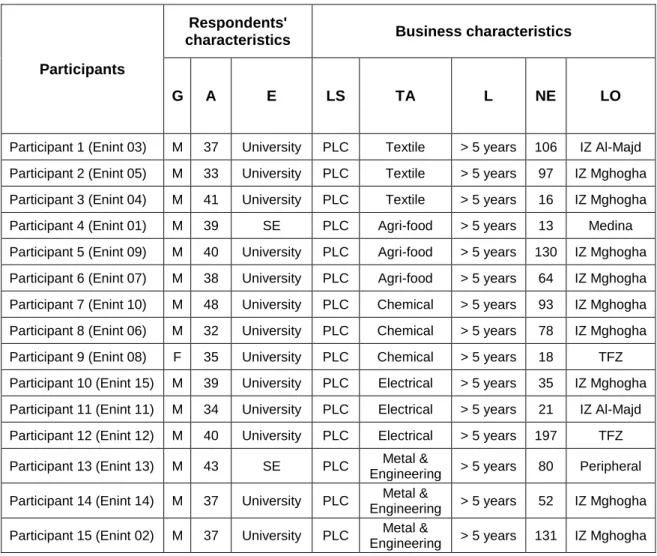
Table 8 shows the profile of the respondents who participated in the interviews:
Table 8: Profile of respondents
Participants
Respondents'
characteristics Business characteristics
G A E LS TA L NE LO
Participant 1 (Enint 03) M 37 University PLC Textile > 5 years 106 IZ Al-Majd Participant 2 (Enint 05) M 33 University PLC Textile > 5 years 97 IZ Mghogha Participant 3 (Enint 04) M 41 University PLC Textile > 5 years 16 IZ Mghogha Participant 4 (Enint 01) M 39 SE PLC Agri-food > 5 years 13 Medina
Participant 5 (Enint 09) M 40 University PLC Agri-food > 5 years 130 IZ Mghogha Participant 6 (Enint 07) M 38 University PLC Agri-food > 5 years 64 IZ Mghogha Participant 7 (Enint 10) M 48 University PLC Chemical > 5 years 93 IZ Mghogha
Participant 8 (Enint 06) M 32 University PLC Chemical > 5 years 78 IZ Mghogha Participant 9 (Enint 08) F 35 University PLC Chemical > 5 years 18 TFZ Participant 10 (Enint 15) M 39 University PLC Electrical > 5 years 35 IZ Mghogha Participant 11 (Enint 11) M 34 University PLC Electrical > 5 years 21 IZ Al-Majd
Participant 12 (Enint 12) M 40 University PLC Electrical > 5 years 197 TFZ
Participant 13 (Enint 13) M 43 SE PLC Metal &
Engineering > 5 years 80 Peripheral
Participant 14 (Enint 14) M 37 University PLC Metal &
Engineering > 5 years 52 IZ Mghogha
Participant 15 (Enint 02) M 37 University PLC Metal &
Engineering > 5 years 131 IZ Mghogha
G = Gender; A = Age; E = Education level; LS = Legal status; TA = Type of activity; L = Longevity of the firm; NE = Number of employees; LO: Location; SE = Secondary education; PLC = Private limited
company; IZ = Industrial zone; TFZ = Tangier free zone
Source: Data analysis
The importance to networking was further reinforced by participants in the qualitative phase of the study. More interestingly, the concept of ‘wasta’, the Arabic word for connections, emerged from this phase.Findings showed that using ‘wasta’, through politico-business networks is important since it enables access to current information that is crucial for the success of SMEs. According to an owner-manager in
the textile sector, his business membership in the Moroccan Association of Textile and Clothing (AMITH) enables him to get the latest information in the textile sector.
‘We have the Moroccan Association of Textile and Clothing (AMITH). It is an association that defends and represents the general interests of the enterprises in the textile sector. It is a very important network to us. When we meet, using our ‘wasta’ and personal relationships, we get the latest information in our sector and share between us many things that are important. Furthermore, we address crucial issues that we face in our business and try to find solutions.’ (Enint05)
Access to current information, through the use of connections, could be very helpful in scanning new opportunities in the market, and therefore, assist in improving business performance. This accords with Hutchings and Weir (2006) who argued that
‘wasta’ is intrinsic to the operation of many valuable social processes, central to the transmission of knowledge, and the creation of opportunity.
The concept of ‘wasta’ was also mentioned in relation to financial resources and suppliers. Findings revealed that strong relationships with suppliers enable firms to get financial resources in the form of trade credits. An owner-manager explained this point by indicating that most of his purchases of raw materials from suppliers are done on credit.
‘Because of our strong relationship with our suppliers, we are able to get a trade credit. Thus, we buy raw materials without immediate payment. This enables us to sell our finished products and then pay at a later time. This is very useful for us because it helps to ease our cash flow management by having more cash inflows at a particular time than cash outflows.’ (Enint07)
Furthermore, the relationship between ‘wasta’ and human resources was also revealed. Findings showed that owner-managers use their network relations through
‘wasta’ in order to recruit their staff. This was expressed in the view of a business owner-manager who indicated that one of the great sources of access to labour was word of mouth:
‘With respect to networking, generally, it is the word of mouth that works in Tangier or in Morocco in general. For instance, to recruit personnel in Tangier, Most SMEs use the word of mouth. The human resources manager uses his network relations to recruit staff.’ (Enint02)
These findings suggest that networking relations using the concept of ‘wasta’ could provide a strong impetus for successful firms in Tangier to be really adept at partnership working. However, whilst it can be argued that the use of ‘wasta’ is legitimate as it can serve a good purpose or that it is part of Moroccan culture, this study substantiates the fact that the use of ‘wasta’, on the other hand, could have negative connotations and thus gives rise to concerns about business ethicality. Hutchings & Weir (2006) argued that it is possible to refer to good ‘wasta’ and negative
‘wasta’. An example of the negative influence of ‘wasta’ was illustrated in the quotation of a business owner-manager, in which money and connections were used to get away with the consequences of non-compliance with health & safety legislation.
‘In the past, health and safety regulations were not 100% respected. So, when inspectors visited our company, we gave them some money in order to write good reports about the working conditions within the company. Also, because of our connections, we got away with it’ (Enint15)
DISCUSSION
Networking was widely considered by participants to have a pivotal impact on the success of SMEs in Tangier. Both quantitative and qualitative phases of the study found that networking was a significant influencing factor in the success of SMEs. Perspectives of SMEs owner-managers of networking were mainly associated with the concept of
‘wasta’, which emerged from the qualitative phase of the study. This finding confirms that some form of networking exists in any culture. Consistent with the different concepts that emerged in a wealth of studies about networking in various cultures(Lo, 2012; Bedford, 2011; Luo, 2007; Hutchings & Weir, 2006a; Ardichvili et al., 2012; Gupta & Singh, 2013; McCarthy et al., 2012), this study argues thatwhilst these concepts may reveal some common as well as unique characteristics derived from the context where they are applied, ‘wasta’, in its turn, has its unique characteristics that are rooted in the nature of the Arabic society.
The influence of ‘wasta’ on the success of SMEs was perceived to be very strong as the experiences of owner-managers drew a different picture from the one that exists in traditional Western models.In this respect, this study confirms previous findings of
several studies (Berger et al., 2015; Hutchings & Weir, 2006)and contributes additional evidence that suggests the significance of ‘wasta’ and its impact on SME success in an economy that functions on relationships.
Specifically, findings showed that using ‘wasta’, through social networks is important since it enables access to current information that is crucial for the success of SMEs. This accords with Hutchings and Weir (2006) who argued that ‘wasta’ is intrinsic to the operation of many valuable social processes, central to the transmission of knowledge, and the creation of opportunity. It also supports the argument of Ramadani et al. (2016) that social networks in the form of social strong and weak ties can be instrumental as sources of novel information and ideas as well as providing access to new resources.
Moreover, the concept of ‘wasta’ was also mentioned in relation to financial resources and suppliers. Findings revealed that strong relationships with suppliers enable firms to get financial resources in the form of trade credits. This corrobates the findings of several studies in which good relationships and working closely with suppliers were reported (Morrissey & Pittaway, 2006; Jones, 1996). This suggests that business networking using ‘wasta’ has a great impact on financial performance.
Furthermore, the relationship between ‘wasta’ and human resources was also revealed. Findings showed that owner-managers use their network relations through
‘wasta’ in order to recruit their staff. This corroborates the ideas of Metcalfe (2006) who indicates that throughout the Arab region, social networks built on family networks are a significant force in all aspects of decision-making and thus play a very important role in the career advancement of individuals. It further supports the argument of Tlaiss & Kauser (2011) who state that ‘wasta’ in the workplace plays a critical role in the recruitment and career success of individuals. Although it may have some positive aspects, it can be argued here that negative connotations of corruption can also exist and thus, the prevalence of negative ‘wasta’ can make the success of small firms dependent on their connections rather than their efforts, skills, or compliance with regulations. A clear and obvious example of the negative influence of ‘wasta’ was illustrated in the quotation of ENint15, in which money and connections were used to get away with the consequences of non-compliance with health & safety legislation.
However, it could be concluded that while some aspects of ‘wasta’ could be seen from outside the context as corrupt, then it might seem different to those inside. This is because ‘wasta’ is an embedded social concept with broad range in Arabic societies – which might alter the degree of proportionality or reasonableness perceived by those within, or belonging to, those societies. Determining the range over which ‘wasta’ is seen as legitimate (by those within the societies concerned) is perhaps the most appropriate basis for considering the relationship of ‘wasta’ to corrupt practices.
In sum, these findings suggest that networking relations using the concept of
‘wasta’ could provide a strong impetus for successful firms in Tangier to be really adept at partnership working. Every business needs partnerships with others in order to succeed. However, what was interesting and does add to our understanding are the particular ways in which entrepreneurs prefer to conduct their businesses using these partnerships in the Moroccan context, which seem to be different from the Western context. It is true that networking connections are particularly important in a number of Arabic cultures. Thus, here firms seem to have networking using ‘wasta’ as being the thing that will work to encourage or support a partnership approach to business success. In societies that exhibit these characteristics, we would think that partnerships would feature more strongly as a cluster individual thing.
This study could have an implication for several international companies established in Tangier. It is clear that expatriate managers need to be conscious of the culture specific networks. The lack of knowledge relating to such cultures and business practices has affected the ability of many international companies to tap into the economic potential of the region (Khakhar & Rammal, 2013). Supporting the implications highlighted by Hutchings & Weir (2006) from their study of understanding networking in China and the Arab World, findings of this study suggest the need for increased cross-cultural training of international managers to adjust to culture-specific networking in Tangier. Thus, policy makers and teaching organizations could provide training programmes that are tailored to the needs of the international managers in order to assist their intercultural effectiveness in Tangier.
Networking practices in Arab countries are hitherto under-researched. Thus, the concept of ‘wasta’, in networking practices, constitutes an intriguing topic, in networking
practices, which could be usefully explored in further entrepreneurship research (Whiteoak, Crawford, & Mapstone, 2006).Furthermore, looked at positively, ‘wasta’ could contribute to the success of business by providing finance and strengthening networks and social relationships in the market, although there could also be negative impacts such as confused stakeholding and obligations. Further investigation in depth of these issues in future studies would provide a rich field of study for future work.
CONCLUSION
The significance of networking and its impact on the performance of SMEs has been highlighted in a number of studies (Franco et al., 2016; Chung et al., 2015; Chen et al., 2015; De Hoyos-Ruperto et al., 2013; Wincent et al., 2009; Watson, 2007; Zaheer & Bell, 2005; Florin et al., 2003; Zhao & Aram, 1995). Collectively, these studies outline the critical impact of networking on the performance of SMEs. However, even though the findings of these studies are interesting, they have not been fully applicable to the current research context, where it was clear that there are potentially significant differences in the concept of networking within Arabic culture compared to the Western contexts. Thus, this study adds to our understanding about the impact of networking on the performance of SMEs by highlighting the concept of ‘wasta’ as detrimental to the success of SMEs.
REFERENCES
Abosag, I., & Lee, J-W. (2013). The formation of trust and commitment in business relationships in the Middle East: Understanding Et- Moone relationships. International
Business Review 22(3), 602–614·
Adler, P. S. (2001) “Market, hierarchy, and trust: the knowledge economy and the future of capitalism”, Organization Science, Vol. 1 No. 2, pp. 215-234.
Adler, P. S. and Kwon, S. (2002), “Social capital: prospects for a new concept”, Academy of Management Review, Vol. 27 No. 1, pp. 17-40.
Ahl, H. J. (2003). Ways to study the text of entrepreneurship. Reykjavik, Iceland.: Scandinavian Academy of Management.
Ahmad, S. Z. (2011a). Evidence of the characteristics of women entrepreneurs in the Kingdom of Saudi Arabia: An empirical investigation, International Journal of Gender and Entrepreneurship, 3(2), 123 – 143
Ahmad, S. Z. (2012). Micro, small and medium-sized enterprises development in the Kingdom of Saudi Arabia, World Journal of Entrepreneurship, Management and Sustainable Development, 8(4), 217-232
Ahmad, S. Z., & Xavier, R. S. (2011). Preliminary investigation of Yemeni women entrepreneurs: some challenges for development and barriers to success. International Journal of Entrepreneurship and Small Business, 13(4), 518 - 534
Aldrich, H. E., & Reese, P. R. (1993). Does networking pay off? A panel study of entrepreneurs in the research triangle, in “Frontiers of Entrepreneurship Research”.In: N. S. Churchill, S. Birley, J. Doutriaux, E. J. Gatewood, F. S. Hoy and W. E. Wetzel (Eds.) Center for Entrepreneurial Studies, Babson Park, pp. 325-339.
Aldrich, H., & Zimmer, C. (1986). Entrepreneurship through social networks. In Sexton, D. & Smiler, R. (eds.), The Art and Science of Entrepreneurship: (pp.3-23). New York: Ballinger.
Al-Khatib, J. A., Robertson, C. J., Stanton, A. & Vitell, S. J. (2002), Business ethics in the Arab Gulf states: a three-country study. International Business Review, Vol. 11 No. 1, pp. 97–111.
Ardichvili, A., Jondle, D., Kowske, B., Cornachione, E., Li, J., &Thakadipuram, T. (2012). Ethical cultures in large business organizations in Brazil, Russia, India, and China. Journal of Business Ethics, 105(4), 415 - 428.
Batjargal, B. (2006). The dynamics of entrepreneurs’ networks in a transitioning economy: the case of Russia. Entrepreneurship & Regional Development: An international journal, 18 (4), 305-320.