ARC: An Integrated
Admission and
Rate
Control
Framework for CDMA Data Networks Based on
Non-Cooperative Games
Haitao Lin
1, Mainak Chatterjee
2, Sajal K. Das
1, Kalyan Basu
1 1 Center for Research in Wireless Mobility and Networking (CReWMaN)Department of Computer Science and Engineering, The University of Texas at Arlington Arlington, TX 76019-0015
{
hlin, das, basu
}@cse.uta.edu
2School of Electrical Engineering and Computer Science, University of Central Florida Orlando, FL 32816-2450
ABSTRACT
The competition among wireless data service providers brings in an option for the customers to switch their providers, due to unsatisfactory service or otherwise. However, the existing resource management algorithms for wireless networks fail to
fully capture the far-reaching impact of thiscompetitiveness.
From this perspective, we propose an integratedadmission
and rate control (ARC) framework for CDMA based
wire-less data networks. The admission control is at thesession
(macro) level while the rate control is at the link layerpacket
(micro) level. The ARC framework is based on a novel game theoretic formulation which defines non-cooperative games between the service providers and the customers. A user’s decision to leave or join a provider is based on a finite set of strategies. A service provider can also construct its game strategy set so as to maximize the utility (revenue) yet
at-taining its targetchurn rate(the probability of users leaving
the network). We show that the pure strategy Nash
equi-libriumcan be established for both under-loaded and fully-loaded systems such that the providers have clearly defined admission criteria as outcome from this game. Users are
categorized into multiple classes and offered differentiated
servicesbased on the price they pay and the service degra-dation they can tolerate. We show that the proposed ARC framework significantly increases the provider’s revenue and also successfully offers differentiated QoS to the users.
Permission to make digital or hard copies of all or part of this work for personal or classroom use is granted without fee provided that copies are not made or distributed for profit or commercial advantage and that copies bear this notice and the full citation on the first page. To copy otherwise, to republish, to post on servers or to redistribute to lists, requires prior specific permission and/or a fee.
MobiCom’03, September 14–19, 2003, San Diego, California, USA.
Copyright 2003 ACM 1-58113-753-2/03/0009 ...$5.00.
Categories and Subject Descriptors
C.2.1 [Computer-Communication Networks]: Network
Architecture and Design—Wireless communication, Network
communications; C.4 [Performance Of Systems]: Mod-eling techniques
General Terms
Algorithms, Design, Experimentation, Economics, Human Factors, Theory
Keywords
Wireless Data Networks, Admission Control, Rate Control, CDMA systems, Non-cooperative Games
1.
INTRODUCTION
Wireless data serviceis perceived as the most important revenue generating service in future wireless networks. This
fact, together with thecompetitionfaced by the service
pro-viders, is imposing unprecedented challenges to theresource
managementproblem in such networks. The two major chal-lenges that the wireless data network designers are facing to-day include (i) establishing the fundamental relationship be-tween the market competitiveness and network design prin-ciples, particularly the resource management schemes; and (ii) devising an efficient resource management framework specifically adapted to wireless data delivery.
Since there are usually multiple wireless carriers (service providers) in every region, customers or users have the free-dom to choose their own providers. This brings in a new perspective to the wireless network design. The users’ de-cision of leaving the current service provider and
subscrib-ing to another is calledchurning. The impact of churning
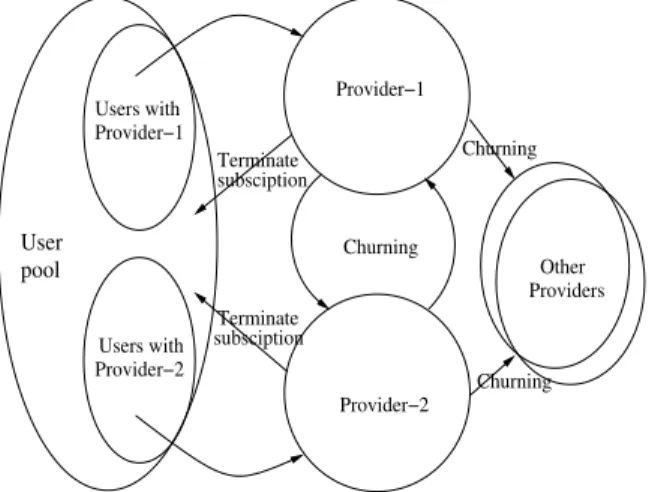
on a competitive environment with two providers is illus-trated in Figure 1. Each provider caters to a subset of the total user pool. It is important for the providers to man-age the network resources based on the expectation of the users; otherwise they may churn to a different provider. In
the traditional regulated telecommunications industry, the freedom of the users to leave a network provider was very limited. The goal of maximizing the provider’s revenue (util-ity), throughput (or resource utilization) in such a
single-provider system was harmonious. However, in acompetitive
market, these two goals may not necessarily lead to the same resource management strategy. How the resource manage-ment, which is one of the main interactions between the wireless system (representing the service providers) and the customers, should be adjusted to reflect this fundamental change in the market daynamics, has received very less at-tention so far. Users with Provider−1 Users with Provider−2 Provider−1 Provider−2 Providers Other User pool Churning Terminate subsciption Terminate subsciption Churning Churning
Figure 1: Two-provider Competition Dynamics
Apart from the competition from other providers, the data services themselves are also posing challenges to the network resource management issues. Consider the admission con-trol problem as an example. In a CDMA (Code Division Multiple Access) cellular system only supporting voice ser-vices, admitting a new user into the system may result in aninfeasible power assignmentthat is very undesirable and should be avoided with extreme care [25]. This judgment comes from the fact that voice is delay sensitive. Infeasible power assignment means immediate dropping of some voice packets because they cannot be buffered. However, wireless data networks are different in nature, due in part to the burstiness of data traffic. Dedicating channels to each data flow is inefficient. Since the wireless links are shared, it is very hard for admission control to make the following
judge-ment: under what conditions the system is considered fully
loaded so that no new request can be accepted. Infeasible power assignment at the instant of session request, used as the main criterion for admission control in voice networks, does not necessarily mean the system’s inability to admit new data session requests. This is because the data flow added by the new session might be buffered for a short time and transmitted later during the “silence” period of other on-going sessions. Therefore, new resource management al-gorithms, which capture the essential nature of data traffic, are needed to strike a balance between the utilization of the limited wireless bandwidth resource and the customer’s sat-isfaction. While wireless voice networks only need to provide the same quality-of-service (QoS) to all the users (the same BER or bit error rate, the same bandwidth, the same de-lay, etc.), wireless data networks should be able to provide
different QoS to different applications and users. Thus,
dif-ferentiated QoSis a major challenge that the data services bring into the wireless networks.
In this paper, we address the above challenges in a novel way. Our contributions include the following:
• We claim thatin a competitive non-cooperative
envi-ronment, the ultimate goal of resource management al-gorithms in network design is maximizing the provider’s revenue, instead of maximizing system throughput (or resource utilization) as in a cooperative environment. By applying this principle to the system design, we propose a novel framework for resource management in wireless data networks based on game theory. We prove this claim by showing significant revenue im-provement in our proposed framework over traditional wireless cellular systems.
• We formulate theadmission controlproblem at macro
(or session) level in wireless data networks as a two-player, nonzero-sum, non-cooperative game between the service provider and the customer requesting for session admission. The non-cooperative nature of the admission control problem due to the market compet-itiveness is properly modeled in this game with care-fully defined payoff functions.
• We show that the proposed formulation of the
admis-sion control game formulated achieves Nash Equilib-rium for both under-loaded and fully-loaded systems, thus leading to the provider’s admission strategy in both cases.
• An admission control scheme has to be used in
com-bination with a proper resource assignment algorithm to make the system feasible and stable. We propose arate controlscheme at micro (or packet) level which resides between the link layer and MAC (Media Access Control) multiplexer that buffers the packets from cer-tain flows when the system has more sessions active at a time than the system’s power budget may allow.
• With different game parameters, the system is able to
provide differentiated QoS to different classes of users, both in terms of session rejection probability and link layer packet delay. This enables the service providers to supply a variety of services to customers with dif-ferent preferences on QoS, tolerance on service degra-dation, and financial budget.
The rest of the paper is organized as follows. Section 2 gives a survey of existing work related to the problem we are addressing and the game theoretic approach we are taking. Section 3 describes the proposed framework. Section 4 dis-cusses the admission control game formulation and the equi-librium solution to the game. Section 5 describes the rate control algorithm and the packet blocking probability esti-mation. Section 6 presents the simulation results to demon-strate the feasibility of the system and the significant im-provement in revenue maximization and differentiated QoS provisioning. Section 7 discusses some issues that can be explored in the future and concludes the paper.
2.
RELATED WORK
Admission control is one of the most fundamental prob-lems in wireless networks, and has been studied extensively
[1] [7] [9] [15] [25]. Most of the work in CDMA networks focus on avoiding infeasible user(s) getting admitted into the system. “Infeasible user” means if the user is admitted, the power assignment to satisfy the SIR (Signal to Inter-ference Ratio) requirements of all the users in the system becomes infeasible. As a result, some sessions have to be dropped. Another focus on admission control has been to reduce the hand off blocking probability while maximizing the total traffic the system can support, because a low hand off dropping rate is always achieved by reserving resources in the neighboring cells. In [15], an integrated system with both voice and data service is proposed. However, in this approach, data service is just a supplemental service which utilizes the residual bandwidth from the voice service. Such works are suitable for wireless networks mainly supporting voice service, because the system load is always evaluated according to the SIR levels and feasible power assignment. Although they can guarantee the QoS for voice service, they are too conservative for data network where channels (codes for CDMA) can be shared among different users. Moreover, providing feasible power assignment to guarantee SIR for all the users is unnecessary because not all users are transmit-ting all the time during the session due to the burstiness of data traffic. More importantly, no admission control so far has considered the competitiveness among service providers. To the best of our knowledge, not much work has been done in jointly addressing the challenges faced by the ad-mission and rate control schemes in wireless data networks. Game theory has been used in a variety of resource man-agement problems in wireless networks. For example, power control problem has been modeled as a non-cooperative game between users competing for the power to reach their SIR re-quirements [2] [24]. It is shown that such a game can reach Nash equilibrium and produce feasible power assignment. In [16], the application of game theory to media random ac-cess problem is discussed. By modeling the users trying to access the same media at the same time as players of the game, it is shown that a random ALOHA with selfish users can also achieve stability for sufficient low attempt rates. However, none of the games formulated in the existing work on power control and access control attempts to capture the competitiveness among the service providers, nor do they aim at maximizing the provider’s revenue. In [5], the game concept is used in admission control, but no formal game is formulated nor equilibrium is established.
Cooperative game theory has been used to obtain a Nash bargaining framework to address issues like network effi-ciency, fairness, revenue maximization and pricing [27]. Re-peated non-cooperative games have been used in [17] for market-based modeling to manage network resources, prove existence of a unique Nash equilibrium [18] and its reach-ability using a de-centralized approach. Game theory has also been used to study the pricing structure of a network. To recover cost, network providers must understand user be-havior and demands so as to offer different service plans. In [13], it has been shown how the network can behave as an active player in order to maximize revenue. The network uses its sole discrimination to force users to an operating point that is favorable to the network. Similar approaches using game theory have been used for determining pricing models for the Internet. A pricing model is proposed in [21] for differentiated network services with one seller, one broker and multiple users. The existence of Nash equilibrium with
two Internet service providers (ISPs) is studied in [6]. It has been shown that cooperation between two ISPs benefit both the ISPs and the users [8]. The relationship between congestion control and pricing is established in [10], a lot of progress has been made on the Internet pricing. It has been argued in [11] that it is possible to provide differentiated QoS to users using simple pricing schemes obtained from a sequence of games. In [14] an algorithm is proposed for both the network to adjust their price and users to adjust their window (rate) such that an optimal equilibrium is reached, thus maintaining proportional fairness.
P
ro
v
id
er
s
S ingl e M ul ti pl e Single MultipleUsers
Non-interesting caseTrivial case Most of existing work Our framework: ARC
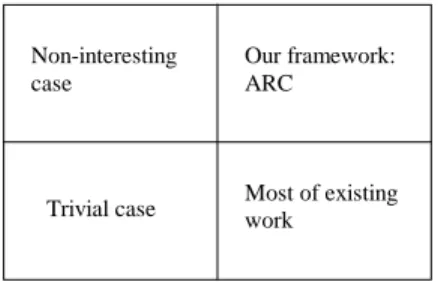
Figure 2: Interactions among service providers and users
Figure 2 categorizes game theoretic formulations into four cases depending on whether the network is dealing with sin-gle or multiple providers and users. Most of the existing work based on non-cooperative game theory for resource management in wireless networks do not incorporate the new paradigm of multiple providers or the competition thereof. Our proposed admission and rate control (ARC) framework applies to multiple-user multiple-provider case which we be-lieve has not been addressed in the same manner as proposed in this paper. This case can be easily mapped into the single provider-multiple user case.
3.
PROPOSED ARC FRAMEWORK
The architecture of the proposed ARC framework for dif-ferentiated wireless services is shown in Figure 3. The CDMA cellular system is connected to the SLA (service level agree-ment) database of the carrier through the Internet to man-age the user policies. It is also connected to the content servers (HTTP or WAP) through the IP backbone. The SLA database carries all the information about the customers and their service plans. The session admission into the system is determined by the admission control algorithm.
In an interference limited multiple access scheme such as CDMA, the admission of a new session into the system has an influence on all the on-going sessions. The admission con-troller not only has to provide the necessary resources to the new session, but also has to maintain the QoS of the existing ones that was promised to them at the time of admission. There is a “graceful degradation” in the system performance as the number of users in a CDMA system goes up. This means that if additional users are accommodated into the
system, thenall the users in the system will suffer. Thus,
in a CDMA system, there is usually a trade-off between the capacity(number of users services) and the offered QoS pa-rameters like SIR or the corresponding BER. To summarize,
SLA Database
Content Server
Mobile
Station CDMA Cellular
Network Admission Control (Macro Level) Rate Control (Micro Level) Gateway Internet Data flow Control Signals Session Request Wireless channel User Information
Figure 3: Framework Architecture
the occurrence of a new event, be it a new service request or change in resource usage of an existing session, has some effect which is propagated to all the on-going sessions.
The admission control and rate control algorithms are closely integrated in the ARC framework. Our admission control does not use the traditional criterion directly based on interference measurements and power assignments, hence power assignment to support all the sessions to transmit at the same time with full rate may not be feasible. We allow this to happen intentionally because single flow data traffic is bursty. If we guarantee full rate transmission of all the sessions at the same time, then the system will be under-utilized most of the time. However, something has to be done if infeasible power assignment occurs in the system. This is where we use a rate control scheme to reduce the rate of certain sessions. With less power to transmit these lower rate sessions, the feasible power assignment can still be achieved. In our ARC framework, admission control and rate control mechanisms work closely together to maximize the provider’s revenue as well as to yield a feasible system.
Our framework provides differentiated services forKclasses
of users, numbered as classes 1 toK. The smaller the class
number, the higher is its priority. A user in a higher prior-ity class pays more premium than a user in a lower priorprior-ity class, and hence gets higher QoS in terms of lower session blocking probability and packet blocking probability.
4.
ADMISSION CONTROL
AS A TWO-PLAYER GAME
Let us analyze the competitive wireless service scenario.
Assume there areM service providers andNusers. At time
t, let the number of users subscribing to provideribe
de-noted asn(t)i, where 1≤i≤M. Excluding the possibility
that a customer subscribes to more than one service provider
at the same time, we have PMi=1n(t)i = N. The vector
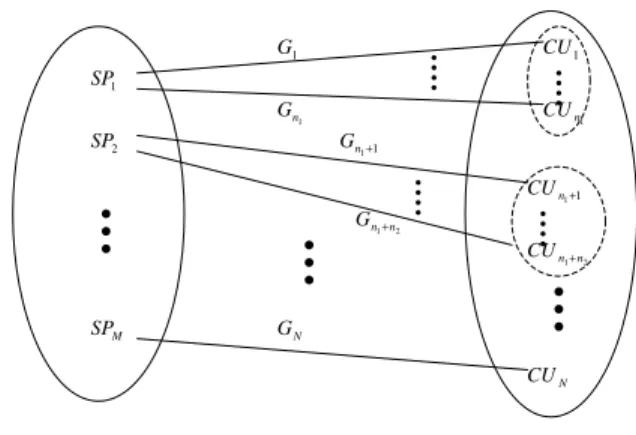
[n(t)1, n(t)2, . . . , n(t)M] changes continuously as the compe-tition dynamics evolves due to the user’s churning behavior, as mentioned earlier. Figure. 4 shows one possible status of
the system. Note that each user may haveM choices for
service provider, which makes the possible number of states
in the system to be MN. Modeling this dynamics as one
game would make it unmanageably complex. However, if
we take a snapshot of the picture in Figure. 4, each user is only associated with one service provider at a time. If we can model this one-to-one relationship between a
par-ticular user and his current service provider as a game Gj
(for 1≤j≤N) at any instant, and manage their
relation-ship properly with the game output, then the competitive scenario can be considered as multiple instances of this one-to-one game between two players (provider vs. user).
1 SP 2 SP M SP 1 CU 1 n CU 1 1+ n CU 2 1n n CU + N CU i
SP : the i th service provider, 1≤i≤M
j
CU : the j th customer, 1≤j≤N
Service Provider Pool Customer Pool
N G 1 G 1 n G 1 1+ n G 2 1n n G +
Figure 4: Relationship Between Multiple Providers and Multiple Customers in the Competitive System
We take this approach in the admission control problem formulation since it is one of the main interactions between the wireless data networks and the users. We capture this interaction with a two-player game. In this section, we first introduce the basic concepts in a normal form two-player game. Then we discuss the nature of the game relationship between the network and the user during the admission con-trol process. Finally, the game is formalized and the admis-sion control criteria is derived as the equilibrium solution of the game.
4.1
Preliminaries on Non-cooperative Games
A two-player game is the most basic form of games, but also a powerful tool for solving problems with conflicting
goals. In such a game, each player has a set of
strate-gies. Two strategies, each coming from the strategy set of a
player, form a pair of strategies in the two-player game.
As-sociated with this pair are twopayoffs, one for each player.
Each player makes his decision independently and tries to get the most out of the game on the basis that the other player is not cooperating in anyway. Games can be
pre-sented in two forms. Games innormal formdeal with the
sit-uation where decision of each player is made without
know-ing the decision of the other player. Extensive formgames
deal the situation where at least one player has partial in-formation about other player(s) decision. Since we only use the normal form game in our admission control scheme, we only discuss the games in normal form.
Mathematically, a two-player non-cooperative game
con-sisting of players P1 and P2 is defined by two payoff
ma-trices A and B. Assume P1 has m strategies denoted as
s1, s2, . . . , smandP2hasnstrategies denoted ast1, t2, . . . , tn.
the columns representsP2’s strategy. The elementaijof
ma-trixAgivesP1’s payoff when playerP1 chooses strategysi
and P2 chooses strategy tj. The element bij of matrix B
is P2’s payoff when player P1 chooses strategy si and P2
chooses strategy tj. Since this type of game is defined by
two payoff matrices, they are also calledbimatrix games.
Games can also be divided into zero-sum and nonzero-sum [3]. If aij+bij = 0,(∀i ∈ 1, . . . , m,∀j ∈ 1, . . . , n),
then it is azero-sum game, otherwise non-zero sumgame.
Note that the games in whichaij+bijis a constant are also
categorized as zero-sum as they can be easily converted to zero-sum games. Zero-sum games are not called bimatrix games because only one player’s payoff matrix is enough to define the game and the payoff matrix of the other player can be easily derived.
In a bimatrix game defined by the payoff matrices A =
[aij] andB= [bij], a pair of strategies{s∗i, t∗j}is said to
con-stitute a non-cooperative pure strategy (Nash) equilibrium
solutionto the game if the following pair of inequalities is satisfied
½
ai∗j∗≤aij∗
bi∗j∗≤bi∗j for alli= 1, . . . , mand allj= 1, . . . , n
It has been shown in [3] that a two-player nonzero-sum game may or may not have a pure strategy Nash equilibrium. Equilibrium can also be established with another form of
strategy calledmixed strategy, which means the equilibrium
is established when at least one of the players has a “mix”
of possible strategies. For example, ifP1 has two strategies
numbered ass1 ands2. A mixed strategy forP1 means he
has a probability ofpto choose strategys1, and a probability
of 1−pto choose strategys2. According to the definition,
the mixed strategy makes sense only when the same game is played multiple times. It has been shown [3] that every bimatrix game has at least one Nash equilibrium solution in mixed strategies.
4.2
Why Non-cooperative and Nonzero-sum?
In this subsection, we justify why in an admission control game, the relationships between a service provider and its customers are non-cooperative and nonzero-sum.
First, in a competitive wireless data service environment, the relationship between a particular service provider and its
customers isnon-cooperativein nature. The service provider,
on one hand, wants to maximize its own revenue. (Note that the service provider’s attempt to maximize user’s sat-isfaction, system utilization, etc., is merely an approach to achieve this ultimate goal of revenue maximization). So the revenue of the service provider is modeled as its payoff from this game. Users, on the other hand, want to maximize their own satisfaction with minimum expense, given that they have the freedom to leave the current service provider and subscribe to a better one in a competitive market. Thus the user’s overall satisfaction is modeled as the user’s payoff from the admission control game. Since these two goals are different and often conflicting with each other, the service provider and customers do not have the apparent motiva-tion to cooperate with each other to achieve a single optimal goal. Single goal optimization, the approach undertaken by most of the existing works does not justify the optimality of the service provider’s strategy for resource management that includes both admission control and rate control.
Second, the game is alsononzero-sum. In order to justify
this, let us assume that the game is zero-sum in the sense that an increase in one player’s payoff implies a decrease in the other player’s payoff. However, this may not be true for the relationship between the payoffs of a wireless service provider and the customer. For instance, when the system is under utilized, admitting a new request that does not affect the QoS of other ongoing sessions, would increase the ser-vice provider’s revenue as well as the customer’s satisfaction. Thus, both the payoffs of the service provider and the user are increased, which conflicts with the zero-sum assumption. So this game has to be modeled as nonzero-sum.
4.3
Admission Control Game Formulation
Existing game theory based approaches to wireless net-work resource management consider the game played by multiple users in the system competing for the resources. In resource management problems such as power control, this is an appropriate model since the strategy chosen by one player (user), which is the power level he is using, has direct impact on the payoffs (SIR) of other users in the sys-tem. This implies direct interaction between multiple users under the same provider. The admission control problem is a little different in the sense that the direct interaction is between the service provider and the user seeking admis-sion. So we choose to model the admission control as a game between the service provider and the user. However, the im-pact of admission control to other users cannot be ignored. The churn rate of the users already in the system and the corresponding revenue losses have been considered in the payoff of the service provider. More importantly, since the goal is to maximize the provider’s revenue, the provider has to be one of the players participating in the game.
We formulate the admission control problem in wireless data networks as a two-player nonzero-sum, non-cooperative game. Admission control happens when a new session re-quest is received by the system. The system then makes the decision whether to accept this request and allocate it a certain amount of resource, or reject it because of lack of re-source. This decision making process is modeled as a game. We first adopt the one-by-one admission control mechanism in which the requests are processed one by one instead of as a bulk, i.e., one instance of the game is played every time a new session request comes into the system. The two players are the service provider (or the system that is processing this session request) and the customer that is currently re-questing a session establishment.
The service provider has two strategies: SS1 or admit
the request, and SS2 or reject the request. The customer
seeking admission has two strategies as well: CS1 or leave
the current provider, and CS2 or stay with the provider.
The payoffs of these two players are expressed in the form
of two 2×2 matricesA= [aij]2×2 andB= [bij]2×2, where
aijandbijfori∈ {1,2}andj∈ {1,2}, denote the provider’s
payoff and customer’s payoff respectively, if provider chooses
strategySSiand the customer chooses strategyCSj. Before
formally defining the payoffs for the service provider and the customer, we define some notations:
• U: the service provider’s current revenue (utility)
com-ing from all the on-gocom-ing sessions.
• Ci: the service provider’s average revenue per session
in classi, for 1≤i≤K. This revenue depends on the
length of the session and the pricing scheme based on either time-usage based or traffic flow usage based.
• Li: the service provider’s average revenue loss for
los-ing a class i customer, where 1 ≤ i ≤ K. This is
estimated based on the cost for the provider to gain a new customer into the system, assuming the provider’s customer base is maintained constant.
• P bi: the predicted packet level blocking rate for class
icustomer, if the new session request is accepted. The
packet blocking probabilityis defined as the probability that a frame coming from link layer is not immediately passed through the rate control unit because of inade-quate power. Note that “blocking” here does not mean “dropping”; the frames are just blocked from immedi-ate transmission. They are queued in the rimmedi-ate control unit for future transmission.
• Ri(P bi): the class icustomer’s churn rate as a
func-tion of the packet level blocking rate. It is defined
as a function of P bi because in the ARC framework,
the customer’s perceived QoS is mainly defined as the customer’s packet blocking probability. The only data unit under consideration in this framework is the link layer packet, sometimes called frames. Packets and frames will be used interchangeably throughout this paper.
• Ni: the number of classiusers currently in the system.
Assume a customer in classkis requesting a session
admis-sion. The provider’s payoff matrixA = [aij]2×2 is defined
as follows: A= · U+Ck−F−Lk U+Ck−F U−Lk U ¸ whereF=PKi=kNiRi(P bi)Li.
Let us discuss these payoff values. a21 = U −Lk
de-notes the provider’s payoff if it chooses strategy SS2 and
customer chooses strategy CS1. This corresponds to the
provider’s strategy of rejecting the customer request and the customer’s strategy of leaving the service provider. The payoff of the service provider in this case is the current rev-enue coming from all on-going sessions, minus the revrev-enue
loss due to the customer’s churning. a22is just the revenue
from the current on-going sessions.
However,a11and a12 need further discussion. a12
corre-sponds to the strategy pair (SS1, CS2), where the provider
admits the request while the customer remains with the provider. This seems to yield the highest payoff for the provider. However, in a fully loaded system, admitting a new customer would either result in an infeasible power as-signment (for cellular network providing voice service) [25], or delay of the current on-going sessions in the wireless data networks. Either of such cases may incur revenue loss be-cause of churning of the customers whose on-going sessions are being affected. How exactly the on-going sessions are affected depends on the rate control mechanisms that are used in the system, which will be detailed in Section 5. The
term a11 is defined in a similar way, just with one more
term of−Lk which corresponds to the revenue loss due to
the customer’s churning.
Admitting a new request into an already fully loaded sys-tem providing voice service is proved to be undesirable be-cause it be-causes dropping of on-going sessions (calls). How-ever, in CDMA wireless data networks, where infeasible power assignment can be avoided by reducing the transmis-sion rates of on-going sestransmis-sions, the pros and cons of admit-ting the new request need to be carefully evaluated in order to maximize the revenue for the service provider. We
cap-tured this aspect in the payoff valuea11anda12. The term
NiRi(P bi)Li gives the total predicted revenue loss for all
classiusers currently having on-going sessions. Our micro
level rate control scheme, described in Section 5, ensures
that when a class k user is admitted and the wireless
re-source is inadequate, only users of the same class or lower
classes will be affected. Thus,F=PKi=kNiRi(P bi)Li
mea-sures the total revenue loss from all possible classes of users.
The churn rate, Ri(P bi), is obtained by applying Sigmoid
utility function and discussed in detail in Subsection 4.4.
We define the user’s payoff matrixB= [bij]2×2as follows:
bij= ½
w1Uij−w2Lc for j= 1
Uij for j= 2
where Uij is the user’s gain without considering churning
andLcis the customer’s possible money loss if the customer
chooses to churn. The term Lc comes from the fact that
if the customer was still under contract with the service provider, he may be charged for early termination fee as a penalty. Subscribing to a new service provider may incur
certain activation fee as well. Lc differs from user to user
since some may be in contract while some others may not.
The weightsw1 andw2 on these two factors of user’s payoff
reflect user’s preference on money saving and satisfaction maximization.
The user’s gain,Uij, without churning is given by:
Uij= ½
Rk(P bk) +Wa for i= 1
0 +Wb for i= 2
where Wa (orWb) is the user’s payoff when the request is
admitted (or rejected). ObviouslyWa> Wb.
It is well known that in a CDMA system, the forward link is power limited while the reverse link is interference limited [12]. We consider a system where the forward link traffic is the bottleneck because of the asymmetry of wireless data traffic. Thus the admission control and rate control are mainly performed over the power limited forward link, to ensure the stability of the system and maximization of the
provider’s revenue. The packet blocking probability,P bk, is
only obtained for forward link. SinceP bk is closely related
to the packet level rate control, which regulates the traffic flows when full rate transmission of all on-going sessions is not possible due to the power constraint, we will discuss
in Subsection 5 how to obtain P bk after the rate control
mechanism is introduced.
The final decision on the admission control scheme as an
outcome of our game formulation, is theequilibrium that is
generally considered as the “best” solution to this type of non-cooperative games. We will discuss how to obtain the equilibrium in subsection 4.5.
4.4
Customer’s Churning Rate
The customer’s churning behavior is the key factor in for-mulating the proposed game for admission control. In this
section, we derive the churn rates, Ri, for all user classes wherei= 1,2, . . . , K.
The churn rateRi(·), is defined as the probability that a
classicustomer leaves the current service provider. Thus,
churn rate is a factor which is very much dependent on the (subjective) satisfaction of the customer and hence difficult to characterize mathematically. Therefore, we resort to the utilityconcept in economics to model this churn rate. Utility is a measure of customer’s degree of satisfaction and can be modeled as a function of the quantity and quality of the merchandizes or services he receives, as well as the money he paid. Since we are not addressing any pricing strategies in this paper, we assume a session request means the customer is willing to pay for the session, and the utility is only a
function of the service quality, which isP biin our context.
The Sigmoid function [22] has been used to approximate the user’s satisfaction with respect to service qualities or resource allocation [26] [23]. We slightly modify the Sigmoid function to incorporate the user’s utility with respect to the
packet blocking probability, P bi. Let Oi be class iuser’s
utility. ThenOias a function ofP bi is given by:
Oi(P bi) = 1 1 +e−αi(βi−P bi)
whereαi andβi decide the steepness and the center of the
curve. Both of them can be tuned to customize the function
for different users. The value of αi indicates the class i
user’s sensitivity to the QoS degradation (i.e., the increase in
packet blocking), whileβiindicates the “acceptable” packet
blocking probability for class i customer. In other words,
with the increase of packet blocking probability,βidecides
when the utility decreases andαidecides how fast the utility
decreases.
Obviously the churn rate Ri is inversely related to Oi.
This is because the more the user is satisfied, the less likely he is going to churn. We assume
Ri(P bi) = 1−Oi(P bi)
= 1− 1
1 +e−αi(βi−P bi) =
1 1 +e−αi(P bi−βi)
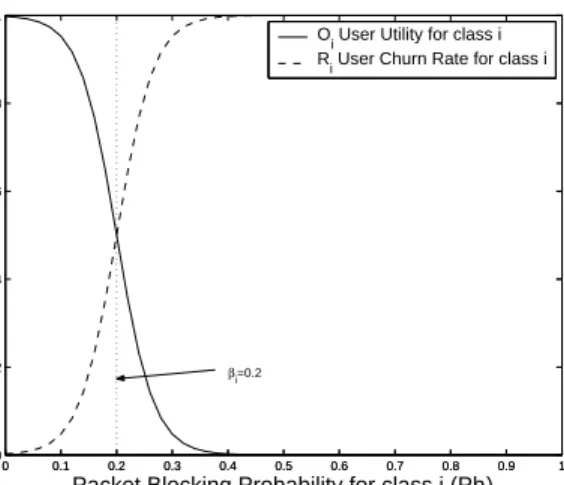
Figure. 5 illustrates the user utility and the churn rate as
functions of packet blocking probability, assuming αi = 30
and βi = 0.2, which indicate that this user can tolerate a
blocking probability ofP bi= 0.2, and is not very sensitive
to the blocking probability increase.
4.5
Equilibrium Solutions
In a bimatrix game, there may or may not be equilibriums in pure strategy, but the existence of at least one equilibrium in mixed strategy is guaranteed [3]. In our admission control game, we will show that pure strategy equilibrium exists for all cases. This property saves us from finding mixed strat-egy equilibriums which requires much more computation. Therefore, this property is very desirable for admission con-trol, which requires the requests to be processed in real-time.
We study the equilibrium solution in two cases:
Case 1: ∀i, P bi = 0, i ∈ {1, . . . , K}, which corresponds to the situation where the system is not full.
Case 2: ∃i, P bi6= 0, i∈ {1, . . . , K}, which corresponds to the situation when the system is fully loaded (or overloaded) to certain extent.
We first show that in Case 1, our proposed admission control game is bound to have a Nash Equilibrium of pure
0 0.1 0.2 0.3 0.4 0.5 0.6 0.7 0.8 0.9 1 0 0.2 0.4 0.6 0.8 1 User Utility
Oi User Utility for class i
Ri User Churn Rate for class i
0 0.1 0.2 0.3 0.4 0.5 0.6 0.7 0.8 0.9 10 0.2 0.4 0.6 0.8 1
User Churn Rate
Packet Blocking Probability for class i (Pb
i)
βi=0.2
Figure 5: User Utility and Churn Rate
strategy in the sense that the strategy for the provider is to admit the call and that for the customer is to stay with the current provider. Formally:
THEOREM 1. When P bi = 0,∀i ∈ {1, . . . , K}, the game has a Nash Equilibrium at strategy pair {SS1, CS2}, i.e., the service provider chooses to admit the session request while the user chooses to remain with the provider.
Proof. When the packet blocking probability P bi = 0,
∀i∈ {1, . . . , K}, the churn rateRi(P bi)≈0,∀i∈ {1, . . . , K}.
Thusa12=U+Ck. a11=U+Ck−Lk,a21=U−Lk and
a22 = U. In the provider’s payoff matrix A = [aij]2×2,
a12> a11,a12> a22anda12> a21.
BecauseRk(P bk)≈0, the user’s payoff matrixB= [bij]2×2
is given by: B= · b11=w1Wa−w2Lk b12=w1Wa b21=w1Wb−w2Lk b22=w1Wb ¸
Clearly b12 > b11. SinceWa > Wb as we mentioned while
formulating the game, b12> b22 andb12> b21. Given that
a12 and b12 are the maximum elements in matrices A and
B, respectively, we conclude that strategy pair {SS1, CS2}
constitutes the Nash equilibrium to this game by definition.
Furthermore,{SS1, CS1},{SS2, CS1}and{SS2, CS2}, these
three strategy pairs do not yield equilibrium.
In Case 2, where∃i, P bi6= 0, i∈ {1, . . . , K}, we show that there also exists a pure strategy Nash equilibrium, but the equilibrium point depends on values of certain terms in the payoffs.
Before discussing the equilibrium for this case, let us first
introduce the concept ofdominant (or dominating) strategy
in game theory.
DEFINITION 1. Let a bimatrix game be defined by two
m×n matrices A andB, which are the payoffs of players
P1 andP2 respectively. For playerP1, we say that “rowi”
dominates“rowk” ifaij≥akj, forj= 1, . . . , n. Here “row
i” is called adominant (or dominating) strategyfor player
P1, and “row j” is called adominated strategy for player
P1.
ForP1, selecting the dominating “rowi” is at least as good
be removed from the game becauseP1 as a rational player
would not consider this strategy at all. The equilibrium for Case 2 is proved below.
THEOREM 2. When∃i∈1,2, . . . , K, such thatP bi6= 0, the equilibrium strategy pair{SSi, CSj}is defined as fol-lows: i= ( 1 if Ck≥ PK i=kNiRi(P bi)Li 2 otherwise j= ( 1 if {i= 1 andb11≥b12}or{i= 2andb21≥b22} 2 if {i= 1 andb11< b12}or{i= 2andb21< b22}
Proof. We prove this theorem for two subcases.
• Ck ≥
PK
i=kNiRi(P bi)Li: in this casea11 ≥a21 and
a12≥a22. By definition,SS1 is the dominating
strat-egy and SS2 is the dominated strategy for the
ser-vice provider. Since SS2 can be eliminated, A and
B degenerate into two 1×2 matrices. Obviously, if
b11> b12, the customer will choose strategyCS1, and if b11 < b12 the customer will choose CS2. When
b11 = b12, CS1 and CS2 have no difference to the
customer. Without loss of generality, we assume the
customer choosesCS1. Hence, the equilibrium
strat-egy pair is {SS1, CS1}if b11≥ b12, or{SS1, CS2}if
b11< b12.
• Ck <
PK
i=kNiRi(P bi)Li: in this case,a11< a21 and
a12< a22. By definition,SS2 is the dominating
strat-egy andSS1 is the dominated strategy for the service
provider. Following the same logic in the above case,
the equilibrium strategy pair is given by{SS2, CS1}if
b21≥b22, or{SS2, CS2}b21< b22.
The intuition behind Theorem 2 is that if the revenueCk
generated from accepting the new session request is greater
than the possible revenue lossPKi=kNiRi(P bi)Li from the
churning of the users, then admitting the session is a better strategy. Otherwise, the provider is better off rejecting the
request. This gives the admission criterion for Case 2: ∃i∈
{1, . . . , K}such that P bi6= 0.
As mentioned earilier, a general bimatrix game may not have pure strategy equilibrium at all, though a mix strat-egy equilibrium is guaranteed. The significance of Theorem 1 and 2 is that they guarantee a pure strategy equilibrium solution for any instance of the admission control game for-mulated as above. Therefore, the system can make the ad-mission decision simply by comparing certain terms in the payoff function, instead of searching for mixed strategy equi-librium, which is time consuming.
4.6
Formulation as
n-player Game
Unlike what we assumed in the two player game, if the admission control is done in bulk, i.e., the admission con-trol unit delays the session requests for a limited time, so that several requests can be processed in batch, the game
changes from two-player game ton-player game. Let us now
formulate suchn-player games.
Assume n session requests are buffered and need to be
processed at a time. This situation can be formulated as a
n+ 1 player game, consisting of the service provider andn
users. Let thecth request belongs to a classKcuser. Based
on either admitting or rejecting each individual request, the
service provider has 2n candidate policies, each of which
can be represented by ann-element binary vector. Theith
policy for the service provider (SSi) is
SSi= [si1, si2, . . . , sin]
where sic ∈ {0,1},c= 1, . . . , n andi= 1, . . . ,2n. sic = 0
means to reject thecth request andsic= 1 means to accept
it. Each user still has two strategies. Let the τth user’s
strategy beCSτ, 1≤τ ≤n, such that CSτ = 1 means the
user leaves the service provider andCSτ= 2 means he stays
with the provider. (Note that the meanings of the strategy notations are different than the two-player game.)
The payoff matrixAfor the service provider and Bτ for
τth user are now (n+ 1) dimensional, with a size of 2n×2×
...×2, denoted as
A = [ai,CS1,CS2,···,CSn]2n×2×···×2
Bτ = [bi,CS1,CS2,···,CSn]2n×2×···×2
where the subscriptionicorresponds to the service provider’s
strategy, andCS1,CS2,. . .,CSncorrespond to the
strate-gies of thenusers who are in the game.
The values of each element of matrices A and Bτ, i.e.,
the payoffs for the service provider and the τth user, are
respectively given by ai,CS1,CS2,···,CSn = U+ n X c=1 sicCKc − K X l=1 NlRl(P bl)Ll− X allCSc=1 LKc bi,CS1,CS2,···,CSn = b(−siτ 2 +2),CSτ
Note that the payoff value forτth user is only dependent
on the service provider’s strategy to him (siτ) and his own
strategyCSτ. This is because the individual customer does
not have global information of whether other requests are admitted or not.
In the equation above,b(−siτ
2 +2),CSτ takes the same form
of bij in the two-player game. For example, if in the ith
service provider strategy the τth user’s request is rejected
(siτ = 0), and theτth user’s strategy is to leave the service
provider (CSτ = 1), then b(−siτ
2 +2),CSτ
=b2,1, which
cor-responds to the same strategy pair (b21) in the two-player
game defined in Subsection 4.3.
Though it is still possible to design the admission
con-trol in batch by formulating it to a (n+ 1) player game,
the payoff matrix becomes complex and the way to find the equilibrium in two-player game is not applicable. In such a game, it is only guaranteed that at least one equilibrium ex-ists in mixed strategy, but finding the equilibrium is compu-tationally expensive. Moreover, for each service provider’s
strategy (remember there are 2nservice provider strategies),
the system has to find the packet blocking probability,P bi,
for allK classes, which is again computationally expensive
and requires a lot of signalling from the power control unit. Since admission control has to be done in real time, in the rest of the paper, we will still use the two-player game for-mulation.
5.
RATE CONTROL SCHEME
Since the admission control scheme in our ARC frame-work does not force a hard limit on the number of sessions that could be admitted into the system, it is possible that not all the sessions can get feasible power assignment to sup-port their full rate transmission. We propose a rate control mechanism between the link layer and MAC layer so that the packets from certain sessions get buffered, such that trans-mission rate of those sessions can be reduced so that power limit is not exceeded.
Though the framework can support K classes of users,
for the sake of simplicity, to show how rate control can
be done for K = 3 classes of users: Premium (class 1),
Gold (class 2) and Silver (class 3). Suppose there are
cur-rently Ni sessions in the system belonging to class iusers
where 1≤i≤ 3. The data rate together with the bit
er-ror rate (BER) requirements can be mapped to the signal to interference ratios (SIR) depending on the multi access scheme and modulation technology used by wireless cellu-lar system. This mapping is beyond our scope (refer to [19] for details). Although different users of the same class have the same SIR requirement, they may require differ-ent forward link power to maintain the necessary SIR due to different path losses and interferences they experience. Finding the feasible power assignment for the forward link is a power control problem and has been solved by existing
work [25] [28]. We use one of the standard power control
schemes[28] mentioned in [25] to find the power assignment vectorP0 = [p01, p02, . . . , p0
N, p0N+1] after admitting the new
customer. Assuming Pmax as the maximal power a base
station can transmit, whenPNi=1+1p0
i> Pmax, the rate con-trol is initiated to ensure no more data than what the system can transmit, is fed into the MAC (Media Access Control) layer multiplexer. Session Duration RLP-PDU Premium Gold Silver Rate Control MAC-MUX
Figure 6: Controlling aggregated flows
As shown in Figure 6, in each base-station, the three ag-gregated forward link traffic flows of three classes are trolled through a gating mechanism. This dynamic rate con-trol uses the estimate by the SIR measurements, to concon-trol the packet rate to the MAC layer multiplexer.
The burst level blocking is determined with the help of “on-off” state model of the traffic bursts. The bursts from a session by a Gold class customer is depicted in Figure. 6. The traffic bursts are segmented into RLP (radio link
pro-tocol) packets or frames [4]. The RLP packet data unit (RLP-PDU) is inserted into the respective class queue to be scheduled to the MAC layer through the rate control logic. Since the session illustrated in Figure. 6 is from a Gold class customer, the RLP-PDUs are inserted into the ‘Gold’ queue. The rate control has the capability of continuously measur-ing the SIR of the system. These SIR measurements indi-cate the average power (or energy) per bit required by the forward link to optimize the flow rate. Based on these mea-surements, the rate control is activated on a frame-by-frame basis. The rate control logic will use the frame level SIR measurements and determine how many RLP-PDUs can be transmitted within the optimal power per bit. Based on this calculation, it allows the RLP-PDU to go to the MAC-MUX. The power control algorithm at the MAC layer is not affected by this control mechanism. The MAC layer gets the number of RLP-PDU frames that can maximize the throughput of the system.
The basic idea of the proposed rate control scheme is to reduce the transmission rate of users in the same class as well as lower classes, so that the power limit is not exceeded.
Assume that there areNiusers of classi, where 1≤i≤3.
Let the average power required for each user in these classes
bePi, for 1≤i≤3. Define power shortageD as:
D=
3 X i=1
NiPi−Pmax
Since class 1 (Premium) is defined as the class with the highest priority, the rate for users in lower classes have to be reduced to yield extra power for class 1 users. The total power budget for class 2 and class 3 users are given by:
P t2=N2P2−γD, P t3=N3P3−(1−γ)D
where γ is a tunable parameter determining the ratio in
which the power is contributed from these two lower classes. According to the reduced power budget and the system mea-surement of energy per bit, the reduced rate for each user can be calculated and maintained by the rate control unit as shown in Figure. 6.
The blocking probability, P bi, for class iuser, is
deter-mined by assuming the “on-off” model on the source traf-fic. It is assumed that the data packets (e.g., TCP, UDP) will arrive to the Base Transceiver System (BTS) from the gateway server or directly from the content server (see Fig-ure. 3). The average power per source required for the Gold class at any instant is obtained from the system measure-ment. This measured average power is used to determine the
blocking probability. IfN0
2 is the average permissible
num-ber of customers of class 2 with full rate transmission, then
N0
2 =P t2/P2. Similarly,N30 =P t3/P3 for class 3 users. If N0
2≥N2, thenP b2= 0, otherwiseP b2has to be calculated
considering the probability of more thanN0
2 bursts at any
instant of time.
Let ρ be the probability of a session being in the “on”
mode. Then the packet blocking probability for class 2 users is given by
P b2 = Prob.{# of sessions in “on” mode> N20}
= N2 X j=N0 2 Ã N2 j ! (ρ)j(1−ρ)N2−j
ob-Table 1: Simulation Parameters Parameter Value Parameter Value
L1 150 Thold 100 sec L2 100 Lc 30 L3 50 Wa 5 C1 0.35 Wb 1 C2 0.15 ρ 0.3 C3 0.05
Thold: Average Session Holding Time.
tained similarly.
The performance of our proposed framework is evaluated in the following section.
6.
PERFORMANCE EVALUATION
We developed a simulation platform to evaluate the per-formance of the ARC framework. Assume that there are more than one service provider in the wireless data market, and one of the providers uses the proposed ARC framework. Though only the operation of the provider utilizing ARC framework is simulated, the market competitiveness is take into account in the user’s churn rate, since a single provider market has no churning or at least its impact is so small that it could be ignored.
The simulated system has a session request generator and a resource management framework, which consists of an ad-mission control unit at the macro (session) level and a rate control unit at the micro (packet) level. A built-in power management unit in the simulation estimates the required power for each class and allocates power to each user. The state of this unit is updated on a frame-by-frame basis. (We assumed 20 ms frames). The values of the parameters used in the admission control game simulations are defined in Ta-ble 1.
We still use three classes of users as defined in Section 5 in our simulation. We assume that the arrivals of session level call admission requests follow Poisson Distribution with
arrival rateλ=λ1+λ2+λ3, and alsoλ1=λ2=λ3, where
λi(i= 1,2,3) is the arrival rate of classiusers.
We conducted extensive simulations to test the perfor-mance of the ARC framework. The perforperfor-mance is evaluated in terms of packet delay, queue length, session level block-ing rate and revenue generation. The expected queue length and packet delay are measured to evaluate the performance of micro level rate control, while the request blocking proba-bility is measured to evaluate the performance of macro level session admission control. Finally, we present the revenue improvement provided by the proposed ARC framework.
6.1
Expected Queue Length and Delay
The transmission delay is directly related to the queue length in each class. With the total queue length, we are able to estimate the RLP frame delay. According to Little’s
theorem,Q=λT whereQis the total number of packets in
the queue, λis the RLP frame arrival rate, while T is the
average time the RLP frames spend waiting in the queue. Because different classes of users have different RLP frame
queues, the delay of each frame of classi(1≤i≤3) can be
estimated asTi=Qλi
i, whereQiis equal to the average queue
length of classiandλiis the average number of frames that
users of classirequest to transmit during each frame time.
Thus λi = E[Ni]ρ, where E[Ni] is the average number of
users in classiandρis the active rate of the source in the
“on-off” model.
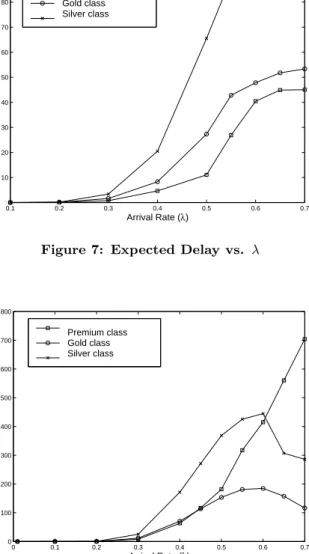
The expected RLP frame delay and the expected total queue lengths of each class are shown in Figure 7 and Fig-ure 8 respectively. It is observed that when the arrival rate is high, though Silver and Gold class have shorter queue length, they have longer delay than the Premium class. The delay difference between Premium, Gold and Silver users shows that the system does a good job providing differenti-ated quality of service (QoS) to each class of users.
0.1 0.2 0.3 0.4 0.5 0.6 0.7 10 20 30 40 50 60 70 80 90 Arrival Rate (λ) Expected Delay Premium class Gold class Silver class
Figure 7: Expected Delay vs. λ
0 0.1 0.2 0.3 0.4 0.5 0.6 0.7 0 100 200 300 400 500 600 700 800 Arrival Rate (λ)
Expected Queue Length
Premium class Gold class Silver class
Figure 8: Expected Queue Length vs. λ
6.2
Session Request Blocking Rates
The relationship between the session request blocking rate
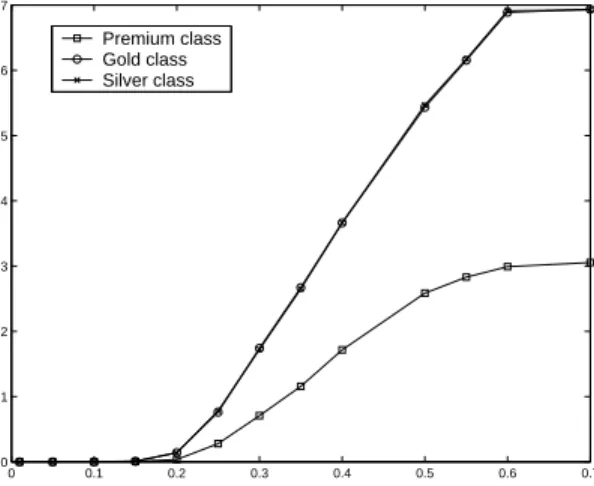
and the arrival rateλis shown in Figure 9. The total
aggregate session arrival rates for Premium, Gold and Sil-ver classes. We design the cellular data system to be able
to supportN = 100 sessions at the same time on an
aver-age. Since we assumedρ = 0.3 (Table 1), the system can
handle on average a session arrival rate of 0.3 requests per second, above which significant session blocking will occur.
We letλvary from 0.01 to 0.7. In other words, the arrival
rate varies from very light load (almost 0) to very heavy load (about twice as much as the system can support). It is observed that the system gives much higher priority to the Premium class users; the rejection rate for this class is never more than half of the rejection rate of Gold and Silver classes. But the rejection rates of Gold and Silver classes do not seem to have any difference at all.
0 0.1 0.2 0.3 0.4 0.5 0.6 0.7 0 0.1 0.2 0.3 0.4 0.5 0.6 0.7 Arrival Rate (λ)
Session Request Blocking Probability
Premium class Gold class Silver class
Figure 9: Request Blocking Probabilities
6.3
Revenue Comparison
In order to show whether the proposed ARC framework can achieve higher revenue for the service provider, we com-pared the proposed system with a reference system having a simple admission control scheme. The simple scheme is designed to admit a request if the total number of users
N0 =N0
1+N20+N30 in the system after admitting the new
request does not exceed the total number of users that the system can serve. All other details of the reference system are the same as our proposed ARC system. The comparison is based on revenue generated by each system operating for 24 hours. The total revenue of each system is calculated by summing all the revenue gathered from the sessions
ad-mitted into the system, minus the revenue loss (L) caused
by the users’ churning due to unsatisfied service. Figure 10 shows the revenue differences between the two systems, as well as the percentage of revenue improvement in the ARC framework.
It is clear that when the arrival rate approaches and/or
exceeds the full capacity of the system, i.e., λ ≥ 0.3, the
proposed ARC system gathers much more revenue than the reference system considered. The revenue improvement is as much as 40% in the proposed system. Figure 11 shows the total number of accepted requests during the 24-hour period. The merit of our proposed framework is this: though the total number of requests accepted is almost the same or slightly less, our system generates more revenue than the
0 0.1 0.2 0.3 0.4 0.5 0.6 0.7 0 1000 2000 3000 4000 5000 6000 7000 8000 Arrival Rate (λ)
Revenue Per Day ($)
Simple Reference System Proposed System 0 0.1 0.2 0.3 0.4 0.5 0.6 0.7 0 5 10 15 20 25 30 35 40 Revenue Improvement (%) Revenue Improvement (%)
Figure 10: System Revenue vs. λ
0.1 0.2 0.3 0.4 0.5 0.6 0.7 1 1.5 2 2.5 x 10⁴ Arrival Rate (λ)
Total Number of Requests Accepted
Simple Reference System Proposed System
Figure 11: Total Accepted Requests vs. λ
reference system in high load situation. In other words, the proposed ARC system is capable of identifying the pros and cons of selectively accepting requests to generate more revenue.
7.
CONCLUSIONS AND DISCUSSIONS
In this paper, we proposed an integrated framework of
Admission andRateControl (ARC) for CDMA data
net-works using game theoretic approach. The framework is able to provide differentiated data services to multiple classes of users. We formulated the admission control problem as a non-cooperative two-player nonzero-sum game between the service provider and the customer. We show that Nash equi-librium can be established both in under-loaded system and fully loaded system. Not only the revenue generated but also the risk probabilities of customers leaving the network, (i.e., churning), are considered in the service provider’s payoffs from the game. Integrated with the admission control we propose a rate control mechanism so that the users’ QoS is differentiated and the power budget is maintained by allow-ing higher classes to draw resources from the lower classes,
when the power is not enough to support full rate trans-mission for all users. The simulation results show that by incorporating the users’ churning behavior in a competitive wireless data network environment, the proposed framework can achieve higher revenue for the service provider, and also yield differentiated QoS to different classes of users.
Let us discuss additional issues that can be explored as a natural extension to this work.
• The possibility of employing n-player game
formula-tion in admission control. It is our intuiformula-tion that if an efficient optimal or sub-optimal algorithm to compute the equilibrium in mix strategy can be formulated, the performance of the admission control can be further improved. This is because, by considering batch re-quests at a time, the session request selection changes from “local” (only one request) to “regional” (more than one request). This granularity may yield better admission strategies for revenue maximization. How-ever, this is at the cost of delayed request response since some requests will be buffered for a certain du-ration before being served.
• How to enhance the rate control mechanism and
mod-eling it as a multi-player non-cooperative game be-tween all the users in the system, find mechanisms to customize the user churn rate function as the game evolves, and attempt to formulate games directly be-tween multiple service providers?
• There might be concerns about the unstable dynamics
of the user subscriptions. For example, there might be bang-bang effect that a user signs on a service provider for a short while, then signs off, and again signs on.
The effect of such dynamics will depend on the
rel-ative rate of user churn and system updates. Note however the resource management in ARC framework takes place in a very different time scale than the user subscription behavior. Usually users change service provider every half year, or a year. A considerable amount of users may not change the service provider for years. That is why we define the churn rate as a probability. It is possible such bang-bang effect hap-pens, but if the user base fluctuates in a time scale of months, it is unlikely to cause significant problem for the real time resource management framework. This kind of dynamics will have impact on the the resource management if in the future the users are able to sub-scribe to wireless service on a session basis, which means the users are free to select the service providers when he needs a connection. In this case, multiple ser-vice providers will be included in an admission control game. We expect this to be a very interesting case to analyze and will work on it.
• Use some other cost/revenue functions, for which
The-orem 1 and TheThe-orem 2 may not hold, thus requiring us to search for equilibrium of mixed strategy. With better cost/revenue models, the proposed framework will be more attractive to the service providers eco-nomically.
• Explore if some of the functions in the ARC
frame-work can be incorporated into the ns-2 wireless pack-ages to achieve more realistic traffic and results. ns-2
provides very good data traffic simulations. At this time, we chose not to use ns-2 because it does not have good support for cellular wireless network simu-lations, not to mention the CDMA air-interface, and developing these parts in ns-2 is more time consuming than stand-alone simulations. Moreover, for this pa-per, the simulation is only for illustrative purpose, so we did it in a stand-alone fashion.
8.
REFERENCES
[1] A. Aljadhai and T.F. Znati, “Predictive mobility support for QoS provisioning in mobile wireless
environments,”IEEE Journal on Selected Areas in
Communications, Vol.19 Issue 10, 2001, pp. 1915-1930. [2] T. Alpcan, T. Basar, R. Srikant and E. Altman,
“CDMA uplink power control as a noncooperative
game”,Wireless Networks, November 2002 Volume 8
Issue 6, pp 659-670.
[3] T. Ba¸sar and G. T. Olsder,Dyanmic Noncooperative
Game Theory, 2nd Ed., Society of Industrial and Applied Mathematics, 1999.
[4] G. Bao, “Performance evaluation of TCP/RLP
protocol stack over CDMA wireless links”,ACM
Wireless Networks Journal, Vol. 2, 1996, pp. 229-237. [5] M. Chatterjee, S. K. Das and K. Basu, “Differentiated
Services in Wireless Data Networks”,Proceedings of
Fifth ACM International Workshop on Wireless Mobile Multimedia (WoWMoM), 2002, pp. 9-16. [6] X. Cao, H. Shen, R. Milito and P. Wirth, “Internet
pricing with a game theoretical approach: concepts
and examples”,IEEE/ACM Transactions on
Networking, vol. 10, April 2002, pp. 208-216. [7] S. Choi and K. G. Shin, “A comparative study of
bandwidth reservation and admission control schemes
in QoS-sensitive cellular networks”,Wireless Networks
Vol. 6, Issue 4, 2000, pp. 289-305
[8] Z. Dziong and L. Mason, “Fair-efficient call admission control policies for broadband networks – A game
theoretic approach”,IEEE/ACM Trans. on
Networking, vol. 4, 1996, pp. 123-136.
[9] C. J. Ho, J.A. Copeland, C. T. Lea and G.L. Stuber, “On call admission control in DS/CDMA cellular
networks”,IEEE Trans. on Vehicular Technology, Vol.
50 Issue 6, 2001 pp. 1328-1343
[10] F. Kelly, A. Maulloo and D. Tan, “Rate control in communications networks: shadow prices,proportional
fairness and stability”, Journal of Operations Research
Society, 1998, vol. 49, pp. 237-252.
[11] P.B. Key and D.R. McAuley, “Differential QoS and pricing in networks: where flow control meets game
theory”,IEE Proceedings on Software, vol. 146, Issue
1, Feb. 1999, pp. 39-43.
[12] Y. K. Kwok and V. K. N. Lau, “On admission control and scheduling of multimedia burst data for CDMA
systems”, Wireless Networks, Vol. 8 Issue 5, 2002, pp
495-506.
[13] R.J. La and V. Anantharam, “Network pricing using
game theoretic approach”,Proceedings of the 38th
IEEE Conference on Decision and Control, vol. 4, 1999, pp. 4008-4013.
[14] R.J. La and V. Anantharam, “Utility-based rate control in the Internet for elastic traffic Networking”,
IEEE/ACM Transactions on Networking, Vol. 10 Issue 2, 2002, pp. 272-286
[15] T. Liu and J.A. Silvester, “Joint admission/congestion control for wireless CDMA systems supporting
integrated services”,IEEE Journal on Selected Areas
in Communications, Vol 16 Issue 6, 1998 pp. 845-857 [16] A. B. Mackenzie and S. B. Wicker, “Game Theory
and the Design of Self-Configuring, Adaptive Wireless
Networks”,IEEE Communication Magazine, Nov,
2001
[17] R.T. Maheswaran and T. Basar, “Decentralized network resource allocation as a repeated
noncooperative market game”,Proceedings of the 40th
IEEE Conference on Decision and Control, vol. 5, 2001, pp. 4565-4570.
[18] J.F. Nash, Equilibrium points in N-person games, Proceedings of the National Academy of Sciences, 1950, Vol 36, pp. 48-49.
[19] T. S. Rappaport,Wireless Communications Principles
and practices, Prentice-Hall, Inc. 1996
[20] C.U. Saraydar, N.B. Mandayam and D.J. Goodman, “Efficient power control via pricing in wireless data
networks”,IEEE Transactions on Communications,
Vol. 50 Issue 2, 2002 pp. 291-303
[21] N. Semret, R.R.F. Liao, A.T. Campbell, and A.A. Lazar, “Pricing, provisioning and peering: dynamic markets for differentiated Internet services and
implications for network interconnections”,IEEE
JSAC, vol. 18 Issue. 12, Dec. 2000, pp. 2499-2513.
[22] D. Seggern,CRC Standard Curves and Surfaces, Boca
Raton, FL, CRC Press, pp. 124, 1993
[23] G.D. Stamoulis, D. Kalopsikakis and A. Kyrikoglou, “Efficient agent-based negotiation for
telecommunications services”,Global
Telecommunications Conference (GLOBCOM), 1999, Vol 3. pp. 1989-1996
[24] C. W. Sung and W. S. Wong, “A noncooperative power control game for multirate CDMA data
networks”,IEEE Trans. on Wireless Communications,
Vol. 2 Issue 1, 2003 pp. 186-194
[25] M. Xiao, N.B. Shroff and E.K.P. Chong, “Distributed admission control for power-controlled cellular wireless
systems”,IEEE/ACM Transactions on Networking,
Vol. 9 Issue: 6, 2001 pp 790-800.
[26] M. Xiao; N.B. Shroff, E.K.P Chong, “Utility-based power control in cellular wireless systems”, INFOCOM 2001, Vol.1, pp. 412-421
[27] H. Yaiche, R.R. Mazumdar and C. Rosenberg, “A game theoretic framework for bandwidth allocation
and pricing in broadband networks”,IEEE/ACM
Transactions on Networking, vol. 8 Issue 5, Oct. 2000, pp. 667-678.
[28] R. D. Yates, “A framework for uplink