ORNL/TM-2010/20
Lessons Learned From Developing
Reactor Pressure Vessel Steel
Embrittlement Database
July 2010
Prepared by
John Jy-An Wang
DOCUMENT AVAILABILITY
Reports produced after January 1, 1996, are generally available free via the U.S. Department of Energy (DOE) Information Bridge.
Web site http://www.osti.gov/bridge
Reports produced before January 1, 1996, may be purchased by members of the public from the following source.
National Technical Information Service 5285 Port Royal Road
Springfield, VA 22161
Telephone 703-605-6000 (1-800-553-6847)
TDD 703-487-4639
Fax 703-605-6900
E-mail [email protected]
Web site http://www.ntis.gov/support/ordernowabout.htm
Reports are available to DOE employees, DOE contractors, Energy Technology Data Exchange (ETDE) representatives, and International Nuclear Information System (INIS) representatives from the following source.
Office of Scientific and Technical Information P.O. Box 62
Oak Ridge, TN 37831
Telephone 865-576-8401
Fax 865-576-5728
E-mail [email protected]
Web site http://www.osti.gov/contact.html
This report was prepared as an account of work sponsored by an agency of the United States Government. Neither the United States government nor any agency thereof, nor any of their employees, makes any warranty, express or implied, or assumes any legal liability or responsibility for the accuracy, completeness, or usefulness of any information, apparatus, product, or process disclosed, or represents that its use would not infringe privately owned rights. Reference herein to any specific commercial product, process, or service by trade name, trademark, manufacturer, or otherwise, does not necessarily constitute or imply its endorsement, recommendation, or favoring by the United States Government or any agency thereof. The views and opinions of authors expressed herein do not necessarily state or reflect those of the United States Government or any agency thereof.
ORNL/TM-2010/20
Materials Science and Technology Division
LESSONS LEARNED FROM DEVELOPING REACTOR PRESSURE VESSEL STEEL EMBRITTLEMENT DATABASE
Jy-An John Wang
Materials Science and Technology Division Oak Ridge National Laboratory
Date Published: July 2010
Prepared by
OAK RIDGE NATIONAL LABORATORY P.O. Box 2008
Oak Ridge, Tennessee 37831-6285 managed by
UT-BATTELLE, LLC for the
U.S. DEPARTMENT OF ENERGY under contract DE-AC05-00OR22725
Contents
ABSTRACT ...1
1. INTRODUCTION...2
1.1 Data Access, Storage and Transfer Systems ...2
1.2 Nuclear Reactor Material Data...4
1.3 The Integrated Distributed Database Management System (IDDMS) ...4
2. RADIATION DAMAGE ...7
2.1 General Consideration on Radiation Effects...7
2.2 The Issue on Radiation Damage Unit ...8
2.3 Metallic Material Behaviors in Response to Radiation ...9
2.4 Pressure Vessel Steels (Ferrite and Martensitic Steels)... 10
3. TYPICAL PROTOCOL USED FOR DEVELOPING DATA BASE FOR “RADIATION EFFECT INVESTIGATION” ... 12
3.1 ORNL Embrittlement Database (EDB) Development ... 13
3.2 Organization of EDB Raw Data Files ... 15
3.3 Fracture Toughness Data ... 17
3.4 The Data Contents of EDB ... 18
3.5 Supplementary EDB Data Input ... 19
3.6 Dosimetry Database... 19
3.7 Applications of EDB in Radiation Embrittlement of RPV Materials ... 20
4. EDB ARCHITECTURE ... 22
4.1 EDB Structure Design Criteria... 22
4.2 Key Identifiers ... 25
4.3 Correlation Monitor Materials (CMMs) ... 27
4.4 Test Reactor Database ... 28
4.5 Annealing Database ... 33
4.6 P-T Database and the Associated Software PT_LIM ... 34
5. IAEA INTERNATIONAL DATABASE ON REACTOR PRESSURE VESSEL MATERIALS (IDRPVM) ... 36
5.1 IAEA IDRPVM Aging Database Initiative ... 36
5.2 The Potential Benefits of IDRPVM Data Base ... 36
5.3. Organization Mechanism for Developing IDRPVM Database ... 37
5.4 Comparison of IDRPVM and ORNL EDB ... 39
5.5 RPV Surveillance Data Presented at “First Meeting of Liaison Officers to the IAEA IDRPVM Database.” ... 44
6. EDB DATABASE QA PROTOCOL ... 46
6.1 PR-EDB QA ... 46
6.2 EDB Data Input Procedures ... 47
7. GENERAL CONSIDERATION OF MATERIAL DATABASE QA PROTOCOL... 49
7.1 Data Quality Definitions ... 49
7.2 Data Quality Assurance Framework ... 49
7.3 Material Database Quality Assurance Protocol ... 51
Figure Content
Figure 1 Architect of IDDMS. ...5
Figure 2 Functional flow of IDDMS ...5
Figure 3 Central Server Functionality ...6
Figure 4 Architecture of EDB. ... 14
Figure 5 Architecture of PR-EDB. ... 15
Figure 6 An overview of the data flow in the EDB ... 25
Figure 7 Architecture of TR-EDB ... 30
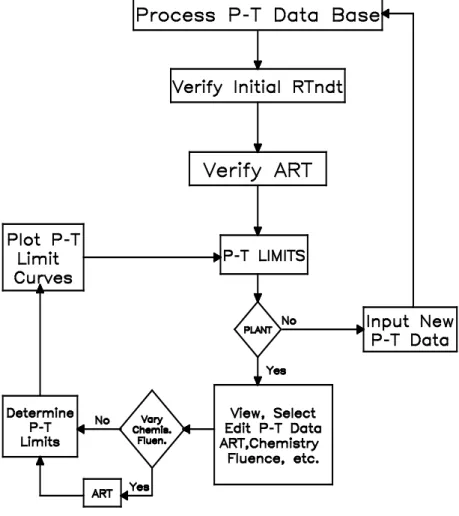
Figure 8 Functional flow of PT_LIM... 35
Figure 9 IAEA IDRPVM database structures ... 40
Table Content
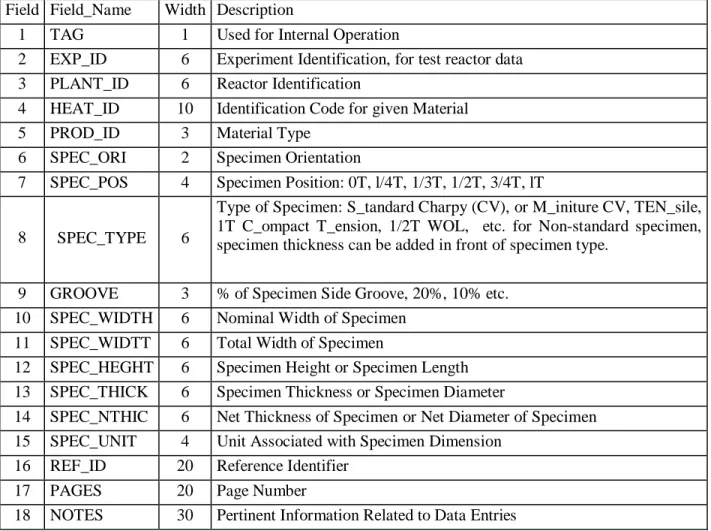
Table 1 Units used in Embrittlement Database (EDB) files... 24Table 2 Data Structure for SPEC_GEO.dbf ... 31
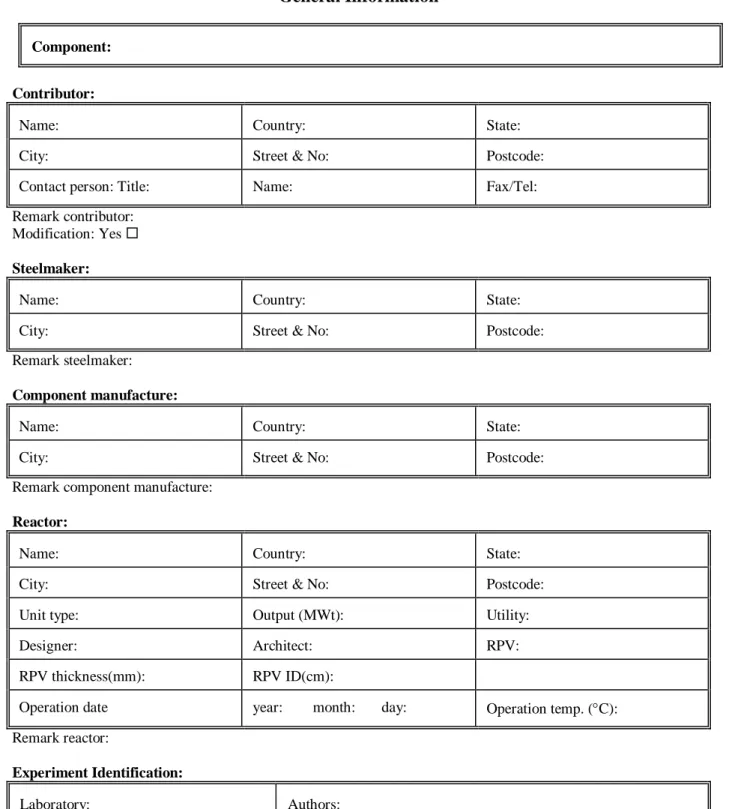
Table 3 Sample Data Acquisition Sheet ... 32
Table 4 Comparison of EDB and IDRPVM ... 42
Table 5: Causes of error leading to insufficient data quality in a registry ... 50
ABSTRACT
Materials’ behavior caused by neutron irradiation under fission and/or fusion environments cannot be understood without practical examination. Easily accessible material information system with large material database using effective computers is necessary for design of nuclear materials and analyses or simulations of the phenomena. The developed Embrittlement Data Base (EDB) at ORNL provides the comprehensive collection of data. The EDB contains power reactor pressure vessel surveillance data, material test reactor data, foreign reactor data (through bilateral agreements authorized by NRC), and the fracture toughness data. The lessons learned from building the EDB program and associated database management activity regarding “Material Database Design Methodology, Architecture and the Embedded QA Protocol” are described in this report. The development of IAEA International Database on Reactor Pressure Vessel Materials (IDRPVM) and the comparison of EDB database and IAEA IDRPVM database are provided in the report. The recommended database QA protocol and database infrastructure are also stated in the report.
1. INTRODUCTION
Collection of specialized information have existed in academic research for many years, usually in the form of libraries attached to universities or in scientific and engineering societies. The National Bureau of Standards and Patent Office have long represented the federal governments in this field. In broad terms, the present day data bases consist of collections of documents, journal articles and their abstracts, and bibliographic compilations, as well as collections of numerical data, often in tabular form. Of interest here are the data bases of science and technology that contain information pertinent to nuclear/material engineering application. Once the information is entered on a magnetic medium in proper format and equipped with relevant keywords, or numerical code words, it can be loaded into a computerized retrieval system. The data files thus created can be queried either off-line by data base personnel, or on-line, by the end user. Data bases that provide an on-line searching capability help extend greatly the resources that are readily accessible to the nuclear and material engineers, provided the engineer is equipped with a suitable computer connected to an appropriate network.
1.1 Data Access, Storage and Transfer Systems
The Committee on Data for Science and Technology (CODATA) is an interdisciplinary committee organized under the International Council of Scientific Unions (ICSU). CODATA is concerned with all types of quantitative data resulting from experimental measurements or observations in the physical, biological, geological, and astronomical sciences. Particular emphasis is given to data management problems common to different scientific disciplines and to data used outside the field in which they were generated. The U.S. National Committee for CODATA (which is organized by the National Research Council) sponsored the first major interdisciplinary conference in December 1997 on the subject regarding the exchange of scientific and technical (S&T) data among different computing environments, and across diverse scientific and engineering disciplines.
This CODATA initiative covered many important issues relating to data exchange. By data exchange is meant several things: the transfer of large amounts of data from one set of software to another software; extracting small amounts of data from one or more data sources for specific use; and the creation of a linked or integrated data system with multiple data sources. Data exchange has two major components: the stream of bits and bytes that actually represent the data items and fields, and the contextual meaning of individual data items and fields. S&T disciplines and applications have begun addressing data exchange issues, but progress has been slow and difficult for a variety of reasons. Scientists are often not accustomed to formal standards. Discipline experts, even though they may be quite knowledgeable in computation and database management, frequently lack expertise in information modeling and exchange standards. Metadata are not well defined, complicating the application of data across diverse scientific areas. As a result, interdisciplinary data exchange has been difficult to promote and rarely implemented. For example, the geographic information, many applications need such
systems serve diverse communities of users, and several efforts to develop standards for exchanging data among these systems have been proposed. Yet progress to develop such standards in other areas has been slow. Other types of scientific data, such as biological nomenclature, chemical and engineering material identification and temporal data, suffer the same problem. Many uses for these data exist outside the scientific disciplines that generate them, yet accepted methods for exchanging these data remain elusive.
From U.S. National Committee for CODATA documented case studies, “The Challenge of Combining Diverse Environmental Data,” in which data interfacing, defined in that report as the coordination, combination or integration of data for the purpose of modeling, correlation, pattern analysis, hypotheses testing, and field investigation at various scales, was necessary to achieve full value of research investment. Data interfacing is founded upon the standards and protocols agreed to by different scientific disciplines to exchange data. Particular emphasis must be put on the role of metadata in this data exchange.
The need to develop standardized representations is well understood. Standards have the advantage of providing a published and stable representation; and standards have a change process that is based on consensus. Proprietary exchange formats can and do change at the discretion of companies and research institutes that developed them. Further, manufacturing is increasingly global. To be more effective, the standards for exchanging product information must gain worldwide acceptance. A single international standard, ISO 10303 – Product data representation and exchange, has been designed to meet this industrial need. This standard is more commonly referred to as STEP, Standard for Exchange or Product model data. The standardized product data representations all use an object description language called EXPRESS to define the content of the data to be communicated. The actual communications interfaces, a message/file format and an application-programming interface, are independent of any particular implementation technology.
The introduction of harmonious cooperation among heterogeneous hardware and software systems carries the potential for great increases in productivity and improvement in application processing. The use of these heterogeneous systems requires an integrated system that would allow the development of global applications requiring communication and cooperation among the pre-existing systems. An InterBase System was proposed to overcome this heterogeneity barrier. It integrates pre-existing systems over a distributed, autonomous, and heterogeneous environment to support global applications while retaining local autonomy.
To achieve integration (integratable systems) requires at least compatibility of data representation, communication paradigms, and system architectures. Advances have been made in each of these areas, such as product data exchange (STEP – ISO 10303), communication protocols (TCP/IP, OSI) and architectures (CIM Framework, CORBA). Although it is the information that must be shared between these systems, it is the representation and language that provides the mechanism to allow the sharing to take place. One area of data representation which has received relatively little attention is process data. A generic process specification language (PSL) program for describing process, for the need to share process information in the manufacturing environment, is currently funded by NIST.
1.2 Nuclear Reactor Material Data
While in the past the industrial and national laboratories carried the bulk of design and development work on nuclear reactors, the task of operating and managing nuclear installations fell, for the most part, to the private utility industry. The industry experienced the need for supporting organizations to orchestrate activities affecting all companies in that field, primarily in research, and in the collection and evaluation of operating data. In response to that need, three organizations were created by the users, and financially supported by their contributions. The principal organizations created by the utility and reactor vendor industry are: the Atomic Industrial Forum, the Electric Power Research Institutive, and the Institute for Nuclear Power Operations. Thus, well designed infrastructure is needed to provide efficient information bridge among the academic, research institution, regulatory agency, and nuclear industry.
Materials’ behavior caused by neutron irradiation under fission and/or fusion environments can be little understood without practical examination. An easily accessible material information system with large material database using effective computers is necessary for design of nuclear materials and analyses or simulations of the phenomena. The author has recommended developing an Integrated Distributed Database Management System (IDDMS) to approach the above criteria.
The IDDMS is constructed on the computer network which connects engineering workstations in the separate organizations. A relational database management system is used. A distributed material database is based on the hardware with specially designed common data structure. Data storage has been carried out continuously in each organization. The equipment of useful user-interface system, such as retrieval, data entry, and process supporting and image data handling systems, have also been constructed to make it friendly for the user. The supporting analytical software is also under development from different research groups.
This integrated system will greatly enhance the information flow and speed up the development of advanced materials, and can bring about technical breakthrough in many areas of interest. Especially, it can be considered that these will bring out remarkable improvements in the performance of nuclear plants and components. The success of IDDMS will be based on the cooperation of nuclear industry, research institutes, and regulatory agency. The main research activity fields of these constituents may be different from each other to some extent; thus, with broaden the point of view on materials research.
1.3 The Integrated Distributed Database Management System (IDDMS)
The IDDMS is proposed and will include three major aspects stated as below:• Generate Common Databases and Application Programs
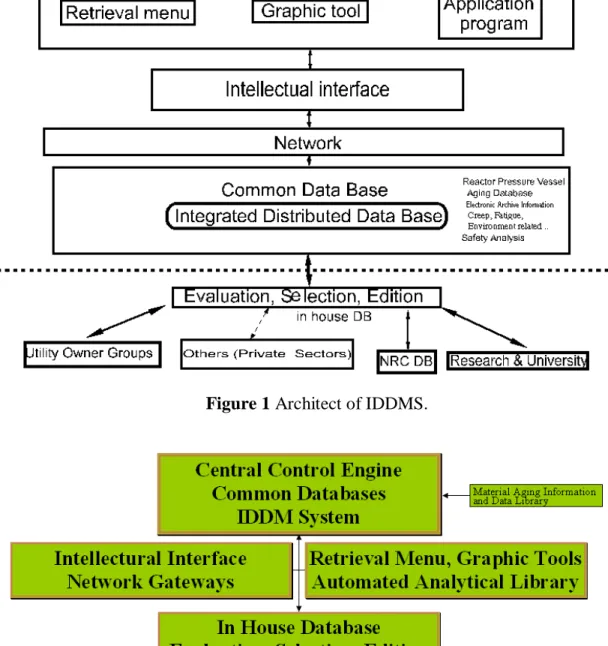
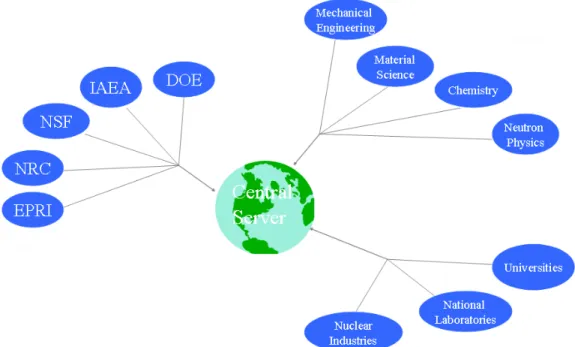
The general tasks that can be evolved from the above mentioned aspects are demonstrated in the following flow chart. The tasks above the dash line are related to the central server, which will be managed and operated at ORNL. The architect and function flow of IDDMS are illustrated in Fig. 1 and Fig.2, respectively.
Figure 1 Architect of IDDMS.
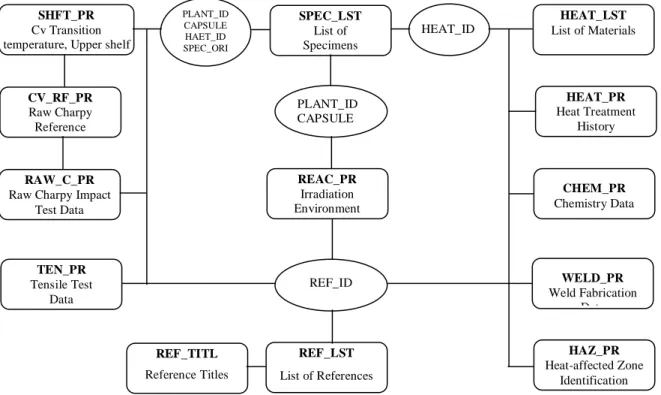
The central server that resides at ORNL, will provide the linking mechanism among the technical community, regulatory or funding agencies and nuclear power industry, as illustrated below.
Figure 3 Central Server Functionality
The general contents for each aspect of IDDMS are described as below.
• Generate Common Databases and Application Programs
Develop unified format and data structures for the common databases
Utilize visual object-oriented program to develop upgrade version of EDB
Generate automated programs and macros to create an analytical program library to carry out the following tasks:
• Updating of analyses whenever new data or new assumptions for the analysis arise, • Follow-up studies with refined models, optimizing procedures, exploring
consequence in what-if scenarios,
• Documentation and opportunity for critical review by NRC or other affected parties.
• Build Networks, Intellectual Interfaces, to carry out Data Sharing and Data Exchange Construct intellectual interface for easy data access and data sharing
Build networks among NRC, Utilities, Research Institutes, Universities
• Develop Long Term Archive Methodology
2. RADIATION DAMAGE
2.1 General Consideration on Radiation Effects
By understanding the underlying mechanisms of the radiation damage, the associated neutron energy and flux evaluation, and the inherited metallic material characteristics will further strengthen database designers’ capability to construct a well-designed material database for the specific applications and provide a basis to develop a meaningful and easily implemented QA protocol. In general, the QA protocol is embedded within a well-designed database automatically, i.e. the methodology of the QA protocol is directly translated into the architect of the designed database structure.
Effects of radiation on solids have been studied for over 150 years. Of much more interest to the present discussion, however, are the intense radiation fields in reactors. That the success of reactor technology would depend critically on the choice of high-temperature material with satisfactory neutronic properties was pointed out by Fermi in 1946. Wigner is generally credited with the first suggestion that fluxes of energetic neutrons and fission fragments in neutron chain reactors would displace significant numbers of atoms and thus alter physical and mechanical properties.
Swelling was discovered in 1967 as a result of electron microscopic observation of a stainless steel that had been irradiated in the Dounreay Fast Reactor in Scotland. Cavities were found ranging in size from the resolution of the electron microscope of few nanometers up to more than 150 nm. Macroscopic swelling was confirmed by immersion density measurements. Irradiation creep was known somewhat earlier. The work was on uranium metal, which exhibited irradiation creep under neutron irradiation. Irradiation creep strains are generally smaller than swelling strains. Irradiation embrittlement of austenitic stainless steel and Inconel was first reported in 1959, when it was noted that lower ductility was observed in tensile and stress-rupture tests after irradiation.
The basic changes produced by irradiation on solids are:
Swelling
Irradiation Creep
Ductility Loss
Microstructure and Microcomposition
Mechanism: Radiation-induced processes in metals and alloys can be thought of in two broad divisions.
• Damage production, or radiation damage, concerns the initial events in the processes embracing the displacement of atoms.
• Radiation effect encompasses the kinetics of processes resulting from the atomic defects so produced and the concomitant evolution of microscopic structure composition and macroscopic properties these induce.
Generally the atom-displacing reactions that occur in fission and fusion reactor structural materials are induced by neutrons. These include (n,γ), (n,n'), (n,p), (n,α), and (n,2n) reactions., where γ denotes gamma ray, n' denotes a neutron of a different energy, p denotes proton and α denotes the helium nucleus. Following the displacement events the energy of the disturbed region is degraded ultimately to thermal energies. The point defects and small-defect clusters relax and diffuse. Typically during diffusion most vacancies and interstitials are annihilated by mutual recombination. Some avoid recombination, however, and these are responsible for radiation effects. These defects are either absorbed at preexisting sinks such as the grain boundary or dislocations, or aggregate with like defects to produce extended defect clusters. Most of defects absorbed at sinks ultimately recombine there. However, some are left to accumulate. When the defect clusters become large enough they are often observed as cavities or dislocation loops.
At the same time, by diffusion, the point defects can induce preferential flows of alloying elements toward or away from sinks. Demixing of the alloy results in local regions being highly enriched or depleted in alloying constituents. Often the phase transformation occurs when the local solubility limit for precipitation is exceeded.
2.2 The Issue on Radiation Damage Unit
The primary source of neutron radiation damage in metals is the displacement of atoms from their normal lattice sites. Hence, an appropriate damage exposure index is the number of times, on the average, that an atom has been displaced during irradiation. Dpa, the average number of times of displaced atoms per atom of the material, is in wide used as an exposure index and as a correlation parameter.
The absolute accuracy of the dpa calculation is strongly affected by the fluence spectrum, the reaction cross section used in calculating σd(E), the Lindhart model for the partition of energy between atoms and electrons, and the conversion of deposited energy to displacements. The relative accuracy of dpa calculations for different environments depends on energy dependence of σd(E) and on the relative accuracy of fluence-spectrum determination.
The dpa is a measure of the potential to create point defects, therefore it is only the first logical step in the determination of the production of the lattice defects that are responsible for changes in the mechanical and physical properties of materials. It is now believed that hardening and embrittlement due to irradiation does not depend on the initial displacement per atom in the metallic lattice, but on the "residual defects" after one accounts for possible recombination of vacancies and interstitials in the metallic lattice. In particular, neutron, and some charged particle irradiations produce high energy pka which, in turn, produces high localized concentrations of displaced atoms and vacant sites. The high defect concentration in these displacement cascades enhances the probability that a displaced atom will recombine with its own or some other vacant lattice site and thus anneal out potential damage. Hence, the number of residual defects produced, rather than the total number of displacements, is an improved measure of damaging exposure.
This residual defect depends on several factors: 1) The temperature of the material, 2) the rate at which the fluence is accumulated, and 3) the energy of the neutrons causing the displacements. Higher temperatures, higher flux levels, and higher energy neutrons all enhance recombination effects.
Generally speaking, dpa is a good first approximation for the correlation of radiation embrittlement, for the flux that consists mainly of fast neutrons, the differences in pka spectra from various neutron spectra are not expected to strongly affect the point defect availability factor. However, additional modification needs to be considered for those spectrums having high thermal/fast neutron ratio, or the displacement damage energy deposited by thermal neutrons is within an order of magnitude of that deposited by fast neutrons.
2.3 Metallic Material Behaviors in Response to Radiation
Some of the general characteristics of metallic materials used in power reactor environments are described below.
Ferrite and Martensitic Steels
The smallest radiation-induced increases in Nil-Ductility-Transition temperature (NDT) take place in steel that is low in interstitial elements (carbon, oxygen, nitrogen), has a small grain size, and possesses a quenched and tempered microstructure. Post-irradiation annealing at 400°C to 450°C results in significant restoration of the baseline material.
Austenitic Stainless Steel
The maximum hardening of austenitic stainless steels by irradiation is produced at temperature of about 300°C. The changes in tensile properties can be removed by annealing at 500 to 600°C. A drastic reduction in the ductility of irradiated austenitic stainless steels takes place at elevated temperatures, which is presently attributed to helium bubbles formed at grain boundaries, and cannot be recovered by annealing at temperature up to 1350°C. Helium is present as a result of the thermal-neutron 10B(n,α)7Li reaction as well as form (n,α) reaction between fast neutrons, and iron, nickel, and other alloy constituents. The magnitude of the ductility loss is increased by large grain size and low strain rates.
Nickel Base Alloys
Radiation affects the mechanical properties of nickel-base alloys in about the same way as it does for austenitic stainless steels.
Refractory Metals
For niobium, molybdenum, rhenium, tungsten, and vanadium alloys, the magnitude of radiation effects on the mechanical properties of these materials was found to be very sensitive to the
interstitial content of the materials. Increased interstitial content resulted in larger radiation-induced increase in ductile-to-brittle transition temperature. The required annealing temperature for removal of the radiation-induced changes in mechanical properties generally increases with increasing melting temperature of the alloy. The refractory metals do not exhibit the radiation-embrittlement at elevated temperatures that is common to austenitic stainless steels and nickel alloys, and the stress-rupture properties are not significantly altered by irradiation.
2.4 Pressure Vessel Steels (Ferrite and Martensitic Steels)
The nuclear industry has used ferritic steels as structural materials in reactor application for many years. Mostly, these steels have been used for pressure vessel construction. Since the ferritic steels have a body-centered crystal structure, their fracture mode changes from ductile to brittle with decreasing temperature. Other characteristics are,
Composition: P, Si, Mo, (C >0.2%)
Grain Size: steels with smaller grain size have been found to have lower NDT temperatures. Cold Work: cold working raised the NDT of steels, and aging following cold work results in
further increasing in NDT, cold working by cyclic fatiguing results in considerable increase in NDT with the increase being largest when the temperature is in the 400 to 580°F range.
Heat treatment: A quenched and tempered structure has a considerably lower NDT than an annealed or normalized structure.
Welding: Welding generally results in higher NDT because the heat-affected zone resulting from welding is similar to that of annealed metal.
General Consideration
Material variability needs to be taken into account for a specific HEAT, since the reported chemistry may not necessary represent the specimen used for testing.
Higher uncertainty exists in irradiation temperature.
100% recovery of upper-shelf energy (USE) of Charpy-V Notch (Cv) trend curve does not mean a full recovery of all the irradiation induced defects.
Below 650°F annealing of fast neutron damage mechanism is essential negligible. Different material heat treatment may play an important role on ∆NDT.
FCC lattice has less resistivity Frenkel Pairs Cu< Al < Ni < Fe < Cr < Zr
Pre-irradiation heat treatment will affect the Cv curve during the irradiation environment. For example longer heat treatment can reduce NDT shift & ∆USE (drop), in some case the USE even increased. There is evidence that other mechanisms are responsible for the reduction of the upper shelf than for the transition temperature shift.
Ni & Cu have a synergetic effect on delta TT30 but may not on ∆USE. Also at high fluence, Ni influence on delta TT30 is unfavorable, probably favorable at low fluence.
At low Cu &Ni a completed saturation curve was observed.
The mechanism of annealing is a combination of the reversible & non-reversible processes. Therefore, the true recovery ought to consider the re-irradiation effect for those unstable defects that recover right after the irradiation and before the initiation of stable defects.
The copper precipitation model has been extremely successful in explaining many aspects of irradiation embrittlement. However, there is increasing evidence that there are other important mechanisms contributing to the embrittlement of RPV steel, including Ni, P, Mn, Mg, void-microvoid.
Irradiation temperature effect: defect region average diameter, 255°C (9 micron) and 350°C (17 micron).
The rate effect may not only state that more defect per dose for low flux irradiation but also imply that the more stable and inhomogeneous distribution of defects will be generated in low flux situation (longer irradiation) than that in the high flux irradiation environment. Therefore, the test reactor (TR) accelerated irradiation may generate more homogeneous defects (evenly distributed point defects), which will have more recovery through the annealing process, due to high recombination rate, the annealing recovery by TR may well overestimate the annealing recovery effect for PWRs.
Since the different damage mechanisms are competing with each other, it is not easy to define the influence of a single element or parameter.
Base and weld category are mainly reflected from their transition temperature curve.
Both Nickel and Manganese are helpful in lowering the initial transition temperature and the question arises as to whether a material more that is highly alloyed with these elements would tend to give a less harmful product when irradiated. The material with a further increased austenite content has better unirradiated properties, but this advantage is lost on irradiation. Cracking in the ferrite seems to govern behavior.
Strain aging: Nitrogen may be responsible for the irradiation of steel at 130-230°C, or irradiation below 100°C followed by post irradiation heating at 200°C results in additional embrittlement. The nitrogen may result from decomposition of aluminum nitride in thermal spike.
3. TYPICAL PROTOCOL USED FOR DEVELOPING DATA
BASE FOR “RADIATION EFFECT INVESTIGATION”
In Phase I, collected data need to be streamlined and grouped into three major categories, namely, material history, service environment, and experimental results. An identification system (key identifiers) needs to be designed and to be implemented into user-friendly software. Each record will have the reference source identified, such as a report or published paper. The graphical reference will be scanned and stored in Tiff or PDF format. The detailed components of each category are listed below:
(1) Material History; which includes the following subcategories, a) Material specification
b) Vendor & Supplier
c) Manufacture & Production information
(2) Service Environment; which includes the following subcategories, a) Reactor name, location, and operation organization.
b) Neutron and gamma evaluation data, and short description of the method used. c) Service environment, including temperature, irradiation, etc.
d) Stress environment, such as thermal, electrical, chemical, or mechanical stresses. (3) Experimental test results; which will include the measurement of the material property in
particular service environment by specific experimental procedures, and includes the following subcategories
a) Test results.
b) Testing procedure, specimen types.
c) System information, such as machine type, capacity and capability, etc. d) Operating Engineering, and testing Laboratory.
In phase II, the development of the user-friendly software will be initiated, which will cover the development of the front end, utilities for data manipulation, plot and final report.
(1) Front end; which includes icons, and selection manuals for a user to select a specific task. (2) Data manipulation; which will includes file manipulation features to allow the user to
link and to process data files, and to create view on the screen. (3) Generate final report or plot to a file or to a printer.
The above methodology was implemented in developing Embrittlement Data Base (EDB) for reactor pressure vessel steels.
3.1 ORNL Embrittlement Database (EDB) Development
The aging and degradation of light-water-reactor (LWR) pressure vessels is of particular concern because of their relevance to plant safety and the magnitude of the expected irradiation embrittlement. The radiation embrittlement of RPV materials depends on many different factors such as flux, fluence, neutron energy spectrum, irradiation temperature, pre-irradiation material history and its chemical compositions. These factors must be considered to reliably predict the pressure vessel embrittlement and to ensure the safe operation of the reactor. Based on embrittlement predictions, decisions must be made concerning operating parameters, low-leakage-fuel management, possible life extension, and the need for annealing of the pressure vessel. Large amounts of data obtained from surveillance capsules and test reactor experiments are needed, comprising many different materials and different irradiation conditions, to develop generally applicable damage prediction models that can be used for industry standards and regulatory guides. The Embrittlement Data Base (EDB) provides this comprehensive collection of data resulting from the merging of the Power Reactor Embrittlement Data Base (PR-EDB) and the Test Reactor Embrittlement Data Base (TR-EDB). The fracture toughness data were also integrated into EDB.
The scope and purpose of this program, which has been sponsored by the Nuclear Regulatory Commission (NRC) since 1987, can be summarized as follows:
1. Compile and verify a comprehensive collection of data from power reactor surveillance programs, and test reactor irradiation experiments of pressure vessel materials from U.S. and foreign laboratories.
2. Provide software support for the use of the data base by furnishing programs and maintaining compatibility with commercially available software.
3. Facilitate the exploration and verification of embrittlement prediction models.
4. Facilitate the exploration and verification of the effects of annealing for pressure vessel life extension.
5. Interact with standards organizations to provide the technical bases for voluntary consensus standards that can be used in regulatory guides, Standard Review Plans, and codes.
To achieve these goals, the design of the data base architecture was made after many discussions and planning meetings with prospective users, materials scientists and members of research staff. The EDB is designed for use with any personal computer using the DOS base system. (Recently, the beta Windows version EDB was also completed) The data format that was chosen for EDB is dBASE; this format was initially introduced by Ashton-Tate and is now the virtual standard for relational data bases. This format allows queries and data processing not only with the current dBASE software but also with any of the now numerous "Xbase" developer tools, such as Foxpro or MS-ACCESS. The dBase files can also be imported into most other data base, spreadsheet, and word processing programs that run in the DOS or WINDOWS environment. The more recent versions of these programs contain extensive facilities for generating reports including statistic, curve fitting, and graphic programs. For often-performed tasks, customized EDB software based on Clipper or Visual Studio and FORTRAN that were written originally for PR-EDB, can be utilized with EDB. This EDB-Utility is menu-driven and self-explanatory requiring no special training.
The data collections of EDB originated from the Material Properties Council (MPC) data base, which contains both power and test reactor data. From this collection an unpublished version of the EDB was constructed and has been augmented with more recently reported data. All data are traceable to the source of references, including page numbers. The architecture of the data base, shown in Fig. 4, is characteristic of a relational data base that makes it relatively simple to maintain and perform quality control.
Figure 4 Architecture of EDB.
A restricted version containing only power reactor surveillance data - the PR-EDB - was assembled under NRC sponsorship to be used primarily for regulatory purposes. Most of the surveillance data listed in PR-EDB have been verified by the reactor vendors responsible for the insertion of the test material into surveillance capsules, and any changes and corrections have been documented in special files for future reference. Version 1 of PR-EDB was released to the public in July 1991. An updated Version 2 was released on January 1994. The architecture of PR-EDB is illustrated in Fig. 5. In the meantime the assembly and review of the MPC and other test reactor results has continued, tracing them to the original reports and adding more data. Significant additions came from NRC-sponsored investigations at Materials Engineering Associates, Inc. (MEA) and Oak Ridge National Laboratory (ORNL), the International Atomic Energy Agency (IAEA)-sponsored program, and a variety of other irradiation experiments at
EDB, mainly because of the way the results were reported. An additional problem is that laboratories and researchers responsible for the published data are often no longer available or cannot be funded for the considerable work required for outside reviews. All data have been checked internally for correctness and consistency, and all unresolved problems are reported in the "NOTES" field. Every effort is being made to resolve discrepancies by contacting the original investigators. Version 1 of TR-EDB was released in January 1994.
Figure 5 Architecture of PR-EDB.
3.2 Organization of EDB Raw Data Files
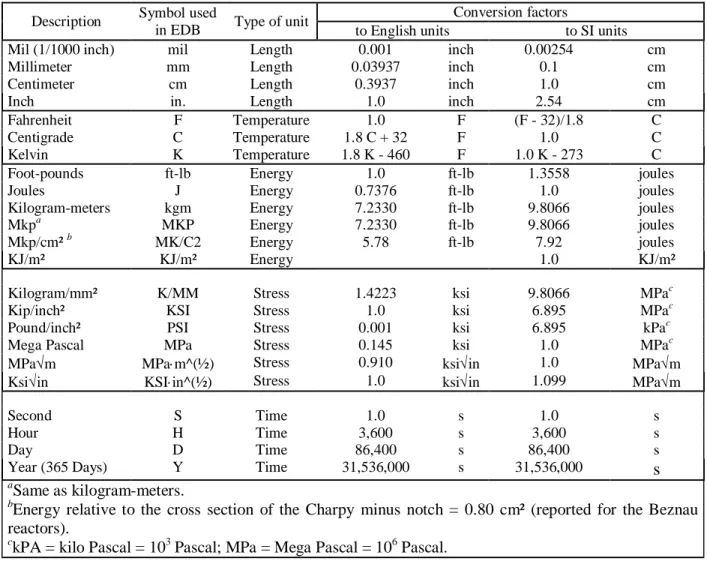
The organization of the current version of PR-EDB is shown in Fig. 5. At the top center of the PR-EDB architecture is the file SPEC_LST.dbf containing a complete list of test specimen sets that are used in the commercial surveillance programs. The specimen sets can be uniquely identified by SPEC_TYPE and four key identifiers; PLANT_ID, CAPSULE, HEAT_ID, and SPEC_ORI. Specimen sets for testing the baseline properties of unirradiated materials are characterized by leaving the CAPSULE field blank.
Radiation embrittlement data are distributed over three major categories in PR-EDB: preirradiation material history, irradiation environment, and mechanical test results. The detailed architecture of the EDB data is also illustrated in Fig.5 and descriptions of each major category of data follow: REAC_PR Irradiation Environment SPEC_LST List of Specimens REF_LST List of References REF_ID PLANT_ID CAPSULE HEAT_ID PLANT_ID CAPSULE HAET_ID SPEC_ORI SHFT_PR Cv Transition temperature, Upper shelf
HEAT_LST List of Materials REF_TITL Reference Titles HEAT_PR Heat Treatment History CHEM_PR Chemistry Data WELD_PR Weld Fabrication Data HAZ_PR Heat-affected Zone Identification CV_RF_PR Raw Charpy Reference RAW_C_PR
Raw Charpy Impact Test Data
TEN_PR
Tensile Test Data
• The first category (left-hand side of Fig.5) includes results of material mechanical property tests. Charpy, both individual tests and results of curve fittings and tensile are currently available (SHFT_PR.dbf, RAW_C_PR.dbf, and CV_RF_PR.dbf for Charpy data; TEN_PR.dbf for tensile). Each record in these files is uniquely characterized by the combination of PLANT_ID, CAPSULE, HEAT_ID, and SPEC_ORI.
• The second category (middle of Fig. 5) contains data describing the reactor and radiation environment for each surveillance capsule. The file REAC_PR.dbf contains a detailed description of the fluence, irradiation temperature and irradiation time for each irradiation capsule. This file links with the others via the key identifiers PLANT_ID, and CAPSULE. This linkage will not be needed in most cases because fluence and irradiation temperature are also given in the data files, such as SHFT_PR.dbf and TEN_PR.dbf. Note that the fluence values given in REAC_PR.dbf apply only for the capsule as a whole (i.e., average or capsule center), which is not necessarily the same as for the individual specimen or specimen group listed in the test data files. However, many details such as values for fluence (E>0.1MeV) or dpa are listed, when available, in REAC_PR.dbf. The file REAC_LST.dbf (see Table 6 for a list of irradiation facilities used in the experiments). The key identifier field in this file is PLANT_ID. The development team is considering the addition of more detailed files containing the irradiation history, the group fluence spectra, and dosimetry data to allow for fluence determination by independent investigators and more detailed investigation on the rate effect, spectrum effect, and residual defects to the embrittlement prediction models.
• The third category (right-hand side of Fig. 5) contains information about the chemical composition and fabrication of materials used in RPV surveillance programs. HEAT_LST.dbf lists all HEAT_IDs with reported codes, and CHEM.dbf, HEAT.dbf, WELD.dbf, and HAZ.dbf list the actual chemical composition and fabrication data. HEAT_ID links these files to the rest of the PR-EDB files.
Most records in the PR-EDB files include a reference in the field REF_ID that includes one or more page numbers which permits verification of the data sources and points to additional information. Exceptions are given in the file REAC_LST.dbf, in which information comes from many different sources. References are not listed in RAW_C_PR.dbf because the associated file CV_RF_PR.dbf has the necessary references. A detailed list of all references with complete title, authors, and date of publication is given in the REF_TITL.dbf. REF_ID and is the link to the other files.
PR-EDB files with the suffix _LST are somewhat different from the other data files in that they provide a sort of directory of the other files and their relations to key identifiers. SPEC_LST.dbf is a directory of capsules and baseline specimen sets. REAC_LST.dbf is a directory of power reactors. Finally, HEAT_LST.dbf is a directory of the materials contained in the PR-EDB files. The effort and coordination with the NRC research staff, EPRI, and industry have led to the adoption of PR-EDB as the basis for an industry-wide data base by the EPRI Reactor Vessel Embrittlement Management Project.
3.3 Fracture Toughness Data
The mechanical test results contained in PR-EDB and TR-EDB are Charpy impact test and tensile test data. The transition temperature approach, mainly relying on the Charpy impact test, is simple and has been used successfully. However, it has the limitation of being a temperature criterion rather than a more familiar stress criterion. Therefore, it cannot be used directly in the design. This shortcoming can be overcome by including fracture mechanics test results into EDB, which can offer a direct linkage to stress analysis and verify the relationships between the Charpy data and fracture toughness data. There are three categories of fracture toughness data available from the reports, static fracture toughness, KIC or KJC, dynamics fracture toughness, KID, and arrested fracture toughness, KIA data. The general specimens used in fracture toughness experiments are Single Edge Notch Bending specimen (SEB), Compact Tension (CT), Arc-Shaped Tension (AT), Disk-Arc-Shaped Compact Specimen (DCT), Crack-Line-Wedge-Loaded Specimen (CLWL, or WOL), Double Cantilever Beam Specimen (DCB), and Center-Cracked Tension Panels (CCT). These specimens are carried out under different criteria and experimental procedures and are responsible for the particular kind of fracture toughness data. Therefore, it is necessary to separate the three major fracture toughness data and carefully distinguish the criteria among the different type specimens.
Considerable controversy still surrounds the question of upper-shelf fracture toughness, two methods are presently available for such determinations: the equivalent energy method and the J integral method. It was recommended that the equivalent energy method only be employed when the fracture of the specimen is cleavage controlled. From the available reports, the most frequently used fracture toughness specimens are CT, WOL, DCB and pre-crack Three Point Bend, therefore, the current main focus of specimens will be on these specimens. There are several schemes being used for the calculation of JIC, among different reports, beside ASME's specification, these methods needed to be identified properly. Also there is needed to identify the different types of fracture behavior, and TAG as A-cleavage fracture, B-stable tearing but do not cross the 1.5 mm exclusion line with fast fracture at Pmax, C-stable tearing with no cleavage, or D-stable tearing extend past the 1.5mm exclusion line with cleavage thereafter. The index for validation of the test is also needed, for example, crack length (a) and specimen thickness (B) need to be consistent with the ASME's specification, a and B >= 2.5(KIC/σys)².
The data obtained from different sources may have developed using different machines and different experimental specifications, the detailed description of the test procedures and testing apparatus, such as machine type and capacity, and responsible engineer, etc, need to be integrated into the data base. Those data will allow the user to trace back the original data source and pin down the difference among different experimental environment and testing methodology. There are several methods being used to determine the crack growth, such as these measured by Crack Mouth Opening Displacement (CMOD) method, Optical method, and Acoustic Emission Evaluation, or predicted by compliance method, and each may require a different adjustment depending on the application to the particular specimens, so this information needs to be handled carefully before registered into data base. For a dynamic or arrest fracture toughness experiment, in order to generate higher initial fracture toughness, KIC, the CT or WOL specimens normally are added with starter such as embrittlement weld bead or duplex specimen.
The additional modification among the specimen, such as pre-crack or side-grooves are also needed to be registered into data base.
Phase I of this project has been completed, three categories of the fracture toughness data available from the reports: static fracture toughness, KIC or KJC; dynamic fracture toughness, KID or KJD; and arrested fracture toughness, KIa data, had been integrated into EDB.
3.4 The Data Contents of EDB
Three major categories of data are included in the EDB, namely, pre-irradiation material history, irradiation environments, and mechanical test results, and contains the following types of data (Fig. 4):
1. Fluence (E > 1.0 MeV, E > 0.1 MeV, and dpa), irradiation time, and irradiation temperature for each irradiated capsule; or at material test reactors,
2. Charpy impact test results before and after irradiation, both for individual specimen and evaluation of transition temperature and upper-shelf energy;
3. Tensile test results before and after irradiation;
4. Fracture mechanics test results before and after irradiation; 5. Chemistry data for each material;
6. Pre-irradiation heat treatment;
7. Data concerning the fabrication of weld material; 8. Lead factor data; and
9. Data related to the determination of the pressure-temperature (P-T) limits.
Most irradiations were performed at the typical operating temperature of power reactors, around 550°F, but enough information for other temperatures is available from the test reactor to investigate in detail the influence of irradiation temperature on embrittlement.
The user of the EDB is expected to have some familiarity with the dBASE philosophy and software to take full advantage of the information contained in the data base. It should be noted that the data in the EDB are taken directly from the quoted documents without any interpretation or evaluation. All numerical values are given in the units of the original documents. All data from any particular record in the EDB file are obtained only from the document quoted in REF_ID, except as noted. More than one record of the same quantities may be included in the files if different documents report different evaluations of the same data. For instance, several determinations of the chemistry of the same material may be performed or fluences may have been updated based on improved methodology or cross section data. It is left to the user to select or, perhaps, average the different values for the same quantity. Automated analysis of the raw data files in the EDB is not recommended; additional evaluation, selection, and unit conversion will be necessary whenever these data are to be used for critical investigations and as support for the analysis of reactor safety issues. The creation of evaluated data files for such purposes is being considered for future releases. In order to allow the user to streamline the raw data and to
the update analysis, it is necessary to further develop the EDB-Utilities to incorporate the built-in macros and special routines to handle “what-if scenario” into analysis and selection procedures.
3.5 Supplementary EDB Data Input
The supplementary EDB data input for the irradiation environment are irradiation-time history, group fluence spectra, and dosimetry data, which are essential for the detailed study of the rate effect, spectrum effect, and further investigation of the damage efficiency and residual defects. The degree of embrittlement is conventionally correlated with fast neutron or with dpa, which are measures of the production rate of point defects. However, radiation effects are driven not by the total atoms displaced but by the small fraction of point defects that avoid annihilation by mutual recombination and are made available to form clusters or to be absorbed at sinks. Therefore, radiation effects are determined by the survival rate of point defects, not by their production rate. The survival rate of point defects (or defect availability) depends on several factors: (1) the temperature of the material, (2) the rate at which the fluence is accumulated, and (3) the energy of the neutrons causing the displacements. Higher temperatures, higher flux levels, and higher energy neutrons all enhance recombination effects and result in fewer final defects. Thus the rate of development of radiation embrittlement under different irradiation environments will not necessarily scale with fast fluence or with dpa unless the survival rate of point defects for each different irradiation also scale with the total defect production rate. Therefore, the above-mentioned supplementary radiation environment data are crucial for obtaining a better correlation parameter for the prediction of the radiation embrittlement of RPV steels.
3.6 Dosimetry Database
Currently, EDB Irradiation Environment contains the reactor list, irradiation time, irradiation temperature from melt wires, and the final evaluated neutronic data, such as fluence and fluence rate. There is no detailed information about transport analysis, dosimetry results, and reactor operating history in the EDB Irradiation Environment. In order to have complete information on the irradiation environment for archive purposes and for future reevaluation of neutronic data for plant specific cases, such as fluence and lead factors, an additional data base, which covers the dosimetry results and neutronic analysis, is desirable, and is suggested to be created and integrated into EDB. Therefore, a new databse, “Dosimetry Data Base,” is recommended to be developed and it will contain the following information;
a) Dosimetry results from each passive neutron monitor, such as measured activity, adjusted saturated activity, measured and adjusted calculated reaction rate, and detailed location of each monitor and the corresponding material type of surveillance specimens, such as plate or weld, or heat-affected-zone material. Also, the physical characteristics of the monitors should be included.
b) The Power-Time history of the reactor for each surveillance capsule.
d) A complete history of reactor core configurations.
e) The calculated neutron energy spectrum at the monitor location, and the calculated reaction cross section at the monitor.
f) The calculated neutron energy spectrum at the inner wall, and the 1/4T, 1/2T, and 3/4T thickness vessel wall locations.
g) Descriptions of transport code and methodology used in the neutron transport analysis and the adjustment analysis.
h) Calculated spectrum-averaged reaction cross sections at the center of surveillance capsules.
Another important category of mechanical test data for future EDB data input is the nondestructive test data, including the indentation test and ultrasonic test data. This proposed nondestructive data base is essential for the calibration and construction of the correlation between the existing mechanical test data and the nondestructive test results. This data may prove to be useful in the near future, especially for those older plants on the verge of exhausting all the available mechanical test specimens loaded in the surveillance capsules.
3.7 Applications of EDB in Radiation Embrittlement of RPV Materials
EDB uses in evaluating radiation embrittlement of reactor pressure vessels cover the following:(1) Validation of the embrittlement prediction models.
(2) Parameter study of the chemistry compositions effect on radiation embrittlement. (3) Irradiation temperature effect on radiation embrittlement.
(4) Investigation of the spectrum effect and rate effect.
(5) Characterization of heat treatment on radiation embrittlement. (6) Study the defect stability by thermal annealing data.
(7) Correlation between Charpy shift and the increase in the tensile yield stress, and Charpy USE vs. tensile strength.
(8) Comparison and unification of Raw Charpy data fitting procedures. (9) Statistical Characterization of Radiation Embrittlement.
Research had been done on, but not limit to, the following issues:
(1) Analyses of correlation monitor materials, A302B and A533B, in surveillance capsule of commercial power reactors.
(2) Sensitivity of specimen orientation to radiation embrittlement. (3) The phosphorus effect in low copper materials.
(4) Check if test results from LT specimens reduced to 65% of their value provided conservative estimates of the expected value from TL specimens.
(5) Comparison of the current PR-EDB data base with Reg. Guide 1.99 Rev. 2's data base. (6) Re-evaluation of the two standard deviation values for the base and weld materials.
(9) Comparison of TANH fitting program at ORNL with one from the EPRI.
(10) Comparison of PR-EDB with EG&G's data base on SHSS02 correlation monitor materials.
(11) Metallurgical and irradiation effects study for the Yankee Rowe's reactor related events. (12) Data analysis for evaluation of irradiation temperature effects.
(13) Thermal annealing study on radiation embrittlement.
(14) Verification of initial RTNDT and ART per ASME Code and R.G. 1.99, Rev. 2.
(15) Determination of Pressure-Temperature Limits curves for commercial power reactors. (16) Background study for R.G. 1.99, Rev. 2.
(17) Residual study for the issue regarding the improvement of fluence evaluation per Rev. 2 of R.G. 1.99.
4. EDB ARCHITECTURE
The methodology and key issue concerns for developing EDB database are:
a) generic and versatile data structures allow easy data integration and future data expansion.
b) retain the data information extracted from the sources
c) database consists of groups of small data files “connected” with “key identifiers” d) embed QA protocol into data structure development and routinely data input
e) provide good data linking mechanism to allow data easily integrated into Xbase program for developing automated program library for update and routine analysis.
4.1 EDB Structure Design Criteria
Most data collections are composed of one or more tables that are two-dimensional arrangements with rows called "records" and the columns designated as "fields." Each record represents an individual (person, test, reactor, etc.), and each field, a particular attribute. For example, a table for persons may list name, age, height, weight, etc., each in its designated field. A data base that consists of only one table is called "flat," and this is the format that was used for the older collections, including the MPC Data Base. This approach makes data retrieval easy, requiring no special software, but ignores completely any connections that may exist between different types of data. For instance, chemistry data are common to a particular material and must be repeated for every record that contains the same material. Also, more than one chemistry determination may be made for the same material such that not only the same chemistry is repeated over several records, but each record must provide room for several different chemistries. (This was actually the case in the MPC Data Base.) These requirements make a flat data base unwieldy and error prone and has led to the introduction of "relational" data bases.
In a relational data base the information is split into several different tables (files), each of which contains only related data. Data from different files are connected (related) with each other by means of “Unique Identifiers” that are common to the related tables. For instance, all chemistry data are collected in a chemistry file, where each chemistry record contains a unique material identifier. The same material identifier is contained in each test record for that material so that test results can be combined with chemistry. In this way duplications are avoided, and it is also possible to list any number of different chemistry determinations for the same material. The downside is that several files must be linked together to extract the desired information, and considerable software support is necessary to do this effectively. Such software support is now widely available as is the use of relational data bases for all but the very simplest data base applications. For the Embrittlement Data Base, both PR-EDB and TR-EDB, the relational data base format has the following significant advantages:
and upper shelf energies for Charpy specimens before and after irradiation and/or the shift in these values during irradiation, and these data are collected in the file "SHFT_PR". Data are collected as reported (i.e., there are fields for unirradiated, irradiated, and shift values, depending on what is reported; fields are added for units because some reports use U.S. units, others, the new international units, and still others, the older European engineering units (see Table 1). Similarly, information about tensile tests is collected in the file TEN_PR, information about the irradiation, such as capsule fluence and temperature, in the file REAC_PR, and so on. This approach has many significant advantages:
1. The structure of the data files needs not be predetermined; the data files are designed according to what is available in the original reports, and new data files can be added without disturbing the existing ones.
2. Because every record in a data file originates from a single report and, in most cases, from a single table in this report, a unique reference, including page number(s), can be given for each record.
3. Multiple determinations of the same quantity are given in different records, each with its proper references. Such multiple determinations occur, for instance, if the chemistry is determined by the manufacturer of the material as well as from broken specimens. Also, fluence determinations are frequently updated in subsequent reports using improved neutron physics calculations. All different determinations are kept in the EDB, and it is up to the user to decide which determination to use for a particular application or, perhaps, calculate averages from several of them.
Because the data in the EDB are distributed over many different files, means must be provided for combining data from several files. This is done with the technique of "relational data bases," specifically dBASE by Ashton Tate. The format for data and auxiliary files and the techniques introduced by dBASE are now widely used in data base applications. The choice of the dBASE format for the EDB allows the use of any version of the dBASE software as well as any of the other software packages which use the dBASE format, such as FoxPro and MS-ACCESS. The linkage between different data files in a relational data base is provided by "key identifiers" which are common to these files. For instance, all files with data concerning a specific material such as results of material property tests, material manufacture, heat treatment, and chemistry contain a field for the material identifier HEAT_ID. Similarly, files with data concerning irradiations contain fields for the identifiers of the reactor, PLANT_ID, and the surveillance capsule, CAPSULE. Extreme care must be exercised to assign the correct identifier to each record since otherwise connection between data from different records cannot be made or are made incorrectly. To assure correct identifications, numerous cross checks are made which have the additional advantage that many mistakes are caught in this manner that have eluded conventional proofreading.
The best designed data base is useless without convenient software to extract data for any given application. The dBASE-compatible software provides the necessary tools but requires some expertise from the user for successful application. For this reason, EDB-Utility has been written
to perform many processing steps such as retrieval and selection of data, calculations, and display to the screen or printer. This software is menu-driven so that it can be used without
Table 1 Units used in Embrittlement Database (EDB) files
Description Symbol used
in EDB Type of unit
Conversion factors
to English units to SI units Mil (1/1000 inch) mil Length 0.001 inch 0.00254 cm Millimeter mm Length 0.03937 inch 0.1 cm Centimeter cm Length 0.3937 inch 1.0 cm Inch in. Length 1.0 inch 2.54 cm Fahrenheit F Temperature 1.0 F (F - 32)/1.8 C Centigrade C Temperature 1.8 C + 32 F 1.0 C Kelvin K Temperature 1.8 K - 460 F 1.0 K - 273 C Foot-pounds ft-lb Energy 1.0 ft-lb 1.3558 joules Joules J Energy 0.7376 ft-lb 1.0 joules Kilogram-meters kgm Energy 7.2330 ft-lb 9.8066 joules Mkpa MKP Energy 7.2330 ft-lb 9.8066 joules Mkp/cm² b MK/C2 Energy 5.78 ft-lb 7.92 joules KJ/m² KJ/m² Energy 1.0 KJ/m² Kilogram/mm² K/MM Stress 1.4223 ksi 9.8066 MPac Kip/inch² KSI Stress 1.0 ksi 6.895 MPac Pound/inch² PSI Stress 0.001 ksi 6.895 kPac Mega Pascal MPa Stress 0.145 ksi 1.0 MPac MPa√m MPa⋅m^(½) Stress 0.910 ksi√in 1.0 MPa√m Ksi√in KSI⋅in^(½) Stress 1.0 ksi√in 1.099 MPa√m Second S Time 1.0 s 1.0 s Hour H Time 3,600 s 3,600 s Day D Time 86,400 s 86,400 s Year (365 Days) Y Time 31,536,000 s 31,536,000 s a
Same as kilogram-meters. b
Energy relative to the cross section of the Charpy minus notch = 0.80 cm² (reported for the Beznau reactors).
c
kPA = kilo Pascal = 103 Pascal; MPa = Mega Pascal = 106 Pascal.
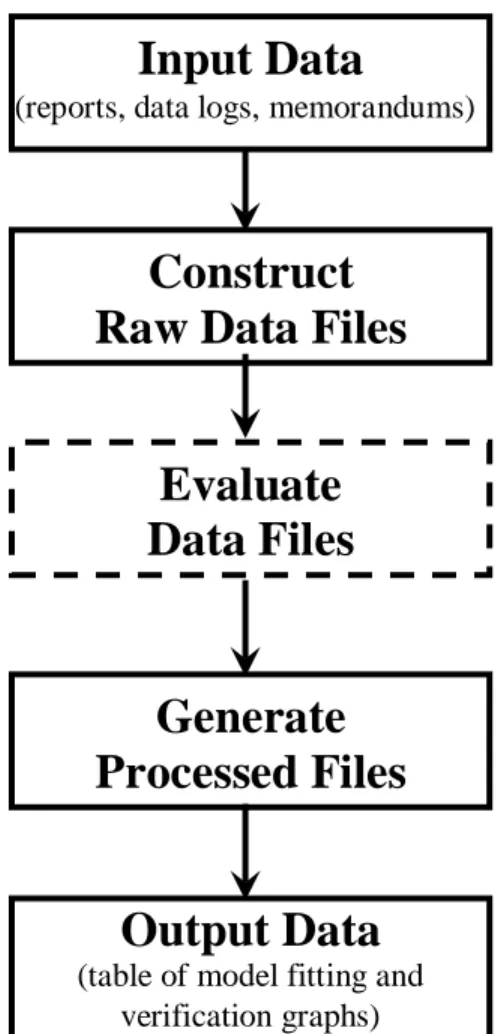
extensive training. An overview of the data flow in the PR-EDB is given in Fig. 6. The source data are first transcribed to "Raw Data Files" in dBASE format as faithfully as possible with complete references. Data entry is currently done through the keyboard. Direct transfer will be used whenever computer-readable documents are available. Any deviation from the norm, which was either reported or noted during transcription (such as the correction of obvious typographical errors) is indicated in the NOTES field. Data from every available report are included, except when the information in a later report is simply a duplication of earlier data without any changes. The dBASE format distinguishes between "character," "numerical," and "date" fields, but all data in the PR-EDB are entered as characters. This somewhat complicates the numerical manipulation of data that have to be converted to numerical form first, but gives much greater freedom to data entry. Information such as <0.001 for an upper bound or RT for
Raw Data Files are next converted to processed files by the EDB-Utilities or other user-supplied software. Processed files will typically be in dBASE format, but ASCII-coded files can also be obtained from dBASE-compatible software for input into scientific software (e.g., numerical analysis programs written in FORTRAN), word processors, and spreadsheets. With the additional software, tables and graphs can be created for the purpose of model fitting, model verification, and other applications.
Figure 6 An overview of the data flow in the EDB
4.2 Key Identifiers
One or more fields in each data file are occupied by "key identifiers," which provide the means for combining data from several files through "relations" that link the corresponding records in these files. These fields differ from other data fields in that the key identifiers are assigned by the manager of the data base in a manner that the same unique identifiers are used to label the data among the various data files that refer to the same experiments, materials, or source
Input Data
(reports, data logs, memorandums)
Construct
Raw Data Files
Generate
Processed Files
Evaluate
Data Files
Output Data
(table of model fitting and verification graphs)
documents. The identifiers used in the reports do not always provide such unambiguous labelling. The following key identifiers are used in the current version of the PR-EDB:
PLANT_ID
Up to six characters are used to identify the reactor in which the irradiation was performed. Only up to three characters are used at present for the identification of commercial power reactors. A list of these identifiers with full name and other information about the reactor is given in the file REAC_LST.dbf. The reactor code in PLANT_ID is also used to identify the surveillance program as a source of data, even if these data do not refer specifically to irradiation (as in files about chemistry or heat treatment).
CAPSULE
Up to six characters are used to identify the surveillance capsule. These are mostly identical to the identifications used in the surveillance program. Sometimes specimens are lumped together which come from different capsules with similar fluences, and in these cases special identifiers for data sets from combined capsules are assigned.
HEAT_ID
The material identifier can have up to ten characters. A simple scheme was devised which works as follows: The coding used for the PR-EDB assigns the first letter to the material type, namely P_late, F_orging, W_eldment, H_eat-affected-zone material, or S_tandard reference material. The next 3 + 2 letters contain the reactor identifier (first three letters of PLANT_ID) plus some identification number, if more than one material is used in the same reactor (e.g., 01, 02, etc; if practical, some correspondence between the EDB and report identifications is retained, e.g., PCC101, PCC102, and PCC103 stand for D7206-1, D7206-2, and D7206-3, respectively). For standard reference materials that are not restricted to a particular reactor, other identification letters are used, namely, SASTM for the A302B ASTM reference plate and SHSS02 for the HSST plate 02. The last four letters are reserved to distinguish between different parts of the same material (e.g., between surface and 1/2T, or between several sections of a plate) if different parts show markedly different material properties as documented in the reports. For instance, SASTM S1 and SASTM S2, denote pieces of the 6-in. ASTM A302B reference plate used in the Garigliano and Yankee Rowe reactors, respectively, whose baseline properties vary considerably from the same material used in Westinghouse reactors, which is denoted simply by SASTM. The file HEAT_LST.dbf gives a complete list of identifiers used in HEAT_ID together with the corresponding identifiers in the surveillance reports.
It was first considered to use the identifiers given in the reports for HEAT_ID, a practice used in the MPC Data base. This, however, has proven to be impractical. Base material (plates or forgings) is usually characterized by the heat number (assigned to the ingot) or a manufacturer's number (assigned to the plate or forging after fabrication; see, for instance, BAW-1820) and one or the other, or neither, is used in reports, frequently with different choices of identification in
wire heat number has been used for identification or just the heat numbers of the two plates joined by the weld. A distinct identification is rarely given for the heat-affected-zone material.
SPEC_ORI
Different orientations of the material test specimens may lead to substantially different property test results, thus this identifier is needed to correctly link the properties of irradiated specimens to the corresponding baseline values.
Orientations are assigned in the now customary T-L-S system as described in ASTM Standard E399, with L the primary rolling or forging direction, or, for welds and HAZ, the direction of the weld seam; T is perpendicular to L and parallel to the plate surface, and S is perpendicular to the plate surface. The first letter describes the longitudinal direction of the specimen (perpendicular to the crack surface, if any), and the second letter describes the direction of the crack propagation (perpendicular to the notch). The orientation for each specimen set was determined as well as possible, preferably from drawings, making sure that the same orientations are assigned to corresponding specimen sets. SPEC_ORI is left blank if no information is available.
REF_ID
In most files, each record is assigned a reference which indicates the source of the data. This is done by means of a 20-character field REF_ID. This identifier is usually a report number or a similar code which links it uniquely to the complete bibliographic information, i.e., author, title, and time of publication, which is given in the file REF_TITL.dbf.
4.3 Correlation Monitor Materials (CMMs)
Generally, the surveillance programs of commercial power reactors include CMMs in addition to base, weld, and HAZ of actual pressure vessel steels. These are specimens fabricated from standard reference steel plates that are similar in most cases in composition and heat treatment to the base material in the respective RPV and are supposed to serve as a reference for comparing the radiation embrittlement of the plant-specific material to the reference material and to detect anomalies in the radiation environment of the surveillance capsules. In order to use these materials as a reference, the "normal" behavior in regard to fluence, flux, and irradiation temperature must be established first, and this requires the collection of data from a sufficient number of irradiations of the material at different irradiation environments, such as different flux and temperatures. Such data, obtained fr