Mining Frequency Content of Network Traffic for Intrusion Detection
Mian Zhou and Sheau-Dong Lang School of Computer Science, and National Center for Forensic Science University of Central Florida, Orlando, FL 32816
E-mail: {mzhou, lang}@cs.ucf.edu
Abstract
This paper presents a novel network intrusion detection method that searches for frequency patterns within the time series created by network traffic signals. The new strategy is aimed for, but not limited to, detecting DOS and Probe attacks. The detection method is based on the observation that such kind of attacks are most likely manipulated by scripted code, which often result in periodicity patterns in either packet streams or the connection arrivals. Thus, by applying Fourier analysis to the time series created by net-work traffic signals, we could identify whether periodicity patterns exist in the traffic. We demonstrate the effective-ness of this frequency-mining strategy based on the syn-thetic network intrusion data from the DARPA datasets. The experimental results indicated that the proposed intru-sion detection strategy is effective in detecting anomalous traffic data from large-scale time series data that exhibit patterns over time. Our strategy does not depend on prior knowledge of attack signatures, thus it has the potential to supplement any signature-based intrusion detection sys-tems (IDS) and firewalls.
Keywords: Network intrusion detection, time series, Fou-rier transform
1. Introduction
Network-based intrusion detection (NID) focuses on network traffic signals passing through the communication infrastructure in an attempt to stop the attacks before they infect the host systems. One approach to intrusion detection is to look for suspicious patterns in the network traffic sig-nals. The network traffic, when recorded in terms of indi-vidual network packets, is a series of time-based events from which various time series can be extracted. Typically, a network packet consists of the header information and the packet payload. The packet header includes a rich amount of information including the arrival time, packet length, payload size, protocol, source and destination ports, flags, window size, etc. Based on the header information, various types of time series can be constructed, such as the follow-ing:
The rate of packet arrivals (in a unit time) The inter-arrival time of the packets
The size of the packet payloads
The time interval of the initial TCP connection at-tempt.
The number of the distinct IP addresses reached dur-ing a time period, etc.
Many network attacks are executed by running pre-written scripts, which automate the processes of attempting connections to various ports, sending packets with fabri-cated payloads, etc. Based on this observation, our intru-sion detection strategy looks for periodicity patterns within the above time series. The first four types of time series given above are particularly relevant to the DOS, probe, and password-guessing attacks. The last type may be used in detecting traffic patterns when a worm or virus is spread-ing itself from an infected computer to other computers. All five time series of traffic signals could exhibit certain fre-quency patterns over time that distinguish the attack traffic from the normal traffic. We adapted the Fourier analysis technique from signal processing to detect periodic fre-quency patterns for network intrusion detection. Our ex-perimental results running synthetic network intrusion data from the DARPA datasets indicate that the proposed intru-sion detection strategy is effective in detecting anomalous traffic data from large-scale time series data that exhibit patterns over time. To reduce the processing time for large traffic datasets, Wavelet transform was applied for data dimensionality reduction, which is similar to that used in [1, 2]. The results of applying the Wavelet transform are not reported in this paper.
The remainder of the paper is organized as follows. Sec-tion 2 describes how to use Fourier analysis to search for periodic frequency patterns. Section 3 describes the process of collecting and preprocessing the traffic data. Section 4 reports the experimental results evaluating the effectiveness of the detection strategy using the DARPA TCPDUMP datasets. Section 5 comments on related work and some issues that need further work. Finally, Section 6 concludes the paper.
2. Mining Periodic Frequency Patterns
We adapted the techniques of signal processing and data mining on time-series data to designing intrusion detection
Variance analysis
Data sequences for each connection
Data sequences for all connections Traffic data new Connection
Parsing the
New connection history Generate the time-series data
Average variance of packet size for each connection
Compare with a threshold value Report attacks Local Frequency pattern DFT Global Frequency pattern Ignore the trusty
Connections
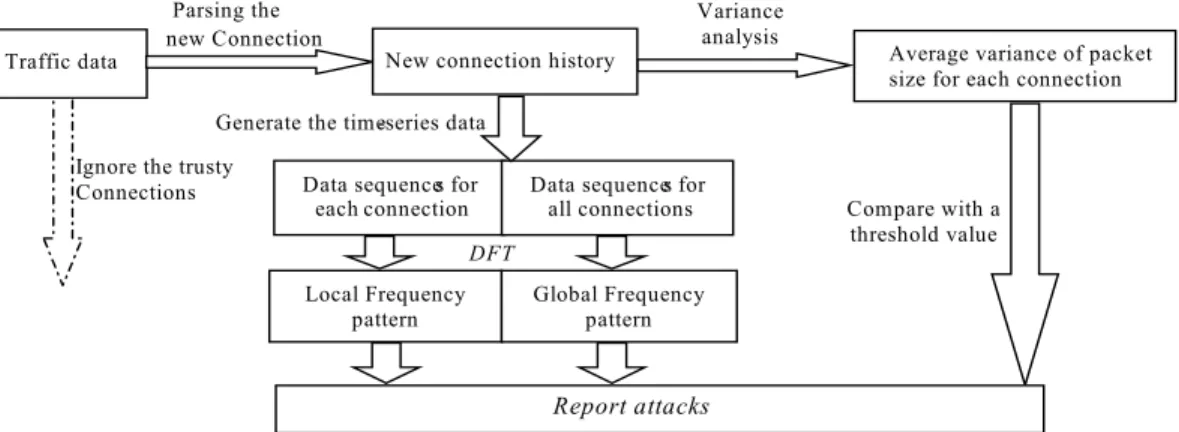
Figure 1. Strategy of mining periodic frequency patterns strategies. In our research, we focus on three types of time
series derived from the network traffic. The first one is the time series on the rates of packet arrivals. The second is the time series of inter-arrival time of network packets. The last one is the time series of the packet payload size. Our observation is that network attacks generated by a brute-force approach such as the DOS, probes, and password guessing, will create a large number of network packets by the scripted code, which often exhibit regular patterns in the traffic data. In addition, such attacks often use fabri-cated payloads of a constant size. By identifying these pat-terns our intrusion detection algorithm attempts to capture anomalous traffic behaviors without prior knowledge of the specific intrusion or attack signatures.
Our intrusion strategy could be used in combination with other intrusion strategies. For instance, before applying our intrusion detection strategy we could use the technique introduced in [3] to differentiate the “clean and dirty” traf-fic so as to reduce the amount of suspicious traftraf-fic that need to be carefully examined by our IDS. The central idea of [3] is based on the observation that under normal situa-tion a machine will make a rather low rate of outgoing connections to new or different machines. Instead, it is more likely to connect to the same IP regularly than to dif-ferent IPs [4, 5], which is referred to as the locality prop-erty of machine interaction. Thus, a connection queue will be built for the protected computers to record all the com-ing connections, in which connections from familiar IPs would have a higher priority than the connections from the new Ips, and the connections with a higher priority will be passed to their destination without much delay. Our fre-quency-based detection strategy could be used to watch those “unfamiliar” connections.
There are three major steps in our detection strategy as depicted in Figure 1. First, we construct the connection history for all those connections from the new IPs and re-cord their traffic measures including: the packet size, the inter-arrival time between packets, and the rate of packet arrivals (per unit time) within or among the connections. Second, we apply the discrete Fourier transform (DFT) to the time series data and collect the resulting frequency in-formation. Both the global frequency patterns for all con-nections in the connection history, and the local frequency patterns for individual connections, are computed using
DFT. Finally, by identifying the sharp peaks in the spec-trum of DFT results, the algorithm determines if periodic frequency patterns exist in the network traffic. Details of the algorithm are presented in the following subsections. 2.1 History of IP connections
In our studies, a network connection includes all the network traffic (packets) sent between two connected IP addresses in a certain time period, which has the following properties:
A pair of source and destination IP addresses A single protocol or a set of multiple protocols used at different times during the connection
A set of consecutive packets within a connection which are not necessarily sent or received consecu-tively in terms of time by a machine
For each protected computer, we use a firewall to control the connection queue. The firewall will pass connections from familiar IPs, and maintain the history of recent new connections, that is, connections from new IPs will be ob-served, and their frequency patterns will be computed and recorded. For each connection within a connection history, all of three types of time series mentioned earlier are gen-erated.
2.2 Types of Frequency Patterns
The generated time series essentially reflects the way by which packets are sent by the attacker, the packet delivery process would eventually fall into three categories. First, the packets are sent out very randomly, that is, the inter-arrival time between two consecutive packets would not conform to any repeated, periodic patterns. Second, the packets are sent out at a constant rate. Third, the packets are not sent out at a constant rate, but a periodic pattern exists in the inter-arrival time. We use a simple example to illustrate these three different patterns:
Random Inter-arrival time sequence:
1 23 4 10 1000 45 320 12 33445 6 23 … Constant Inter-arrival time sequence:
5 5 5 5 5 4.9 5 5 5 5 5 … Periodic Inter-arrival time sequence:
Each number in the above sequence stands for an inter-arrival time between two consecutive packets. The case of a constant inter-arrival time would be easy to detect either by analyzing packet arrival rates or the inter-arrival time . When the inter-arrival time is not a constant but is periodic, the packet arrival rates will not necessarily produce peri-odic patterns since a time unit is an adjustable value de-pending on the duration of the connection and the sending speed of the traffic. However, applying the DFT to the series of inter-arrival time would be appropriate to capture the periodicity pattern. For the series with a random inter-arrival time, our intrusion detection strategy will fail . The traffic could be legitimate or could be from a manually operated attack. Another possibility is that the traffic flow is still an automated attack, but is created in a purely ran-dom manner. We had simulated the attacks using various DOS and probe tools downloaded from Internet. Some of them use a simple attack strategy, such as flooding a ma-chine by sending packets at a rate based on a user-specified time. Some of them allow the user to specify the scan delay or the time range for a RTT timeout before processing the next packet, which creates a uniformly distributed packet stream. The periodic inter-arrival time patterns would ap-pear in the more sophisticated attacks, which loop through the same random process. However, for attacks that gener-ate the entire traffic stream from a long, single random process (i.e., no repeated use of the same random proc-esses), detection by purely looking for periodic patterns would fail. Possible remedies are discussed in Section 5. 2.3 Frequency Extraction
Fourier Transform is a well-known technique used in signal processing [6]. The Discrete Fourier Transform (DFT) takes the original time series in the time domain, and transforms them into the associated frequency data in the frequency domain. For a given data sequence s(n) where n ≥ 0 is a discrete value representing the time, the DFT coefficients F(k) are defined as follows:
∑
− = − = 1 0 / 2 ) ( ) ( N n N kn j e n s k F πwhere 0 ≤ k≤ N–1, and N is the length of the sequence s(n). Expanding the right-hand side yields
∑
−∑
= − = − = 1 0 1 0 ) / 2 sin( ) ( ) / 2 cos( ) ( ) ( N n N n N kn n s j N kn n s k F π πUsing the Fast Fourier Transformation (FFT) procedure, the frequency coefficients F(k), 0 ≤k≤N–1, can be com-puted in O(N logN) time.
2.4 Global Frequency vs. Local Frequency
As mentioned in Figure 1, we create local time series for each separate connection as well as the time series for the multiple connections. Both the local frequency patterns within each single new connection and the global fre-quency patterns over multiple connections in the connec-tion history list are analyzed. The local frequency patterns can be used in detecting attacks originated from a single source IP targeting a single victim IP. However, when an attack sends packets using multiple spoofed IPs as their source addresses, attempting to evade the intrusion
detec-tion systems, we will see many incoming connecdetec-tions to the target, but in fact, the attack traffic is not independent and is possibly originated from one source computer, and we shall search for frequency patterns from arrivals of those connections. On the other hand, the reverse of the above phenomenon is also possible. When a single attacker sends out packets to exploit a group of machines, each vic-tim only receives a part of the exploit traffic. For this situa-tion, the firewalls installed on the gateways for the victim LAN will record all the exploit traffic heading to different victim IPs. Both of these two cases will need the global frequency analysis to detect the “one to many” or “many to one” attacks.
In reality, when connections are established between dif-ferent pairs of computers, the connection traffic from one connection is statistically uncorrelated to the connection traffic from the others, so there should be no frequency patterns across the different connections. Therefore, the local frequency patterns are mainly used to identify the uncoordinated attacks occurring in the different connec-tions.
3. Preparing Input Data
We have two sources for the network traffic data, one comes from the DARPA TCPDUMP files, which contain intrusion traffic simulating various network attacks [7], the second data source is the synthetic data captured by the network sniffer tool Ethereal [8], which was installed on our local networks that captured both the intrusion traffic and normal traffic. We used the network exploration and auditing tool NMAP [9] to generate the intrusion traffic. For both the TCPDUMP files and Ethereal files, we used our own pre-processing tools to extract the traffic informa-tion. After parsing the TCPDUMP files and Ethereal files, we have the information on data packet headers, the flag information, the time distribution, etc.
The traffic datasets from the DARPA Lab normally col-lect a whole day’s traffic with a file size of around 500 mega-bytes. To process the traffic file and generate the time series, we chose a sliding window of 20-minute span to slice each dataset into small pieces, with an overlap of three minutes between two consecutive windows.
At the end of data parsing and extraction, the time-series data generated within a sliding window would include the following items:
(1) Global data sequence of packet arrival rates. (2) Global data sequence of packet inter-arrival time (3) Global data sequence of packet size
(4) Local data sequence of packet arrival rates for each connec-tion.
(5) Local data sequence of inter-arrival time for each connec-tion.
(6) Local data sequence of packet size for each connection.
4. Experimental Studies
We report the results on using the DARPA datasets, which are supposed to simulate the attacks across the Inter-net. In the following we describe the experimental results for three different attacks from the DARPA 1999 week 5 and 4 datasets (abbreviated as L1999w4&w5). . The three
attacks are ProcessTable, Portsweep, and Dictionary attack. The first one is a DOS attack; the other two belong to Probe and remote-to-root attacks, respectively. A detailed description of the attacks could be found in [10].
(a) (b)
Figure 3: (a) Local frequency patterns on inter-arrival-time for the first 9 connections in the portsweep attack. (b) The global frequency pattern on inter-arrival time of the ports-weep attack, which includes 18 connections.
Connection 0 Connection 1 Connection 2
Connection 3 Connection 4 Connection 5
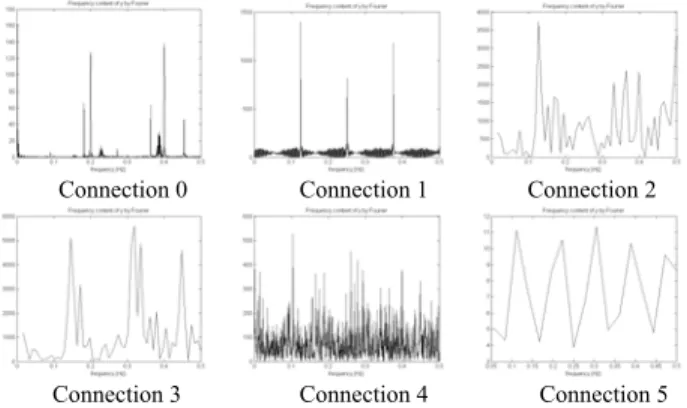
Figure 2: Frequency patterns on inter-arrival time for each connection in the ProccessTable attack.
4.1 The ProcessTable Attack
The ProcessTable attack is a TCP connection based at-tack, which may attack various network services by launch-ing a huge number of TCP/IP connections to a particular port in a short period. For each incoming TCP/IP connec-tion, the underlying Unix system allocates a new process to handle it. Therefore, it is possible to completely fill a target machine's process table with a large number of network service instantiations, eventually rendering the system life-less until the attack terminates or is killed by the system administrator [10].
In our studies, we used the DARPA TCPDUMP file that contains the ProcessTable attack packets, which contains slightly less than 2 minutes of data with a total of 5526 data packets.
Our intrusion detection (frequency mining) algorithm constructs the connection history table for the target com-puter “zeno.eyrie.af.mil”. The record of each connection includes all the statistical features of the connection, and the IP address that identifies the connection. The DFT is then applied to two time series created: the packet arrival rates series and the inter-arrival time series. The variance of the packet size is calculated. Based on the output from DFT coefficients, the frequency patterns of each connection are plotted in Figure 2. There are a total of 12 connections in the connection history table. Five of them have less than 20 packets. We plot the frequency information on six connec-tions that are long enough to bear meaningful DFT analy-sis.
From Figure 2 we could see that the patterns for con-nections 0 and 1 show distinct frequency peaks, whereas the rest of them do not. In fact, the first connection is the processTable attack that we were expected to find, and as a byproduct, we also detected a Probe attack in connection 1, which probes the ports ranging from 1794 to 2631. The attacker’s IP address was identified as “hobbes.eyrie.af.mil (172.16.112.20)”.
4.2 The Portsweep Attack and Dictionary Attack
The source data for Portsweep traffic is from the Tues-day data of L1999w5 outside data. The attacker sends a small number of packets to each of 38 different destina-tions. The local frequency patterns for each separate con-nection didn’t reveal much information as depicted in Fig-ure 3 (a). Since the attacking process to each target lasts a very short time (about 3 seconds) and used very few pack-ets (around 10 packpack-ets), there is no obvious peak in the local frequency patterns (except for that all the local fre-quency patterns are very similar to each other). However, the global frequency pattern for all connections originated from the same IP (attacker) shows an obvious sharp peak depicted in Figure 3(b). All the variances of the packet size for each separate connection are zero except for the con-nection with 192.168.1.20, which has a variance of 10.63. We identified the IP address 195.73.151.50 as a suspicious attacker.
Connection 0 Connection 1 Connection 2
Connection 3 Connection 4 Connection 5
Figure 4: Frequency patterns on inter-arrival time for each connection in the Dictionary attack.
In addition to the DOS and Probe attacks, other types of attack such as the Dictionary attack, which belongs to the type of remote-to-root attack, also falls into the scripted attack category. Figure 4 is the frequency pattern for the dictionary attack, data originally from Monday of L1999w5 TCPDUMP data. There are a total of 11 connections to the victim. We give our experimental result on their frequen-cies in Figure 4. There is an obvious frequency pattern for connection 1. The variance of the packet size is 0.117088, the sending speed is very high, 5265 packets sent out in 834.067566 seconds. We confirmed that this connection is for a password guessing attack, which tried different user-name/password combinations to the telnet service.
Attack Name Type Manual
/Auto Attack Duration Total Time (DFT) Frequency found?
pingofdeath DOS Man 0:00:06 2.79400 Y packets/unit time Dosnuke DOS Auto 0:16:41 10.65500 Y inter-arrival time Apach2 DOS Man 0:11:00 92.39300 Y packets/unit time
Syslogd DOS Auto 0:15:01 7.56100 N didn’t find apparent frequency pattern Neptune DOS Auto 0:06:51 2.97500 Y inter-arrival time
Crashiis DOS Auto 0:00:06 16.90700 N totally only two connections to victim: 172.16.112.100, and each connection has only 7 and 5 packets
Selfping DOS Auto 0:03:03 4.56700 Y packets/unit time ProcessTable DOS Auto 0:02:02 12.98600 Y inter-arrival time Sshprocess
Table DOS Auto 0:00:8-0:00:50 3.75600 Y inter-arrival time & packets/unit time Back DOS Auto 0:05:00-0:20:38 904.60100 Y packets/unit time
Udpstorm DOS Auto 0:15:00 8.37200 N didn’t find apparent frequency pattern mailbomb DOS Auto 0:04:27 10.21500 Y packets/unit time
Dict RLA Auto 0:00:10-0:08:40 12.11700 Y inter-arrival time
Guesstelnet RLA auto 0:03:19 10.61500 Y inter-arrival time & packets/unit time
Ipsweep Probes auto 0:00:01*6 16.37300 N single packet sent to each IP from different sources IP Portsweep Probes auto 0:04:00 10.10500 Y inter-arrival time & packets/unit time
queso Probes auto 0:00:01*7 2.93400 Y inter-arrival time
(a large time gap exists in the middle of the attack though) tcpreset Probes auto 0:10:38 12.17700 Y packets/unit time
nmap Probes auto 0.04:24 8.54600 Y packets/unit time & inter-arrival time teardrop Probes auto 0:15:01 4.76700 Y packets/unit time & inter-arrival time satan Probes auto 0:02:12 82.72900 Y packets/unit time
ntinfoscan Probes auto 0:16:09 26.82800 N didn’t find apparent frequency pattern
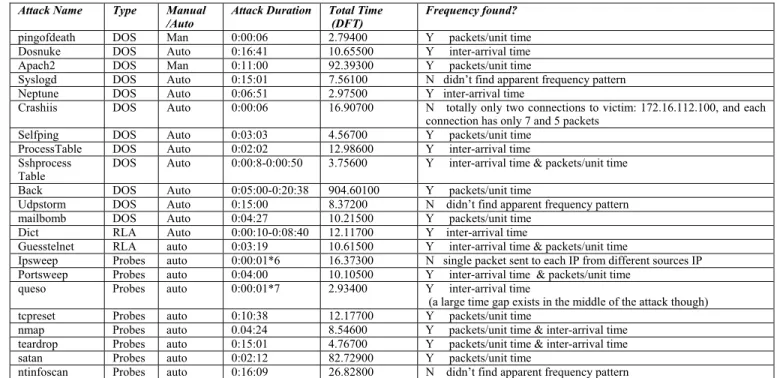
Table 2: DOS and Probe Attacks in Lincoln Lab IDS evaluation data, 1999 weeks 4 and 5 4.3 Experimental Results of DOS and Probe
At-tacks in 1999 DARPA Data
We attempted a thorough study of the DOS and Probe at-tacks from the L1999w5&w4 datasets. Since our fre-quency-based approach is sensitive to the attack duration and whether an attack is automated, we are not reporting those that are either manual attacks or have very short at-tack time. Table 2 lists all the atat-tacks we considered, which include eight probes, eleven DOS attacks, and two Remote-to-Local Attacks. The unit time used in the frequency analysis is defined as:µ=0.1×(T/n), where T is the dura-tion of a connecdura-tion or multiple connecdura-tions depending on whether it is a local frequency or global frequency, and n is the number of packets.
Out of 22 attacks, our detection algorithm failed on five attacks: Ipsweep, crashii, syslogd, udpstorm and ntinfo-scan. The data sources for the first three attacks are from Monday, L1999w5 data; ntinfoscan is from Thursday, L1999w5 data. Among them, Ipsweep is conducted by sending a single packet to each target IP from different source IP, which is contrary to what we expect that the attack is originated from the same IP; The crashii attack sent only seven and five packets to the victim IPs in two separated connections, which are not long enough to bear frequency analysis. Syslogd, ntinfocan and Udpstorm are three automated attacks with long attack durations, but we couldn’t identify any frequency patterns in the traffic data.
We were also able to detect certain DOS attacks even though they are manual attacks. The ping of death and apache2 attacks are from the Monday of week five dataset, which was labeled as manual attack. The apache2 attack created a huge amount of traffic: 53931 packets are sent in 603.971863 seconds; the Ping of death attack sent out 91 packets in 30.114 seconds. They both showed frequency
patterns in local connections. A possible explanation for this is that the traffic sent out in the attacks is mostly proc-essed automatically without much human interaction in-volved. For all these attacks, our detection strategy does not need any prior knowledge of the attack signatures, and the false alarm rate is fairly low.
In practice, periodic but legitimate traffic flow does exist commonly in the real world. For example, network traffic sent by a router, which broadcasts periodically to the lists of its subnet machines to look for the shortest routing path, shows frequency patterns. (Details of Internet routing pro-tocols can be found in [11].) The DNS service sometimes creates traffic with frequency patterns. The traffic under the Network Time Protocol for time synchronization certainly creates periodic patterns as well. For most of these legiti-mate periodic traffic flows, both the sender and receiver belong to the insiders of the LAN, and the traffic occurs routinely. Thus, the generated traffic should be filtered out as from trusted IPs due to the locality strategy mentioned in Section 2, and immune from the false alarms under our detection algorithms. However, it would be a tricky prob-lem for intrusion detection when these trusted machines have been compromised and are attempting to infect the others.
5. Discussions and Related Work
Developing countermeasures for random exploration is crucial to our work. To begin with, we will study in detail the TCP protocol effects on the traffic time series pattern. We concentrate on TCP instead of other protocols because TCP provides connection-oriented stream services, and because its popularity in the Internet. The TCP traffic flows are initialized by a three-way handshake protocol [12]. Af-ter a connection is established, the inAf-teractive bulk data flow is controlled by the sliding window protocol. There-fore, the TCP-based attacks which exploit the
establish-ment/termination of a TCP flow, and those attacks that exploit the bulk data flow, will have different traffic char-acteristics. As a simple example, a TCP SYN attack would not be affected by a victim’s response time, all the attacker needs to do is to send a SYN/FIN packet and, without wait-ing for any feedback, the next SYN packet could be sent immediately to the target. The traffic-timing patterns at the receiver end should match closely to the timing patterns of how the attack tools generate the traffic. However, for a “Back” attack which sends many HTTP requests with a URL containing many slashes, the packet’s arrival process is also affected by the sliding window protocol. Since the sender machine has to wait for the acknowledgement on the last group of packets before it could process the next packet, the traffic flow is closely related to the Round Trip Time (RTT) [13]. For the first type of the attacks, when the random exploit is used as mentioned in section 2.2, a pos-sible solution is to study the timing characteristics of le-gitimate TCP connections, e.g., the inter-arrivals times of TCP connections are distributed approximately Weibull [14,15]. The manipulated random arrivals are expected to deviate from the Weibull distribution or exponential distri-bution. For the second type of attack, applying the power spectral density of the traffic signal within a TCP connec-tion would be appropriate to differentiate the normal traffic from the one mixed with attack [13]. Both of these two approaches, nevertheless, require an analysis of the traffic that lasts a relatively long duration.
6. Conclusions and Future Work
In this paper, we proposed a time-series frequency min-ing technique for detectmin-ing automated, scripted network attacks, which typically exhibit frequency patterns over time. The technique is based on the sound theory of Fourier analysis from signal processing research. We used the DARPA datasets in our simulation studies; the experimen-tal results demonstrated that the frequency-based intrusion detection algorithm is effective in, but not limited to, de-tecting the DOS and probe attacks that typically run from pre-written scripts and have relatively long duration.
Some limitations of our frequency-based intrusion detec-tion approach include its sensitivity to the attack’s duradetec-tion and the degree to which the attack is automated. Also, the computation time of the algorithm may place a high de-mand on the detection hardware. We are yet to apply the frequency mining technique to live network traffic signals in real time. Another piece of future work is to integrate our intrusion detection (frequency mining) strategy into a firewall device and evaluate its effectiveness against other strategies that are based on network traffic’s temporal properties in real network environments.
References
[1] R. Agrawal, C. Faloutsos, A. Swami, “Efficient Simi-larity search in sequence databases”, Proceedings of the 4th Conference on Foundations of Data
Organiza-tion and algorithms, 1993.
[2] E. Keogh, K. Chakrabarti, M. Pazzani, S.Mehrotra, “Dimentionality Reduction for Fast Similarity Search in large Time Series Databases”, Journal of
Knowl-edge and Information Systems, 2000.
[3] M. Williamson, “Throttling Viruses: Restricting Propagation to Defeat Malicious Mobile Code”, Pro-ceedings of 18thAnnual Computer Security Applica-tions Conference, 2002.
[4] L. Heberlein, G. Dias, K. Levitt, B. Mukherjee, J. Wood, and D. Wolber, “A Network Security Monitor”, Proceedings of IEEE Symposium on Security and Pri-vacy, 1990.
[5] S. Hofmeyr, “A Immunological Model of Distributed Detection and its Application to Computer Security”, Ph.D. thesis, Department of Computer Science, Uni-versity of New Mexico, Apr. 1999.
[6] E. Brigham,. The Fast Fourier Transform, Prentice-Hall, 1974.
[7] DARPA Intrusion Detection Evaluation project, at http://www.ll.mit.edu/IST/ideval/data/1999/
1999_data_index.html.
[8] G. Combs, Ethereal – Network Protocol Analyzer, http://www.ethereal.com/
[9] NMAP, at http://www.insecure.org.
[10] K. Kendall, “A Database of Computer Attacks for the Evaluation of Intrusion Detection Systems”, Master's Thesis, Massachusetts Institute of Technology, 1998. [11] J. Slone, editor, Handbook of Local Area Networks,
CRC Press LLC, 1999.
[12] W.R. Stevens, TCP/IP illustrated, volume I , Addison-Wesley press, 1994.
[13] C. Cheng, H. Kung, K. Tan, “Use of Spectral Analysis in Defense Against DOS Attacks”, Proceedings of
IEEE GLOBECOM 2002.
[14] A. Feldmann, “Characteristics of TCP Connection Arrivals”, Technical Report, AT&T, 1998.
[15] W. S. Cleveland, D. Lin, D. Sun, “IP Packet Genera-tion: Statistical Models for TCP Start Times Based on Connection-Rate Superposition”, Proceedings of SIGMETRICS 2000.