Safe Communities ~ Safe Schools
Planning Guide
A Tool for Community Violence Prevention Efforts
Center for the Study and Prevention of Violence
Safe Communities ~ Safe Schools
Safe Communities ~ Safe Schools
Planning Guide
A Tool for Community Violence Prevention Efforts
Delbert S. Elliott Jane M. Grady Tiffany E. Shaw Tonya Aultman-Bettridge Michelle T. Beaulieu May 2000
Acknowledgments
Development, editing, printing and dissemination of this publication were made possible with support from the Safe Communities ~ Safe Schools Partnership:
Colorado Association of School Boards Colorado Association of School Executives
Colorado Federation of Teachers Colorado Education Association Colorado Department of Education
Metro-Denver & Front Range Safe and Drug-Free Schools Colorado Attorney General
Coors Brewing Company University of Colorado at Boulder
The Colorado Trust
The Colorado Trust has provided the primary funding for this $1 millions, three-year initiative. .
SCSS-001 Copyright 8 2000
by the Institute of Behavioral Science, Regents of the University of Colorado Center for the Study and Prevention of Violence
Institute of Behavioral Science University of Colorado, Boulder
1440 15th Street Boulder, CO 80302
Phone: (303) 492-1032 Fax: (303) 492-2151 E-mail: [email protected]
TABLE OF CONTENTS
List of Figures…..……….……..ii
Introduction………..1
Safe Communities ~ Safe School Planning Team……….4
Community and School Assessment……….……...9
Violence Prevention Strategies and Programs………14
Social Support Team………...20
Crisis Planning………..23
Conclusion……….25
LIST OF FIGURES
Figure 1: Safe Communities ~ Safe Schools Model………...………3 Figure 2: Sample Safe Communities ~ Safe Schools
Planning Team……….5
Figure 3: Sample Planning Team Agenda………….………..7
Figure 4: Sample Planning Sheet for Community Partnership Objectives…………14 Figure 5: CSPV Blueprints Program Descriptions……….16 Figure 6: CSPV Blueprints Promising Programs….……….16 & 17
INTRODUCTION
Though the recent series of highly publicized suburban school shootings instigated a great deal of fear in many communities, schools remain to be some of the safest places for our children and young people. However, it is now more recognized that all schools, whether rural, suburban or urban, are vulnerable to devastating acts of violence. As a result, all schools and the communities that surround them must now deal with this reality. To help stem the recent tide of school violence within the state of Colorado, a partnership has been formed to establish a model for safe school planning throughout the state. The proactive collaboration has been created by: The Colorado Association of School Boards, The Colorado Association of School Executives, The Colorado Federation of Teachers, The Colorado Education Association, The Metro-Denver and Front Range Safe and Drug-free School Coordinators, The Colorado Department of Education, The Colorado Attorney General’s Office, The Coors Brewing Company, The Colorado Trust and The Center for the Study and Prevention of Violence at the University of Colorado at Boulder. This group launched the Colorado Safe Communities ~ Safe Schools Initiative in October, 1999. The Colorado Trust has provided the primary funding for this three-year initiative.
This dynamic partnership is promoting a model
for safe communities and safe schools
throughout the State of Colorado. The Safe Communities ~ Safe Schools Model was developed by the Center for the Study and Prevention of Violence (CSPV) and designed as a framework for action that can be used as a guide today and a planning tool for the future. The model addresses both the personal and
property protection aspects of violence
prevention for school communities across the state. The goal of safe school planning is to create and maintain a positive and welcoming school climate that promotes academic success
and is free of drugs, violence, intimidation, and fear - an environment strongly supported by the community in which teachers can teach and students can learn.
While recent data from the Department of Justice indicates that violent crime is on the decline in the U.S., the rash of school shootings in the past two years has led Americans to become more concerned than ever about the safety of their children at school. Last August, 47% of parents said they feared for their children’s safety at school; this proportion is nearly doubled compared with a 1977 poll conducted by the
same organization (U.S. Department of
Education, 1998).
This public perception that our children are not safe at school is understandable, but not entirely justified. Data from the Department of Justice suggests that school-age children are, in fact, safer in school than they are at home or in their neighborhoods. Regardless, 19% of middle schools and 21% of high schools in the U.S. reported at least one incident of serious violent crime during the 1996-97 school year. More than half of all middle and high schools reported at least one incident of unarmed assault during this year and 12% and 13%, respectively, reported at least one attack or fight involving a weapon. Teachers are also vulnerable to violent or criminal acts. On average each year, from 1992 to 1996, about four out of every 1,000 elementary, middle, and high school teachers were the victims of serious violent crime at school. Fear of violence in schools affects attendance of students and tenure of staff, while a warm and positive school climate helps to improve academic achievement and professional longevity.
These violent attacks and threats of violence negatively affect students, school staff, and the entire educational process. Children and teens are often afraid to go to school. Once at school,
many are afraid to go into the restrooms or out on the playground. Others live in fear that they will be shot or hurt by classmates who carry weapons to school. Teachers can not be expected to teach at their best level, nor can students be expected to learn and perform well if they constantly have to deal with bullying, theft, peer pressures and physical assaults. The school violence problem and the lack of organized community response have interrupted public education in the United States and are interfering with the quality and performance of our educational system.
CSPV strongly suggests that a societal paradigm shift is necessary in order to effectively address and prevent violence at its roots. Changes in school community ideology, school structure and
organization, and greater community
involvement and commitment will have to take place. While metal detectors may temporarily increase school safety by limiting the presence of weapons, a ―safe school‖ is one in which the entire school climate is warm and inviting without the overwhelming shadow of security equipment or locks on exterior doors that create a jail-like atmosphere. The long-term presence of such technology interferes with learning and these ―target hardening‖ approaches do not promote friendly, supportive environments. Model safe school plans, like model prevention programs, are comprehensive. The best plans involve the entire community and are customized to meet the unique needs and circumstances of each local school. Safe community and safe school plans should vary according to issues of ethnic, cultural, and geographic diversity and reflect the population of the school community that it is to support. It is critical that the entire community supports the design of the safe community – safe school plan since many of the community’s problems spill into the school and cause school violence problems, and solutions to concerns may be found within the community as well. The implementation of a solid plan can
prevent many crises, help to reduce anger and
tension in the school community and
consequently, enhance the learning environment. The Safe Communities ~ Safe Schools Initiative was developed to assist Colorado public schools and communities in the development and implementation of their own customized safe community – safe school plans.
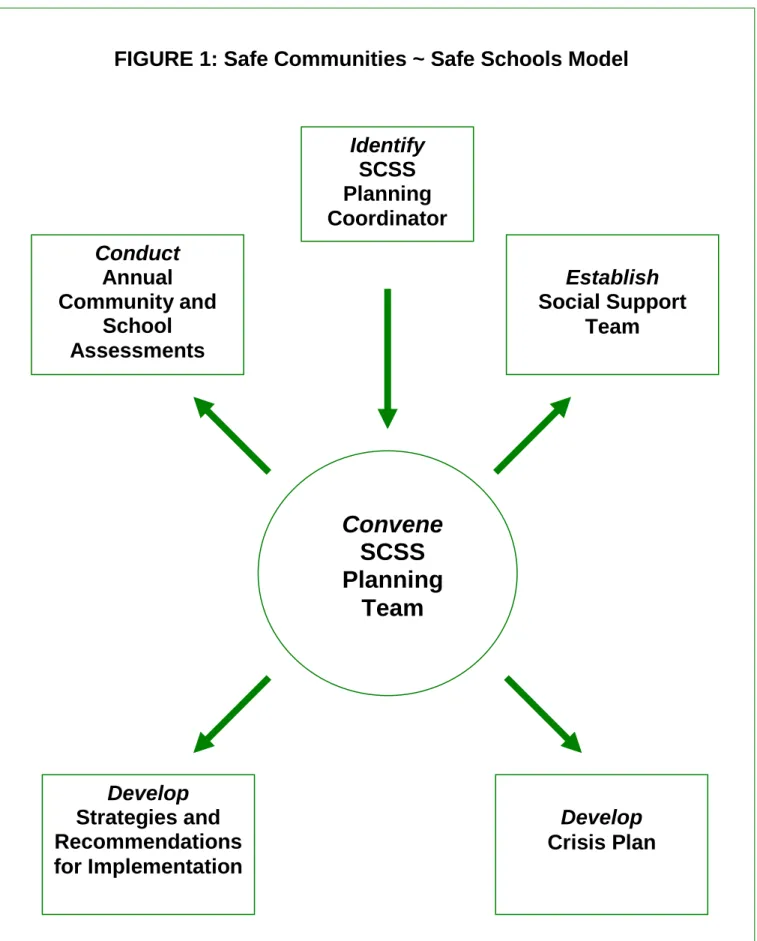
The Safe Communities ~ Safe Schools Model is the conceptual scaffold for safe community – safe school planning. The five components of the Safe Communities ~ Safe Schools Model are as follows:
1. Convene a Safe Communities ~ Safe
School Planning Team
2. Conduct Community and School
Assessments
3. Develop Strategies and Implement
Violence Prevention Programs to
Address School Safety Concerns 4. Establish a Social Support Team 5. Develop a Crisis Plan
Figure 1 is a visual representation of the Safe Communities ~ Safe Schools Model.
This Safe Communities ~ Safe Schools Planning Guide defines and discusses the five crucial components of the Safe Communities ~ Safe Schools Model. It is intended to be a directive tool for communities and their schools as they
embark on an especially comprehensive
approach to safe community – safe school planning. When introducing this model to educators, parents, and community members, CSPV encourages individuals and groups to perceive it not as a program, but as a framework that helps school communities re-organize and enhance their current activities.
CSPV encourages individuals and groups to perceive it as a framework that helps school communities to re-organize and enhance their current activities.
FIGURE 1: Safe Communities ~ Safe Schools Model
Convene
SCSS
Planning
Team
Conduct
Annual
Community and
School
Assessments
Identify
SCSS
Planning
Coordinator
Establish
Social Support
Team
Develop
Strategies and
Recommendations
for Implementation
Develop
Crisis Plan
SAFE COMMUNITIES ~ SAFE SCHOOLS PLANNING TEAM
Safe community ~ safe school planning is a collaborative effort, and effective planning requires the expertise and contribution of key community and school representatives. The Safe Communities ~ Safe Schools Planning Team (hereinafter referred to as the ―Planning Team‖) is the nucleus of the Safe Communities ~ Safe Schools Model and should be the driving force
from which all planning strategies are
determined, developed and implemented. The
Planning Team is responsible for the
development and implementation of each of the key components of the Safe Communities ~ Safe Schools Model. This includes selecting and administering appropriate community and school assessments, interpreting the results from those assessments, and identifying effective violence prevention programs and working to ensure that those programs are implemented correctly. The Planning Team will also establish the site’s Social Support Team, create community and school-based crisis plans, and conduct annual assessments for future planning.
A Safe Communities ~ Safe Schools Planning Coordinator (hereinafter referred to as the ―Planning Coordinator‖) will direct the Planning Team. However, it may be feasible for smaller districts (those in a remote area with only a few schools) to have only one Planning Team that will serve the entire district. In order to promote an inclusive team that is well sustained over
time, it is essential that the group consist of individuals from all aspects of the community and reflects the ethnic, cultural, and geographic diversity of the community it represents. A varied team will enhance community buy-in and strengthen the community-school partnership. This is especially important when schools attempt to bring to the planning table those individuals or groups that rarely interact with the school community. A team may include, but is not limited to: students, parents, teachers, administrators, school support staff (such as custodial staff, cafeteria workers), mental health and public health professionals, business leaders, clergy, law enforcement officers, legal counsel, local government officials, etc.
The Planning Team should be prepared to meet frequently, as often as weekly or biweekly during the initial six months to one year of its development. Because the Planning Team has so many critical issues to address and a very demanding first year of realization, it may be more practical for the Planning Coordinator to organize subcommittees that can meet on
different occasions according to their
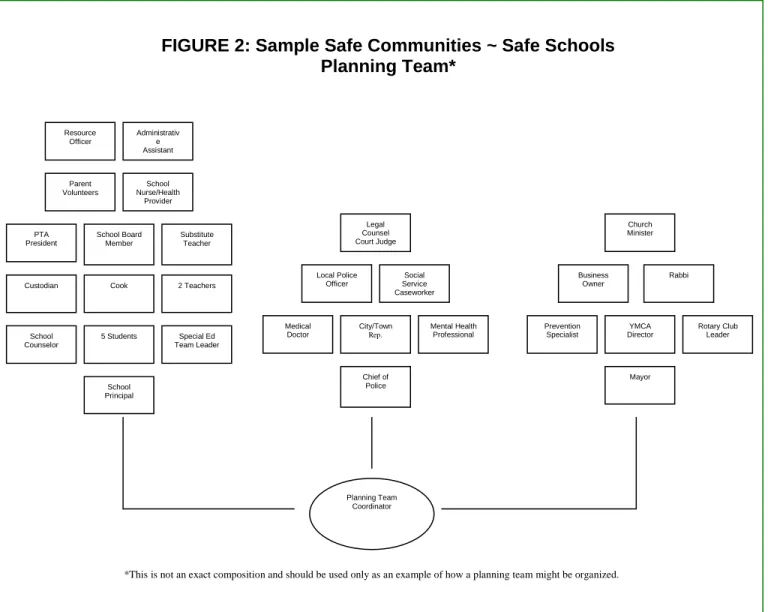
assignments. Figure 2 is a sample of a safe community – safe school planning team. (Please keep in mind that the figure is not an exact composition and should be used only as an example of how one planning team may be organized.) Pay special attention to the size of the Planning Team, as it is important to compose an inclusive team, while also keeping the total participants at a manageable number.
The Planning Team is to be organized and facilitated by a Planning Coordinator, ideally, an educational professional who is both experienced in the school system and with community relations. However, this individual must first recognize the importance of his/her role as the leader of the entire planning effort and be willing to commit the time and energy necessary to systematically implement the Safe Communities ~ Safe Schools Model. In some school communities, a parent or neighborhood volunteer may adequately serve as the coordinator, or a law enforcement officer such as the local chief of police, while other schools may pursue hiring a part-time or full-time employee whose sole
responsibility would be safe school planning. Though budgets may not always allow, it is strongly encouraged that schools reallocate funds and responsibilities so that a qualified person can assume this important position. It is then more likely that the coordinator will have an improved understanding of the school community and can be held professionally accountable for his/her duties. This position also requires the unfailing support of the school’s administration and should be given some degree of authority regarding the annual assessments, development of discipline policies, prevention program selection, and crisis response. Likewise, the Planning Coordinator ought to possess a clear understanding of the
School Counselor
5 Students Special Ed Team Leader Custodian Cook 2 Teachers
PTA President School Board Member Parent Volunteers Substitute Teacher Resource Officer School Nurse/Health Provider Administrativ e Assistant Planning Team Coordinator School Principal Legal Counsel Court Judge Social Service Caseworker Local Police Officer Mental Health Professional City/Town Rep. Medical Doctor Chief of Police Mayor Church Minister Rotary Club Leader Rabbi Business Owner Prevention Specialist YMCA Director
*This is not an exact composition and should be used only as an example of how a planning team might be organized.
FIGURE 2: Sample Safe Communities ~ Safe Schools Planning Team*
school’s population and policies so that the administration can confidently empower the Planning Coordinator and Planning Team to pursue what he/she/they find to be the most appropriate action for the good of the school. The Planning Coordinator may act as a leader, educator, manager, and observer throughout the planning process. He/she is responsible (with outside input when appropriate) for identifying and inviting the initial members of the Planning Team. The Planning Coordinator is to determine the frequency and format of the planning meetings and may facilitate all of those meetings. The Planning Coordinator must be willing to execute important leadership strategies so that the Planning Team is effective in communicating with school personnel and community members and attaining long-term goals and objectives. The Planning Coordinator should have a substantial knowledge base of previous and current public issues, school-based prevention efforts, and community resources. It is also imperative that the Planning Team be nondiscriminatory and works to invite people of color, different age groups, varying ethnicity, and a balanced representation of men and women. Because some schools may be dealing with sensitive issues such as the discrimination and/or violent behavior towards alternative youth subcultures, the Planning Coordinator must be aware of and occasionally call on local or regional resource agencies that can offer support and specialized assistance. The Planning Coordinator should also consider inviting individuals of differing backgrounds and work experiences to be on the Planning Team because those members may be effective in potentially difficult situations.
The Planning Coordinator organizes and plans the activities of the Planning Team. One such task may involve the development of a timetable or action plan. The Planning Coordinator should establish some foundation for the Planning Team
before its first meeting. Such information may include:
A description of the Safe Communities ~ Safe Schools Model;
The requirements and responsibilities of the Planning Team members;
Letter of support from a school administrator (superintendent, principal, assistant principal);
Letter of support from a local law enforcement official or political representative (chief of police, mayor), and
Youth violence, suicide, drug use statistics for the county, city, school and district.
The Planning Coordinator is also responsible for providing a variety of resources to Planning Team members; such as violence-related statistics of the area, educational opportunities, school performance data, retention/dropout rates, and information on: the roots of violence, trends and patterns of youth violence, existing community resources, and recent advancements in the field of violence prevention. This can be accomplished by hosting seminars with expert speakers, attending conferences, and collecting and distributing current violence research literature that can be obtained from the Center for the Study and Prevention of Violence. The Learning Community Model is something that many school communities are already engaged in – calling upon the expertise available on the Planning Team or in the community.
The timetable or action plan is developed to ensure that objectives are being met so that both short-term and long-term goals can be achieved in a timely manner. It can be organized in a variety of ways. The Planning Coordinator may choose to set a calendar of time, dates, and may even determine the agendas for the first six to twelve meetings. The Planning Coordinator may create an actual table on which specific goals and objectives are itemized with tentative due dates.
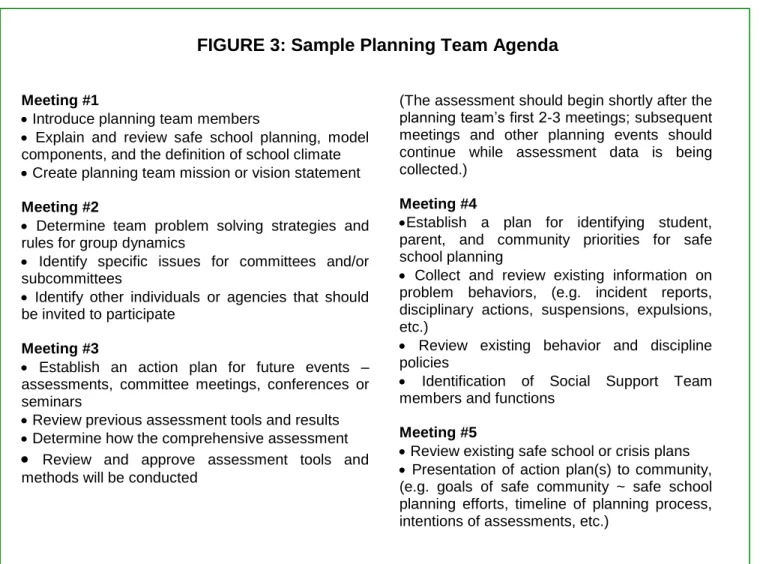
Though composing future agendas may seem like an efficient preparation method, it is important to keep in mind that safe school planning is not static, but is a process that may change over time. The schedule should allow for flexibility of meetings so that all pressing matters can be addressed as they emerge. Figure 3 is a sample planning team agenda for the team’s first five meetings.
When the Planning Team officially convenes, it should establish its mission statement and agree to the requirements necessary to actively participate as team members. The Planning Team should also determine what it perceives a ―safe school‖ to be, (i.e. behavior improvements, higher test scores, etc.).
The Planning Coordinator may deliver a synopsis of what a safe school climate is or the
Planning Team can offer ideas and
interpretations to what the group will collectively refer to as their vision for a safe community and school. Other topics that can be discussed (at a minimal level due to the fact that the community and school assessments will pose new questions and more thorough investigations) during these opening meetings are: How does the Planning Team’s definition of a safe school compare to the existing conditions of the school? What rules and regulations need to be recognized for the Planning Team to be able to function effectively? How will the Planning Coordinator and Planning Team evaluate its work and progress?
Meeting #1
Introduce planning team members
Explain and review safe school planning, model components, and the definition of school climate
Create planning team mission or vision statement
Meeting #2
Determine team problem solving strategies and rules for group dynamics
Identify specific issues for committees and/or subcommittees
Identify other individuals or agencies that should be invited to participate
Meeting #3
Establish an action plan for future events – assessments, committee meetings, conferences or seminars
Review previous assessment tools and results
Determine how the comprehensive assessment
Review and approve assessment tools and methods will be conducted
(The assessment should begin shortly after the planning team’s first 2-3 meetings; subsequent meetings and other planning events should continue while assessment data is being collected.)
Meeting #4
Establish a plan for identifying student, parent, and community priorities for safe school planning
Collect and review existing information on problem behaviors, (e.g. incident reports, disciplinary actions, suspensions, expulsions, etc.)
Review existing behavior and discipline policies
Identification of Social Support Team members and functions
Meeting #5
Review existing safe school or crisis plans
Presentation of action plan(s) to community, (e.g. goals of safe community ~ safe school planning efforts, timeline of planning process, intentions of assessments, etc.)
The Planning Coordinator and Planning Team may begin with a strong sense of its community support systems and services, while others may struggle to determine just what their school community includes and where it lies. Some suburban schools, for example, may draw students from different towns, or even counties. Private schools may also have to delineate what perimeters make up their larger community. This can be problematic when a school attempts to mobilize its school community and build a strong school-community partnership. The Planning Coordinator and Planning Team may wish to assess and redefine its community and, if necessary, discuss its role and possible opportunities for community capacity building. Community capacity building is a concept that many neighborhoods, towns and cities wrestle to understand and develop.
Community capacity is the combined influence of a community’s commitment, resources, and skills which can be deployed to build on community strengths and address community problems (Mayer, p.3). The Safe Communities ~ Safe Schools Model places the emphasis on the community as the responsible party for providing safe schools. Community problems are often manifested in the school; therefore, a school often reflects the major problems of its community. As a community works to strengthen itself, it will consequently help to strengthen the community’s school system. A possible committee of the Planning Team might be dedicated to community outreach and community capacity building. The issues of community mobilization and use of community resources is discussed further in the section of this Planning Guide dedicated to Violence Prevention Programs and Strategies.
COMMUNITY AND SCHOOL ASSESSMENT
Why the Assessment is Important
A critical component of comprehensive safe community ~ safe school planning involves conducting an annual community and school assessment (hereinafter referred to as the ―Assessment‖). The initial assessment will serve two functions. First, it will provide the Planning Team and the community with vital information about safety issues within the school and the community as a whole. Second, the initial assessment will become the benchmark against which future gains in safety resulting from the Safe Communities ~ Safe Schools Plan can be measured. This assessment process is similar to program evaluation; however, because the Safe Communities ~ Safe Schools Plan is more of a comprehensive framework instead of a specific program, CSPV uses the word Assessment. It is important to remember that although the term Assessment is singular, the actual Assessment that will be conducted is comprised of a variety of assessment tools addressing a broad area of safety concerns.
While safe community ~ safe school planning follows a standard process, all schools are unique. The Assessment should serve to highlight the unique strengths and weaknesses of each individual school, offering guidance for the Planning Team, the school as a whole and the community at large in their efforts to develop an individualized Safe Communities ~ Safe Schools Plan.
Another important function of the Assessment is the gathering of information and the creation of information gathering systems that can be used on a yearly basis to track progress toward meeting the objectives stated in the Safe Communities ~ Safe Schools Plan. School personnel, along with the Planning Team members, should regularly review the Plan in order to assess its effects and make adjustments
to accommodate the changing needs of the school and community.
The Assessment: Three Parts
The Assessment will cover three primary areas: pre-program evaluation, outcomes and process. The pre-program evaluation is aimed at evaluating existing resources for school security and violence prevention. The results of this component of the assessment will be used to identify strengths and weaknesses in the school’s or district’s existing system for ensuring student safety, will aid in developing priorities for action and will serve as the basis for the development of the Safe Communities ~ Safe Schools Plan. Some schools may also wish to conduct community surveys at this point in the process in order to examine community needs, priorities and resources for safe community ~ safe school planning. Six key areas will be addressed in the pre-program evaluation:
Security resources and physical safety: includes security personnel and equipment, building and site lay-out and the adequacy of intra-school communication systems.
Crisis Plan: includes a review of the emergency management and crisis response plans.
School and district policy: includes discipline codes, policies on the use of force,
class management policies, policies
regarding new teacher screening and teacher training, characteristics of the curriculum, the existing incident reporting system and policies regarding the management and reporting of threats and the continuum of care for all students.
Student resources: includes before- and after-school programs, available violence prevention resources, health and mental health services, social workers, school psychologists, individual assessment and intervention resources for high-risk and violent students.
Figure 2: Safe Communities ~ Safe Schools Planning Team* Figure 2: Safe Communities ~ Safe Schools Planning Team*
Special needs: includes the number and proportion of students in the school/district who are identified as learning disordered, high-risk (for violence) or emotionally disturbed.
School-community partnerships: includes
partnerships with law enforcement,
collaborations with community agencies and organizations and corporate partnerships. The second component of the Assessment is an outcomes assessment. The results of this component of the initial site assessment will be used as a benchmark against which the effects of the Safe Communities ~ Safe Schools Plan on school climate and safety will be measured. The outcomes assessment will address several or all of the following issues:
School climate: includes student perceptions of safety, feelings/attitudes toward the school, attitudes toward diversity and perceptions of the fairness of behavior codes and discipline policies, respect for authority, perceived norms for enforcement, student-teacher-administrator relationships,
relationships with peers, school
bonding/attachment, parent involvement in the school, the presence of graffiti, presence of gangs in school, overall condition of the school campus and teacher morale.
Violence and victimization: includes bullying, gang activity, school crime, rates of and attitudes toward violence, aggression and conflict, witnessing of violence at school, availability of firearms, and peer norms about fighting.
Other problem behaviors: includes drug and alcohol use, truancy, early sexual activity and teen pregnancy, and vandalism.
Mental health: includes depression, hopelessness and fatalism, risk factors for suicide and mental health diagnoses, such as Attention Deficit/Hyperactivity Disorder and Attention Deficit Disorder.
Protective factors: includes positive self concept, social competence, self-efficacy
with respect to conflict resolution,
involvement in conventional community activities, social responsibility, social support structures, bonding with family/peers/other adults, parental control, academic motivation, academic self-efficacy, aspirations for the future, involvement in school activities, religious involvement, family encouragement toward conventional behavior, parental acceptance, high parental expectations, and spending quality time with family.
Student achievement: includes attendance, grades, test scores and participation in academic activities.
Opportunities for students: includes participation in before- and after-school
programs and community-based youth
development programs and participation in and availability of employment opportunities for youth, participation in other school activities, and participation in leadership and decision-making opportunities.
Community perceptions of the school and its students: includes parent involvement in the school, parent attitudes toward the school and community attitudes toward the school and youth.
Community climate: includes community conditions, the rates of violence within the community (including family violence) and the proportion of students who have witnessed or been victims of violence in the community or at home, community cohesion, community perception of safety, family and
community values opposing violence,
presence of gangs in the community, availability of firearms, adult participation in community activities, and teens ―acting out‖ in the community.
The third component of the Assessment is the process assessment. This portion of the assessment will address the degree to which various stakeholders are involved in decision-making regarding school policies as a whole and the Safe Communities ~ Safe Schools Plan, in
particular. The process assessment will also measure the degree to which the Plan was administered in accordance with the Model. This information is crucial in understanding the effects of the Safe Communities ~ Safe Schools Plan on school climate and safety--interventions that are poorly delivered or implemented are less likely to have the intended effects. The process assessment addresses four aspects of the Model:
Collaboration and community
involvement: includes communication of the goals and objectives of the Model with community members, attendance at Planning Team meetings, community and minority representation at meetings and on the Planning Team, sense of ownership of the Safe Communities ~ Safe Schools Plan and communication of the Planning Team’s mission, goals and priorities to community members (and vice versa).
Training: includes attendance at training events and acquisition of appropriate skills.
Assessment: includes adherence to the stated timeline and protocol for data collection appropriateness of the selected assessment tools and the appropriate use of the data for evaluation and revision of the Safe Communities ~ Safe Schools Plan.
Implementation of violence prevention programs: includes the appropriateness of the chosen interventions, communication of the purpose and goals of the selected
interventions and adherence to the
intervention protocols.
Conducting the Outcomes Assessment: Seven Steps
The Assessment will require the dedication of considerable resources and expertise. CSPV Field Representatives will be available to provide guidance and expertise throughout this process. The pre-program evaluation is essentially a review of existing resources and will not require the collection of new data. For the most part, the process assessment can also be
based on existing data, such as meeting minutes and attendance lists. The outcomes assessment, on the other hand, will be based mainly on new data collected in the form of surveys completed by students, teachers, administrators and/or parents. Given the breadth of the outcomes assessment and the number of individuals involved, this will be a lengthy process. Certain schools may wish to administer the outcomes assessment in two parts, each covering different measurements with a few repeated questions to determine test-retest reliability--a measure of how reliably a survey measures the outcomes it is designed to measure.
The outcomes assessment can be broken down into seven steps. These steps will apply also to the collection of new data (such as satisfaction surveys) during the process assessment.
Step 1: Define the problems and goals
The pre-program evaluation will provide the information needed to identify strengths and weaknesses in the school’s or district’s existing system for ensuring student safety, which can then be used to develop priorities for action. Once these priorities are developed, the Planning Team will need to identify the specific problems to be addressed in the Safe Communities ~ Safe Schools Plan and the goals for addressing these problems.
Example:
Problem: Students are reporting a high rate of bullying.
Goal: Implement Bullying Prevention Program
Step 2: Specify the research objectives and outcomes
Once the goals are set, the Planning Team will need to specify specific objectives that can be used to measure whether or not the goals were achieved. For each problem issue identified there will be several goals, and for each goal there should be several measurable objectives. The objectives should be both specific and
reasonable, and, when possible, based on prior results with similar programs.
Example:
Goal: Implement Bullying Prevention Program Objective: Students will report 10% fewer instances of bullying activities after 1 year.
Step 3: Choose the evaluation tools
Before choosing the evaluation instruments, the Planning Team should gather all secondary
resources—information that is already
available—that may be used to measure the stated objectives. Some examples of these types of information include data collected on office referrals, attendance records and standardized test scores. Surveys will be needed to evaluate any objectives not already addressed with these other sources of information. The Planning Team may also wish to use both a survey and a secondary resource to evaluate some of the most critical objectives, since having multiple sources of data strengthen later assertions that Team’s efforts have had a positive effect.
When choosing the evaluation tools, care should be taken to ensure that developmentally and culturally appropriate tools are selected. Other issues to consider include the ease of use (is the scale or set of scales too long or difficult to understand?), reliability and validity, and the availability of community, state or national norms. Based on the pre-program, outcome and process measures described above, CSPV has gathered a series of assessment instruments that schools may choose from to evaluate their specific objectives. For some of these instruments, information on reliability and validity are available, while for others these characteristics have not been assessed. The reliability of an assessment instrument refers to its ability to achieve consistent results, while validity indicates that the instrument truly measures the outcomes it proposes to measure.
Step 4: Address issues of consent and confidentiality
Participation in surveys and other studies where students/teachers answers or responses are not anonymous must be voluntary. For any study where individual data can be linked to a specific participant, the federal government requires that informed consent be obtained from each participant. The purpose of the informed consent is to protect study subjects from unknowingly participating in research and to insure that they know their right to withdraw or limit participation without penalty or repercussion. For research involving minors, consent must be obtained from both the child and a parent or guardian.
Informed consent may be obtained in two ways: passive or active. In either case, the purpose of the assessment, the types of questions that will be asked, the risks associated with participation and the right to refuse to complete the survey or any of its specific questions must be clearly communicated to all participants (students, teachers, parents, etc.). If active consent is required, each participant (and parent/guardian for minors) must also sign a written statement indicating his or her understanding of the project’s goals and methods and willingness to participate. With passive informed consent, participants (and parent/guardian for minors) must formally decline or express their decision not to participate. Failure to decline is assumed to be a positive consent to participate, and completion of the survey is used in lieu of a signed written statement to indicate informed consent.
Once consent is obtained, steps should be taken to ensure confidentiality of results. Such steps may include instructing participants not to write their names on the surveys and reporting only summary data, with no individual-level data or identifiers such as grade, gender or position.
Step 5: Collect the data
Once steps 1 through 4 have been completed, the Planning Team can develop a specific protocol for collecting the data. This protocol should specify the persons who will be in charge of administering the surveys or interviews, when and where the surveys/interviews will be administered and a timeline for their completion. The protocol should also include instructions for completing the survey/interviews, the specific questions to be asked and, for surveys, response options. The data should be collected in accordance with this protocol.
Step 6: Analyze the data
Once the data are collected, data entry and analysis must be made for the initial site assessment to be complete. During assessments, CSPV will be available to offer assistance on data coding management, entry, and analysis as the need arises.
Data analysis can take on two forms: descriptive and analytical. Descriptive analysis involves the calculation of frequencies, means, percentages, rates, etc. (measures of central tendency) for specific questions or scales. For example, the proportion of students who reported bringing weapons to school in the last year, the number of bomb threats at a specific school during the past semester and the violent crime rate in the surrounding community are all descriptive statistics. Analytical data analysis, on the other hand, is used to identify relationships between different measures used in the assessment. For example, analytical analysis may be used to determine if students who bring weapons to school are more likely than other students to be involved in fights or to have poor grades.
Step 7: Interpret and disseminate the findings
The most important step in the Assessment will be the dissemination of the assessment results. The findings should be summarized in a relevant, simple and brief report that includes an
interpretation of the pattern of findings, particularly with respect to how they relate to school safety. For example, a consistent finding that elementary school students are being bullied in areas where there is minimal adult supervision—in the school yard or specific hallways—may lead to the interpretation that additional adult supervision is needed in these areas.
The Assessment report should be disseminated to all individuals involved in the safe community ~ safe school planning process, and should be used to make specific adjustments in the Safe Communities ~ Safe Schools Plan. In addition, the results of the initial outcomes assessment will serve as a starting point for assessing progress in achieving targeted changes. With each annual review of the community’s and school’s safety efforts, the Planning Team will have additions and new information to be used for prioritization of important issues affecting the safety of students, staff and community members and evaluating the effectiveness, efficiency and appropriateness of the Planning Team’s efforts. CSPV is in the process of collecting and reviewing numerous assessment tools. Many of these tools will be provided and discussed in a publication currently being developed. CSPV will make this document of assessments available to the public once completed.
VIOLENCE PREVENTION STRATEGIES AND PROGRAMS
The Planning Coordinator and Planning Team are responsible for developing and implementing an inclusive Safe Communities ~ Safe Schools Plan. The violence prevention strategies and programs that will be implemented in response to the needs of the school community will become an integral component of the plan. The plan will typically incorporate all of the components of the Safe Communities ~ Safe Schools Model and should be developed after information from the assessment has been collected and analyzed (perhaps with the technical assistance of an outside resource agency). Since the plan must be comprehensive, it should address a variety of school climate issues, such as the conditions of the school grounds and facilities, the relationships between
school professionals and parents or community members, levels and location of victimization events, and school pride among students. The Planning Team should develop a plan that meets the needs identified in the annual community and school assessment and specify strategies and programs that will be implemented to enhance the school climate.
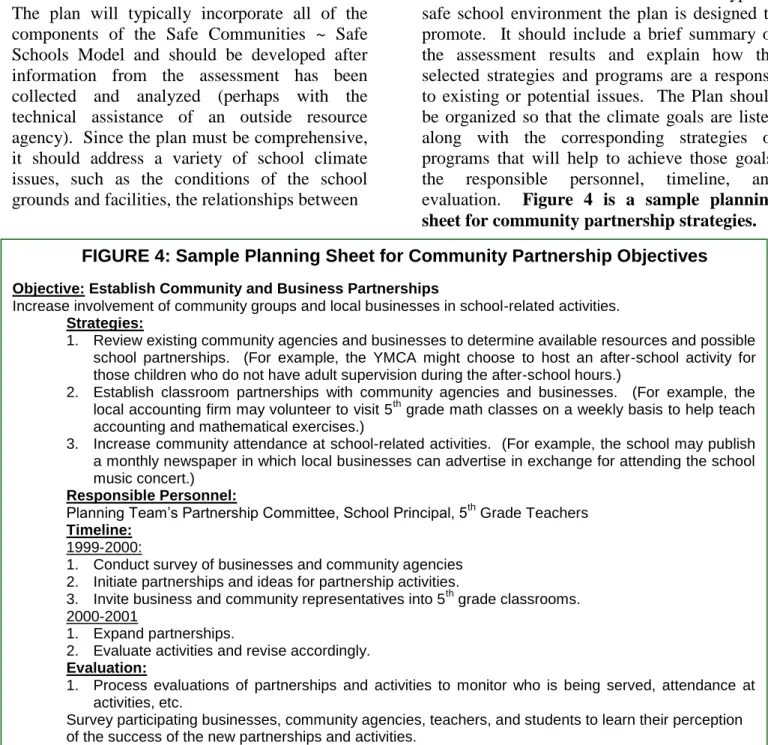
The Plan should begin with the Planning Team’s mission statement and definition of the type of safe school environment the plan is designed to promote. It should include a brief summary of the assessment results and explain how the selected strategies and programs are a response to existing or potential issues. The Plan should be organized so that the climate goals are listed along with the corresponding strategies or programs that will help to achieve those goals,
the responsible personnel, timeline, and
evaluation. Figure 4 is a sample planning sheet for community partnership strategies. FIGURE 4: Sample Planning Sheet for Community Partnership Objectives
Objective: Establish Community and Business Partnerships
Increase involvement of community groups and local businesses in school-related activities.
Strategies:
1. Review existing community agencies and businesses to determine available resources and possible school partnerships. (For example, the YMCA might choose to host an after-school activity for those children who do not have adult supervision during the after-school hours.)
2. Establish classroom partnerships with community agencies and businesses. (For example, the local accounting firm may volunteer to visit 5th grade math classes on a weekly basis to help teach accounting and mathematical exercises.)
3. Increase community attendance at school-related activities. (For example, the school may publish a monthly newspaper in which local businesses can advertise in exchange for attending the school music concert.)
Responsible Personnel:
Planning Team’s Partnership Committee, School Principal, 5th
Grade Teachers
Timeline:
1999-2000:
1. Conduct survey of businesses and community agencies 2. Initiate partnerships and ideas for partnership activities.
3. Invite business and community representatives into 5th grade classrooms. 2000-2001
1. Expand partnerships.
2. Evaluate activities and revise accordingly.
Evaluation:
1. Process evaluations of partnerships and activities to monitor who is being served, attendance at activities, etc.
Survey participating businesses, community agencies, teachers, and students to learn their perception of the success of the new partnerships and activities.
If bullying is identified as a problem, the Safe Communities ~ Safe Schools Plan should include strategies that will decrease or eliminate the incidents of bullying at the school level and throughout the community. The assessment may also reveal that middle school students bully elementary students as they ride to and from school on the school bus. One immediate strategy to protect the physical well being of the younger children might be for a parent volunteer to ride the bus and monitor the interaction between the students. In addition, the school community may choose to implement a long-term, school-based or community-based program to deal with the roots of bullying and prevent future problems. By applying both of these strategies, students’ physical and emotional needs are more likely to be satisfied.
Some other general strategies to consider are:
Establish a clear Code of Behavior that includes the rights and responsibilities of both
adults and students within the school
community.
Include all youth in positive, rewarding activities and relationships at school.
Review federal, state, and local statutes pertaining to student management and school order with the school district lawyer as well as review relevant school and district policies.
Establish a parent or volunteer organization (if one does not already exist) to help mobilize school neighbors and parents.
Control campus access and establish uniform visitor screening procedures.
Keep an accurate and detailed record of all community and school crime incidents.
Keep an accurate record of office referrals, disciplinary actions, attendance, grades, and standardized test scores.
Align and integrate violence prevention into academic curricula, (e.g. the state of Colorado content standard for Geography could be addressed by studying the violence prevention efforts of other regions and cultures).
Develop community-based before and after-school programs for youth that are otherwise unsupervised during the early morning and late afternoon hours.
Promote an ongoing relationship with local law enforcement authorities, local businesses, and other community organizations.
Provide a community and school or district hotline that can be accessed anonymously to report a threat or pending violent incident.
Establish guidelines and procedures for identifying students at risk of violence towards themselves or others.
Select appropriate violence prevention
programs that meet the needs of the school community, including both in-school programs and community-based programs appropriate for referring students and families. The Center for the Study and Prevention of Violence has examined the published evaluations of over 500 violence and crime prevention programs. Using a very stringent set of criteria, CSPV identified highly effective Model programs and Promising programs, which are commonly referred to as
CSPV Blueprints Model and Promising
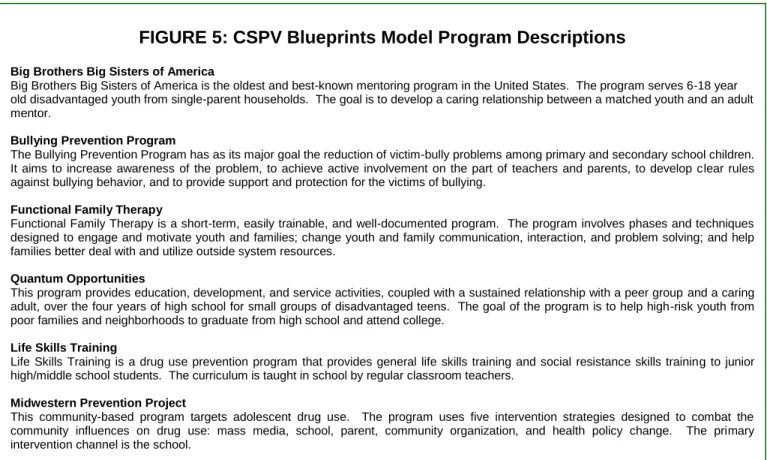
programs. Figures 5 and 6 list all of the Blueprints Model Programs and Blueprints Promising Programs.
FIGURE 5: CSPV Blueprints Model Program Descriptions
Big Brothers Big Sisters of America
Big Brothers Big Sisters of America is the oldest and best-known mentoring program in the United States. The program serves 6-18 year old disadvantaged youth from single-parent households. The goal is to develop a caring relationship between a matched youth and an adult mentor.
Bullying Prevention Program
The Bullying Prevention Program has as its major goal the reduction of victim-bully problems among primary and secondary school children. It aims to increase awareness of the problem, to achieve active involvement on the part of teachers and parents, to develop clear rules against bullying behavior, and to provide support and protection for the victims of bullying.
Functional Family Therapy
Functional Family Therapy is a short-term, easily trainable, and well-documented program. The program involves phases and techniques designed to engage and motivate youth and families; change youth and family communication, interaction, and problem solving; and help families better deal with and utilize outside system resources.
Quantum Opportunities
This program provides education, development, and service activities, coupled with a sustained relationship with a peer group and a caring adult, over the four years of high school for small groups of disadvantaged teens. The goal of the program is to help high-risk youth from poor families and neighborhoods to graduate from high school and attend college.
Life Skills Training
Life Skills Training is a drug use prevention program that provides general life skills training and social resistance skills training to junior high/middle school students. The curriculum is taught in school by regular classroom teachers.
Midwestern Prevention Project
This community-based program targets adolescent drug use. The program uses five intervention strategies designed to combat the community influences on drug use: mass media, school, parent, community organization, and health policy change. The primary intervention channel is the school.
Multisystemic Therapy
This program targets chronic and violent juvenile offenders and specific factors in each youth’s and family’s environment (family, peer, school, neighborhood) that contribute to antisocial behavior. The goal of the intervention is to help parents deal effectively with their youth’s behavior problems, including deviant peers and poor school performance.
Prenatal and Infancy Home Visitation by Nurses
Nurse home visitation is a program that sends nurses to homes of pregnant women who are predisposed to infant health and developmental problems in order to improve parent and child outcomes. Home visiting also promotes the cognitive and social-emotional development of the children, and provides general support and parenting skills to the parents.
Promoting Alternative Thinking Strategies
Promoting Alternative Thinking Strategies (PATHS) is an elementary school-based intervention designed to promote emotional competence, including the expression, understanding and regulation of emotions.
Multidimensional Treatment Foster Care
This program is an effective alternative to residential treatment for adolescents who have problems with chronic delinquency and anti-social behavior. Community families and trained to provide placement, treatment and supervision to participating adolescents.
FIGURE 6: CSPV Blueprints Promising Program Descriptions
Baltimore Mastery Learning and Good Behavior Game Intervention
These interventions improve elementary school children’s academic achievement and prosocial behavior. The Mastery Learning curriculum targets group-based learning and student reading skills, while the Good Behavior Game combats disruptive and problem classroom behaviors.
Children At Risk (CAR)
This program seeks to decrease individual, peer group, and family and neighborhood risk factors through case management services, after-school and summer activities, and increased police involvement. CAR also works to improve attachment to adults, attachment to prosocial norms, school performance, and participation in prosocial activities/peer groups.
FAST (Families and Schools Together) Track Program
FAST Track is a comprehensive, six-year school-based program that reduces children’s anti-social behavior. Its components include parent training, home visitation, social skills training, academic tutoring, and a multidimensional elementary school curriculum.
FIGURE 6: CSPV Blueprints Promising Program Descriptions (Continued)
Intensive Protective Supervision Project
The Intensive Protective Supervision Project (IPSP) provides non-violent adjudicated youth with an alternative to institutionalization. In order to decrease future, serious delinquency, project counselors closely supervise the offenders, maintain close contact with their families, and identify additional professional and therapeutic services when necessary.
I Can Problem Solve (ICPS)
This universal, school-based curriculum enhances children’s problem-solving skills and peer relationships by teaching participants to evaluate conflict situations and the feelings and motives that created them, develop alternative solutions, and consider the consequences of their behavior.
Iowa Strengthening Families Program
This universal, family-based program enhances parents’ general management skills, parent-child affective relationships, and family communication. By increasing these protective family processes and strengthening children’s peer resistance and refusal techniques, the intervention delays the onset of adolescent alcohol and substance use.
Parent Child Development Center Programs
These programs offer low-income mothers a wide range of support services to combat the many social problems that can accompany poverty. Project staff teach mothers about their children’s development, provide training in home management and child-rearing techniques, and share community resource and adult education opportunities.
Perry Preschool Program
The Perry Preschool provides disadvantaged children with two years of high-quality early education. Its success in decreasing delinquency and improving later life experiences lies in the following key components: small classroom size, trained staff who provide close supervision and encourage parent involvement, and sensitivity to children’s non-educational needs.
Preparing for the Drug-Free Years
This family competency training program promotes healthy and protective parent-child interactions and reduces adolescent initiation into alcohol and drug use. Parents learn to manage anger, reduce family conflict, set appropriate guidelines regarding children’s substance use, and provide effective discipline practices, and children are trained in peer resistance skills.
Preventive Intervention
Preventive Intervention targets at-risk adolescents to prevent delinquency, substance use, and school failure. Project staff and teachers monitor students’ school performance, inform parents of their children’s progress, and reward participants for school attendance and prosocial behaviors.
Preventive Treatment Program
This program focuses on youth who display early, problem behavior. Parents are taught to monitor children’s behavior, provide positive reinforcement, use effective discipline, and manage family crises, while children practice self-control and model prosocial behaviors. Project Northland
Project Northland allows students, teachers, parents, and community members to collaborate in preventing adolescent alcohol use. Its intervention strategies include a school curriculum, parent involvement, a community task force, and a peer participant program.
Project PATHE (Positive Action Through Holistic Education)
Project PATHE encourages school staff, students, parents, and community members to work together to improve schools’ academic weaknesses, discipline policies, and climate. At-risk students receive additional monitoring to improve their academic success, social bonds, self-concept, and healthy behaviors.
School Transitional Environmental Program (STEP)
The STEP program seeks to make transitions between schools less stressful. Incoming students are assigned to homerooms where teachers provide extra guidance and increased communication with parents, and participants are enrolled in a core group of classes with the same students to foster stable peer groups and reduce social isolation.
Seattle Social Development Project
This universal intervention provides on-going training for students, teachers, and parents to increase children’s prosocial bonds and decrease delinquency. Instructors improve their classroom management and interactive teaching skills; students learn communication, decision-making, and conflict resolution techniques; and parents are encouraged to improve their discipline and supervision strategies and increase their communication with teachers.
Syracuse University Family Development Research Program (FDRP)
This multi-year intervention strengthens child and family functioning for low-income participants. Project staff make frequent home visitations to provide mothers with social support, parent training, and prosocial role models. Children attend a day care program that utilizes cognitive and interactive games and positive reinforcement to emphasize cooperation and caring.
Yale Child Welfare Project
The Yale Child Welfare Project offers disadvantaged parents personalized support for their newborn and infant children. Its interventions include home visitations, pediatric medical care, day care services, and regular, physical exams to assess children’s development.
Program Recommendations
CSPV has developed three levels of program recommendation. As stated, the Blueprints Model Programs are those which meet and maintain the most stringent set of research and evaluation criteria. CSPV has the highest confidence in the Blueprints Programs. The Blueprints selection criteria include: (1) an experimental design, (2) evidence of statistically significant (or marginal) deterrent effect, (3) replication at multiple sites with demonstrated effects, and (4) evidence that the deterrent effect was sustained for at least one year post treatment. Scientific evaluation is currently underway for a number of programs and several have met the first two selection criteria but are not far enough along in the evaluation process to determine issues of sustained effect or successful multiple site replication. CSPV refers to these as Promising Programs, which may likely after further evaluation, meet CSPV Blueprints standards and become Blueprints Programs. The Promising Programs have been relatively successful in reducing the risk factors related to delinquency, drug abuse and/or violence. CSPV considers the Promising Programs as the second level of program recommendation and believes that these programs can be quite successful with appropriate implementation and evaluation.
Other research agencies have identified
additional programs as being successful violence
prevention programs. These typically
demonstrate reductions in risk factors or enhancement of protective factors that can be attributed to program activities. The third level of recommendation regards those programs that satisfy other research standards of such agencies as the Office of Juvenile Justice and Delinquency Prevention and the U.S. Department of Education, (see Safe Schools, Safe Students: A
Guide to Violence Prevention Strategies). These
general guidelines of strong programs are as follows:
Meta-analysis findings of the programs conclude that they do ―work.‖
The programs are contextual, multi-domain and risk/protective factors focused.
The programs are theoretically justified and research based.
There are currently great advancements being made in violence prevention program research. The identification of successful programs provides significant support to communities and schools interested in operating cost-effective prevention efforts. While careful, scientific evaluations of these programs are still quite limited, research has succeeded in demonstrating the effectiveness of selected programs in preventing or deterring crime and violence. It is known that these programs work, i.e., that participation in these programs or interventions substantially reduces the likelihood that youth will become involved in violent behavior (onset), or if previously involved in violence, that their
rates of offending or the seriousness of their
offending will be reduced. Evaluations have also demonstrated that some very popular programs are ineffective and that a few are actually harmful, putting youth at an even greater risk of involvement in serious violent behavior. The Planning Coordinator and Planning Team should be extremely thorough when investigating
programs they are considering for
implementation.
In general, individual-level approaches that modify or enhance personal and social competencies like problem-solving skills, moral reasoning, decision-making skills, self-control and academic or job-related skills can be effective if they are high quality, well implemented programs. The evidence for programs that focus on family relationships and functioning, particularly on family management and parenting practices is quite strong and consistent. There are some school-based programs that are quite successful (e.g. PATHS,
however, most programs currently being implemented have not yet been evaluated or have been found to be ineffective. Therefore, it is recommended that schools invest their time and financial resources into implementing those programs that have demonstrated effectiveness, or be prepared to conduct their own evaluations of the program. Based on the stringent criteria used by CSPV in its search for model and promising violence prevention programs, peer
mediation, peer counseling and conflict
resolution training programs have only limited evaluations, but none appears to be effective, particularly when they are implemented as single-component programs. They appear more promising when implemented as part of a more
comprehensive, multi-contextual intervention. School programs that address both individual competencies and contextual reinforcements are more effective than those addressing only one dimension.
Some community-based programs that appear to have significant deterrent effects include the use of directed police patrols in community ―hot spots,‖ mentoring programs, and gang violence prevention programs. There is little evidence that traditional institutional programs such as
diversion, boot camps, wilderness/stress
programs, shock/scare programs, positive peer culture or guided group interaction programs are effective.
SOCIAL SUPPORT TEAM
The purpose of the Social Support Team is to help improve the social climate of the school and address the needs of students at risk by identifying and managing individual student cases. It serves as an information gathering and decision making mechanism that is extremely valuable to a school community’s ability to meet the emotional and developmental needs of its students. The team is to be composed of both school and community professionals who possess the training and experience necessary for identifying and evaluating warning signs, exploring the likelihood of possible dangerous
situations, and then making collective
recommendations for treatment or intervention programming.
The Planning Coordinator and the Planning Team should establish the Social Support Team. Its members may include: the Planning Coordinator or district Safe and Drug-Free
school coordinator, school administrator,
community-based mental health professional, school counselor or psychologist, social worker, local law enforcement official, school resource
officer, social services provider, public
healthcare worker, and a legal advisor. This is not an all-inclusive list, as each Planning Team will recognize its community’s unique resources that should also be included. The Social Support Team should have at least three non-school professionals who are able to contribute objective assessments due to their more removed relationship with the school. Unlike the Planning Team, parents, teachers, and students should not be members of the Social Support Team due to issues of sensitivity and confidentiality. The way the Social Support Team is intended to operate is as follows:
1. Students, school personnel, parents,
community members, and ―hot-line‖
operators report concerns or incidents to a Social Support Team member. There should be a designated contact person (and
established referral form or mailbox, hotline, etc. to allow for anonymity) within each school to receive information and report it to the team. Reporting procedures should be carefully considered so that it is clear and efficient for those who need to give information to the Social Support Team to do so. A member of this team may want to act as the team facilitator or coordinator who will be responsible for the team’s communication with the public. This person would need to be responsible for the team’s meeting logistics, including the arrangement of interviews with parents or students, keeping of minutes, screening of initial referrals/reports, and the gathering of other team members for emergency meetings. An administrative assistant may also be able to assist with the logistical coordination.
2. The Social Support Team reviews ―cases‖ on
a biweekly or monthly basis, but can be called into an emergency meeting if the need arises. The team decides how to monitor and track specific cases, with the understanding that a computer database or paper trail may
be problematic due to matters of
confidentiality.
3. The Social Support Team determines
whether more information needs to be gathered such as interviews with other students, parents, etc. or if it will continue to monitor the incoming reports. At this point, police records, school discipline reports, medical reports and mental health records are also to be disclosed to ensure that the team is
aware of all pertinent background
information. Proceedings and information held by the Social Support Team are to be strictly confidential in order to protect the privacy of students and their families. Public disclosure of information could perpetuate unwarranted and harmful stereotyping, and further stigmatize students.
4. The Social Support Team sets for each case an individualized plan that could include