The life and contribution of Dr. Ronald Gitelman:
a pioneer of modern chiropractic science
Howard Vernon
DC, PhD, FCCS, FCCPOR, FICC*Objective: The life and contribution to chiropractic science of Dr. Ronald Gitelman is reviewed.
Methods: Sources for this article included review of the notes prepared by Dr. Joseph Keating in his “biography” of the Canadian Memorial Chiropractic College (CMCC); review of the important articles published by Dr. Gitelman; review of the important projects undertaken by him along with various colleagues; notes from reminiscences obtained from many of these colleagues and discussions with his family.
Discussion: Dr. Gitelman’s academic career spanned
from 1963 to the late 1980’s. During that time, he made foundational contributions to the development of chiropractic science including: developing the
Archives (1974), the first collection of scientific
articles supporting chiropractic science (which was subsequently published as the Chiropractic Archives Research Collection (CRAC)); delivering one of the few chiropractic papers at the seminal NINCDS conference (1975) and, developing the collaboration between CMCC and Dr. Kirkaldy-Willis at the University of Saskatoon (1976). He practiced in Toronto from 1961 to 2007.
Summary: Dr. Gitelman was a pioneer in the
development of chiropractic science. He died on October 7, 2012.
k e y w o r d s : Gitelman, NINCDS, pioneer
*Canadian Memorial Chiropractic College
6100 Leslie Street, Toronto, Ontario, Canada, M2H 3J1 [email protected]
©JCCA 2013
Objectif: Analyse de la vie du Dr Ronald Gitelman et de sa contribution à la science chiropratique.
Méthodologie : Les sources de cet article comportent notamment l’examen des notes préparées par le Dr Joseph Keating dans sa « biographie » du Canadian Memorial Chiropractic College (CMCC), l’examen des articles importants publiés par le Dr Gitelman, l’examen des projets importants qu’il a entrepris avec divers collègues, les notes obtenues à partir des souvenirs de beaucoup de ces collègues et des discussions avec sa famille.
Discussion : La carrière universitaire du Dr
Gitelman a englobé la période de 1963 jusqu’à la fin
des années 1980, pendant laquelle il a contribué de façon fondamentale au développement de la science chiropratique, notamment par : l’organisation des archives (1974), la première collection d’articles
scientifiques à l’appui de la science chiropratique (qui
a ensuite été publiée dans le cadre de la collection Chiropractic Archives Research Collection (CRAC)); la présentation d’un des rares articles chiropratiques à la conférence NINCDS (1975); et, le renforcement de la collaboration entre le CMCC et le Dr Kirkaldy-Willis à l’Université de Saskatoon (1976). Il a exercé la chiropratique à Toronto, de 1961 à 2007.
Résumé : Dr Gitelman était un pionnier dans le développement de la science chiropratique. Il est décédé le 7 octobre 2012.
Introduction
On October 7, 2012, the chiropractic profession lost one of its greatest scientific founders – Dr. Ronald Gitelman. As a patient, colleague and friend, I knew Dr. Gitelman from 1971-2012. I was close to him as he achieved some of his greatest accomplishments and I witnessed how much he impacted the development of chiropractic science in the modern era. I hope this article provides a proper memorial for the sake of those who knew or knew of him. For those who are not aware of his career, I hope it provides an op-portunity to posthumously meet someone to whom all of the chiropractic profession should be most grateful. Methods
This article is based on a number of sources including: review of the notes prepared by Dr. Joseph Keating1 in his
“biography” of the Canadian Memorial Chiropractic Col-lege (CMCC); review of the important articles published by Dr. Gitelman; review of the important projects under-taken by him along with various colleagues; notes from reminiscences obtained from many of these colleagues and discussions with his family.
Results and Discussion The early years
Dr. Gitelman was born in 1937 in the town of Trenton, Ontario, about two hours east of Toronto. He grew up lov-ing the outdoors. This love would stay with him for the rest of his life.
Ron was a natural athlete. Playing tennis as a teen, he developed a shoulder problem and the orthopaedic spe-cialist in Kingston, Ontario told him an operation was needed and that that would be the end of his tennis ca-reer. Ron could not accept this so he rode his bike up the mountain to the “strange man’s” office. The kids had al-ways called him a quack and said he broke bones but Ron thought perhaps this man could save him. His name was Dr. Halett. He was Trenton’s chiropractor. He examined the shoulder and had Ron back on the courts, free of pain in two weeksa.
That encounter ignited the spark that led Ron to the Canadian Memorial Chiropractic College. He entered CMCC in 1956. During his student years, he was already
a My appreciation to Mrs. Joan Gitelman for this anecdote.
showing signs of the kind of career he would eventually forge. One of his close friends, Dr. Len Faye, recounts the following anecdote:
“Did you know as a student, he got an introduc-tion from (Dr.) Herb Vear, to the U of T (Univer-sity of Toronto) medical pathology department and he learned to prepare pathology slides that he then produced in a special lab at CMCC? We all studied from Ronnies’ slides, with the new microscopes the college also purchased. In the end, the U of T department were using his slides as well for the medical students. He became a master at it, like most other things he got interested in”.
Ron required an extra year to graduate, owing to a health scare that turned out to be a false alarm. He gradu-ated CMCC in 1961. According to the records summar-ized in Keating’s work1, by 1963 Dr. Gitelman had
be-come a member of the Board of Directors of the College. His career as an upstart in the profession was well under-way! It appears from these records that Dr. Gitelman was given assignments on the Board that clearly related to the scientific support of chiropractic. The leadership of CMCC appears to have understood that it was critical to the success of the College and the Canadian profession that the profession “get its scientific house in order”. Pres-sures from external sources such as the Ontario medical profession and the Ontario government were requiring that chiropractic account for itself and properly enter the realm of legitimate, science-based health care professions. Some of this pressure came in the form of governmental inquiries into chiropractic; some involved the effort of Ontario chiropractors to obtain inclusion in the provincial “medicare” system. Otherwise, the natural maturation of the profession drove this effort to modernize the science of chiropractic, and Dr. Gitelman was front and center in this effort at CMCC.
device to measure skin temperature over the spine – the Syncrotherme. It was thought at the time that this device would overcome some of the deficiencies of older devices such as the neurocalometer, and provide valid insight into the function of the autonomic regulation of spinal blood flow. Dr. Gitelman led an effort to review the usefulness of this new device and to develop studies using it.
In 1969, Dr. Scott Haldeman joined the CMCC and began to participate in these efforts. He recalled that there were a number of scientific papers on spinal function and on autonomic regulation of the spine in the office housing the Syndrotherme.
“When I arrived they asked me to do research on the Synchrotherme. CMCC had spent a lot of money developing the instrument. I cannot recall everyone involved but it included Ron, Adrian (Grice), Dave Drum and others. They were very enthusiastic about somatovisceral reflexes and had a broad vision that was often illustrated in Dave’s drawings. There was a large stack of research pa-pers in a cupboard that had been collected and piled in a corner and I spent time reading them. We had monthly meetings that were basically reviews of research papers.”
Dr. Haldeman went on to author two papers on the Syn-crotherme2,3, however, CMCC’s interest in this device
faded as the 1970’s began.
1970-1986:
Dr. Haldeman recalled that the monthly research meet-ings “eventually led to discussion on forming the CCS. We continued with these discussions which eventually led to the formation of the FCCS that we all decided to grand-father into.” Here, he is referring to the development of one of the first two “Specialty” Colleges in Canadian chiropractic, the College of Chiropractic Clinical Sci-ences (CCS) whose members were conferred the status of “Fellows”. Dr. Gitelman was one of the driving forces behind the development of this College which has been in existence ever since as a major source of scholarship and expertise in the Canadian chiropractic profession. The success of this College, and its Residency programme at CMCC (the first of its kind in chiropractic) in develop-ing teachers, graduate education at CMCC, researchers
and chiropractors who contributed greatly to policy de-velopment and other leadership within the profession is a wonderful testament to the vision Dr. Gitelman and his colleagues espoused at the start of the 1970’s.
Dr. Haldeman’s reference to “monthly meetings to dis-cuss research papers” speaks to the other critical develop-ment undertaken by Dr. Gitelman in the early 1970’s. Several of the founding CCS Fellows appear to have been dismayed at the lack of an organized collection of scientific information, in the form of published articles, on chiropractic. They talked about ways to remedy that situation and, in 1972, Dr. Gitelman undertook one of his most important endeavours – the development of the “Ar-chives”4.
Ron is on record as acknowledging the inspiration for this effort as coming from one of the founding Fellows – Dr. J. O. Edgar Houle, then a teacher at CMCC. Ron pro-posed to formally and systematically collect all of the lit-erature that supported the science of chiropractic. He got assistance from the CMCC Library Staff (especially Ms. Claire Callaghan) and he organized a small group of sen-ior students to assist him. In short order, this group began to manually search all of the journals to date which might contain relevant articles, including standard journals such as the Journal of Bone and Joint Surgery, Clinical Ortho-pedics and Related Research, the Journal of the American Osteopathic Association and others. Also included were the profession’s in-house journals such as the ACA Jour-nal, the Swiss Annals, the Journal of the Canadian Chiro-practic Association and others. Every potential article found by the team was reviewed by Ron for relevance to the project and, if that was found, a permanently housed copy was made along with an abstract, typed by hand onto an index card which was numbered and stored in a separate database. Remember, this was in the era before any computers for word processing and filing!
In his Preface to the 1974 publication of “The Ar-chives”, Dr. Gitelman stated:
fifty years earlier, the term “unscientific cult” would never have been levelled against chiropractic”. Ron described the work of the team as “extensive litera-ture searches, translating the abstracts, annotating an au-thor index and devising a key word index that would han-dle the diverse topics of this publication”. This key word index was, itself, 20 pages long, while the total number of articles included in the 1974 edition was 914. Dr. Gitel-man acknowledged the support of both of the Ontario and Canadian Chiropractic Associations as well as CMCC. Indeed, The Archives was published as a CMCC product with the following editors: Drs. R. Gitelman, G. G. Mur-doch, B. E. Embree and V. G. Dyck, the last three men being recent CMCC graduates.
Dr. Gitelman’s summary of The Archives project was amazingly visionary:
“We are entering a new era in chiropractic, a scien-tific era, ushered in by the work of chiropractors, osteopaths, medical doctors and scientists. Many researchers….are working in parallel fields and are not aware that the product of their research is sup-portive to chiropractic science. The accumulated literature in this volume will bear tangible evi-dence to this fact”
The Archives was published in a plastic, three-ring binder! It became an instant hit at CMCC. As a student from 1973 – 1977, I can attest to this, as we began to regularly consult this invaluable resource for our educa-tion. The very idea that there was supportive literature that went beyond the pronouncements of our teachers was thrilling. Much time was taken up searching the indexes (subject and author), identifying stimulating studies and photocopying them in whole. I still have some of these papers!
As the methods of publication matured in our profes-sion, and as the era of computers dawned, The Archives was re-published in the early 1980’s by CMCC as the Chiropractic Research Archives Collection – CRAC! The first of four soft-bound volumes was published in 1984 and the last in 1986. In all, 6000 articles were collected. Figure 1 shows Dr. Gitelman around that time with one of his heroes, Dr. Joseph Janse.
Looking back, it is obvious that this monumental
ef-fort presaged the development of the computer databases that were to come. Indeed, the Index to Chiropractic Lit-erature emerged in the mid-1970’s, first as hard-bound volumes and, later, as a web-based database. Not long after the last CRAC volume, the Index to Medical Litera-ture (later PubMed) blossomed into the largest electronic database in health science, eventually including, first, the Journal of Manipulative and Physiologic Sciences (born in 1978) and then, later, numerous other chiropractic and manipulation-related journals (including the JCCA!). The CMCC Archives is now, indeed, in the CMCC archives! Dr. Haldeman had the following recollection about the next important development in Dr. Gitelman’s career:
“I was invited to be a member of the NINCDS committee that organized the (1975) conference. When I searched the literature and visited multiple colleges I had difficulty identifying any clinicians who had some understanding of the literature and the ability to provide a presentation that would be coherent to a wide audience. I fell back on my ex-perience at CMCC and nominated Adrian (Grice) and Ron (Gitelman). My recommendations were accepted by the committee and they did an excel-lent job.”
and Stroke) Conference. Dr. Gitelman was one of 15 chiropractic participants, and one of 6 chiropractic speak-ers. Along with Dr. David Drum, he represented the Can-adian chiropractic profession on the podium.
No one in chiropractic after 1975 should be unaware of the NINCDS Conference (actually published by the newly re-named National Institute of Neurological and Communicative Diseases and Stroke (NINCDS).5 Dr.
Gitelman’s visionary understanding of the “new era in chiropractic, a scientific era, ushered in by the work of chiropractors, osteopaths, medical doctors and scientists” was fully realized at this seminal conference, the first by the US government to investigate the scientific basis of chiropractic. Scholars and researchers from all of these professions and sciences gathered together to hear papers, discuss issues, try to reach consensus and otherwise try to develop long-overdue collegiality.
Dr. Gitelman’s NINCDS paper, The treatment of pain by spinal manipulation6, is a classic. The only regret is
that, being published in a monograph, it is not available in the indexed literatureb. Otherwise, it would have been
cited by hundreds of subsequent authors. The paper first provided a full review of the clinical studies to that date on spinal manipulation for pain, citing published work from as early as 1932, and including what were then the most authoritative case series reports. The latest of these was the 1974 study by Kane et al. published in the Lan-cet.7
Then, Gitelman reviewed the various mechanisms that had been posited to explain the effect of spinal manipu-lation on pain. The following remark is truly amazing, given that it was written in 1974, as it is still completely valid today:
“…(pain) is not merely the stimulation of recep-tors… that stimulus enters a nervous system that is already a total of past experience, trauma, anxiety, cultural factors, etc. These higher processes, these past experiences, and the state of the nervous sys-tem at the time of stimulus, participate in the selec-tion, abstraction and synthesis of information from the total sensory input”7.
b http://www.canadianchiropracticresearchfoundation.com/
uploads/9/1/4/9/9149010/ninds_article.pdf
In understanding the mechanism of action of spinal manipulation, he urged an understanding of “the combin-ation of functional reflexes which are disturbed”. From personal communication with Dr. Gitelman, I know that he was referring to the full panoply of pain-modulated reflexes that have become so well-studied since that time: somato-sensory reflexes that promote pain referral and chronicity; somato-motor reflexes that promote muscular reactions to spinal pain, both segmentally and regionally, including the full postural and motor-control mechanisms that act at the level of the entire person; somato-auto-nomic reflexes that underlie the response to spinal pain in the sympathetic system, again, both locally and more widely distributed so as to affect not only pain mechan-isms, but visceral function as well. Gitelman presciently urged “manipulation scientists” and chiropractors in gen-eral to eschew narrowly defined limits of the subluxation:
“It would seem to me that one thing is clear: if we direct all of our efforts into investigation of nerve compression at the intervertebral foramina, we will obtain only partial answers to our ques-tions. Foraminal compression is the end result of a pathological process. We must investigate the process itself… understanding the normal and ab-normal mechanics of the spine and the effects of joint function on the afferent side of the nervous system. Somato-somatic and somatovisceral re-flexes must be clearly understood if we are ever to appreciate the mechanism of vertebrogenic pain and other symptomatologies and their relief by ma-nipulation”.7
These words were a perfect prescription for the agenda of future chiropractic scientific efforts, and they did inspire a generation of such activity.
Two important developments followed the 1975 NINCDS Conference. The first involved two conferences in which Ron participated. The first was the staging of a second so-called “NINCDS” conference in 1977 at the University of Michigan, East Lansing, MI, under the dir-ection of osteopath Dr. P. Greenman, and published under the editorship of Dr. Irwin Korr.8 Dr. Gitelman was one of
confer-ence and see, first-hand, how highly regarded he was by all of the conference attendees.
The second conference was the seminal scientific con-ference in chiropractic, Modern Developments in the Principles of Chiropractic at which Ron delivered another classic paper on the chiropractic approach to the lumbar spine and pelvis.9 This chapter was reprised in the second
edition of Haldeman’s classic text(See: Figure 2).10
The second, and, arguably, much more important post-NINCDS development arose out of the promise of fund-ing for research from the NIH followfund-ing the conference. In an initially unrelated, but later much-related, develop-ment, an esteemed orthopedic surgeon had recently taken up a post at the Royal Saskatoon Hospital, Saskatoon, Saskatchewan. His name was Dr. William Kirkaldy-Willis. He had recently been practicing Kenya, where he had used local manual therapists in his management of orthopedic conditions. Upon settling into Saskatoon, he set about finding a chiropractor to work with and came upon a CMCC graduate – Dr. Gordon Potter – who had recently completed his MD degree. They began a clinical collaboration on spinal pain patients.
At one point, possibly because of the news of the very recent NINCDS conference, Dr. Kirkaldy-Willis men-tioned an interest in conducting some research into chiro-practic for low back pain. Dr. Potter advised contacting CMCC and, in short order, Drs. Gitelman and Grice were assigned to respond. I can recall that there were several visits by Ron and Adrian to Saskatoon, where they care-fully explained the chiropractic approach to back pain, greatly impressing the medical team. Convinced that he had found excellent collaborators, Dr. Kirkaldy-Wil-lis agreed to begin developing a proposal for a clinical trial of chiropractic for back pain to be submitted for the post-NINCDS NIH funding. In advance of receiving the award, Dr. Gitelman appointed a newly graduated chiro-practor who was practicing in his first year as an asso-ciate in Dr. Gitelman’s office – Dr. David Cassidy – to go to Saskatoon to begin setting the project up. The pro-posal was submitted to the NIH, but was not accepted for funding. Dr. Cassidy decided to remain in Saskatoon and pursue an observational study involving low back pain patients who were referred to his private practice by Dr. Kirkaldy-Willis. This collaborative work eventuated in publication of this study11 as well as several chapters in
important texts12,13. It formed the basis for all of the work
subsequently so ably pursued by Dr. Cassidy while he remained in Saskatoon, including the establishment of a clinical placement in Saskatoon for the CMCC Clinical Sciences Residency Programme.
While Ron played no role in these subsequent develop-ments, he was always proud that he had “been there on the ground floor” of what, arguably, became the most import-ant clinical research programme in Canadian chiropractic in the twentieth century.
In 1985, Ron authored an article for the ACA Journal in which he reviewed the profession’s scientific develop-ments.14 His breadth of knowledge and vision were in full
bloom in this article. He minced no words in describing the profession’s sorry past with respect to lack of academ-ic and scientifacadem-ic credibility. He praised the recent develop-ments around the NINCDS conference, but wisely noted that this was barely a start and that so much more was needed. He called on the profession to turn away from practice building “gurus” and make the clinician scien-tists of our future the proper role models for the profes-sion. He expressed his hope for a chiropractic profession fully integrated into the health care system while still re-taining our wholistic approachc.
Ron’s academic career ended in 1986 with the
publica-c My apprepublica-ciation to Dr. Lou Sportelli for providing me with this article as well as his thoughtful recollections.
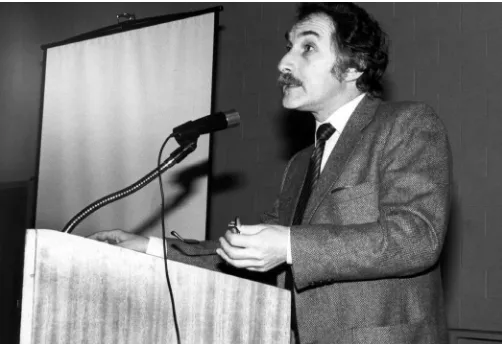
tion of the final volume of CRAC, although he authored one more paper15 and he was a guest speaker at several
important Canadian research conferences in the following years (See Figure 3).
Clinical Practice:
Dr. Gitelman established a clinical practice in Toronto in 1961 and practiced continually until 2007. During that time, it is estimated by his family that he treated about 40,000 patients. He was greatly beloved by his patients. It is the greatest testament to a chiropractor when your practice refuses to let you go! It took Ron over five years to fully retire.
Ron was universally acknowledged by his peers as a consummate chiropractor. He was a superb diagnostician, and no case seemed too difficult for his acumen. He was an outstanding adjuster. I have been told by many ex-pa-tients that they would never let anyone else adjust them after receiving chiropractic from Ron.
Ron had a unique ability to interact with the highest level of medical colleagues and other academics. By the time he met Dr. Kirkaldy-Willis in 1975, he had already made numerous presentations to medical audiences and had made many friends and clinical colleagues with To-ronto orthopedists, neurologists and psychiatrists, many of whom became his patients! He had a similar impact in the medico-legal world, where he was widely regarded as an excellent expert witness. He continued to do this kind of work right up to his retirement.
Honors:
Dr. Gitelman was a Fellow of the College of Chiropractic Clinical Science (CAN) and a Fellow of the International Chiropractic College (1990). Among many honors he re-ceived were Chiropractor of the Year, Ontario Chiroprac-tic Association (1975) and the Award of Merit, Canadian Chiropractic Association (1984).
Personal life:
Ron and Joan Gitelman were married for 52 years. They had three children who all grew up to become successes in their own rights. His daughter bore him his only grand-child, Jennifer.
Ron was an ultra-avid outdoorsman. He was an expert fly-fisherman, tying his own award-winning flies. He travelled far and wide to fish… up in the north of Canada,
and to other great rivers of the world. In his later years, he became an expert wood craftsman, playing off of years of work with tools, especially at his beloved country chalet on the banks of the Beaver River.
Ron contracted pancreatic cancer in July of 2012. He remained at home, dying peacefully with his family sur-rounding him.
decided to donate $10,000 to a research project just get-ting underway at CMCC entitled “Physiologic responses to spinal manipulation”. He knew that I, along with lead author Dr. Brian Budgell and our colleagues, Dr. John Srbely and Drs. Stephen and Julita Injeyan, had already drawn up a proposal to investigate autonomic nervous system effects of cervical adjustment, and he wanted to make sure that this project got done. His last great act for our profession was to make this donation to what we are calling the Dr. Ronald Gitelman Project.
As Ron’s health failed, he said he had a great go of life and his bucket was empty, although he thought there might be one last ‘permit’ still in the bucket (still hoping to catch the big one!). He challenged his illness like he did every other problem in life – head on and with a sense of determination.
We know that Ron would want us to ‘catch and re-lease’, stop and smell the forest, laugh at a good joke and celebrate life the way he did. He would want us all to as-pire to greatness in chiropractic, but with humility about the marvels of the human body and the complexities of the people that are our patients. We’ve lost a great friend, healer and teacher.
Acknowledgements:
I would like to thank the following people for their help in writing this article: Joan Gitelman, Ron’s wife of almost fifty years; Drs. Scott Haldeman, Len Faye and Lou Spor-telli; Mr. Jay Bowes for help with the photos.
References:
1. Vear HJ, Lee HK, Keating JC. Early Canadian chiropractic colleges. Chiropr Hist. 1997;17(2):57-68.
2. Haldeman S. First impressions of the synchro-therme as a skin temperature reading instrument. J Can Chiropr Assoc. 1970;April:7-8.
3. Haldeman S. Observations made under test conditions with the Synchro-Therme. J Can Chiropr Assoc. 1970:October:9-12.
4. The Archives: Gitelman R, Murdoch GG, Embree BE, Dyck VG, eds. Toronto, ON: Canadian Memorial Chiropractic College, 1974.
5. The Scientific Status of Spinal Manipulative Therapy. Goldstein M, ed. Bethesda, MD. NINCDS, #(NIH) 76-998.
6. Gitelman R. The treatment of pain by spinal manipulation. In: Goldstein M, ed. Bethesda, MD. NINCDS, #(NIH) 76-998, pp. 277-285.
7. Kane RL, Leymaster C, Olsen D, Woolley FR, Fisher FD. Manipulating the patient. A comparison of the effectiveness of physician and chiropractor care. Lancet. 1974;June 29:1333-1336.
8. The Neurobiologic Mechanisms in Manipulative Therapy. Korr IM, ed., New York, NY: Plenum Press, 1977. 9. Gitelman, R. A chiropractic approach to biomechanical
disorders of the lumbar spine and pelvis. IN: Modern Developments in the Principles and Practice of
Chiropractic. Haldeman S. Ed. Appleton-Century-Crofts, 1980.
10. Gitelman R, Fligg B. Diversified Technique. IN: Haldeman S, ed. Principles and Practice of Chiropractic, 2nd Ed.
Norwalk, CT: Appleton & Lange, 1992, pp 483-502. 11. Kirkaldy-Willis WH, Cassidy JD. Spinal manipulation
in the treatment of low-back pain. Can Fam Physician. 1985;31: 535–540.
12. Managing Low Back Pain. Kirkaldy-Willis WH, Bernard TM, Eds. New York, NY; Churchill Livingstone Inc. 2nd
Ed., 1988
13. Cassidy JD, Kirkaldy-Willis WH, McGregor M. Spinal manipulation for the treatment of chronic low back and leg pain: an observational trial. IN: Buerger AA, Greenman PE, eds. Empirical approaches to the validation of spinal manipulation. Springfield, IL: Charles C Thomas, 1985. 14. Gitelman R. Chiropractic and Research. J Amer Chiropr
Assoc. 1985;22:5-16.
![Figure 1. Dr. Gitelman with Dr. J. Janse, (1982). [From CMCC stock footage]](https://thumb-us.123doks.com/thumbv2/123dok_us/995698.1599291/4.594.319.569.123.298/figure-dr-gitelman-dr-janse-cmcc-stock-footage.webp)