Compressive Online Video Background-Foreground
Separation Using Multiple Prior Information and
Optical Flow
Srivatsa Prativadibhayankaram1,†, ID, Huynh Van Luong1,∗,‡,ID, Thanh Ha Le2, and André Kaup1 1 Multimedia Communications and Signal Processing, University of Erlangen-Nuremberg, 91058 Erlangen,
Germany; [email protected]; [email protected]; [email protected]
2 Human Machine Interaction, University of Engineering and Technology,Vietnam National University, Hanoi, Vietnam; [email protected]
* Correspondence: H. V. Luong, Email: [email protected], Tel: + 32 2 629 1674, Fax: + 32 2 629 2883. † Current address: Digital Cinema Group, Fraunhofer IIS, Erlangen, Germany
‡ Current address: Department of Electronics and Informatics, Vrije Universiteit Brussel, Brussels, Belgium; [email protected]
Abstract: In the context of video background-foreground separation, we propose a compressive online Robust Principal Component Analysis (RPCA) with optical flow that separates recursively a sequence of video frames into foreground (sparse) and background (low-rank) components. This separation method can process per video frame from a small set of measurements, in contrast to conventional batch-based RPCA, which processes the full data. The proposed method also leverages multiple prior information by incorporating previously separated background and foreground frames in an n-`1 minimization problem. Moreover, optical flow is utilized to estimate motions between the previous foreground frames and then compensate the motions to achieve higher quality prior foregrounds for improving the separation. Our method is tested on several video sequences in different scenarios for online background-foreground separation given compressive measurements. The visual and quantitative results show that the proposed method outperforms other existing methods.
Keywords:robust principal component analysis; video separation; compressive measurements; prior information; optical flow; motion estimation; motion compensation
1. Introduction
Emerging applications in surveillance and autonomous driving are challenging the existing visual systems to detect and understand objects from visual observations. Video background-foreground separation is one of great important components for object detection, identification, and tracking. In video separation, a video sequence can be separated into a slowly-changing background (modeled byLas a low-rank component) and the foreground (modeled byS, which is a sparse component). RPCA [1,2] was shown to be a robust method for separating the low-rank and sparse compenents. RPCA decomposes a data matrixMinto the sum of unknown sparseSand low-rankLby solving the Principal Component Pursuit (PCP) [1] problem:
min
L,S kLk∗+λkSk1subject toM =L+S, (1)
wherek · k∗ is the matrix nuclear norm (sum of singular values) andk · k1is the`1-norm. Many applications of RPCA can be found in computer vision, web data analysis, and recommender systems. However, batch RPCA processes all data samples, e.g., all frames in a video, which demands high computational and memory requirements.
Moreover, the video separation can be improved by taking into account the correlation between consecutive frames. The correlations can be obtained in the form of motions, which manifest as change in information from one frame to the other. Detecting motion is an integral part of the human visual system. A popular and convenient method for estimating motion in computer vision is by using optical flow [3–5] by variational methods. The optical flow estimates motion vectors of all pixels in a given frame due to the relative motions between frames. In particular, the motion vectors at each pixel can be estimated by minimizing a gradient-based matching of pixel gray value, combined with a smoothness criteria [3]. Thereafter, the computed motion vectors in the horizontal and vertical directions [4] are used to compensate and predict information in the next frame. For producing highly accurate motions and accurate correspondences between frames, a large displacement optical flow [6], that combines a coarse-to-fine optimization with descriptor matching can be used to estimate the motions from previously separated frames and subsequently use them to support the separation of the current frame.
In order to deal with the video separation in an online manner, we consider an online RPCA algorithm that recursively processes a sequence of frames (a.k.a., the column-vectors in M) per time instance. Additionally, we aim at recovering the foreground and background from a small set of measurements rather than a full frame data, leveraging information from a set of previously separated frames. In particular, at time instancet, we wish to separate Mt intoSt= [x1 x2 ... xt]
andLt= [v1v2...vt], where[·] denotes a matrix andxt,vt ∈ Rn are column-vectors inSt andLt,
respectively. We assume thatSt−1= [x1x2...xt−1]andLt−1= [v1v2...vt−1]have been recovered at time instancet−1. In the next instancet, we have access to compressive measurements of the full frame, a.k.a., vectorxt+vt, that is, we observeyt=Φ(xt+vt), whereΦ∈Rm×n(m<n)is a random
projection. The recovery problem at time instancetis thus written [8] as min
xt,vt
k[Lt−1vt]k∗+λkxtk1subject toyt=Φ(xt+vt), (2)
whereLt−1andSt−1are given.
1.1. Related Work
Many methods [9–15] have been proposed to solve the separation problem by advancing RPCA [1] exist. Incremental PCP [9] processes each column-vector in M at a time, but it needs access to complete data (e.g., full frames) rather than compressive data. A counterpart of batch RPCA that operates on compressive measurements known as Compressive PCP can be found in [16]. The studies in [12–15,17] aim at solving the problem of online estimation of low-dimensional subspaces from randomly subsampled data for modeling the background. An algorithm to recover the sparse componentxt in (2) has been proposed in [18], however, the low-rank componentvtin (2) is not
recovered per time instance from a small number of measurements.
The alternative method in [19,20] estimates the number of compressive measurements required to recover foregroundxtper time instance via assuming the backgroundvtnot-varying. This assumption
is invalid in realistic scenarios due to variations in illumination or dynamic backgrounds. The online method in [17] works on compressive measurements without taking the prior information into account. The problem of separating a sequence of time-varying frames using prior information brings significant improvements in the context of online RPCA [18,21,22]. Some studies on recursive recovery from low-dimensional measurements have been proposed to leverage prior information [18,19,21,23]. The study in [23] provided a comprehensive overview of the domain, reviewing a class of recursive algorithms. A review of all the recent problem formulations is made in [24] with a unified view with Decomposition into Low-rank plus Additive Matrices (DLAM).
The recent work in [8] leverages correlations across the previously separated foreground frames. However, displacements between the previous foreground frames and the current frame are not taken into account. These displacements can incur the degradation of the separation performance.
There are alternative approaches such as, double-constrained RPCA, namely shape and confidence map based RPCA (SCM-RPCA) in [26] that combines saliency map along with RPCA for automated maritime surveillance. Recently a method that incorporates the spatial and temporal sparse subspace clustering into the RPCA framework was developed in [27] and earlier in [28]. Recent studies in [29] proposes a non-parametric approach for background subtraction.
1.2. Contributions
In this paper, we propose acompressive online robust PCA with optical flow(CORPCA-OF1) method, which is based on our previous work in [8]. We leverage information from previously separated foreground frames via optical flow [6]. The novelty of CORPCA-OF over CORPCA [8] is that we make use of optical flow to estimate and compensate motions between the foreground frames, in order to generate new prior foreground frames. These new prior frames have high correlation with the current frame and thus improve the separation. We also exploit the slowly-changing characteristics of backgrounds known as low-rank components via an incremental SVD [30] method. The compressive separation problem in (2) is solved in online manner by minimizing not only ann-`1-norm cost function [31] for the sparse foreground but also the rank of a matrix for the low-rank backgrounds. Thereafter, the new separated foreground and background frames are used to update the prior knowledge for the next processing instance. This method makes video separation better with higher accuracy and more efficient implementation. The algorithm has been implemented in C++ using OpenCV and also tested on Matlab. Various functions/methods that are needed in performing video separation or general compressed sensing have been developed in C++ and can be used as stand-alone libraries.
The paper is organized as follows. We provide a brief introduction to the CORPCA algorithm [8], on which our proposed CORPCA-OF is built upon. Based on this, we formulate the problem statement in Sec.2.1, followed by a proposed CORPCA-OF algorithm in Sec.2.2.1. The visual and quantitative results obtained by testing our method on real video sequences are presented and discussed in Sec.3.
2. Compressive Online Robust PCA Using Multiple Prior Information and Optical Flow
In this section, we firstly review the CORPCA [8] algorithm for online compressive video separation and state our problem. Thereafter, we proposed CORPCA-OF, which is summarized in the proposed CORPCA-OF algorithm.
2.1. Compressive Online Robust PCA (CORPCA) for video separation
The CORPCA algorithm [8] for video separation is based on RAMSIA [31], that solves ann-`1 minimization problem with adaptive weights to recover a sparse signalx from low-dimensional random measurementsy = Φxwith the aid of multiple prior information or side informationzj,
j∈ {0, 1, . . . ,J}, withz0=0. The objective function of RAMSIA [31] is given by
min
x
n
H(x) =1
2kΦx−yk 2 2+λ
J
∑
j=0
βjkWj(x−zj)k1 o
, (3)
whereλ >0 andβj>0 are weights across the prior information, andWj is a diagonal matrix with
weights for each element in the prior information signalzj; namely,Wj=diag(wj1,wj2, ...,wjn)with
wji>0 being the weight for thei-th element in thezjvector.
The CORPCA algorithm processes one data vector per time instance by leveraging prior information for both its sparse and low-rank components. At time instance t, we observe yt = Φ(xt+vt)withyt ∈ Rm. LetZt−1 := {z1, ...,zJ}, a set ofzj ∈ Rn, and Bt−1 ∈ Rn×ddenote prior
information forxtandvt, respectively. The prior informationZt−1andBt−1are formed by using the already reconstructed set of vectors{xˆ1, ..., ˆxt−1}and{vˆ1, ..., ˆvt−1}.
The objective function of CORPCA is to solve Problem (2) and can be formulated by
min
xt,vt
n
H(xt,vt|yt,Zt−1,Bt−1) = 1
2kΦ(xt+vt)−ytk 2 2
+λµ J
∑
j=0
βjkWj(xt−zj)k1+µ
[Bt−1vt] ∗
o
, (4)
whereµ > 0. It can be seen that ifvtis static (not changing), Problem (4) reduces to Problem (3).
Furthermore, whenxtandvtare batch variables and we do not take the prior information,Zt−1and
Bt−1, and the projection matrixΦinto account, Problem (4) reduces to Problem (1). The CORPCA algorithm2 solves Problem (4) given that Z
t−1 and Bt−1 are known (they are obtained from the time instance or recursion). Thereafter, we updateZtandBt, which are used in the
subsequent time instance.
Let us denotef(vt,xt) = (1/2)kΦ(xt+vt)−ytk22, g(xt) =λ∑
J
j=0βjkWj(xt−zj)k1, andh(vt) =
k[Bt−1vt]k∗, where f(.)is a function of both background and foreground,g(.)is a function of the
foreground (sparse) component andh(.)is a function of the background (low rank) component. The componentsx(tk+1)andvt(k+1)are solved iteratively at iterationk+1 via the soft thresholding operator [32] forxtand the single value thresholding operator [33] forvt:
v(tk+1)=arg min
vt
n
µh(vt) + vt−
v(tk)−1
2∇vtf(v
(k)
t ,x
(k)
t ) 2 2 o , (5)
x(tk+1)=arg min
xt
n
µg(xt) + xt−
x(tk)−1
2∇xtf(v (k)
t ,x
(k)
t ) 2 2 o . (6)
2.2. Video Foreground and Background Separation using CORPCA-OF
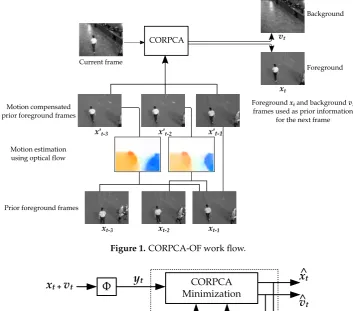
Problem statement. Using the prior information in CORPCA [8] has provided significant improvement of the current frame separation. However, there can be displacements between the consecutive frames that can deteriorate the separation performance. Fig.1illustrates an example of three previous foreground frames,xt−3,xt−2, andxt−1. These frames can be used directly as prior information to recover foregroundxtand backgroundvtdue to temporal correlations betweenxtand xt−3,xt−2,xt−1, as seen in CORPCA. In the last row of the prior foreground frames in Fig.1, it can be seen that motions exist between frames. By estimating motion using optical flow [6], we can obtain motions between the previous foreground frames as in Fig.1, which are visualized using color codes based on the magnitude and direction of motion vectors [6]. These motions can be compensated to generate better quality prior frames (compare compensated framesx0t−3,x0t−2withxt−3,xt−2,xt−1), and it is better correlated toxt. In this work, we discuss an algorithm we proposed - CORPCA with
Current frame
Background
Foreground CORPCA
Prior foreground frames
x't-3 x't-2 x't-1
xt-3 xt-2 xt-1
xt vt
Foreground xt and background vt
frames used as prior information for the next frame
Motion estimation using optical flow Motion compensated prior foreground frames
Figure 1.CORPCA-OF work flow.
Φ
x
t +v
ty
t CORPCAMinimization
x
^
tv
^
tPrior Update
Z
t-1B
t-1Prior Generation using Optical Flow
CORPCA-OF
x
t-1,
x
t-2,,
x
t-3,,
Figure 2.Compressive separation model using CORPCA-OF .
2.2.1. Compressive Separation Model with CORPCA-OF
A compressive separation model using the CORPCA-OF method is shown in Fig.2. At a time instancet, the inputs consist of compressive measurementsyt =Φ(xt+vt)and prior information
from time instancet−1,Zt−1(foreground) andBt−1(background). The model outputs foreground and background informationxtandvtby solving the CORPCA minimization problem in (4). Finally,
the outputsxtandvtare used to generate better prior foreground information via a prior generation
using optical flow and updateZt−1andBt−1 for the next instance via a prior update. The novel block of CORPCA-OF compared with CORPCA [8] is the Prior Generation using Optical Flow, where prior foreground information is improved by exploiting the correlation between frames using large displacement optical flow [6]. The method is further described in Algorithm1.
Algorithm 1:The proposed CORPCA-OF algorithm. Input:yt, Zt−1, Bt−1;
Output:xbt, vbt, Zt, Bt;
// Initialize variables and parameters.
1 x(t−1)=x(t0)=0;v(t−1)=v(t0)=0;ξ−1=ξ0=1;µ0=0; ¯µ>0;λ>0; 0<e<1;k=0;g1(·) =k · k1;
// Motion estimation and compensation using Large Displacement Optical Flow [6]
2 (v1x,v1y) = fME(xt−1,xt−2); 3 (v2x,v2y) = fME(xt−1,xt−3); 4 x0t−1=xt−1;
5 x0t−2= fMC(xt−1,v1x,v1y);
6 x0t−3= fMC(xt−1,12v2x,12v2y);
7 zJ =x0t−1; zJ−1=x0t−2; zJ−2=x0t−3;
8 whilenot convergeddo
// Solve Problem (4).
9 vet(k)=vt(k)+ξk−1−1
ξk (v
(k)
t −v
(k−1)
t );
10 xet(k)=xt(k)+ξk−1 −1
ξk (x
(k)
t −x
(k−1)
t );
11 ∇vtf(vet (k),
e
xt(k)) =∇xtf(vet (k),
e
xt(k)) =ΦT
Φ(vet(k)+xet (k))−y
t
;
12 (Ut,Σt,Vt) =incSVD h
Bt−1
e
vt(k)−12∇vtf(vet (k),
e
xt(k)) i
;
13 Θt=UtΓµk
2 g1(Σt)V
T t;
14 v(tk+1)=Θt(:, end);
15 x(tk+1)=Γµk
2 g
e
xt(k)−12∇xtf(vet (k),
e
xt(k))
; whereΓµk
2 g(·)is given as in RAMSIA [31];
// Compute the updated weights [31].
16 wji= n
(|xti(k+1)−zji|+e)−1 n
∑ l=1
(|xtl(k+1)−zjl|+e)−1
;
17 βj=
||Wj(xt(k+1)−zj)||1+e −1
J ∑ l=0
||Wl(xt(k+1)−zl)||1+e −1;
18 ξk+1= (1+ q
1+4ξ2k)/2;µk+1=max(eµk, ¯µ);
19 k=k+1; 20 end
// Update prior information.
21 Zt:={zj=xt−J(k+1+)j}Jj=1;
22 Bt=Ut(:, 1 :d)Γµk
2g1(Σt)(1 :d, 1 :d)Vt(:, 1 :d) T;
23 returnxbt=x(tk+1), vbt=v(tk+1), Zt, Bt;
2.2.2. Prior Generation using Optical Flow
The main idea of CORPCA-OF is to improve the foreground prior frames using the correlation between frames, which is done by estimating motion between frames via optical flow. In Algorithm1, the prior frames are initialized withxt−1,xt−2andxt−3. Optical flow is used to compute the motions between framesxt−1andxt−2(alsoxt−1andxt−3) to obtain flow vectors for these two frames. This can be seen in Fig.1from the color coded representation of optical flow fields [6]. The function fME(·)
in Lines2and3[see Algorithm1] computes the motions between prior foreground frames. It involves computing the optical flow vectors consisting of horizontal (x) and vertical (y) components, and is denoted byv1x,v2xandv1y,v2y∈Rn, respectively. The estimated motions in the form of optical flow
the forward motions onxt−1. The prior frames,x0t−2andx0t−3are generated by performing motion compensation. This is indicated by the function fMC(·)as shown by Lines5and6in Algorithm1.
Considering a point or a pixeliin the given frame, the horizontal and vertical componentsv1xi
andv1yiof corresponding horizontal and vertical flow vectorsv1xandv1yare obtained, as mentioned
in [34], by solving :
I1x·v1xi+I1y·v1yi+I1t=0, (7)
whereI1x =∂I1/∂xandI1y = ∂I1/∂yare the intensity changes in the horizontal (x) and vertical (y)
directions, respectively, constituting the spatial gradients of the intensity levelI1;I1t=∂I1/∂tis the
time gradient, which is a measure of temporal change in the intensity level at pointi. There are various methods [3–6] to determinev1xi andv1yi. Our solution is based on large displacement optical flow [6], that is a combination of global and local approaches to estimate all kinds of motion. It involves optimization and minimization of error by using descriptor matching and continuation method, which utilizes feature matching along with conventional optical flow estimation to obtain the flow field. We combine the optical flow components of each pointiin the image into two vectors(v1x,v1y), i.e., the
horizontal and the vertical components of the optical flow vector. Similarly, we obtain(v2x,v2y).
The estimated motions in the form of optical flow vectors are used along with the framext−1to produce new prior frames that form the updated prior information. Linear interpolation is used to generate new frames via column interpolation and row interpolation. This is represented as fMC(·)in
Lines5and6in the Algorithm1. The obtained frame is the result of using the flow fields(v1x,v1y)and
(12v2x,12v2y)to predict motions in the next frame and compensate them on the framext−1to obtainx0t−2 andx0t−3respectively. It should be noted thatx0t−3is obtained by compensating for half the motions, i.e.,(12v2x,12v2y), betweenxt−1andxt−3. These improved framesx0t−2,x0t−3are more correlated to the current framextthanxt−2,xt−3, i.e., without motion estimation and compensation. We also keep the most recent framex0t−1=xt−1(in Line4) as one of the prior frames.
Thereafter,v(tk+1)andxt(k+1)are iteratively computed as in Lines14-15in Algorithm1. It can be noted that the proximal operatorΓτg1(·)in Line13of Algorithm 1 is defined [8] as:
Γτg1(X) =arg min
V
n
τg1(V) + 1
2||V−X|| 2 2 o
, (8)
whereg1(·) =k · k1(`1-norm). The weightsWjandβjare updated per iteration of the algorithm (see
Lines16-17). As suggested in [2], the convergence of Algorithm1in Line8is determined by evaluating the criterionk∂H(xt,vt)|x(k+1)
t ,v
(k+1)
t k2
2<2∗10−7k(x (k+1)
t ,v
(k+1)
t )k22. In the next step, we perform an update of the priorsZtandBt.
2.2.3. Prior Update
The update ofZtandBt[8] is carried out after each time instance (see Lines21-22, Algorithm
1). Due to the correlation between subsequent frames, we update the prior informationZtby using
theJlatest recovered sparse components, which is given by,Zt:={zj=xt−J+j}Jj=1. ForBt∈Rn×d,
we consider an adaptive update, which operates on a fixed or constant numberdof the columns of
Bt. To this end, the incremental singular value decomposition [30] method (incSVD(·)in Line12,
Algorithm1) is used. It is worth noting that the updateBt=UtΓµk
2g1(Σt)V T
t, causes the dimension
ofBtto increase asBt ∈ Rn×(d+1)after each instance. However, in order to maintain a reasonable
number ofd, we takeBt = Ut(:, 1 :d)Γµk
2g1(Σt)(1 : d, 1 : d)Vt(:, 1 : d)
T. The computational cost of
incSVD(·)is lower than conventional SVD [9,30] since we only compute the full SVD of the middle matrix with size(d+1)×(d+1), wheredn, instead ofn×(d+1). The computation of incSVD(·)
is presented as follows: The goal is to compute incSVD[Bt−1vt], i.e.,[Bt−1vt] =UtΣtVTt. By taking
[Bt−1vt] = h
Ut−1
δt
kδtk2 i
·
"
Σt−1 et 0T kδtk2
#
·
"
VTt−1 0 0T 1
#
, (9)
where et = UTt−1vt andδt = vt−Ut−1et. By computing the SVD of the central term of (9), we
obtain "
Σt−1 et 0T kδtk2
#
= UeΣeVe T
. Eventually, we obtainUt = h
Ut−1 kδt
δtk2 i
·Ue,Σt=Σe, and also,
Vt= "
VTt−1 0 0T 1
#
·Ve.
3. Experimental Results
In this section we present and discuss the experimental results obtained by applying our method CORPCA-OF on real video data. We also evaluate the performance of our algorithm and compare the results with other existing methods.
Experimental setup. The experiments were carried out on two computers. The Matlab implementation was carried out and tested on a desktop PC with Intel i5 3.5GHz CPU (4 cores) and 12GB RAM. The C++ implementation was carried out and tested on a computer with i7-4510U 2.0 GHz CPU (2 cores) and 8GB memory.
For the experimental evaluation with the various existing methods, mainly two sequences [35],
Bootstrap(80×60)andCurtain(80×64)were used. TheBootstrapsequence consists of 3055
frames and has a static background and a complex foreground. TheCurtainsequence contains 2964 frames with a dynamic background and simple foreground motion. For separating each of these sequences, 100 frames are randomly selected and used for initialization of prior information. The prior information is later updated by selecting three most recent frames as seen in Sec.2.2.3.
We evaluate the performance of the proposed CORPCA-OF in Algorithm1and compare it against the existing methods, RPCA [1], GRASTA [12], and ReProCS [18,23]. RPCA [1] is a batch-based method assuming full access to the data, while GRASTA [12] and ReProCS [18] are online methods that can recover either the (low-rank) background component (GRASTA) or the (sparse) foreground component (ReProCS) from compressive measurements.
3.1. Prior Information Evaluation
We evaluate the prior information of CORPCA-OF compared with that of CORPCA[8] using the previously separated foreground frames directly. For CORPCA-OF, we generate the prior information by estimating and compensating motions among the previous foreground frames. Fig.3shows a few examples of the prior information generated for the sequencesBootstrapandCurtain. In Fig.3(a), it can be observed that frames #2210’, #2211’ and #2212’ (of CORPCA-OF) are better than corresponding #2210, #2211 and #2212 (of CORPCA) for the current frame #2213, similarly in Figs.3(b),3(c), and3(d). Especially in Fig.3(c), the generated frames #448’ and #449’ have significantly improved due to dense motion compensations. In Fig.3(d), it is clear that the movements of the person is well compensated in #2771’ and #2772’ by CORPCA-OF compared to #2771 and #2772 respectively, of CORPCA, leading to better correlations with the foreground of current frame #2774. Replace one of the curtain and bootstrap sequences by an elevator and a fountain sequence.
3.2. Compressive Video Foreground and Background Separation
CORPCA-OF
#2213 Prior information - foreground
#2212 #2212'
#2211 #2210
#2210' #2211' Original frame
CORPCA [8]
(a)Bootstrap#2213
#2866 Original frame Prior information - foreground
#2865 #2865'
#2864 #2863
#2863' #2864'
CORPCA-OF
CORPCA [8]
(b)Curtain#2866
CORPCA-OF
#451 Prior information - foreground
#450 #450'
#449 #448
#448' #449' Original frame
CORPCA [8]
(c)Bootstrap#451
#2774 Original frame Prior information - foreground
#2773 #2773'
#2772 #2771
#2771' #2772'
CORPCA-OF
CORPCA [8]
(d)Curtain#2774
Figure 3.Prior information generation in CORPCA-OF using optical flow [6].
CORPCA [8]
CORPCA-OF RPCA [1] GRASTA [12] ReProCS [18]
(a)Bootstrap
(b) Original
CORPCA-OF CORPCA [8] RPCA [1] GRASTA [12] ReProCS [18]
(b)Curtain
m/n
= 0.6
m/n
= 0.4
m/n
= 0.2
m/n
= 0.8
(a) CORPCA-OF
m/n
= 0.8
m/n
= 0.6
m/n
= 0.4
m/n
= 0.2
(b) CORPCA [8]m/n= 0.8 m/n= 0.6 m/n= 0.4 m/n= 0.2
(c) ReProCS [18]
Figure 5.Compressive foreground and background separation of CORPCA-OF, CORPCA [8], and ReProCS [18] with different measurement ratesm/nof frameBootstrap#2213.
3.2.1. Visual Evaluation
We first consider background and foreground separation with full access to the video data; the visual results of the various methods are illustrated in Fig. 4. It is evident that, for both the video sequences, CORPCA-OF delivers superior visual results than the other methods, which suffer from less-details in the foreground and noisy background images. We can also observe improvements over CORPCA.
m/n
= 0.8
m/n
= 0.6
m/n
= 0.4
m/n
= 0.2
(a) CORPCA-OFm/n
= 0.8
m/n
= 0.6
m/n
= 0.4
m/n
= 0.2
(b) CORPCA [8]m/n = 0.8 m/n = 0.6 m/n = 0.4 m/n = 0.2
(c) ReProCS [18]
Figure 6.Compressive foreground and background separation of CORPCA-OF, CORPCA [8], and ReProCS [18] with different measurement ratesm/nof frameCurtain#2866.
CORPCA and ReProCS. Even at a high rate ofm/n=0.8 the sparse components or the foreground frames using ReProCS are noisy and of poor visual quality. TheBootstrapsequence requires more measurements thanCurtaindue to the more complex foreground information. It is evident from Figs. 5and6that the visual results obtained with CORPCA-OF are of superior quality compared to ReProCS and have significant improvements over CORPCA.
3.2.2. Quantitative Results
We evaluate quantitatively the separation performance via thereceiver operating curve(ROC) metric [36]. The metricsTrue positivesandFalse positivesare defined in [36] as:
True positives= | {Foreground} ∩ {Groundtruth Foreground} |
0 0.2 0.4 0.6 0.8 False positives 0.4 0.5 0.6 0.7 0.8 0.9 1 T ru e po si tiv es CORPCA-OF CORPCA [8] RPCA [1] GRASTA [12] ReProCS [18] (a)Bootstrap
0 0.02 0.04 0.06 0.08 0.1
False positives 0 0.2 0.4 0.6 0.8 1 T ru e po si tiv es CORPCA-OF CORPCA [8] RPCA [1] GRASTA [12] ReProCS [18] (b)Curtain
Figure 7.ROC for the different separation methods with full data.
0 0.1 0.2 0.3 0.4 False positives 0 0.2 0.4 0.6 0.8 1 True positives (a) CORPCA-OF
0 0.1 0.2 0.3 0.4 False positives 0 0.2 0.4 0.6 0.8 1 True positives
(b) CORPCA [8]
0 0.1 0.2 0.3 0.4 False positives 0 0.1 0.2 0.3 0.4 0.5 0.6 0.7 0.8 True positives
(c) ReProCS [18]
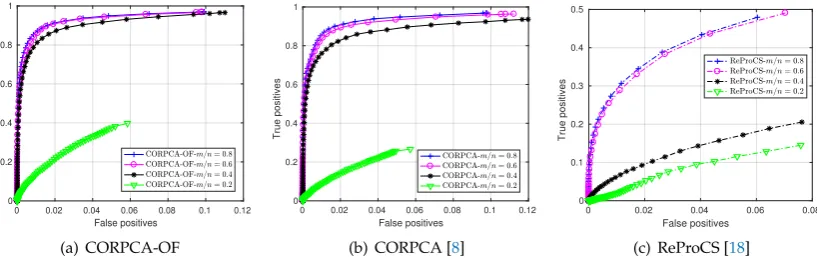
Figure 8.ROC for CORPCA-OF, CORPCA [8], and ReProCS [18] with compressive measurement rates m/nforBootstrap.
0 0.02 0.04 0.06 0.08 0.1 0.12 False positives 0 0.2 0.4 0.6 0.8 1 True positives (a) CORPCA-OF
0 0.02 0.04 0.06 0.08 0.1 0.12 False positives 0 0.2 0.4 0.6 0.8 1 True positives
(b) CORPCA [8]
0 0.02 0.04 0.06 0.08
False positives 0 0.1 0.2 0.3 0.4 0.5 True positives
(c) ReProCS [18]
Figure 9.ROC for CORPCA-OF, CORPCA [8], and ReProCS [18] with compressive measurement rates m/nforCurtain.
False positives= | {Foreground} ∩ {Groundtruth Background} |
| {Groundtruth Background} | (11)
Fig. 7illustrates the ROC results when assuming full data access, i.e., m/n = 1, of CORPCA-OF, CORPCA, RPCA, GRASTA, and ReProCS. The results show that CORPCA-OF delivers higher performance than the other methods.
0 0.2 0.4 0.6 0.8 False positives 0 0.1 0.2 0.3 0.4 0.5 0.6 0.7 0.8 0.9 1 True positives (a) CORPCA-OF
0 0.05 0.1 0.15 0.2 0.25
False positives 0 0.1 0.2 0.3 0.4 0.5 0.6 0.7 0.8 0.9 1 True positives
(b) CORPCA [8]
Figure 10.ROC of CORPCA-OF and CORPCA [8] methods with different rates forEscalatorsequence.
0 0.01 0.02 0.03 0.04 0.05 0.06
False positives 0 0.1 0.2 0.3 0.4 0.5 0.6 0.7 0.8 0.9 True positives (a) CORPCA-OF
0 0.01 0.02 0.03 0.04
False positives 0 0.1 0.2 0.3 0.4 0.5 0.6 0.7 0.8 0.9 True positives
(b) CORPCA [8]
Figure 11.ROC of CORPCA-OF and CORPCA [8] methods with different rates forFountainsequence.
than those of CORPCA. This is evident forBootstrapatm/n={0.2; 0.4; 0.6}[see Fig.8(a)]. For the
Curtainsequence, which has a dynamic background and less complex foreground, the measurements
atm/n={0.2; 0.4}[see Fig.9(a)] are clearly better. The ROC results for ReProCS are quickly degraded even with a high compressive measurement ratem/n=0.8 [see Figure9(c)].
3.3. Additional Results
3.3.1.EscalatorandFountainsequences
The CORPCA-OF method was also compared with CORPCA againstEscalatorandFountain
sequences for compressive measurements. From Figs. 10(a)and10(b), it is clear that CORPCA-OF performs slightly better than CORPCA. In Fig.11(a)and Fig.11(b)we can see that for theFountain
m/n = 1.0 m/n = 0.8 m/n = 0.6 m/n = 0.4 m/n = 0.2
(a) CORPCA-OF
m/n = 1.0 m/n = 0.8 m/n = 0.6 m/n = 0.4 m/n = 0.2
(b) CORPCA [8]
Figure 12.Comparison of CORPCA-OF and CORPCA [8] at full resolution with different ratesm/n forBootstrap#2213.
m/n= 1.0 m/n= 0.8 m/n= 0.6 m/n= 0.4 m/n= 0.2
(a) CORPCA-OF
m/n= 1.0 m/n= 0.8 m/n= 0.6 m/n= 0.4 m/n= 0.2
(b) CORPCA [8]
3.3.2. Visual Comparison of CORPCA-OF and CORPCA for Full Resolution
The visual comparison of CORPCA and CORPCA-OF for frame #2213 in full resolution (160×120) of theBootstrapsequence can be seen in Fig.12. In Fig.13, we compare the full resolution (160×128) frame #2866 of theCurtainsequence. It can be seen that the background and foreground frames of CORPCA-OF for bothBootstrapandCurtainare much smoother and the contents have better structure compared to that of CORPCA. The improvements in foreground can be observed significantly at ratesm/n={0.6; 0.4; 0.2}for theBootstrapsequence for CORPCA-OF in Fig.12(a)over CORPCA in Fig. 12(b). But in case ofCurtainsequence, at low rates m/n = {0.4; 0.2}, there is significant improvement of foreground in Fig.13(a)for CORPCA-OF over CORPCA in Fig.13(b).
3.3.3. Separation Results with Various Datasets
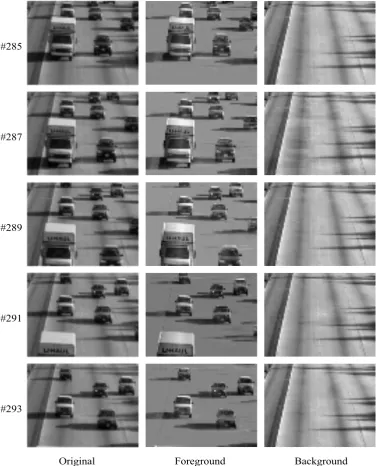
HighwayI:This sequence is from the ATON dataset [37]. It is a sequence with fast motion of cars
along a highway, with strong shadows and small camera jitter. The clear foreground and background separation for frames #285 to #293 can be seen from Fig.14.
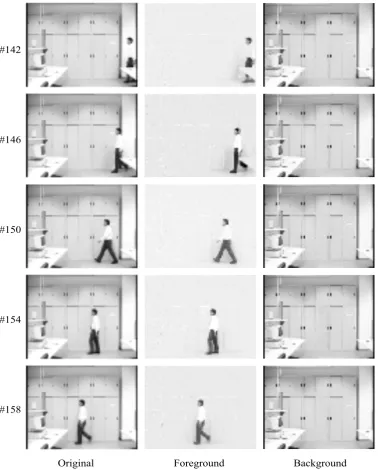
Laboratory:This sequence is from the ATON dataset [37]. It contains an indoor sequence with
two persons appearing for certain intervals. Original frames #142 to #158 are shown in Fig.15along with the separated background and foreground frames.
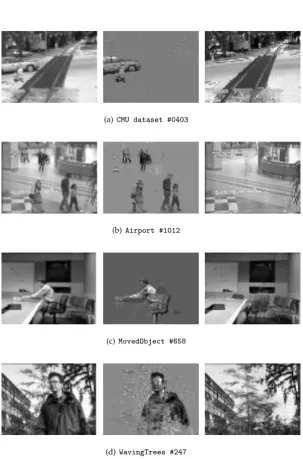
The CORPCA-OF algorithm was also tested with other sequences namely, CMU dataset [38] (Fig. 16(a)),Airport(Fig.16(b)),MovedObject(Fig.16(c)) andWavingTrees(Fig.16(d)) sequence from the wallflower dataset [39]. The results are as shown in Fig.16.
4. Conclusion
We have considered online video foreground background separation using RPCA approach from compressive measurements. A compressive online robust PCA algorithm with optical flow (CORPCA-OF) that can process one frame per time instance from compressive measurements was proposed. CORPCA-OF efficiently incorporates multiple prior frames based on then-`1minimization problem. Furthermore, the proposed method can exploit motion estimation and compensation using optical flow to refine the prior information and obtain better quality separation. The proposed CORPCA-OF was tested on compressive online video separation application using numerous video sequences. The visual and quantitative results have shown the improvements on the prior generation and the superior performance offered by CORPCA-OF compared to the existing methods including the CORPCA baseline.
It is worth mentioning that CORPCA-OF can work in a general manner, with any number of prior frames. In this work, for the video separation, three prior frames are used as a compromise between performance and computational load. The C++ implementation of CORPCA-OF3has been carried out, where the methods can be used as libraries for video separation. Building on this, the next step would be to make the algorithm more robust, adaptive, dynamic, and real-time by using GPUs.
Acknowledgments:This work was supported by the Chair of Multimedia Communications and Signal Processing at University of Erlangen-Nuremberg (FAU), Germany and the Humboldt Research Fellowship, the Alexander von Humboldt Foundation, Bonn, Germany.
Author Contributions:The work was carried out by Srivatsa Prativadibhayankaram based on the research and guidance of Huynh van Luong in collaboration with Thanh Ha Le and the supervision of Prof. André Kaup.
Conflicts of Interest:The authors declare no conflict of interest.
#285
#287
#289
#291
#293
Original Foreground Background
#142
#146
#150
#154
#158
Original Foreground Background
(a)CMU dataset #0403
(b)Airport #1012
(c)MovedObject #658
(d)WavingTrees #247
Figure 16.Foreground and background separation of various sequences.
Abbreviations
The following abbreviations are used in this paper:
CORPCA Compressive Online Robust Principal Component Analysis
CORPCA-OF Compressive Online Robust Principal Component Analysis with Optical Flow GPU Graphical Processing Unit
GRASTA Grassmannian Robust Adaptive Subspace Tracking Algorithm
OF Optical Flow
PCA Principal Component Analysis PCP Principal Component Pursuit
RAMSIA Reconstruction Algorithm with Multiple Side Information using Adaptive weights ReProCS Recursive Projected Compressive Sensing
ROC Receiver Operating Curve
Appendix A. Overview of CORPCA-OF Implementaion in C++
An overview of the various C++ classes and functions implemented and a sample code snippet to demonstrate the usage of CORPCA-OF is as shown below.
Figure A1.Overview of CORPCA-OF implementation
Figure A2.A sample of CORPCA-OF code usage
References
1. Candès, E.J.; Li, X.; Ma, Y.; Wright, J. Robust principal component analysis?Journal of the ACM (JACM)2011, 58, 11.
2. Wright, J.; Ganesh, A.; Rao, S.; Peng, Y.; Ma, Y. Robust principal component analysis: Exact recovery of corrupted low-rank matrices via convex optimization.Advances in neural information processing systems,2009, pp. 2080–2088.
3. Horn, B.K.; Schunck, B.G. Determining optical flow.Artificial intelligence1981,17, 185–203.
4. Bruhn, A.; Weickert, J.; Schnörr, C. Lucas/Kanade meets Horn/Schunck: Combining local and global optic flow methods.International journal of computer vision2005,61, 211–231.
5. Baker, S.; Scharstein, D.; Lewis, J.; Roth, S.; Black, M.J.; Szeliski, R. A database and evaluation methodology for optical flow.International Journal of Computer Vision2011,92, 1–31.
7. Prativadibhayankaram, S.; Luong, H. V.; Le, T.H.; Kaup, A. Compressive Online Robust Principal Component Analysis with Optical Flow for Video Foreground-Background Separation. Proceedings of the Eighth International Symposium on Information and Communication Technology. ACM,2017, pp.385–392.
8. Luong, H. V.; Deligiannis, N.; Seiler, J.; Forchhammer, S.; Kaup, A. Compressive online robust principal component analysis with multiple prior information. IEEE Global Conference on Signal and Information Processing. Montreal, Canada,2017.
9. Rodriguez, P.; Wohlberg, B. Incremental principal component pursuit for video background modeling. Journal of Mathematical Imaging and Vision2016,55, 1–18.
10. Hong, B.; Wei, L.; Hu, Y.; Cai, D.; He, X. Online robust principal component analysis via truncated nuclear norm regularization.Neurocomputing2016,175, 216–222.
11. Xiao, W.; Huang, X.; Silva, J.; Emrani, S.; Chaudhuri, A. Online Robust Principal Component Analysis with Change Point Detection.arXiv preprint arXiv:1702.056982017.
12. He, J.; Balzano, L.; Szlam, A. Incremental gradient on the grassmannian for online foreground and background separation in subsampled video.IEEE Conference on Computer Vision and Pattern Recognition (CVPR),2012, pp. 1568–1575.
13. Xu, J.; Ithapu, V.K.; Mukherjee, L.; Rehg, J.M.; Singh, V. Gosus: Grassmannian online subspace updates with structured-sparsity.IEEE International Conference on Computer Vision (ICCV),2013, pp.3376–3383.
14. Feng, J.; Xu, H.; Yan, S. Online robust pca via stochastic optimization. Advances in Neural Information Processing Systems,2013, pp. 404–412.
15. Mansour, H.; Jiang, X. A robust online subspace estimation and tracking algorithm. IEEE International Conference on Acoustics, Speech and Signal Processing (ICASSP),2015, pp. 4065–4069.
16. Wright, J.; Ganesh, A.; Min, K.; Ma, Y. Compressive principal component pursuit.Information and Inference: A Journal of the IMA2013,2, 32–68.
17. Pan, P.; Feng, J.; Chen, L.; Yang, Y. Online compressed robust PCA. International Joint Conference on Neural Networks (IJCNN),2017, pp. 1041–1048.
18. Guo, H.; Qiu, C.; Vaswani, N. An online algorithm for separating sparse and low-dimensional signal sequences from their sum.IEEE Transactions on Signal Processing2014,62, 4284–4297.
19. Mota, J.F.; Deligiannis, N.; Sankaranarayanan, A.C.; Cevher, V.; Rodrigues, M.R. Adaptive-rate reconstruction of time-varying signals with application in compressive foreground extraction.IEEE Transactions on Signal Processing2016,64, 3651–3666.
20. Warnell, G.; Bhattacharya, S.; Chellappa, R.; Basar, T. Adaptive-Rate Compressive Sensing Using Side Information.IEEE Transactions on Image Processing2015,24, 3846–3857.
21. Qiu, C.; Vaswani, N.; Lois, B.; Hogben, L. Recursive Robust PCA or Recursive Sparse Recovery in Large but Structured Noise.IEEE Transactions on Information Theory2014,60, 5007–5039.
22. Zhan, J.; Vaswani, N. Robust PCA with partial subspace knowledge. IEEE International Symposium on Information Theory,2014.
23. Vaswani, N.; Zhan, J. Recursive Recovery of Sparse Signal Sequences From Compressive Measurements: A Review.IEEE Transactions on Signal Processing2016,64, 3523–3549.
24. Bouwmans, T.; Sobral, A.; Javed, S.; Jung, S.K.; Zahzah, E.H. Decomposition into Low-rank Plus Additive Matrices for Background/Foreground Separation.Comput. Sci. Rev.2017,23, 1–71.
25. Vaswani, N.; Lu, W. Modified-CS: Modifying compressive sensing for problems with partially known support.IEEE Transactions on Signal Processing2010,58, 4595–4607.
26. Sobral, A.; Bouwmans, T.; ZahZah, E.h. Double-constrained RPCA based on saliency maps for foreground detection in automated maritime surveillance.12th IEEE International Conference on Advanced Video and Signal Based Surveillance (AVSS),2015, pp. 1–6.
27. Javed, S.; Mahmood, A.; Bouwmans, T.; Jung, S.K. Background–Foreground Modeling Based on Spatiotemporal Sparse Subspace Clustering.IEEE Transactions on Image Processing2017,26, 5840–5854. 28. Javed, S.; Mahmood, A.; Bouwmans, T.; Jung, S.K. Spatiotemporal low-rank modeling for complex scene
background initialization.IEEE Transactions on Circuits and Systems for Video Technology2016.
29. Berjón, D.; Cuevas, C.; Morán, F.; García, N. Real-time nonparametric background subtraction with tracking-based foreground update.Pattern Recognition2018,74, 156–170.
31. Luong, H. V.; Seiler, J.; Kaup, A.; Forchhammer, S. Sparse Signal Reconstruction with Multiple Side Information using Adaptive Weights for Multiview Sources.IEEE International Conference on Image Processing, 2016.
32. Beck, A.; Teboulle, M. A Fast Iterative Shrinkage-Thresholding Algorithm for Linear Inverse Problems.SIAM Journal on Imaging Sciences2009,2(1), 183–202.
33. Cai, J.F.; Candès, E.J.; Shen, Z. A Singular Value Thresholding Algorithm for Matrix Completion.SIAM J. on Optimization2010,20, 1956–1982.
34. Szeliski, R. InComputer vision: algorithms and applications; Springer Science & Business Media, 2010. 35. Li, L.; Huang,W.; Gu, I.Y.H.; Tian, Q. Statistical modeling of complex backgrounds for foreground object
detection.IEEE Transactions on Image Processing2004,13, 1459–1472.
36. Dikmen, M.; Tsai, S.F.; Huang, T.S. Base selection in estimating sparse foreground in video. 16th IEEE International Conference on Image Processing (ICIP),2009, pp. 3217–3220.
37. Cucchiara, R.; Grana, C.; Piccardi, M.; Prati, A. Detecting moving objects, ghosts, and shadows in video streams.IEEE transactions on pattern analysis and machine intelligence2003,25, 1337–1342.
38. Sheikh, Y.; Shah, M. Bayesian modeling of dynamic scenes for object detection.IEEE transactions on pattern analysis and machine intelligence2005,27, 1778–1792.
![Figure 3. Prior information generation in CORPCA-OF using optical flow [6].](https://thumb-us.123doks.com/thumbv2/123dok_us/1028006.1602969/9.595.100.500.448.723/figure-prior-information-generation-corpca-using-optical-ow.webp)
![Figure 5. Compressive foreground and background separation of CORPCA-OF, CORPCA [8], andReProCS [18] with different measurement rates m/n of frame B o o t s t r a p #2213.](https://thumb-us.123doks.com/thumbv2/123dok_us/1028006.1602969/10.595.123.482.85.522/figure-compressive-foreground-background-separation-andreprocs-different-measurement.webp)
![Figure 6. Compressive foreground and background separation of CORPCA-OF, CORPCA [8], andReProCS [18] with different measurement rates m/n of frame C u r t a i n #2866.](https://thumb-us.123doks.com/thumbv2/123dok_us/1028006.1602969/11.595.121.480.83.552/figure-compressive-foreground-background-separation-andreprocs-different-measurement.webp)
![Figure 10. ROC of CORPCA-OF and CORPCA [8] methods with different rates for E s c a l a t o r sequence.](https://thumb-us.123doks.com/thumbv2/123dok_us/1028006.1602969/13.595.109.486.331.503/figure-roc-corpca-corpca-methods-different-rates-sequence.webp)
![Figure 12. Comparison of CORPCA-OF and CORPCA [for8] at full resolution with different rates m/n B o o t s t r a p #2213.](https://thumb-us.123doks.com/thumbv2/123dok_us/1028006.1602969/14.595.118.477.427.721/figure-comparison-corpca-corpca-for-resolution-different-rates.webp)