RVC OPEN ACCESS REPOSITORY – COPYRIGHT NOTICE
This is the peer-reviewed, manuscript version of an article published in Veterinary Record. The final version is available online via http://dx.doi.org/10.1136/vr.104621.
The full details of the published version of the article are as follows:
TITLE: Mindset and its relationship to anxiety in clinical veterinary students
AUTHORS: Bostock, R., Kinnison, T., May, S.A.
JOURNAL TITLE: Veterinary Record
PUBLISHER: BMJ Publishing Group
PUBLICATION DATE: 16 October 2018 (online)
Mindset and its relationship to anxiety in clinical veterinary students
Rebecca Bostock, Royal Veterinary College, The Royal Veterinary College, Hawkshead Lane, North Mymms, Hatfield, UK AL9 7TA
Tierney Kinnison, Pathobiology and Population Science, The Royal Veterinary College, Hawkshead Lane, North Mymms, Hatfield, UK AL9 7TA
Stephen A. May, Royal Veterinary College, Department of Veterinary Clinical Sciences, Hawkshead Lane, North Mymms, Hatfield, Hertfordshire, UK AL9 7TA. [email protected] 01707 666270
CORRESPONDING AUTHOR
Key Words: mindset, mindset, anxiety, clinical education, mental health, preparation for practice
Abstract (200)
This study investigated anxiety, one aspect of mental wellbeing, in fourth year veterinary students prior to the final clinical section of their course (intramural rotations, IMR). It explored the
relationship between reported anxiety and ‘mindset’: an individual’s view on the ability to develop (e.g. improve intelligence). Questionnaires were completed by 130 students. Students were mindset typed for ability and personality and rated their anxiety towards IMR. Students with different overall mindsets (‘strong growth’, ‘growth’ and ‘fixed’) were invited to participate in focus groups, to discuss causes of their anxieties. Quantitative results indicated 63.1% of students had strong growth or growth mindsets overall, and that females were more fixed mindset-oriented than males. Females reported significantly greater anxiety than males. A fixed mindset view overall, and of ability, were significantly correlated with increased anxiety, while mindset view of personality was not. Students provided various reasons for their anxieties, which differed with mindset. Fixed mindset students (n=2) focused on concerns about knowledge, whereas growth students (n=6) were also anxious about work-life balance and future work. Growth students saw clinicians as future colleagues, rather than intimidating teachers. Students reported an awareness of being graded, although growth students were aware that IMR are learning opportunities.
Introduction
Mental wellbeing issues in veterinarians are acknowledged by the Royal College of Veterinary Surgeons (RCVS) (RCVS 2014a), but their cause is not fully understood. It has been hypothesised that personality traits (Bartram and Baldwin 2010; Crane and others 2015) and the nature of work (Bartram and Baldwin 2010; Platt and others 2010; Gyles 2014) may be an influence, but it is not known when these problems start. Bartram and Baldwin (2010) suggest that the high level of academic achievement needed to enter veterinary training and the demanding nature of the course affects students. A better understanding of the prevalence and causes of mental wellbeing issues in veterinary students is needed to enable educators to reflect upon these factors to improve the mental wellbeing of students, and thus future veterinarians.
(diagnosed) anxiety is higher in females than males (Martín-Merino and others 2010). Little information exists regarding everyday general anxiety as opposed to clinical disease, but research has shown that females generally have more anxiety than males: 21.5% of UK females over the age of 16 showed signs of depression or anxiety compared to 14.8% of males (Mental Health Foundation 2015).
Several measures have been used within studies of veterinary mental wellbeing, with concerning results. For example, communication with support organisations indicates that three-quarters of contacts with the Veterinary Benevolent Fund’s Vetlife Helpline are from females (2015). However, it is noted that this may be due only in part to increased mental health issues in females (Mental Health Foundation 2015) as females outnumber males in the profession (RCVS 2014b) and may show more help-seeking behaviour. The Veterinary Benevolent Fund (2015) also reports that roughly 50% of communications are with under 30 year olds, suggesting higher levels of mental distress or help-seeking behaviour in younger veterinarians. Suicide rates in the veterinary profession also provide evidence of potentially concerning mental health issues. Research has suggested that veterinarians are more likely to commit suicide than the general public (Mellanby 2005; Bartram and Baldwin 2010; Nett and others 2014) and other healthcare professionals (Mellanby 2005). However, although most accept that there are high levels of stress in the profession, some argue that there is little evidence that veterinarians have significantly poorer mental wellbeing than other professions (Platt and others 2012).
Despite these contrasting reports regarding wellbeing, it is accepted that training to be a
veterinarian is long and demanding (Bartram and Baldwin 2010). The last section of the course is usually spent in clinics, taking joint responsibility for cases and performing supervised procedures. This emulates working life, which is known to be taxing: 87% of veterinarians from the USA found their job stressful (Platt and others 2012).
ability to learn practical skills and retain information over the course of their education. In short, mental health issues during veterinary training could decrease student confidence and competence. Mental wellbeing is not the only factor affecting learning. A student’s attitudes can have an effect. It has been suggested that the high level of mental health problems in the profession is due in part to the characteristics required to be accepted onto the veterinary degree (Bartram and Baldwin 2010) including the need to be a high achieving, dedicated individual. Bartram and Baldwin (2010) state that these individuals are at high risk of fear of being discovered to be less intelligent than expectations from society and peers, so-called “imposter syndrome” (Clance and O’Toole 1987; Zenner and others 2005).
One major differentiating aspect of student attitudes to learning is mindset (Dweck 2012). This relates to how individuals meet new challenges and variety, a feature of veterinary study. Some see new challenges as opportunities to learn, even if they initially fail. Such individuals believe that if they find an activity hard, extra work will lead to mastery. This has been characterised as a “growth” mindset. In contrast, others see new challenges as a threat, which might lead to exposing them as being stupid. These individuals do not see ability as an attribute that can be improved but rather a fixed attribute - you are either intelligent or not. These are examples of ‘ability’ mindsets. Individuals may have a different mindset regarding ‘personality’. For example, regarding the ability to change basic things about the kind of person you are (SNRPDP, n.d.).
A “fixed” ability or personality mindset can lead to perverse behaviours such as avoidance of new challenges in the presence of others, leading to a denial of the very learning opportunities that could be helpful to their progress. There are correlations between fixed mindset and both imposter syndrome (Dweck 2012) and perfectionism (Dweck 2013), another trait linked to those who achieve high grades (Knights and Kennedy 2007). Perfectionism’s further association with suicidal behaviour (O’Connor 2007) is an example of how mindset, learning and wellbeing are interlinked. A fixed mindset could hinder a student’s progress, with consequences for their early career.
This study adds to this research. The study is focused on one aspect of mental wellbeing, anxiety, a common cause of mental distress with known effects on learning (Robinson and others 2013). Measuring anxiety is challenging and there is an abundance of scales available specific to
categorising if an individual has an anxiety disorder, or focusing on contexts such as disease. This study uses a simple uni-dimensional scale to allow students to indicate their general anxiety towards one future event, intramural rotations (IMR). The students are from the final, clinical section, of the veterinary course, which is perhaps the most relevant section of training, due to its similarities to practice. The aims of this study were as follows:
1. To identify students’ attitudes to learning by mindset typing and evaluate gender differences
2. To investigate the possibility of a correlation between anxiety and mindset
3. To identify the nature of self-reported anxieties experienced by veterinary students at the commencement of IMR.
Materials and Methods
Study participants
Fourth year veterinary students at the Royal Veterinary College (RVC) in 2015/16, n=219. Students enter IMR 17 months before graduating. The majority of university-based compulsory IMR takes place in the university referral teaching hospital (URTH), the focus of this study
Study design
This was a sequential mixed methods study whereby quantitative research informed qualitative research (Morgan 1998). It received ethical approval from the RVC’s Clinical Research and Ethical Review Board (URN 2015 1459).
Quantitative study design
Students were invited to participate in an online SurveyMonkey® questionnaire, during the last two days of pre-rotational teaching, by a research intermediary, who has little direct contact with students and no impact on their course progression. Three electronic reminders were given before the questionnaire closed on the first day of IMR; the survey was open for 19 days.
(SNRPDP, n.d.) resource, which was based on Dweck’s mindset research. This allowed determination of ability and personality mindsets. Twenty statements were adapted to ensure their relevance to veterinary students. Statements were reordered to reduce bias related to question grouping. The anxiety section required respondents to score subjectively their current anxiety level towards the URTH IMR on a five-point scale as either ‘no anxiety’, ‘some anxiety’, ‘moderate anxiety’, ‘severe anxiety’ or ‘very severe anxiety’. There were also a small number of demographic questions, relating to routes into the veterinary course and career aspirations. Responses were collated by the research intermediary, anonymised, and sent to the research team.
Quantitative analysis
The mindset statements were given scores based on the approach of the original source (SNRPDP, n.d.). These were combined to give each respondent three scores: overall mindset; ability mindset (‘growers’ agree with the statement ‘You can always substantially change how intelligent you are’); and personality mindset (‘growers’ agree with the statement ‘You can always change basic things about the kind of person you are’). Due to the different number of ability and personality
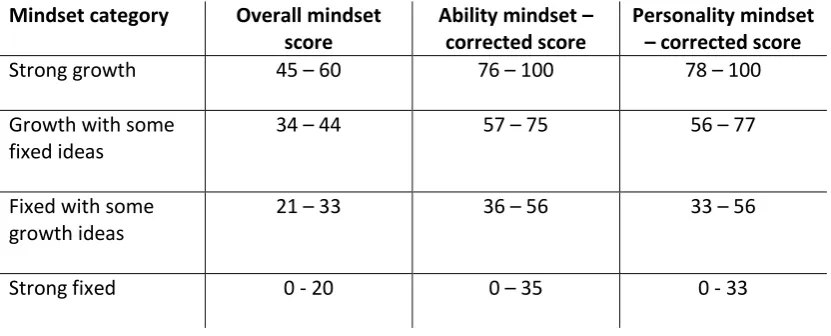
statements, ability and personality scores were corrected to provide scores out of 100 for comparison (Table 1).
Statistical analysis
Statistical analyses were completed using Microsoft Excel 2013 and GraphPad Prism 6. All variables except mindset scores (continuous) were classed as categorical. Analyses performed were as follows: D’Agostino-Pearson omnibus normality test for continuous data; unpaired t-test for comparison of male and female mindset scores; Pearson’s rank Correlation Coefficient to assess correlation between ability and personality mindset scores; ANOVA for comparison of mindset and anxiety scores, and comparison of mindset and anxiety scores with age group, educational
background and career aspiration; and Chi-squared for comparison of anxiety levels of males and females to the URTH IMR. Significance was set at p<0.05.
Qualitative study design
At the end of the questionnaire, students were asked if they would be willing to participate in future focus groups, aimed at investigating reasons for reported anxieties, and facilitated by an
over the fifth to seventh weeks of IMR, according to student availability. Interviews and focus groups were semi-structured, utilising a framework designed by the lead researcher (RB), which primarily asked the students to consider situations on rotations that would make them feel anxious. Interviews were transcribed independently and transcriptions were verified by the interviewer. The results refer to the growth focus groups as SG (strong growth) and G (growth), and Fa and Fb to represent the two interviews with students reporting fixed mindsets.
Qualitative analysis
Thematic analysis was undertaken by RB, who was blinded to the group’s mindset, on each
transcript using the Braun and Clarke (2006) framework. This involved creating codes for each data extract and grouping these into possible themes using an inductive method. The themes and sub-themes were created where there was no overlap between sub-sub-themes and where the development of a new sub-theme added to the understanding created through the analysis. Theme development did not depend on the number of references made to a point, and instead on relevance to the research question in accordance with qualitative methods (Braun and Clarke 2006). Iterative
discussions were held with TK to enhance credibility, but as per Braun and Clarke’s method, only one person, immersed in the data conducted the coding. Mindset results and qualitative results were linked prior to final analysis and manuscript writing.
Results
Quantitative analysis
Demographic characteristics
Of the studied population (n=219), 62.1% (136) completed at least some of the questionnaire. Six incomplete responses were removed. 104 (80%) respondents were female. Most students were aged 20-25 (116; 89.2%) and from the UK (111; 85.4%). Students entered the BVetMed course via multiple routes, although the majority (81; 62.3%) came to the RVC immediately following high school or college. Future career aspirations were reported by the majority as working with small animals (91; 70.0%), followed by farm animals and horses. All proportions are typical of current RVC cohorts.
Mindset scores revealed that the majority of students could be categorised as growth or strongly growth mindset overall (63.1%; 82). Regarding ability, 70.8% (92) were categorised as growth or strongly growth in mindset, compared to 60% (78) for attitudes towards personality.
All mindset scores were normally distributed, males generally having higher (64.4 ± 2.1 ability, 58.8 ± 2.5 personality) scores, indicating a stronger growth mindset orientation, than females (60.7 ± 1.0 ability, 54.4 ± 1.3 personality). However, there was no significant difference between male and female ability (p=0.100) or personality (p=0.128) scores.
Ability and personality mindset scores were significantly positively correlated (r=0.546 p<0.0001). There was no significant relationship between mindset score and educational background or career aspirations.
Anxiety scores
Sixty percent of students reported moderate to very severe anxiety about the URTH IMR. Comparisons of male and female reported anxiety levels revealed a significant gender difference (p=0.0020) (Figure 1).
Anxiety scores and mindset
Higher anxiety scores were associated with lower mindset scores (Figure 2a,b,c). There was a significant difference in overall mindset score between the grades of anxiety towards the URTH IMR (p=0.0029) and in the ability mindset score (p<0.0001), but not in the personality mindset score (p=0.7684).
Several other variables, including age, educational background, career aspirations and whether students opted out of focus groups, were compared with both reported anxiety and mindset scores, but tests were either not valid due to low numbers or showed no significant difference.
Qualitative analysis
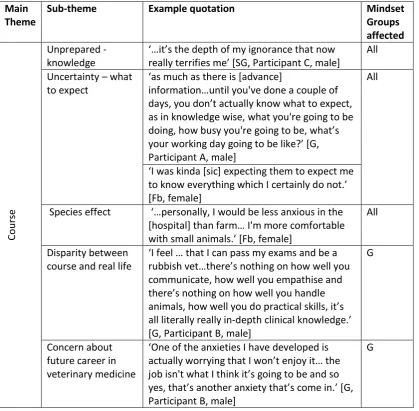
Three students took part in a SG mindset focus group (2 male, 1 female) lasting 70min, three in a G mindset focus group (2 male, 1 female) lasting 60min, and two in individual fixed mindset interviews (both females) lasting 21m and 22m. Example quotations from the mindset groups support the students’ position in their allotted group (Table 2).
nervous of case responsibility and possibly looking stupid. While F students remained focused on anxiety about knowledge, G/SG students recognised IMR as a learning opportunity, though with challenges to work-life balance. The third theme is ‘Students’. All groups were concerned about working with new peers. F students focused on others’ opinions, with teachers seen as intimidating, while G/SG students focused on improving themselves, with teachers as their future colleagues.
Discussion
This study explored the anxieties of veterinary students prior to entering their rotation year, and the influence of mindset. Sixty percent of students reported moderate to very severe anxiety about the URTH IMR. Having a fixed mindset view of ability was related to reports of higher anxiety, as was being female, supporting the first two hypotheses. Reasons given for this anxiety focused on feeling unprepared, either for IMR or life after graduation, peer comparison, views of IMR as either
assessments or teaching opportunities, and work-life balance. Mindset
In this population, 63.1% of students were categorised as overall growth or strongly growth
Dweck showed that females are more likely to be fixed mindset than males (2013) which this study mirrored. In particular, high achieving females have an increased likelihood of being fixed mindset and responding helplessly to failure (Dweck 2007). Both fixed mindset students interviewed in the current study were female, with one expressing concern about clinicians expecting her “to know everything”. The other was conscious of everyone around her and showed characteristics of ‘imposter syndrome’. This is more commonly reported in females, and is linked to fixed mindsets (Kumar and Jagacinski 2006).
Generally, the students interviewed with fixed mindset scores demonstrated fixed views in discussion. However, the growth and strong growth groups, although reporting views that are classically growth, appeared to have some fixed traits as well. The growth group in particular felt anxious about being graded whilst on IMR, despite acknowledging that it is a safe learning environment. This suggests that the 20% of the population that has been reported as fitting into both growth and fixed categories (Dweck 2008) might have emerged in this study as cognitively growth through the way they have rationalised their learning opportunities, although they still had some underlying naïve fixed beliefs and emotions.
This study identified 63.1% growth or strong growth mindset in fourth year veterinary students. It was beyond this study’s scope to track changes throughout the course, although this would be relevant to student support. It would be interesting to determine whether students entering veterinary education are inadvertently selected for the course due, in part, to their mindset, and whether their mindset changes as they develop. Previous research has identified that approximately 42.9% of first year veterinary students had growth mindset (compared to intermediate, which was removed from further analysis, and fixed) (Whittington and others 2017) and 70.2% of second year veterinary students had strong growth/ growth mindset (compared to fixed and strong fixed) (Root Kustritz 2017). However, due to the different scales used, different cohorts and veterinary schools studied and varying number of responses, it is not possible to map mindset changes while at veterinary school until longitudinal research is conducted.
Anxiety
so poor mental wellbeing could become a pervasive trait of veterinarians if it is commonplace in students. It is currently unknown whether high levels of anxiety are due to an inherent susceptibility of students selected for the veterinary course, or whether the training itself, reinforcing trends towards perfectionism in the guise of “best practice”, and professional identities ill-suited to certain branches of practice(Armitage-Chan and others 2016), is the root cause of the problem.
Females have been reported to have a higher prevalence of mental wellbeing issues in the medical (Toews and others 1997; Amr and others 2008) and veterinary (Platt and others 2012; Reisbig and others 2012) professions, and in the general population (Tyssen and others 2001), reflecting this study’s finding that females generally reported more anxiety than males. It is interesting to note that some studies in the medical field, however, have reported no gender difference in stress levels (Supe 1998; Tyssen and others 2001). The veterinary population is becoming more and more ‘feminised’ (Allen 2016), so higher levels of anxiety in females during veterinary training may result in higher levels of anxiety in the working population, negatively impacting the mental wellbeing of the profession.
Growth mindset students reported feeling unprepared for future life. Indeed, Garrett (2009) reports that the transition from veterinary student to equine practitioner is a difficult one, with many students opting to enter an internship to ‘bridge the gap’. In one study over half of graduates surveyed said their course had poorly or very poorly equipped them for interacting with clients (Gilling and Parkinson, 2009). Recent research on clinical reasoning suggests some students have a deficit in skills when starting their first job (Vinten and others 2016). It is disappointing that students do not feel appropriately prepared for life as a clinician after five years of full time training. This perceived inadequacy could result in increased stress when entering a first job.
Unsurprisingly, many students reported decreased feelings of anxiety about working with species with which they were more experienced, although statistical comparison was not valid due to sample size. This could be investigated further, as increasing students’ familiarity with different species throughout the course could reduce anxiety about IMR.
Mindset and anxiety
of fear of failure, which mirrors recent results of Cardwell and Lewis (2017), the fixed mindset students were especially anxious about being questioned, compared their achievements to others’ and were intimidated by others’ knowledge. In the IMR environment where students cannot know everything, success is not guaranteed, and patients may die, these experiences may be taken as a sign of inadequacy (Dweck 2013), especially for fixed mindset students, which will be detrimental to learning.
This study has demonstrated that it is simplistic and inaccurate to think of fixed mindset students as being anxious and growth mindset students as not. However, one interesting finding is that
“constructive anxiety” may not just relate to the level of anxiety (Meharg 1988), it may also relate to its effect. Thus the anxiety of growth mindset students, focused on learning to remedy their feelings of lack of preparedness for practice and their wellbeing, including work-life balance, is likely to be a much more constructive perspective than anxiety focused on exposure and limitation.
Anxiety is only one factor that affects mental wellbeing of veterinarians and there is little research on other such factors and how these are affected by mindset. This is an area for further study. Limitations
Interpretations of differences between genders should be understood in light of the gender disparity in questionnaire results (20% respondents were males); however, this gender proportion reflects current ratios at veterinary schools.
Focus groups were smaller than ideal. Due to the nature of IMR, students were in various locations at any one time; therefore, students with the desired mindset scores were not available
concurrently. Notably, multiple invitations were required to secure even two fixed mindset
interviews. This is perhaps not surprising, since the interviews exposed anxieties, and a classic fixed trait is fear of exposure and being seen as less able. Despite low numbers, the purposive sampling of all mindsets allowed a range of opinions to be explored. It was not possible to hold the focus groups before students started IMR. Anticipation of an event has been shown to cause more anxiety than the event itself (Davidson and others 2000), so student reports of anxiety during focus groups may differ compared to those expressed in the questionnaire, despite them being asked to think back before IMR started. When students were asked whether their anxiety had changed, they all reported that it had stayed the same or decreased since starting IMR.
mindset had a significant correlation with anxiety. However, it is hard to determine whether these results may be due to lack of discrimination on the part of personality scores. Further research is needed to determine this. Finally, anxiety is challenging to measure and usually involves
self-reported data, as in this study. Typical anxiety scales may relate to specific disorders or populations. This study focused on general (not clinical) anxiety towards one specific future event and therefore used a simple uni-dimensional scale.
In conclusion, this study found that there is a significant level of anxiety about clinical rotations reported by this veterinary student population, and that this is linked to gender and mindset. Having a fixed mindset view of ability and being female were linked with an increased level of reported anxiety towards IMR. In addition, the factors described as causing anxiety varied with mindset. Fixed mindset students were, in general, more concerned about knowledge and their lack thereof,
whereas growth mindset students were aware of learning opportunities and that clinicians were their future colleagues, but wanted time to relax outside IMR to become effective veterinarians. Reported anxiety levels in the student body are concerning, especially given that these students, as they realised, are the future of the profession.
Acknowledgements
The authors are grateful to Martha Rodman, Rachel Davis, and all the student participants, without whom this study would not have been possible.
References
1. ALLEN, L.C.V. (2016) Feminisation: threat or opportunity? Veterinary Record 178, 391–393 2. AMR, M., EL GILANY, A.H. & EL-HAWARY, A. (2008) Does Gender Predict Medical Students’
Stress in Mansoura, Egypt? Medical Education Online 13, 12
3. ARMITAGE-CHAN, E., MADDISON, J. & MAY, S.A. (2016) What is the veterinary professional identity? Preliminary findings from web-based continuing professional development in veterinary professionalism. Veterinary Record 178, 318–318
5. BRAUN, V. & CLARKE, V. (2006) Using thematic analysis in psychology. Quality Research Psychology 3, 77–101
6. CARDWELL, J.M. & LEWIS, E.G. (2017) Vocation, Belongingness, and Balance: A Qualitative Study of Veterinary Student Well-Being. Journal of Veterinary Medical Education 44, 29-37 7. CLANCE, P.R. & O'TOOLE, M.A. (1987) The Imposter Phenomenon. Women & Therapy 6, 51–
64
8. CORNELL UNIVERSITY COLLEGE OF VETERINARY MEDICINE. (n.d.) Essential skills and abilities. https://www2.vet.cornell.edu/education/doctor-veterinary-medicine/curriculum/essential-skills-and-abilities. Accessed September 04, 2016
9. CRANE, M.F., PHILLIPS, J.K. and KARIN, E. (2015) Trait perfectionism strengthens the negative effects of moral stressors occurring in veterinary practice. Australian Veterinary Journal 93, 354–360.
10. DAVIDSON, R.J., MARSHALL, J.R., TOMARKEN, A.J. & HENRIQUES, J.B. (2000) While a phobic waits: regional brain electrical and autonomic activity in social phobics during anticipation of public speaking. Biological Psychiatry 47, 85–95
11. DEMARIA, S., BRYSON, E.O., MOONEY, T.J., SILVERSTEIN, J.H., REICH, D.L., BODIAN, C. and LEVINE, A.I. (2010) Adding emotional stressors to training in simulated cardiopulmonary arrest enhances participant performance. Medical Education 44, 1006–1015.
12. DUPEYRAT, C. & MARINÉ, C. (2005) Implicit theories of intelligence, goal orientation, cognitive engagement, and achievement: A test of Dweck’s model with returning to school adults. Contemporary Educational Psychology 30, 43–59
13. DWECK, C.S. (2007) Is Math a Gift? Beliefs That Put Females at Risk. In Why aren’t more women in science?: Top researchers debate the evidence. Ed S.J. Ceci & W.M. Williams. pp 47–55
14. DWECK, C.S (2008) Mindsets and Math/Science Achievement.
http://www.growthmindsetmaths.com/uploads/2/3/7/7/23776169/mindset_and_math_sci ence_achievement_-_nov_2013.pdf. Accessed September 01 2016
15. DWECK, C.S. (2012) Mindset: how you can fulfil your potential. London: London Constable & Robinson
16. DWECK, C.S. (2013) Self-theories: Their Role in Motivation, Personality, and Development. Hove: Psychology Press
18. DWECK, C.S & LEGGETT, E.L. (1988) A social-cognitive approach to motivation and personality. Psychological Review 95, 256–73
19. GARRETT, K.S. (2009) The Transition from Veterinary School to Equine Practice. Veterinary Clinics of North America: Equine Practice 25, 445–54
20. GILLING, M.L. and PARKINSON, T.J. (2009) The Transition from Veterinary Student to Practitioner: A “Make or Break” Period. Journal of Veterinary Medical Education 36, 209– 215.
21. GYLES, C. (2014) Mental health and veterinary suicides. Canadian Veterinary Journal 55, 1123–6
22. JEGATHESAN, M., VITBERG, Y.M. & PUSIC, M.V. (2016) A survey of mindset theories of intelligence and medical error self-reporting among pediatric housestaff and faculty. BMC Medical Education 16, 58
23. KNIGHTS, J.A. & KENNEDY, B.J. (2007) Medical school selection: impact of dysfunctional tendencies on academic performance. Medical Education 41, 362–8
24. KUMAR, S. & JAGACINSKI, C.M. (2006) Imposters have goals too: The imposter phenomenon and its relationship to achievement goal theory. Personality and Individual Differences 40, 147–57
25. MARTÍN-MERINO, E., RUIGÓMEZ, A., WALLANDER, M.A., JOHANSSON, S. &
GARCÍA-RODRÍGUEZ, L.A. (2010) Prevalence, incidence, morbidity and treatment patterns in a cohort of patients diagnosed with anxiety in UK primary care. Family Practice 27, 9–16
26. MCILROY, D. & BUNTING, B. (2002) Personality, Behavior, and Academic Achievement: Principles for Educators to Inculcate and Students to Model. Contemporary Educational Psycholoy 27, 326–37
27. MEHARG, S.S. (1988) Help for the Anxious Performer. Journal of Research in Musical Education 75, 34–7
28. MELLANBY, R.J. (2005) Incidence of suicide in the veterinary profession in England and Wales. Veterinary Record 157, 415–7
29. MENTAL HEALTH FOUNDATION. Fundamental Facts About Mental Health.
https://www.mentalhealth.org.uk/sites/default/files/fundamental-facts-15.pdf. Accessed March 08 2016
30. MENTAL HEALTH FOUNDATION. (2017) What are mental health problems?
31. MORGAN D,L. (1998) Practical Strategies for Combining Qualitative and Quantitative Methods: Applications to Health Research. Qualitative Health Research 8, 362–76
32. NETT, R.J., WITTE, T.K., HOLZBAUER, S.M., ELCHOS, B.L., CAMPAGNOLO, E.R., MUSGRAVE, K.J., CARTER, K.K., KURKJIAN, K.M., VANICEK, C., O'LEARY, D.R., PRIDE, K.R. & FUNK, R.H. (2014) Notes from the Field: Prevalence of Risk Factors for Suicide Among Veterinarians 33. NUNES, T.C., HIRANO, R.S., CRUZ, L.C., SEIXAS, A., JEAN-LOUIS, G. and FONSECA, V.A. da S.
(2018) Self perceived memory difficulties in medical students as another symptom of anxiety. Trends in Neuroscience and Education 11, 9–12.
34. O’CONNOR, R.C. (2007) The relations between perfectionism and suicidality: a systematic review. Suicide & life-threatening behavior 37, 698–714.
35. PATEL, V., FLISHER, A.J., HETRICK, S. & MCGORRY, P. (2007) Mental health of young people: a global public-health challenge. The Lancet 369, 1302–13
36. PLATT, B., HAWTON, K., SIMKIN, S. & MELLANBY, R.J. (2010) Systematic review of the prevalence of suicide in veterinary surgeons. Occupational Medicine 60, 436–46 37. PLATT, B., HAWTON, K., SIMKIN, S. & MELLANBY, R.J. (2012) Suicidal behaviour and
psychosocial problems in veterinary surgeons: a systematic review. Social Psychiatry and Psychiatric Epidemiology 47, 223–40
38. RCVS (ROYAL COLLEGE OF VETERINARY SURGEONS). (2014a) Mind Matters: new mental health initiative launched http://www.rcvs.org.uk/news-and-events/news/mind-matters-initiative-new-veterinary-mental-health-and/. Accessed September 03 2016
39. RCVS (ROYAL COLLEGE OF VETERINARY SURGEONS). (2014b) RCVS Facts 2014. http://www.rcvs.org.uk/publications/rcvs-facts-2014. Accessed September 03 2016 40. REISBIG, A.M.J., DANIELSON, J.A., WU, T.-F. HAFEN, M.JR, KRIENERT, A. GIRARD, A. &
GARLOCK, J. (2012) A Study of Depression and Anxiety, General Health, and Academic Performance in Three Cohorts of Veterinary Medical Students across the First Three Semesters of Veterinary School. Journal of Veterinary Medical Education 39, 341-358 41. ROBINSON, O.J., VYTAL, K., CORNWELL, B.R. & GRILLON, C. (2006) The impact of anxiety
upon cognition: perspectives from human threat of shock studies. Frontiers in Human Neuroscience 7, 203
42. ROLLIN, B.E. (2006) The ethics of referral. Canadian Veterinary Journal 47, 717–8
44. SNRPDP (SOUTHERN NEVADA REGIONAL PROFESSIONAL DEVELOPMENT PROGRAM). (n.d.) Mindset quiz. http://rpdp.net/admin/images/uploads/resource_177.pdf. Accessed
December 2015
45. SUPE, A.N. (1998) A study of stress in medical students at Seth G.S. Medical College. Journal of Postgraduate Medicine 44,1
46. TEUNISSEN, P.W. & BOK, H.G.J. (2013) Believing is seeing: how people’s beliefs influence goals, emotions and behaviour. Medical Education 47, 1064–72
47. TOEWS, J.A., LOCKYER, J.M., DOBSON, D.J., SIMPSON, E., BROWNELL, A.K., BRENNEIS, F., MACPHERSON, K.M. & COHEN, G.S. (1997) Analysis of stress levels among medical students, residents, and graduate students at four Canadian schools of medicine. Academic Medicine: Journal of the Association of American Medical Collages 72, 997–1002
48. TYSSEN, R., VAGLUM, P., GRØNVOLD, N.T. & EKEBERG, Ø. (2001) Factors in medical school that predict postgraduate mental health problems in need of treatment. A nationwide and longitudinal study. Medical Education 35, 110–20
49. VETERINARY BENEVOLENT FUND (VBF). (2015) Annual Report and Accounts for the year ended 31 December 2014.
http://www.vetlife.org.uk/sites/default/files/VBF%20ANNUAL%20REPORT%20%26%20ACCO UNTS%202014.pdf. Accessed March 09 2016
50. VINTEN, C.E.K., COBB, K.A., FREEMAN, S.L. and MOSSOP, L.H. (2016) An Investigation into the Clinical Reasoning Development of Veterinary Students. Journal of Veterinary Medical Education 43, 398–405.
51. WHITTINGTON, R.E., RHIND, S.., LOADS, D. & HANDEL, I. (2017) Exploring the Link between Mindset and Psychological Well-Being among Veterinary Students. Journal of Veterinary Medical Education 44, 134-140
52. WHO (WORLD HEALTH ORGANIZATION). (2001) The World Health Report 2001: Mental Health: New Understanding, New Hope, Geneva: World Health Organization.
53. YOUSEFI, F., TALIB, M.A., MANSOR, M.B., JUHARI, R.B. & REDZUAN, M. (2010a) The
Relationship between Test-Anxiety and Academic Achievement among Iranian Adolescents. Asian Social Science 6, 100
55. YUSOFF, M.S.B., ABDUL RAHIM, A.F. & YAACOB, M.J. (2010) Prevalence and Sources of Stress among Universiti Sains Malaysia Medical Students. Malaysian Journal of Medical Science 17, 30–7
56. ZENNER, D., BURNS, G.A., RUBY, K.L., DEBOWES, R.M. & STOLL, S.K. (2005) Veterinary Students as Elite Performers: Preliminary Insights. Journal of Veterinary Medical Education 32, 242–248
Table 1
Composition of mindset categories based on the Southern Nevada Regional Professional Development Programme Scheme. Ability and personality scores were corrected to provide scores out of 100 to allow comparison.
Mindset category Overall mindset score
Ability mindset – corrected score
Personality mindset – corrected score
Strong growth 45 – 60 76 – 100 78 – 100
Growth with some fixed ideas
34 – 44 57 – 75 56 – 77
Fixed with some growth ideas
21 – 33 36 – 56 33 – 56
Strong fixed 0 - 20 0 – 35 0 - 33
Table 2. Mindset groups and representative example quotations
Mindset Group Example Quotations [participant identifier]
Fixed
Ability mindset score range: 48-55
‘if you have a more confident, extroverted
personality, you're like, go for it and ask for things, you’ll get more out of it and that’s hard for someone like me but I don’t blame anything for it, it’s just me!’ [Fb, female]
‘I know they have the learning advice centre, I’ve personally never gone, I’ve thought about it but been a bit … reluctant, anxious to go!’ [Fb, female] Growth
Ability mindset score range: 64-67
Strong Growth
Ability mindset score range: 76-90
‘I think when I was younger, I used to get quite anxious about talking to new people and public speaking … all the placements I think have really helped, or meeting lots of people at uni or things like that, so I think that’s probably helped a lot so when you get to rotations, you're a bit more confident to meet lots of new people’ [SG, Participant C, female] ‘[It’s] not just the fear of looking silly because essentially that’s why we’re here, we’re all here to look silly just now and we’re all here to ask the stupid questions’ [SG, Participant B, male]
Table 3. The three main themes and sub-themes developed to explain anxiety. Example quotations are provided, with participant information, and an indication if this sub-theme related to a specific mindset group, or spanned all groups
Main Theme
Sub-theme Example quotation Mindset
Groups affected Co u rse Unprepared - knowledge
‘…it’s the depth of my ignorance that now really terrifies me’ [SG, Participant C, male]
All Uncertainty – what
to expect
‘as much as there is [advance]
information…until you've done a couple of days, you don’t actually know what to expect, as in knowledge wise, what you're going to be doing, how busy you're going to be, what’s your working day going to be like?’ [G, Participant A, male]
All
‘I was kinda [sic] expecting them to expect me to know everything which I certainly do not.’ [Fb, female]
Species effect ‘…personally, I would be less anxious in the [hospital] than farm… I'm more comfortable with small animals.’ [Fb, female]
All
Disparity between course and real life
‘I feel … that I can pass my exams and be a rubbish vet…there’s nothing on how well you communicate, how well you empathise and there’s nothing on how well you handle animals, how well you do practical skills, it’s all literally really in-depth clinical knowledge.’ [G, Participant B, male]
G
Concern about future career in veterinary medicine
‘One of the anxieties I have developed is actually worrying that I won’t enjoy it… the job isn't what I think it’s going to be and so yes, that’s another anxiety that’s come in.’ [G, Participant B, male]
Deficit in practical skills
‘People just assume you’ve got it. You get into practice and they’re just like, “give it an injection”, you're like “college has never taught me that” and if you say that to a vet, they’d laugh at you, “your college has never taught you how to inject an animal?” that’s embarrassing.’ [G, Participant B, male]
G and SG
Enviro n m ent o n IM R Responsibility for caseload
‘there’s always going to be that fear that you mess up and obviously your mistakes, if they’re small, it’s not a big deal, it’s just a little bit embarrassing but then if they’re large, you literally kill something … I don’t want to hurt any animals and then that animal’s
connected to a person who’s seriously going to be upset.’ [Fb, female]
All
Fear of feeling stupid to clinicians and owners
‘you don’t want to give a bad impression … feeling like “I'm useless, why have I made that mistake? Why have I done this? They think I must be stupid.”’ [G, Participant A, male].
All
‘being asked a question in front of an owner and if you don't know the answer, it makes you look really silly and feel intimidated’ [SG Participant B, female]
Individual questioning
‘I guess worried about being asked questions on rounds and it was the first time that we would get one on one questioning… I was a bit worried about that one on one brain picking.’ [Fa, female]
F
Time management ‘some rotations drag you back in after you’ve finished rounds…when that takes up three hours of your time … no wonder people don’t have a work/life balance if in your final year before you graduate, all you're used to being is getting in at 7[am], leaving at 9[pm]’ [G, Participant A, male]
G
Learning opportunity
‘I'm being watched by someone who’s grading me …that does lead to stress because you're like, … “If I make a mistake, how is that going to impact?” when what you should be thinking is “this is a learning opportunity, this is the safest environment I ever have to make a mistake” but because you're being assessed, you don’t think like that, you think it’s an exam, this is what I need to do, which it’s not and they do make perfectly clear it’s not…’ [G, Participant A, male]
SG (G) Stu d ents Personality trait affects anxiousness
‘the personality of some people, just a lot more placid and chilled… some people are able to [think they’ll be ok] whereas some people imagine the worst case scenarios and
need to eat a text book before they turn up.’ [Fa, female]
Fear of feeling stupid, comparison with others
‘I think that consciousness of everyone else’s performance has become more of a thing as I’ve got maybe a bit more shy [sic] about knowledge sharing or whatever, than I would have been just to say something in A Level’ [Fa, female]
All
Working with peers ‘something else that’s a bit of a worry is how well the rotation group is going to work together and how well individuals will get on with each other because I think it can either make the whole year really good or it can make it really horrendous’ [SG, Participant B, female]
All
Peer reports – reassure or create a reputation for stressful rotations
‘other students say things that are highly ranked as being the most terrifying rotations are things like medicine, anaesthesia, … I can’t think of any horror stories that I’ve been told from any of the other rotations’ [Fa, female]
All
Working with clients
‘getting close in a room with a client and an animal is quite nausea inducing at the start but now I’ve done it and it’s not been too bad’ [Fa, female]
All
Focus on others’ opinions v Focus on self-improvement
‘if you were top of the class in secondary school, it’s not going to be the case here, so it’s … feeling a bit more conscious of being surrounded by a lot of very intelligent people and maybe not so much being on that spectrum yourself.’ [Fa, female]
F
‘I am one of these people that if I'm [bad] at something, I will make myself good at it’ [SG, Participant C, male]
G and SG
Working with clinicians – intimidation by teachers v. Working with colleagues
‘a lot of clinicians we’re working with have been doing it for 40 years and literally they’re top in their field so, it’s a bit intimidating because their knowledge is going to be so much greater than yours’! [Fb, female]
F
‘they're our future colleagues rather than our superiors [SG, Participant B, female]…. Yeah it’s not that, you know, I am going to be your colleague, I am their colleague now because essentially we are the future of veterinary medicine.’ [SG, Participant C, male].
Figure Captions:
Figure 1:
Male and female anxiety levels towards the URTH IMR. There was a significant difference between males and females, with females identifying as being more anxious.
Figures 2a, 2b and 2c: