chiropractic prescribed home exercise:
a review of the literature
Patrick Milroy,
BA, MA, DC*
Gary O’Neil,
SSW, BRec, MA*
Canadians are often confronted with health conditions that impede their lifestyles. To overcome health related limitations individuals often seek assistance from chiropractors or other allied health care professionals. However, despite the recognized benefits of at home exercise programs, patients continue to remain non-compliant to prescribed routines. Non-compliance to home based routines reduces the probability of successful outcome for therapeutic intervention. The advent of the rehabilitation focus in the Chiropractic profession warrants an examination of factors
influencing compliance to home exercise prescribed by the chiropractor. The physiological and psychological benefits are well established. If compliance is high, results will typically be positive (i.e. reduced symptoms of pain, reduced anxiety related to condition, and therapeutic goals attained). However, if compliance is low, therapeutic outcomes will often plateau or worse, reverse. Why does non-compliance seem to prevail? The purpose of this paper is to define exercise compliance, identify factors influencing compliance and to suggest intervention strategies that may improve adherence to home-based exercise prescription by chiropractors. (JCCA 2000; 44(3):141–148)
K E YW O R D S: chiropractic, rehabilitation, exercise.
Les Canadiens et Canadiennes présentent souvent des troubles qui portent atteinte à leur mode de vie. Dans bien des cas, pour résoudre leurs problèmes de santé, les gens consultent des chiropraticiens ou d’autres professionnels de la santé. Cependant, malgré les avantages reconnus des programmes d’exercices à domicile, les patients ne respectent pas les traitements prescrits. La non-observance des programmes
d’exercices à domicile diminuent les chances de succès des interventions thérapeutiques. L’introduction de la réadaptation dans la profession justifie l’examen des facteurs qui ont une incidence sur le respect des programmes d’exercices à domicile prescrits par les chiropraticiens. Les bienfaits physiologiques et psychologiques sont bien connus. Un degré élevé d’observance est généralement associé à des résultats positifs (soulagement de la douleur, diminution de l’anxiété liée à l’affection, atteinte des objectifs thérapeutiques). Au contraire, un faible degré
d’observance peut se traduire par le plafonnement ou, pire encore, la régression des bienfaits thérapeutiques escomptés. Alors, pourquoi la non-observance semble-t-elle si fréquente? Le présent article vise à définir l’observance thérapeutique à l’égard des exercices, à cerner les facteurs qui ont une incidence sur
l’observance et à suggérer des stratégies d’intervention susceptibles d’améliorer le respect des programmes d’exercices à domicile prescrits par les chiropraticiens. (JACC 2000; 44(3):141–148)
M O T S C L É S : chiropratique, réadaptation, exercices.
* Spring Garden Chiropractic, Halifax Professional Centre, 5991 Spring Garden Road, Suite 460, Halifax, Nova Scotia B3H 1Y6, (902) 429-3443. Requests for reprint: Patrick Milroy, BA, MA, DC.
Introduction
Health problems for people of any age can be reduced or prevented with more active lifestyles. If people are aware of the health benefits, then why are they not able to follow through with a regimen of physical activity that may limit an already detrimental health condition?
Improving compliance to home-based exercise pre-scription by chiropractors is imperative when attempting to achieve therapeutic outcome and enhancing quality of life. A healthy quality of life is important to most individu-als. Such a lifestyle can be achieved through exercise since it has been proven that there are many positive associa-tions between physical activity (i.e. home-based exercise) and physical and mental well-being.1–19 Although the
health benefits of physical exercise are well documented, estimates indicate that only 10–20% of the 18–65 year old population regularly participates in activity to improve physical health.20 Within patient populations at least one
third fail to follow through with physician recommenda-tions.21
A problem statement, which provides a focus for this paper, is as follows. “Since compliance to practitioner pre-scribed home exercise is low,20, 22–24 what do practitioners
and patients need to know to improve exercise compli-ance?” If patients and chiropractors are aware of the con-straints associated with home exercise programs, then preventative measures can be initiated to overcome and work toward an optimum quality of life.
Prior to defining constraints to chiropractic prescribed
exercise it is necessary to provide definitions of the terms related to compliance. Compliance is often confused with other terms such as motivation and adherence. A review of all three terms will provide clarity and set the stage for an in depth review of issues surrounding compliance (Table 1).
Motivation
Motivation is the stimulus or influence that compels a per-son to pursue a physically demanding activity. Without motivation, complacency would prevail and nothing would be accomplished. Motivation implies an emotion or desire that influences a person causing him/her to conduct an action. The motivation can be intrinsic or extrinsic.25
Intrinsic motivation
Internal or intrinsic factors are often associated with the benefit of doing something solely for the satisfaction gained from doing the activity. “With the absence of any external force controlling either the instigation or mainte-nance of the activity, the interaction is presumed to be internally induced and the participant to be intrinsically motivated.”25 Generally, it can be said that intrinsic
moti-vation is the basic internal reward that offers the partici-pant the self satisfaction gained from doing an activity.
Extrinsic motivation
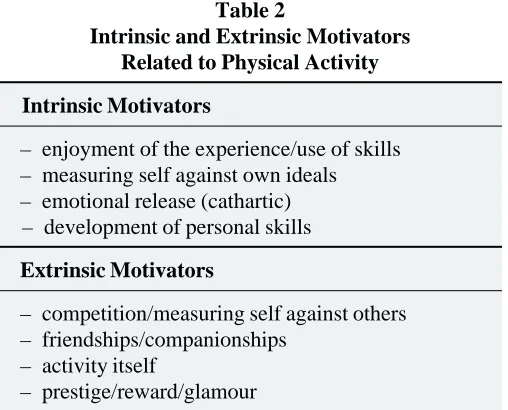
Extrinsic motivation is when a person performs a physical activity solely to obtain some external reward.25 Extrinsic
Table 2
Intrinsic and Extrinsic Motivators Related to Physical Activity
Intrinsic Motivators
– enjoyment of the experience/use of skills – measuring self against own ideals – emotional release (cathartic) – development of personal skills
Extrinsic Motivators
– competition/measuring self against others – friendships/companionships
– activity itself
– prestige/reward/glamour Table 1
Motivation, Adherence and Compliance: Basic Definitions
Motivation
Motivation is the stimulus or influence that compels a person to pursue a physically demanding activity.
Adherence
Adherence is the ability to be consistent with a task.
Compliance
motivation can be a means for improving one’s compli-ance with chiropractic prescribed home-based exercise.
Csikszentmihalyi26 states that involvement in physical
activity can be extrinsically and intrinsically motivated (Table 2).
Intrinsic and extrinsic factors can both be motivating factors for complying with a home-exercise program. Practitioners must assess patient needs and properly iden-tify the motivating factors that will increase adherence to exercise prescription. If extrinsic and intrinsic motives are the terms that initiate a response to participate in an activ-ity then adherence would be the term which identifies, staying with an activity once it has been initiated.
Adherence
Adherence is the ability to be consistent with a task. The belief that certain ideals like the strong positive association between physical fitness and health will result in continued participation in an activity. Dishman16 suggests that over
half of those who begin a program of health related fitness quit within the first six months, with the greatest dropout occurring early in the program. It is difficult to discuss adherence with respect to one age group because the fac-tors for dropping out of a physically active program are common among all age groups.27
Dishman,16 noted that research surrounding exercise
adherence revealed associations between personal factors, environmental factors and exercise adherence (Table 3).
Past program participation is a means for determining
the person’s genuine interest in adhering to physical activ-ity. Past behaviors are very good indicators of determining future outcomes. Inherently, people do not change with respect to motivation and adherence to exercise programs. Typically, adherence to a program ceases once a certain body image or health goal has been achieved. Often a person sets out to ameliorate a condition, and once this has been achieved adherence drops off. Past patterns of behavior have to be assessed prior to exercise prescription. The second item in Dishman’s (1988) model is per-ceived health. Most individuals have an opinion regarding their health condition. Often this opinion is misunderstood and proper physical activity is overlooked. Hence, adher-ence to a program is met with unrealistic goals to achieve an objective. Once the objective has been met, most people feel that continuing home exercise is unnecessary.
The third personal factor was that of self-motivation. Individuals all have varying levels of self-motivation. This self-motivation is a large component of adherence. Self-motivation is affected by the previously identified envi-ronmental factors as described in Table 3 (lack of spousal support, lack of time, lack of access to facilities and equip-ment). The environmental factors can be real or perceived. Regardless of the perception, chiropractors have to work with their patients to improve compliance.
Compliance
Compliance is the act of complying to a demand or pro-posal. It is the process of conforming to another’s wishes in order to fulfill a requirement or feeling compelled to participate out of a sense of obligation. The obligation may be unwanted but the person complies to appease the other to maintain a friendship, group commitment and/or amel-iorating health.
Compliance does not seem to be an internal construct, but rather an extrinsic motivator with the possibilities of intrinsic reward. For example, a chiropractor prescribes an exercise program and states that compliance will improve a patient’s health. The extrinsic motivator is the doctor’s prophecies that health will improve. The intrinsic motiva-tion for the patient is the hopes of improved well-being, brought on by better health. The problem is that there is a lack of guarantee and results, which are usually not imme-diate. Often, exercise compliance comes as a strategy to improve health as related to a diagnostic entity (e.g. me-chanical low back pain). In other instances prescribed ex-Table 3
Personal and Environmental Factors Related to Exercise Adherence
Personal Factors
– past program participation – perceived health
– self motivation
Environmental Factors (potentially act as constraints)
– spousal support
ercise is used as a preventative method.
Exercise compliance often results in negative outcomes. Dishman states “though exercise programs vary widely, it is typical to expect a 40%–50% dropout rate within six months to a year after start-up”28 Other researchers show
an even lower rate of long-term compliance. For example, Sluijs and Knibbe24 state that physical therapists estimate
that 64% of their patients comply with the short-term exer-cise regimen, but only 23% of them persevere with long-term exercise.
There are many constraints that may deter a person from complying with an exercise prescription. For instance, the cost of exercise equipment, lack of exercise knowledge, and lack of support can all contribute to negative compli-ance with exercise prescription. The point is that there are many constraints that contribute to the possibility that a patient will not comply with a chiropractor’s prescription. For instance, with respect to exercise and mental health Dishman writes, “many patients referred by a physician or hospital either never show up or leave after a few sessions, long before medical or psychological benefits are possi-ble.”29 The health care model of prescribing a regimen
after a problem has arisen typically results in low compli-ance.
Constraints to compliance
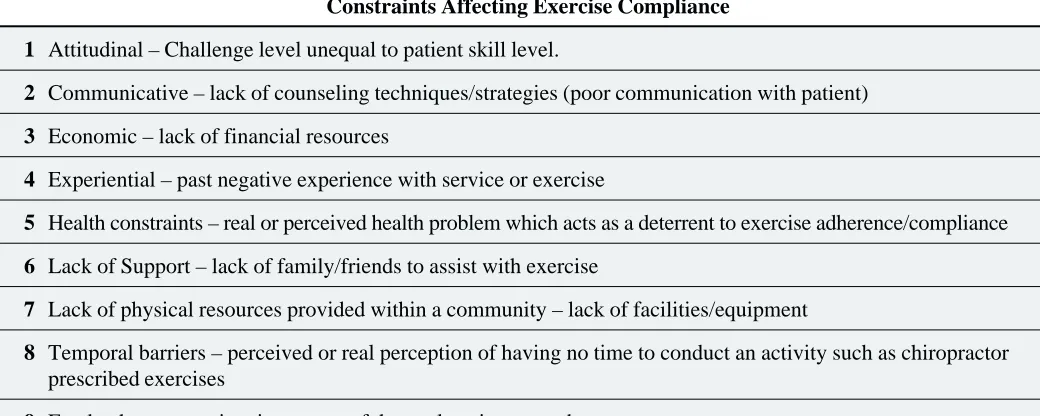
To ensure a positive level of compliance within our pa-tients, practitioners have to understand the constraints that affect their daily lifestyles. Our patients encounter many constraints (real or perceived) beyond their presenting health concern.
Attitudinal barriers are the client’s thoughts on whether he/she has the skills and coordination to properly complete a prescribed exercise. Anxiety may come about and result in negative compliance due to the challenge of the exercise exceeding the skill level of the patient. If practitioners do not provide sufficient challenge to patients, then adher-ence/compliance will decline.26 The exercise has to
pro-vide some enjoyment for the person as well as a challenge which meets the patient skill level. The confidence during exercise prescription coupled with words of encourage-ment by the chiropractor will positively influence a pa-tient’s attitude toward a prescribed exercise.
Communicative barriers are those that may arise due to the lack of rapport established by the chiropractor. The inability of the chiropractor to provide clear, concise and
meaningful information regarding a home-based exercise prescription exemplifies the communicative barrier. Em-ploying proper counseling techniques are important in at-taining patient compliance.31,32 Some of these techniques
have been proven to show positive outcomes between a helper and client.33,34
A third constraint is economic barriers. Some patients may have limited discretionary income with which to pur-sue certain exercise prescriptions. This should be taken into consideration and appropriate and cost effective exer-cise equipment such as a physioball or low-tech exerexer-cise requiring no equipment should be utilized. Furthermore, when a third party payer is involved and willing to pay for a gym membership, the patient’s long-term compliance will be adversely affected upon settlement if the patient has no discretionary income for gym membership.
A fourth barrier is the past experiential components of exercise prescription. The component of memory plays a large factor on future motivation for any form of exercise. It is the manner in which the individual determines sense of self and also the way in which the individual builds personal capabilities. This motive provides the person with a pleasurable internal state and experiences to reflect upon for subsequent exercise prescription. These memo-ries or experiences are a prime motivator for subsequent activity. If the memories of the exercise prescription pro-vide a pleasurable feeling then the individual will be moti-vated to pursue the same activity in the future.16 If the
experience was not pleasurable, then the yearning to en-gage in the activity will be diminished and participation will be avoided. Identifying this barrier during the initial consultation or future appointments prior to attempting exercise prescription will assist the chiropractor in modi-fying his/her approach to encourage compliance.
Fol-low-up visits with patients provide social interaction via support staff, other patients and the chiropractor, social interaction between the chiropractor and patient may be directed at the exercise.
As mentioned, the lack of support within the client’s social network can also act as a constraint to exercise com-pliance. For instance, an adult may not comply with an exercise regimen if she/he is expected to conduct the activ-ity without the support of friends or family. Shinew35
states that previous research has indicated that social inter-action is an important element of the recreation experi-ence. Most people conduct their exercise activities with others. The fitness club industry has blossomed largely due to the social interaction amongst clients and staff.
A seventh barrier is the lack of physical resources pro-vided within a community. Some of our patients may pre-fer to access the help of community facilities because of a disinterest in home-based exercise. This may prove as a barrier if there are no available facilities or if access is difficult (i.e. lack of accessibility for disabled clients).
Temporal barriers are also quite common within most patient populations. The perception that a client will not have enough time to complete the prescribed exercises often acts as a constraint to positive compliance. Duration, frequency, time of day, number of exercises prescribed influence real or perceived temporal barriers.
Table 4 provides some insight into the constraints that practitioners must take into consideration when devising programs with patients.30
Counseling Methodology
Once constraints to compliance have been identified strat-egies must be developed in conjunction with our patients to increase the potential of optimum compliance. The em-ployment of basic counseling techniques by a chiropractor will facilitate the patient attaining goal(s) with therapeutic prescription. There is an association between sound counseling methodologies and level of compliance with exercise adherence.31,32 Establishing a positive rapport
and treating our patients with a non-judgmental attitude sets the stage for a sound professional relationship. Counseling techniques may be used to encourage motiva-tion, adherence and compliance to exercise. Marcus et al. stated, “that increases in physical activity are greater for patients who reported receiving a greater number of counseling messages.”36
A common goal of any helping profession is to over-come varying constraints and to empower a patient. It is difficult to motivate a patient especially if exercise has not been a part of their daily routine. As a chiropractor it is important to understand some basic counseling concepts to help motivate our patients. It is one issue to prescribe
treat-Table 4
Constraints Affecting Exercise Compliance
1 Attitudinal – Challenge level unequal to patient skill level.
2 Communicative – lack of counseling techniques/strategies (poor communication with patient)
3 Economic – lack of financial resources
4 Experiential – past negative experience with service or exercise
5 Health constraints – real or perceived health problem which acts as a deterrent to exercise adherence/compliance
6 Lack of Support – lack of family/friends to assist with exercise
7 Lack of physical resources provided within a community – lack of facilities/equipment
8 Temporal barriers – perceived or real perception of having no time to conduct an activity such as chiropractor prescribed exercises
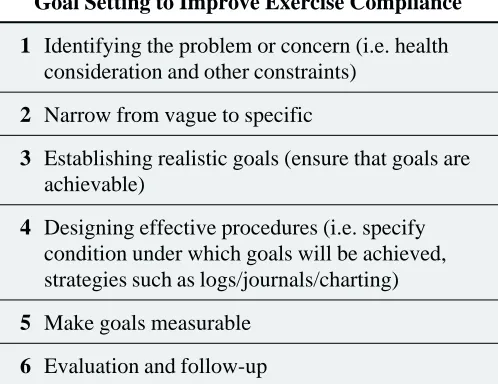
ment to patients but another to ensure that they are empow-ered to achieve successful incorporation of our requests in their lives. Non-compliance means that our patients are unable to fulfill the goals that have been identified within the professional relationship. A main focus within the chiropractor/patient relationship should revolve around goal setting. Hutchins and Vaught34 provide some goal
setting principles that may be appropriate within any help-ing profession (Table 5).
Ensure identification of the problem and discern be-tween the aforementioned constraints to exercise compli-ance. The health consideration is one issue but underlying problems and concerns have to be clarified in order to achieve optimum compliance. Once identified, the spe-cific problem(s) (e.g. weakness of spinal extension muscle) ensure that the patient understands the health con-sideration (e.g. importance of the muscle as a postural stabilizer) and clarify any myths or misconceptions re-garding the condition (e.g. pelvic tilt stretches this muscle and does not strengthen). Specific problems or constraints should be clearly identified and prioritized into a level of importance.
Once the problem has been specified it is time to estab-lish realistic goals with the patient. A clear picture of the problem enables the patient to comprehend the health con-dition. Realistic and achievable goals relate back to the constraint regarding a match between skill and chal-lenge.26 Ensure that the patient’s skill level meets the
chal-lenges (i.e. exercise prescription) and this will enable them to reach their goals.
One means for ensuring that patients achieve their goals is to incorporate their input by letting them choose appro-priate exercises. One of the main principles in ensuring positive compliance is the fact that patients have to feel like they are part of the process. The formulation of an exercise program has to be a collaborative effort between chiropractor and patient. Patients must have some freedom in choosing exercises that provide a feeling of compe-tence. For instance, provide 2–3 of the most appropriate exercises targeting spinal stability muscle and allow the patient to choose or alternate between exercises. A chiro-practor could initially provide education regarding the pa-tient’s health consideration and together appropriate exercises could be prescribed. People have to feel that they are contributing to their learning and recovery. This may provide a greater feeling of competence and self-determi-nation within the patient and the fact that they have some control over their condition.25 A barrier will arise if
exer-cise prescription is a one-way communication, chiro-practor to patient.
Designing effective procedures and ensuring that goals are measurable can be achieved through the following strategies. To ensure that patients have a grasp of various exercises it may be useful to prepare supportive literature with visual depictions including frequency, prescription parameters such as repetition and sets as well as intensity and duration. The visual depictions could be presented within exercise brochures. These brochures should be dis-played within the chiropractor’s office to allow for con-venient doctor patient access. Supportive literature can be one means for ensuring that our patients have a clear pic-ture of the exercises and this will enable them to come one step closer to achieving their goal(s). The brochures pro-vide specifics regarding the conditions under which goals will be achieved. Most practitioners contend that for posi-tive results, exercises must be specific,37–39 of the proper
intensity,40,41 and performed consistently with the correct
technique.42 Supportive literature (e.g. diagrams,
explana-tions of therapeutic regimen) act as a means for augment-ing compliance. The brochures also break the goals down into measurable steps so that the client knows when he/she has successfully completed a component of the prescrip-tion. A prescription written in a clear concise manner (e.g. outlining parameters such as duration, frequency, repeti-Table 5
Goal Setting to Improve Exercise Compliance
1 Identifying the problem or concern (i.e. health consideration and other constraints)
2 Narrow from vague to specific
3 Establishing realistic goals (ensure that goals are achievable)
4 Designing effective procedures (i.e. specify condition under which goals will be achieved, strategies such as logs/journals/charting)
5 Make goals measurable
tion and sets) provides the patient with a means for operationalizing and attaining goals.
The final component of goal setting behavior is the evaluation and follow-up session. Evaluation should in-clude an assessment that is conducted with the patient. This will include baseline data as well as results after the exercise prescription has been completed. Patients are able to relate improvements to objective (e.g. number of repeti-tions, time to hold position).
The follow-up session may include reevaluation of the presenting complaint or a time for reviewing patient goals. This may provide the chiropractor with some information regarding patient compliance to exercise prescription. The main goal of the follow-up session is to reinforce positive exercise behavior changes and to provide corrective feed-back so that patients can get feed-back on track.34 Once goals
have been met the follow-up session allows the practi-tioner to prescribe a more advanced regimen with a speci-fied goal.
Conclusion
This article has provided an overview of the terms motiva-tion, adherence and compliance. Constraints to prescribed exercises have also been identified along with goal setting strategies to improve compliance. To ensure that patients comply with prescriptions practitioners must first deter-mine their level of motivation and whether it is intrinsi-cally or extrinsiintrinsi-cally based. As health care professionals chiropractors must share knowledge that empowers pa-tients to be intrinsically motivated. This motivation comes from within and ensures that our patients develop a genu-ine, internal interest to improve their health. This internal motivation allows our patients to initiate a level self-deter-mination that can be used outside of the chiropractic/ patient relationship.
Optimum compliance can be achieved through a thor-ough identification of the constraints to exercise. Provid-ing patients with an exercise prescription is not enough. Practitioners must counsel patients and take a holistic look at the problem. The health consideration is the presenting problem, however, there are often many constraints that will impede a patient’s compliance to prescribed exer-cises. Once the presenting complaint is understood, other constraints associated with the patient’s lifestyle can be addressed toward appropriate prescription.
Chiropractic prescribed exercises will only be
success-ful when the value of self-determination is instilled within a patient. Home-based exercise should not terminate when the patient achieves clinical goals such as reduction or elimination of pain, return to work or return to other activi-ties of daily living. Patients have to feel that they are a part of the process and this includes input regarding the identi-fication of realistic and operationalized goals. Exercise prescriptions coupled with techniques that empower and instill compliance are important factors in enabling pa-tients to achieve a healthy lifestyle.
References
1 Paffenbarger RS, Hyde RT, Wing AL. A natural history of athleticism and cardiovascular health. J Am Med Assoc 1984; 252:327–330.
2 Pollock M, Willmore J. Exercise in health and disease. Philadelphia: W.B. Saunders, 1990: 6–11.
3 Powell K, Blair S. The public health burdens of sedentary living habits: theoretical but realistic estimates. Medicine and Science in Sports and Exercise 1994; 26:851–856. 4 Rankin J. Diet, exercise and osteoporosis. Certified News
(American College of Sports Medicine) 1993; 3:1–4. 5 Smith E, Gilligan C. Effects of inactivity and exercise on
bone. Physician and Sports Medicine 1987; 15:91–102. 6 Wheeler D, Graves J, Miller G, Vander Griend R,
Wronski T, Powers SK, Park H. Effects of running on the torsional strength, morphometry, and bone mass on the rat skeleton. Medicine and Science in Sports and Exercise 1995; 27:520–529.
7 Bouchard C, Shephard R, Stephens T, Sutton J,
McPherson B. Exercise, fitness, and health: a consensus of current knowledge. Champaign: Human Kinetics, 1994: 2–9.
8 Fleg J, Lakatta E. Role of muscle loss in the age-associated reduction in VO2 max. J Applied Physiology 1988;
65:1147–1151.
9 Paffenbarger R, Hyde R, Wing, A, Hsieh C. Physical activity, all cause mortality, longevity of college alumni. N Eng J Med 1986; 314:605–613.
10 Powers SK, Dodd SL, Total fitness exercise nutrition and wellness. Needham Heights: Allyn & Bacon,1996: 1–14. 11 Kelly JR. Leisure. 2nd. ed. Englewood Cliffs:
Prentice-Hall, 1990: 1–20.
12 Sonstroem RJ. Psychological models. In: Dishman RD (ed.), Exercise adherence. Champaign: Human Kinetics, 1988: 113–117.
13 Sonstroem R. Exercise and self-esteem. Exercise and Sport Scientific Review 1984; 12:123–155.
15 Martinsen EW, Hoffart A, Solberg O. Aerobic and non-aerobic forms of exercise in the treatment of anxiety disorders. Stress Medicine 1989; 5:115–120. 16 Dishman RK. Overview. In: Dishman RK, Exercise
Adherence. Champaign: Human Kinetics, 1988: 1–9. 17 Dishman R, Sallis J, Orenstein D. The determinants of
physical activity and exercise. Public Health Reports 1985; 100:158–171.
18 Petruzello S, Landers D, Hatfield B, Kubitz K, Salazar W. A meta-analysis on the anxiety-reducing effects of acute and chronic exercise. Sports Medicine 1991;
11(3):143–182.
19 Taylor C, Sallis J, Needle R. The relation of physical activity and exercise to mental health. Public Health Reports 1985; 100:195–202.
20 Becker MH, Maiman LA. Sociobehavioral determinants of compliance with health and medical care
recommendations. Med Care 1975; 13:10–21. 21 Dzewaltowski DA. Toward a model of exercise
motivation. Journal of Sport & Exercise Psychology 1989; 11:251–269.
22 Haynes R (ed). Ten year update on patient compliance research. Patient Educ Couns 1987; 10:107–174. 23 Meichenbaum D, Turk DC. Facilitating treatment
adherence. New York: Plenum Press, 1987.
24 Sluijs EM, Knibbe J. Patient compliance with exercise: different theoretical approaches to short-term and long term compliance. Patient Educ Couns 1991; 17:191–204. 25 Iso-Ahola SE. Social Psychological Perspectives on
Leisure and Recreation. Springfield: Charles C Thomas Publisher, 1980: 1–20.
26 Csikszentmihalyi M. Beyond Boredom and Anxiety. San Francisco: Josey-Bass, 1975.
27 Herbert L, Teague ML. Exercise adherence and older adults: a theoretical perspective. Activities, Adaptation and Aging 1989; 13:91–105.
28 Dishman RK. Compliance/adherence in health related exercise. Health Psychology 1982; 1:237–267. 29 Dishman RK. Exercise adherence. In: Morgan WP,
Goldston SN (eds.). Exercise and mental health. Washington: Hemisphere, 1986: 57–83.
30 Edginton CR, Hanson CJ, Edginton SR, Hudson SD. Leisure programming a service centered and benefits approach. 3rd. ed. Boston: WCB McGraw Hill, 1998: 439.
31 Shangold MM. Beyond the exercise prescription. Making exercise a way of life. Physician and Sportsmedicine 1998; 26(11):35–36.
32 Jensen GM, Lorish CD. Promoting patient cooperation with exercise programs: linking research, theory and practice. Arthritis Care Res 1994; 7(4):181–189. 33 Carkhuff RR, Anderson DD, Benoit D, McLaughlin C,
Linder J. The Art of Helping VI. Amherst: Human Resource Development Press, 1987: 3–12.
34 Hutchins DE, Cole Vaught C. Helping relationships and strategies. 3rd. ed. Toronto: Brooks Cole Publishing, 1997: 137–185.
35 Shinew KJ. Leisure interactions with family & friends. The Leisure Research Symposium October 1996 23–27, Kansas City, MO.
36 Marcus BH, Goldstein MG, Jette A. Simkin-Silverman L, Pinto BM, Milan F, Washburn R, Smith K, Rakowskie W, Dube CE. Training physicians to conduct physical activity counseling. Preventative Medicine 1997; 26(3):382–388. 37 Erhard RE, Delitto A, Cibulka MT. Relative effectiveness
of an extension program and a combined program of manipulation and flexion and extension exercises in patients with acute low back syndrome. Phys Ther 1994; 74:1093–1100.
38 Kendall PH, Jenkins JM. Exercises for backache: a double blind controlled trial. Physiotherapy 1968; 54:154–157 39 Nwuga F, Nwuga V. Relative therapeutic efficiency of the
Williams and McKenzie protocols in back pain management. Physiotherapy Practice 1985; 1:99–105. 40 Mitchell RI, Carmen GM. Results of multicenter trial
using an intensive exercise program for the treatment of acute soft tissue and back injuries. Spine 1990;
15:514–521.
41 Kohles S, Barnes D, Gatchel RJ, Mayer TG. Improved physical performance outcomes after functional restoration treatment in patients with chronic low back pain; early versus recent training results. Spine 1990; 15:1321–1324. 42 Friedrich M, Cermak T, Maderbacher P. The effect of
brochure use versus therapist teaching on patients performing therapeutic exercise and on change in impairment status. Physical Therapy 1996; 76 (10):1082–1088.
2nd Canadian Chiropractic Scientific Symposium Is Coming
Contact: DR. ALLAN GOTLIB DC
CANADIAN CHIROPRACTIC ASSOCIATION TEL: 416-781-5656 ext. 224
FAX: 416-781-0923 EMAIL: [email protected]