Every Inch Of Many Effigies:
Six Courthouse Songs
Music Theatre piece for Baritone and Chamber Ensemble
Dramatic vocal composition combining lyric singing with extended vocal techniques
Analytical Commentary
Joanna Lee
A thesis submitted in partial fulfilment of the requirements of Birmingham City University
for the degree of Doctor of Philosophy
2015
Birmingham Conservatoire
Abstract
The topic of this PhD thesis is dramatic vocal composition combining lyric singing with
extended vocal techniques. The aim of the research is to compose a music theatre piece or
chamber opera for voice and chamber ensemble that exploits both the lyrical singing voice
and extended vocal techniques, in ways that are practical and appealing to the lyric singer.
The main submission is Every Inch Of Many Effigies: Six Courthouse Songs (2012/13), a
music theatre piece for baritone and chamber ensemble. The composition, twenty-five
minutes in duration, is a political satire piece set to a combination of original text by Alan
McKendrick and found texts. The work was premiered by Leigh Melrose and Birmingham
Contemporary Music Group, conducted by Oliver Knussen in March 2013.
This commentary examines Every Inch Of Many Effigies and its level of success in achieving
the above aim. It charts the exploration of the topic and the progression to the final piece
through the composition of supporting works.
A key area of research is the discovery and exploration of extended vocal techniques: the
considerations and effectiveness of their application with regard to the response of singers,
notation and balance. Alongside this, considering the singer in terms of the role of extended
vocal techniques in theatrical works and how this can justify their use, the pursuit and
integration of lyrical singing and the musical difficulties of contemporary music.
This commentary will discuss the application and success of this research by considering the
Acknowledgements
To my daughter Isla, who was born as I wrote this thesis, for inspiring me to achieve more.
My parents Sylvia and Graham, brother Richard and husband Simon for their endless
support throughout my musical pursuits and life. My Grandparents Doris and Robert, who
passed away as I wrote this thesis, for always being so proud. And my wonderful friends,
musical and non.
To those who have selflessly and generously offered enduring support and guidance, for
whom my career is indebted; Jane Manning, Sarah Leonard, Oliver Knussen, Colin
Matthews, Richard Causton, Edwin Roxburgh, Joe Cutler, Howard Skempton and Jonathan
Reekie.
To additional practitioners who have supported and inspired me along the way; Jonathan
Dove, David Sawer, Jackie and Stephen Newbould, Sonya Knussen, Ryan Wigglesworth,
Katie Mitchell, Stephen Plaice and all the ensembles, singers, players, artistic directors who
have performed my work and shown interest.
A special thank you to Leigh Melrose, Oliver Knussen, Birmingham Contemporary Music
Group and Sound and Music for their commitment to commissioning, developing and
performing Every Inch Of Many Effigies.
To my collaborators and writers Alan McKendrick, Howard Skempton and Rory Mullarkey
for their integral and talented contributions to my work.
To those at Birmingham Conservatoire who have facilitated my PhD; Liz Reeve, Steve
Contents
Contents of Portfolio P. 5
Chapter 1: Context
1.1 - History and Background P. 8
1.2 - Extended VocalTechniques P. 13
1.3 - Notation P. 20
1.4 - Text and Theatre P. 28
Chapter 2: Every Inch Of Many Effigies - Compositional Commentary
2.1 - Introduction P. 45
2.2 - Extended Vocal Techniques P. 48
2.3 - Considering the Singer P. 70
Chapter 3: Conclusion
3.1 - The voice and ensemble P. 89
3.2 - My aesthetic P. 96
3.3 - Moving forward P. 100
Bibliography P. 103
Contents of Portfolio
Analytical Commentary
Main Work
Every Inch Of Many Effigies: - 2012/13 - c. 25 minutes
Six Courthouse Songs
Text by Alan McKendrick.
Baritone,
Flute/Piccolo, Oboe, Clarinet in Bb /Bass Clarinet in Bb, Bassoon,
Horn in F, Percussion, Harp, Piano /Toy Piano,
Violin I, Violin II, Viola, Violoncello, Double Bass.
Supporting Works
1) Mannequin - 2011 - c. 10 minutes
Text by Hannah Silva.
2 Soprano, 1 Mezzo-soprano.
Clarinet, Cello, Piano, Percussion.
2) Krazy Kat - 2010 - c. 40 minutes
Text by Howard Skempton after George Herriman.
Soprano, Mezzo-soprano, Tenor, Baritone,
Piccolo/Flute/Castanets, Clarinet in Bb/Bass Clarinet/Castanets,
Percussion, Harp, Violin, Cello, Double Bass.
3) The Princess: A Story from the Modern Greek
- 2008 - c. 15 minutes
Text by Howard Skempton.
4) Chansons Innocentes - 2008 - c. 20 minutes
Text by E.E. Cummings. Female Voice,
Flute, Oboe, Clarinet in Bb, Bassoon, 2 Horns in F, Trumpet,
Percussion, Harp, Piano,
Violin I & II, Viola, Cello, Double Bass
5) Elephant Woman: a woman’s love & life
- 2007 - c. 14 minutes
Text by Jo Shapcott, Elizabeth Jennings, E.E. Cummings & Anne
Stevenson. Female Voice,
Flute, Clarinet in Bb, Piano, Viola, Cello.
6) whippoorwill - 2006 - c.6 mins / flexible
Text by E.E. Cummings
Choir
7) your little voice - 2001 - c. 4 minutes
Text by E.E. Cummings.
Soprano
CD Recording
1) Every Inch Of Many Effigies – Six Courthouse Songs
March 2013
Leigh Melrose & Birmingham Contemporary Music Group, conducted by Oliver Knussen.
Crossing the Atlantic, CBSO Centre, Birmingham.
2) Chansons Innocentes
February 2008
Jane Manning & Orchestra of the Swan, conducted by David Curtis.
‘American Dreams’, Town Hall, Birmingham.
3) Elephant Woman: a woman’s love & life [excerpts]
March 2007
Jessica Walker & Psappha, conducted by Nicholas Kok, staged by Elaine Tyler-Hall.
Martin Harris Centre for Music and Drama, Manchester.
4) whippoorwill
June 2006
CoMA Voices, directed by Sarah Leonard.
CoMA Summer School 2006, Doncaster.
5) your little voice
December 2003
Jane Manning.
CHAPTER 1: CONTEXT
The aim of this project is to compose a music theatre piece or chamber opera for voice and
chamber ensemble that exploits both the lyrical singing voice and extended vocal techniques,
in ways that are practical and appealing to the lyric singer. To summarise the key issues this
project addresses:
The discovery and exploration of extended vocal techniques. The considerations and
effectiveness of their application with regard to:
- Response of singers
- Notation
- Balance
Considering the singer:
- The role of extended vocal techniques in theatre and how this can justify their
use
- Pursuit and integration of lyrical singing
- Musical difficulties of contemporary classical music
1.1 – History and Background
In this chapter, I will discuss the historical context behind extended vocal techniques and the
lyric tradition, and the background of my work and experiences that led me to this research
topic.
History
According to Jane Manning’s seminal work New Vocal Repertory: An Introduction, ‘the
breaking down of stylistic barriers in vocal music is long overdue’ (Manning, 1994, p. 2).
She notes the tendency of contemporary composers to write for specialist new music singers,
whilst lyrical singers are often unwilling to ‘question accepted patterns’ (ibid) of their
The origin of the lyric tradition stems from the 17th century Bel Canto, or ‘beautiful
singing…[which involves] graceful, smoothly flowing phrases’ (Barker, 2004, p. 7). In order
to achieve this, the head and chest registers are joined and singing is based on vowels to
create smoothness of tone throughout the range. Development of instruments in the 17th
century and expansion of concert halls in the 19th century forced singers towards extension
of range, agility and volume, which is linked to increased use of vibrato, in order for voice
and text to be heard. The lyric tradition and its repertory, characteristics and techniques have
continued to form the core of classical vocal music today.
Extended vocal techniques are so named because they require singers to use their voice in
ways outside accepted lyric conventions, which includes speaking to gasping, yodelling, a
nasal sound or American accent. Their use is associated with the experimental ‘avant garde’
composers of the 1950s-70s, such as Luciano Berio, John Cage, Mauricio Kagel, György
Ligeti and Peter Maxwell Davies. Seminal works include Sequenza III (1965) by Berio,
Anagrama (1957-58) by Kagel, Aventures (1962) by Ligeti and Eight Songs for a Mad King
(1969) by Maxwell Davies.
These composers pursued extreme experimentation that affected all aspects of established
compositional practice in Western classical music; this included timbre, which led to the
development of extended vocal techniques. The creation of new timbres required different
notation as standard conventions did not cater for the new sounds composers were exploring.
As all aspects of music were pushed to the extreme, extended vocal techniques are often
associated with music that is stylistically and technically challenging, requiring performance
by specialist new music singers. These demands are heightened in dramatic contexts, where
the singer performs from memory and has non-musical factors to consider, e.g. staging.
These difficulties, the conservatism of opera and the wish of ‘avant garde’ composers to
dissociate from traditional established practices led to the development of music theatre, a
dramatic form where experimental approaches to the voice and composition are pursued.
In more recent times, extended vocal techniques have become less prevalent but can be seen
Sporadic application coupled with lyrical singing can be seen in works by David Sawer,
Gerald Barry and Greek (1986–88) by Mark-Anthony Turnage. However, in the majority of
vocal music and larger-scale operas by high-profile composers in the UK, such as Harrison
Birtwistle, Thomas Adés and Jonathan Dove, the voice is essentially used in a lyrical
manner. Therefore, many of the contextual works I will discuss stem from the 1950-70s era.
Background
My interest in extended vocal techniques arose in 2001 upon hearing Eight Songs for a Mad
King by Peter Maxwell Davies: the theatricality, virtuosity and vocal techniques were
entirely new to my experience. I responded to this work by composing your little voice
(2001) for soprano. your little voice explores a variety of vocal styles and techniques I had
experienced during my training as a singer, as seen in Example 1.
Example 1 – Vocal styles and techniques used in your little voice
- CH: Child. Sweet, squeaky and childlike.
- JZ: Jazzy. Sexy, velvety, with an American twang.
- ML: Musical theatre. West-end musical style, preferably in chest voice,
legato.
- NA: Normal/Arabic. Normal voice but sung through the nose.
- NM: Normal. What would be regarded as the singer's normal voice.
- OP: Operatic. Much warble and resonance.
- SW: Sweet. A gentle and sweet tone, in a Motherly manner (Mary
Poppins).
It was apparent during my experience as a singer that certain vocal styles and techniques
were applied to specific musical genres, which were kept distinct from each other and in
some instances, frowned upon by practitioners of other genres. Whilst trying to gain a
performance of your little voice at music college, I recognised singers pursued a traditional
set repertoire centred on opera and they offered a dislike and fear of contemporary music.
I was dismayed by this segregation between contemporary and traditional music circles,
singers and composers, and the different areas and genres of vocal music. Spurred on by this
state of affairs and my new zeal for extended vocal techniques, I set about a new phase in my
work, centred on the research aim of this PhD, which has endured to this day.
your little voice went on to be shortlisted by the Society for the Promotion of New Music,
selected for performance by Jane Manning and Sarah Leonard, recommended in The Singer
and Association of Teachers of Singing magazines, and is in regular use by teachers with
their students at music colleges in England. This piece signified a pivotal point as it initiated
my desire to focus on vocal composition; it also introduced me to two mentors and
collaborators who have been integral to my career, Jane Manning and Sarah Leonard.
Manning and Leonard introduced key repertoire to aid my development, for example
Manning’s renowned association with Pierrot Lunaire (1912) by Arnold Schoenberg, a work
that spearheaded the advance of contemporary vocal repertoire. In addition, Leonard’s
collaboration with Helmut Lachenmann for Das Mädchen mit den Schwefelhölzern
(1988-96) and György Ligeti for Aventures; these composers have been significant in this
genre for their extreme use of extended vocal techniques and new methods of notation.
Manning and Leonard have generously supported my research by trialling a variety of vocal
techniques, providing advice and performance opportunities. I have also worked with other
specialist new music singers, including Loré Lixenberg and Omar Ebrahim.
These latter two examples are singers who have a particular skill in contemporary vocal
music but are equally engaged in traditional operatic posts; this applies too for Leigh
Melrose, the singer for Every Inch Of Many Effigies. Contemporary music specialist singers
have been vital for my research but it has been essential to work with lyric singers with
limited experience of contemporary music. This has occurred through the Britten-Pears
Contemporary Composition Course, Jerwood Opera Writing Foundation course (Mannequin)
and performances for my Psappha (Elephant Woman) and Tête á Tête (Krazy Kat) opera
projects. These presented ideal opportunities to gauge what type and level of extended
The Jerwood, Psappha and Tête á Tête projects involved staged settings and therefore
enabled me to explore the role and purpose of extended vocal techniques within opera and
music theatre. The Britten Pears programme, London Symphony Orchestra Panufnik
Scheme and my residency with BCMG provided the opportunity to develop my instrumental
writing, with BCMG granting my first opportunity to work extensively with a male voice;
contemporary music specialist singers are more frequently female. These opportunities also
initiated contact with mentors and composers that have particular knowledge in my research
area, including Harrison Birtwistle, Jonathan Dove, Oliver Knussen, Roger Marsh and David
Sawer, whose opinions and advice on my work has been essential.
The projects I have undertaken during my PhD have provided ideal situations in which to
explore my research aim, each time taking what knowledge I can from the singer, player,
conductor, composer, performance and experience to enhance the success of my PhD and
compositions. This commentary charts the influence of these projects leading to and chiefly
1.2 – Extended Vocal Technique
Exploring and discovering extended vocal techniques has been a key area of my research.
These techniques were mainly pinpointed at the start of my research but tested and honed in
my compositions throughout. Therefore, I shall begin by defining the extended vocal
techniques I have been looking at. The source of these techniques can loosely be grouped
into being derived from vocal technique, text or theatrical stimuli.
Vocal Range
The lyric tradition categorizes voices into soprano, mezzo-soprano, alto, tenor, baritone and
bass according to a designated range and the voice’s timbre. This range indicates what a
singer is likely to encounter in the lyric tradition and should sing with ease. Ordinarily,
singers can extend beyond the set lyric range, as indicated in Example 2 in reference to what
is expected of a soprano voice in lyric conventions and the usable extended range of Sarah
Leonard’s soprano voice. An example of the extended range in contemporary music is
Thomas Adès’ opera The Tempest (2004), where the role of Ariel sits very high in the
soprano range: ‘Ds, Es, Fs and a G [above the treble stave] at one point’ (Adès, 2012).
Example 2 – Lyric and extended range
!
Register
A singer’s training works with registers, for example chest and head register/voice or
falsetto. ‘Register refers to a range of pitch [within the voice] having a consistent timbre or
quality…a change in voice quality at particular pitches, due to changes in the vocal
mechanism’ (Kayes, 2004, p. 164). Registers correspond to a particular range, area of
resonance and colour. For example, a male singer’s falsetto is heard in the upper range and
female’s chest register/voice is low in the range, creates the sense of resonance of vibration
in the chest and has a more robust and speech-like colour.
Register can be specified to achieve a certain colouristic, emotional or theatrical effect; for
example, asking a male singer to use falsetto creates a gentle or haunting quality in
comparison to full voice. A lyric soprano pulls the head voice down into the lower range; a
request for ‘chest voice’ instead will bring a more full-bodied tone or pushing the chest voice
upwards, known as belting, will create something characteristic of Pop or Musical Theatre
styles.
In the last two bars of Example 3, the range is in the extreme lower register of the soprano
voice, necessitating her to apply her chest voice in order to achieve the pitches.
Colouristically, this creates a burly sound to depict the hippopotamus portrayed in the text.
In bar 43-45, I have requested ‘sung tone of sprechsgesang in head voice’, which will make
the voice float and glide, creating a melancholic sound to parallel with the words.
Example 3 – Register use
‘Hippopotamus Dance’, Chansons Innocentes – Bar 41
!
There is a break in the voice between registers, called the passaggio. If this is transitioned
over in quick repetition, it creates yodelling due to perceptible changes in colour and
dynamic of the different registers. The passaggio is an unstable part of the voice.
between large intervals, necessitating quick register changes and therefore creating an
ungainly quality to depict the lumbering hippopotamus.
Voicing
This is in reference to the type and amount of voicing applied to the tone. It varies from
whispering, spoken, sprechgesang (between singing and spoken) and singing. The first, in
its pure form, is categorised as unvoiced, and the remaining three are voiced with the degree
of sung tone increasing. There is a gradual spectrum between these.
Lachenmann’s scores indicate the pitch of a whisper can be altered, although I have found
this can only be achieved when voicing or some spoken tone is added or the phonetic is
changed. It is difficult to pitch spoken tones precisely and the range is not as wide as sung
tones; spoken tones seem to tally with where the chest voice sits so for a soprano, I would
chose spoken pitches between the interval shown in Example 4.
Example 4 – Spoken range of soprano
!
The tessitura, or pitch area where the voice sits most comfortably, of a soprano or mezzo is
much higher than their speaking voices, so spoken tones sound contrived in their mid-range
as they have to add some sung tone and it is not possible high in the range. The more sung
tone added to the sound, the more appropriate it is to add specific pitching and the wider the
range, dynamic and colour possibilities become. An example of spoken tones can be found
in William Walton’s Façade (1926 & 1938) and Sprechsgesang is associated with
Schoenberg’s Pierrot Lunaire.
Breath
Use of breath can be exploited, be it on an exhale or inhale. Examples of breath-based
techniques include whispering, hissing, gasping, panting or simply asking for a ‘breathy
use of breathy tones can be heard in ‘Walking Song’ from Meredith Monk’s Volcano Songs
(1994).
Example 5 – Breath techniques
Hiss Pant Breathy tone
!
Colour and Style
The singer can be asked to apply a certain colour to the sound, for example breathy, nasal,
screechy or guttural. This can be to one note or for an extended period. As with your little
voice, specific vocal styles can also be specified as they are associated with certain
techniques, for example a request for ‘musical theatre’ may create a more nasal and
twang-based sound with an American accent.
Text
Text is another key area that instigates the use of extended vocal techniques, where the
sounds and phonetics of the text form the basis of extended vocal techniques; they go
hand-in-hand with each other. One method of using text to create extended vocal techniques is to
deconstruct the text: analysing its phonetic content and then exploiting the sonic or
percussive element of the phonetics.
Vowels versus consonants
The singer can use more intrusive consonants, as employed in Pop music and in contrast to
lyric singing, which is chiefly based on applying pure vowel sounds; Manén speaks of ‘the
unique power of the voice to produce vocal colourings based on the exclamatory
vowels’ (1974, p. 12). ‘Ah’ and ‘oo’ are the most relaxed vowels as they are closest to the
larynx at rest, and are therefore the most desirable of the vowels to sing on, with ‘ee’ and ‘ae’
being less comfortable.
where the consonants are extended out of the word and emphasised. Alternatively, it can be
applied in a more continuous form, for example in beatboxing, which I will discuss more in
chapter 2. The use of vocal lines based on fragmentary text and phonetic sounds can be
found in Ligeti’s Aventures, Berio’s Sequenza III and O King (1968), and Aperghis’
Recitations (1977-78).
Example 6 – Over-pronounced consonants
‘Hippopotamus Dance’, Chansons Innocentes – Bar 49
!
Diphthongs
Lyric singers avoid fully pronouncing a diphthong because the transition between the two
combined vowels does not correspond to their quest for pure vowel sounds; instead, they
prefer to stay on the first vowel for as long as possible and quickly enter the last at the final
moment. As an extended technique, the vowel modification of diphthongs, triphthongs or a
line of vowels can be elongated, which affects the overtones of the sound. An example of
elongation to a vowel is seen in Example 7, where the ‘i’ of ‘knife’ is slowly stretched to
‘ah-ih-ee.’ Examples of works that explore overtone singing or vocal harmonics through vowel
modification are Stimmung (1968) by Stockhausen and Sequenza III by Berio.
Example 7- Diphthong extension
‘The Victory’, Elephant Woman – Bar 142
Placement
Vowels can be more open or closed, or articulated further to the front or back of the mouth,
altering the colour of the sound. Example 8 shows ‘a’ articulated at the back of the mouth as
‘ah’ and the front as ‘ae’; the former gives a more rounded sound, the latter sounding more
‘strangled.’
Example 8 - Change of vowel placement on “a”
your little voice - Bar 6
!
Mouth open or closed
An ‘ah’ with the mouth open is the same inner mouth shape as an ‘mm’ with the mouth
closed. An ‘nn’ (mouth closed) creates a more squeezed and nasal sound than an ‘mm’.
Humming and a vocalise (song without words) are stylistic to singing. A combined example
of opening and closing the mouth, changing placement of vowels and modifying the vowels
can be heard in ‘Old Lava’ from Meredith Monk’s Volcano Songs.
Linguistic Accents
The accent of choice in lyric singing is Received Pronunciation, ‘the standard form of British
English pronunciation, based on educated speech in southern England, widely accepted as a
standard elsewhere’ (----, 2015). Other methods of pronunciation or linguistic accents would
be deemed as an extended technique, for example the use of a Cockney accent in
Mark-Anthony Turnage’s opera Greek. I will discuss this area further in chapter 2.
Theatrical
The lyric tradition leaves the singer to emotionally interpret the score as they wish, hinted at
and ‘wistful’ are indicated. In turn, this suggests what vocal technique, often several within
one piece, should be applied.
Indicating a specific character can suggest much about the type of vocal style and techniques
to be used. For example, a witch might lead a singer to adopt a more nasal and shrill tone.
This could then be used alongside the extended vocal techniques of cackles, shrieks, fast and
wide vibrato and a regional linguistic accent.
Other extended vocal techniques
There is an endless list of possible extended vocal techniques, to name some: giggling,
crying, gulping, clicking, extended vibrato, senza vibrato, quarter and microtones, glissandi,
trilled glissandi, tremolo, vocal fry (lowest area of the voice characterised by a rattling
sound) and a glottal stop (a click in the voice when the airflow is rapidly stopped, as heard
when saying ‘uh-oh’). Some of these techniques, for example microtones, do not form part
of my compositional style but the area of extended vocal techniques is sufficiently large
enough to not be able to cover everything in detail in this project. Therefore, this
commentary will discuss those extended vocal techniques that are relevant to my
1.3 – Notation
In this section, I will discuss the notation I have developed and settled upon in my scores in
light of the use of extended vocal techniques; this includes noteheads, staves and the text
underlay.
Notation
The lyric tradition chiefly entails sung tones and therefore a standard notehead fulfils all
purposes. However, this does not cater for extended vocal techniques and therefore,
unconventional or new notation is required.
Studying contemporary music scores shows there is ambiguity in the notation of extended
vocal techniques. Aperghis’ Recitations and Maxwell Davies’ Eight Songs for a Mad King
use some elements of established notations, for example sung noteheads, and others new,
such as the use of single-line staves in Aperghis. Both scores use an unconventional layout
of staves: ‘A Lady in Waiting’ from Eight Songs for a Mad King is inspired by stories of
King George III teaching bullfinches to sing and includes the stave drawn in the shape of a
birdcage.
The exploration of the graphic aspect of scores was common in the 1950-70s, for example
Stripsody (1966) by Cathy Berberian, where the notation is inspired by comic strips. With
the exception of a parody to operatic singing for which a short excerpt of conventional
notation is used, the score of Stripsody solely uses drawings and onomatopoeic words to
indicate all aspects of the performance, including extended vocal techniques; relative pitch is
implied via a giant three-line stave.
For Sequenza III, Berio created a new notation, including noteheads for a variety of vocal
techniques and the use of phonetics in the text. For musical aspects, duration in seconds
replaces conventional notation for rhythm and time signatures, a variety of staves with a
different number of lines are used, and adjectives are placed throughout to imply emotion,
Ligeti’s Aventures uses a very detailed score, including an array of noteheads and one
hundred and nineteen phonetics to indicate the timbre of extended vocal techniques; the
score includes a large key that requires intensive study before the music can be learnt.
Lachenmann’s Got Lost (2008) for soprano and piano uses a two stave system for the
soprano, again with many different noteheads to indicate the various extended vocal
techniques; these noteheads include round, square, diamond, cross, triangle (upwards and
downwards), headless and dashed.
The type and definition of different noteheads varies between composers. In light of this and
the general ambiguity of notation between composers, I have developed a notation for my
own work. This notation is a result of trials and alterations over my research and it
endeavours to use conventions where possible and to be clear and succinct. The notation I
propose is seen in Example 9.
Example 9 - Notation
This key appears in the performance notes of the score and a reminder of the notation’s
meaning is also placed above the stave in its first appearance in the music.
Some of the notation is lifted from established practices, for example sung tone is a standard
from the lyric tradition. The use of a small circle above the note is also a standard for
falsetto and for example, can be seen in recurrent use through scores of Gerald Barry. The
notation above for Sprechsgesang ‘is now used universally to define a style between speech
and singing and identified with Schoenberg’s use of the term Sprechsgesang’ (Gould, 2011,
p. 458), associated with Pierrot Lunaire.
‘The crossed notehead has been widely adopted to represent speech’ (ibid). However, there
is more ambiguity over this, for example Turnage’s Greek uses headless notes to represent
spoken tones. I initially used headless notes to represent whispering: as Gould suggests ‘the
norm is to choose notehead shapes that graphically reduce the notehead as pitch [tone] is
reduced out of the voice’ (ibid). However, without a notehead, it was hard distinguish the
duration, e.g. a minim and crotchet are differentiated by an empty or filled in notehead and a
semi-breve became non-existent because it is all notehead and no stem.
Increasing understanding of extended vocal techniques has caused changes to my notation.
Breath-based tones have caused most alterations. Initially, I differentiated between a whisper
and unvoiced exhale. However, I recognised these are the same technique and given the
confusion of the headless notation used for a whisper, I amalgamated the two. Instead, I use
the arrow noteheads that define an inhale and exhale in Ligeti’s Aventures. To cater for the
spectrum of voicing that a breathy sound can be applied to, I added a cross to the stem of an
inhale/exhale to represent a voiced inhale/exhale and a sung notehead to the stem of an
exhale to indicate a sung exhale (N.B. This was not applied to a sung inhale as I do not use
this technique). However, the latter is not clear in indicating pitch. Therefore, if a sung tone
has a breathy colour, I tend to write ‘breathy tone’ above a sung note.
I also initially had a notehead for ‘click’, which I defined as ‘a percussive sound: a short,
However, I removed this after realising it was easier to notate using the text underlay and a
spoken notehead with a loud dynamic and accent.
Aside from using the inhale and exhale notation from Aventures, additional examples of
notation I drew from other scores includes ‘as high or low as possible’, where an upwards or
downwards arrow is used for the notehead. The three dashes of a tremolo are used on the
stem as per convention, only altering the notehead according to the voicing.
In instances where no set notation was available, notation is applied by what seems logical.
For example, a wide wavy line is used to indicate extra vibrato and a glottal stop is allocated
the same symbol used in the International Phonetic Alphabet. A square notepad was added
to represent techniques that had not been covered and were unlikely to be used frequently; a
descriptive word appears above the note to define the precise technique, e.g. ‘cackle’.
I also experimented with less formal notation in whippoorwill (2006). Notation appears in a
box and without a stave when the music is improvised and standard notation on a
conventional stave is used when the music is fixed. The noteheads I employ for extended
vocal techniques, as seen in Example 9, remain and a key is provided in the front of the score
to explain these and the boxes. This notation worked in performance as it enabled the
desired structural and textural freedom. However, it has limitations in indicating specific
pitching and for another work, the lack of structural control would not be appropriate. This
style of notation is also less customary for lyric singers; whippoorwill was written for a choir
of amateur vocalists.
Text underlay
Text and its phonetic content go hand-in-hand with extended vocal techniques. In turn, this
necessitates consideration of how the text appears in scores to assist notation of extended
vocal techniques. In order to fully understand the relationship between text and extended
Example 10 – International Phonetic Alphabet chart
Learning the IPA chart provided a better understanding of extended vocal techniques and
therefore, I would recommend that any composer who wishes to pursue this vocal style
become acquainted with the IPA system. I transferred this knowledge to my scores by using
phonetic symbols in the text underlay to help define the extended vocal techniques. This
also included the use of diacritic symbols, used to indicate how the phonetic should be
pronounced, e.g. nasal or to the front of the mouth. This use is seen in Example 11, taken
Example 11 – Phonetic symbols in notation
‘Jimmie’s got a goil’, Chansons Innocentes – Bar 145
1. Top line. The text, coupled with phonetic symbols [in square brackets] when the
percussive or acoustic effect of the text/phonetic should take precedence over
narrative purpose.
2. Second line. Respellings appear below the phonetics as a helpful guide.
This method provided a precise indication of the phonetic quality of an extended vocal
technique. However, it became apparent that the majority of singers do not know IPA
symbols and therefore, their inclusion was unhelpful. Sarah Leonard (personal
communication, October 2007) pointed out that Ligeti’s Aventures, a work that contains a
plethora of phonetic symbols, takes a vast amount of time to learn because of the phonetics,
which require painstaking study of the substantial key before you can even start learning the
music.
Therefore, as my research as progressed, I have phased out the use of phonetic symbols; they
have been helpful for my understanding of extended vocal techniques but they have been
little use to singers, instead creating a laborious learning process. In their place, I simply put
a ‘respelling’ of the phonetic, so [ʃ] becomes ‘sh’.
General
Minimising the amount of detail in the notation has been beneficial. To begin with my
scores were littered with detail, as seen Example 12. The lyric singer for this piece
Voice &44 24 44
[m] m [m] m gliss. whehn when when mf x yoo you x see sihee x
˜hawihher
x Sal Sahl f Sal Sahl [m] m ? sh [∫] sh
[∫] sha
sheh x [kæ] kae -- bb [bb] sheh shake x kih it x sheh shake kih it and ihuhnd shih shim mee mie ˜ -- [m] m mf ? huh
[hə]
Pant f
uh
[ə]
huh
[hə]
uh
[ə]
huh
[hə]
uh
[ə]
3:2
œ
fj ‰ œ œ œ œ
responded that the level of detail in the score is overwhelming, impossible to achieve and
leaves little artistic freedom for the singer (Jessica Walker, personal communication, March
2007). This is a result of: the notation for extended vocal techniques, with much variety of
noteheads, symbols and descriptive words; a text that includes phonetic symbols and
theatrical indications calling for three different characters; musical considerations that
include frequent time signature changes, articulations and dynamics. Such detail risks
putting a lyric singer off at the earliest stage.
Following this, I endeavoured to decrease the level of detail in scores. Looking at Example
12, I removed the use of brackets to indicate how long a technique lasts, e.g. Bar 67/68 for
‘Squeaky’, replacing instead with the indication of ‘nat’ or allowing the next technique to
take over. I also removed redundant details, for example in the last two bars, the ‘C’ on the
note stems indicates chest voice but the singer will automatically do this given the low range.
As previously mentioned, I phased out the use of phonetic symbols. In addition, I aim to
pace the level of detail, for example if the vocal line is musically difficult, I avoid a plethora
of extended vocal techniques.
Overall, I try to be as clear in the notation as possible, whilst being practical about what is
achievable and avoiding complexity for the sake of the score looking impressive. I have
found this approach to be beneficial as by doing so, time is saved in the performer’s learning
process, rehearsals and the amount of clarification needed by the composer, which makes for
Example 12 – Detailed notation
‘may i feel’, Elephant Woman - Bar 63
1.4 - Text and Theatre
In this section, I will discuss the role of text and theatre in vocal composition, including
copyright and collaborating with librettists.
The role of text in vocal composition
Text is a vital consideration when working in vocal music, it is a means to initiate
composition. Theatre is also intrinsic to vocal music, be it specific in terms of composing
opera or a concert work where the singer is conveying a character, sentiment or story. I have
learnt that singers are intrigued by the text: they are keen to research this before learning the
music as it helps them understand the work, memorize and immerse themselves in the role.
Therefore, I always place the text in the front of the score so the singer can gain a clear
insight into the work.
I began my research by composing a vocalise, a song without words, to explore what the role
of text is in vocal composition. This is seen in Example 13. Without the consideration of
text, I thought more focus could be placed on exploring the colours of the voice and in this
instance, the head and chest registers, indicated as ‘C’ and ‘H’ in the score, and yodelling.
When I showed the vocalise to a singer, they were baffled and disappointed by the lack of
text and a beneficial element to vocal music was missing; it was as if the skeleton on which
the music is woven was missing. By removing the text, variety of vocal colour was lost
because it is intrinsic to the vowel sounds and the emotional depth was lessened because
there was no story or character to hold onto. This is not to say a vocalise cannot be
Example 13 – Vocalise
Choice of text has been imperative in determining how the voice is used, including extended
vocal techniques. Texts that readily lend themselves to extended vocal techniques are those
that explore the sounds of words, e.g. poems, sounds poems and Dada texts. Taking
Chansons Innocentes as an example, the text by E.E. Cummings (1994) determines the way 1
in which the voice is applied.
i) ‘whistles far & wee: jackanory’
in Just-
spring when the world is mud-
luscious the little
lame balloonman
whistles far and wee
and eddieandbill come
running from marbles and
piracies and it’s
spring
when the world is puddle-wonderful
the queer
old balloonman whistles
far and wee
and bettyandisbel come dancing
from hop-scotch and jump-rope and
it’s
and
the
goat-footed
balloonMan whistles
far
and
wee
I interpreted this poem as descriptive, setting an enchanting and serene scene through
narration. I decided to create a sense of story telling: the clearest vocal association of this is
spoken tones. Alongside speech, areas of lyrical singing are applied to bring a sense of
serenity. The poem suggests a sinister element relating to Pan, which is portrayed through
less pure vocal tones, such as sprechsgesang, inhaling and exhaling on fricatives and
glissandi.
ii) ‘Jimmie’s got a goil: playground song’
Jimmie’s got a goil
goil
goil,
Jimmie
‘s got a goil and
she coitnly can shimmie
when you see her shake
shake
shake,
when
you see her shake a
Oh for such a gurl
gurl
gurl,
oh
for such a gurl to
be a fellow’s twistandtwirl
talk about your Sal-
Sal-
Sal-,
talk
about your Salo
-mes but gimmie Jimmie’s gal.
The playful nature of this poem led to the creation of a light-hearted and fun playground
song. The poem expresses a link to dance through its use of rhythm, repetition and
dance-related vocabulary. In turn, I dance-related this to popular music and beatboxing, which was made
possible through the phonetic content of the text: the abundance of ‘sh, ss, m, t, k, j, g’ could
be used to create percussive sounds and the beatboxing patterns shown in Example 14. I will
explain these beatboxing patterns further in chapter 2. Cummings suggests the use of
accents through his multiple pronunciations of ‘girl’, thereby enabling the use of linguistic
accents and also, the portrayal of multiple characters through extended vocal techniques.
Example 14 – Beatboxing patterns
‘Jimmie’s got a goil,’ Chansons Innocentes
!
iii) ‘tapping toe hippopotamus: Granddad’s song’
ta
ppin
g
toe
hip
popot
amus Back
gen
teel-ly
lugu-
bri ous
eyes
LOOPTHELOOP
as
fathandsbangrag
The fragmentary nature and frequent use of stop consonants or plosives ‘t, p, g, d, b, k’,
Therefore, the vocal line entails use of the extended lower range, chest voice, isolating and
emphasising specific consonants, e.g. ‘g’ to gulp, and swooping glissandi.
iv) ‘Tumbling-hair: lullaby’
Tumbling-hair
picker of buttercups
violets
dandelions
And the big bullying daisies
through the field wonderful
with eyes a little sorry
Another comes
also picking flowers
The quality I took from this poem is one of lyrical beauty. Thereby, with a lullaby in mind,
using the voice solely in a lyrical manner seemed the most appropriate setting.
v) ‘hist whist: devil’s dance & witches’ song’
hist whist
little ghostthings
tip-toe
twinkle-toe
little twitchy
witches and tingling
goblins
hob-a-nob hob-a-nob
little itchy mousies
with scuttling
eyes rustle and run and
hidehidehide
whisk
whisk look out for the old woman
with the wart on her nose
what she’ll do to yer
nobody knows
for she knows the devil ooch
the devil ouch
the devil
ach the great
green
dancing
devil
devil
devil
devil
wheeEEE
Cummings’ vocabulary in ‘hist whist’ makes reference to witchcraft, which enabled the use
of extended vocal techniques for theatrical purposes to convey a witch. The vocal quality of
a witch can be associated with a thin, nasal and wobbly sound. Methods of achieving this
unsteady area of the singer’s break or passaggio, thereby creating an unstable tone. This
reference is furthered by trilled glissandi and wide vibrato. Other vocal techniques used to
convey the twitchy and coarse nature of a witch include staccato and syllabic settings of
words, a colloquial accent, a cackle, and inhaling and exhaling on fricatives. The last word
‘wheeEEE’ is ideal for creating a nasal sound: of the vowels, ‘ee’ is the most nasal.
Overall, Cummings’ text determined how the voice is used in Chansons Innocentes. The
extent to which extended vocal techniques are used is also determined by the text. Examples
15 to 18 take two contrasting examples from Krazy Kat (2010) and Mannequin (2011). The
text in Example 15 called for little use of extended vocal techniques as it offers limited
phonetic richness; their use is restricted to evocative words like ‘shadow’. Therefore, this
opera has vocal parts that chiefly consist of lyrical singing, as seen in Example 16. The text
for Mannequin in Example 17 is a sound poem: experimental, fragmentary and based on
phonetics, where sound supersedes meaning, which led to vocal lines filled with extended
vocal techniques, as seen in Example 18.
Example 15 – Lyrical text
Krazy Kat – text excerpt
You have written truth, you friends
of the “shadows”, yet be not
harsh with Krazy -
he is but a shadow himself,
caught in the web of
Example 16 – Vocal line based predominantly on lyrical singing
Krazy Kat – Bar 13
Example 17 – Fragmentary, phonetic-based text
Mannequin – text excerpt
We sa sa s say save sell
lute win t in
ter’s eleg her
ant mili m
tary inspired inspire expire sp
suicide redd eadp erfectin fectde fectre flect
smock suicideinsidesmockmock
Scoop Neck sc oooo k
V Neck v n k
Halter Neck Ha ha ha k k k t
Bateau Neck eau eau t t t t k k
Boat Neck b b bow row boat gently…. n k
Cowl Neck l l merrily!
Crew Neck
No neck
neck and neck lace [necklace]
necklace
neck
less breath less neck less
Example 18 – Vocal line based predominantly on extended vocal techniques
‘winter’, Mannequin – Bar 192
!
Copyright
I have found sourcing text is mainly straightforward in a concert setting as existing work can
be set, books are easily obtained and appeal can immediately be gauged. With contemporary
poetry, problems can arise due to copyright clearance and although I have usually gained
this, some publishers will not consent, which is disappointing if time and soul have been
invested.
The process of copyright clearance can be long-winded, adding time and uncertainty to a
project so ensuring applications are made in advance is advisable. There is also the
consideration of the writer or their publishing house wanting a fee for use or cut of profits
and the duration of rights given, for example the license for one text I have set has to be
renewed every five years. With staged works, sourcing a text has brought more challenges,
Text and Theatre
In staged settings, finding text has been more difficult, the reasons for which I will now
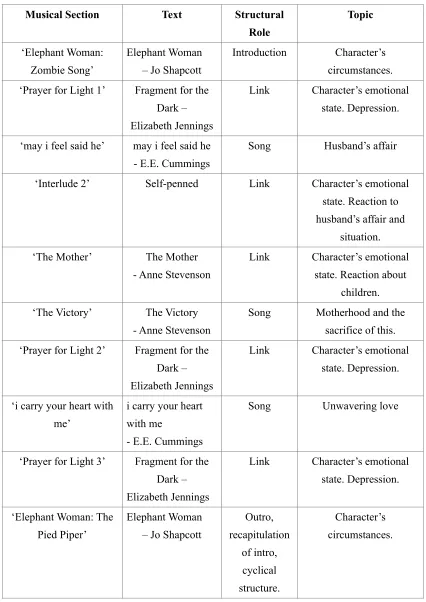
discuss. My first approach was to use poetry. Elephant Woman (2007) is set to a selection of
poems by Jo Shapcott, Elizabeth Jennings, E.E. Cummings and Anne Stevenson. These texts
determined the structure of the piece, as seen in Table 1.
The texts provided an inspiring basis to compose and enabled the opportunity to use
extended vocal techniques and varied musical atmospheres. Nevertheless, copyright caused
delays running into months. It was challenging to create a continuous narrative and dramatic
strength from different texts and authors; the composition process mimicked the generation
of songs, which were fused together via link sections. As a result, the pacing and dramatic
strength of the work is poor: it conveys a stream of snapshots rather than a continuous
narrative and the changes in music material are too rapid to be assimilated by the listener.
The structure represents some affiliation with the traditional convention of arias and
recitative, which was beneficial as some of the songs subsequently received performances.
Nevertheless, it became apparent that to continue working in music theatre and opera, and to
Table 1 – Text selection determining structure
‘Elephant Woman’
Musical Section Text Structural
Role
Topic
‘Elephant Woman: Zombie Song’
Elephant Woman – Jo Shapcott
Introduction Character’s circumstances.
‘Prayer for Light 1’ Fragment for the Dark – Elizabeth Jennings
Link Character’s emotional state. Depression.
‘may i feel said he’ may i feel said he - E.E. Cummings
Song Husband’s affair
‘Interlude 2’ Self-penned Link Character’s emotional state. Reaction to husband’s affair and
situation.
‘The Mother’ The Mother - Anne Stevenson
Link Character’s emotional state. Reaction about
children.
‘The Victory’ The Victory - Anne Stevenson
Song Motherhood and the sacrifice of this.
‘Prayer for Light 2’ Fragment for the Dark – Elizabeth Jennings
Link Character’s emotional state. Depression.
‘i carry your heart with me’
i carry your heart with me
- E.E. Cummings
Song Unwavering love
‘Prayer for Light 3’ Fragment for the Dark – Elizabeth Jennings
Link Character’s emotional state. Depression.
‘Elephant Woman: The Pied Piper’
Elephant Woman – Jo Shapcott
Outro, recapitulation
of intro, cyclical structure.
Collaborating and librettists
Finding librettists has entailed a long, frustrating and often disappointing experience. Firstly,
where does one meet a librettist? There are many playwrights and poets but few with the
title ‘librettist’ or experience of writing for opera. I have made contact with librettists
through suggestions from opera practitioners, usually directors. Alternatively, programmes
like the Jerwood Opera Foundation course bring together composers, writers and directors.
The second challenge is to find the right librettist. This choice is vital as the text provides
the skeleton on which the music is woven: on a broad level, it defines the structure, pace and
dramatic character of a piece, and on a detailed scale, it provides the basis of vocal colour
and musical facets like rhythm. I have read many reviews where an opera has been poorly
received on the basis of a weak libretto; the best operas are when all facets of libretto, music,
direction and performance come together.
Similarly to composers, writers have their own style; finding a writer whose text inspires the
composer and aligns stylistically is essential. Early on, I twice made the error of jumping
into a collaboration based on being delighted to meet a librettist. In one instance, the writer
was unsuitably skilled for the role and the other was a mismatch of style. In both cases, I
was uninspired by the text and, therefore, composing was difficult and the outcome
ineffective.
The third challenge is to manoeuvre through what can be the difficult process of
collaboration. I collaborated with a writer whose aesthetic and interests were a perfect match
to my own: we engaged in two productive projects together but ironically, it became
apparent our aesthetic was so closely aligned that we began to encroach on each other’s role,
causing frustration to one another; we were also not compatible personally.
The trials and tribulations of collaboration between composers and librettists seem to be
longstanding in the history of opera, one recent example being Thomas Adès’ The Tempest,
where the composer found the initial libretto unworkable and a second librettist, Meredith
There is no set choice on working with librettists. Judith Weir writes her own libretto.
David Sawer’s From Morning to Midnight (1998-2001) is based on Georg Kaiser’s play but
adapted by the composer. Benjamin Britten and Harrison Birtwistle have used a variety of
librettists each, although with repeated collaborations, e.g. Myfanwy Piper and Eric Crozier
for Britten and David Harsent for Birtwistle.
George Benjamin has used the same librettist, Martin Crimp, for his operas. Crimp is a
playwright with a poetic language. The director for their opera Written on Skin (2012), Katie
Mitchell, suggested a dramatist like Crimp is essential for an opera to ensure dramatic
strength (personal correspondence, April 2013); this would imply a poet is not suitable for
opera, even if their language suits a musical setting. However, David Harsent, who wrote
the libretto for Birtwistle’s hugely successful works The Minotaur (2008) and Gawain
(1990), is a poet.
Therefore, it is possible to conclude that the choice of librettist is a personal matter. A
successful collaboration is a wonderful experience: the inspiration and new ideas another
artist brings to the table is a catalyst for work to flourish. Writers can provide bespoke texts
in order to pursue specific musical or theatrical ideas that are not possible from a text that
has already been written. For a composer, whose training and experience has usually been
entirely in music, a librettist provides the dramatic framework for an opera.
The role of theatre in vocal composition
Extended vocal techniques in a staged work like opera can add to the theatricality of the
piece. With Mannequin, the fragmentary, robotic nature of the chosen techniques assists the
portrayal of mannequins. Vice versa, the context of mannequins instigates the use of
extended vocal techniques and their presence is justified because of this theatrical call. I
have found having good reason to use extended vocal techniques is advantageous to how
singers respond to them; this is an area I will discuss more in chapter 2.
Extended vocal techniques tend towards more detailed and challenging scores, which in turn
lyrical lines of Krazy Kat were memorised with relative ease but for Mannequin, music
stands were incorporated into the set as the singers needed the score; the potential for acting
was impeded because of this. As mentioned in chapter 1.1, the difficulty of extended vocal
techniques was part cause of the creation of music theatre, with extended vocal techniques
being uncommon in opera, a genre in which Paul Griffiths (1995, p. 172) suggests the power
of tradition is felt particularly strongly.
The desire to hear words often arises when working in staged pieces; the audience expects to
follow a story and although staging can express this to an extent, word audibility is integral.
‘The great lesson of the standard repertory is that the story is paramount’ (Griffiths, 1995, p.
172) so lyrical singing techniques were developed in order to clearly project text and voice
across large concert halls before the electronic assistance of amplification and surtitles were
available. Extended vocal techniques can affect the communication of text, for example
because of fragmentation to the text or a technique does not project well. Therefore, balance
is an important factor to consider with extended vocal techniques; this is an area I will
CHAPTER 2: COMPOSITIONAL COMMENTARY
2.1– Introduction
The main work for this thesis, Every Inch Of Many Effigies, was composed as part of an
Apprentice Composer in Residence post with Birmingham Contemporary Music Group
(BCMG). This scheme involved two workshops, mentorship and close contact with the
singer and players, leading onto the final concert performance. Therefore, various research
aims could be explored in the piece, feedback gained and alterations made.
As I had not focused on a male voice before, a baritone was chosen alongside the ensemble’s
sinfonietta line-up. Leigh Melrose, the baritone, is an experienced lyric singer but with a
specialism for contemporary vocal music. I decided upon a political satire piece, which
would be set to an amalgamation of found texts and ones written specifically for the work by
Alan McKendrick. The piece was structured as a trial:
i) Opening Statement
ii) Cross-Examination
iii) Defence
iv) Summary of Facts
v) Deliberation
vi) Verdict
The nature of each of these events conjured up clear and varied musical and vocal ideas,
which I will now discuss.
The beginning of the ‘Opening Statement’ was to set the dark scene of the courtroom. From
here, the piece would entail a narrator introducing the audience to the scene. During my
residency, I witnessed BCMG’s performance of Gerald Barry’s opera The Importance of
Being Earnest (2010). I was hugely inspired by this work, not least the acrobatic vocal
writing that involved singers tearing through text at great speed whilst leaping around a
jagged pitch field; I wished to attempt something similar in the ‘Opening Statement’. I was
‘The Cross Examination of George ‘Dubya’ Bush’ was to have a strong theatrical basis,
using an array of extended vocal techniques to convey the mannerisms and folly of George
W. Bush. I wished to ensure the instrumental writing was as proficient and important as the
vocal part throughout the work: a cross-examination would enable the singer and ensemble
to be in conversation with each other. One player was to spearhead the ensemble’s
cross-examination, almost like a concerto; the versatile nature of a clarinet seemed ideal to depict
an inquiring style. Referring back to The Importance of Being Earnest, Gerald Barry had
used the German anthem in his piece but applied in such a way that it transformed into his
own style. I wished to attempt something similar in my own piece; with Bush as the central
character for this movement, the American anthem was an obvious equivalent.
‘The Defence of Margaret Thatcher: George Square Death Party’ was to be the most
traditional and aria-like of the movements, pertaining to the lyric tradition through legato
vocal lines and a piano trio accompaniment. McKendrick was aware of a real-life party
planned in George Square, Glasgow to celebrate Thatcher’s death. This topic was chosen for
the movement: Thatcher defending her actions as the indignant rallying masses of the Great
British Public loom. This duality would be conveyed in the music by the singer and a piano
trio undertaking a serene aria, against the increased interruption of a menacing and dark
ensemble. Thatcher, with her ambiguous female/male vocal tone, provided the opportunity
to explore the use of the extended vocal technique of falsetto.
‘Summary of Facts’ was to be a ‘patter song’ involving widespread fragmentary vocal effects
referring to snippets of information. The instrumental ensemble was to parallel the vocal
line with extended techniques. ‘Deliberation’ is an instrumental movement. Given my focus
on vocal composition, it seemed important to spend time working on my instrumental
writing. It would also provide the singer with some respite and add variety of
instrumentation to the piece. The ‘Deliberation’ would depict individuals projecting their
opinion, which is taken on or argued by others.
The ‘Verdict’was to draw on the ‘Opening Statement’, to bring the piece round in a loop as a
by Charles Ives’ in which two contrasting threads of music are introduced and then
combined to create a collage of sound; this was a technique I hoped to explore in this
movement.
The texts, both found and by McKendrick, provided ideal material with which to explore the
musical ideas I had in mind. However, I would add that using an amalgamation of texts was
not ideal in terms of structural unity, which I found myself grappling with on occasion. As
one review said: ‘[the] text, a patchwork of Dubyaisms, famous Thatcher quotes and
rambling apologias, is rather uncertain’ (Clements, 2013). Furthermore, I went to McKendrick with a long list of my musical desires for the piece, which a text would have to
be shaped around; McKendrick stepped up to the challenge but placing such demands on a
2.2 – Extended Vocal Techniques
In this section, I will discuss the extended vocal techniques I employ in Every Inch Of Many
Effigies, grouping them according to whether they derive from a vocal, text or theatrical
basis. For each technique, I will examine the considerations and effectiveness of their
application with regard to how singers respond to them, their notation and balance.
Vocal Range
In ‘Opening Statement’, the vocal line initially involved some wide leaps and extremes of
range. The octave of some of these had to be re-pitched to a more accessible area of the
voice as they were hard to execute in terms of pitch and word audibility, particularly at such
a rapid speed.
Singing in the extended range contradicts the lyric tradition’s idea of tessitura: the central
point and most commonly used pitch field of a piece, which is studied by singers to ensure it
sits comfortably for their voice. A practical option is to sit within the set range for the
majority of the time, whilst making occasional excursions outside; this also makes for a more
extraordinary moment when the extremes are heard. When using a twelve-tone row in a fast
setting, it is beneficial to keep the pitching in close proximity and a comfortable area of the
voice to aid execution.
However, Gerald Barry’s The Importance of Being Earnest suggests otherwise as within the
opening pages, the baritone line includes wide leaps at a rapid pace, as seen in Example 19.
How the singer achieves these intervals alongside a shift to falsetto and during a line that is
rapid, relentless, syllabic and atonal can only merit admiration.
Example 19 – Wide vocal leaps
Balance
The extreme lower range of the baritone voice did not carry as well as I imagined both in
terms of volume and word audibility; it is also worth noting in regard to extremes that the
upper range of the soprano voice is an area where words can be hard to comprehend. In Bar
105 of ‘Opening Statement’, as seen in Example 20, there was initially a fuller ensemble
doubling the baritone’s first minim on the D# below the bass clef stave. The singer was
inaudible and therefore, the orchestration was reduced to just the bassoon accompanying
with the remainder of the instruments joining on the second note. The dynamic of the
instruments was also reduced through Bars 104 and 105 p. 21, to piano from what was
initially mezzo forte.
Example 20 – Balancing when the voice is in the extreme lower vocal range
‘Opening Statement’, Every Inch Of Many Effigies – Bar 104
!
In Bar 103 of ‘Opening Statement’, the projection of the baritone at the higher extreme of his
range, the weakness of which is exacerbated by falsetto, is aided by the instrumentation
delicate-sounding instruments are used with light articulation and a pianissimo dynamic.
However, I have often found this high-pitched and fast orchestration causes clutter around
the voice, making it hard to hear; therefore, I would amend this section by decreasing the
number of instruments and rhythmic rapidity.
Register
Falsetto was an extended technique I had barely explored before Every Inch of Many Effigies
but was inspired