http://www.sciencepublishinggroup.com/j/sjee doi: 10.11648/j.sjee.20190704.11
ISSN: 2376-810X (Print); ISSN: 2376-8126 (Online)
Energy Efficient Biomass Cookstoves: Performance
Evaluation, Quality Assurance and Certification
Izuchukwu Francis Okafor
National Stove Eligibility Laboratory, National Center for Energy Research and Development, University of Nigeria, Nsukka, Nigeria
Email address:
To cite this article:
Izuchukwu Francis Okafor. Energy Efficient Biomass Cookstoves: Performance Evaluation, Quality Assurance and Certification. Science Journal of Energy Engineering. Vol. 7, No. 4, 2019, pp. 54-62. doi: 10.11648/j.sjee.20190704.11
Received: January 28, 2019; Accepted: March 19, 2019; Published: October 25, 2019
Abstract:
This study investigated the thermal and emissions performance characteristics of biomass cookstoves developed by the National Center for Energy Research and Development (NCERD) as well as other biomass cookstoves received by the Centre from stove designers and manufactures to ensure conformity with stipulated standard. The Center has acquired a Laboratory emissions monitoring system (LEMS) domicile at its National Stove Eligibility Laboratory (NSEL) for comprehensive biomass cookstoves performance evaluations. Water boiling test (WBT) and food cooking (rice and beans) tests were conducted with at the NSEL with LEMS for firewood and charcoal cookstoves to determine their thermal and emissions performance characteristics. Out of 15 sample charcoal stoves tested, 62% satisfied the minimum standard of tier 2, while 51% of 10 sample of firewood stoves tested satisfied the minimum standard of tier 2. The star rating of a biomass cookstove is determined from the thermal efficiency tier value of the stove. The available cookstoves in the local markets in Nigeria do not display any star rating. It was also found that nearly all the biomass cookstoves available in the local markets in Nigeria have not been tested and few tested ones at NSEL, NCERD were inconclusive. This could be attributed to non-enforcement of the standard and possibly lack of fund and incentives to enable the stove producers to undertake for full testing of the required sample test number of the stoves by Standard to attain full certifications.Keywords:
Biomass Cookstoves, Performance Standard, Energy Efficiency, Emissions and Thermal Performance1. Introduction
In Nigeria, about 67% of the country’s population depends on fuel wood for their daily cooking. Cooking with fuel wood in Nigeria is mostly through the poor energy efficient traditional open fire method [1]. Initial efforts to spread the use of energy efficient cook stoves in Nigeria were poorly designed and thus yielded limited results [2]. Presently, different types of both wood and charcoal cookstoves with uncertified quality and safety issues are now available in the markets in Nigeria. The National Mirror Committee on Clean Cooking Solution in Nigeria under the leadership of SON of developed a Standard for Biomass cookstoves in Nigeria to ensure quality compliance. Inefficient and poor quality cookstoves waste fuel wood, create health problems and emissions into the environment [3, 4]. It has been estimated that about 1.6 million people, mainly women and children, die every year as a result of the smoke from wood stoves [5]. In a study carried out by [6] in Delta State of Nigeria with a
sample size of 500 rural dwellers noted that 14.60% suffered red eyes, 71.60% cough complications, and 6.80% suffered sneezing due to exposures to smoke in their cooking environment.
could provide detailed information on thermal and emissions performance standard of the biomass cookstoves available in the country are lacking in the literature. However, the National Stove Eligibility Laboratory of the National Centre for Energy Research and Development, University of Nigeria Nsukka (UNN) has acquired the state-of-the-art technology for thermal performance analysis and indoor emissions monitoring system, developed by Aprovecho Research Center, Oregon USA, for comprehensive performance evaluations of biomass cookstoves [9]. Since the inception of the Lab, the Centre has acquired expertise in design, manufacture and testing of improved biomass cookstoves (charcoal, wood and briquettes fired). The Centre has conducted comprehensive performance evaluation of biomass cookstoves based on water boiling tests and field testing and verifications/certifications of a number of biomass cookstoves and also works in partnership with Standard Organistion of Nigeria (SON) in manpower training and in developing the standard on biomass clean cookstoves.
2. Biomass Cookstoves Performance
Evaluation
A number of standard methods have developed for evaluating the performance of biomass cook stoves. Such methods are the constant heat output, constant temperature rise, constant time and water boiling test [10, 11]. But water boiling test is mostly used because it is short and provides a simple simulation of standard cooking procedures. It measures the quantity of fuel consumed and time required for the simulated cooking and usually employed in investigating the performance of cook stoves under different operating conditions [12]. It also provides a quick method of comparing the performance of cook stoves. This method has been adopted in evaluating and comparing the performance
of the biomass cookstoves developed at the National Stove Eligibility Laboratory (NSEL), NCERD, UNN and other biomass stoves received from designers as well as manufactures for performance evaluations and their certifications. The performance evaluation of the biomass cookstoves conducted with the LEMS at NSEL covers both thermal and emission performance characteristics of the biomass cookstoves.
2.1. Emissions Performance Evaluation of Biomass Cookstoves
The emissions performance characteristics of a biomass cookstove can be determined through water boiling test (WBT) using a Laboratory Emissions Monitoring System. The WBT protocol is described in version 4.2.3 [13, 14]. The test consists of three phases: high-power (cold start) phase, high power (hot start) phase, and low power (simmer) phase. These test phases are very important indicators in evaluating the performance ability of cookstoves to conserve fuel and emissions performance. The apparatus required for the test include: (i) Cooking pots, (ii) thermocouple for measuring the ambient and temperature of the water being heated, (iii) A digital balance for measuring the weight of the fuelwood, charcoal, water and cooking pot. (iv) Laboratory emissions monitoring system (LEMS) developed by Aprovecho Research Center [9] is used for the WBT. It quantifies the emissions from cookstoves by collecting, measuring and analyzing the emissions: CO2, CO and particulate matter (PM)
emitted from the stove.
Figure 1 shows the LEMS at the National Stove Eligibility Laboratory, NCERD, UNN, with a nozzle type biomass energy efficient cookstove developed by the Centre, mounted inside the metal hood of the LEMS during water boiling tests. The LEMS consists of carbon monoxide (CO) sensor, which is an electrochemical cell with two electrodes.
The conductivity between the two electrodes gives the proportional concentration of the CO produced by the stove under testing. The carbon dioxide (CO2) sensor uses
non-dispersive infrared to measure CO2 concentration and outputs
voltage [9]. The LEMS has two particulate matter (PM) sensors – the gravimetric system and light scattering photometer. The gravimetric system gives a direct measurement of total PM using filter-based sampling. The light scattering photometer has both a laser and a light receiver. When smoke enters the sensing chamber, particles of smoke scatter the laser light into the receiver and more light reaching the receiver indicates more smoke in the chamber. The flow grid is an amplified pitot tube that provides a low pressure drop through the system and a strong differential pressure signal, averaged across the entire duct cross-section. The exhaust gas velocity, volume, and mass flow rate within the duct, are calculated based on pressure drop recorded using the Magnesense pressure transducer. The thermocouple (TC) temperature sensor is used to record the water temperature of the pot. The thermocouple temperature output is linear and the thermocouple probe provided with the LEMS is rated for temperatures up to 250°C [9].
2.2. Thermal Performance Evaluation of Biomass Type Cookstove
The thermal performance characteristics of any biomass type cookstove can be determined from the WBT with the Laboratory Emissions Monitoring System based on the parameters described in Equations (1) to (8).
(i) Burning rate of the stove
The burning rate R (g/min) which measures how economically the stove burns the fuel wood in its combustion chamber is determined using Equation (1) [12]:
t
H
H
M
M
W
W
R
w c c f i1
)
100
(
)
(
100
−
+
−
=
(1)Wi is the initial weight of fuelwood at start of test (g), Wf
is the final weight of fuelwood at end of test (g), M is the moisture content of fuelwood (%), Hc is the Calorific value
of charcoal (28.8MJ/kg), Mc is the weight of charcoal (g), Hw
is the Calorific value of fuel wood (15.5MJ/kg) and t is the total time taken for boiling the water.
(ii) Thermal efficiency of the stove
The thermal efficiency measures how the heat generated by the stove is utilized in boiling the water or in cooking the food. The thermal efficiency (
η
th ) of the stove can be determined using the Equation (2) [15].c h
th
η
η
η
=
×
(2)It is also related to the percentage heat utilized (
PHU
)by the stove, which is given as:
th
η
= Burning Rate xPHU
(3)The percentage heat utilized (PHU) is determined by Equation (4).
PHU=
x
100%
(Input)
fuel
burning
by the
burning
by the
produced
energy
Heat
(output)
pot
in the
water
reaching
energy
Heat
(4)Heat Energy Output = Mw Cw (Tb-Ti) + Me L (5)
Mw = Initial amount of water in the Pot (kg)
Cw = Specific heat of water (kJ/kg/°C)
Tb= Boiling temperature of water (°C)
Ti = Initial temperature of water in the Pot (°C) Me = Amount of water evaporated (kg)
L = Latent heat of water evaporation at atmospheric pressure and 100 (kJ/kg)
Heat Energy Input = Mf × Ef (6)
Mf = amount of fuel burnt (kg),
Ef = calorific value of fuel used (kJ/kg)
(iii) Specific fuel consumption (SFC)
The specific fuel consumption is expressed in Equation (7).
[
]
w C fM
M
M
W
SFC
=
(
1
−
)
−
1
.
5
(7)(iv) Power consumption for boiling or simmering:
This measures the wood energy consumed by the stove per unit time. It indicates the average power output of the stove (in Watts) during the high-power test. The power consumed
(
PC
) for boiling water is expressed in Equation (8).[
]
t
H
M
X
W
PC
f C w60
5
.
1
)
1
(
−
−
×
=
(8)3. Biomass Cookstoves Testing at
National Stove Eligibility Laboratory,
NCERD
The emissions and thermal performance characteristics of biomass cookstoves have been conducted at the National Stove Eligibility Laboratory, NCERD, via water boiling test and food cooking (beans and rice) tests. The summary of tests results for both firewood and charcoal stoves are presented in this section.
3.1. WBT Results for Firewood and Charcoal Cookstoves
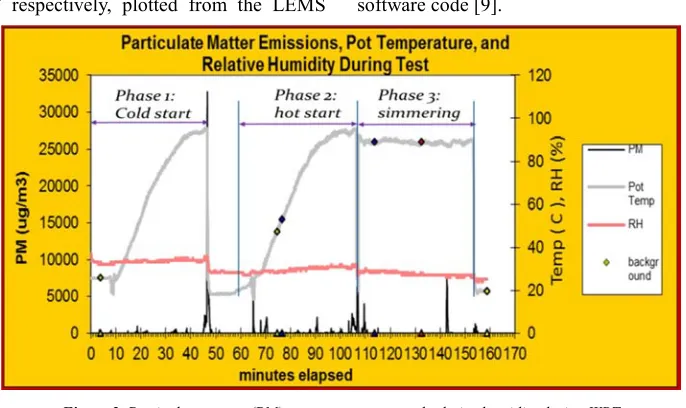
Figure 2 indicates the real-time PM, pot temperature, and relative humidity profiles and Figure 3 indicates the real-time CO2 and CO emissions profiles during the cold start
phases of the WBT respectively, plotted from the LEMS software code [9].
Figure 2. Particulate matter (PM), pot temperature, and relative humidity during WBT.
Figure 3. CO2 and CO emissions during WBT.
Table 1 compares the performance of the nozzle type cookstove and the minimum performance standard (Tier 2) for biomass cookstoves established by Standard Organization of Nigeria (SON) [16]. It can be observed in Table 1 that the thermal and emission performance values of the stove are in line with the minimum performance standard of Tier 2 acceptable by IWA [16, 17].
Table 1. International workshop agreement (IWA) performance metrics.
IWA Performance Metrics Units Nozzle type cookstove performance Minimum standard (Tier 2)*
High Power Thermal Efficiency % 26.4 > 25.0 Low Power Specific Consumption Rate MJ/min/L 0.036 < 0.039
High Power CO g/MJd 10.97 < 11
Low Power CO g/min/L 0.18 < 0.13
High Power PM mg/MJd 352.0 < 386
Low Power PM mg/min/L 3.76 < 4
Indoor Emissions CO g/min 0.61 < 0.62 Indoor Emissions PM mg/min 15.9 < 17
*Source: Nigerian Industrial Standard, FDNIS 1000: 2017 [16]
Table 2. WBT results for firewood cookstoves.
IWA Performance metrics Units Performance range Minimum standard (*Tiers 2)
High power thermal efficiency % 18.0 – 37.40 ≥ 0.25 Low power specific consumption MJ/min/L 0.041-0.052 ≤ 0.039 High power CO g/MJd 0.13– 9.33 ≤ 11 Low power CO g/min/L 0.04 – 0.12 ≤ 0.13 High power PM mg/MJd 30.6 – 311.6 ≤ 386 Low power PM mg/min/L 0.18 – 3.91 ≤ 4 Indoor Emissions CO g/min 0.03 – 0.57 ≤ 0.62 Indoor Emissions PM mg/min 2.30 – 18.5 ≤ 17
*Source: Nigerian Industrial Standard, FDNIS 1000: 2017 [16]
Table 3. WBT results for charcoal cookstoves.
IWA Performance metrics Units Performance range Minimum standard (*Tiers 2)
High power thermal efficiency % 20.0 - 41.40 ≥ 0.25 Low power specific consumption MJ/min/L 0.003-0.045 ≤ 0.039 High power CO g/MJd 2.14 – 9.32 ≤ 11 Low power CO g/min/L 0.02 – 0.09 ≤ 0.13 High power PM mg/MJd 13.8 – 242.7 ≤ 386 Low power PM mg/min/L 0.012 – 2.98 ≤ 4 Indoor Emissions CO g/min 0.10 – 0.52 ≤ 0.62 Indoor Emissions PM mg/min 1.30 – 16.80 ≤ 17
*Source: Nigerian Industrial Standard, FDNIS 1000: 2017 [16]
3.2. Food Cooking (Beans and Rice) Tests Results for Charcoal Cookstoves
The rice and beans cooking tests results with a charcoal cookstove designed and produced in NCERD for a family of four to eight people are presented in table 4. Figure 1 shows the experimental test rig of the laboratory emissions monitoring system used for the hexagonal type charcoal
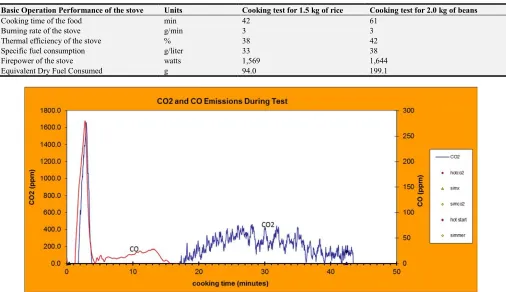
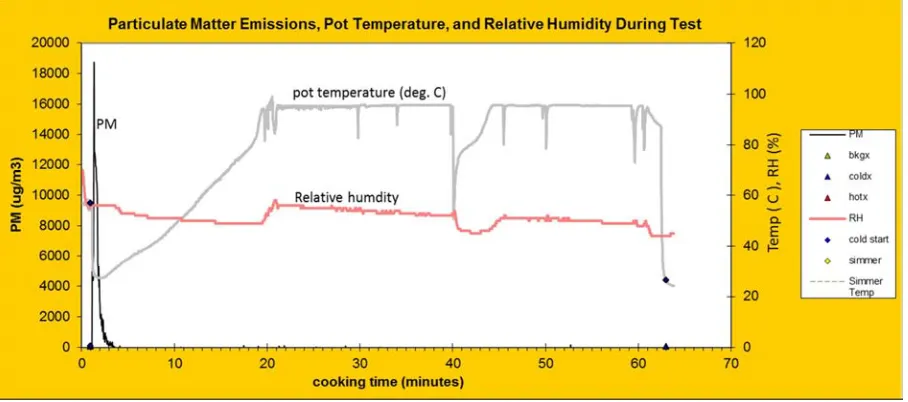
cookstove for the rice and beans cooking tests. Figure 4 and 5 indicate the real-time PM, pot temperature, and relative humidity profiles and Figure 6 and 7 indicate the real-time CO2 and CO emissions profiles plotted from the LEMS
software code during the rice and beans cooking tests respectively.
Table 4. Cooking test results of the hexagonal type charcoal stove.
Basic Operation Performance of the stove Units Cooking test for 1.5 kg of rice Cooking test for 2.0 kg of beans Cooking time of the food min 42 61
Burning rate of the stove g/min 3 3 Thermal efficiency of the stove % 38 42 Specific fuel consumption g/liter 33 38 Firepower of the stove watts 1,569 1,644 Equivalent Dry Fuel Consumed g 94.0 199.1
Figure 5. Carbon monoxide (CO), Carbon dioxide (CO2) emissions profile during beans cooking test.
Figure 6. Particulate matter (PM) emissions, pot temperature, and relative humidity profile during the rice cooking test.
4. Biomass Clean Cookstoves Standard
The standard for biomass clean cookstoves developed in 2015 by the National Mirror Committee on Clean Cooking solution and fuel standards under the leadership of SON was approved in 2017 by Governing Council of SON [16]. This is to address the quality and safety issues concerning the clean cookstoves sold in the Nigerian Market and to reduce health risk associated with inefficient cookstoves and other negative impacts such as deforestation and environmental pollutions.
4.1. Thermal Efficiency and Emissions Performance Standard
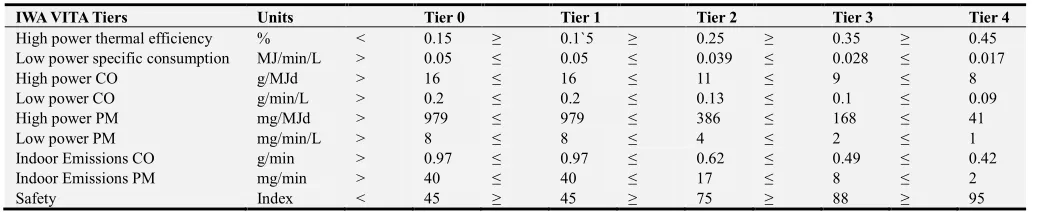
The SON stipulated that any biomass cook stove sold in the Nigerian Market must be fully tested in a Standard Laboratory by using Emissions Measuring System. The tested stoves must comply with the minimum standard described in Tables 5-7 for efficient performance and quality assurance [16, 17]. Table 8 gives the thermal and emissions performance tires rating of biomass cookstoves as stipulated by IWA, VITA [17, 18].
Table 5. Thermal efficiency and fuel consumption.
Type of stove Chimney stove (Natural draft) Chimneyless stove (Natural draft) Forced draft stove (Fan stove) High power thermal efficiency (%) ≥ 20 ≥ 25 ≥ 35
Specific fuel consumption (MJ/min/L)* ≤ 0.045 ≤ 0.039 ≤ 0.028
*The high power values are mandatory values and low power values are preferred values only
Table 6. Total Emissions.
Type of stove Chimney stove (Natural draft) Chimneyless stove (Natural draft) Forced draft stove (Fan stove)
CO Emissions High power (g/MJd) ≤ 16 ≤ 11 ≤ 9 Low power (g/min/L)* ≤ 0.20 ≤ 0.13 ≤ 0.10 PM2.5
Emissions
High power (g/MJd) ≤ 979 ≤ 386 ≤ 168
Low power (g/min/L)* ≤ 8 ≤ 4 ≤ 2
*The high power values are mandatory values and low power values are preferred values only
Table 7. Indoor Emissions.
Types of stove Chimney stove (Natural draft) Chimneyless stove (Natural draft) Forced draft stove (Fan stove) CO (g/min) ≤ 0.42 ** ≤ 0.62 ≤ 0.49
PM 2.5 (mg/min) ≤ 2** ≤ 17 ≤ 8
**The high power values are mandatory values and low power values are preferred values only
Table 8. Biomass cookstoves performance tiers.
IWA VITA Tiers Units Tier 0 Tier 1 Tier 2 Tier 3 Tier 4
High power thermal efficiency % < 0.15 ≥ 0.1`5 ≥ 0.25 ≥ 0.35 ≥ 0.45 Low power specific consumption MJ/min/L > 0.05 ≤ 0.05 ≤ 0.039 ≤ 0.028 ≤ 0.017 High power CO g/MJd > 16 ≤ 16 ≤ 11 ≤ 9 ≤ 8 Low power CO g/min/L > 0.2 ≤ 0.2 ≤ 0.13 ≤ 0.1 ≤ 0.09 High power PM mg/MJd > 979 ≤ 979 ≤ 386 ≤ 168 ≤ 41 Low power PM mg/min/L > 8 ≤ 8 ≤ 4 ≤ 2 ≤ 1 Indoor Emissions CO g/min > 0.97 ≤ 0.97 ≤ 0.62 ≤ 0.49 ≤ 0.42 Indoor Emissions PM mg/min > 40 ≤ 40 ≤ 17 ≤ 8 ≤ 2 Safety Index < 45 ≥ 45 ≥ 75 ≥ 88 ≥ 95
Source: Nigerian Industrial Standard, FDNIS 1000: 2017 [16, 18]
4.2. Star Rating System for Biomass Cookstoves
It is very essential that biomass cookstoves available in the Nigerian markets are rated to enable end-users make informed-decisions concerning the energy efficiency of the stove before purchasing. The star rating of biomass cookstoves are determined from the thermal efficiency tier value (TETV) of a stove expressed in Equation (9) [16]. A stove with thermal efficiency value of 29%, for instance, the TETV could be determined as expressed in Equation (9). From Table 8, a stove with thermal efficiency value of 29%, falls within Tier 2, where 25 ≤ TE ˂ 35. Thus, the TETV is determined as follows:
TETV = 2 + . .
. .
= 2.40 (9)
Source: Nigerian Industrial Standard, FDNIS: 2017 [16]
Figure 8. Star rating system for biomass cookstoves.
4.3. Sampling Plan for Stove Testing and Verification
Sampling technique for selecting the number of stoves samples for testing per batch is very critical in order to avoid erroneous conclusions. As presented in Table 9, samples of the stoves to be tested should be drawn from each lot for conducting verification of the product performance in conformity with the stipulated standard by SON [16].
Table 9. Sampling scale.
Number of clean cook stove in a Lot Sample Size Number of stove to be selected Samples to be tested
Up to 50 5 2
>50 - 100 10
Minimum 20% of number selected
101 - 500 15
501 - 1000 20
> 1000 25
4.4. Criteria for Acceptance and Quality Assurance
At the end of the tests and analyses of data collected. As stipulated standard by SON, if over 90% of the tested samples drawn from the selected lot or batch passed, the lot or batch is said to have complied with the requirements of the Standard. If > 60% but < 90% of the samples passed, two additional samples can be taken from the selected lot or batch of the stoves for further test. If < 60% of the samples passed, the stoves in that lot or batch are said to have failed and the stoves are rejected. Efficient performance of the stoves cannot be guaranteed [16].
5. Conclusion
Inefficient biomass cookstoves waste fuel, create health problems and emissions (CO, CO2, PM) into environment.
Lack of standard laboratory in Nigeria has hampered quality assurance and performance evaluation standard of the few existing biomass cookstoves in the country. All the energy efficient cookstoves available in the local markets in Nigeria need to be fully tested and certified in line with the Standard before marketing them to end-users. Biomass Cook stoves Standard has been developed and approved SON in 2017 as a guide on stoves design, manufacture, quality and safety assurance in the interest of users, manufacturers and the nation in general. The standard is yet to be implemented. Presently, nearly all the biomass cookstoves available in the local markets in Nigeria have not been tested and the few tested at NSEL, NCERD, UNN were inconclusive. This
could be due to non-enforcement of the standard and possibly lack of fund and incentives to enable the stove producers to undertake for full testing of the required sample test number of the stoves by Standard to attain full certifications.
References
[1] ICEED. 2007. Improved woodstoves Workshop and Exhibition. International Centre for Energy, Environment and Development http://www.iceednigeria.org/project
[2] M. A. Jeuland, and S. K. Pattanayak (2012). Benefits and Costs of Improved Cookstoves: Assessing the Implications of Variability in Health, Forest and Climate Impacts. PLoS One. 7 (2): e30338.
[3] WEO-2017 Special Report: Energy Access Outlook,
International Energy Agency, 2017
(https://webstore.iea.org/weo-2017-special-report-energy-access-outlook).
[4] H. Ali, Planting Trees: Is this Enough?: Beyond firewood: Exploring Alternative fuels and Energy technologies in humanitarian Settings. Conference, Delhi, India, 2008. [5] M. B. Witt, An Improved Wood Cook Stove: Harnessing Fan
Driven Forced Draft for Cleaner Combustion. Dept. of Mechanical Engineering, Trinity College, Hartford, CT. 2005. [6] O. S. Adah, L. D. Shown, O. E. Yusuff, E. A. Envuladu, M. E.
[7] Unachukwu, G. O. Chinda G., Abada U. C. Nwoke O. Benchmarking of Energy Consumption of Common Domestic Cookstoves Available in Nigeria. Journal of Renewable and Alternative Energy Technologies, vol. 2, no. 1. pp. 32-39, 2016.
[8] Ayo, S. A., Design, Construction and Testing of an Improved Wood Stove. AU J. T. vol. 13, no 1, pp. 12-18, 2009.
[9] Instructions for Use of the Laboratory Emissions Monitoring System (LEMS), Aprovecho Research Center, Advanced Studies in Appropriate Technology Laboratory, Cottage Grove Oregon, USA, 2013.
[10] S. C. Bhattacharge, M. R. Siddique, M. Augustus, H. L. Pham and A. Mahandari, Study on Improved Institutional Biomass Stoves. Energy Programme, Asian Institute of Technology, Klong Luang, Pathumthiani, Thailand, 1984.
[11] R. Bailis, D. Ogle, N. MacCarty, K. R. Smith and R. Edwards, The Water Boiling Test (WBT) Version 3.0. Household Energy and Health Programme, Shell Foundation, pp. 2-7, 2007.
[12] B. B. Olalekan and O. Ayoola, Development of an Improved Coal Stove for Cooking in Developing Countries. AU. J. T., vol. 12, no. 3, pp. 82-187, 2009.
[13] WBT protocol version 4.2.3 for download at www.community.cleancookstoves.org/files
[14] VITA, Volunteers in Technical Assistance. Testing the efficiency of wood burning cookstoves: provisional international standards. Mt. Rainier, Mary-land, USA; 1982. [15] S. A. Ayo, (2009). Design, Construction and Testing of an
Improved Wood Stove. AU J. T. vol. 13, no. 1, pp. 12-18. [16] Nigerian Industrial Standard, FDNIS 1000, 2017.
[17] ISO International Workshop Agreement: http://community.cleancookstoves.org/files/172