1
DEVELOPING SME’S AS ENVIRONMENTAL BUSINESSES
Tochukwu Ben Onyido, David Boyd & Niraj Thurairajah
School of Engineering and the Built Environment
Birmingham City University, UK
ABSTRACT
Purpose: The research was conducted to establish the opportunities for SMEs to become environmental businesses. The ‘Environmental Business’ concept refers to a commercial organisation that provides goods and/or services which provide socio-environmental value, and which are produced in such a way that the organisation addresses environmental and social problems whilst avoiding the creation of new ones.
Design/methodology/approach: Interviewing and observation were used to conduct a case study of how 30 SMEs prepared for the UK’s Green Deal programme in the West Midlands County, UK. Twenty interviews were conducted and twenty three field notes were recorded. Based on the literature review, the philosophical approach of pragmatism and research inquiry into practice, a ‘Three Ps’ analytical framework (Profit, Process and Product) was established with which to operationalise the environmental business.
Findings: The research identifies opportunities and tactics that assist SMEs to function as environmental businesses whilst maintaining the traditional focus on economic performance. It also shows the benefits and challenges involved.
Research limitations: The research focused on a specific sector (building) within a specific UK region (West Midlands). The use of a single case study, in which companies had already an environmental interest, limits the generalizability of the results.
Practical implications: The research highlights the practical opportunities for SMEs to address existing environmental and social problems through their products and processes, and prevent new problems arising due to their operations whilst making a profit.
Originality/value: This research represents an initial step in developing a pragmatic implementation model by which SMEs can overcome barriers to being environmental businesses whilst maximising business advantages.
The final, definitive version of this paper has been published in Construction Innovation by Emerald Insight Ltd, All rights reserved. © This is an earlier version, posted by the second author on the Researchgate.net website under the terms of the contributor agreement.
Please reference final version as:
Onyido, Tochukwu Ben C.; Boyd, David; Thurairajah, Niraj, (2016),"Developing SMEs as environmental businesses", Construction Innovation, Vol. 16 Iss 1 pp. 30 - 45
Permanent link to this document:
2 INTRODUCTION
As a dominant form of social organisation, business enterprises have significant impacts on the environment and society (Melville and Ross, 2010). These impacts are not always positive, and they often cause environmental and social damage. Instances of this damage include soil, water and atmospheric pollution; land degradation; habitat loss; resource depletion; and social inequalities and conflicts (Ekins, 2000). A major reason for this is that business and production models are mainly economic and have largely overlooked the broader socio-environmental context (Folmer and Johansson-Stenman, 2011). With these economic models, there is a tendency for companies to pass environmental and social costs onto society – in the form of resource depletion, dirty air, unsafe products, labour exploitation, and other adverse effects – rather than internalising these costs (Carroll and Buchholtz, 2012).
Consequently, over the years there has been a call for an alternative approach to business and economic development, one which takes greater account of environmental and social issues (Mendonca et al., 2010; Stanfield and Carroll, 2009; Milani, 2000). Previous work by authors such as Hernesniemi et al. (2007) and Chopey and Ondrey (1997) draws attention to the concept of an ‘Environmental Business’, through which an organisation provides goods and services in a manner that addresses existing environmental and social problems while avoiding the creation of new ones. However, there remains a significant degree of ambiguity about exactly how traditional business success can be integrated with environmental protection and social responsibility on a consistent basis (Bosworth and Clemens, 2011; Isaksson et al., 2010). It is not always clear in the literature the extent to which a company can feasibly maintain environmental and social business practices in dynamic and challenging business conditions.
For Small and Medium Enterprises (SMEs), this issue is particularly crucial. Worthington and Patton (2005) report that up to seventy per cent of all commercial waste and CO2 emissions are attributed
to SMEs, and this figure has not been challenged in subsequent research. SMEs possess unique advantages – such as entrepreneurial spirit, flexibility, and resourcefulness – but they have limited resources and breadth of capabilities (Singh and Garg, 2008; Harvie, 2004). Consequently, SMEs may be reluctant to attach importance to environmental protection and social responsibility if they perceive that these do not provide economic benefits for them (Simpson et al., 2004).
3 THE DEVELOPING ENVIRONMENTAL BUSINESS CONCEPT
There is a growing literature calling for traditional business and economic systems to adopt environmental stewardship and social accountability. According to Carroll and Buchholtz (2012) and Daly (1991), this would require companies to internalise environmental and social costs rather than pass them onto society in the form of pollution, labour exploitation, sub-standard products and other adverse socio-environmental effects. Such passing on of costs is referred to by Meade (1973) as an externality, an activity that either ‘confers an appreciable benefit’ or ‘inflicts an appreciable damage on some person or persons who were not fully consenting parties in reaching the decision or decisions which led directly or indirectly to the event in question’. Subsequent literature sources (such as Carroll and Buchholtz, 2012; Placet et al., 2005; and Stock et al., 1997) include the entire ecosystem, rather than just humans, as victims of negative externalities.
However, pro-environmental and social literature also concede that there is a practical challenge for companies in the area of reconciling profit making with good socio-environmental performance. The primary emphasis of conventional economic models is on financial success, and therefore the objectives of cost and risk reduction dominate business decision-making, growth is promoted over sustainability, and the finite nature of resource supply is understated (Beamon, 2008; Andrews, 1998). Conventional business systems do not place ownership of, and accountability for, the environment and society on the business community (Tebo, 2005). The principles of environmental protection and social responsibility, on the other hand, place value on external stakeholders such as society and the ecosystem, rather than just on internal company growth (Lozano, 2008; Placet et al., 2005; O’Boyle, 1999). A company’s internalisation of negative externalities can involve the replacement of products or production methods that cause the externalities, the purchase of specialised equipment or other resources to reduce externalities, and even a reduction of production levels by a company (Jaffe et al., 2005). This can increase production costs, which could in turn raise product prices and make companies less competitive in the marketplace.
Thus, within the context of traditional economic and business systems, socio-environmental responsibility may not always have a strong, immediate, beneficial link to business success and economic performance. Companies could view the cost of eliminating negative externalities as exceedingly high, especially in the light of Meade’s (1973) statement that a moderate amount of an externality may actually do only little damage to society. The tendency for companies to hold this view increases for SMEs, due to their size and resource constraints and their managerial focus on firm survival above every other objective (Pansiri and Temtime, 2008). A previous study of SMEs by Simpson et al. (2004) indicates that traditional SMEs are of the view that environmental costs do not contribute to competitive advantage since they are not transferable to customers.
4 lie more in the domain of macroeconomics and policymaking by government, international organisations and large corporations, than in business development for smaller commercial entities. In addition, they are not without criticism. For instance, authors such as Folmer and Johansson-Stenman (2011), Tsai and Chou (2009), and Mebratu (1998) are of the view that socio-environmental concepts oversimplify reality and are too reliant on ethics-based arguments. Lozano (2008) suggests that many models of sustainable development are as guilty as traditional business, financial and production models in not achieving integration and interrelatedness among social, environmental and economic aspects. Kemp and Rotmans (2005) state that there is a conflict between the short-term goals of environmental policy and the long-short-term change required for sustainability. Brand (2012) goes so far as to state that sustainable development ‘has failed’ due to insufficient socio-economic actors to champion and advocate for this strategy. In a similar vein, Haberl et al. (2011) and Rockstrom et al. (2009) suggest that within the past two decades, the rate at which the earth’s resources are being commercially exploited has not declined. Overall, while there is support for greater attention towards socio-environmental responsibility, a significant level of pessimism about the success potential of environmental and social practices can also be detected. Based on the literature explored so far, there are a limited number of drivers for socio-environmental responsibility compared to barriers against.
There is thus still a conceptual gap to be filled in order to achieve a balance between economic and socio-environmental elements for SMEs. In response to this situation, publications by scientists and economists alike are increasingly focusing on the practice of sustainability not in socio-environmental terms, but rather as an active generator of economic gain for businesses. It is in this regard that the concept of an ‘environmental business’ comes into prominence. Hernesniemi et al. (2007) summarises the role that an environmental business should play:
‘The environmental business strives to prevent, reduce, offset or completely eliminate as well as correct negative environmental externalities spawned by economic activities …The aims of the environmental business can be fostered by reducing use of natural resources, limiting pollution, preventing creation of waste and emissions and by clean-up of environmental accidents’
Similarly, Schaper (2005) writes that an environmental business should produce environmentally friendly products, provide environmental management services, preserve wildlife habitat, and/or develop environmental technology. Earlier works (e.g. Schmidt, 2003; Nowak, 2001; Chopey and Ondrey, 1997; Dunbar and Foster, 1996) also add a social dimension to environmental business by including principles such as ethics and Corporate Social Responsibility (CSR). However, the environmental business is often discussed in isolation from market realities and the dynamic nature of business. Also, an increasing number of companies across different industries have green and social responsibility statements included in their corporate policies (Powell, 2011), and it is debatable how much of this is merely a rhetorical or compliance exercise and how much is an actual ambition of the company. These factors need to be taken firmly into account in further attempts to develop an environmental business approach.
5 challenges that lie within a practical environmental business approach? Such a pragmatic view could make SMEs more inclined towards viewing socio-environmental responsibility as inherent to their business objectives, rather than divorced from it as traditional business systems suggest (Nidumolu et al., 2009).
RESEARCH METHODOLOGY
The research identifies with the philosophy of pragmatism, which holds that the value of knowledge does not lie merely in its methodical and accurate interpretation from data, but in its usefulness as a basis for practical action (Rescher, 2005; Reybold, 2002). The study of how SMEs can function as environmental businesses is not simply a capturing of socially constructed reality; it is an attempt to establish how SMEs could be better enabled and motivated to minimise their negative socio-environmental impacts in practice. This inevitably requires the adoption of a critical rather than neutral standpoint towards the negative impacts, which the goal-oriented nature of pragmatism allows (Modell, 2009). The research’s pragmatic stance, guided by the literature reviewed in the previous section, combines the need for an environmental business approach with the need for SMEs to make profit from operating in this manner.
In order to gain an understanding of how environmental business elements feature in SMEs’ operations, it was necessary to gain access to a setting in which business strategy development was being carried out. A five-month case study was thus conducted on the strategy development activities of thirty SMEs from construction, property and energy sectors in the West Midlands, which is the UK’s second largest base of economic activity (Laughlin, 2012; AWM, 2009). The companies came together under the auspices of the Sustainable Housing Action Partnership (SHAP) to exploit the sustainable energy market in the West Midlands. Management-level staff from these companies met regularly to work on understanding and analysing the Green Deal situation including; market, supply chain, skills, finance and other resources, and to optimise the economic, environmental and social returns from this activity. The Green Deal is a UK governmental policy aimed at encouraging the widespread implementation of a diverse range of sustainable energy products across the country, from insulation to window glazing to low-energy lighting and heating systems to renewable energy technologies, and it officially commenced in January 2013 (Richards, 2013).
The study was done using participant observation with the researcher involved in the proceedings whilst recording what was being observed (Iacono et al., 2009). This allowed real data from the interactions taking place during the SHAP sessions to be recorded, whilst gaining first-hand knowledge about the individual companies strategy development processes. Participant observation data was captured using field notes, as this is unobtrusive and minimises the risk that the behaviour of the research subjects would be unduly influenced by the data recording activity. A total of twenty three field notes (labelled F1-F23 in order of earliest to latest) were compiled.
6 (interviewees are referred to as I1-I20 in the Results section), at which point ‘saturation’ – new data fitting into categories already devised from old ones without introducing any new category (Charmaz, 2003) – was considered to have been achieved. The interview data was captured via audio recording. The observation and interview data were analysed through coding using NVivo 10, that allows a comprehensive and structured interpretation of rich qualitative data (Robson, 2011; Hunter & Kelly, 2008; Neuman, 2005).
RESEARCH FINDINGS
The Three Ps Framework: an Introduction
The companies involved in the study displayed a strong commercial focus as well as an emphasis on the provision of goods and services and the process of doing this. In addition, the environmental business literature highlights the role of an organisation’s processes and products in addressing existing environmental and social problems while avoiding the creation of new ones. These factors all influenced the framework used for analysing the primary data. The commercial aspect of companies’ operations needed to be taken into account, along with the interplay between it and the socio-environmental aspect, in order to achieve an integrated environmental business approach for SMEs.
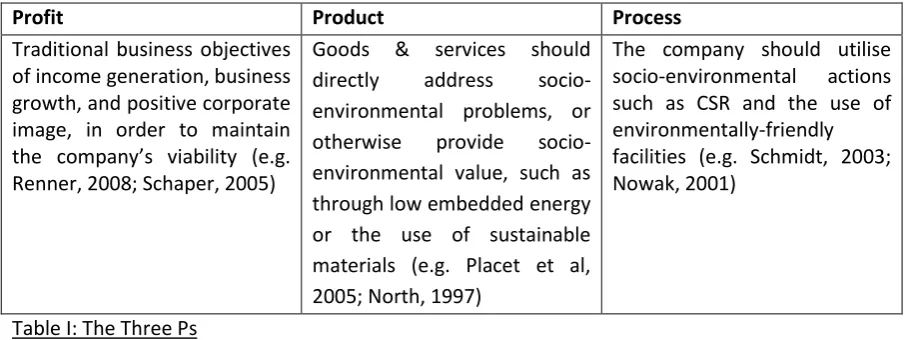
Consequently, the research utilises an analytical structure that was categorised into three parts; Profit, Process, and Product which the research collectively referred to as the ‘Three Ps’. Profit includes the key commercial elements of a company’s operations to which environmental and social strategies need to be applied. The process and product refers to the way the company operates and their particular output. These are described in Table I in relation to the environmental business concept concept.
Profit Product Process
Traditional business objectives of income generation, business growth, and positive corporate image, in order to maintain the company’s viability (e.g. Renner, 2008; Schaper, 2005)
Goods & services should directly address socio-environmental problems, or otherwise provide socio-environmental value, such as through low embedded energy or the use of sustainable materials (e.g. Placet et al, 2005; North, 1997)
The company should utilise socio-environmental actions such as CSR and the use of environmentally-friendly facilities (e.g. Schmidt, 2003; Nowak, 2001)
Table I: The Three Ps
Using the Three Ps framework, it was possible to capture from data the benefits and barriers that an environmental business approach holds for SMEs, and what these mean for its practical application. Framework Element: Profit
7 implemented, with respect to type, the required quantity, and the geographical areas in which they will be installed’. F7 mentions that participants felt ‘the publication of a range of key products and standards would provide confidence in the market and encourage investment in local production’. Apart from product specification, the participants focused on estimating the level of demand that would arise out of the Green Deal scheme at national, regional and county levels. For instance, F20 records: ‘There are an estimated over three million solid-walled properties in England with suspended timber floors which are suitable for insulation’. Based on this sizing, participants projected the Green Deal market value. F16 records: ‘The members presented examples of this market opportunity within the West Midlands. These include a total market value of three billion pounds, 194 million pounds worth of labour and materials for the installation of new boilers, and two thousand jobs per year for the installation of solid wall insulation over ten years’.
Participants also explored ‘mechanisms for dedicated finance …and inward investment and joint ventures’ to identify sources of capital funding by which SMEs would be able to develop their businesses to gain a share of market demand. Areas for business development included skills, supply chain and knowledge. Three skill categories were designed to identify low, medium and high-level skill sets respectively. The low-level skill set targeted ‘local community members, hard-to-reach and long-term unemployed’ (F8), medium-level focused on ‘new employment, the re-skilling of the existing workforce, the reskilling of unemployed, and part-time opportunities’ (F8), and high-level targeted ‘the existing workforce, new employment, college and university graduates, Small and Medium-scale Enterprises (SMEs), and the manufacturing sector’ (F8).
Supply chain development efforts involved ‘mapping of the local supply chain capacity’ (F16) that ranged ‘from manufacture to customer care’ (F15). Participants also developed knowledge by drawing upon case studies of energy-efficiency programs similar to the Green Deal. F4 shows that participants were interested in gaining ‘an overview of relevant UK-based research activity in conjunction with the ESKTN (Environmental Sustainability Knowledge Transfer Network) and Building KTN (Knowledge Transfer Network); and research findings of overseas experience’.
Framework Element: Product
Participants focused on identifying environmental and social problems that could emerge from production activities that would be undertaken to meet Green Deal demand. Significant problems identified are ‘additional emissions, energy use and waste’ (F19) due to companies’ increased use of resources to address demand from the new market. Participants recommended a reskilling process aimed at ‘moving away from traditional construction trades’ (F12), in order for the existing building workforce to not just install sustainable energy products with a traditional construction mind-set, but to also care that the products fully realise their environmental, energy-saving potential upon installation.
8 …the product itself is being manufactured in the right kinds of ways’ (I4). Local employment was found to improve a company’s prospects of winning public sector work. For instance, I1 states that ‘It helps our ability to win work because we work with public sector clients, they want us to use local labour’. However, the setting up of local supply chain activities was found to require major financial investment and increase the intensiveness of the procurement process. I1 mentions: ‘We probably have more audit procedures because …we want to know where our products are coming from …there probably are more procedures than you’d have with a company that wasn’t bothered’. There also exists conflict between the socio-environmentally friendly principle of localisation and the mainstream practice of globalisation, because staunch commitment to the former could exclude economic opportunities that lie in the latter. I19 states: ‘UK companies ought just not to be thinking about the market here, they ought to be thinking about the growing market (sic) there are (abroad) ...but then of course we’re back to what’s localised, and so I think there’s a little bit of a theoretical dilemma between the global market, (and) the localisation’ (I19).
In addition to supply chain localisation, materials and products should be procured from suppliers that observe environmental and social practices, as evidenced by interview quotes such as the following: ‘If you can’t demonstrate that your process has got low energy, low resource, all the things we’ve talked about, you probably won’t get into (our) supply chain’ (I19); ‘A lot of the trade contractors we use as well, part of their pre-qual. (pre-qualifications) to work for us, they’ve got to have sustainability sources, they’ve got to be green, they’ve got our ethics’ (I20). However, supply chain partners chosen based on socio-environmental criteria may not always offer the cheapest financial quotes, and this means that a company may have to forego cheaper partnership options.‘If you’re ruling certain people out they may be cheaper than others’ (I1). There are also conflicts with mainstream customer preferences, as exemplified by one of the interview responses: ‘You do have projects where the client will specify a material that is not from a sustainable source. We will in those instances look to amend or change that product to a sustainable product. But there are instances when a client will say, ‘No, that’s the product that I want, and that’s the product that I specify’’. Participants also identified engagement with building occupants and other building users as a way of gaining external knowledge inputs with which to minimise the invasiveness and disruption caused by installation of sustainable energy products in buildings. They felt that such consultation would additionally serve as an opportunity for ‘the development of customer engagement initiatives to reduce energy demand’ (F16), as it could be usedto spread awareness among building occupants of the need for a more responsible energy lifestyle (such as by switching off lights when not in use). Framework Element: Process
9 Energy conservation and resource efficiency were also identified as integral environmental processes. They have the advantage of reducing business costs for a company: ‘If we can reduce the amount of energy that we consume, then we can reduce the cost that we have … Reducing waste reduces …the amount of raw material we’re buying in the first place’ (I1). However, on the whole the application of environmental and social measures appears to be cost-intensive due to the investment in specialised facilities and processes to lessen negative externalities. According to I1, one of the reasons why his organisation is having difficulty in becoming a ‘zero-carbon business’ is because ‘We will become too expensive and …we would become non-competitive. Our clients aren’t going to pay us extra money because we are a zero-carbon business’. Participants identified the need for a ‘business support strategy that addresses the high compliance and accreditation costs’ (F16) associated with becoming certified to a high environmental and social standard. High accreditation standards can also increase a company’s administrative workload. ‘There probably are more procedures to go through, because we are accredited to certain standards, so there are certain procedures that we have to have. So yes, there is more work involved in it’ (I1). Environmental practices could also restrict a company’s planning and infrastructure options. To illustrate this, some interviewees indicated that while their organisations would like to expand and get new premises, they are constrained to buying or building rather than renting, as they would not be able to increase the energy efficiency of a leased building due to their limited rights over the building. There was a prevalent view among the research participants that companies that uphold a strong socio-environmental ethos are in a less competitive market position than the more mainstream companies. I9 states that ‘a company that doesn’t think sustainably has higher profit margins than we do’. I5 mentions: ‘That’s (environmental and social actions are) the problem …which has actually held us back compared to some competitor businesses, hasn’t it? Because other businesses …maybe (socio-environmental responsibility) hasn’t been a consideration (for them), so they’ve grown more quickly’.
Due to the capital-intensive nature of environmental business processes, participants recommended a business approach that would encourage companies to take a longer-term view of business rather than seek quick economic wins. This would draw particular attention to the economic benefits that might accrue to companies in the future to offset initial investment costs; it would place ‘a greater emphasis on whole-life costing rather than upfront costing’ (F11).
THE PRACTICALITY OF IMPLEMENTING THE ENVIRONMENTAL BUSINESS
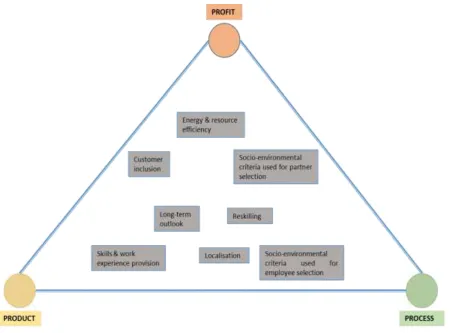
The ‘Product’ and ‘Process’ aspects highlight a number of tactics that SMEs need to apply in order to operate as environmental businesses, and the implications of their application. Eight environmental business tactics can be interpreted, four from ‘Product’ and four from ‘Process’. These are socio-environmental reskilling (product); supply chain localisation (product); skills and work experience provision for the socially disadvantaged (process); a longer-term business outlook (process); the selection of business partners (product) and employees (process) with a strong environmental and social ethos; customer inclusion in the business development process (product); and energy and resource efficiency (process).
10 better able to address environmental and social issues. This is supported by previous literature from Naumann (2013) and Martinez-Fernandez and Choi (2012), who both suggest that an available workforce with skills that help in the maintenance of a sustainable ecosystem is required if the ‘greening’ of traditional industries and the production of environmental goods and services is to increase. It could be expected that for a traditional company wishing to implement skills reorientation, a revision of its existing skills development processes would be required.
Supply Chain Localisation: Based on the research results, supply chain localisation would serve to reduce the distance across which products can be distributed (thus reducing the release of transport-related carbon emissions), and would allow for closer environmental monitoring of the production and delivery of goods and services. However, the research did not establish how a SME can best reconcile supply chain localisation with the mainstream business practice of globalisation. Provision of Skills and Work Experience: The provision of skills and work experience for socially-disadvantaged members of society was recommended by research participants. This requires significant investment in training the beneficiaries.
Longer-Term Business Outlook: The research suggests the adoption of a ‘whole-life’ business outlook that encourages SMEs to take a longer-term view of their operations and eschew a focus on quick financial gains. However, in traditional business practice, businesses often interpret future events as costs, with a clear bias for current benefits, and it is also difficult to translate cultural value objectives and ecological metrics – such as high environmental and social performance – to a system of market prices (Roper and Beard, 2006). In this research, participants instead chose to interpret future market events as holding a lot of economic potential for their companies, based on the market sizing and evaluation activities that the participants performed. In this regard, the expectation of a significant future economic payoff further encourages the adoption of a longer-term view of success. Without such an expectation, the strategy becomes more difficult to justify. Partner Selection Based on Socio-environmental Ethos: The research points to the relevance of a company working with a like-minded partner with similar environmental and social standards. An even implementation of standards across a business network would require all parties in the network to attach the same level of priority to socio-environmental performance. Without this condition, a SME’s ability to influence environmental and social behaviour within its business network may be dependent only on whether or not it is a dominant party within the network. Employee Selection Based on Socio-environmental Ethos: As with business partners, environmental and social criteria can be included in a company’s employee selection process. Candidates could demonstrate a professional commitment towards environmental stewardship and social accountability as part of the staff recruitment stage.
11 Energy and Resource Efficiency: Energy efficiency and waste reduction are notable environmental practices as they help companies to reduce the emissions and materials impacts of their activities. The research also indicates that energy and resource efficiency doubles as an economic measure due to its potential to reduce companies’ expenditure.
The ‘Profit’ aspect highlights factors vital to the commercial success of the SMEs’ operations. These include market expansion, as indicated by the research participants’ focus on market sizing and product specification. An effective flow of goods and services to consumers is also required, as evidenced by the participants’ efforts to develop a reliable supply chain; and the mobilisation of significant financial resources, which the participants looked into, is equally crucial. The development of suitable and adequate knowledge and work skills are other key factors, which was evidenced by participants’ efforts to develop skill categories and gather knowledge about market initiatives similar to the Green Deal.
The research findings suggest that the supply chain, and the skilling and recruitment of staff, provide the most opportunity for the ‘Profit’ aspect of the environmental business to interact with the ‘Product’ and ‘Process’ aspects. With regard to the supply chain, an environmental business should procure materials and products from local suppliers that show a similar commitment to socio-environmental responsibility. A likely outcome of this is that socio-environmental businesses would tend to operate as a community or cluster, which can potentially increase emphasis on collaboration as opposed to the traditional business tendency towards competition. As interviewee I9 states, ‘If you’re truly trying to do it (operate a business) for sustainable reasons, then you want the whole industry to progress with you’.
12 Figure I: Operationalising the Environmental Business Concept
In terms of the practical implications of operating as an environmental business, a SME’s adherence to the concept comes with significant economic opportunities, based on the ‘Product’ and ‘Process’ aspects. Energy and resource efficiency have cost-saving potential, a company’s image could be enhanced, and customer inclusion in business strategy development can help improve companies’ service delivery. These commercial benefits create incentives for companies to implement the environmental business concept.
However, the research results also point to barriers and challenges as well. In choosing partners based on socio-environmental criteria, SMEs may have to sacrifice cheaper business partnership options. A strong focus on socio-environmental responsibility can also lead to conflict with conventional customer preferences and commercial practices, limit infrastructure options, and increase workload. In addition, supply chain localisation requires a high level of upfront investment, and it is unclear whether it improves the flow of products to customers when compared to non-local supply chains. SMEs with limited resources may also not be able to recruit from the NEET category due to the training levels and costs involved.
13 urgency for them to seek out immediate economic opportunities and make them more willing to rely on longer-term planning that takes account of environmental and social issues.
The research has identified tactics that could be used to construct a practical environmental business framework, although it does not provide information on how they can be applied on a continuous basis in ever-changing business conditions with minimal adverse effects to SMEs. However, further studies will be carried out in order to enhance the practicality of the environmental business concept and develop a final implementation model.
CONCLUSION
This research was done with the aim of establishing an ‘Environmental Business’ opportunity for SMEs by which they can provide products with socio-environmental value, address existing environmental and social problems while avoiding the creation of new ones, and maintain a traditional focus on commercial performance. It focused on interviews and observations of strategy development meetings conducted by SMEs within the building sector to build capacity for the UK’s Green Deal programme. Analysis of the primary data yielded a set of tactics with which SMEs can apply the environmental business concept. These include socio-environmental reskilling, supply chain localisation, a longer-term business outlook, customer inclusion, energy and resource efficiency, the selection of business partners and employees with a strong environmental and social ethos, and the provision of work opportunities to the socially disadvantaged. The research highlights the potential of the environmental business concept to reduce business costs and increase corporate reputation. This potential offers SMEs economic opportunities while at the same time making them active agents of environmental protection and social stewardship. There are some operational barriers however; the implementation of the environmental business approach is capital and skills intensive and deviates significantly from traditional business practices and customer requirements.
The research has limitations in that it does not provide information about how an environmental business approach can be implemented continuously in a dynamic business environment with minimal exposure to challenges. In addition, the study focused on a specific industry (building) and a specific UK region (West Midlands), and this should be taken into account when attempting to generalise the research findings. The research output is a useful preliminary step in the design of a practical environmental business implementation model for SMEs, and the subject will be developed further in future work.
REFERENCES
Andrews, C. (1998), “Environmental Business Strategy: Corporate Leaders' Perceptions”, Society & Natural Resources: An International Journal,Vol. 11, No. 5, pp. 531-540.
14 Bosworth, W. and Clemens, B. (2011), “Does it Pay to be Environmentally Responsible? Toxic Releases and Financial Performance”, Journal of Strategic Innovation and Sustainability,Vol. 7, No. 2, pp. 115-119.
Brand, U. (2012), “Green Economy – The Next Oxymoron? No Lessons Learned from Failure of Implementing Sustainable Development”, GAIA - Ecological Perspectives for Science and Society,Vol. 21, No. 1, pp. 28-32.
Carroll, R. and Buchholtz, A. (2012), Business and Society: Ethics, Sustainability and Stakeholder Management,Cengage Learning, Ohio, OH.
Charmaz, K. (2003), “Grounded Theory: Objectivist and Constructivist Methods”, in Denzin, N. & Lincoln, Y. (Eds.), Strategies of Qualitative Inquiry, Sage Publications, California, pp.249-291.
Chopey, N. and Ondrey, G. (1997), “The Environmental Business Girds for Harder Times; Firms Reposition Themselves to Be Less Dependent on Regulatory Initiatives”, Chemical Engineering, Vol. 4, No.9, pp. 45-45.
Daly, H. (1991), “Elements of Environmental Macroeconomics”, in Costanza, R. (Ed.), Ecological Economics: the Science and Management of Sustainability,Columbia University Press, New York, NY, pp. 1-20.
Dunbar, G. and Foster, S. (1996), “Strategies for Remediation Managers”, Civil Engineering, Vol. 66, No. 6, pp. 53-55.
Ekins, P. (2000), Economic Growth, Human Welfare and Environmental Sustainability, Routledge, London.
Folmer, H. and Johansson-Stenman, O. (2011), “Does Environmental Economics Produce Aeroplanes without Engines? On the Need for an Environmental Social Science”, Environmental and Resource Economics,Vol. 48, No. 3, pp. 337-361.
Gall, M., Gall, J., Borg, W. (2003), Educational Research: An Introduction, A & B Publications, Massachusetts.
Haberl, H., Fischer-Kowalski, M., Krausmann, F., Martinez-Alier, J. and Winiwarter, V. (2011), “A Socio-metabolic Transition towards Sustainability? Challenges for another Great Transformation”, Sustainable Development,Vol. 19, No. 1, pp. 1–14.
Harvie, C. (2004), “East Asian Capacity Building, Competitiveness and Market Opportunities in a Global Economy”, working paper 04-16, Department of Economics, University of Wollongong, Wollongong, August.
Hernesniemi, H., Oy, E. and Sundquist, H. (2007), “Rapidly Growing Environmental Business Needs Monitoring”, available at: http://www.sitra.fi/julkaisut/muut/environmental_business.pdf (accessed 30 April, 2014).
Hunter, K., Kelly, J. (2008), “Grounded Theory”, in Knight, A. & Ruddock, L. (Eds.), Advanced Research Methods in the Built Environment, Blackwell Publishing Ltd, Oxford, pp.86-98.
15 Isaksson, R., Johansson P. and Fischer, K. (2010), “Detecting Supply Chain Innovation Potential for Sustainable Development”, Journal of Business Ethics, Vol. 97, No. 3, pp.425-442.
Jaffe, A., Newell, R. and Stavins, R. (2005), “A Tale of Two Market Failures: Technology and Environmental Policy”, Ecological Economics,Vol. 54, Nos. 2-3, pp.164-174.
Kemp, R. and Rotmans, J. (2005), “The Management of the Co-evolution of Technical, Environmental and Social Systems”, in Weber, M. and Hemmelskamp, J. (Eds.), Towards Environmental Innovation Systems,Springer, Heidelberg, pp. 33-35.
Kua, H. and Lee, S. (2002), “Demonstration Intelligent Building—a Methodology for the Promotion of Total Sustainability in the Built Environment”, Building and Environment, Vol. 37, No. 3, pp.231-240. Kumar, R. (2005), Research Methodology: A Step-by-step for Beginners, Sage Publications, London. Lozano, R. (2008), “Envisioning Sustainability Three-dimensionally”, Journal of Cleaner Production, Vol. 16, No. 17, pp. 1838-1846.
Martinez-Fernandez, C. and Choi, K. (2012), “Skills Development Pathways in Asia”, OECD Local Economic and Employment Development working paper 2012/12, Organisation for Economic Cooperation and Development, Paris, 1 July.
Meade, E. (1973), The Theory of Economic Realities: the Control of Environmental Pollution and Similar Social Costs, Brill, Leiden.
Mebratu, D. (1998), “Sustainability and Sustainable Development: Historical and Conceptual Review”, Environmental Impact Assessment Review, Vol. 18, No. 6, pp.493-520.
Melville, N. and Ross, S. (2010), “Information Systems Innovation for Environmental Sustainability”, MIS Quarterly,Vol. 34, No. 1, pp. 1-21.
Mendonca, M., Jacobs, D. and Sovacool, B. (2010), Powering the Green Economy: the Feed-in Tariff Handbook, Earthscan Publishing, London.
Milani, B. (2000), Designing the Green Economy: The Post-industrial Alternative to Corporate Globalization, Rowman and Littlefield, Maryland.
Modell, S. (2009), “In Defence of Triangulation: a Critical Realist Approach to Mixed Methods Research in Management Accounting”, Management Accounting Research, Vol. 20, No. 3, pp. 208-221.
Naumann, R. (2013), EEO Review: Promoting Green Jobs throughout the Crises, European Commission, Luxembourg.
Neuman, W. (2005), Social Research Methods: Qualitative and Quantitative Approaches, Allyn & Bacon, Boston.
Nowak, L. (2001), “Consumer Reactions to Pro-environmental Business Policies”, in proceedings of the AMA Winter Educators’ conference in Arizona, USA, 2001, American Marketing Association, Chicago, pp. 366-366.
16 Pansiri, J. and Temtime, Z. (2008), “Assessing Managerial Skills in SMEs for Capacity Building”, Journal of Management Development,Vol. 27, No. 2, pp. 251-260.
Placet, M., Anderson, R. and Fowler, K. (2005), “Strategies for Sustainability”, Research Technology Management,Vol. 48, No. 5, pp. 32-41.
Powell, S. (2011), “The Nexus between Ethical Corporate Marketing, Ethical Corporate Identity and Corporate Social Responsibility”, European Journal of Marketing,Vol. 45, Nos. 9-10, pp. 1365-1379.
Richards, P. (2013), “The Green Deal”, available at:
http://www.eesy.uk.com/data/The%20Green%20Deal%20Science%20and%20the%20Environment.p df (accessed 1 April 2014).
Robson, C. (2011), Real World Research: a Resource for Users of Social Research Methods in Applied Settings, Wiley, Chichester.
Rockström, J., Steffen, W., Noone, K., Persson, A., Chapin III, F., Lambin, E., Lenton, T., Scheffer, M., Folke, C., Schellnhuber, H., Nykvist, B., De Wit, C., Hughes, T., Van der Leeuw, S., Rodhe, H., Sörlin, S., Snyder, P., Costanza R., Svedin U., Falkenmark, M., Karlberg, L., Corell, R., Fabry, V., Hansen, J., Walker, B., Liverman, D., Richardson, K., Crutzen, P. and Foley, J. (2009), “Planetary Boundaries: Exploring the Safe Operating Space for Humanity”, available at http://www.ecology andsociety.org/vol14/iss2/art32 (accessed 28 February 2013).
Saunders, M., Thornhill, A., Lewis, P. (2006), Research Methods for Business Students, Prentice Hall, New Jersey.
Schaper, M. (2005), Making Ecopreneurs: Developing Sustainable Entrepreneurship, Ashgate Publishing, Hampshire.
Schmidt, W. (2003), “Life-cycle Costing as Part of Design for Environment: Environmental Business Cases”, The International Journal of Life Cycle Assessment,Vol. 8, No. 3, pp. 167-174.
Simpson, M., Taylor, N. and Barker, K. (2004), “Environmental Responsibility in SMEs: Does It Deliver Competitive Advantage?”, Business Strategy and the Environment, Vol. 13, No. 3, pp. 156-171. Singh, R. and Garg, S. (2008), “Strategy Development by SMEs for Competitiveness: a Review”, Benchmarking: an International Journal,Vol. 15, No. 5, pp. 525-547.
Stanfield, J. and Carroll, M. (2009), “The Social Economics of Neoliberal Globalization”, Forum for Social Economics,Vol. 38, No. 1, pp. 1-18.
Stock, G., Hanna, J. and Edwards, M. (1997), “Implementing an Environmental Business Strategy: a Step-by-Step Guide”, Environmental Quality Management,Vol. 6, No. 4, pp. 33-41.
Tebo, P. (2005), “Building Business Value through Sustainable Growth”, Research Technology Management, Vol. 48, No. 5, pp. 28-32.
17 Worthington, I. and Patton, D. (2005), “Strategic Intent in the Management of the Green Environment within SMEs: an Analysis of the UK Screen-printing Sector”, Long Range Planning,Vol. 38, No. 2, pp. 197-212.