1Abstract—This paper proposes an improved Genetic Algorithms (GA) based sparse multipath channels estimation technique with Superimposed Training (ST) sequences. A non-random and periodic training sequence is proposed to be added arithmetically on the information sequence for energy efficient channel estimation within the future generation of wireless receivers. This eliminates the need of separate overhead time/frequency slots for training sequence. The results of the proposed technique are compared with the techniques in the existing literature -the notable first order statistics based channel estimation technique with ST. The normalized channel mean-square error (NCMSE) and bit-error-rate (BER) are chosen as performance measures for the simulation based analysis. It is established that the proposed technique performs better in terms of the accuracy of estimated channel; subsequently the quality of service (QoS), while retrieving information sequence at the receiver. With respect to its comparable counterpart, the proposed GA based scheme delivers an improvement of about 1dB in NCMSE at 12 dB SNR and a gain of about 2 dB in SNR at 10-1 BER, for the population size set at twice the length of channel. It is also demonstrated that, this achievement in performance improvement can further be enhanced at the cost of computational power by increasing the population size.
Index Terms—Channel estimation, genetic algorithms, superimposed training, channel.
I. INTRODUCTION
One of the major problems that limits the high speed data transmission through a wireless channel is the Inter Symbol Interference (ISI) [1]. ISI is caused by the time dispersion induced due to multipath propagation phenomena. The performance and efficiency of channel estimation and equalization techniques is of vital importance in designing advanced communication equipment to mitigate the channel distortions. The channel estimation techniques are
Manuscript received 12 May, 2015; accepted 8 November, 2015.
traditionally classified as: training-based and blind. In the training sequence based approaches, the receiver estimates the channel by exploiting the available training and its corresponding received sequences. Based on the behaviour of channel’s selectivity in frequency and time domains, the known training sequence is either transmitted frequently over the dedicated time slots (across over the entire frequency slots), or transmitted over the dedicated frequency slots (across over the entire time slots). This dedicated allocation of time/frequency slots for the training sequence is an overhead on the spectral efficiency, specifically for the case of highly selective wireless fading channels. Blind channel estimation techniques avoid this overhead by not using an explicitly known training sequences. Instead, the channel is estimated by exploiting the statistical properties of information sequence known at the receiver. However, such blind estimation techniques also impose certain shortcomings, like, need of long information sequences and complex signal processing techniques leading to slow convergence rate [2], [3]. Therefore, with the purpose to further enhance the spectral efficiency, various superimposed training (ST) sequence based estimation techniques have been proposed in the literature [3]–[7]. Here, instead of using explicit time/frequency slots for training sequence, a low-power periodic training sequence is arithmetically added over the information sequence. This not only improves the spectral efficiently but also effectively tracks the time and frequency selectivity in the communication channel.
Impulse response of wireless communication channels is encountered as sparse in various physical propagation scenarios where exist only a few largely separated (in delay) dominant propagation paths, e.g., aeronautical communications, under-water acoustic communications, high-frequency radio communication systems where the dominant waves arrive reflected from the ionosphere, and
GA Based Sensing of Sparse Multipath
Channels with Superimposed Training Sequence
Syed Junaid Nawaz
1, Moazzam I. Tiwana
1, Mohammad N. Patwary
2, Noor M. Khan
3,
Mohsin I. Tiwana
4, Abdul Haseeb
5 1Department of Electrical Engineering, COMSATS Institute of Information Technology,
Islamabad, Pakistan
2
Faculty of Computing Engineering and Sciences, Staffordshire University,
Stoke-on-Trent, United Kingdom
3
Acme Center for Research in Wireless Communications, Mohammad Ali Jinnah University,
Islamabad, Pakistan
4
Department of Electrical Engineering, National University of Science and Technology,
Islamabad, Pakistan
5
Department of Electrical Engineering, Institute of Space Technology,
terrestrial high-definition television broadcasting systems, etc. A ST sequence based technique by Jitendra et al. [3] utilizes the first-order statistics of training and information sequences to estimate the channel. The proposed work aims at enhancing the performance of the channel estimation scheme presented in [3] by using Genetic Algorithms (GAs), specifically for the case of sparse multipath channels. GAs are evolutionary computing techniques that have been used in various different fields to solve the complex optimization problems [8]. GAs are efficient stochastic search based techniques that very efficiently and quickly attain near optimal solution in large solution spaces. GAs model the biological processes of evolution, crossover, and mutation repeatedly in order to optimize a highly complex cost function [8]. The gradient free nature of GA (with sufficient chromosomes) make them very robust against getting stuck in the local optimum solutions. GAs have also been employed, for solving the channel estimation problem, in the literature [8]–[13]. However, no GA based channel estimation technique with ST sequence exist in the literature which also exploits the available prior knowledge of channel’s sparsity for accurate estimation of channel.
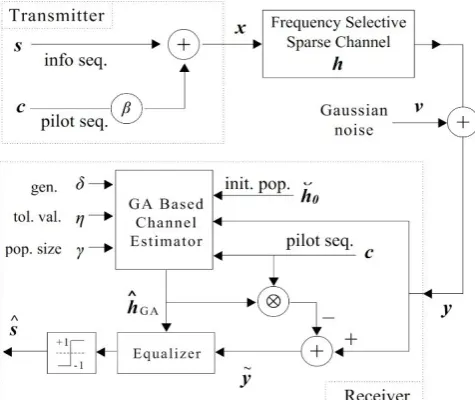
Fig. 1. System model with proposed GA based channel estimator and equalizer for frequency-selective sparse multipath channels.
This paper proposes a GA based channel estimation technique for time-invariant sparse multipath channels with ST sequence. Sec. II presents the considered system model and proposed GA based estimation and equalization technique. The obtained simulation results are presented in Sec. III, along with a comprehensive performance analysis. Finally, the proposed work is concluded in Sec. IV.
II. CONSIDEREDSYSTEMMODEL
The system model of considered communication system with GA based channel estimator is illustrated in Fig. 1. The information and training sequences are shown by b and c, respectively. The information sequence is taken as zero mean BPSK modulated information sequence defined as,
[ 0s 1s s N 1]T,
s where the superscript T
represents transpose of the vector. A known periodic training
sequence is defined as c[ c
0 c 1 c N
1 ] ,
T where β scales the training sequence to maintain a certain power ratio between training and information sequences. The variance of information and training sequence is denoted bys2 and c2, respectively. The training sequence is superimposed (arithmetically added) over the information sequence; the transmitted sequence is thus defined as
[ 0 1x x x N 1 ] .T
x s c This superimposed
sequence is transmitted over a time-invariant and multipath frequency-selective channel, h[ 0 1h
h h L
1
]T. The multipath propagation channel is defined as
1
0
,
L
l l
l
h
h (1)
where hl and l is the gain and delay of lth propagation path. Path delay is taken as integer multiple of a symbol duration.
. is the Kronecker delta function. The channel’s impulse response is modelled as sparse with only K Non-Zero (NZ) taps (such that KL) at the positions,NZ [ 0 1 1] T K
p p p
P
NZ 0 , 0 , other
, wise.
l
l
h
P
(2)
The energy of channel impulse response vector is modelled normalized as h2 1 (where . 2 denotes
2norm
). The sequence received at received is denoted by y[ 0 1 sy
y y N
1 ]
T which is obtained as,
y Xh n Sh Ch v (3)
whereX,SandCare [N×L] convolutional Toeplitz matrices obtained from transmitted sequencex, information sequence s, and known training sequence c, respectively.
[ 0 1 1 ]Tv v v N
v is the measurement noise
modelled as white and zero mean Gaussian distributed with variance 2
v
.
A. First Order Statistics Based Channel Estimators In this section, the derivation of first order statistics based channel estimators with superimposed pilot sequence proposed in [3], [14], and Error! Reference source not found. are presented. The information and noise sequences are assumed zero mean, therefore, after taking expectation (i.e., E
. ) of received signal y n
, from the contribution of non-random periodic training sequence with periodP, we get
1
0
.
L l l
E y n h c n l
(4)
1 0,
m
P j n l
m m
c n l c e
in (4) we get1
0
{ ( )} P j mn,
m m
E y n d e
(5)where dm can be obtained as given below 1 0 , m L j l
m l m
l
d h c e
(6)where m2m P/ and
10
1 / P j mn
m m
c P c n e
.Amean-square consistent estimate of dm can be found as
10
ˆ 1 m .
N
j n n
m
d y n e
N
(7)The estimate dˆm approaches to dm as N approaches to . Vector representation dˆ[ d dˆ ˆ0 1 dˆP1]T is given as
ˆ ,
m
d C h (8)
where Cm isa
P L u
matrix obtained as:
0 0 0 1 0 1 1 0 0 1 1 0 0 0 1 1 1 1 1 1 e e e e , P P P c j L jj Lu u j c c m C (9)
where Lu is the upper bound on channel length, such that .
u
L L The least-squares estimate of the channel proposed in [3] can thus be obtained from the model in (8) as
2
2
arg min ˆ .
ˆ
SI J m
h
h d C h (10)
This estimate can also be obtained as †
ˆ ,
SI J m m
h C d (11)
where the superscript † represents Moore-Penrose pseudoinverse. The contribution of superimposed information sequence and additive measurement noise leads to an error m in the estimate dˆm of dm, i.e.,
ˆ .
m m m
d d The estimation error m can be realized by substituting y n
in (7), given as below
1 1 1
0 0 0
1 1
e m .
N L N
j n
m l
n l n
h s n l z n
N N
(12)This inherent estimation error leads to an imprecise estimate of the channel. Moreover, for the case of sparse multipath channels, this estimation method do not exploit the available prior knowledge of channel’s sparsity, thus fails to correctly estimate the zero valued channel taps. Therefore, an extension of this method is proposed in [14] for the case of sparse multipath channels, which propose the following solution to obtain the channel’s estimate
subject to 1
arg min ,
ˆ ˆ
SI CCS m
h
h h C h d (13)
where 1
. denotes 1norm. The convex program Dantzig Selector (DS) has been casted to optimize the estimate in (13). This method performs betters than (11) for the cases of sparse multipath channels [14]. Another extension of the model in (8) is presented in Error! Reference source not found., which uses matching pursuit algorithm to enhance the estimate by calculating the positions of non-zero channel taps.
B. GA Based Channel Estimator
The first order statistics based channel estimation techniques, mentioned above, do not compensate for inherent estimation error ξ. This results in an inaccurate channel estimate. Evolutionary search technique of GAs, has been seen as a potential candidate to provide promising solutions to various challenging problems of estimation and equalization of wireless channels. This section presents a GA assisted channel estimator by extending the first order statistics based estimator in [3] for the case of sparse multipath channel. It exploits the available a priori knowledge of channel’s sparsity and introduces a compensation parameter for the estimation of error vector
ξ in the objective function. The GA stochastically searches for a solution in the entire solution space that minimizes the following objective function
2 2 2 subject to GA 1 ˆ
ˆ arg min ,
1,
Cm
h
h d
h
h h (14)
where the parameter should be set in proportion to magnitude of error, i.e.,
ξ 22. Since, the channel is sparse, therefore minimization of objective function for its1norm
crossover, andmutation. First the chromosomes of hi1 are evaluated and sorted based upon the objective function in (14). In the selection process, better performing chromosomes are selected based upon stochastic uniform sampling method. Selected chromosome with lowest score passes off “as it is” to the next generation. While the remaining selected chromosomes either undergo crossover or mutation to generate hi. In crossover, pairs of chromosomes are randomly combined to produce new chromosomes, while mutation involves making random changes to individual chromosomes. Mutation also avoids premature convergence to a suboptimal solution. Now, GA replaces hi1 with hi. The process continues iteratively, till GA terminates at the pre-set maximum limit on generations or if the average change in objective function’s fitness value at successive generations is less than a pre-set value . Finally, the individual chromosomes corresponding to the lowest value of objective function together is the determined estimate of the sparse multipath channel hˆGA.
C. Equalizer
A linear equalizer followed by a hard decision mapper is used to obtain estimate of the information sequence ˆs, as illustrated in Fig. 1. The symbol denotes convolution operation. The equalizer is fed with the regulated received sequence y, which is obtained after removing the contribution of pilot sequencec, given as under
ˆ. C
y y h (15) The block representation of the obtained estimate of information sequence ˆs is given as below
1
ˆ ˆ ˆ
ˆ s T s T v ,
s R H H R H R y (16)
where Rs s2I, Rv ˆv2 I, and Hˆ is a [N×N] Toeplitz matrix structured as shown below
ˆ
ˆ ˆ ˆ
ˆ ˆ ˆ
0 0 0
0 0 0
,
0 0 0 0 0 ˆ
0 1 L
0 1 L
0
h h h
h h h
h
T
H (17)
Estimate of noise power ˆv2 is obtained as
2
1 ˆ ˆ
0, ( ) 0,
1 ˆ ˆ
( ) , other
ˆ
wise.
T T
v
T T
y y h h N
y y h h N
(18)
D. Performance Metrics
Normalized Channel Mean Square Error (NCMSE) and Bit Error Rate (BER) are used as performance metrics. The
NCMSE is defined as under 1
1 2 1 2
0 0
NCMSE ˆ .
L L
l l l
l l
h h h
(19)The NCME and BER performance of the system is measured against Signal-to-Noise-Ratio (SNR). The SNR is defined as the ratio between power of information sequence and measurement additive noise, SNR s2/ v2.
a) b)
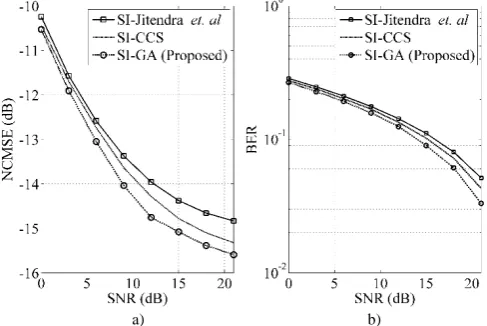
Fig. 2. Performance Comparison of Proposed GA based Technique with techniques by Jitendraet al.in [6] and SI-CCS Nawazet al.in [13]: a) NCMSE vs SNR; b) BERvsSNR. (N= 600,Monte= 1000 runs,L= 10,K = 3,P= 15,γ= 20, andβ= 0.7).
a) b)
Fig. 3. NCMSE performance of proposed GA based technique: a) Effect of population sizeγon NCMSE w.r.t. SNR; b) Effect of channel’s sparsity on NCMSE w.r.t. SNR. (N= 600,Monte= 1000 runs,L= 10,K= 3,P= 15, γ= 20, andβ= 0.7)
III. RESULTS ANDDISCUSSION
channel length and amount of non-zero taps are taken as L= 10 and K = 3, respectively. The power ratio between pilot and information sequences is set to 0.8. The periodic pilot sequence with periodP= 15 is taken same as taken [3] by for the simulations, which is
1:P
1, 1 , 1, 1, 1, 1, 1, 1, 1, 1, 1, 1, 1, 1, 1 .
c
It is clearly evident that the proposed GA based technique performs significantly better than the techniques in [3] and [14] for the case of sparse multipath channel. This improvement is because of the improved estimation objective function in our proposed scheme by considering a compensation for estimation error introduced by added information sequence. The proposed scheme provides an improvement of about 1 dB in NCMSE at 12 dB SNR, this improvement further increases by an increase in SNR, which is clearly evident in Fig. 2(a). It can be witnessed in Fig. 2(b) that a performance gain of about 2 dB in SNR can be achieved by proposed GA based technique for BER of 10-1. The size of population is set 20 for the graphs
plotted in Fig. 2. In order to demonstrate the effect of population size on the performance of proposed scheme, the NCME against SNR is plotted in Fig. 3(a). It can be witnessed that the performance of GA estimator significantly improves with an increase in population size up to 2L. By further increasing beyond 2L, further slight improvement in NCMSE performance can be achieved at the cost of computational power. The impact of channel’s sparsity on the performance of proposed GA based scheme is plotted in Fig. 3(b). The proposed technique provides improvement in estimation of channels with high sparsity. An improvement of 0.4 dB in NCMSE is observed with an increase in channel’s sparsity (K/L) by 0.2.
IV. CONCLUSIONS
A GA based channel estimation technique for time-invariant sparse multipath channels with ST sequences has been proposed. NCMSE and BER based performance comparison of proposed technique with some notable ST based channel estimation technique has been presented. It has been established that the proposed technique performs better in terms of the accuracy of estimated channel and estimated information sequence. It has been shown that the proposed technique promises an improvement of about 1 dB in NCMSE at 12 dB SNR and consequently a gain of about 2 dB in SNR at 10-1 BER, when compared to [3] with
population size set at twice the length of channel. Moreover, it has also been established that, this performance improvement can further be enhanced at the cost of
computational power by an increase in the population size. REFERENCES
[1] S. Bernard,Digital communications. NJ: Prentice Hall, 2001. [2] W. U. Bajwa, J. Haupt, A. M. Sayeed, R. Nowak, “Compressed
channel sensing: A new approach to estimating sparse multipath channels”, in Proc. IEEE, vol. 98, no. 6, 2010, pp. 1058–1076. [Online]. Available: http://dx.doi.org/10.1109/JPROC.2010.2042415 [3] J. K. Tugnait, W. Luo, “On channel estimation using superimposed
training and first -order statistics”, IEEE Commun. Letters, vol. 7, no. 9, pp. 413–415, 2003. [Online]. Available: http://dx.doi.org/ 10.1109/LCOMM.2003.817325
[4] R. Carrasco-Alvarez, R. Parra-Michel, A. Orozco-Lugo, J. Tugnait, “Time-varying channel estimation using two dimensional channel orthogonalization and superimposed training”,IEEE Trans. on Signal Process., vol. 60, no. 8, pp. 4439–4443, 2012. [Online]. Available: http://dx.doi.org/10.1109/TSP.2012.2195658
[5] L. He, Y.-C. Wu, S. Ma, T.-S. Ng, H. Poor, “Superimposed training-based channel estimation and data detection for OFDM amplify-and-forward cooperative systems under high mobility”, IEEE Trans. Signal Process., vol. 60, no. 1, pp. 274–284, 2012. [Online]. Available: http://dx.doi.org/10.1109/TSP.2011.2169059
[6] A. Orozco-Lugo, M. Lara, D. McLernon, “Channel estimation using implicit training”, IEEE Trans. Signal Process., vol. 52, no. 1, pp. 240–254, 2004. [Online]. Available: http://dx.doi.org/10.1109/ TSP.2003.819993
[7] J. Tugnait, X. Meng, “On superimposed training for channel estimation: performance analysis, training power allocation, and frame synchronization”,IEEE Trans. Signal Process., vol. 54, no. 2, pp. 752–765, 2006. [Online]. Available: http://dx.doi.org/10.1109/ TSP.2005.861749
[8] K. Yen, L. Hanzo, “Genetic algorithm assisted joint multiuser symbol detection and fading channel estimation for synchronous CDMA systems”,IEEE J. on Sel. Areas in Commun., vol. 19, no. 6, pp. 985– 998, 2001. [Online]. Available: http://dx.doi.org/10.1109/49.926355 [9] H. Ali, A. Doucet, D. I. Amshah, “GSR: A new genetic algorithm for
improving source and channel estimates”,IEEE Trans. on Circuits and Sys., vol. 54, no. 5, pp. 1088–1098, 2007. [Online]. Available: http://dx.doi.org/10.1109/TCSI.2007.893507
[10] G. Routraya, P. Kanungo, “Genetic algorithm based RNN structure for Rayleigh fading MIMO channel estimation”, in Proc. Engineering, vol. 30, 2012, pp. 77–84.
[11] K. Yen, L. Hanzo, “Genetic-algorithm-assisted multiuser detection in asynchronous CDMA communications”, IEEE Trans. on Veh. Technol., vol. 53, no. 5, pp. 1413–1422, 2004.
[12] S. Chen, Y. Wu, “Maximum likelihood joint channel and data estimation using genetic algorithms”, IEEE Trans. on Signal Process., vol. 46, no. 5, pp. 1469–1473, 1998. [Online]. Available: http://dx.doi.org/10.1109/78.668813
[13] M. Jiang, J. Akhtman, L. Hanzo, “Iterative joint channel estimation and multi-user detection for multiple-antenna aided OFDM systems”, IEEE Trans. on Wireless Commun., vol. 6, no. 8, pp. 2904–2914, 2007. [Online]. Available: http://dx.doi.org/10.1109/TWC. 2007.05817
[14] S. J. Nawaz, K. I. Ahmed, M. N. Patwary, N. M. Khan, “Superimposed training-based compressed sensing of sparse multipath channels”,IET Communications, vol. 6, no. 18, pp. 3150– 3156, 2012. [Online]. Available: http://dx.doi.org/10.1049/iet-com.2012.0162