Type of the Paper (Review)
1
A review on battery charging and discharging control
2
strategies: Application to renewable energy systems
3
Edison Banguero 1*, Antonio Correcher 1, Ángel Navarro 2, Francisco Morant 1 and Andrés
4
Aristizabal3,*
5
1 ai2-Universitat Politècnica de València, Camino de Vera, s/n, Valencia, 46022, Spain;
6
[email protected]; [email protected]; [email protected]
7
2 IUIIE- Universitat Politècnica de València; Camino de Vera, s/n, Valencia, 46022, Spain;
8
9
3 Universidad de Bogotá Jorge Tadeo Lozano, Carrera 4 # 22-6, Colombia.
10
11
* Correspondence: [email protected], [email protected]; Tel: +34-697966373
12
13
Abstract: Energy storage has become a fundamental component in renewable energy systems,
14
especially those including batteries. However, during the charging and the discharging process,
15
there are some parameters that are not controlled by the user. That uncontrolled working leads to
16
aging of the batteries and a reduction of their life cycle. Therefore, it causes an early replacement.
17
Different control methods have been developed with the goal of protecting the battery and
18
extending its life expectancy, being the most used the constant current-constant voltage. However,
19
several studies show that charging time can be reduced by using Fuzzy Logic Control or Model
20
Predictive Control. Other benefits are; temperature control and an extension of life expectancy. For
21
all these reasons, FLC and MPC have proven to be more efficient than traditional charge control
22
methods.
23
Keywords: Energy storage; battery; control; energy management systems; FLC; MPC.
24
25
1. Introduction
26
Electrification of remote and rural isolated areas with the national grid is not always possible due to
27
the prohibitive costs. Therefore, many off-the-grid communities have been using diesel engines as
28
the main power source. To meet the energy needs, governments have opted for the installation of
29
independent renewable energy systems with battery energy storage systems (BESS) [1]. However,
30
energy storage is one of the greatest challenges for renewable energy systems, especially in
31
stand-alone solar photovoltaic system and wind farms, where the application of electrochemical
32
energy storage demonstrates high response times and round-trip efficiencies [2]. Moreover, from an
33
economical point of view, in a solar photovoltaic system, the energy storage system (ESS) represents
34
40% of the total cost [3 – 4].
35
Storage technologies are usually categorized based on time scale of applications such as
36
instantaneous (less than a few seconds), short term (less than a few minutes), mid-term (less than a
37
few hours), and long-term (days) [5]. Moreover of the BESS there are different types of energy
38
storage technologies [5 – 12]: pumped hydro energy storage (PHES), compressed air energy storage
39
(CAES), flywheel energy storage (FES), hydrogen-based Energy Storage System (HES), flow battery
40
energy storage (FBES), superconducting magnetic energy storage (SME), and supercapacitor energy
41
storage (SES). However, because of their localization flexibility, efficiency, scalability, and other
42
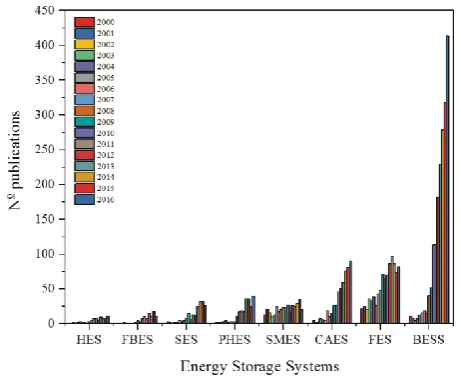
appealing features [13], the BESS is the preferred technology [14], (see Fig. 1).
43
44
Fig. 1. Energy storage systems (ESS).
45
At present, there are numerous commercial batteries used in renewable energy systems, such as:
46
lead acid, lithium ion (Li-ion), nickel cadmium (Ni-Cd), sodium sulfur (Na-S), among other. Table 1
47
shows the main characteristics of this type of batteries [6, 8 – 12, 15-20].
48
49
Table 1. Battery technologies in RES.
50
51
Regarding BESS used in photovoltaic systems, lead-acid is the most used technology [10, 16], due to
52
its low cost, maturity, high reliability, fast response and low self-discharge rate [10, 21]. However,
53
charging process is non-linear [22].
54
Due to the high economic cost generated by the replacement of a BESS, a charge control method and
55
control strategy is required to protect the battery from overcharging and over-discharging [23]. The
56
efficiency of charge control methods will depend on the amount of current used for the charging
57
process, the level of the oscillations in the charging current, the charging voltage levels, the charging
58
time, and the fluctuations in the temperature during the charging process [24]. Moreover, there are
59
battery parameters such as charging rate, the permitted maximum charging current, the internal
60
Characteristics Pb-Acid Li-Ion Ni-Cd Na-S PSB VRB
Capital cost ($/kWh) 400 [6, 12], 200-400 [8, 9, 20], 50-150 [17]
2500 [6,12], 600-2500 [8, 9, 20], 900-1300 [17]
800-1500 [6, 9, 10, 20], 1500 [11], 400-2400 [17]
300-500 [6, 9, 10, 20], 500 [11], 200-600 [17]
300-1000 [17], 150-1000 [20]
150-1000 [9, 20], 600 [17]
Efficiency (%) 90 [6,12], 75-80 [8], 70-92 [8], 70-80 [17], 80-90 [18]
85-90 [6,12], 85-90 [9], 75-95 [17], 85-75-95 [18]
60-65 [6,12], 60-70 [9], 70 [17]
80-90 [6,12], 85 [8], 75-90 [9], 75-89 [17], 71-75-90 [18]
60-65 [11], 60-75 [17] 65-85 [9,17]
Operating temperature (0C) -5 to 40 [17] -30 to 60 [17] -40 to 50 [14] 325 [17] 0 to 40 [17] 0 to 40 [17]
Depth of discharge (%-DOD) 60-70 [8], 70 [17] 80 [17] 100 [17] 60-80 [7], 100 [17] 75 [17] 75 [17]
Energy density (Wh/kg)
30-50 [6, 9, 10, 12], 35-50 [17]
75-200 [6, 10, 12], 75-250 [9], 100-200 [17]
50-75 [6, 9, 10, 12], 30-80 [17]
150-240 [6, 9, 10, 12], 100-175 [17]
>400 [17] 10-75 [9], 10-30 [10], 30-50 [17]
Life cycles (cycles)
500-1200 [9], 500-1000 [10,20], 2000 [12], 500-2000 [17,18]
1000-10000 [9, 11, 20], 4500 [13], 1500-3500 [17], 1000-30000 [18]
1000-2500 [9], 2000-2500 [10, 20], 3000 [12], 3500 [17]
2000-5000 [9], 2500 [10, 17, 20], 4500 [12], 2500-5000 [18]
100-13000 [17] 13000+ [9], 12000+ [10, 20], 100-13000 [17]
Lifetime (years)
5-15 [6, 9, 10, 12, 17, 18, 20], 5-8 [8], 3-12 [19]
15 [6, 10, 12, 18, 20], 5-20 [9], 14-16 [17]
10-20 [6, 10, 12, 17, 20], 5-20 [9], 15-5-20 [19]
10-15 [6, 8, 10, 12, 20], 15 [9], 10-20 [17], 5-15 [18]
10-15 [10, 20], 15 [17] 10-20 [9, 17], 5-10 [10, 20]
Availability (%) 99,99 [9] 97+ [9] 99+ [9] Up to 99,98 [9] ***** 96-99 [9]
Technological maturity level (1-lower to 5-higher)
5 [9] 4 [9] 4 [9] 4 [9] ***** 3 [9]
Response time (ms) Fast [6, 12] Fast [6, 12] Fast [6, 12] Fast [6, 12] ***** *****
Capacity (MW) 0-40 [6, 12]; 0,001-50 [9]; 0,001-40 [17]
0,1 [6, 12]; 0,1-50 [9]; 0,001-50 [17]
0-40 [6, 12]; 0-46 [9]; 6,75 [17]
0,05-8 [6, 12]; 0,05-34 [9]; 0,4-244,8 [17]
resistor, the port voltage, the temperature and humidity that changing during the charging and
61
discharging process and cannot be directly obtained, so it is difficult to achieve the optimal
62
operation performance by using traditional control methods.
63
This paper compiles the traditional control methods used to control the charging and discharging of
64
lead-acid batteries commonly used in renewable energy systems such as solar photovoltaic and
65
wind power. Although lithium iron phosphate (LiFePO4) batteries are being used in renewable
66
energy systems, they will not be included in this paper.
67
Regarding battery management systems, our research focused on Fuzzy Logic Control (FLC) and
68
Model Predictive Control (MPC) due to the leading role in the battery control (Fig. 2). Where the
69
power input can be supplied by the grid, a photovoltaic system or wind power system.
70
Fuzzy Logic Control (FLC) and Model Predictive Control (MPC) have proven to have higher
71
performance than traditional charging control methods in terms of energy management, thus
72
improving charging time, charging efficiency, states of charge (SOC) and life battery expectancy. The
73
strategies used, goals, and the results reached with these controls are detailed.
74
75
76
Fig. 2. Battery control scheme.
77
78
The paper is structured as follows: Section 2 describes the traditional methods used to control the
79
charge and discharge of batteries, the time and the state of charge reached. Section 3 the strategies,
80
and the fields where the FLC and MPC controls have been applied. The obtained results are
81
presented and discussion in Section 4. Section 5 concludes by stating possible avenues for future
82
research while summarizing the papers principle contributions.
83
84
2. Traditional charging control methods
85
The main goal of a charge control method is to increase the SOC. Moreover, additional specifications
86
such as battery performance, charging time, protecting the battery from overcharging and
87
over-discharging, and increasing its useful life are needed too.
88
As battery charging process is non-linear [22], different methods have been developed to effectively
89
battery charging control. Control methods commonly used in battery charging are: constant current
90
(CC), constant voltage (CV), two-step charging (CC-CV), pulse charging (PC), reflex charging or
91
negative pulse charging (NPC), trickle charge or taper-current (TC) and float charge (FC) [25-27].
92
2.1.Constant current (CC): this method consists of charging the battery with a constant current.
93
voltage value will depend on the charging current whereas the charging time and the SOC
95
can be easily calculated [29]. As voltage is not usually controlled, this can cause battery
96
overcharging and temperature rising, resulting in the degradation of battery life [25, 27].
97
2.2.Constant voltage (CV): it is used to charge the battery by applying a constant voltage on its
98
terminals. During the initial stage of charging the charge current is high. As the battery
99
voltage reaches the charger voltage setting, the charging current decreases [27]. This type of
100
control is used in applications that require extended charging periods to reach full charge.
101
As it requires a long charging time, this will cause temperature rises and degradation of the
102
battery life.
103
104
2.3.Constant current – Constant voltage (CC-CV): this charging method is also known as the
105
two-step method, because it combines both CC and CV. CC is applied at the initial charging
106
stage until the battery voltage reaches an over-charged stage or a pre-defined voltage. In the
107
second stage, the charging method switches to CV to maintain the battery voltage, so it
108
avoids overvoltage [25, 29].
109
Research shows that, the CC-CV charging method is the most efficient for battery charging
110
regardless of the battery type [30]. Also, it is the most used control method [31-33]. However,
111
charging speed and efficiency of the CC-CV charging strategy are very low [34]. Moreover, the
112
CC-CV is not suitable for rapid charging, because the CV charging stage extends the charging time,
113
it rises the battery temperature, and it reduces battery lifecycle [35-36].
114
115
2.4.Pulse charging (PC): this charging method consists of periodically applying a pulse current
116
to the battery. Batteries are completely discharged and recharged periodically in what is
117
called an equalizing charge [37]. This will allow the battery voltage to become more stable.
118
In this charging method, it is important to take into account the charging frequency, pulse
119
peak and pulse width, because they are related to the capacity and the charging time. This
120
method it can reduce the polarization to prevent the battery temperature rise [28], is the
121
weak point of this charging method is its complexity.
122
123
2.5.Reflex charging or negative pulse charging (NPC):this is an improvement on the PC. The
124
concept of applying a reflex charging started with the patents by W. Burkett & J. Bigbee and
125
W. Burkett & R. Jackson [29, 38] in 1971. NPC consist of performing the following charging
126
sequence: a positive charging pulse, a rest period (no charging), and a discharge pulse
127
(burp) [38]. This method can reduce the polarization to prevent the battery temperature
128
from rising. However, it also may reduce the charge efficiency [39-40].
129
2.6.Trickle charge or taper-current (TC): A trickle charge is a continuous CC charge at a low
130
(about C/100) rate, which is used to maintain the battery in a fully charged condition. IT is
131
designed to compensate the self-discharge of the battery [37]. This method can charge the
132
SLI (Starting Lighting, Ignition SLI) battery applications but it is not suitable for batteries
134
that are susceptible to be damaged from over-charging.
135
136
2.7.Float charge (FC): this method involves a CV charge after the charge process has been
137
completed in which the capacity of the battery is maintained at its maximum value against
138
self-discharge [41]. This method is used for stationary batteries mainly lead acid batteries
139
[37].
140
These traditional charging control methods have been incorporated in commercial inverters such as
141
Victron Energy, sunny island of SMA solar technology among others. The latter controls the charge
142
of the battery in three phases: CC (I phase/bulk phase), CV phase (absorption phase/Vo phase), and
143
float charge/V phase (Fig. 3).
144
145
Fig. 3. Sunny Island charging phases with sample values for an AGM battery [42].
146
147
3. Battery management systems
148
As the process of battery charging and discharging is complex, it required the design of a robust
149
supervisory control over the classic controller presented in section 2.
150
FLC and MPC are especially suitable to battery charging management because they do not requiring
151
precise knowledge of mathematical system models and they have high flexibility.
152
153
3.1.Fuzzy logic control (FLC)
154
In 1965, Lotfi Zadeh first proposed fuzzy theory [43]. Between the applications of fuzzy logic, fuzzy
155
control (FC) has been one of the fields where fuzzy techniques have obtained greater amount of
156
successful results when they work with complex nonlinear systems or even nonanalytic ones [44-45].
157
FLC is composed by a knowledge base, which incorporates the information given by the operator of
158
the controlled process following some linguistic control rules pattern [46].
159
In general terms, the input variables used in a FLC are battery voltage and temperature, and the
160
3.1.1. Fuzzy Logic Control of Energy Storage Systems in stand-alone applications
162
163
A FLC was developed by Bandara et al. [24] to charge a lead acid battery. The FLC charges the
164
battery at two stages. At the first stage, it uses a high current that charges the battery until 70% of its
165
full capacity. At the second stage, the battery voltage is maintained at a set value and the current is
166
left to decrease exponentially. Rahim et al. [47] showed a battery charger with a digital signal
167
processor which included FLC as a control algorithm. This approach produced a higher charging
168
current and it supported a higher input supplies. Thus, the charging time could be reduced.
169
Huang et al. [48] used a single crystal processor as the basic controller and a digital signal processor
170
to get the feedback of the voltages, temperature, and current of the batteries. This approach allowed
171
them to lower the battery temperature about four degrees. Kim et al [49] proposed a fuzzy PID
172
controller to improve the frequency control performance of microgrid islanded. The control strategy
173
was based on primary control action of the BESS and a secondary control action of the energy
174
management system. The control is composed of FLC and a conventional PI controller, connected in
175
series. The gains of conventional PI controller and fuzzy PID controller were determined by the PSO
176
algorithm. The showed simulation that with the proposed control, the performance is improved
177
compared to a conventional PI.
178
Welch et al. [50] showed that using particle swarm optimization (PSO) the optimized FLC achieves
179
performed better by 26.13% in energy usage than un-optimized FLC. The charge strategy was
180
improved about 5.22% respect to [51]. Fu-shun et al. [52] observed that using a PIC6014
181
microcontroller as control core in the design of the FLC, the battery charge time is reduced two hours
182
compared to the three stage control method. Swathika et al. [53] show that using a FLC the voltage of
183
the battery can be controlled effectively than with a conventional controller. Also, the ISE (Integral of
184
Square Error), IAE (Integral of the Absolute value of the Error) and settling time can be reduced
185
considerably in comparison to a PI control. Safari et al. [54] developed an optimized FLC based on
186
the particle swarm optimization (PSO) algorithm. In the control design took into account the weekly
187
operation and maintenance (O&M) costs and the loss of power supply probability (LPSP). The
188
results of the simulation showed that optimized FLC reduces fluctuations in batteries SOC
189
extending life battery expectancy. Moreover, can be lowered O&M costs and LPSP by 57% and 33%,
190
respectively and average SOC can be increased by 6.18%. Reducing the investment cost by up to 18%
191
in the capacity of autonomous hybrid green power system (HGPS) equipment. Improving what was
192
presented in [50]. Berrazouane et al. [55] adopts the idea of an optimized FLC but, contrary to [50]
193
and [54] use cuckoo search (CS). The CS was used to adjust the shape of the system membership
194
functions of FLC to achieve a better performance instead of using a conventional FLC or optimized
195
FLC based on PSO algorithm. The results of the simulation showed that with the proposed control
196
loss of power supply probability, excess energy, and levelized energy cost the results were improved
197
compared to optimized FLC based on PSO or a non-optimized FLC.
198
199
3.1.2. Fuzzy Logic Control of energy storage systems in grid connected applications
200
Yin et al. [22] divided the charging process into two stages. At the first stage, they implemented a
201
insufficiently battery charging. At the second stage, they used the normal charging method.
203
However, during the simulation, the temperature was not taken into account in the inner loop of the
204
control unit.
205
Contrary to [49], Haoran et al. [56] take into account the SOC of the BESS in the control of the
206
microgrid where the FLC was used to maintain the SOC of the BESS above a certain level and to
207
mitigate the fluctuation. Thus, the FLC adjusts the active power output reference of the BESS based
208
on the SOC and the target active power for the grid-connected operation. In island mode, the FLC
209
adjusts the active power output reference of the BESS based on the SOC and the active power
210
command for frequency control. Arcos-Aviles et al. [57] divided its strategy into two stages: At the
211
first stages, it minimizes the power peaks and fluctuations in the grid power profile and it maintains
212
the lead-acid battery SOC above 70%. At the second stages, it performs an off-line optimization
213
process based on a set of evaluation quality criteria. With to simple moving average strategy the
214
proposed control reduced maxima and minimum grid power in 61% and 15% %, respectively, and
215
53% and 4%, respectively, with respect to the fuzzy based on microgrid net power trend. The
216
strategy proposed by Derrouazin et al. [58] consisted in leading to optimal use of available energy
217
resources beyond a threshold to withstand the load demand, giving priority to the highest source of
218
power, while enough available energy is routed directly to the battery through a
219
charging/discharging regulator system. This allowed them to have improved energy efficiency
220
about 7% compared with the classical FLC. Paliwal et al. [59] reveal that incorporating battery
221
charging efficiency as a battery SOC function offers a more practical approach to system planning.
222
Also, conclude that assuming a constant value of efficiency can hamper the efforts to come up
223
optimum system, because the charging efficiency obtained can be higher or lower than the constant
224
assumed value affecting charging power drawn by storage and consequently the energy availability
225
in the battery. Teo et al. [60] design a control based on Fuzzy Inference System (FIS) to determine the
226
charging/discharging rate of the ESS depending on the RES and current SOC of the ESS. Power
227
variation range (PVR), power quality (PQ) and battery dynamic range (BDR) were the quality
228
indices they took into account to evaluate the effectiveness of the proposed fuzzy controller. The
229
maximum and minimum power of the grid was reduced. Hussain et al. [61] proposed a control
230
strategy were where the controller decides the mode of BESS operation: subservient mode, resilient
231
mode or in emergency mode. In subservient mode, the BESS is fully controlled by the EMS while in
232
resilient mode minimize the operation cost of the microgrid. The goal of the emergency mode
233
operation is minimize the load shedding during the emergency period. Respect to the latter, load
234
shedding can be reduced by 92%.
235
3.2.Model predictive control (MPC)
236
Model Predictive Control (MPC) is an advanced control method which provides the sequence of
237
optimal control variables over a finite time horizon by solving an optimization problem. Therefore it
238
is widely used in many fields [62-69].
239
240
241
242
3.2.1. Model Predictive Control of Energy Storage System in stand-alone applications
244
Perez et al. [70] designed a control that anticipates the future saturations of the ESS. The MPC
245
allowed the system to reduce its power production during the first hours. To obtain the optimal
246
performance of the battery Pezeshki et al. [71] focus on two goals: Energy operational cost and
247
smooth loading.
248
Based on a nonlinear model predictive control (NMPC), Dizqah et al [72], developed an energy
249
management strategy that manages the energy flow across a standalone DC microgrid. The NMPC
250
continuously solves an optimal control problem (OCP) and finds the optimum values of the pitch
251
angle and three switching duty cycles. The control had three main goals: voltage level regulation,
252
proportional power sharing, and battery management. While Morstyn [73] used a convex
253
formulation of the DC microgrid dynamic optimal power flow problem. It is, based on a static
254
voltage-current model and linear power flow approximations. Simulations were made on a real-time
255
digital simulator (RTDS) which used non-linear battery models and switching converter models. In
256
[74] this method does not assume that real and reactive power flows are decoupled; allowing line
257
losses, voltage constraints, and converter current constraints have been addressed. The simulation
258
was carried out in real time for an islanded microgrid based on the IEEE 13 bus prototypical feeder,
259
with distributed li-ion BESS and intermittent PV generation. The computational time was reduced
260
by a factor of 1000.
261
Kujundžić et al. [75] used a full-state observer to solve that problem some states of the model cannot
262
be directly measured. Also, resort to converting the model to a non-minimal state space form which
263
uses the plant input and outputs as state variables. Added additional constraints to the MPC
264
problem to keep the voltage of every battery below the upper threshold voltage level provided by
265
the manufacturer. This caused the MPC algorithm to decrease the charging current. Causing a
266
slower charging compared to a standard MPC method. The algorithm was validated on a valve
267
regulated lead acid (VRLA) battery through simulation tests and experimentally. An advantage of
268
using MPC algorithm with respect to CC-CV method was its ability to take into account the
269
constraints on the maximum temperature and the maximum voltage of individual batteries. While
270
Zeng et al [76] proposed combine an MPC and hierarchical optimization to maximize the RES
271
generation and to minimize the variations between the intraday schedule and day-ahead schedule.
272
This combination facilitated the integration between BESS and RES. The goal was to maximize
273
output using appropriate charging and discharging control strategy for ESS based on the prediction
274
of renewable power output, demand and network capability in future time horizon. The method
275
was applied as a case study to the modified IEEE-30 bus test system and northwest power grid of
276
China. Li et al. [77] presented a BESS control algorithms based on MPC to mitigate wind power
277
intermittency. The MPC algorithm considers two practical aspects: the efficiency loss of BESS and
278
the smoothness in wind power scheduling. They compare performance between the horizon-based
279
revised MPC and the instantaneous heuristic algorithm, and came to the conclusion that MPC shows
280
the best performance.
281
3.2.2. Model Predictive Control of energy storage system in grid connected applications
285
A control system based on MPC was proposed by Khalid et al. [78] for the reliable operation of the BESS for
286
primary frequency regulation. A frequency predictor was used to optimize the performance of the controller
287
using multi-step ahead predictions. Two scenarios were presented. A first scenario where the BESS operation
288
was adjusted between 40% to 80% and a second one where the BESS was adjusted between 10% to 50%. In the
289
first case, the maximum battery SOC was reached at ~17 min, while the minimum battery SOC was reached at
290
~70 min. In the second case, the maximum battery SOC was reached at ~80 min, while the minimum battery
291
SOC was reached at ~12 min.
292
Ferrarini et al. [79] developed a MPC to store energy that was not used by a building and to deliver it when the
293
building load requires it, instead of buying it from the grid. Two MPC controls were designed: the building
294
MPC and the battery MPC. The goal of the building MPC was to optimize the temperature control.
295
Additionally, the battery MPC had as main goal to minimize the power flow at point of common coupling
296
(PCC). The PCC power flow was successfully maintained around 50% value until the battery reaches a SOC of
297
90%. Wang et al. [80] used a MPC to optimize and distribute the PNM prosperity energy storage project in New
298
Mexico. The storage system was divided into two BESS units, a large slower moving unit for energy shifting
299
and arbitrage and a small rapid charging unit for smoothing. The first goal was to provide energy arbitrage and
300
to smooth the intermittent output from the PV array. Additionally, the second goal was to minimize the
301
excessive charge-discharge cycles of the BESS units. Petrollese et al. [81] proposed EMS based on Optimal
302
Generation Scheduling (OGS) combined with Model Predictive Control (MPC), which optimizes the short-term
303
microgrid operation. The OGS was used to compare the expected power produced by the renewable generators
304
with the expected load demand for the following days and determines the scheduling and evolution of the state
305
of charge of the different energy storage systems for the next few hours to minimize the operating cost of the
306
overall microgrid. The MPC has goal of the real-time control in order to guarantee the stability of the microgrid.
307
A stochastic approach was implemented to weather and load forecasting uncertainties. By working
308
simultaneously the OGS and MPC, the computational load is reduced as achieved in [74].
309
Matthiss et al. [82] used an MPC to maintain high levels of self-consumption, reduce the peak feed-in power for
310
improved grid compatibility and to minimize energy costs. Four battery charge algorithms were implemented:
311
charge at the earliest opportunity, linear delayed charging, peak shaving, and a model predictive control (MPC).
312
Additionally, energy prizing was used as an additional parameter to the optimization process. The results show
313
that using a MPC the use of wind energy is improved by 35% and the energy costs could be reduced about 25%.
314
315
4. Results and discussion
316
This research shows that in renewable energy systems with battery energy storage the most used control method
317
for controlling the charging and discharging of lead acid batteries is CC-CV. However, this control requires a
318
long time to charge the battery. This prolongation in the charging time generates battery temperature rises, so it
319
produces battery irreversible damages. Moreover, during the process of battery charging and discharging,
320
traditional controls leave some aspects uncontrolled.
321
In order to solve these events, simulations and, in some cases, experimental tests with FLC and MPC are being
322
carried out. Generally, these controls are being used in the energy management of stand-alone microgrids and
323
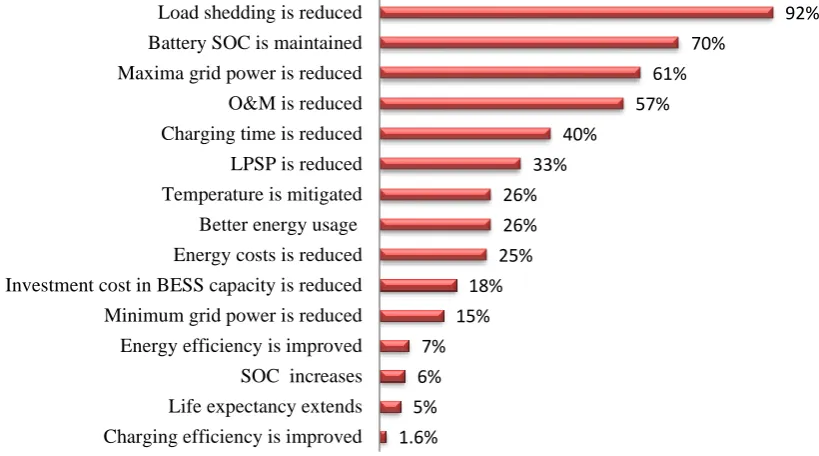
grid connected microgrids. These controls have been proven to be more efficient than a traditional control. Fig.
4 shows some results achieved using FLC or MPC in renewable energy systems with batteries energy storage.
325
When comparing these results with a traditional control, we have found some advantages. The load shedding
326
can be reduced up to 92%; the implementation of these controls, allows maintaining the SOC above 50%, thus
327
avoiding deep discharges that lead to the deterioration of the battery. Through energy optimum use, the
328
maximum and minimum power of the grid can be reduced by 61% and 15% respectively. This rational and
329
efficient use of energy allows reducing microgrid energy costs by 25%. Also, the operation and maintenance
330
and loss of power supply probability can be lowered around 57% and 33% respectively. Regarding to energy
331
storage system in batteries, the charging time is reduced about 40%, which leads to a decrease in temperature
332
about 26% and a reduction of the investment cost in energy storage capacity about 18%. So, it allowed some
333
approaches to extend the life expectancy around 5%.
334
335
Fig. 4. Main advantages of FLC or MPC with respect to traditional controls methods.
336
337
Despite the advantages of FLC and MPC controllers compared to traditional controls, it is required an
338
implementation of these types of controls in real environments with large-scale energy storage systems, because
339
many of the results have been achieved through simulation. Moreover, parameters such as dynamic selection of
340
battery SOC limits and the influence of ambient variables such as relative humidity or SOH prediction were not
341
studied. Finally, these controls are also being implemented to control the charging of lithium iron phosphate
342
(LiFePO4) batteries as shown in [83-85].
343
5. Conclusions and future work
344
Renewable energy systems have been a short-term solution in the mitigation of energy needs in isolated areas
345
where there is no energy service grid connected. Many of these systems have battery energy storage to giving
346
energy in those hours where natural resources such as sun or wind are not present. In in a connected microgrid,
347
the BESS is used to minimize active power exchange at the point of common coupling of the microgrid.
348
A control and control strategy is required to optimize the energy management and to avoid overcharging and
349
overdischarging in the energy storage system. Despite of being the constant-current constant-voltage (CC-CV)
350
1.6% 5% 6%
7% 15%
18% 25%
26% 26%
33% 40%
57% 61%
70%
92%
Charging efficiency is improved Life expectancy extends SOC increases Energy efficiency is improved Minimum grid power is reduced Investment cost in BESS capacity is reduced Energy costs is reduced Better energy usage Temperature is mitigated
the most used control method for battery charging and discharging, other method such as FLC or MPC have
351
shown better performances. The main benefits are: reduced charging time, improved charging efficiency,
352
mitigation of the temperature rises, and maintenance of the battery SOC within secure limits. Moreover, they
353
reduce of the investment cost in energy storage capacity and they extend the life expectancy.
354
Most of the papers consulted based their results on simulations and in some cases on experimental tests with
355
VRLA batteries. Therefore, much more real experiments are needed to extend the conclusion to real systems.
356
The extension to other types of batteries such as OPzS lead-acid batteries and lithium iron phosphate (LiFePO4)
357
batteries is also a hot research topic. However, the high cost of LiFePO4 batteries becomes a constraint for
358
large-scale implementations in RES.
359
Future work will focus on experimental application of FLC and MPC in the energy management of a
360
grid-connected system located in Departamento del Chocó – Colombia (in Spanish).
361
362
Acknowledgements: The authors would like to acknowledge the research project “Implementación de un
363
programa de desarrollo e investigación de energías renovables en el departamento del Chocó, BPIN
364
2013000100285 (in Spanish)” and the Universidad Tecnológica del Chocó (in Spanish).
365
Author Contributions: All authors have worked on this manuscript together and all authors have read and
366
approved the manuscript.
367
Conflicts of Interest: The authors declare no conflict of interest.
368
369
References
370
371
372
1. Khalilpour, Rajab; Vassallo, Anthony. Planning and operation scheduling of PV-battery
373
systems: A novel methodology. Renewable and Sustainable Energy Reviews, 2016, vol. 53, p.
374
194-208.
375
2. Yang, Z., Zhang, J., Kintner-Meyer, M. C., Lu, X., Choi, D., Lemmon, J. P., & Liu, J.
376
Electrochemical energy storage for green grid. Chemical reviews, 2011, vol. 111, no 5, p.
377
3577-3613.
378
3. Sayigh, Ali (ed.). Renewable Energy in the Service of Mankind Vol I: Selected Topics from the
379
World Renewable Energy Congress WREC 2014. Springer, 2015.
380
4. Armstrong, S.; Glavin, M. E.; Hurley, W. G. Comparison of battery charging algorithms for
381
stand-alone photovoltaic systems. In Power Electronics Specialists Conference, 2008. PESC
382
2008. IEEE. IEEE, 2008. p. 1469-1475.
383
5. Koohi-Kamali, S., Tyagi, V. V., Rahim, N. A., Panwar, N. L., & Mokhlis, H.. Emergence of
384
energy storage technologies as the solution for reliable operation of smart power systems: A
385
review. Renewable and Sustainable Energy Reviews, 2013, vol. 25, p. 135-165.
386
6. Kousksou, T., Bruel, P., Jamil, A., El Rhafiki, T., & Zeraouli, Y. Energy storage: Applications
387
and challenges. Solar Energy Materials and Solar Cells, 2014, vol. 120, p. 59-80.
388
7. Akinyele, Daniel; Belikov, Juri; Levron, Yoash. Battery Storage Technologies for Electrical
389
Applications: Impact in Stand-Alone Photovoltaic Systems. Energies, 2017, vol. 10, no 11, p.
390
1760.
391
8. Kaldellis, J. K.; Zafirakis, D.; Kavadias, K. Techno-economic comparison of energy storage
392
systems for island autonomous electrical networks. Renewable and Sustainable Energy
393
Reviews, 2009, vol. 13, no 2, p. 378-392.
394
9. Ferreira, H. L., Garde, R., Fulli, G., Kling, W., & Lopes, J. P. Characterization of electrical
395
10. Chen, H., Cong, T. N., Yang, W., Tan, C., Li, Y., & Ding, Y. Progress in electrical energy storage
397
system: A critical review. Progress in Natural Science, 2009, vol. 19, no 3, p. 291-312.
398
11. Díaz-González, F., Sumper, A., Gomis-Bellmunt, O., & Villafáfila-Robles, R. A review of energy
399
storage technologies for wind power applications. Renewable and sustainable energy reviews,
400
2012, vol. 16, no 4, p. 2154-2171.
401
12. Evans, Annette; Strezov, Vladimir; Evans, Tim J. Assessment of utility energy storage options
402
for increased renewable energy penetration. Renewable and Sustainable Energy Reviews, 2012,
403
vol. 16, no 6, p. 4141-4147.
404
13. Alotto, Piergiorgio; Guarnieri, Massimo; Moro, Federico. Redox flow batteries for the storage
405
of renewable energy: A review. Renewable and Sustainable Energy Reviews, 2014, vol. 29, p.
406
325-335.
407
14. Nikdel, M. Various battery models for various simulation studies and applications. Renewable
408
and Sustainable Energy Reviews, 2014, vol. 32, p. 477-485.
409
15. Hoppmann, J., Volland, J., Schmidt, T. S., & Hoffmann, V. H. The economic viability of battery
410
storage for residential solar photovoltaic systems–A review and a simulation model.
411
Renewable and Sustainable Energy Reviews, 2014, vol. 39, p. 1101-1118.
412
16. Hesse, Holger C., et al. Economic optimization of component sizing for residential battery
413
storage systems. Energies, 2017, vol. 10, no 7, p. 835.
414
17. Fathima, Hina; Palanisamy, K. Optimized sizing, selection, and economic analysis of battery
415
energy storage for grid-connected wind-PV hybrid system. Modelling and Simulation in
416
Engineering, 2015, vol. 2015, p. 16.
417
18. Battke, B., Schmidt, T. S., Grosspietsch, D., & Hoffmann, V. H. A review and probabilistic
418
model of lifecycle costs of stationary batteries in multiple applications. Renewable and
419
Sustainable Energy Reviews, 2013, vol. 25, p. 240-250.
420
19. Luo, X., Wang, J., Dooner, M., & Clarke, J. Overview of current development in electrical
421
energy storage technologies and the application potential in power system operation. Applied
422
Energy, 2015, vol. 137, p. 511-536.
423
20. Dekka, A., Ghaffari, R., Venkatesh, B., & Wu, B. A survey on energy storage technologies in
424
power systems. In Electrical Power and Energy Conference (EPEC), 2015 IEEE. IEEE, 2015. p.
425
105-111.
426
21. Hsieh, Hung-I.; Tsai, Cheng-Yuan; Hsieh, Guan-Chyun. Photovoltaic burp charge system on
427
energy-saving configuration by smart charge management. IEEE Transactions on Power
428
Electronics, 2014, vol. 29, no 4, p. 1777-1790.
429
22. Yin, Y., Luo, X., Guo, S., Zhou, Z., & Wang, J. A battery charging control strategy for renewable
430
energy generation systems. In Proceedings of the World Congress on Engineering. 2008. p. 2-4.
431
23. Dakkak, Mohamed; Hasan, Adel. A charge controller based on microcontroller in stand-alone
432
photovoltaic systems. Energy Procedia, 2012, vol. 19, p. 87-90.
433
24. Bandara, Gemdc; Ivanov, Ratcho; Gishin, Stoyan. Intelligent fuzzy controller for a lead-acid
434
battery charger. En Systems, Man, and Cybernetics, 1999. IEEE SMC'99 Conference
435
Proceedings. 1999 IEEE International Conference on. IEEE, 1999. p. 185-189.
436
25. Hua, Chih-Chiang; Lin, Meng-Yu. A study of charging control of lead-acid battery for electric
437
vehicles. In Industrial Electronics, 2000. ISIE 2000. Proceedings of the 2000 IEEE International
438
Symposium on. IEEE, 2000. p. 135-140.
439
26. Ayoub, Elie; Karami, Nabil. Review on the charging techniques of a li-ion battery. En
440
Technological Advances in Electrical, Electronics and Computer Engineering (TAEECE), 2015
441
Third International Conference on. IEEE, 2015. p. 50-55.
442
27. Rand, D. A. J., Moseley, P. T., Rand, D. A. J., Moseley, P. T., Garche, J., & Parker, C. D. Valve
443
regulated lead acid batteries, 2004. ISBN: 0-4445-0746-9.
444
28. Hua, A. Chih-Chiang; Syue, B. Zong-Wei. Charge and discharge characteristics of lead-acid
445
battery and LiFePO4 battery. En Power Electronics Conference (IPEC), 2010 International.
446
29. Lee, Cheng Siong; Lin, Hsiung Cheng; Lai, Sin-You. Development of fast large lead-acid
448
battery charging system using multi-state strategy. International Journal on Computer,
449
Consumer and Control (IJ3C), 2013, vol. 2, no 2.
450
30. Yan, J., Xu, G., Qian, H., Xu, Y., & Song, Z. Model predictive control-based fast charging for
451
vehicular batteries. Energies, 2011, vol. 4, no 8, p. 1178-1196.
452
31. Eldahab, Yasser E. Abu; Saad, Naggar H.; Zekry, Abdalhalim. Enhancing the design of battery
453
charging controllers for photovoltaic systems. Renewable and Sustainable Energy Reviews,
454
2016, vol. 58, p. 646-655.
455
32. Wong, Y. S.; Hurley, W. G.; Wölfle, W. H. Charge regimes for valve-regulated lead-acid
456
batteries: Performance overview inclusive of temperature compensation. Journal of Power
457
Sources, 2008, vol. 183, no 2, p. 783-791.
458
33. Rossinot, E., Lefrou, C., Dalard, F., & Cun, J. P. Batteries in standby applications: comparison of
459
alternate mode versus floating. Journal of Power Sources, 2001, vol. 101, no 1, p. 27-34.
460
34. Chen, Liang-Rui. Design of duty-varied voltage pulse charger for improving Li-ion
461
battery-charging response. IEEE Transactions on Industrial Electronics, 2009, vol. 56, no 2, p.
462
480-487.
463
35. Liu, C. L., Chiu, Y. S., Liu, Y. H., Ho, Y. H., & Huang, S. S. Optimization of a
464
fuzzy-logic-control-based five-stage battery charger using a fuzzy-based taguchi method.
465
Energies, 2013, vol. 6, no 7, p. 3528-3547.
466
36. Huang, Shyh-Jier; Huang, Bo-Ge; Pai, Fu-Sheng. Fast Charge Strategy Based on the
467
Characterization and Evaluation of LiFePO4 Batteries. IEEE Transactions on Power Electronics,
468
2013, vol. 28, no 4, p. 1555-1562.
469
37. Linden, David; Reddy, Thomas B. Handbook of Batteries. 3rd. 2002.
470
38. Nasser Kutkut, Ph.D. – Power Designers, LLC - Madison, WI. Negative Pulse Charging: Myths
471
and Facts.
472
http://www.batterypoweronline.com/images/PDFs_articles_whitepaper_appros/powerdesigne
473
rs.pdf. [Consulted: 03-05-2017]
474
39. Li, Siguang; Zhang, Chengning; Xie, Shaobo. Research on fast charge method for lead-acid
475
electric vehicle batteries. En Intelligent Systems and Applications, 2009. ISA 2009. International
476
Workshop on. IEEE, 2009. p. 1-5.
477
40. James, M., Grummett, J., Rowan, M., & Newman, J. Application of pulse charging techniques
478
to submarine lead-acid batteries. Journal of power sources, 2006, vol. 162, no 2, p. 878-883.
479
41. Chuang, Y. C., Ke, Y. L., Chuang, H. S., & Chang, S. Y. Battery float charge technique using
480
parallel-loaded resonant converter for discontinuous conduction operation. IEEE Transactions
481
on Industry Applications, 2012, vol. 48, no 3, p. 1070-1078.
482
42. Battery Management of the SunnyIsland.
483
http://files.sma.de/dl/7910/SI_Batteriemanagement-TI-en-21.pdf. [Consulted: 22/06/2017]
484
43. Zadeh, Lotfi A. Fuzzy sets. Information and control, 1965, vol. 8, no 3, p. 338-353.
485
44. Hsieh, Guan-Chyun; Chen, Liang-Rui; Huang, Kuo-Shun. Fuzzy-controlled Li-ion battery
486
charge system with active state-of-charge controller. IEEE Transactions on industrial
487
electronics, 2001, vol. 48, no 3, p. 585-593.
488
45. Precup, Radu-Emil; Hellendoorn, Hans. A survey on industrial applications of fuzzy control.
489
Computers in Industry, 2011, vol. 62, no 3, p. 213-226.
490
46. Bago, J. C., Galán, S. G., Aguilera, J., Velasco, J. R., & Magdalena, L. Fuzzy controller
491
applications in stand-alone photovoltaic systems. Mathware & soft computing, 2008, vol. 9, no
492
1, p. 85-105.
493
47. Rahim, N. A., Mekhilef, S., Chan, E. L., & Ping, H. W. Fuzzy-controlled battery charger
494
state-of-charge controller. International Journal of Modelling and Simulation, 2006, vol. 26, no
495
2, p. 106-111.
496
48. Huang, C. H., Huang, C. C., Ou, T. C., Lu, K. H., & Hong, C. M. Intelligent fuzzy logic
497
controller for a solar charging system. In Advanced Intelligent Mechatronics, 2009. AIM 2009.
498
49. Kim, J. Y., Kim, H. M., Kim, S. K., Jeon, J. H., & Choi, H. K. Designing an energy storage system
500
fuzzy PID controller for microgrid islanded operation. Energies, 2011, vol. 4, no 9, p. 1443-1460.
501
50. Welch, Richard L.; Venayagamoorthy, Ganesh Kumar. Energy dispatch fuzzy controller for a
502
grid-independent photovoltaic system. Energy Conversion and Management, 2010, vol. 51, no
503
5, p. 928-937.
504
51. Welch, Richard L.; Venayagamoorthy, Ganesh K. Comparison of two optimal control strategies
505
for a grid independent photovoltaic system. In Industry Applications Conference, 2006. 41st
506
IAS Annual Meeting. Conference Record of the 2006 IEEE. IEEE, 2006. p. 1120-1127.
507
52. Fu-Shun, Wang; Xue-Song, Suo. Research on Batterys charging system based on the Fuzzy
508
control. En Proceedings of the 2nd International Conference on Computer Science and
509
E-lectronics Engineering. 2013.
510
53. Swathika, R., Ram, R. G., Kalaichelvi, V., & Karthikeyan, R. Application of fuzzy logic for
511
charging control of lead-acid battery in stand-alone solar photovoltaic system. En Green
512
Computing, Communication and Conservation of Energy (ICGCE), 2013 International
513
Conference on. IEEE, 2013. p. 377-381.
514
54. Safari, S.; Ardehali, M. M.; Sirizi, M. J. Particle swarm optimization based fuzzy logic controller
515
for autonomous green power energy system with hydrogen storage. Energy conversion and
516
management, 2013, vol. 65, p. 41-49.
517
55. Berrazouane, Sofiane; Mohammedi, Kamal. Parameter optimization via cuckoo optimization
518
algorithm of fuzzy controller for energy management of a hybrid power system. Energy
519
Conversion and Management, 2014, vol. 78, p. 652-660.
520
56. Haoran, Z. H. A. O., Qiuwei, W. U., Chengshan, W. A. N. G., Cheng, L., & Rasmussen, C. N.
521
Fuzzy logic based coordinated control of battery energy storage system and dispatchable
522
distributed generation for microgrid. Journal of Modern Power Systems and Clean Energy,
523
2015, vol. 3, no 3, p. 422-428.
524
57. Arcos-Aviles, D., Pascual, J., Marroyo, L., Sanchis, P., & Guinjoan, F. Fuzzy logic-based energy
525
management system design for residential grid-connected microgrids. IEEE Transactions on
526
Smart Grid, 2016. doi 10.1109/TSG.2016.2555245
527
58. Derrouazin, A., Aillerie, M., Mekkakia-Maaza, N., & Charles, J. P. Fuzzy logic controller versus
528
classical logic controller for residential hybrid solar-wind-storage energy system. In AIP
529
Conference Proceedings. AIP Publishing, 2016. Vol. 1758. No. 1p. 030055.
530
59. Paliwal, Priyanka; Patidar, N. P.; Nema, R. K. Fuzzy logic based determination of battery
531
charging efficiency applied to hybrid power system. J World Acad Eng Sci Technol, 2012, vol.
532
71, p. 1164-1168.
533
60. Teo, T. T., Logenthiran, T., Woo, W. L., & Abidi, K. Fuzzy logic control of energy storage
534
system in microgrid operation. En Innovative Smart Grid Technologies-Asia (ISGT-Asia), 2016
535
IEEE. IEEE, 2016. p. 65-70.
536
61. Hussain, Akhtar; Bui, Van-Hai; Kim, Hak-Man. Fuzzy Logic-Based Operation of Battery
537
Energy Storage Systems (BESSs) for Enhancing the Resiliency of Hybrid Microgrids. Energies,
538
2017, vol. 10, no 3, p. 271.
539
62. Camacho, E. F., & Alba, C. B. Model predictive control. Springer Science & Business Media.
540
2013.
541
63. Qin, S. Joe; Badgwell, Thomas A. A survey of industrial model predictive control technology.
542
Control engineering practice, 2003, vol. 11, no 7, p. 733-764.
543
64. Geyer, Tobias; Papafotiou, Georgios; Morari, Manfred. Hybrid model predictive control of the
544
step-down DC–DC converter. IEEE Transactions on Control Systems Technology, 2008, vol. 16,
545
no 6, p. 1112-1124.
546
65. Cortes, P., Rodriguez, J., Antoniewicz, P., & Kazmierkowski, M. Direct power control of an
547
AFE using predictive control. IEEE Transactions on Power Electronics, 2008, vol. 23, no 5, p.
548
2516-2523.
549
66. Xie, Yanhui H. Ghaemi R. Sun J. and Freudenberg J. S. Implicit model predictive control of a
550
full bridge DC–DC converter. IEEE Transactions on Power Electronics, 2009, vol. 24, no 12, p.
551
67. Quevedo, D. E., Aguilera, R. P., Perez, M. A., Cortés, P., & Lizana, R. Model predictive control
553
of an AFE rectifier with dynamic references. IEEE Transactions on Power Electronics, 2012, vol.
554
27, no 7, p. 3128-3136.
555
68. Townsend, Christopher D.; Summers, Terrence J.; Betz, Robert E. Multigoal heuristic model
556
predictive control technique applied to a cascaded H-bridge StatCom. IEEE Transactions on
557
Power Electronics, 2012, vol. 27, no 3, p. 1191-1200.
558
69. Maciejowski, J. M. Predictive control: with constraints. Pearson education. 2002.
559
70. Perez, E., Beltran, H., Aparicio, N., & Rodriguez, P. Predictive power control for PV plants with
560
energy storage. IEEE Transactions on Sustainable Energy, 2013, vol. 4, no 2, p. 482-490.
561
71. Pezeshki, Houman; Wolfs, Peter; Ledwich, Gerard. A model predictive approach for
562
community battery energy storage system optimization. En PES General Meeting| Conference
563
& Exposition, 2014 IEEE. IEEE, 2014. p. 1-5.
564
72. Dizqah, A. M., Maheri, A., Busawon, K., & Kamjoo, A. A multivariable optimal energy
565
management strategy for standalone dc microgrids. IEEE transactions on power systems, 2015,
566
vol. 30, no 5, p. 2278-2287.
567
73. Morstyn, Thomas; Hredzak, Branislav; Agelidis, Vassilios G. Dynamic optimal power flow for
568
DC microgrids with distributed battery energy storage systems. In Energy Conversion
569
Congress and Exposition (ECCE), 2016 IEEE. IEEE, 2016. p. 1-6.
570
74. Morstyn, T., Hredzak, B., Aguilera, R. P., & Agelidis, V. G. Model Predictive Control for
571
Distributed Microgrid Battery Energy Storage Systems. IEEE Transactions on Control Systems
572
Technology, 2017.
573
75. Kujundžić, G., Ileš,Š., Matuško, J., & Vašak, M. Optimal charging of valve-regulated lead-acid
574
batteries based on model predictive control. Applied Energy, 2017, vol. 187, p. 189-202.
575
76. Zeng, P. P., Wu, Z., Zhang, X. P., Liang, C., & Zhang, Y. Model predictive control for energy
576
storage systems in a network with high penetration of renewable energy and limited export
577
capacity. In Power Systems Computation Conference (PSCC), 2014. IEEE, 2014. p. 1-7.
578
77. Li, Chiao‐Ting; Peng, Huei; Sun, Jing. Predictive control and sizing of energy storage to
579
mitigate wind power intermittency. Wind Energy, 2016, vol. 19, no 3, p. 437-451.
580
78. Khalid, Muhammad; Savkin, Andrey V. Model predictive control based efficient operation of
581
battery energy storage system for primary frequency control. In Control Automation Robotics
582
& Vision (ICARCV), 2010 11th International Conference on. IEEE, 2010. p. 2248-2252.
583
79. Ferrarini, Luca; Mantovani, Giancarlo; Costanzo, Giuseppe Tommaso. A Distributed Model
584
Predictive Control approach for the integration of flexible loads, storage and renewables. In
585
Industrial Electronics (ISIE), 2014 IEEE 23rd International Symposium on. IEEE, 2014. p.
586
1700-1705.
587
80. Wang, Trudie; Kamath, Haresh; Willard, Steve. Control and optimization of grid-tied
588
photovoltaic storage systems using model predictive control. IEEE Transactions on Smart Grid,
589
2014, vol. 5, no 2, p. 1010-1017.
590
81. Petrollese, M., Valverde, L., Cocco, D., Cau, G., & Guerra, J. Real-time integration of optimal
591
generation scheduling with MPC for the energy management of a renewable hydrogen-based
592
microgrid. Applied Energy, 2016, vol. 166, p. 96-106.
593
82. Matthiss, B., Müller, D., Binder, J., & Pietruschka, D. Model Predicitive Control Schemes for
594
PV-Storage Systems to Increase Grid Compatibility and Optimise Energy Costs. EU PVSEC
595
Proc, 2014, p. 3581-6.
596
83. Kim, Jonghoon; Nikitenkov, Dmitry. Fuzzy logic-controlled online state-of-health (SOH)
597
prediction in large format LiMn2O4 cell for energy storage system (ESS) applications. In
598
Industrial Technology (ICIT), 2014 IEEE International Conference on. IEEE, 2014. p. 474-479.
599
84. Li, Xiangjun; Yan, Heming. Fuzzy logic-based coordinated control method for multi-type
600
battery energy storage systems. Artificial Intelligence Review, 2016, p. 1-17.
601
85. Li, X., Li, N., Jia, X., & Hui, D. Fuzzy logic based smoothing control of wind/PV generation
602
output fluctuations with battery energy storage system. In Electrical Machines and Systems
603
![Fig. 3. Sunny Island charging phases with sample values for an AGM battery [42].](https://thumb-us.123doks.com/thumbv2/123dok_us/1084342.1609116/5.595.136.456.287.469/fig-sunny-island-charging-phases-sample-values-battery.webp)