Relph, Nicola, Goodwin, Victoria and Egerton, Judi (2016) Impacts of ‘change
projects’ in Cumbria partnership trust’s Learning Leaders programme: evaluating
qualitative participant endpoint reflections. Cumbria Partnership Journal of
Research, Practice and Learning, 5 (1). pp. 3641.
Downloaded from: http://insight.cumbria.ac.uk/id/eprint/2814/
Usage of any items from the University of Cumbria’s institutional repository ‘Insight’ must conform to the following fair usage guidelines.
Any item and its associated metadata held in the University of Cumbria’s institutional repository Insight (unless stated otherwise on the metadata record) may be copied, displayed or performed, and stored in line with the JISC fair dealing guidelines (available here) for educational and notforprofit activities
provided that
• the authors, title and full bibliographic details of the item are cited clearly when any part of the work is referred to verbally or in the written form
• a hyperlink/URL to the original Insight record of that item is included in any citations of the work • the content is not changed in any way
• all files required for usage of the item are kept together with the main item file. You may not
• sell any part of an item
• refer to any part of an item without citation
• amend any item or contextualise it in a way that will impugn the creator’s reputation • remove or alter the copyright statement on an item.
The full policy can be found here.
Affiliations
Pippa Orr, Knowledge Support Librarian, North Cumbria NHS Library and Knowledge Services
Contact information
Pippa Orr. Email: [email protected]
References
Booth, A., Papaioannou, D. & Sutton, A. (2012). Systematic approaches to a successful literature review. London: Sage. Brown, L.M. & Posner, B.Z. (2001). Exploring the relationship between learning and leadership. The Leadership and Organizational Development Journal, 22, 274-280.
Chivers, M. & Pedler, M. (2010). D.I.Y. Handbook for action learners (2nd ed.). Liverpool: Mersey Care NHS Trust Healthcare Improvement Scotland (2012). Getting
knowledge into action to improve healthcare quality: Report of strategic review and recommendations. Retrieved 29
July 2013 http://www.knowledge.scot.nhs.uk/media/CLT/ ResourceUploads/4016980/20120805%20K2A%20short%20 report%20for%20Board%20distribution%20v2%200.pdf McGill, I. & Beaty, L. (2001). Action learning: A guide for professional, management and educational development
(2nd ed. rev.). London: RoutledgeFalmer.
Oxford Strategic Marketing. (2008). Customer journey mapping: Guide for practitioners. Retrieved 5 June 2013 http://webarchive.nationalarchives.gov.uk/+/http:/www. cabinetoffice.gov.uk/media/123970/journey_mapping1.pdf Poyner, A. (2005). Enabling end-users: Information skills training. Oxford: Chandos.
Silverman, D. (2006). Interpreting qualitative data: Methods for analysing talk, text and interaction (3rd ed.). London: Sage.
Strauss, A. & Corbin, J. (2008). Basics of qualitative research: Techniques and procedures for developing grounded theory (3rd ed. rev.). Los Angeles: Sage.
Impacts of ‘change projects’ in Cumbria partnership trust’s
Learning Leaders programme: Evaluating qualitative
participant end-point reflections
Nicola S. Relph, Vicki Goodwin & Judi Egerton
Abstract
This paper reports findings arising from a broader evaluation of the first tranche of Cumbria Partnership Foundation Trust’s Learning Leaders Programme (LLP). At the final ‘Celebration Day’ of the LLP, all participants (N=15) were invited to fill a form in which they could self-assess the impacts of their projects, and results were analysed using Straussian Grounded Theory. Responses indicated that key concerns related to extant impacts, impact mechanisms (i.e. the manner through which impacts were effected) and obstacles to impact. The overwhelming consensus generated was that the projects had produced strong positive impacts at time of reporting, and had the potential to effect further affirmative change.
Keywords
education; evaluation; healthcare; leadership; learning; quantitative methods; training
Introduction
This paper reports findings arising from a broader evaluation of the first tranche of Cumbria Partnership Foundation Trust’s Learning Leaders Programme (LLP) running from 2012-2013, conducted by analysts at the University of Cumbria’s unit for Health and Social Care Evaluations (HASCE).
The LLP was developed against a backdrop of extensive organisational change to serve a number
of purposes in the Cumbria Partnership Foundation Trust (CPFT). The programme was primarily
Impacts of ‘change projects’: Evaluating qualitative participant end-point reflections
The LLP was further designed (a) to promote and develop a Learning Network across the organisation, (b) to be a resource for organisational development, (c) to develop expertise in the Trust’s chosen change methodology, (d) to facilitate the embedding of a learning culture within the organisation, and (e) to encourage participants to take a lead in further embedding a reflective approach to the delivery of care across the organisation. The content of the LLP’s ‘taught’ component was developed using an experiential learning model (Kolb, 1985) and included learning models, action learning sets (ALS), difference and diversity, communities of practice leading change and influencing decision making. A large part of the programme involved participants in ‘live’ change projects of their own choosing, using simple change methodology (a fuller account of the LLP objectives and content can be located in CPFT, 2012)
Change projects
Although numerous forms of data were collected for the evaluation exploring all dimensions of the programme, the focus here falls upon one
dimension. This is the reflections made by programme participants regarding the impacts of their change projects. These were an integral part of the LLP, designed to be:
[A] project in [the participant’s] area of work which would form part of the selection process and clearly makes the link between ‘learning’ and ‘doing’. The project would be something [the participant] is already working on or wanting to develop but requires help, support and skills development. Projects will have a focus on supporting integration and improving the experience of patients and carers. Projects should be chosen with full support
of locality management. (CPFT, 2012)
The participant projects addressed a wide range of concerns related to leadership and learning.
Evaluation Methodology
At the final ‘Celebration Day’ of the LLP, all participants were invited to complete a form in which they could self-assess the impacts of their projects. Participants were provided with free-text space to facilitate personalised responses, presented here with the greatest degree of anonymity possible with qualitative data of this form. A total of n=13 participants, from a total cohort of N=15, returned these forms. All participants are indexed by a number (i.e. P1, P2 etc.).
Design
The form focused upon three specific areas, via the following questions:
1. Please tell us why you applied to take part in the Learning Leaders programme.
2. Please tell us five things you have learned/
discovered/found beneficial while on the programme, or since becoming a Learning Leader.
3. Please tell us here about the milestones/ successes/obstacles you faced while carrying out your project. What worked? What didn’t? What would you change? How do YOU think your project has made an impact?
This paper, given strictures of brevity, and also a core interest in the unanticipated insights that can emerge from largely unstructured qualitative data (Silverman, 2010) focuses only upon the free-form responses emerging from question three.
Data analysis
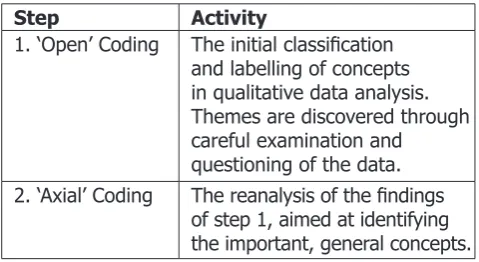
Data were explored for patterns and themes using many of the general principles of Straussian Grounded Theory (Strauss & Corbin, 1998) and within Scientific Software’s ATLAS.Ti qualitative analysis package. Evaluative strategy herein involves two central analytic steps geared towards ongoing category-refinement, as displayed in Table 1 (below):
Table 1: Analytic Steps in Straussian Grounded Theory
Step Activity
1. ‘Open’ Coding The initial classification and labelling of concepts in qualitative data analysis. Themes are discovered through careful examination and questioning of the data. 2. ‘Axial’ Coding The reanalysis of the findings
of step 1, aimed at identifying the important, general concepts.
Results
Project impacts discussed by participants fell into two broad categories; extant impacts and prospective impacts (i.e. those that they were confident would
occur).
Extant impacts
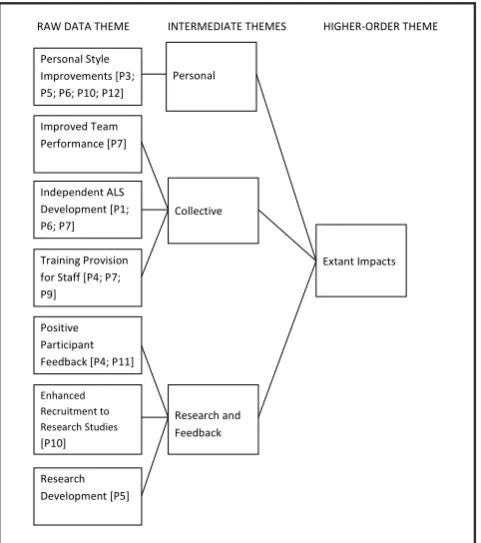
The dimensions of the first of these categories are illustrated in Figure 1 (below), and were taken to have manifested in three core domains.
A number of participants indicated that participation in the project had, among other key impacts, directly affected their own workplace style and skills.
boosts in confidence and motivation. As P12 notes,
“My learning and leading styles have changed
completely since taking part.”
In a more tangible domain, there is a range of structural-collective raw data themes that are noted by participants to be clear impacts of their projects in operation. Firstly, P7 argues that the impacts of the project upon their workplace team had visible and measurable indicators:
P7: “The impact on the cohesion of the team has
been enormous, leading to us re-asserting our evidence-based and essential approach to our client group. In addition over the year, sick leave has fallen and though our number of referrals has doubled so has the number of face to face contacts.”
Secondly, three participants (P1, P6 and P7) maintained that the introduction of independent Action Learning Sets within their own workplaces as parts of their project had improved general communication and cohesion. Finally, two further participants (P7 and P9) draw attention to the fact that direct training for Trust staff has already been provided as part of their projects. For example:
P7: “A team training day was arranged, all tasks
were delegated to members of the ALS. We
influenced senior managers to support the day, and
gained funding.”
The final intermediate theme relating to extant impacts addresses research and feedback. In terms of feedback, P4 and P11 both note that the collection of feedback from participants in their projects (and
related enterprises) had yielded highly positive results, indicating strong levels of user-satisfaction. Moreover, P11 directly indicated that this feedback would inform future stages of the project itself.
P4: “[F]ollowing the training I asked delegates
to complete an evaluation form regarding the training and the information discussed. All of these anonymous forms were positive.”
P11: “Useful feedback and recommendations were
received from participants, which will contribute to the development of the Library Outreach Service developments.”
In a related vein, P5 drew attention to the
development of formal research tools as part of their project, with the potential to be rolled out at a wider level, while P10 indicated a quantitative increase in recruitment to research studies as a direct output of Learning Leaders project work:
P10: “I can definitely say from our recruitment figures for this year that our research awareness programme that was launched for the first time last year in August was a great success. It has clearly attracted quite a few professionals to take part in different research studies approved by our trust so far.”
Prospective impacts
Alongside the firm impacts documented above, participants also outlined prospective (which is to say ‘expected but as yet unrealised’) impacts of the LLP project work. These prospective impacts fell into three central categories.
As evidenced in Figure 2, human impacts
addressed such issues as benefits for patient care, for the provision of as yet undelivered training and for the enhancement of social inclusion and employment. Regarding the first of these, P3 was in little doubt that while “… [the] project is in the very early stages, [it] will definitely make an impact in patient care.” As regards the latter, P6 asserted that:
P6: “I have been working with the local training
provider…to look at setting up an unpaid employment placement for six months, with the intended progression to paid employment for the remaining six months as an apprentice.”
In short, wheels were turning in order to make such placements a reality. In terms of resources, quantifiable financial gains were expected as a project impact by P10, who asserted that “I am sure that the result will clearly be seen in revenue figures in our
trust.” P13, meanwhile, forecast that “…the project
will cut down on the time spent by both clinicians and clinical audit staff…” in a range of activities. Finally, further research development was expected as an outcome of P9’s project, while P13 was confident that improved information access across the Trust would be a measurable impact.
Figure 1: Extant project impacts
RAW DATA THEME INTERMEDIATE THEMES HIGHER-ORDER THEME
Personal Style Improvements [P3; P5; P6; P10; P12]
Improved Team Performance [P7]
Independent ALS Development [P1; P6; P7]
Training Provision for Staff [P4; P7; P9]
Positive Participant Feedback [P4; P11]
Research Development [P5]
Enhanced Recruitment to Research Studies
[P10]
Extant Impacts
Impacts of ‘change projects’: Evaluating qualitative participant end-point reflections
Obstacles to impact
In terms of obstacles to the achievement of
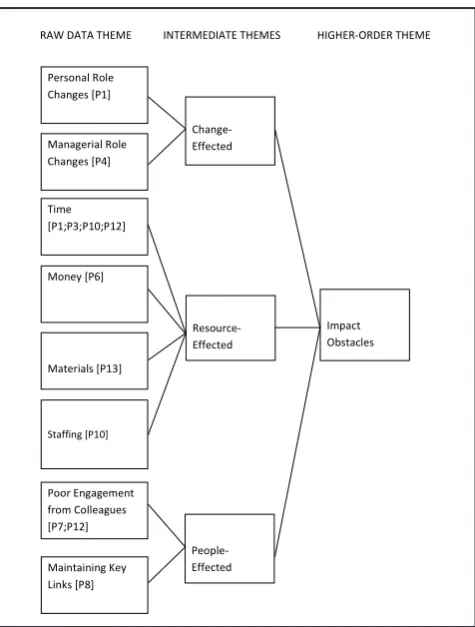
anticipated project impacts, participants identified a variety of issues in three core domains, as evidenced in Figure 3.
The change-effected obstacles noted by
participants related to shifts in the roles of individuals as results of restructuring within the Trust itself. These had the impact of slowing, or altering (and thereby slowing) the progress of the project. In one case, this related to a role-shift for the participant themselves, and in another the project was derailed by the relocation of a supportive manager:
P1: “My project plan had to be put on hold as
finally changes were afoot in my department. It
was frustrating to feel that the time wasn’t right to proceed with the project but six months down the line my role has changed and now the time is right to get back on track with that particular project.”
P4: “My manager at the time encouraged me to
develop a programme regarding dignity, nominated me to attend the dignity workshops throughout Cumbria and hold dignity training in my work place...Unfortunately due to organisational change my initial manager was relocated.”
Four participants identified time constraints as being natural obstacles to the success of their projects, citing both a general lack of time within their own schedules, poor estimation of how long things might actually take from the outset and also a lack of spare time to absorb the impact of delays. For example:
P3: “[I] need to be more realistic whilst maintaining
my belief in the project proposal…I would change my underestimation about how long things take!!”
P12: “There are many obstacles around the limited
number of hours I work. However, the final project
is now well underway, deliverable and of benefit to
both service users and our Trust.”
Other cited obstacles in the realm of resources included difficulties securing funding when it was needed (P13), difficulty in accessing materials such as computer software (P13) and human resources – i.e. being short-staffed.
Finally, some participants found human agents to be the key obstacles. P8 highlighted the difficulties of sustaining the intensity of key relationships on a day-to-day basis such that project momentum could be sustained, while P7 and P12 noted a general lack of engagement and/or enthusiasm from some colleagues, which inevitably limited the scope of the project’s reach, especially at the beginning.
P7: “I found that it was difficult to maintain the
team’s interest/commitment over that [early] time frame and was disappointed by their passivity.”
Key impact mechanisms
The final higher-order theme to emerge from the impact reflections related to the mechanisms through which the participants believed that impacts had been,
Figure 3: Obstacles to impact Figure 2: Prospective project impacts
RAW DATA THEME INTERMEDIATE THEMES HIGHER-ORDER THEME
afwafafw Improved Patient Care [P3;P9]
Training for Staff [P5]
Enhancing Social Inclusion and Employment [P6]
Financial Gains [P10]
Time Savings [P13]
Information Access [P13]
Research Development [P9]
Prospective Impacts
Knowledge Impacts Resource Impacts Human Impacts
RAW DATA THEME INTERMEDIATE THEMES HIGHER-ORDER THEME
Personal Role Changes [P1]
Managerial Role Changes [P4]
Time [P1;P3;P10;P12]
Money [P6]
Materials [P13]
Poor Engagement from Colleagues [P7;P12] Staffing [P10]
Impact Obstacles
People-Effected Resource-Effected Change-Effected
or would be, achieved. Intermediate themes within this category were also three-fold. As shown in Figure 4, these themes each comprised two main issues.
In terms of interactions, participants cited an enhanced willingness to cooperate with others, both within their own teams, within the wider Trust and without, as core to the success of the projects:
P2: “I had a vision of how things could be improved
but after having my first learning set meeting, I
changed or incorporated quite a few ideas, [and] questions, because I was lucky enough to get a Bank Staff member who works quite regularly to join us and she has some really useful views.”
P6: “I have [also] been working with my colleagues
within children services admin team throughout this project and they all share my passion and enthusiasm to ensure this pilot [is] successful.”
P13: “I discussed the idea with several clinicians
– who were enthusiastic – and with my manager – who agreed that we would implement the idea.”
P13: “University involvement was very helpful for
my project, especially when my tutor suggested I investigate screen capture software.”
Secondly, participants highlighted increased use of a realistic and reflective mindset (assimilated through the Learning Leaders programme) when addressing the demands of the projects. This was, in some cases, deemed essential to the projects’ practical progress. For example:
P8: “The first milestone was realising and accepting
that you can’t change the world! However you can
influence people, systems and the way we work.”
P11: “After Day 1 I reflected and then submitted a different and more realistic project plan.”
P12: “[Among] my personal milestones [was the
moment] when I realised I could not ‘Change the World’ with a very large project.”
Finally, participants drew attention to the importance of (i) knowledge transfer and (ii) knowledge
generation as key vehicles for their projects’ success.
Four participants explicitly cited the classic knowledge transfer cycle of learning (via training) and then training others as linchpin mechanisms within their projects. Five participants, meanwhile, stressed the importance of first-hand research (i.e. knowledge generation through novel data) as key. For example:
P9: “I will collect my surveys forms soon then
collate and analyse them and present the result and recommendations to the Learning Network. The result of this should inform the organisation of training needs to raise awareness and knowledge for the benefit of patients and their carers.”
P11: “Useful feedback and recommendations were
received from participants, which will contribute to the development of the Library Outreach Service developments.”
P13: “I investigated and evaluated a range of
alternatives to the training and information that our team had so far been providing to support trust staff to carry out clinical audit projects.”
Discussion
The impacts of the projects (and participation in them) were explored in terms of the extant and the prospective. Extant impacts detailed by the participants included personal growth; collective impacts such as training delivery, team performance improvements and the development of independent Action learning Sets; and impacts in the domain of research and feedback such as increased recruitment to research studies, positive feedback from service users and the development of new research tools. Prospective impacts included human impacts such as further training provision, improvements in service-user experience and greater social inclusion; resource impacts such as time savings and financial gains; and knowledge impacts such as greater information accessibility and further research development. This provides evidence for project success and continuation of this training programme.
Other programmes have also supported leadership training for managers using comparative techniques. Graham and Partlow (2004) used a similar learning set approach to develop nurse leaders and the results of the evaluation were very positive. Participants stated the training facilitated their growth as a leader, and helped them explore new ideas through sharing personal and professional experiences. As a consequence, they became more confident and
Figure 4: Impact mechanisms
RAW DATA THEME INTERMEDIATE THEMES HIGHER-ORDER THEME
Internal Interactions [P1;P2;P6;P7;P9;P13]
External Interactions [P2;P6;P13]
Realism [P3;P8;P11;P12]
Reflection [P7;P10;P11]
Knowledge Transfer [P4;P5;P7;P9]
Knowledge Production [P5;P9;P10;P11;P13]
Impact Mechanisms
Impacts of ‘change projects’: Evaluating qualitative participant end-point reflections
knowledgeable in their leadership roles. Evaluating a management training programme in Lanarkshire, Scotland, Munro and Russell (2007) found similar impacts, concluding that“…the impact that the education provision has made on the ability of the participants to do their job better throughout their working lives [is] a result of the learning that has
taken place.”(p.441).
Obstacles to extant or prospective impacts being made, as cited by participants in the current study, were organisational changes – such as mid-project changes of role for participants or their managers; resource restrictions, such as limited time, funds, materials and personnel; and unengaged colleagues, and difficulties in sustaining intensity in important links. These barriers to change have been reported in previous literature. Werrett, Griffiths & Clifford (2002) evaluated a leadership training programme in the West Midlands and participants reported both organisational barriers and resource issues as barriers to improvements. Furthermore, Janes (2008) stated financial constraints and cultural issues (such as tradition and custom) as inhibitors to change. These could be acknowledged in future LLPs.
The mechanisms through which participants felt change had been actualised – or would be – were enhanced and productive interactions with individuals and agencies within the Trust and without; a
more realistic and reflective mindset; and effective production and transfer of knowledge. These explanations for change are supported in previous literature. For example Edmonstone and Jeavons (2000) reported managers felt more knowledgeable about the institution and hence more capable of installing change following leadership training. Similarly, Werrett et al., (2002) noted improved assertiveness and creativity of managers following training. Janes (2008) further indicated training enhanced workplace change due to changed attitudes and increased knowledge of both participants and their colleagues.
Conclusion
In conclusion the evaluation of the Cumbria Partnership Foundation Trust’s Learning Leaders Programme was very positive. Participants were able to report that the training had brought about both instantaneous and prospective impacts on their practice. Potential barriers to change were also
highlighted to inform future programmes. Finally, training induced three beneficial improvements in the interactions, psychological mind-sets and knowledge of both participants and their staff.
Author Affiliations
Nicola S. Relph, Lecturer, Department of Medical & Sport Sciences, University of Cumbria / Senior Analyst, HASCE, University of Cumbria.
Vicki Goodwin, Business Development Manager, Business Lead for HASCE, University of Cumbria Judi Egerton, Psychotherapist and Organisational Development Lead Cumbria Partnership NHS Foundation Trust.
Contact Information
Nicola Relph. Email: [email protected]
Acknowledgements
The research reported herein was funded by the Cumbria Partnership Foundation Trust as part of a broader evaluation of the Learning Leaders initiative.
References
Edmonstone, J., Jeavons, M. (2000) An Evaluation of the Leading an Empowered Organisation (LEO) Programme. Leeds: Centre for the Development of Nursing Policy and Practice, University of Leeds.
Graham, I. W. & Partlow, C. (2004). Introducing and developing nurse leadership through a learning set approach. Nurse Education Today, 24, 459-465. Janes, G. (2008) Improving services through leadership development. Nursing Times; 104, 58-59.
Kolb, D. A. (1985). Learning Style Inventory, Revised Edition. Boston, MA: Hay Group, Hay Resources Direct. Munro, K. M. & Russell, M. C. (2007). Leadership development: A collaborative approach to curriculum development and delivery. Nurse Education Today, 27, 436-444.
Silverman, D. (2010). Doing Qualitative Research (3rd ed.). London: Sage
Strauss, A. & Corbin, J. (2008). Basics of Qualitative Research: Techniques and Procedures for developing Grounded Theory. London: Sage
Werrett, J., Griffiths, M. & Clifford, C. (2002). A regional evaluation of the leading empowered organisation