Applications of artificial intelligence technologies in COVID-19 research:
A bibliometric study
Md Mahbub Hossain,1,21Shah Akib Sarwar,3 E. Lisako J. McKyer,1 Ping Ma1
Abstract
The novel coronavirus disease (COVID-19) pandemic has impacted health and wellbeing
globally. To strengthen preventive and clinical care amid this pandemic, technological
innovations like artificial intelligence (AI) are increasingly used in different contexts. This
bibliometric study aimed to assess the current scholarly development and prominent research
domains in applications of AI technologies in COVID-19 research. A total of 105 articles were
retrieved from MEDLINE database that emphasized on the use of AI in the context of
COVID-19. Most articles had multiple authors with a collaboration index of 7.18. Moreover, most of the
articles were produced from the USA (22.86%) and China (21.9%), whereas developing
countries were underrepresented among the contributing nations. Furthermore, several research
domains were identified, including prevention and control, diagnostics, epidemiological
characteristics, therapeutics, psychological conditions, and different areas of data sciences
related to COVID-19. The current bibliometric evidence shows the early stage of development in
this field, which necessitates equitable applications of AI in COVID-19 research emphasizing on
health disparities, socio-legal issues, vaccine development, and applied public health research in
this pandemic.
Keywords: COVID-19; Coronavirus; Artificial intelligence; Machine learning; Data mining
11. Department of Health Promotion and Community Health Sciences, School of Public Health, Texas A&M University,
College Station, TX 88743, USA.
2. Nature Study Society of Bangladesh, Khulna 09000, Bangladesh.
3. J. Mike Walker '66 Department of Mechanical Engineering, College of Engineering, Texas A&M University, College Station, TX 88743, USA.
Corresponding author: Md Mahbub Hossain, Department of Health Promotion and Community Health Sciences, School of Public Health, Texas A&M University, College Station, TX 88743, USA. Ph: +1-979-739-7014, Email: [email protected]
2
Introduction
Since the novel coronavirus disease 2019 (COVID-19) outbreak started in December 2019, the
global number of identified cases and mortality attributable to this pandemic have been
increasing over time [1]. Later it was declared as a public health emergency and a global
pandemic, highlighting the significance of the disease in the global context [1,2]. This pandemic
has shown critical weaknesses of global health systems in terms of responding to public health
emergencies [3]. To improve health systems preparedness for COVID-19 and future public
health crises, it is essential to leverage technological advancements that may help in preventing
outbreaks, detecting cases, tracing contacts, diagnosing clinical conditions, evaluating
therapeutic and public health strategies, and predicting health outcomes in individuals and
populations [4–6].
In recent years, artificial intelligence (AI) technologies are increasingly used to leverage
computational approaches that stimulate or mimic cognitive processes, including reasoning,
adaptation, sensory assessment, deep learning, and meaningful interactions [7,8]. Scholarly
contributions from diverse fields of knowledge such as computer sciences, mathematics, biology,
and psychological sciences have informed the development of AI, which is widely used in
modeling, replicating, understanding, and predicting complex problems, processes, and outcomes
in health sciences [9,10]. The use of AI in modern medicine is well documented in several
meta-analyses in different clinical sub-specialties [11–13]. In the era of COVID-19, a growing interest
in the use of AI developed in the global health community. A recent systematic review identified
51 studies representing 66 AI models that predicting hospital admission from pneumonia-related
events, COVID-19 infection, length of hospital stay, progression to severe disease, and mortality
risks in this pandemic [14]. As AI is emerging as a useful tool in this pandemic, it is necessary to
assess the scientific development in this field by evaluating the growth of scholarly publications
that inform how AI is being used in the context of COVID-19.
Scientometric assessments such as bibliometric studies are widely used to quantitatively evaluate
the scientific publications in a given domain of research and inform the overall growth and
pattern of development in that domain [9,15]. Such assessments are critical for prioritizing
research and mobilizing resources for addressing research gaps in different branches of
3
fields of health sciences [9,16,17]. Moreover, emerging bibliometric studies have reported how
COVID-19 related research is increasingly produced globally [18–20]. However, to the best of
our knowledge, no bibliometric study is available that reports the applications of AI in
COVID-19 related research. This study aimed to address this knowledge gap by a bibliometric evaluation
of the current publications on the use of AI in COVID-19 research. Specifically, this study
assessed the characteristics of relevant studies, top authors and sources of scholarly publications,
and common research domains through keyword mapping on applications of AI technologies in
COVID-19 related research publications.
Methods
In this study, we retrieved bibliometric data from the MEDLINE database using a set of
keywords related to AI and COVID-19 (Table 1). After extracting the available literature, we
reviewed the titles and abstracts of those articles to assess their eligibility for bibliometric
analysis. Articles were excluded if they did not refer to any of the AI-related keywords or did not
focus on COVID-19. Due to a limited number of publications, articles irrespective of their study
design were included in this study with no language restrictions. As the COVID-19 outbreak
started in December 2019, the search strategy was limited to 2019 and 2020.
Table 1: Search strategy
Search query Title, abstract, subject heading (MeSH)
Set 1: COVID-19 related keywords
“COVID-19” OR “2019-nCoV” OR “2019 coronavirus” OR “Wuhan coronavirus” OR “Wuhan virus” OR “Wuhan pneumonia” OR “2019 novel coronavirus” OR “novel coronavirus” OR “SARS-CoV-2”
Set 2: AI-related keywords
"Artificial intelligence" OR "Machine intelligence" OR "Artificial neutral network" OR "Recurrent neural network" OR "Machine learning" OR "Generative adversarial network" OR "Deep learning" OR "Supervised learning" OR "Unsupervised learning" OR "Semi-supervised learning" OR "Reinforced learning" OR "Natural language processing" OR "Robotic" OR "Thinking computer system" OR "Fuzzy expert system" OR "Evolutionary computation" OR "Hybrid intelligent system" OR "Data mining" OR "Text mining" OR "Robotics" OR "Image recognition" OR "Speech processing"
Final
search query
4
At the next stage, a descriptive summary of the key bibliometric characteristics was prepared,
which included the frequency of the documents, sources, keywords, author appearance,
co-authors per document, collaboration index, top ten co-authors, top countries affiliated with first
author of respective documents, and journals that published AI-related articles on COVID-19.
Further, the co-occurrence of keywords was assessed to identify common research topics and
connectivity within those topics using a mapping approach. Such keywords analysis is widely
used in bibliometric studies to identify research hotspots within a given domain of knowledge,
which informs what are the common topics represented in the literature and how those topics are
related to each other [9,20]. A co-citation analysis was not performed considering the early stage
of COVID-19 research and a low number of studies related to AI. In this study, reference
management, statistical analyses, and keywords mapping were conducted using RefWorks, R
(Version 3.6.1), and VOSViewer software, respectively.
Results
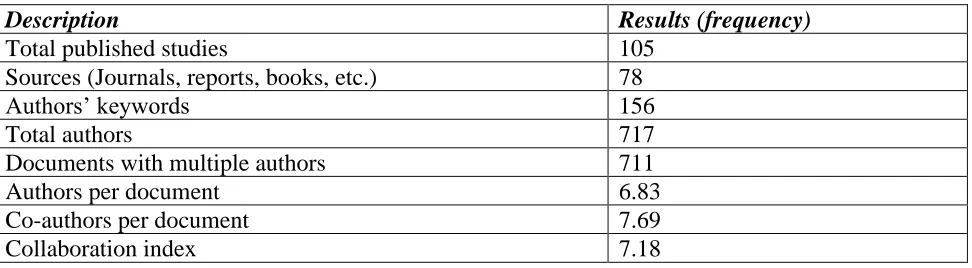
A total of 105 articles were identified that met the criteria for this study. The summary of the
bibliometric findings (Table 2) shows that these articles were published in 78 sources, and they
had a total of 156 keywords. These documents were authored by 717 authors, whereas most of
the articles had multiple authors (n = 711) with about seven authors per document and a
collaboration index of 7.18.
Table 1: Summary of the bibliometric findings
Description Results (frequency)
Total published studies 105
Sources (Journals, reports, books, etc.) 78
Authors’ keywords 156
Total authors 717
Documents with multiple authors 711
Authors per document 6.83
Co-authors per document 7.69
5
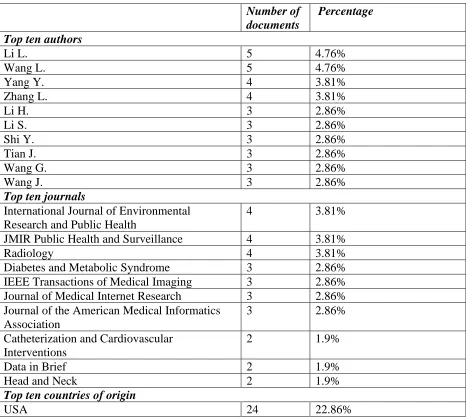
Further, the top ten authors, journals, and countries of primary affiliations were identified (Table
3). Among the top ten authors, Li L and Wang L had the highest number of publications (n = 5
for each author) followed by Yang Y and Zhang L (n = 4 for each author). Moreover, the
International Journal of Environmental Research and Public Health, JMIR Public Health and
Surveillance, and Radiology journals published the highest (n = 4 for each journal) number of
articles on AI and COVID-19. Furthermore, among the countries with highest scientific
production on AI application in COVID-19 research, the USA had highest number of articles (n
= 24) followed by China (n = 23), Italy (n = 8), Canada (n = 8), and India (n = 7).
Table 2: Top authors, journals, and originating countries
Number of documents
Percentage
Top ten authors
Li L. 5 4.76%
Wang L. 5 4.76%
Yang Y. 4 3.81%
Zhang L. 4 3.81%
Li H. 3 2.86%
Li S. 3 2.86%
Shi Y. 3 2.86%
Tian J. 3 2.86%
Wang G. 3 2.86%
Wang J. 3 2.86%
Top ten journals
International Journal of Environmental Research and Public Health
4 3.81%
JMIR Public Health and Surveillance 4 3.81%
Radiology 4 3.81%
Diabetes and Metabolic Syndrome 3 2.86%
IEEE Transactions of Medical Imaging 3 2.86%
Journal of Medical Internet Research 3 2.86%
Journal of the American Medical Informatics Association
3 2.86%
Catheterization and Cardiovascular Interventions
2 1.9%
Data in Brief 2 1.9%
Head and Neck 2 1.9%
Top ten countries of origin
6
China 23 21.9%
Italy 8 7.62%
Canada 8 7.62%
India 7 6.67%
Germany 4 3.81%
Netherlands 3 2.86%
UK 3 2.86%
Republic of Korea 2 1.9%
Turkey 2 1.9%
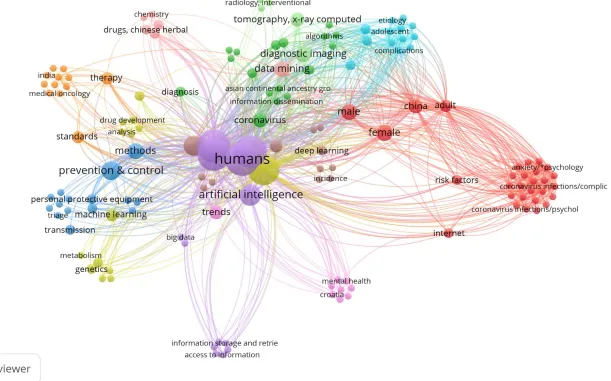
In the keyword analysis, several thematic areas of COVID-19 research were identified (Figure
1). While keywords related to coronavirus and AI appeared in the center of the word cloud,
different sub-domains are found to be clustered around these topics. First, a cluster on the
prevention and control of COVID-19 had several co-occurring keywords that included personal
protective equipment and disease transmission-related keywords. These keywords represented
several studies that reported the use of AI for the prevention and control of COVID-19 in clinical
settings. For example, Zheng and colleagues proposed an improved susceptible-infected (ISI)
model to estimate the variety of the infection that used the natural language processing (NLP)
module and the long short-term memory (LSTM) network for predicting COVID-19 infection
and prevention [21]. Second, a cluster of keywords related to diagnostics included tomography,
x-ray, and diagnostic imaging. For example, Wang and colleagues described a fully automatic
deep learning system for COVID-19 diagnostics by analyzing routinely used radiological data
7
8
Third, keywords related to the epidemiology of COVID-19 including etiological terms, age
groups, ethnicity, and disease complications, created a cluster that highlighted the use of AI for
etiological classifications among study samples. A study by Bai and colleagues assessed AI
augmentation in radiological evaluation of the etiology of COVID-19 [23]. This study found a
test accuracy of 96% (95% confidence interval [CI]: 90-98%), sensitivity of 95% (95% CI:
83-100%) and specificity of 96% (95% CI: 88-99%) with Receiver Operating Characteristic (ROC)
AUC of 0.95 and Precision-Recall (PR) AUC of 0.90. Fourth, therapy-related keywords formed
two closely appearing clusters that included drug development, drug therapy, alternative drugs,
and therapy for complications. For example, Gurwitz discussed the use of data mining for
repurposing drugs for providing care to COVID-19 patients through analyzing electronic health
records data [24]. Fifth, several keywords related to anxiety and other psychological issues
developed a cluster highlighting a growing use of AI in coronavirus-related psychological
research. For example, Li and colleagues analyzed social media (Weibo) posts from 17,865 users
using the approach of Online Ecological Recognition (OER) based on several machine-learning
predictive models for studying psychological impacts of COVID-19 [25]. Lastly, smaller clusters
of less-commonly appearing keywords highlighted research domains that included
evidence-based medicine, access to information, disasters, genetics, metabolism, and different areas of
data sciences [26–28].
Discussion
This study assessed the bibliometric characteristics of the current scholarly literature on the
application of AI in COVID-19 research. Despite a considerable expansion of COVID-19
publications, the number of articles on AI in this domain appears to be low, necessitating further
research leveraging AI technologies in this pandemic. Moreover, a major proportion of the
available literature originated from the US and China, whereas studies from South America,
Australia, and Africa were considerably low. This can be attributable to the variations in the
number of cases, research priorities, and institutional capacities of respective countries [20,29].
This informs a need for strengthening AI-related research in under-representing countries that are
currently having a high burden of COVID-19 and have inadequate resources for research.
9
community has been leading the use of AI in COVID-19 research, which may inform future
researchers and journals to explore opportunities to make meaningful contributions through
scholarly communications in this field. Another important finding of this study is the research
domains consisting of frequently co-occurring keywords, which highlights how AI is being used
in preventive, diagnostic, psychological, and epidemiological research in COVID-19. However,
the keywords mapping also inform research gaps such as a lack of keywords on vaccine-related
research, social aspects of COVID-19, and health systems [20]. These under-reported research
domains should be explored in future applications of AI in COVID-19 research.
There are several bibliometric studies on COVID-19 publications [18–20]. To the best of our
knowledge, this is the first one to evaluate the contemporary COVID-19 literature than
emphasized on the applications of AI technologies. In recent years, scholars and practitioners are
increasingly using AI in health sciences research that is facilitating the use of advanced analytics
to better understand different aspects of human health and wellbeing [11,13]. However, the
number of articles and limited research domains within the same suggests that the application of
AI in COVID-19 research is a developing area in the global research landscape. This study
provides bibliometric evidence on the early-stage of research in this field and calls for further
research using AI exploring diverse research domains that may help policymakers and
practitioners to make informed decisions during this pandemic. Also, ethical concerns, as well as
safety and security of using patient data, are critical concerns in data sciences [30,31].
Prospective research using AI should acknowledge such issues addressing socio-legal issues that
may arise in using COVID-19 data.
Another perspective on using AI in health sciences is promoting equity since the beginning of
the AI-related research. Contemporary scholarly discourses highlight the fact that the use of AI
does not consider potential pitfalls that may underestimate health disparities in marginalized
populations or underrepresented groups [32,33]. Moreover, specific population groups may have
unique health risks amid this pandemic, which includes older adults and people with co-morbid
conditions [34–37]. In this regard, the use of AI should be leveraged to proactively identify
complex health needs that may arise during this pandemic and address the same. As AI-related
research in COVID-19 is still under development, we call for intellectual and professional
10
in addressing health disparities. Furthermore, current scholarly contributions of AI do not
provide much insights on how such technologies are used for public health surveillance, mass
communication, or applied public health practice. It is necessary to facilitate such applied
research on AI to strengthen measures addressing public health challenges during this pandemic.
The findings of this study also inform a critical lack of diversity in research domains and
contexts, highlighting the need for global collaborations for multidisciplinary research. Such
collaborations may bring the technical competencies of multiple knowledge domains from
different contexts complementing knowledge exploration and synthesis in COVID-19 [20,30].
There are a few limitations of this bibliometric study that should be acknowledged. One such
limitation is the selection of the MEDLINE database for this study. Although it is the most
extensive database in the health sciences, it may not cover a complete collection of COVID-19
research. Therefore, the inclusion of other databases, especially a growing body of preprints
available in the Google Scholar database, could have provided additional insights that are not
available in our study. Another limitation of this study is a lack of citations and collaborations
networks, which could not be developed due to a low number of studies and continuously
changing citations metrics. Future bibliometric studies should address these limitations and
examine how the use of AI in COVID-19 evolves over time.
Conclusions
COVID-19 pandemic has become a global health concern affecting health and wellbeing across
populations. For effective decision-making, the scholars, practitioners, and policymakers need
evidence on the etiology, clinical features, diagnosis, prognosis, health outcomes, and potential
impacts of this pandemic on societies and systems. AI offers a wide range of opportunities to use
the emerging data on COVID-19 and yield meaningful insights that may help the key
decision-makers amid this pandemic. Given the current state of scholarly development, the application of
AI in COVID-19 research is still low and focused on fewer research domains, which necessitates
further research on how different AI technologies can be used to leverage computational
advantages in addressing uncertainties regarding this pandemic. It is essential to prioritize
applications of AI to facilitate research-driven decision-making and ensure global advancements
11
Funding: None.
Author contributions: MMH and SAS conceptualized this study. MMS and ELJM designed the
methodology. MMH and SAS retrieved and reviewed the literature. MMH and PM analyzed the
data. MMH prepared the first draft of the manuscript. SAS, ELJM, and PM reviewed and edited
the first draft. All authors reviewed and approved the submitted version of the manuscript.
12
Reference
[1] World Health Organization. Coronavirus Disease (COVID-19) Situation Reports 2020. https://www.who.int/emergencies/diseases/novel-coronavirus-2019/situation-reports/ (accessed June 11, 2020).
[2] World Health Organization. Coronavirus (COVID-19) events as they happen 2020.
https://www.who.int/emergencies/diseases/novel-coronavirus-2019/events-as-they-happen (accessed June 11, 2020).
[3] Shamasunder S, Holmes SM, Goronga T, Carrasco H, Katz E, Frankfurter R, et al.
COVID-19 reveals weak health systems by design: Why we must re-make global health in this historic moment. Glob Public Health 2020:1–7.
https://doi.org/10.1080/17441692.2020.1760915.
[4] Abeler J, Bäcker M, Buermeyer U, Zillessen H. Covid-19 contact tracing and data protection can go together. JMIR MHealth UHealth 2020;8.
https://doi.org/10.2196/19359.
[5] Moore JH, Barnett I, Boland MR, Chen Y, Demiris G, Gonzalez-Hernandez G, et al. Ideas for how informaticians can get involved with COVID-19 research. BioData Min
2020;13:3. https://doi.org/10.1186/s13040-020-00213-y.
[6] Mahmood S, Hasan K, Colder Carras M, Labrique A. Global Preparedness Against COVID-19: We Must Leverage the Power of Digital Health. JMIR Public Heal Surveill 2020;6:e18980. https://doi.org/10.2196/18980.
[7] Jiang F, Jiang Y, Zhi H, Dong Y, Li H, Ma S, et al. Artificial intelligence in healthcare: Past, present and future. Stroke Vasc Neurol 2017;2:230–43. https://doi.org/10.1136/svn-2017-000101.
[8] Fellous JM, Sapiro G, Rossi A, Mayberg H, Ferrante M. Explainable Artificial
Intelligence for Neuroscience: Behavioral Neurostimulation. Front Neurosci 2019;13. https://doi.org/10.3389/fnins.2019.01346.
[9] Tran B, Vu G, Ha G, Vuong Q-H, Ho M-T, Vuong T-T, et al. Global Evolution of Research in Artificial Intelligence in Health and Medicine: A Bibliometric Study. J Clin Med 2019;8:360. https://doi.org/10.3390/jcm8030360.
[10] Deo RC. Machine learning in medicine. Circulation 2015;132:1920–30. https://doi.org/10.1161/CIRCULATIONAHA.115.001593.
[11] Islam MM, Poly TN, Walther BA, Yang HC, Li Y-C (Jack). Artificial Intelligence in Ophthalmology: A Meta-Analysis of Deep Learning Models for Retinal Vessels Segmentation. J Clin Med 2020;9:1018. https://doi.org/10.3390/jcm9041018.
[12] Moon SJ, Hwang J, Kana R, Torous J, Kim JW. Accuracy of machine learning algorithms for the diagnosis of autism spectrum disorder: Systematic review and meta-analysis of brain magnetic resonance imaging studies. J Med Internet Res 2019;21.
https://doi.org/10.2196/14108.
machine-learning-13
assisted detection for anterior cruciate ligament injury based on magnetic resonance imaging: Protocol for a systematic review and meta-analysis. Med (United States) 2019;98. https://doi.org/10.1097/MD.0000000000018324.
[14] Wynants L, Van Calster B, Bonten MMJ, Collins GS, Debray TPA, De Vos M, et al. Prediction models for diagnosis and prognosis of covid-19 infection: Systematic review and critical appraisal. BMJ 2020;369. https://doi.org/10.1136/bmj.m1328.
[15] Hossain MM. Umbrella Review as an Emerging Approach of Evidence Synthesis in Health Sciences: A Bibliometric Analysis. SSRN Electron J 2020.
https://doi.org/10.2139/ssrn.3551055.
[16] Tran BX, McIntyre RS, Latkin CA, Phan HT, Vu GT, Nguyen HLT, et al. The current research landscape on the artificial intelligence application in the management of depressive disorders: A bibliometric analysis. Int J Environ Res Public Health 2019;16. https://doi.org/10.3390/ijerph16122150.
[17] Chen X, Chen J, Cheng G, Gong T. Topics and trends in artificial intelligence assisted human brain research. PLoS One 2020;15. https://doi.org/10.1371/journal.pone.0231192.
[18] Chahrour M, Assi S, Bejjani M, Nasrallah AA, Salhab H, Fares MY, et al. A Bibliometric Analysis of COVID-19 Research Activity: A Call for Increased Output. Cureus 2020;12. https://doi.org/10.7759/cureus.7357.
[19] Kambhampati SBS, Vaishya R, Vaish A. Unprecedented surge in publications related to COVID-19 in the first three months of pandemic: A bibliometric analytic report. J Clin Orthop Trauma 2020;11:S304. https://doi.org/10.1016/j.jcot.2020.04.030.
[20] Hossain MM. Current status of global research on novel coronavirus disease (COVID-19): a bibliometric analysis and knowledge mapping. F1000Research 2020;9:374.
https://doi.org/10.12688/f1000research.23690.1.
[21] Zheng N, Du S, Wang J, Zhang H, Cui W, Kang Z, et al. Predicting COVID-19 in China Using Hybrid AI Model. IEEE Trans Cybern 2020.
https://doi.org/10.1109/TCYB.2020.2990162.
[22] Wang S, Zha Y, Li W, Wu Q, Li X, Niu M, et al. A Fully Automatic Deep Learning System for COVID-19 Diagnostic and Prognostic Analysis. Eur Respir J 2020. https://doi.org/10.1183/13993003.00775-2020.
[23] Bai HX, Wang R, Xiong Z, Hsieh B, Chang K, Halsey K, et al. AI Augmentation of Radiologist Performance in Distinguishing COVID-19 from Pneumonia of Other Etiology on Chest CT. Radiology 2020:201491.
https://doi.org/10.1148/radiol.2020201491.
[24] Gurwitz D. Repurposing current therapeutics for treating COVID-19: A vital role of prescription records data mining. Drug Dev Res 2020. https://doi.org/10.1002/ddr.21689.
14
[26] Rada G, Verdugo-Paiva F, Ávila C, Morel-Marambio M, Bravo-Jeria R, Pesce F, et al. Evidence synthesis relevant to COVID-19: a protocol for multiple systematic reviews and overviews of systematic reviews. Medwave 2020;20:e7868.
https://doi.org/10.5867/medwave.2020.03.7867.
[27] Randhawa GS, Soltysiak MPM, El Roz H, de Souza CPE, Hill KA, Kari L. Machine learning using intrinsic genomic signatures for rapid classification of novel pathogens: COVID-19 case study. PLoS One 2020;15:e0232391.
https://doi.org/10.1371/journal.pone.0232391.
[28] Tárnok A. Machine Learning, COVID-19 (2019-nCoV), and multi-OMICS. Cytometry A 2020;97:215–6. https://doi.org/10.1002/cyto.a.23990.
[29] Hossain MM, Sultana A, Tasnim S, Fan Q, Ma P, McKyer ELJ, et al. Prevalence of mental disorders among people who are homeless: An umbrella review. Int J Soc Psychiatry 2020:002076402092468. https://doi.org/10.1177/0020764020924689.
[30] Hossain MM, Sharma R, Sultana A, Tasnim S, Faizah F. Globalising artificial intelligence for improved clinical practice. Indian J Med Ethics 2019:01–2.
https://doi.org/10.20529/ijme.2019.074.
[31] Hossain MM, Hong YA. Trends and characteristics of protected health information breaches in the United States. AMIA . Annu Symp Proceedings AMIA Symp 2019;2019:1081–90.
[32] Gianfrancesco MA, Tamang S, Yazdany J, Schmajuk G. Potential Biases in Machine Learning Algorithms Using Electronic Health Record Data. JAMA Intern Med 2018;178:1544–7. https://doi.org/10.1001/jamainternmed.2018.3763.
[33] Parikh RB, Teeple S, Navathe AS. Addressing Bias in Artificial Intelligence in Health Care. JAMA - J Am Med Assoc 2019;322:2377–8.
https://doi.org/10.1001/jama.2019.18058.
[34] Hossain MM, Mazumder H, Tasnim S, Nuzhath T, Sultana A. Geriatric Health in
Bangladesh during COVID-19: Challenges and Recommendations. J Gerontol Soc Work 2020:1–4. https://doi.org/10.1080/01634372.2020.1772932.
[35] Mazumder H, Hossain MM, Das A. Geriatric Care during Public Health Emergencies: Lessons Learned from Novel Corona Virus Disease (COVID-19) Pandemic. J Gerontol Soc Work 2020. https://doi.org/10.1080/01634372.2020.1746723.
[36] Raifman MA, Raifman JR. Disparities in the Population at Risk of Severe Illness From COVID-19 by Race/Ethnicity and Income. Am J Prev Med 2020.
https://doi.org/10.1016/j.amepre.2020.04.003.
[37] Hossain MM, Tasnim S, Sultana A, Faizah F, Mazumder H, Zou L, et al. Epidemiology of mental health problems in COVID-19: a review. PsyArXiv 2020.