1 Article
1
A Survey on Infrastructure of Vehicles-To-Grid: A
2
State-Of-Art Challenges and Solutions
3
Tohid Harighi 1, Ramazan Bayindir 1, Sanjeevikumar Padmanaban 2, Lucian Mihet-Popa 3, Eklas
4
Hossain 4
5
1 Department of Electrical and Electronics Engineering, Gazi University, Istanbul 06700, Turkey;
6
[email protected]; [email protected]
7
2 Department of Energy Technology, Aalborg University, Esbjerg 6700, Denmark; [email protected]
8
3 Faculty of Engineering, Østfold University College, Kobberslagerstredet 5, 1671 Kråkeroy-Fredrikstad,
9
Norway
10
4 Oregon Tech, Department of Electrical Engineering & Renewable Energy, OR-97601, USA;
11
12
* Correspondence: [email protected] (S.P.); Tel.:+45- [email protected] (L.M.-P.); Tel.: +47-922-713-53
13
14
15
Abstract: The increase in the emission of greenhouse gases (GHG) is one of the most important
16
world problems. Decreasing of GHG emission is a big challenge in the future. Transportation
17
sector uses a significant part of petroleum production in the world and it leads to an increase in
18
the emission of GHG. The result of this issue is that population of the world befoul environment
19
of transportation system automatically. Electric Vehicles (EV) have a potentiality to solve a big
20
part of the GHG emission and energy efficiency issues such as stability and reality of energy. The
21
energy actors and their research team determine some targets for 2050; hence, they hope to
22
decrease the world temperature to 6°C in the best and 2°C in the normal condition. Fulfillment of
23
these scenarios needs suitable grid infrastructure, but in most of the countries, the grid does not
24
have a suitable background to apply those scenarios. In this paper, some problems about energy
25
scenarios, energy storage systems, grid infrastructure and communication systems in supply and
26
demand side of the grid and its solutions have been investigated.
27
Keywords: Vehicle to grid, grid to vehicle, electric vehicles, batteries, harmonic distortion, IEEE
28
bus standards
29
30
1. Introduction
31
The world population is growing rapidly so as an outcome greenhouse gas (GHG) emission
32
and energy consumption increases year by year. There is not a traditional fuel for transportation
33
systems at hand which is both clear and efficient (mostly fossil fuels), while in other hand electric
34
fleet systems can work with lower GHG emission and energy loss. Therefore, exchanging fuels
35
seems the best idea to get the best result here. To make this happen at first step, the electric grids,
36
which are used, must be smart (Mostly done in North America, Europe and pacific Asia) [1].
37
Electric Vehicle (EV) is one of the electric transportation technologies; therefore, EV and Smart Grid
38
has been integrated to execute our plan. EVs should connect to the smart grid in the form of
39
(vehicle to grid) V2G or (grid to vehicle) G2V. In V2G technology, EV and grid share energy from
40
vehicle to grid and inverse in G2V. Hence, it could be said that EVs are the subdivision of electric
41
fleet systems and grids. The result of this integration is to have critical specific features such as
42
having high storage and low GHG emission. According to the factors, the entire energy arena actors
43
have developed energy strategies. They have changed transportation system to electric fleet system
44
to meet the targets made by IEA 2030 and 2050. The Paris agreement (UNFCCC, 2015a) contributed
45
to decrease GHG emission in the world, so this agreement declares that countries should come up
46
with plans to decrease global average temperature up to 2⁰C. IEA 2DS trajectory sets the goal,
47
2 which is reducing GHG emission from 33 GtCO2 approximately up to 15 GtCO2 in 2050, which is
48
roughly 45% of the CO2 emitted in 2013. Besides, in 6DS IEA trajectory GHG emission
49
approximately is 55 GtCO2. Some predictions of IEA and UNFCCC until 2030 and 2050 on EV plan
50
are as follows [1]:
51
• About 1 billion Electric Vehicle, demonstrate above 40% of total LDV stock, which is in
52
trajectory 2DS.
53
• More than 400 million electric 2-wheelers vehicle will be produced in 2030.
54
• All of the cars will have electric 2-wheelers by 2050.
55
• The EVI member are 16 governments today.
56
• Between 2014~2015, new enrolment of EV (BEV, PHEV) increased by 70% (more than 550K
57
sold in worldwide)
58
• Annual vent of 2015 in comparison to 2014 increased more than 75% in EVs in these
59
countries: France, Germany, Korea, Norway, Sweden, The UK and India.
60
• Cost of the PHEV batteries decreased from USD 1000/kWh in 2008 to USD 268/kWh in 2015
61
and the target of 2022 is USD 125/kWh.
62
• Density of the PHEV batteries increased from 60Wh/L in 2008 to 295Wh/L in 2015 and the
63
target of 2022 is 400Wh/L.
64
Some countries take actions to get IEA 2030 and 2050 targets. For example, Ireland created a
65
roadmap from 2011 to 2050. In this plan, 800K tons of oil and 4M CO2 emission will be reduced by
66
2050 per annum. [2] Considering mentioned materials, the grid supported by V2G can play a big
67
role on grid Stability, Reliability, Storage of the grid and reduction of GHG emission produced by
68
transportation system. In the other side of the energy sector, renewable energies such as wind and
69
solar are very important because they produce energy with zero GHG emission and the grids
70
supplied by both energy type are flexible than grids supplied by only fossil energy [3-5]. All type of
71
the renewable energy are available in special situations because they are not stable energy sources.
72
However, all of them can be constructed in every size and everywhere. V2G, smart grid and micro
73
grid are supplementary to each other and also can expand one another. All of the renewable energy
74
conversion procedures include AC to DC or inverse. DC type of energy supplies batteries and EVs
75
energy storage system plays a big role in grid when it needs energy exchange. EVs can save energy
76
when the demand side of the grid strongly decreases for example a decrease between 11PM to 5AM.
77
Hence, reducing energy level immediately in power plants (in every condition) is not economical.
78
Fossil ICE efficiency in the best condition and with last technology is 18%~20%. However, the fossil
79
power plant efficiency is 38%~40% and CHP energy efficiency is 60%~75% [6]. It clearly shows that
80
EVs benefits is not limited only in having zero GHG emission. Thus the EVs are supplied with
81
electric energy, which is generated by 38%~75% which it depends on energy generating condition.
82
[7-12].
83
This paper, covers discussions about the energy scenarios, storage systems and infrastructure
84
of the grid related to V2G technology. The scenarios, policies and targets of the governments and
85
agencies for the world with lower GHG emission and high-energy efficiency have been suggested.
86
They change the grid target and duty, but the collection of infrastructures cannot respond to the
87
requirements mentioned in scenarios. According to the scenarios (created for grid upgrades),
88
storage systems (such as batteries and chargers) and infrastructures of grid should be changed by
89
the latest technologies in each section.
90
2. Energy scenarios
91
Each energy plan has some scenarios. The energy efficiency and GHG emission are target of
92
the each energy scenarios in the world and scenarios about V2G technology depends on own
93
location, so everywhere have different requirements and energy stocks. The road maps created by
94
IEA give result of the general scenarios for 2050. Table 1 gives the number of EV and PHEV that
95
will be sold in 2050. It is clear that EVs have lower GHG emission than PHEV. According to 2050
96
road map, the North America, Europe and Pacific countries will have lower PHEV then China and
97
Table 1 Electric vehicle will be sold in 2050 by IEA scenario
3
Location EV PHEV
North America 8800K 3800K
Europe 6400K 3100K
China 9400K 11400K
India 8600K 9600K
Pacific 2400K 1300K
99
India. It means that their fossil energy consumption in transportation sector will be lower than
100
India and China.
101
For example, china’s government tries to reduce GHG emission more than other countries.
102
However, the mentioned countries update their grid from cyber security, smart and micro grid side
103
of the grid [13]. Energy efficiency is possible, if the mentioned parameters are used together. Today
104
energy providers give energy with different types of energy such as oil, Gas (LPG, CNG, and LNG)
105
or electric. Energy using method is very important and it must be observance in all part of the
106
energy consumption. Energy using percentages in some place could be as follows: electricity 30%,
107
heat 40%, and transport 30%. In addition, they can be supplied with renewable energy by CEESA
108
2050 scenario [14]. Control of the supply and demand is the primary parameter of the energy
109
quality, so reduction of the GHG emission and efficiency of energy is possible by assuming supply
110
and demand accurately [15-17]. Control of those, give facilitates of integrating renewable energy
111
network with grid and EVs, but it needs data from metrology, supply and demand of the grid,
112
infrastructure of grid and some additional mathematic method to provide great and predictable
113
data [18-20]. The V2G technology should be economical, so all of the mentioned items should have
114
reasonable relation between technical benefit and economic condition of investor. Performance of
115
the V2G technology depends on grid infrastructure and type of the electric vehicle storage system.
116
Quality and size of them influence performance grid directly [21-22]. Hence not all of them are
117
completely controllable but they are predictable. Predictable means that the management team can
118
modify demand time schedule [23-25]. According the scenario (can be different in each location),
119
the design of the grid have to developable, flexible and manageable more than grids used currently,
120
so grids after design will be created more complex and comprehensive. Scenarios of the grid have
121
some algorithms to use in normal and critic situation and all sections of the grid have connection
122
with another section of the grid that is very important to control of the grid and one of the grid
123
designing protocols [26-28].
124
3. Storage Systems in V2G Technology
125
3.1 Batteries use on the electric vehicles: Energy storage types are different in each situation. For
126
example, hydro power plant is used water pumping for saving energy. Type of the energy storage
127
categorized with the some environmental and advanced parameters, such as GDR or technical
128
aspects. Both of them most considered together [29-30]. The type depends on rating of power,
129
charge and discharge, density of power and energy, response time, efficiency, self-discharge and
130
lifetime. EVs battery most be solid and have mentioned parameters [31]. Today, four types of the
131
batteries are better to be used in Electric Vehicle such as Li-on, NiCd, NaS and ZnBr. However, the
132
specific of those are different in each material. Mentioned property of the EV batteries were given in
133
Table 2 [32]. Cost of the each type of battery are different, but technical side of this issue clearly
134
shows that the Li-on batteries are the best choice for EVs in every situation. Li-Ion batteries with
135
some alloy such as Fe, Mn give best performance. In latest measurements, the EVs can travel
136
between 250~350 miles with Li-on battery. Generally , and types of
137
batteries are used in the EVs. All of them are produced in anode and cathode type [29-32-33]. Table
138
3 illustrates the type of Li battery and its specifications.
4 Table 2 Type of Batteries and they specifications [32]
141
NiCd NaS ZnBr Li-ion
Power rating (MW) 0~40 0.05~8 0.05~2 0~0.1
Discharge time s~h s~h s~10h Min~h
Power density (W/I) 75~700 120~160 1~25 1300 ~ 10,000
Energy density (Wh/I) 15~8 15~300 65 200~400
Response time <S <S S <S
Efficiency (%) 60~80 70~85 65~75 65~75
Lifetime in year 5~20 10~15 5~10 5~100
Lifetime in cycle 1,500 ~ 3,000 2,500 ~ 4,500 1,000 ~ 3,650 600 ~ 1,200 Cost $ (kW) 500 ~ 1,500 1,000 ~ 3,000 700 ~ 2,500 1,200 ~ 4,000 Cost $ (kW/h) 800 ~ 1,500 300 ~ 500 150 ~ 1,000 600 ~ 2,500
142
Table 3 Some type of Li battery and specifications [33]
143
Type of Li-ion Practical energy density (Wh/kg) Cycle Life Safety
/ 110~190 500~1,00 Poor
/ 100~120 1,000 Safer
/ 90~115 >3,000 Very safe
/ 70~75 >4,000 Extremely safe
/ ~70 >4,000 Extremely safe
144
The batteries performance depends on alloy used on it, so to know the grade of the battery
145
quality, manufactures of EV or users of Li battery check the result of tests due on it. Current,
146
voltage, mechanical strike and temperature are important parameters to be considered on all tests
147
on the batteries, so these parameters are fluctuant during the day.
148
149
3.1.1 Mechanical strike influence: Mechanical strike is an unavoidable problem, when the EVs have
150
normal or abnormal condition. In normal condition, EV battery abuse mechanical strike from effect
151
of the road, but the EVs batteries have unreliable behaviour in case of an accident. Thus, it must be
152
pass some tests such as T4, FMVSS 305 tests or the battery should be confirm some standards such
153
as SAE j2464 [34-35]. The battery is strongly sensitive; when the SOC ratio is up to 80%. Figure 1
154
shows how much mechanical strike and thermal are important. All of them influence life and all
155
other aspects of the battery [36-40].
156
157
Figure 1 Effect of mechanical strike [41]
158
3.1.2 Temperature stability influence:
159
Temperature stability should be considered in all situations, so the battery have different behaviour
160
in each temperature. It does not work perfectly in overdue temperature such as -20⁰C or 120-130⁰C,
161
-5 0 5 10 15 20 25
%50 SOC %60 SOC %60 SOC %80 SOC
Load (Klb)
Voltage
5 in this situation the runaway threat is closer than normal condition. Hence, the EV battery must be
162
protected against the temperature (Battery heat and cool system) and mechanical strike issue.
163
164
3.1.3 Control on the storage systems:
165
Grid integration contribute grid to use power efficiency in each branch of the electric grid. Storage
166
system needs more control than other part of the grid, so the health of the storage systems is critical
167
and sensitive. Storage control system is not limited for grid storages, EVs battery are part of the grid
168
storage, hereby it can control all EVs storage and grid storage system, because EVs are short time
169
energy storage for the grid. Local governments achieve storage system without any payment. It is
170
one of the economic benefit of V2G technology for grid. Control system and EVs storage systems
171
make grid without shock when demand is strongly decrease or increase. If the infrastructure of the
172
grid response control of the V2G technology and some environmental condition. Control of the grid
173
need scenario, plan and data about the grid future, so the grid should be predict data depends on
174
old data, plan and scenarios [36-38-42-45].
175
176
3.1.4 Longevity of the EVs battery:
177
Lifetime of the Li-ion batteries is a complex issue and it depends on mentioned parameters such as
178
charge, discharge, thermal condition and some other parameters. Hence electric grid can assume
179
batteries life and capacity by controlling the grid fully [39-40-46-47]. EVs batteries are using in order
180
to AM and SM, however they have used in both side of the grid. This option gives economic
181
encourage and eventually cost of the electric power and energy system can change in each location
182
[48-55].
183
3.2 Charging Systems: Charging system in electric grid is a bidirectional system, which grid support
184
V2G technology. The charging system quality has a special point; it is almost determined as the
185
efficiency of V2G system. Figure 2 shows basic V2G technology procedure and clearly explains that
186
technology [56-57]. Charging system is almost covered the core of V2G. Charging systems are
187
changed in each grid, it
188
depends on infrastructure of the grid. Some charging systems support only DC or AC and both of
189
them. Therefore, the chargers produce considered infrastructure of the grid with various power
190
electronic parts. IEC 62196-2 TYPE 1, 2, hybrid, SAE J1772 TYPE 1, 2, Combo and CHAdeMO are
191
types of the charger connectors. All of the connectors work in some critical options. For example,
192
CHAdeMO only works in a DC system [58] Table 4 gives some charger connectors and type of the
193
charge model.
194
Table 4 EV charger connectors power type [35]
195
Type of port AC DC
IEC 62196-2 AC Type 1 : 120V AC Type
2 : 240V
* Hybrid version
SAE J1772 * Combo
version
CHAdeMO *
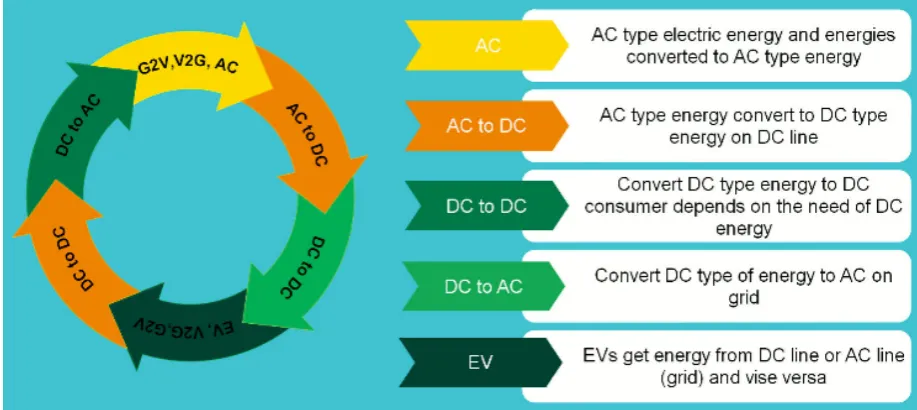
Base of the energies like power plant or renewable energy have to convert to DC type of
196
energy, if the grid has connection with storage network. While increasing number of DC convertors
197
ratio of the THD is automatically increase on grid. Creation of DC lines in infrastructure of the grid
198
is beneficial for grid which are used in smart grids and V2G technology, for example DC line is
199
improve charge stations performance in public places by solar energy or using wireless charging
200
system. Power electronic converters always change energy alongside loss of energy, especially
201
when it is change from DC to AC. Infrastructure of the electric grid and THD issues are critical
202
problems and Nowadays countries try to reduce both problems. Table 5 mentions that balance of
203
the energy is a big future challenge. Number of EVs, Chargers, Population, and space of the
204
location have a crucial role on the load spread balance. All of them are important for control and
6 modelling of the grid. Computing their data accuracy contributes to predict the future of the grid.
206
Nowadays, energy consumption should be efficient. Hence heating, cooling, transportation systems
207
are eager to use electric type of energy as much as possible. Solution of the grids modelling are
208
different in each location. Creating energy node in the urban and redistributing energy and DC
209
reserve line to supply DC base energy equipment are ways to reinforce the infrastructure of the grid.
210
Support of the infrastructure and EV induced in creating positive opinions in people’s minds.
211
People are looking all facilities of the V2G technology [59-67].
212
213
Table 3 Some numeric location data related of V2G technology
214
215
U.S China Japan U.K Netherland
EV (k) 404 312 126 49.67 87.53
Chargers (k) 28.15 46.65 16.12 8.716 17.78
Fast chargers (k) 3.524 12.1 5.99 1.158 0.465 Population (M) 324.6 1373.5 126.8 65.11 17.10
P. Per Square of KM 35 145 346 255 412
Area Square of KM 9,833,520 9,596,961 377,972 242,495 41,543
Figure 2 Procedure of V2G technology
7 3.2.1 Potentials to build charge station by renewable energies:
217
Creating a sensible effect on the people’s life is important. It is one of the effective factors. Charging
218
systems must be available on EV driver’s home or office. In fact, the charging system convert
219
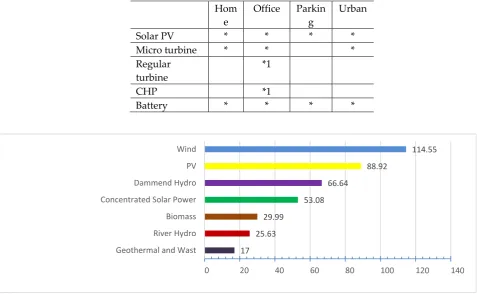
energy and transfer from EV or grid to storage system. Storage side of V2G technology (home,
220
office, parking and some public place) might be one of the VPP. VPPs can support grid and they
221
efficiency is in medium-high level, such as WPP, Solar energy, CHP. Renewable energies can
222
generate energy everywhere and every scales [68]. Table 5 shows VPP majority. It means that EVs
223
complete energy circle by V2G technology. In this circle EVs do transmission line and temporary
224
storage duty. If both home and office be equipped with VPP and V2G technology and personnel
225
EVs always could be connected to grid. All of them have some benefit to the energy sector they
226
were mentioned below:
227
• Low GHG emission in supply and demand side
228
• Reduction of the grid shock strongly
229
• Reduction of energy cost so helping home and office economy
230
• Reduction of fossil, coal and nuclear energy contribution
231
Table 4 VPP availability division by users
232
Hom e
Office Parkin g
Urban
Solar PV * * * *
Micro turbine * * *
Regular turbine
*1
CHP *1
Battery * * * *
Figure 3 South east Europe renewable electricity in the year 2050 [TW/H] [85]
233
*1: its availability depends on the condition.
234
Ratio of the mentioned benefits depend on metrology, cost of energy and supply/demand
235
profile and grid data in the location. Metrology is a power of the renewable energy, such as solar
236
and wind. Solar power is available until sun radiation exists. And wind energy is available until air
237
flow exists. After predicting renewable energy availability in the respective location, next step is to
238
compute efficiency and cost benefit to compare with the previous condition. However, sun and
239
wind probability are influenced with all calculation of the benefits [68-70]. Renewable energy
240
benefit, supply/demand on grid, storage capacity and cost of it must be computed to give clear view
241
of the energy efficiency. How much energy was transferred with EV? How much energy was saved
242
with EV and local storage system? How much GHG emission was decreased? In this situation, the
243
provider can get the ratio of energy usage by renewable energy and other sources of energy. In
244
17 25.63
29.99
53.08 66.64
88.92
114.55
8 addition, with the systems collectivity (V2G technology, Renewable energy and smart grid), reduce
245
fossil energy automatically in the grid, but its ratio decreases slowly. For example someone creates
246
an energy plan with 20%~80% wind energy in his/her own scenario [73-75]. VPPs generate energy
247
with a high efficiency. It means low GHG emission. In this situation EVs or departments receive a
248
tax discount from their own governments. At this point, they must prove their data to get a tax
249
discount. It needs operating with accurate calculation and a developable control system, otherwise
250
all the benefits and losses are indemonstrable and the data is under the haze. [76-77]. Some data has
251
transferred between V2G technology installed place and control center [78]:
252
253
• EVs battery status
254
• EVs location
255
• EVs supply/demand status
256
• EVs GHG emission
257
• Charge station status
258
• Grid supply/demand status
259
• Cost of energy on grid, EV, Homes or other energy producer and storage
260
Some projects related V2G are accomplished and all mentioned parameters are considered in
261
projects. For example Taiwan, U.S (Florida), Netherlands and China [79-82]. Priority of source to
262
supply charging center is local energy production. Electric Storage system and their charging
263
system in V2G technology and same technologies (which energy transfer between them is
264
bidirectional) are the important part of the grid, so the reason of having this technology is electric
265
storage systems, which have good energy responsibility. According to the mentioned advantages
266
and disadvantages, it seems that, the Lifepo4 type of li batteries is a best choice between various
267
types of the batteries.
268
4. Infrastructure
269
4.1. Strategy: Strategy of V2G technology works according to some plan and targets. Besides, the
270
targets are zero GHG emission and energy efficiency such as stability, reliability. Some parameters
271
cause changes in plan. Infrastructure, energy sources, budget and some other parameters in each
272
country are determined with the energy plan, which is necessary to develop V2G technology.
273
Energy sources and ability to generate renewable energy are determined with benefits and market
274
share of the V2G technology. Renewable energy developments, V2G technology and smart grid are
275
impelled alongside [83-84]. Figure 4 gives renewable electricity targets of South East Europe in the
276
year 2050.
277
278
4.1.1. Pricing of energy:
279
280
Energy sector pricing system is different from other sectors. Supply / demand and determining cost
281
of the energy by time and other grid priority give balance and discipline on all of the grid. However,
282
in the energy systems supply/demand balance is the second important factor. Balancing is a means
283
to distribute energy correctly in the electric grid. Density of population is not constant in each
284
location, but specification population is clear for governments. Hence Location and Density of
285
population, Time of supply/demand, measure of supply/demand and balancing of supply/demand
286
[87] influence the price of the energy. Location and Density of population determines grid demand
287
average in all electric grids. High population density mostly is located in down town of the cities or
288
capital of the country. In this condition density of the transmissions lines are increased, so ratio of
289
the loss energy is increased. For example, when energy demands are in high level and the energy
290
generation is low, the cost of energy in these locations is in the highest level [88-91]. The time of the
291
energy using is important, sometimes all customers of the grid use energy. In this condition electric
292
grid work with full capacity. It is not an acceptable situation. Hence, the electric supervisors are
293
encouraging people to use electric energy except for the demand peak time (18:00 – 22:00) [92, 89].
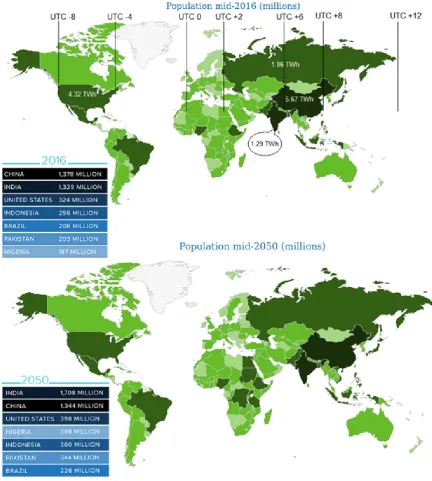
9
295
Figure 4 The world population from 2016 to 2050, some countries time zone and energy generation
296
difference
297
298
Figure 5 IEEE 33-BUS grid
10 Today everyone can generate energy in own house or office. It’s depend on environmental
300
condition. With the V2G technology, someone can transfer energy customer to customer and grid.
301
Generate energy contribute the grid and the supervise pay cache for energies are generated from
302
customers [93]. Supervisors have to balance energy on the grid, so unbalance grid can damage the
303
grid. They use some methods such as building switching centres to balance energy in the grid [94].
304
Figure 5 illustrates time zone difference, population and energy generation in some countries. It
305
clearly shows that the mentioned issues influence the electric grid directly. Social infrastructure in
306
the countries such as economy, psychology, appliance and cognitive science should be prepared to
307
use EVs. People of the world have to use EVs because fossil energies is going to extinct and people
308
who use fossil transportation system are increasing. In other hand type of energy, consumption
309
differs in each area depending on sunrise and set where some countries grid work synchronize. The
310
management group must organize it with considering local time and other local abilities [106-110].
311
V2G technology helps to reduce mentioned problems by EVs. Governments can create prefect
312
charging design, pricing and grid infrastructures control plan with the challenging mentioned
313
problems in background and future targets. One of the good control systems must be teste in
314
international sample electric grids and each part of the network must be tested in international
315
standards grid patent such as IEEE 33 Node, IEEE 34 Node and IEEE 300-Bus Network. Figure 5
316
shows an IEEE 33-bus grid system. Grid coordination under the mentioned standards gives wide
317
developing facility such as grid behaviour predict, charging, scheduling and risk management
[96-318
100].
319
320
4.1.2. Control system communications:
321
322
One of the control systems duty is online observation, so the EVs are mobile devices and they can
323
be on supply or demand side of the grid (charge/discharge). It gives some favourably strong points
324
from people. EVs users can see online exist charging centres and their status. In the online system,
325
all variable parameters change in each condition. It gives facility to provide fine pricing and
326
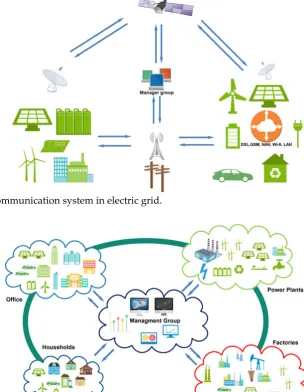
managing system. The control system communicates with WAN, HAN, NAN, SCADA, DSL, GSM,
327
SATELLITE, GPS. In fact, they have chain connection with other parts of the grid. They were
328
illustrated in Figure 6, it also depends on local and situation, for example use GSM, DSL and
329
Satellite connection way to connect some data centres with other part of the grid [101-105]. All of
330
them are available everywhere. Data of the EVs are sent to EVs controller operator to control all EVs
331
on each location but in some situations, the grid works in uncertain conditions and uncertain
332
condition gives different behaviour from the grid. Some methods contribute to calculating energy
333
cost in uncertain conditions such as ENTRUST algorithm.
334
335
4.2 Grid Modelling: Infrastructure of model the grid is a base of the V2G technology.
336
337
Mentioned topics are impelled in best efficiency and GHG emission targets. Thus, to reform in some
338
section of grid is too hard and needs to be investigated deeply. Fossil Power planets, Renewable
339
energies and V2G-G2V (subsets of Renewable Energies) are the inputs of grids. Today, the policy
340
and planning of the countries is to make grids supplied by renewable energy and it is subsets to
341
consume green and efficient energy. All energies injected to grid should manage, so all type of
342
energies have special specifics. For example, convertors of the renewable energies such as DC to AC
343
and reverse generate THD or energies on the storage system should be controlled in
344
supply/demand side. Electric distribution are the last node of the grid electrification. In this section,
345
grid supply all demands side of grid and Energy distribution condition depends on the location.
346
Grid modelling with V2G technology is same smart grid, so the gird in both systems work
347
unidirectional. The grid can supply with both type of AC and DC electric energy [111]. Most of the
348
electric devices work with AC type of electric power. In this situation energy, providers have to
349
provide AC type of energy and DC type of energy achieve from DC/AC convertors. Different types
350
of energies is one of the cause of the energy loss. Today to have one of the DC lines from source to
11 consumer is compulsory. In such a condition AC type of energy have THD problem. The DC type
352
of energy can response wide customer of the grid. Different chargers, different convertors, different
353
sources is sample of the energy type problems. AC and DC customers are also connected and
354
energy exchange will have loss energy and increase THD but DC line have some critic advantage
355
such as
356
Figure 6 Communication system in electric grid.
357
358
Figure 6 All grid energies connect to other sources and customer
359
360
reducing energy loss, response local renewable energy source and the other sources which works
361
with DC type of energy that can work hybrid. For example, Egypt and India tested the DC line in
362
some projects [112-121]
363
364
4.2.1 Frequency control: Electric power frequency is one of the most important parameters in the grid.
365
The grid frequency is not controllable when supply and demand is not balanced; usually demand
366
side of the grid overcomes the supply. In V2G, technology charge and discharge influence the grid
367
frequency, especially in charge condition. EVs have batteries with large capacity and quantity of the
368
EVs is high which means overall energy exchange is homogenized but it is not true in all time. All
369
of that have negative effect on the grid frequency. Hence, solution of the frequency issue is control
370
all parameters and equipment of the grid and demands such as (quantity of the EV’s active or EV’s
12 energy capacity). Power systems must be controlled with special control nodes depending on area,
372
demand and sources [122-126].
373
4.2.3 System Integration: One of the smart and unidirectional power system must be integrated
374
system. So all parts of it should be connected and work synchronize. Process of the integration need
375
to make capacity and limit some factors depending on the grid design. Each part of the materials
376
mentioned in this paper play big role on the power system integration. Why the power system
377
integration is important?. Because V2G technology upset of the power system and V2G work
378
correctly when supply/demand condition is fine. For example, status of the charging station, battery
379
status of the EVs and grid supply/demand power are some aspects of V2G technology related to
380
power system integration. Figure 6 gives the facts clearly. The Power system is integrated to give
381
low energy loss, high efficiency so with this technology gap of the supply/demand is reduce and
382
power of the control system is increased. For example home or office interference to generate
383
energy by some local renewable energy sources [74-127-131]. The power system infrastructure
384
should be designed according to some parameters such as accessibility, reliability and being able to
385
be developed. Result of this action is that the grid can be updated with some technologies such as
386
V2G and the subset technologies. Grid should support the energy traffic, which is achieved by
387
newer technologies such as V2G or energy storage systems. The grid designers must care about
388
communication between grid and people. Therefore, in emergency situations, the grid management
389
group may increase and decrease supply/demand by people. It is only a recommendation which
390
would work by grid infrastructure.
391
5. Conclusion
392
In the infrastructure of the world electric grid, some revisions have been done. However, all
393
energy scenarios after increasing GHG emission in the world have changed according to some
394
agreements and conferences such as UNFCCC 2015a in Paris. The infrastructure of each system
395
should be changed when the enrolment scenarios change. Ratio of revisions depends on old
396
infrastructure conditions and future targets, which are mentioned in context. Storage systems is one
397
of the sensitive parts of latest grid models such as micro and smart grids but their development
398
does not satisfy and response the grid requirements. Hence, the batteries need to be more
399
developed to comply more charge/life cycle and more safety. In the other side of the storage
400
systems, charger of the batteries almost generate THD in the grid and THD is a disadvantage for
401
charge systems. At a glance, all mentioned problems force infrastructure of the grid to work
402
without good quality. Today, after the development of the lithium type of batteries and power
403
electronic systems, the researchers who are working on V2G technologies can take some actions
404
easily so the new battery and power electronic systems provide fast charging, high life and charge
405
cycle with lowest THD influence in supply and demand side of the grid. With those benefits, the
406
grid can work properly so lack of energy and temperate storage are solved. The life/charge cycle,
407
energy density and safety problems are solved with some polymer type of the lithium batteries.
408
THD of charge equipment can be improved with DC line, so in this technology most of the chargers
409
with heavy THD generation eliminate. Problems of infrastructure of the grid can be detected
410
quickly with synchronized communication system. The V2G technology received a big acceptance
411
from people but it need great market share to develop this technology. Psychology of the people is
412
important, so people must have satisfaction and great view from EV. Hence, officials have to
413
achieve people’s acceptance and create encouragement plan. For example, the tax of EV is zero in
414
some country or explain the benefits of the V2G technology by Li batteries, mobile energy station
415
and ultra-capacitor.
416
417
Author Contributions: The authors participated evenly in framing the research survey and execute
418
the task with writing this manuscript in current full research article format.
419
420
Conflicts of Interest: The authors declare no conflict of interest.
13 References
422
423
[1] IEA, "GLOBAL EV OUTLOOK," 2016. [Online]. Available:
424
https://www.iea.org/publications/freepublications/publication/Global_EV_Outlook_2016.pdf.
425
[2] SEAI, "http://www.seai.ie," SEAI, [Online]. Available:
426
http://www.seai.ie/Publications/Statistics_Publications/SEAI_2050_Energy_Roadmaps/Electri
427
c_Vehicle_Roadmap.pdf.
428
[3] Sarkar and Reuben, "The Transforming Mobility Ecosystem: Enabling an Energy-Efficient
429
Future," U.S Department of Energy, 2016.
430
[4] a. Energinet.dk’s, "Energy scenarios for 2030," energinet.dk, 2016.
431
[5] M. Baumhefner, R. Hwang and P. Bull, "How Utilities Can Accelerate the Market for Electric
432
Vehicles," NRDC, 2016.
433
[6] [Online]. Available: https://energy.gov/eere/amo/combined-heat-and-power-basics.
434
[7] Y. Shirazi, E. Carr and L. Knapp, "A cost-benefit analysis of alternatively fueled buses with
435
special considerations for V2G technology," Energy Policy, vol. 87, no. Energy, pp. 591-603,
436
2015.
437
[8] B. Hoang, "Plug-In Hybrid Electric Vehicles (PHEVs)," IEEE Emerging Technology portal, no.
438
PHEV, p. 3, 2006-2012.
439
[9] "Environmental Assessment of Plug-In," Electric Power Research Institute, no. Electric
440
Vehicle, pp. 1-56, 2007.
441
[10] S. Heinen, D. Elzinga, S.-K. Kim and Y. Ikeda,
442
"https://www.iea.org/publications/freepublications/publication/smart_grid_peak_load.pdf,"
443
August 2011. [Online]. Available: www.IEA.org.
444
[11] P. J. O. Lewis, "seai.org," 2011. [Online]. Available:
445
https://www.iea.org/publications/freepublications/publication/smartgrids_roadmap.pdf.
446
[12] L. M. F. (. Davis), A. Seleem, F. Boshell and A. S. a. D. Saygin, "ELECTRIC VEHICLES,"
447
International Renewable Energy Agency, 2017.
448
[13] m. l. tuballa and m. l. abundo, "A REVIEW OF THE DEVELOPMENT OF SMART GRID
449
TECHNOLOGIES," RENEWABLE AND SUSTAINABLE ENERGY REVIEWS, vol. 59, no.
450
SMART GRID, pp. 710-725, 2016.
451
[14] B. Mathiesen, H. Lund, D. Connolly, H. Wenzel, P. Østergaard, B. Möller, S. Nielsen, I. Ridjan,
452
P. Karnøe, K. Sperling and F. Hvelplun, "Smart Energy Systems for coherent 100% renewable
453
energy and transport solutions," Applied Energy, vol. 145, no. renewable energy, pp. 139-154,
454
2015.
455
[15] h. farzane, C. N. Doll and J. A. P. d. Oliveira, "An integrated supply-demand model for the
456
optimization of energy," Journal of Cleaner Production, vol. 114, no. energy, pp. 268-285, 2016.
457
[16] M. Sonnenschein, O. Lünsdorf, J. Bremer and M. Tröschel, "Decentralized control of units in
458
smart grids for the support of renewable energy supply," Environmental Impact Assessment
459
Review, vol. 52, no. energy, pp. 40-52, 2015.
460
[17] J. Brady and MargaretO’Mahony, "Modelling charging profiles of electric vehicles based on
461
real-world electric vehicle charging data," Sustainable Cities and Society, vol. 26, no. energy,
462
pp. 203-216, 2016.
463
[18] A. Schuller, C. M. Flath and S. Gottwalt, "Quantifying load flexibility of electric vehicles for
464
renewable energy," Applied Energy, vol. 151, no. energy, pp. 335-344, 2015.
465
[19] P. Prebeg, G. Gasparovic, G. Krajacic and N. Duic, "Long-term energy planning of Croatian
466
power system using multi-objective optimization with focus on renewable energy and
467
integration of electric vehicles," Aplied Energy, vol. 184, no. energy, pp. 1493-1507, 2016.
468
[20] G. d. A.Dantas, N. J. d. Castro, R. Brandão, R. Rosental and A. Lafranque, "Prospects for the
469
Brazilian electricity sector in the 2030s: Scenarios and guidelines for its transformation,"
470
Renewable and Sustainable Energy Reviews, vol. 68, no. Energy, pp. 997-1007, 2017.
471
[21] D. RickShang and g. Sun, "Electricity-price arbitrage with plug-in hybrid electric vehicle :
472
gain or loss?," energy policy, vol. 95, no. energy, pp. 402-410, 2016.
14 [22] T. Kaschub, P. Jochem and w. Fichtner, "Solar energy storage in germany households:
474
profitability, load changes and flexibility," Energy Policy, vol. 98, no. energy, pp. 520-532,
475
2016.
476
[23] A. Arif, M. Babar, T. I. Ahamed, E. Al-Ammara, P. Nguyen, I. R. Kamphuis and N. Malik,
477
"Online scheduling of plug-in vehicle in dynamic pricing schemes," Sustainable Enegy, Grid
478
and Networks, vol. 7, no. energy, pp. 25-36, 2016.
479
[24] J. Soares, M. FotouhiGhazvini, N. Borges and Z. Vale, "A stochastic model for energy
480
resources management considering demand response in smart grids," Electric Power Systems
481
Research, vol. 143, no. energy, pp. 599-610, 2017.
482
[25] L. Noel and BenjaminK.Sovacool, "Why Did Better PlaceFail?: Rangeanxiety, interpretive
483
flexibility, and electric vehicle promotion in Denmarkand Israel," Energy Policy, vol. 94, no.
484
energy, pp. 377-386, 2016.
485
[26] J. C. Mukherjee, S. Shukla and A. Gupta, "Mobility aware scheduling for imbalance reduction
486
through charging coordination of electric vehicles in smart grid," Pervasive and Mobile
487
Computing, vol. 21, no. Energy, pp. 104-118, 2015.
488
[27] E. Niesten and F. Alkemade, "How is value created and captured in smart grids? A review of
489
the literature and ananalysis of pilot projects," Renewable and Sustainable Energy Reviews,
490
vol. 53, no. Energy, pp. 629-638, 2016.
491
[28] T. Sousaa, T. Soares, H. Morais and Z. V. Rui Castro, "Simulated annealing to handle energy
492
and ancillary services joint management considering electric vehicles," Electric Power
493
Systems Research, vol. 136, no. Energy, pp. 383-397, 2016.
494
[29] B. Li, J. Shen, X. Wang and C. Jiang, "From controllabe loads to generalized demand-side
495
resources: A review on developments of demand-side resources," Renewable and Sustainable
496
Energy Reviews, vol. 53, no. energy, pp. 936-944, 2016.
497
[30] T. Ayodele and A. Ogunjuyigbe, "Mitigation of wind power intermittency: Storage
498
technology approach," Renewable and Sustainable Energy Reviews, vol. 44, no. energy, pp.
499
447-456, 2015.
500
[31] J. Lee and g.-L. Park, "Dual battery managment for renewable energy integration in EV
501
charging station," Neurocomputing, vol. 148, no. Energy, pp. 181-186, 2015.
502
[32] H. Zhao, Q. Wu, S. Hu, H. Xu and C. N. Rasmussen, "Review of energy storage system for
503
wind power integration support," Applied Energy, vol. 137, no. Energy, pp. 545-553, 2015.
504
[33] A. Opitz, P.Badami, L.Shen, K.Vignarooban and A. Kannan, "Can Li-ion batteries be the
505
panacea for automotive application?," Renewable and Sustainable Energy Reviews, vol. 68,
506
no. Energy, pp. 685-692, 2017.
507
[34] ". G. o. t. T. o. L. Batteries", "Testing of Large Lithium Batteries and Lithium Battery
508
Assemblie Transmitted by the Council on the Safe Transportation of Hazardous," UN,
509
washington, 2010.
510
[35] D. Ph.D., D. H., P. Ph.D. and A. A., "Vehicle Battery Safety Roadmap Guidance," NREL,
511
COLRADO, DENVER, 2012.
512
[36] X. Hu, ClaraMarinaMartinez and YalianYang, "Charging, power management ,and battery
513
degradation mitigation in plug-in hybrid electric vehicles: A unified cost-optimal approach,"
514
Mechanical Systems and Signal Processing, vol. 87, no. mechanic system, pp. 4-16, 2017.
515
[37] B. Skugor and J. Deur, "A novel model of electric vehicle fleet aggregate battery for energy
516
planning studies," Energy, vol. 92, no. Energy, pp. 444-455, 2015.
517
[38] K. E. Forrest, B. Tarroja, L. Zhang, B. Shaffer and S. Samuelsen, "Charging a renewable future:
518
The impact of electric vehicle charging intelligence on energy storage requirements to meet
519
renewable portfolio standards," Journal of Power Sources, vol. 336, no. Power Source, pp.
63-520
74, 2016.
521
[39] A. Farmann, W. Waag, A. Marongiu and D. U. Sauer, "Critical review of on-board capacity
522
estimation techniques for lithiumion batteries in electric and hybrid electric vehicles," Journal
523
of Power Sources, vol. 281, no. Energy, pp. 114-130, 2015.
15 [40] D. Lee and c.-c. Cheng, "Energy savings by energy managment system: A review,"
525
Renewable and Sustainable Energy Reviews, vol. 56, no. Enegy, pp. 760-777, 2016.
526
[41] H. Wang, E. Lara-Curzio, E. T. Rule and C. S. Winchester, "Mechanical abuse simulation and
527
thermal runaway risks of large format Li-ion batteries," Journal of Power Sources, vol. 342, no.
528
Power Source, pp. 913-920, 2017.
529
[42] J. Beiera, B. Neef, S. Thiede and C. Herrmann, "Integrating on-site renewable electricity
530
generation into a manufacturing system with intermittent battery storage from electric
531
vehicles," 23rd CIRP Conference on Life Cycle Engineering, vol. 48, no. energy, pp. 483-488,
532
2016.
533
[43] K. Darcovich, B. Kenney, D. MacNeil and M. Armstrong, "Control strategies and cycling
534
demands for Li-ion storage batteries in residential micro-cogeneration systems," Applied
535
Energy, vol. 141, no. energy, pp. 32-41, 2015.
536
[44] G. Suri and S. Onori, "A control-oriented cycle-life model for hybrid electric vehicle
537
lithiumion batteries," Energy, vol. 96, no. Energy, pp. 644-653, 2016.
538
[45] S. Khemakhem, M. Rekik and L. Krichen, "A flexible control strategy of plug-in electric
539
vehicles operating in seven modes for smoothing load power curves in smart grid," Energy,
540
vol. 118, no. energy, pp. 197-208, 2017.
541
[46] C. Calvillo, A.Sanchez-Miralles and J.Villar, "Energy Managment and planing in smart cities,"
542
Renewable and Sustainable Energy Reviews, vol. 55, no. Energy, pp. 273-287, 2016.
543
[47] J. Groenewald, T. Grandjean and J. Marco, "Accelerated energy capacity measurement of
544
lithium-ion cells to support future circular economy strategies for electric vehicles,"
545
Renewable and Sustainable Energy Reviews, vol. 69, no. Energy, pp. 98-111, 2017.
546
[48] M. H. Lee and D.-S. Chang, "Allocative efficiency ofhigh-power Li-ion batteries from
547
automotive mode (AM) to storage mode (SM)," Renewable and Sustainable Energy Reviews,
548
vol. 64, no. Energy, pp. 60-67, 2016.
549
[49] S. Speidel and T. Braunl, "Leaving the grid—The effect of combining home energy storage
550
with renewable energy generation," Renewable and Sustainable Energy Reviews, vol. 60, no.
551
Energy, pp. 1213-1224, 2016.
552
[50] B. Faessler, P. Kepplinger and J. Petrasch, "Decentralized price-driven grid balancing via
553
repurposed electric vehicle batteries," Energy, vol. 118, no. Energy, pp. 446-455, 2017.
554
[51] X.-H. Sun, T. Yamamoto and T. Morikawa, "Charge timing choice behavior of battery electric
555
vehicle users," Transportation Research Part D, vol. 37, no. Energy, pp. 97-107, 2015.
556
[52] D. Magnor, B. Lunz and D. U. Sauer, "‘Double Use’ of Storage Systems," in Electrochemical
557
Energy Storage for Renewable Sources and Grid Balancing, Elsevier, 2015, pp. 453-463.
558
[53] F. Schmalfu, C. Mair, S. Döbelt, B. Kämpfe, R. Wüstemann, J. F. Krems and A. Keinath, "User
559
responses to a smart charging system in Germany: Battery electric vehicle driver motivation,
560
attitudes and acceptance," Energy Research & Social Science, vol. 9, no. Social Science, pp.
60-561
71, 2015.
562
[54] A. Tinton Dwi Atmaja, "Energy storage system using battery and ultracapacitor on mobile
563
charging station for electric vehicle," 2nd International Conference on Sustainable Energy
564
Engineering and Application, ICSEEA 2014, vol. 68, no. Energy, pp. 429-437, 2015.
565
[55] M. Aziz, T. Oda and T. Kashiwagi, "Extended utilization of electric vehicles and their re-used
566
batteries to support the building energy management system," The 7th International
567
Conference on Applied Energy – ICAE2015, vol. 75, no. energy, pp. 1938-1943, 2015.
568
[56] H. Shareef, M. M. Islam and A. Mohamed, "A review of the stage-of-the-art charging
569
technologies, placement methodologies, and impacts of electric vehicle," Renewable and
570
Sustainable Energy Reviews, vol. 64, no. energy, pp. 403-420, 2016.
571
[57] J. Y. Yong, V. K. Ramachandaramurthy, K. M. Tan and N. Mithulananthan, "A review on the
572
state-of-the-art technologies of electric vehicle, its impacts and prospects," Renewable ans
573
Sustainable Energy Reviews, vol. 49, no. Energy, pp. 365-385, 2015.
16 [58] K. A. Kalwar, M. Aamir and S. Mekhilef, "Inductively coupled power transfer (ICPT) for
575
electric vehicle charging - A review," Renewable and Sustainable Energy Reviews, vol. 47, no.
576
Energy, pp. 462-475, 2015.
577
[59] R. Godina, E. M. Rodrigues, J. C. Matias and J. P. Catalão, "Smart electric vehicle charging
578
scheduler for overloading prevention of an industry client power distribution transformer,"
579
Applied Energy, vol. 178, no. energy, pp. 29-42, 2016.
580
[60] H. Yang, T. Xiong, J. Qiu, D. Qiu and Z. Y. Dong, "Optimal operation of DES/CCHP based
581
regional multi-energy prosumer with demand response," Applied Energy, vol. 167, no.
582
Energy, pp. 353-365, 2016.
583
[61] B. Zhou, F. Yao, T. Littler and H. Zhang, "An electric vehicle dispatch module for
demand-584
side energy participation," Applied Enegy, vol. 177, no. Energy, pp. 464-474, 2016.
585
[62] P. Nunes, R. Figueiredo and M. C. Brito, "The use of parking lots to solar-charge electric
586
vehicles," Renewable and Sustainable Energy Reviews, vol. 66, no. Energy, pp. 679-693, 2016.
587
[63] Z. Bi, T. Kan, C. C. Mi, Y. Zhang, Z. Zhao and G. A. Keoleian, "A review of wireless power
588
transfer for electric vehicles: Prospects to enhance sustainable mobility," Applied Energy, vol.
589
179, no. Energy, pp. 413-425, 2016.
590
[64] Z.-j. Pan and Y. Zhang, "A novel centralized charging station planning strategy considering
591
urban power network struture strength," Electric power system research, vol. 136, no. Energy,
592
pp. 100-109, 2016.
593
[65] C. Capasso and O. Veneri, "Experimental study of a DC charging station for full electric and
594
plug in hybrid vehicles," Applied Energy, vol. 152, no. Energy, pp. 131-142, 2015.
595
[66] B. Yagcitekin and M. Uzunoglu, "A double-layer smart charging strategy of electric vehicles
596
taking routing and charge scheduling into account," Applied Energy, vol. 167, no. energy, pp.
597
407-419, 2016.
598
[67] C. Will and A. Schuller, "Understanding user acceptance factors of electric vehicle smart
599
charging," Transportation Research Part C, vol. 71, no. Psychology, pp. 198-214, 2016.
600
[68] S. Motie, F. Keynia, M. R. Ranjbar and A. Maleki, "Generation expansion planning by
601
considering energy-efficiency programs in a competitive environment," Electrical Power and
602
Energy Systems, vol. 80, no. Energy, pp. 109-118, 2016.
603
[69] M. alirezaei, M. noori and O. tatari, "Getting to net zero energy building: investigating the
604
role of vehicle to home technology," Energy and buildings, vol. 130, no. energy, pp. 465-476,
605
2016.
606
[70] G. C. Mouli, P. Bauer and M. Zeman, "System design for a solar powered electric vehicle
607
charging station for workplace," Applied Energy, vol. 168, no. Energy, pp. 434-443, 2016.
608
[71] "1," [Online]. Available:
609
http://www.shodor.org/os411/courses/_master/tools/calculators/solarrad/.
610
[72] "1," [Online]. Available: http://www.greenrhinoenergy.com/solar/radiation/geometry.php.
611
[73] C. Wolf-Peter Schill, "Power system impacts of electric vehicle in germany: Charging with
612
coal or renewable?," Applied Energy, vol. 156, no. Energy, pp. 185-196, 2015.
613
[74] H. O. R. Howlader, H. Matayoshi and T. Senjyu, "Distributed generation integrated with
614
thermal unit commitment considering demand response for energy storage optimization of
615
smart grid," Renewable energy, vol. 99, no. Energy, pp. 107-117, 2016.
616
[75] I. Pavic, T. Capuder and I. Kuzle, "Low carbon technologies as providers of operational
617
flexibility in future power system," Aplied Energy, vol. 168, no. Energy, pp. 724-738, 2016.
618
[76] A. G. Zamani, A. Zakariazadeh and S. Jadid, "Day-ahead resource scheduling of a renewable
619
energy based virtual power plant," Applied Energy, vol. 169, no. Energy, pp. 324-340, 2016.
620
[77] A. Barisa, M. Rosa, I. Laicane and R. Sarmins, "Application of low-carbon technologies for
621
cutting household GHG emissions," Energy Procedia, vol. 72, no. Energy, pp. 230-237, 2015.
622
[78] J. Hu, H. Morais, T. Sousa and M. Lind, "Electric vehicle fleet management in smart grids: A
623
review of services, optimization and control aspects," Renewable and Sustainable Energy
624
Reviews, vol. 56, no. Energy, pp. 1207-1226, 2016.
17 [79] Y. Zhao, N. C. Onat, M. Kucukvar and O. Tatari, "Carbon and energy footprints of electric
626
delivery trucks: A hybrid multi-regional input-output life cycle assessment," Transportation
627
Research Part D, vol. 47, no. Transportation, pp. 195-207, 2016.
628
[80] A. H. Lee, H. H. Chen and J. Chen, "Building smart grid to power the next century in
629
Taiwan," Renewable and Sustainable Energy Reviews, vol. 68, no. Energy, pp. 126-135, 2017.
630
[81] Y. Li, C. Davis, Z. Lukszo and M. Weijnen, "Electric vehicle charging in China’s power
631
system: Energy, economic and environmental trade-offs and policy implications," Applied
632
energy, vol. 173, no. Energy, pp. 535-554, 2016.
633
[82] F. Alavi, E. P. Lee, N. v. d. Wouwa, B. D. Schutter and Z. Lukszo, "Fuel cell cars in a
634
microgrid for synergies between hydrogen and electricity networks," Applied Energy, vol.
635
192, no. Energy, pp. 296-304, 2017.
636
[83] S. M. M. Tafreshi, H. Ranjbarzadeh, M. Jafari and H. Khayyam, "A probabilistic unit
637
commitment model for optimal operation of plug-in electric vehicle in microgrid," Renewable
638
and Sustainable Energy Reviews, vol. 66, no. Energy, pp. 934-47, 2016.
639
[84] L. Liu, T. Zhu, Y. Pan and H. Wang, "Multiple energy complementation based on distributed
640
energy systems - case study of chongming county, china," Aoolied Energy, vol. 192, no.
641
Energy, pp. 329-336, 2017.
642
[85] D. Dominkovic, I. Bacekovic, B. Cosic, G. Krajacic, T.Puksec, N.Duic and N. Markovska,
643
"Zero carbon energy system of South East Europin 2050," Applied Energy, vol. 184, no.
644
Energy, pp. 1517-1528, 2016.
645
[86] K. Laurischkat, A. Viertelhausen and D. Jandt, "Business Model For Electric Mobility,"
646
Procedia CIRP, vol. 47, no. Product-service Systems across Life Cycle, pp. 483-488, 2016.
647
[87] Z. Hu, K. Zhan, H. Zhang and Y. Song, "Pricing mechanisms design for guiding electric
648
vehicle charging to fill load valley," App;ied energy, vol. 178, no. Energy, pp. 155-163, 2016.
649
[88] N. Andrenacci, R.Ragona and G. Valenti, "A demand-side approach to the optimal
650
deployment of electric vehicle charging station in metroplitan areas," Applied Energy, vol.
651
182, no. Energy, pp. 36-46, 2016.
652
[89] H. Morais, T.Sousa, J.Soares and P. F. Z. Vale, "Distributed energy resource management
653
using plug-in hybrid electric vehicle as a fuel-shifting demand," Energy Conversion and
654
Management, vol. 97, no. Energy mng, pp. 78-93, 2015.
655
[90] Z. Guo, J. Deride and Y. Fan, "Infrastructure planning for fast charching stations in a
656
compactitive market," Transportation Research Part C, vol. 68, no. Transportation, pp.
215-657
227, 2016.
658
[91] F. Salah, J. P. Ilg, C. M.Flath, H. Basse and C. v. Dinther, "Impact of electric vehicles on
659
distribution substations: A Swiss case stady," Applied Energy, vol. 137, no. Energy, pp. 88-96,
660
2015.
661
[92] N. G. Paterakis and M. Gibescu, "A methodology to generate power profiles of electric
662
vehicle parking lots under different operational strategies," Applied energy, vol. 173, no.
663
Energy, pp. 111-123, 2016.
664
[93] A. G. Kumar, Anmol.M. and A. V.S, "A strategy to Enhance Electric Vehicle Penetration Level
665
in india," Procedia Technology, vol. 21, no. Energy, pp. 552-559, 2015.
666
[94] B. Tarroja, L. Zhang, V. Wifvat, B. Shaffer and s. Samuelsen, "Assessing the stationary energy
667
storage equivalency of vehicle-to-grid charging battery electric vehicle," Energy, vol. 106, no.
668
Energy, pp. 673-690, 2016.
669
[95] [Online]. Available: http://www.worldpopdata.org/.
670
[96] Y. Luo, T. Zhu, S. Wan, S. Zhang and K. Li, "Optimal charging schoulding for large-scale EV
671
(electric vehicle) deployment base on the interaction of the smart-grid and
intelligent-672
transport systems," Energy, vol. 97, no. Energy, pp. 359-368, 2016.
673
[97] X. Fang, Q. Yang, J. Wang and W. Yan, "Coordinated dispatch in multiple cooperative
674
autonomous islanded microgrids," Applied Energy, vol. 162, no. Energy, pp. 40-48, 2016.
675
[98] N. nezamoddini and Y. Wang, "Risk management and participation planning of electric
676
vehicle in smart grid for demand response," Energy, vol. 116, no. Energy, pp. 836-850, 2016.
18 [99] M. Honarmand, A. Zakariazadeh and S. Jadid, "Self-scheduling of electric vehicle in an
678
intelligent parking lot using stochastic optimization," Journal of the Franklin Institute, vol.
679
352, no. Energy, pp. 449-467, 2015.
680
[100] G. Bharati and S. Paudyal, "Coordinated control of distribution grid and electric vehicle
681
loads," Electric Power Systems Research, vol. 140, no. Electric Power, pp. 761-768, 2016.
682
[101] F. Martin-Martinez, A. Sanchez-Miralles and M. Rivier, "A literature review of microgrids: A
683
functional layer based classifiction," Renewable and sustainable energy reviews, vol. 62, no.
684
energy, pp. 1133-1153, 2016.
685
[102] M. Manbachi, H. Farhangi, A. palizban and S. Arzanpour, "Smart grid adaptive volt-VAR
686
optimization: challenges for sustainable future grids," Sustainable Cities and Society, vol. 28,
687
no. Energy, pp. 242-255, 2017.
688
[103] N. S. Nafi, K. Ahmed, M. A. Gregory and M. Datta, "A survey of smart grid architectures,
689
applications, benefits and standardization," Journal of Network and Computer Applications,
690
vol. 76, no. EV, pp. 23-36, 2016.
691
[104] M. Emmanuel and RameshRayudu, "Communication technologies for smart grid
692
applications: A survey," Journal of Network and Computer Applications, vol. 74, no.
693
commucations, pp. 133-148, 2016.
694
[105] G. López, J. Moreno, H. Amarís and F. Salazar, "Paving the road toward Smart Grids through
695
large-scale advanced metering infrastructures," Electric Power Systems Research, vol. 120, no.
696
Energy, pp. 194-205, 2015.
697
[106] P. Maheshwari, P. Kachroo, A. Paz and R. Khaddar, "Development of control models for the
698
planning of sustainable transportation systems," Transportation Research Part C, vol. 55, no.
699
Transportation, pp. 474-485, 2015.
700
[107] S. Misra, S. Bera, T. Ojha, H. Mouftah and A. Anpalagan, "ENTRUST: Energy trading under
701
uncertainty in smart grid systems," Computer Networks, vol. 110, no. Computer Networks,
702
pp. 232-242, 2016.
703
[108] I. s. Bayram and T. S. Ustun, "A survey on behind the meter energy managment system in
704
smart grid," Renewable and Sustainable Energy Review, no. energy, 2016.
705
[109] Y. Kabalci, "A survey on smart metering and smart grid communication," Renewable and
706
Sustainable Energy Reviews, vol. 57, no. Energy, pp. 302-318, 2016.
707
[110] S. Ali, M.Jawad, B.Khan, C.A.Mehmood, N.Zeb, A.Tanoli, U.Farid, J. Glower and S.U.Khan,
708
"Wide area smart grid architectural model and control: A survey," Renewable and
709
Sustainable Energy Reviews, vol. 64, no. Energy, pp. 311-328, 2016.
710
[111] A. Ferreira, Â. Ferreira, O. Cardin and P. Leitão, "Extension of holonic paradigm to smart
711
grids," IFAC, Vols. 48-3, no. Energy, pp. 1099-1104, 2015.
712
[112] O. Erdinc, N. G. Paterakis, I. N. Pappi, A. G. Bakirtzis and J. P. Catalão, "A new perspective
713
for sizing of distributed generation and energy storage for smart households under demand
714
response," Applied Energy, vol. 143, no. Energy, pp. 26-37, 2015.
715
[113] D. Božič and M. Pantoš, "Impact of electric-drive vehicles on power system reliability,"
716
Energy, vol. 83, no. Energy, pp. 511-520, 2015.
717
[114] O. Erdinc, N. G. Paterakis and J. Catalão, "Overview of insular power systems under
718
increasing penetration of renewable energy sources: Opportunities and challenges,"
![Table 2 [32]. Cost of the each type of battery are different, but technical side of this issue clearly](https://thumb-us.123doks.com/thumbv2/123dok_us/1000111.1599807/3.595.217.377.69.158/table-cost-type-battery-different-technical-issue-clearly.webp)
![Figure 1 Effect of mechanical strike [41]](https://thumb-us.123doks.com/thumbv2/123dok_us/1000111.1599807/4.595.175.422.547.697/figure-effect-of-mechanical-strike.webp)