as mechanical back pain;
a case report
Robert R. Burton, BSc, DC, FCCRS(C)*
The clinical features of a 67-year-old female suffering recurrent low back pain (LBP) who developed
Parkinson’s disease (PD) are presented.
PD is a progressive, age-specific neuro-degenerative disorder characterized by a combination of bradykinesia (slowness of movement), rest tremor (initially unilaterally and usually of the hands), rigidity or stiffness of the arms, legs or neck, and/or postural instability. Other non-motor and cognitive symptoms may accompany these features. Tremor, at rest, is usually the earliest and most prominent cardinal symptom of PD, but is absent in approximately 30% of patients.
Considering mechanical back pain commonly presents with slowed movement and gait disturbance due to pain avoidance behavior, and considering Canada’s
population is aging and living longer will inevitably cause the number of Parkinson’s patients to increase, it is important for chiropractic doctors to maintain an awareness of the condition to facilitate its early referral, diagnosis and management.
(JCCA 2008; 52(3):185–192)
k e y wo r d s: back pain, chiropractic, Parkinson’s disease
Introduction
Parkinson’s disease (PD) is named after Dr. James Par-kinson, a British doctor who described the disease in an
essay published in 1817.1 The disease has been primarily
regarded as a progressive neuro-degenerative motor disorder but non-motor and cognitive symptoms also
* Private practice: 251 Empire Avenue, St. John’s NL A1C 3H9. Phone Work: (709) 726-2225; Home: (709) 576-2225; Fax: (709) 754-2225. © JCCA 2008
Les caractéristiques cliniques d’une femme de 67 ans souffrant de lombalgie chronique et de la maladie de Parkinson sont présentées.
La maladie de Parkinson est un trouble
neurodégénératif progressif par âge caractérisé par une combinaison de lenteur généralisée des mouvements, tremblements au repos (au début unilatéralement et généralement les mains), rigidité des bras, des jambes ou du cou, et/ou instabilité posturale. D’autres symptômes cognitifs et non-moteurs peuvent accompagner ces caractéristiques. Les tremblements au repos constituent généralement le premier et le plus évident symptôme cardinal de la maladie de Parkinson, mais 30 % des patients n’en souffrent pas.
Puisque les maux de dos mécaniques incitent la personne souffrante à ralentir ses mouvements et à modifier sa démarche afin d’éviter la douleur, et que la population canadienne vieillit et vit plus longtemps, le nombre de patients souffrant de la maladie de Parkinson sera inévitablement à la hausse. Il est donc important pour les docteurs en chiropratique de comprendre ce trouble afin d’orienter le malade vers le spécialiste approprié tôt dans le processus, de poser un diagnostic approprié, ainsi que de bien gérer la maladie.
(JACC 2008; 52(3):185–192)
velop.2 PD is one of the most common
neuro-degenera-tive disorders3 second to Alzheimer’s and afflicting more
than all those with multiple sclerosis, amyotrophic lateral sclerosis and muscular dystrophy combined.1 Although
medication and surgery may help symptoms, they neither stop or reverse the degeneration; the objective is to im-prove the quality of the patient’s life.
Men are more likely to develop PD4 and it can present
from any age from the teens upward; actor Michael J. Fox was diagnosed at age 30, yet PD is rare before age 30.5 The average age of diagnosis is 56.5 There is a 1:50
prevalence in adults over 80 years of age.5 There are
nearly 100,000 Canadians living with Parkinson’s Dis-ease and 6.3 million world wide.5 This number is
expect-ed to double by 2016.5
Management represents the epitome of a multi-disci-pline approach with the specialist, family doctor, commu-nity nurses, therapists, and family members all serving as care givers. The chiropractic doctor can have a valuable role within this team by providing early diagnostic detec-tion and referral, supportive counseling and educadetec-tion, and treatment and rehabilitation to help pain and symp-toms.
Case Report
A 67 year old female patient presented on multiple occa-sions over a 10 year period and was treated for chronic recurrent (20 years) lower back pain (LBP) without leg pain. She also experienced mild joint achiness in her hands, elbows and knees. Common with back pain, the patient demonstrated slow movement and mildly antalgic flexed posture on many occasions. Radiographs revealed mild lumbar spine scoliosis with multilevel degenerative changes particularly at the L4/5 discal interspace and ap-ophyseal joints. A bone scan revealed mildly increased uptake in the right SI joint area. Chiropractic care was limited to her back for the diagnosis of a chronic lumbar and/or sacroiliac strain and/or mechanical back pain with degenerative changes, and included spinal manipulation, soft tissue release, electrical modalities, specific exercise, and back school education. The impression medically for her generalized achiness, stiffness, slowness, and gait dis-turbance was that she was “full of arthritis.” The patient was receiving a supportive plan of management for her back pain taking NSAIDs as needed and being attended every three to four weeks for chiropractic care. Her back
back pain significantly attenuated and became tolerable but remained recurrent. She was also medically diag-nosed as being mildly depressed.
Over the course of the preceding year the patient’s gait was observed to have more of a mild scuffing, shuffling pattern, and movements to rise from a sitting position and to lie prone on the treatment table were becoming a little slower but there were no overt signs and symptoms to alert the doctor to anything atypical to mechanical back pain and the aging process.
One day the patient was markedly slow lying prone, taking about 20 seconds. The usual brief reassessment of the lumbar spine soft tissues while lying prone prior to treatment surprisingly revealed negligible objective back pain. It looked like back pain but it was not. It was this one particular office visit that provided the motivation to literally sit down and question this case. A refreshed de-tailed review of the history was made and it was revealed that the patient was experiencing a gradual emergence of subtle generalized motor difficulties with some specifici-ty of the right hand and right leg. She was having difficul-ties raising from a toilet seat, raising from kneeling cleaning the bathtub, lifting her right leg into and out of a car, getting dressed using the right arm, turning over in bed, and peeling vegetables especially with the right hand. She reported tripping up in her feet and falling at home or in her garden on several occasions recently.
A review of the patient’s history included the pharma-ceuticals prescribed and the findings suggested that the patient could be suffering from medication side effects. The patient was ingesting three anti-depressants. One medication called Apo-Imipramine (75 mg) was pre-scribed for bladder control but having the less common side effects of slow movement and shuffling gait. Stroke was doubtful in the differential because her condition was a progressive versus a transient or sudden problem. She could be developing a neurodegenerative disease like PD, but there was no tremor.
exami-nation found vertical gaze, facial expression, and speech volume intact. Cranial nerves were normal. Her length of stride and arm swing on the right side were slightly short-ened but overall her gait was good, just a little slow. There was clear evidence of rigidity and bradykinesia in the right arm and right leg; a wide variety of alternating movements with the right hand and arm were clearly and moderately slowed, as was heel tapping on the right. There was absolutely no weakness on the right. Speed of movement was normal on the left. A diagnosis of idio-pathic Parkinson’s disease without tremor confined to the right side was made. There were no atypical features.
The meningioma discovered was benign and unre-markable. With such lesions cells typically do not spread from the original site, however they could grow. The cur-rent opinion was that this discovery would likely be in-significant but to be safe the patient would receive follow-up for it in two years. The discovery of the parotid lesion was more fortuitous because tumours of the sali-vary glands can be sinister even though they are fewer than 1% of all cancers.6 Parotid tumours are most
com-mon in the sixth decade of life with malignancy having an equal sex distribution and benign tumours being more female predominant; pleomorphic adenoma, also called benign mixed tumour, is the commonest tumour repre-senting 60% of cases.7 Parotidectomy is a primary
treat-ment and the patient had a deep seated egg sized tumour removed. Complications include facial nerve paralysis but follow up for most patients show remarkably little ad-verse effect on the quality of life. The prognosis for these coincidental findings is good.
Subsequent to specialist diagnosis of PD, SinemetTM
25–100 monotherapy (containing 25 mg of carbidopa and 100 mg of levodopa)8 was prescribed, and the patient was
referred for physical therapy at a movement disorder clin-ic. She was strongly recommended to be active and espe-cially increase walking, and encouraged to continue her chiropractic care. The patient was attended by a PD spe-cialist nurse and received supportive information, includ-ing education about general home safety and helpful orthotic devices to assist ambulation, such as using chairs with arm-rests and using hand rails around her bath area. The patient’s family has been kept informed and is ac-tively involved. Management includes periodic follow-up with her specialist which has included an increase in medication.
Chiropractic care is continuing to provide supportive back pain management and rehabilitation for both her PD and back pain, which involves stretching to counteract shortening and stiffness of the lower extremity muscles as observed in a cross layered pelvic syndrome, and the use of non-labile and labile proprioceptive facilitation protocols to improve gait and balance. Independent activ-ity is being encouraged.
Rehabilitation efforts are slow as motor activity physi-ologically remains inhibited and the patient remains de-conditioned; she also has extremity (knee) joint pain and a mild imbalance. For example, squats remain difficult to perform; she needs to use her arms supported on two chairs and needs assistance from the doctor. However, the patient is in the infancy of PD care.
For this patient, chiropractic care provided early PD detection and referral which resulted in an appropriate di-agnosis and treatment. The patient has been encouraged and buoyed as she has a diagnosis for what were trou-bling symptoms and likely contributory to a depression. She continues to be seen concurrently by many profes-sionals for follow-up management. Despite undergoing a challenging experience she is reporting significant im-provement and if compliant to rehabilitation, her progno-sis is optimistic.
Discussion
Etiology and epidemiology
PD is caused by a deficiency of the neurotransmitter dopamine found in the substantia nigra.9 This area is a
component of the basal ganglia that plays a key role in the efficient execution of learned motor tasks.
PD’s pathophysiology is a complex topic and it is not intended to be addressed in detail within the context of this paper. Genetics are believed to be involved in a small number of persons.10 Genes may require exposure to
spe-cific environmental factors such as herbicides and pesti-cides, such as rotenone used in fishery management and poultry farming,11 or heavy metals like manganese or
iron.4 There is an association with exposure to well water
in some rural communities in Western Canada.12
Canada in 2002.13 Emergency admissions account for
58% of PD admissions in the United Kingdom with an average hospital stay of 20 days.14 The Canadian
Move-ment Disorder Group, an affiliate of the Canadian Congress of Neurological Sciences, states the cost of Par-kinson’s medication in some cases can reach $1000 a month.15
This case is made more relevant because Canada is facing a significant aging of its population as the propor-tion of seniors, those above 65 years, increases more rap-idly than any other age group. In 1921, there was one senior in every twenty people, and in 2001 there was one in every eight; by 2026 one in five will have reached aged 65.16 Life expectancy is expected to grow reaching 81
years for men and 86 years for women by 2041 as com-pared to 75.8 and 81.4 respectively in 2001.16 Because
PD is an age related disease and acknowledging that life expectancy is predicted to improve, the number of Par-kinson’s patients will inevitably increase. Life expectan-cy is somewhat shortened if one develops PD, but because it is a disease of older persons most persons die of other causes. Currently four out of five seniors living at home suffer from a chronic health condition and al-most all seniors consult health professionals during any given year.16 Pain is present in 30% of PD patients.17
It is interesting to note that this patient worked in a poultry farm for 25 years begging the question whether rotenone could have been causative. Unfortunately con-firmation of such a link is difficult. Although rotenone is a substance registered as a controlled pesticide by Health Canada and available in 22 products, 6 used commercial-ly, these products are regulated on the provincial level and historically there has been limited record keeping on usage. Legislative and/or policy changes over the past few years are improving controls. In one jurisdiction (Newfoundland) within the past year, manufacturers of such substances are now required to file copies of their sales receipts to government so that a company’s specific usage may be monitored.18
Diagnosis
The diagnosis of Parkinson’s disease (PD) is clinical and is based on the identification of at least two of the pathognomonic motor signs of bradykinesia, rest tremor, rigidity, and/or postural instability.15,19 De novo
emer-gence of resting tremor on it’s own merits in an otherwise
healthy elderly individual is a very strong indicator for a diagnosis of PD.20 Symptoms typically begin unilaterally.
Bradykinesia may be manifested by slowness of walking and reduced arm swing, generalized slow movements, and reduced blinking or facial expression. Rigidity is a form of increased tone and observed as stiffness or hav-ing a cogwheel pattern in the limbs when moved passive-ly by the doctor. Tremor is characteristicalpassive-ly resting with a rate of three to five hertz. Postural instability may be present after a few years. Atypical varieties may take years to manifest. There are differences in presentations with some patients developing a tremor dominant disor-der, while others developing a motor dominant disorder observed mostly through gait and postural disturbances.11
CT and MRI scans are frequently requisitioned primarily to rule out other pathology that could require a different management plan; there is no definitive test to diagnose PD except at autopsy.15
More attention is now being given to the non-motor and cognitive dysfunction, as these problems are usually present prior the development of the motor signs.20,21
Some feel the development of such may help affirm a pre-clinical diagnosis,21 however at present the diagnosis
cannot be made without observing the cardinal motor findings. Mild cognitive impairments at the time of diag-nosis may be as simple as attention deficits and/or prob-lems with response times, verbal fluency, word retrieval, and memory.22 Slow information processing, poor
plan-ning skills, personality changes and visuospatial dysfunc-tions, such as hesitation passing through a doorway type space, can be present in early stage PD.2
Within 2 years of diagnosis 36% of patients may have some form of cognitive impairment and 8% may have marked impairments.23 Of the cognitive functional
prob-lems, depression is the most common and the most im-portant factor negatively affecting quality of life.24,25
Depression and anxiety frequently co-exist; anxiety is found in up to 40% of patients.26 PD patients experience
more depression, anxiety, panic disorders or social phobi-as than any other disephobi-ase population.26,27 Sleep disorders,
excessive sweating, restless leg syndrome,28 anosmia,
dsyphagia, bowel and bladder dysfunction, and infection can develop and facilitate a worsening of PD.22
referred to as Parkinson’s Syndrome (PS).15 Parkinson’s
Syndrome is often used synonymously with atypical PD or Parkinsons-plus; the different terms may be confusing yet they continue to be used.
A clinical clue of the presence of Parkinson’s Syndrome is the lack of response to levodopa early in the disease. The absence of tremor is another red flag to consider this group of disorders. An example would be progressive supranu-clear palsy which is characterized by drug resistant Par-kinson’s with an inability to move the eyes up and down, a peculiar posturing of the neck causing the head to be fixed skyward, difficulty swallowing, difficulty speaking, and a tendency to suddenly lose balance.15
Secondary causes of Parkinsonism include dopamine blocking drugs, carbon monoxide poisoning, MPTP (a byproduct in illicit narcotic production), multiple bilater-al strokes and hydrocephbilater-alus.8 These disorders typically
have a worse prognosis than those with PD.
Because the chiropractic doctor will see many seniors in their practice, recognition of PD can occur in the chi-ropractic office. PD symptoms begin with simple changes such as generalized slowed movement, and gait or pos-tural changes. It would be understandable that family may notice symptoms before the patient does20 and the
practitioner would benefit by encouraging family to ob-serve unusual signs and symptoms if suspected.
This case report provides an example of how the inter-net has become an important clinical tool for doctors; even the use of generalized search engines like GoogleTM are
proving to be helpful in diagnosing difficult cases.29 The
web is a giant database, admittedly one that contains good, bad and indifferent material and as such one that is unre-liable in making important clinical decisions. None-the-less it is a tool that may help raise the index of suspicion when initially processing a differential especially if prac-titioners have a limited access to traditional databases.
What really causes this case report to bear significance to the chiropractic doctor is how early PD without tremor imitated mechanical back pain. A patient’s recurrent back problem treated favorably over many years can confer a degree of familiarity in management and as a result can create a disadvantageous degree of overconfidence in a case. On subsequent review with the patient after the spe-cialists’ diagnosis, “something” started to change approxi-mately one year prior to official diagnosis. In retrospect, under the circumstances in a back pain clinic, diagnosis
may not have been able to be made any sooner as the pa-tient’s symptoms were very subtle, non-specific, and com-mon; in the absence of tremor they could have been equally due to pain avoidance behavior. If it were not for the absence of significant objective back pain symptoms one day which caused the case re-evaluation, one may not have been alerted to an atypical set of symptoms develop-ing and dialdevelop-ing into the diagnosis of PD may have been even further delayed. Even after a differential diagnosis by the chiropractic doctor was established, the general medi-cal opinion was that PD was not present. Discussion with the patient’s neurologist suggested that when PD without tremor is in its infancy it is likely to mimic a very wide range of diagnoses and such vague symptoms may not help doctors focus on PD without tremor as a diagnosis. From a clinical perspective, in this case, a unilateral pres-entation observed through slowed movement of one arm during gait swing and increased tone in that arm would have been the clues that a diagnosis of PD was likely. These symptoms were not overtly evident during chiro-practic assessment; despite numerous telephones calls to assist in expediting the specialist’s diagnosis there was 6 month delay before the patient was actually officially di-agnosed, and some advancement of her condition likely occurred. Early referral to a neurologist is instrumental in diagnosis and treatment.1,3,4,5,9,14,15,22,30
Treatment
The principles of treatment are described well by the National Collaborating Centre of Chronic Conditions (NCCC) (table 1).30
There are many medical approaches involving
differ-Table 1 Principles of PD Treatment
• early specialist referral
• control of symptoms via medication
• regular multi-disciplinary assessment & wide range of therapy
• management of non-motor symptoms
• educaiton and information for practical help and support
• consideration of the needs of the palliative patient
ent medications, adjustments, and withdrawal of medica-tions which can make PD’s medical management complicated.20
Administration of dopamine is ineffective in the treat-ment of Parkinson’s disease because it does not cross the blood-brain barrier.31 However, levodopa, the metabolic
precursor of dopamine, does cross the blood-brain barrier and is converted to dopamine in the dopaminergic cells of the brain.31 This is thought to be the mechanism whereby
levodopa relieves symptoms of Parkinson’s disease. When the disease is clearly affecting social and occupa-tional function levodopa is the primary treatment.2
When levodopa is administered orally it is rapidly de-carboxylated to dopamine in the extracerebral tissues, outside the cerebral hemispheres, so that only a small portion of a given dose is transported unchanged to the central nervous system.31 For this reason, large doses of
levodopa were required for adequate therapeutic effect and these would often be accompanied by nausea and other adverse reactions, some of which were attributable to dopamine formed in extracerebral tissues.31 To reduce
side effects, levodopa is now only given with a dopa de-carboxylase inhibitor such as carbidopa which reduces the amount of levodopa required by about 75%, and, when administered with levodopa, increases both plasma levels and the plasma half-life of levodopa.31 This
combi-nation drug is called Sinemet.
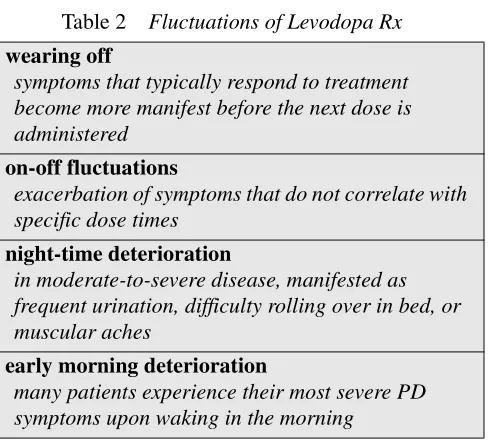
After 3 to 5 years the clinical efficacy of Sinemet dimin-ishes because there is less capacity of the cells to store lev-odopa and this marks the onset of fluctuations observed during clinical response to treatment31,32 (table 2).
Dyskinesia15,31 in the form of mild involuntary
move-ment to extreme flailing is a common side effect of medi-cation. More complex disturbances involving impulse control may result, such as gambling, food cravings, ex-cessive shopping, hypersexuality, and punding, the act of taking something apart and not being able to put it back together.22 Psychosis in the form of visual, auditory and
tactile hallucinations may similarly occur as drug related consequences.22,32 The effects of medical treatment may
be more distressing than PD itself.20
Dopamine agonists are options for initial treatment in younger patients where tremor is the dominant problem. These drugs may delay the onset of motor complications, or may be used after levodopa-related motor complica-tions develop.31 However, they are inferior to levodopa in
controlling motor symptoms.31
In more advanced disease, lowering dietary protein or shifting the maximum dietary protein to the last meal of the day may be helpful; protein interferes with the ab-sorption of levodopa.
Deep brain stimulation of the subthalamic nucleus has been shown to ameliorate symptoms in well defined pa-tients with advanced disease or early onset papa-tients (<50) whose disease is not adequately controlled by medica-tion.32
Recently, in-vivo gene therapy has been safely trialed in the human brain with no evidence of side-effects one year after treatment.33 Participants with severe
Parkin-son’s for at least five years and who were not being helped with medication anymore reported marked im-provement. This approach is a hopeful intervention that might be safe for many neuro-degenerative diseases; it avoids adverse medication effects, surgical implants and risk of infection.
Gleaning the literature provides some valuable advice for rehabilitation of PD’s muscular and dexterity prob-lems, but expect challenges associated with rehabilitation. Dementia or memory loss can be distressing to all health care providers, patients and family members caring for pa-tients; memory loss and dementia are features that may lead to institutionalized care.22 Anxiety that develops in
PD patients can cause significant resistance to motivation Table 2 Fluctuations of Levodopa Rx
• wearing off
symptoms that typically respond to treatment become more manifest before the next dose is administered
• on-off fluctuations
exacerbation of symptoms that do not correlate with specific dose times
• night-time deterioration
in moderate-to-severe disease, manifested as frequent urination, difficulty rolling over in bed, or muscular aches
• early morning deterioration
and rehabilitation goals. Memory loss and anxiety prob-lems observed during rehabilitation may be helped by pro-viding pictorial information of the exercise to act as a reminder.22 Memory strategies such as prompting can also
be helpful. External cues such as applying tape to the floor can guide gait and ambulatory exercise.22 PD patients may
have difficulty processing instructions so it is important that rehabilitation programs are always monitored. PD can affect the ability to communicate, both verbally and through facial expression, and this may provide another challenge for the patient’s difficulties to be conveyed ac-curately; professionals need to take the time to listen.22
Keep basic tenets of rehabilitation in mind, such as provid-ing adequate fluid intake and a nutritious diet. As with standard rehabilitation protocols, the rehabilitation pro-fessional can peel-back progression by breaking down in-structions into smaller more manageable pieces of information. Patients who present with different symp-toms may respond to different therapies; professionals have to be cognizant of variances during rehabilitation.
Chiropractic manipulative care has been reported as being successful for some patients with Parkinson’s dis-ease.34,35 Stretch reflex inhibition has been reported to
in-duce a reduction of the muscle rigidity.36 Further
investigation is needed but the results lend promise that complementary therapies like chiropractic may assist with some symptoms. Overall rehabilitative and manual treatments of PD are in need of further and more inten-sive scientific research.37
Information and education to help explain the com-plexities of treatment and self-management are impor-tant; some movement disorder clinics have PD nurse specialists and allied healthcare workers that are helpful, and the chiropractic doctor can provide valuable educa-tional support as well.
Conclusion
PD’s early history of slowed movement and gait distur-bance, in the absence of tremor, may mimic pain avoid-ance behavior due to mechanical back pain. Its complex nature requires doctors to refer suspicious neurological symptoms for confirmation of diagnosis. Multi-discipline management is vital and the inclusion of chiropractic doctors acting as an important source of diagnostic refer-ral and subsequent support through education and reha-bilitation is convincingly evidenced.
Acknowledgment
The author is grateful to Dr. Alan Goodridge MD FRCPC for assistance with review of this case report.
References
1 Parkinson facts. National Parkinson Foundation, Inc. Available from: URL: http://www.parkinson.org (accessed August 21, 2007).
2 Ehrt U, Aarsland D. Psychiatric aspects of Parkinson’s disease. Curr Opin Psychiatry. 2005; 18(3):335–341. 3 Thomas S, MacMahon DG, Maguire J. Moving and
shaping: A Guide to Commissioning Integrated Services for People with Parkinson’s Disease. PDS, London. 2006 4 Clough CG, Chaudhuri KR, Sethi KD. Parkinson’s
Disease: Fast Facts Indispensable Guide to Clinical Practice. Health Press, Oxford. 2003.
5 What is Parkinson’s Disease, Parkinson’s Society of Alberta. Available from: URL: http://
www.parkinsonalberta.ca (accessed August 21, 2007). 6 Johns ME, Goldsmith MM. Incidence, diagnosis, and
classification of salivary gland tumors. Oncology Part 1, Williston Park. 1989; 3(2):47–56.
7 Nitzan D, Kronenberg J, Horowitz Z, Wolf M, Bedrin L, Chaushu G, Talmi Y. Quality of life following
parotidectomy for malignant and benign disease. Plast Reconstr Surg. 2004; 14(5):1060–1067.
8 Merck manual online medical library. Parkinson’s Disease. Available from: URL: http://www.merck.com/mmpe/ sec16/ch221/ch221g.html (accessed September 24, 2007). 9 Nutt JG, Wooten GF. Clinical practice. Diagnosis and
initial management of Parkinson’s disease. N Eng J Med. 2005; 353(10):1021–1027.
10 Folytnie T, Sawcer S, Brayne C, Barker RA. The genetic basis of Parkinson’s disease. J Neurol Neurosurg Psychiatry. 2002; 73(4):363–370.
11 Betarbet R, Canet-Aviles RM, Sherer TB et al. Intersecting pathways to neurodegeneration in Parkinson’s disease: effects of the pesticide retonone on DJ-I, alpha-synuclein, and the ubquitin-proteasome system. Neurobiol Dis. 2006; 22(2):404–420.
12 Rajput AH, Uitti RJ, Stern W, Laverty W. Early onset Parkinson’s disease in Saskatchewan: environmental considerations for etiology. Can J Neurol Sci. 1986; 13:312–316.
13 IMS Health. Latest Statistics on Parkinson’s Disease. 2003. Available from: URL: http://www.imshealth.com/web/ content/0,3148,77303623_63872702_77
770096_77809964,00.html (accessed August 22, 2007). 14 ESonlIne. Hospital Episode Statistics. Available from:
15 Canadian Movement Disorder Group. Parkinson’s Disease. Available from: URL: http://www.cmdg.org/Movement_/ parkinso/parkinso.htm (accessed August 21, 2007). 16 Health Canada, Interdepartmental Committee on Aging
and Seniors Issues. Canada’s Aging Population. 2002; Cat. H39-608/2002E
17 Bekkelund SI, Selseth B, Mellgren SI. Parkinson’s sykdom i en nordnorsk befolkningsgruppe. Tidsskr Nor Laegeforen. 1989; 109(5):561–563.
18 Ingram, G. Government of Newfoundland. Pesticide Licensing Officer. Personal Communication. 2007. 19 Ceballos-Baumann A. Diagnosis and treatment of
Parkinson’s syndrome. What is important for the general practitioner? Fortschr Med. 2003:145(2); 99–102. 20 Rajput AH. Clinical features and natural history of
Parkinson’s disease. Neurodegenerative Diseases . 1st ed. Philadelphia: W.B. Saunders. 555–571.1994.
21 Chaudhuri KR, Healy DG, Schapira AH. National Institute for Clinical Excellence. Non-motor symptoms of
Parkinson’s Disease and management. Lancet Neurol. 2006; 5(3):235–245.
22 Noble C. Understanding Parkinson’s disease. Nurs Stand. 2007; 21(34):48–56.
23 Lewis S, Foltynie T, Blackwell A, Robbins T, Owen A, Barker R. Heterogeneity of Parkinson’s disease in the early clinical stages using a data driven approach. J Neuro Neurosurg Psychiatry. 2005; 76(3):343–348.
24 Findley L, Bowman C. Factors Influencing Quality if Life in Parkinson’s disease. Aesculapius Medical Press, London. 2004.
25 Burn R, Chaudhuri KR. Depression: a key non-motor symptom of Parkinson’s disease. Prog Neurol Psychiatry. 2006; 10(5):4–9.
26 Starkstein SE, Robinson RG, Leiguardia R. Anxiety and depression in Parkinson’s disease. Behav Neurol. 1993; 6(3):151–154.
27 Richard IH, Schiffer RB, Kurlan R. Anxiety and
Parkinson’s disease. J Neurosychiatry Clin Neurosci. 1996; 8(4):383–392.
28 Brosnan C, Burchell B. Diagnosing restless leg syndrome; when words get in the way. Prog Neurol Psychiatry. 2006; 10(3):33–35.
29 Tang H, Ng J. Googling for a diagnosis—use of Google as a diagnostic aid. BMJ. 2006:333; 1143 -1145.
30 National Collaborating Centre for Chronic Conditions. Parkinson’s Disease National Clinical Guidelines for Diagnosis and Management in Primary and Secondary Care. Royal College of Physicians, London. 2006. 31 Cinemet CR. Marketing material of Bristol-Myers Squibb
Company, Princeton NJ, 08543. Available from: URL: http://www.bms.com/cgi-bin/
anybin.pl?sql’select%20PPI%20from%20T
B_PRODUCT_PPI%20where%20PPI_SEQ’93&key’PPI (accessed August 29, 2007).
32 Guttman M, Kish SJ, Furukawa Y. Current concepts in the diagnosis and management of Parkinson’s disease. CMAJ. 2003; 168 (3).
33 Kaplitt M, Feigin A, Tang C, Fitzsimons H, Mattis P, Lawlor P, Bland R, Young D, Strybing K, Eidelberg D. Safety and tolerability of gene therapy with an adeno-associated virus (AAV) borne GAD gene for Parkinson’s disease: an open label, phase I trial. Lancet. 2007; 369(9579):2097.
34 Elster EL. Eighty-one patients with multiple sclerosis and Parkinsons disease undergoing upper cervical chiropractic care to correct vertebral subluxation: a retrospective analysis. J Vert Sublux Res. 2004; AUG 2: online access only.
35 Elster EL. Upper cervical chiropractic management of a patient with Parkinson’s disease: a case report. J Manipulative Physiol Ther. 2000; 23(8):573–577. 36 Boucher JP, Duval C, Lafontaine D, Hebert J, Leroux A,
Panisset MJ. The effect of Trager therapy on the level of evoked stretch responses in patients with Parkinson’s disease and rigidity. J Manipulative Physiol Ther. 2002; 25(7): 55–464.