Public health:
Community learning disability nurses’
perception and experience of their role –
An exploratory sequential multiple methods study
Kudzai Mafuba
2013
A thesis completed in partial fulfilment of the
University of West London
i CONTENTS
List of boxes, figures, and tables v
List of appendices viii
Dedication ix
Acknowledgements x
Abstract xi
INTRODUCTION 1
SECTION 1: REVIEW OF THE LITERATURE AND RATIONALE
Introduction 5
Chapter 1: Context 6
Introduction 6
1.1 Literature review strategy 6
1.2 Public health policy and learning disability 10
1.3 Learning disability policy 16
1.4 Health needs of people with learning disabilities 21 1.5 Public health policy implementation and people with
learning disabilities in the UK
27
1.6 Conclusion 39
Chapter 2: The nature of role theory and application to nursing 41
Introduction 41
2.1 The origins of role theory 41
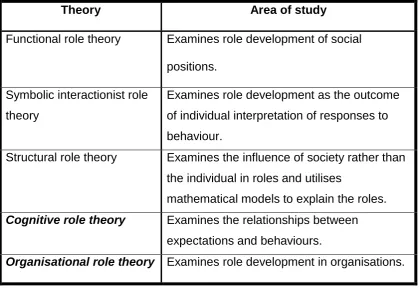
2.2 Organisational and cognitive role theories 54 2.3 Role theory in community learning disabilities nursing 60
2.4 Purpose of job descriptions 63
2.5 Conclusion 73
SECTION 2: RESEARCH METHODS
Introduction 74
Chapter 3: Study design 76
Introduction 76
3.1 Cosmology, ontology, and epistemology 77
3.2 Overview of study design 79
3.3 The research paradigm divide 83
3.4 Multiple methods 90
3.5 Sequential multiple methods 103
3.6 Ethical considerations 105
Chapter 4: Stage 1 – Documentary analysis (exploratory phase) 108
Introduction 108
4.1 The documentary method 108
4.2 Documents 111
4.3 Sampling 113
4.4 Preparing data for analysis 121
4.5 Data analysis 122
4.6 Validity and reliability considerations 130
4.7 Conclusion 131
Chapter 5: Stage 2 – Semi-structured interviews (descriptive phase)
132
Introduction 132
5.1 Grounded theory 133
5.2 Sampling and participant recruitment 137
5.3 Data collection 143
5.4 Data analysis 144
5.5 Validity and reliability of grounded theory analysis 149
5.6 Conclusion 155
Chapter 6: Stage 3 – Questionnaire survey (explanatory phase) 157
Introduction 157
6.1 The survey method 158
6.2 Survey questionnaire development 160 6.3 Sampling and participant recruitment 164
6.4 Data collection 170
6.5 Data analysis 170
6.6 Validity and reliability considerations 176
6.7 Conclusion 177
SECTION 3: RESULTS
Introduction 179
Chapter 7: Results 1 – Documentary analysis 181
Introduction 181
7.1 Data analysis stage 1 – A priori theoretical
categories 183
7.2 Data analysis stage 2 – Word frequencies 184 7.3 Data analysis stage 3 – Free nodes 184 7.4 Data analysis stage 4 – Initial codes 237 7.5 Data analysis stage 5 – Initial themes 239 7.6 Data analysis stage 6 – Themes 240 7.7 Data analysis stage 7 – Densified themes (roles and
policies) 240
7.8 Summary of findings 241
iii
Chapter 8: Results 2 – Semi structured interviews 244
Introduction 244
8.1 Data analysis stage 1 – Open coding (1) 244 8.2 Data analysis stage 2 – Code clusters 245 8.3 Data analysis stage 3 –Referenced ‘line-by-line’
data extracts 245
8.4 Data analysis stage 4 – Open coding (2) 266 8.5 Data analysis stage 5 – Axial coding 267 8.6 Data analysis stage 6 – Theoretical coding 269 8.7 Data analysis stage 6a – Selective coding
(role moderators) 269
8.8 Data analysis stage 6b – Selective coding
(roles and policy) 270
8.9 Data analysis stage 7 – Integration 271 8.10 Data analysis stage 8 – Memoing and diagramming 272
8.11 Summary of findings 274
8.12 Conclusion and key findings 275
Chapter 9: Results 3 – Questionnaire survey 276
Introduction 276
9.1 Nurse distribution by band and employer 277 9.2 Explanatory phase questionnaire reliability test
results 278
9.3 Correlations 279
9.4 ANOVA 281
9.5 Role clarity in job descriptions 286
9.6 Role review 288
9.7 Daily activities 291
9.8 Role perception 293
9.9 Perceived role value 295
9.10 Public health roles 295
9.11 Perceptions of employers’ priorities 300 9.12 Perceptions of employers’ knowledge 302
9.13 Summary of findings 305
9.14 Conclusion and key findings 308
SECTION 4: DISCUSSION
Introduction 310
Chapter 10: Policy involvement roles 311
Introduction 311
10.1 Policy involvement 311
10.2 Role clarity 317
10.3 Policy implementation roles 322
10.4 Policy dissemination roles 335
10.5 Policy development roles 345
10.6 Policy evaluation roles 347
Chapter 11: Moderators of public health role enactment 349
Introduction 349
Cause families of public health role moderators 352 11.1 Role clarity in job descriptions 352
11.2 Role review 355
11.3 Consistency of role expectations with daily activities 357 11.4 Role perception and perceived role value 358
11.5 Type of employer 359
11.6 Employer priorities 362
11.7 Perceptions of employer’s knowledge of public health needs of people with learning disabilities 363
11.8 Band 364
11.9 Public health role expectations 367
11.10 Dialogical definitions 371
11.11 Demographic ignorance 374
11.12 Professional silo mentality 377
11.13 Organisational silo mentality 378 11.14 Policy formulation and implementation vacuum 380
11.15 Leadership vacuum 381
Context families of public health role moderators 383 11.16 Centralisation versus decentralisation 383
11.17 Policy process 385
11.18 Resource constraints 386
Process families of public health role moderators 387 11.19 Organisational culture, change, and inertia 387
11.20 Policy conflict 391
11.21 Political power and influence 392 Consequence families of public health role moderators 392 11.22 Inter-agency and philosophical tensions 392
11.23 Role encroachment 394
11.24 Role validation behaviour 395
11.25 Role extension 397
11.26 Conclusion 398
Chapter 12: Conclusions, strengths, weaknesses and
recommendations 400
Introduction 400
12.1 Research’s contribution to knowledge 400
12.2 Strengths of the study 403
12.3 Weaknesses and limitations of the study 405
12.4 Implications of the study 406
12.5 Conclusion 410
12.6 Recommendations 412
References 421
v LIST OF BOXES, FIGURES, AND TABLES
Box 1a: Key areas of public health practice (UK Faculty of Public
Health) 12
Box 9a: Interpretation of mean scores 276
Figure 1c: Perspectives of policy implementation – summaries 31 Figure 3a: Study design
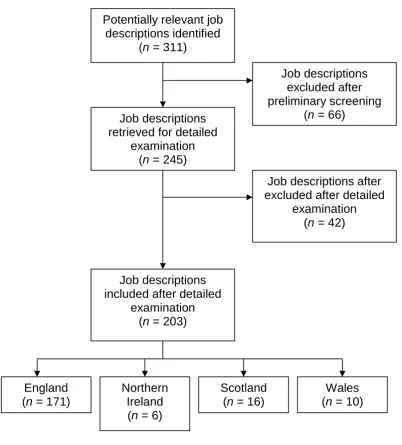
Figure 4a: Illustration of how job descriptions were sampled
82 121 Figure 5a: Illustration of constant comparative analysis activities
Figure 5b: Process of independent review of findings (Stage 2)
145 154 Figure 6a: Explanatory phase sample calculation 168 Figure 7a: Band 5 nurses’ public health role expectations 185 Figure 7b: Band 5 job descriptions policy references 194 Figure 7c: Band 6 nurses’ public health role expectations 199 Figure 7d: Band 6 job descriptions policy references 206 Figure 7e: Band 7 nurses’ public health role expectations 213 Figure 7f: Band 7 job descriptions policy references 221 Figure 7g: Band 8 nurses’ public health role expectations 231 Figure 7h: Band 8 job descriptions policy references 236 Figure 8a: Cause families of public health role moderators 246 Figure 8b: Context families of public health role moderators 255 Figure 8c: Process families of public health role moderators 258 Figure 8d: Consequence families of public health role moderators 262
Figure 8e: Descriptive phase data analysis stage 7 (integrated
relationships and core categories) 272
Figure 9a: Nurse distribution by band and employer Figure 9b: Means plot (band)
277 283
Figure 9c: Means plot (type ofemployer) 286
Figure 9d: Role clarity in job descriptions means plots Figure 9d1:Distribution of scores for Q1 – ‘role clarity’
287 288 Figure 9e: Role review means plots
Figure 9e1: Distribution of scores for Q2 – ‘role review’
289 290 Figure 9f: Daily public health role activities means plots
Figure 9f1: Distribution of scores for Q3 – ‘consistency of role expectations’
292
Figure 9g: Role perception means plots
Figure 9g1:Distribution of scores for Q4 – ‘role perception’
294 295 Figure 9h: Perceived role value means plots
Figure 9h1: Distribution of scores for Q5 – ‘perceived role value’
296 297 Figure 9i: Band 5 nurses’ involvement with public health 298 Figure 9j: Band 6 nurses’ involvement with public health 298 Figure 9k: Band 7 nurses’ involvement with public health 299 Figure 9l: Band 8 nurses’ involvement with public health 300 Figure 9m: Perceptions of employer’s priorities means plots
Figure 9m1:Distribution of scores for Q7 – ‘perceptions of employer’s
priorities’
301
301 Figure 9n: Perceptions of employer’s knowledge means plots
Figure 9n1: Distribution of scores for Q8 – ‘perceptions of employer’s
knowledge’
Figure 11a: Moderators of public health role enactment
304
305 351 Table 1a: The stages model in the policy cycle 28 Table 1b: Perspectives of policy implementation – comparisons 37
Table 2a: Definitions of role 53
Table 2b: Major models of role theory 55
Table 2c: Extracts from the National Profiles of community learning
disability nurses 70
Table 2d: The NHS Knowledge and Skills Framework – Dimension
HWB1 71
Table 2e: Public health role descriptors (expectations) Table 4a: Details of job descriptions
72 115 Table 5a: Descriptive phase participants
Table 5b: Stage 2 participants biographical data
141 142 Table 6a: UK NMC registered learning disability nurses
Table 6b: Stage 3 participants biographical data
165 169 Table 6c: Data codes for explanatory phase analysis
Table 6d: Pearson correlations interpretation guide
172 173 Table 7a: UK National Profiles of community learning disability nurses’
vii
Table 7b: A Priori theoretical categories 184
Table 7c: Exploratory phase initial codes (public health role
expectations and policy references) 238 Table 7d: Exploratory phase axial codes and initial themes 239 Table 7e: Exploratory phase public health policy implementation
themes 240
Table 7f: Exploratory phase themes (policy and policy implementation
roles) 241
Table 8a: Descriptive phase data analysis stage 4 (open codes) 267 Table 8b: Descriptive phase data analysis stage 5 (axial codes) 268 Table 8c: Descriptive phase data analysis stage 6 (theoretical codes) 269 Table 8d Descriptive phase data analysis stage 6a (selective codes
– role enactment moderators) 270
Table 8e: Descriptive phase data analysis stage 6b (selective codes – roles and policy)
Table 8f: Example of memoing (roles)
Table 8g: Example of memoing (coding families)
271 273 273 Table 9a: Explanatory phase questionnaire reliability test results 278 Table 9b:Interpretations of the relationships between variables (Stage
3) 280
Table 9c: Levene’s statistic test results (band) 281 Table 9d: Between bands ANOVA test results (band) 281 Table 9e: Tukey’s HSD post-hoc test results (band) 282 Table 9f: Levene’s statistic test results (employer) 284 Table 9g: Between employer groups ANOVA test results 284 Table 9h: Tukey’s HSD post-hoc test results (employer) 285 Table 11a:Public health involvement summary of response
rates
LIST OF APPENDICES
Appendix 1a: Emerging themes – A priori literature review 489
Appendix 1b: Publication paper 1 492
Appendix 1c: Publication paper 2 497
Appendix 1d: Publication paper 3 Appendix 1e: Publication paper 4
500 503 Appendix 3a: Multiple methods design checklist (Creswell 2009,
p205) 512
Appendix 3b: Ethics approval letter (Stages 1 and 2) 513 Appendix 3c: Ethics approval letter (Stage 3) 514 Appendix 3d: Invitation letter and consent form (Stage 2) 515 Appendix 3e: Invitation letter and consent (Stage 3) 517 Appendix 5a: Interview protocol and interview questions (Stage 2) 519 Appendix 6a: List of learning disability nurses’ professional networks
(Stage 2) 520
Appendix 6b: Online survey questionnaire (Stage 3) 522 Appendix 6c: Participant invitation e-mail (Stage 3) 525 Appendix 7a: Word frequencies (examples) (Stage 1) 527 Appendix 7b: Initial free nodes (public health roles) (examples)
(Stage 1) 528
Appendix 7c: Ranked summary of roles by band (Stage 1) 529 Appendix 7d: Ranked summary of policies by band (Stage 1) 530 Appendix 8a: Data analysis stage 1 – Referenced ‘line-by-line’ data
extracts (Open Codes) (examples) (Stage 2) 531 Appendix 8b: Data analysis stage 2 - Code clusters (examples)
(Stage 2) 537
Appendix 9a: Correlation matrix of group variables (n = 171) (Stage
3) 538
Appendix 9b: Correlation matrix of combined variables (n = 171)
ix
Dedication
This thesis is dedicated to my mother who single-handedly raised me, following the untimely passing of my father when I was 5 years old. She laid the foundations of one of the values that underlie my ontological position, and that is, ‘...to leave the
Acknowledgements
Firstly, I would like to thank my supervisors, Professors Bob Gates and Kath Mitchell, for their very professional support, and guidance throughout the research process and the compilation of this thesis.
Many thanks go to my daughter Nyasha for her practical assistance during stage 2 of this study. She practically helped me to stay within the boundaries of my normalcy.
xi Abstract
Purpose
Research into how public health policy is translated into role specifications within job descriptions of community learning disability nurses is important. In addition, the need for research that focuses on describing how community learning disability nurses perceive, and enact their public health roles has been identified. Furthermore, there is need to explain the ‘moderators’ of how community learning
disability nurses enact their public health roles.
Methods
This was a 3-stage exploratory sequential multiple methods study. Stage 1 was documentary, and involved collecting and analysing community learning disability nurses’ job descriptions, and or person specifications. Stage 2 was descriptive, and
used a grounded theory approach. Stage 3 was explanatory, and involved an on-line questionnaire survey.
Main findings
There were inconsistencies in public health role expectations in community learning disability nurses’ job descriptions and person specifications. The public health roles
perception, perceived role value, community learning disability nurses’ perceptions of employing organisations’ priorities, and community learning disability nurses’ perceptions of employing organisations’ knowledge of the public health needs of
people with learning disabilities, band, and finally the type of employer.
Significance for research and practice
There is a need for clarity of community learning disability nurses’ public health roles
1
INTRODUCTION
This study has investigated how community learning disability nurses enacted their public health roles, and thereby contributed to role theory, and public health policy implementation for people with learning disabilities. While a limited number of exploratory, and descriptive studies exist in this subject area, there is a dearth of explanatory studies. An examination of existing literature showed that there was need to move from studies which create, replicate role lists, and describe roles, tasks, and functions of community learning disability nurses. There is a need for inductive, and deductive studies to ascertain the nature, and extent of the involvement of community learning disability nurses in public health policy implementation for people with learning disabilities. This study had three key aims. Firstly, this study explored how public health policy was reflected, and articulated in community learning disability nurses’ job descriptions, and or person specifications.
Key question:
What are the public health roles of the community learning disability nurse, and what are the moderators of how they enact their public health roles?
Subsidiary questions:
a. How is public health policy reflected in community learning disability nurses’ job descriptions, and person specifications?
b. What is the community learning disability nurse’ perception of the moderators of how they enact their public health roles?
c. What are the correlates of public health role moderators of how community learning disability nurses enact their public health roles in implementing public health policy for people with learning disabilities?
3
Health, Social Services and Public Safety 2004; Scottish Executive 2000; Welsh Office 2001). Furthermore, the NHS Knowledge and Skills Framework
has outlined role expectations for community learning disability nurses in the UK (DH 2004b). In light of the absence of an unambiguous definition of ‘community learning disability nurse’, it is important to clarify the meaning for the purpose of this study. In this study, ‘community learning disability nurse’ refers to Nursing and Midwifery Council ‘learning disabilities nurse’ RN5 or
RNLD registrant whose role involves provision of nursing care to people with learning disabilities in a wide range of community settings. In the context of this study, the ‘community learning disability nurse’ work in a multi-disciplinary
team, holds a caseload, and, admits and discharges people with learning disabilities who have health needs. While previously the title ‘community learning disability nurse’ was predominantly used in community learning
disability nursing, the developments noted here have resulted in a wide range of new job titles for community learning disability nurses.
This thesis is divided into 4 sections. There is an introduction to each section. Further details of the structure of each chapter are contained in the introduction to each of the sections, and the introduction to each of the chapters.
Section 1 reviews literature pertinent to this study. Chapter 1 sets out the context of the United Kingdom’s public health, and learning disability policies
Section 2 explains the research design, and methodological approaches to the study. Chapter 3 outlines the overview of the study design. The aims of the study, ethical considerations, ontological, and philosophical assumptions that underlie the research are also addressed in this chapter. Chapter 4 details the sampling, collection, and analysis of data for stage 1 of the study. Chapter 5 explains the methodology for stage 2 of the research. Chapter 6 is the penultimate chapter in this section, and explains the approach to stage 3 of this study.
Section 3 contains 3 chapters, which outlines the results of the study. Each stage of the research was independent of each other; and therefore it is appropriate that results for each stage are presented independent of each other. Chapter 7 covers results for stage 1 of this study. Results for stage 2 of this study are given in chapter 8. The last chapter in this section, chapter 9, reports on the findings of stage 3 of this study.
5
SECTION 1: REVIEW OF THE LITERATURE AND RATIONALE
Introduction
In chapter 1, an outline of the literature review strategy is given. The second section discusses current public health policy, and its relevance to learning disability nursing practice. This is followed by an exploration of literature relating to learning disability policy and its relevance to public health. The fourth section explores literature regarding the public health needs of people with learning disabilities. The last section in this chapter explores literature that dealt with how public health policy is currently implemented for people with learning disabilities.
Chapter 1: Context
Introduction
This chapter begins by outlining the literature review strategy adopted for this study. This is followed by an exploration of the literature that currently exists regarding public health policy, and it’s relevance to learning disability nursing
practice. Approaches to public health policy implementation in the United Kingdom are also explored. Broad overviews of current learning disability policy in the United Kingdom are then outlined. This leads to an exploration of the literature that highlights the nature, and extent of the health and public health needs of people with learning disabilities. The last section in this chapter reviews literature on how public health policy is implemented for people with learning disabilities.
1.1 Literature review strategy
1.1.1 The purpose of this study was to generate, and contribute new knowledge to our understanding of how community learning disability nurses perceive, interpret, and enact their public health roles, and to locate this within role theory. The study also investigated the involvement of community learning disability nurses in the implementation of public health policy for people with learning disabilities. The study took place in two broad and complex contexts. Firstly, the study took place in the context of the United Kingdom’s government’s disparate public health policy. Secondly, the study took place in
7
1.1.2 A narrative approach to literature review was preferred over the systematic method (Parahoo 2006). The rationale for this was two-fold. Firstly, the qualitative nature of the relevant literature meant that a systematic approach would have been inappropriate. Secondly, the complexity, and extent of the research field necessitated the need to be selective with the literature considered for review (Cronin et al. 2008).
1.1.3 Extensive literature on key topics in public health exist (Ewles 2005; Naidoo and Wills 2005). A wide range of relevant government public health policy documents exist (DH 1999a; DH 2001; DH 2010; Scottish Government 2008; DHSSPSNI 2002). Many publications on the study of role theory exist (Biddle and Thomas 1966; Biddle 1979; Goffman 1961). In addition, studies exist that investigated community learning disability nursing roles (Jukes 1994; Mansell and Harris 1998; Stewart and Todd 2001; Mobbs et al. 2002; Llewellyn and Northway 2007; RCN 1985; Elliot-Cannon 1981; Barr 2006; Barr et al 1999). Finally, some investigations into health policy implementation for people with learning disabilities have been undertaken (Fyson 2002; Boarder 2002).
1.1.4 In light of the complexity of the research field in which this study took place the review of the literature was approached in two ways, a priori and ad hoc.
The literature search strategy described in this section relates to the a priori
However, because of its nature the process of ad hoc literature review is not reported, but the literature is embedded throughout this thesis.
1.1.5 The rationale for the a priori review of the literature was seven-fold. Firstly, it was important to learn from existing literature in order to develop a clear picture of existing knowledge (Parahoo 2006). The second reason was to set the research project in the context of existing knowledge. In addition, the literature review was important in identifying gaps in knowledge. This was important in rationalising the study. Furthermore, this process also contributed significantly to my theoretical sensitisation, which was essential in how the research questions were developed, and refined over time. Another reason for the a priori review of the literature was in developing the theoretical and philosophical frameworks on which the study was built (Cronin et al. 2008; Parahoo 2006). Additionally, this was useful in clarifying the school of thought in which the findings of the study would eventually sit (Coughlan et al. 2007). Finally, undertaking the a priori literature review contributed significantly to the overall research design, methods of data collection, and data analyses adopted (Cronin et al. 2008).
1.1.6 The a priori literature review focused on two broad groups of studies. The first group covered studies that explored the public health role of learning disability nurses and their involvement with public health policy implementation. The second group covered studies of people with learning disabilities’ perceptions,
9
1.1.7 The approach to literature search involved undertaking computer database searches using EBSCOhost, CINAHL, Academic Search Elite, Ovid Online, IBSS, Index to Theses, PsycARTICLES, ScienceDirect, RCN Journals Database, ZETOC Search, and Google Scholar. The approach was consistently used for both a priori, and ad hoc searches. For both literature searches, search words were placed into two categories. One category contained key terms, i.e., learning disability, learning difficulty, mental retardation, and intellectual disability. These were combined with words or phrases pertinent to the study; learning disability nurse, community learning disability nurse, role, public health, health promotion, public health policy, healthcare, views, perceptions, experience, user involvement, policy implementation, participation, and consultation. Suitable articles were those:
that related to public health roles of learning disability nurses, and which focused on people with learning disabilities’ perceptions and
experience of accessing public health services.
1.1.8 Studies were excluded if they were non-English, government documents, and studies covering the ‘non-health’ roles of learning disability nurses. The
search produced 75 articles of relevance. Three very distinct groups of studies emerged, and these are:
studies which addressed public health roles of the learning disability nurse;
studies which sought the perceptions, and experiences of people with learning disabilities regarding access to public health / healthcare, and studies, which explored the implementation of health policy for people
1.1.9 Literature was then read, summarised, and themes identified (see Appendix 1a). The themes that emerged were central to the formulation of the research aims and questions. Following the a priori literature review, a number of articles were produced for publication in double blind peer reviewed journals (see Appendices 1b, 1c, and 1d).
1.2 Public health policy and learning disability
1.2.1 The concept of public health is a contentious one (Dawson and Verweij 2007). Consequently there is no agreed definition of what ‘public health’ means
(Baggott 2011; Kaiser and Mackenbach 2008). Given this ambiguity it was important to explore the relevant literature in order to arrive at a working definition for this study. According to Blaxter (2004), this lack of an agreed dialogical definition is not surprising, given that the meaning of ‘health’ itself is
11
definitions of public health for this study. What is not disputed in the literature is that public health refers to the health of identified populations (WHO 1986). The contention regarding defining public health was partly explained by Rosen’s observations that health is inter-connected with social life (Rosen
1993).
1.2.2 According to Winslow,
‘Public health is the science and the art of preventing disease, prolonging life and promoting physical health and efficiency through organised community efforts for the sanitation of the environment, the control of community infections, the education of the individual in principles of personal hygiene, the organisation of medical and nursing service for the early diagnosis and preventative treatment of disease, and the development of social machinery which will ensure to every individual in the community a standard of living adequate for the maintenance of health’ (Winslow 1920, p.23).
This approach to public health highlights the importance of public health roles, including those of community learning disability nurses.
1.2.3 The Acheson Report has described public health as,
‘....the science and art of preventing disease, prolonging life and promoting health through organised efforts of society’ (Acheson 1988, p.27).
of the meaning of UK public health, and its relevance to this study is the Faculty of Public Health. The Faculty of Public Health (FPH) is the standard setting body for professionals, and specialists in public health in the UK. The FPH organises public health practice into 3 domains (health improvement, health protection, and improving services) (Faculty of Public Health 2012). These domains are similar to Griffiths et al.’s model (Griffiths et al. 2005). In addition to the 3 domains, the FPH identifies 9 key areas of public health practice and these are given in Box 1a below.
Box 1a: Key areas of public health practice (Faculty of Public Health 2012).
1. Surveillance and assessment of the population’s health and wellbeing.
2. Assessing the evidence of effectiveness of health and healthcare interventions, programmes and services.
3. Policy and strategy development and implementation. 4. Strategic leadership and collaboration for health. 5. Health improvement.
6. Health protection.
7. Health and social service quality. 8. Public health intelligence.
9. Academic public health.
1.2.5 Griffiths et al.’s model (Griffiths et al. 2005), the FPH’s domains of public
13
1.2.6 In order to identify what constitutes ‘public health policy’ for the purpose of this study, the definitions of what is ‘public’, what is ‘health’, and what is ‘policy’
needed to be clarified. There is very little agreement on how to define ‘policy’
(Ham and Hill 1984; Davis 1993; Torjman 2005). Predominantly there are two broad views that emerge from literature. The classical view, which looks at public policy as an object or product (Colebatch 1998), and the interactional position (Colebatch 1998; Stone 1988), which looks at policy as a complex process and interaction between policy makers, policy implementers, and policy recipients. The classical view was particularly important in stage 1, and the interactional position was relevant for stages 2, and 3 of this study. Dye (1972) has defined public policy as any action a government chooses to do or not to do. Bridgman and Davis (1998) describe a complex 6-stage model (problem recognition; identification of possible solutions; choice of best solution; policy implementation; policy evaluation, and policy termination) of the policy making process which was relevant in contextualising this study. My understanding of this model was useful in locating the public health policy implementation involvement of community learning disability nurses within the wider policy context. This study adopted Dye’s definition described above.
What the UK government chooses to do regarding public health for people with learning disabilities is perhaps reflective of the complexity of both the classical, and interactional views of public health policy in the UK.
uncoordinated. Each of the four countries of the United Kingdom has different policies, and this divergence has been increasing since devolution (Greer 2009).
1.2.8 In England, Choosing health (DH 2004a) identified six key priority areas for public health (reducing the numbers of people who smoke; reducing obesity and improving diet and nutrition; increasing exercise; encouraging and supporting sensible drinking; improving sexual health; and improving mental health). Since then a series of other public health policy initiatives have been adopted including, Delivering choosing health (DH 2005b); Our health Our care Our say (DH 2006a); Health challenge England (DH 2006b); Tackling health inequalities (DH 2007a), and more recently, Healthy lives Healthy people (DH 2010).
1.2.9 Since devolution there has been a distinct public health approach in Scotland (Greer 2009; Donnelly 2007). Prior to devolution, Scotland’s health: A
15
1.2.10 Northern Ireland has adopted a much more focused, and sustained public health policy approach (Wilde 2007; NI Executive 2008). Since the 1990s key policy documents have emerged and include, Health and wellbeing: Towards the new millennium (DHSSNI 1996), Well in 2000 (DHSSNI 1997), Investing for health (DHSSPSNI 2002) and A healthier future (DHSSPS 2004). Recent work led by the Public Health Agency has strengthened this position for people with learning disabilities (Public Health Agency 2011; Slevin et al.
2011).
1.2.11 Wales was the first UK country to develop a comprehensive and inclusive public health strategy (Welsh Office NHS Directorate 1989; 1992), which was quite distinct (Greer 2009; Coyle 2007). The identified priority areas were, cancer, maternal and child health, emotional health, respiratory illness, cardiovascular diseases, learning disability, mental distress and illness, injuries, healthy environments, and physical disabilities. Since then a series of other public health policy initiatives emerged and include, Better health Better Wales (Welsh Office 1998), Improving health in Wales (NAfW 2001),
Wellbeing in Wales (Welsh Assembly Government 2002), Wales – A better country (Welsh Assembly Government 2003), and Designed for life (Welsh Assembly Government 2005).
1.2.12 In 2004 the UK-wide GP contract was renegotiated (Aswani 2007), and it specified three distinct groups of services, essential services (compulsory - consultations), additional services (optional – immunisation and screening), and enhanced services (optional – specialised services). There were originally
repeatedly revised, and has included learning disabilities since 2006. What is important to note in relation to this study is the optional nature of the approach to key public health policy delivery at the primary care level. This is likely to have an impact on how community learning disability nurses enact their public health roles in implementing public health policy for people with learning disabilities. In 2008 additional payment for the provision of Clinical directed enhanced services (DES) for people with learning disabilities was introduced. This was intended to improve access to generic public health services by people with learning disabilities at the primary healthcare level. In turn this policy initiative is likely to have had an impact on how community learning disability nurses enact their public health roles.
1.2.13 The approach to public health policy in the UK, outlined here, can best be described as unco-ordinated. What is not clear from existing studies is what roles community learning disability nurses play in implementing these policies, how they interpret and enact those roles, and what moderates how they enact those roles. This study sought to find some answers to these questions.
1.2.14 In addition to the public health policies discussed here, specific policies, which aim to address the public health, needs of people with learning disabilities exist. It is therefore important at this point to explore some of these policy initiatives and highlight their relevance to this study.
1.3 Learning disability policy
17
century. In England, the 1913 Mental Deficiency Act provided a distinct legal identity for people with learning disabilities. The operational segregation of service provision for people with learning disabilities provided for in the Act has had a long and lasting effect. Remnant effects are still evident today, and may influence how community learning disability nurses enact their public health roles. Under the Act, service provision for people with learning disabilities was based in large hospitals, which were under the remit of psychiatry.
1.3.2 Negative reports regarding segregated service provision (Department of Health and Social Security 1969; Morris 1969) led to a new policy direction through Better services for the mentally handicapped (Department of Health and Social Security 1971). This policy shift had two significant effects in relation to this study. The first effect was the shift of service provision from institutions to the community. The second effect was that learning disability nurses had to re-align their roles with the new models of service provision. As de-institutionalisation gathered pace in the 1980s and 1990s, policies focusing on meeting the public health needs of people with learning disabilities in the community began to emerge.
nation (DH 1992) identified five key public health areas for England (coronary heart disease and stroke, cancer, HIV/AIDS and sexual health, accidents, and mental illness). A specific ‘Health of the nation strategy’ for people with learning disabilities was published in 1995 (DH 1995), and focused on the five key public health areas.
1.3.4 Signposts for success (NHS Executive 1998) outlined care pathways for people with learning disabilities in mainstream services. This was an acknowledgement that people with learning disabilities were experiencing poor access to services in the NHS. The emphasis was on ensuring that people with learning disabilities’ healthcare needs were met through
mainstream services. However, the policy document recognized the need for continued specialist health, and healthcare provision in areas such as mental health, epilepsy, and complex needs.
1.3.5 Another important policy development was Once a day (NHS Executive 1999). This policy highlighted the challenges people with learning disabilities faced in accessing health services. The policy also provided guidance for primary healthcare teams on how supports could be provided to people with learning disabilities in order for them to access health promotion, and health screening services through primary care services.
19
with learning disabilities are acknowledged, and the inadequacies of existing models of healthcare provision for people with learning disabilities in generic healthcare settings highlighted. In Scotland, the Health needs assessment report: People with learning disabilities in Scotland (NHS Health Scotland 2004) highlighted the needs of people with learning disabilities and provided guidance to healthcare professionals on how these could be met.
1.3.7 A number of initiatives relevant to policy implementation, and public health roles of learning disability nurses were proposed in Valuing people (DH 2001). In order to improve the implementation of public health policy initiatives, and access to services for people with learning disabilities, health action planning was introduced (DH 2002; DH 2009a). Health facilitation and health liaison were also introduced (DH 2001). These policy initiatives had a significant effect on the public health roles of community learning disability nurses.
people with learning disabilities. Death by indifference (Mencap 2007) alleged institutional discrimination within the NHS, which resulted in people with a
learning disabilities receiving ineffective healthcare. The report presented the
stories of six people who the authors believed had died unnecessarily as a
result of healthcare professionals’ lack of understanding of the complexity of
the healthcare needs of people with learning disabilities. Healthcare for all
(Michael 2008) highlighted the high levels of unmet health needs of people with learning disabilities, and poor access to services, and ineffectiveness of the treatment they received. Valuing people now (DH 2009b) outlined the English government’s response to the Healthcare for all report (Michael 2008). Six lives (Parliamentary and Health Service Ombudsman and Social Services Ombudsman 2009) was the government’s response to Death by indifference (Mencap 2007).
1.3.9 The policies and recommendations in documents identified here are noble, and well meaning. However, it is important to note that most of these reports, and policies only provided ‘frameworks’ for action. The visions set out in these
documents, and recommendations were visionary, ambitious, and in some cases comprehensive. However, no resources were provided for their implementation for people with learning disabilities. Mansell (2008) has observed that the implementation of these ‘soft’ policies was more likely to be
opportunistic, and ad hoc and resulted in a ‘post code’ approach to national health policy implementation for people with learning disabilities.
21
there is a lack of clarity at organisational, and professional level is to where responsibility lies for their implementation. This was quite important in how I formulated interview questions in stage 2, and how I formulated the survey questionnaire in stage 3. The consequences of this lack of clarity on how community learning disability nurses are involved in the implementation of these initiatives need to be addressed. How these policies are cascaded into community learning disability nurses’ job descriptions, and other role
descriptors across the UK is what stage 1 of this study sought to answer.
1.3.11 The lack of organisational and professional role clarity for the implementation of public health policy for people with learning disabilities is rather surprising at the least, given the extent of the health, and healthcare needs of people with learning disabilities. An exploration of literature relating to the extent of the health, and healthcare needs of people with learning disabilities is appropriate at this point in order to contextualise the study.
1.4 Health needs of people with learning disabilities
1.4.1 There is a disparity between the health, and the healthcare needs of people with learning disabilities as compared to that of the general population (Kerr 2004; DH 2001). According to van Schrojenstein Lantman-de Valk et al.
nurses. Investigating how community learning disability nurses enact this role would be important in understanding their contribution to public health policy implementation for people with learning disabilities.
1.4.2 People with learning disabilities are known to have much greater health needs than those of comparable age groups who do not have learning disabilities (NHS Executive 1998; DH 1999b; Cancer Research UK 2008; Backer et al.
2009). For example, people with learning disabilities experience higher rates of mental disorders as compared to the general population (Wilson and Hare 1990; Linna et al. 1999). Moreover, existing studies show that these health problems are commonly, and widely undiagnosed, misdiagnosed, and untreated (Wilson and Hare 1990; Bailey and Cooper 1997). In addition, people with learning disabilities experience higher rates of visual impairments (Beange et al. 1995; Barr et al. 1999); epilepsy (Ryan and Sunada 1997; McDermott et al. 1997; Whitfield et al. 1996); hypertension and hypothyroidism (Barr et al. 1999); and, obesity (van Schrojenstein Lantman-de Valk et al. 2000). Furthermore, people with learning disabilities are more likely to die from preventable causes (Hollins and Sinason 1998; Mencap 2007; DH 2007a; DH 2007b; Durvasula et al. 2002; Nissen and Havemann 1997; Pawar and Akuffo 2008; van Schrojenstein Lantman-de Valk et al.
23
(Durvasula et al. 2002). The literature explored here suggest that there is a need for research that evaluates how community learning disability nurses enact their surveillance roles in identifying the complex health, and healthcare needs of people with learning disabilities.
1.4.3 People with learning disabilities experience health inequalities (Scheepers et al. 2005; Melville et al. 2006), and poor access to healthcare (DH 1999b; DH 2001; NPSA 2004; Mencap 2004; DRC 2006; Whitehead 1992; Nocon et al.
2008; Brown et al. 2010). Studies have shown that people with learning disabilities are considered a low priority by healthcare professionals (Aspray
et al. 1999). International studies have demonstrated widespread concerns about the inequalities in health for people with learning disabilities (Janicki 2001; Scheepers et al. 2005; WHO 2003). Evidence suggests that these disparities in health, and health outcomes for people with learning disabilities have been attributed to service users, health organisations, and health service systems. Straetmans et al. (2007) identified communication difficulties and limited understanding of the diagnostic, and treatment issues for people with learning disabilities. In addition, Lennox and Diggins (1999) have noted that healthcare professionals have limited augmentative communication skills, which further limits their ability to diagnose, and treat people with learning disabilities appropriately. People with learning disabilities have complex health needs, and comorbidity is common. Messent et al. (1999) identified life-style related comorbidity as a significant contributory factor to disparities in health for people with learning disabilities. In addition, Jones and Kerr (1997) have noted that cognitive impairments limit people with learning disabilities’ ability
1.4.4 People with learning disabilities experience unequal access to health services (Kerr 2004; DRC 2006; Iacono and Davis 2003; Janicki et al. 2002; Scheepers et al. 2005; Mencap 2004). People with learning disabilities experience inadequate diagnosis of treatable conditions (Hollins et al. 1998; Mencap 2007; DH 2007a; DH 2007b; Durvasula et al. 2002). In the UK, access to public health is primarily through the primary healthcare system. Current literature show that a significant proportion of health inequalities in people with learning disabilities are linked to poor quality healthcare provision (Michael 2008; Mencap 2012; Parliamentary Health Ombudsman and Social Services Ombudsman 2009). This rather suggests that these inequalities are preventable. The UK government policy has focused on improving people with learning disabilities’ access to generic, and preventative health services for
some considerable time (DH 1992; DH 1995; NHS Executive 1998; DH 2001; DH 2009b; Ruddick 2005). However, the continuing disparities in health in people with learning disabilities suggest that policies alone are not enough. What is important and what this study sought to understand was how community learning disability nurses mediated public health policy implementation (Thornton 1996) for people with learning disabilities.
25
1996; Powrie 2003; NHS Health Scotland 2004; Phillips et al. 2004; Melville et al. 2005). The importance of primary healthcare services in meeting the health needs of people with learning disabilities has been highlighted (Lennox and Kerr 1997; Phillips et al. 2004). However, there appear to be a lack of evidence as to the role of community learning disability nurses in addressing barriers experienced by people with learning disabilities when accessing generic public health services.
1.4.6 International studies have shown poor uptake of public health initiatives in the population of people with learning disabilities (Beange et al. 1995; Beange and Bauman 1990; Jacobson et al. 1989; Kerr et al. 1996; Stein and Allen 1999; Jones and Kerr 1997; Sullivan et al. 2003; Wood and Douglas 2007). Other studies have shown that people with learning disabilities have reduced access to health screening, and health promotion services (Kerr et al. 1996; Whitfield et al. 1996). Lennox et al. (2000) have noted the need for effective health advocacy from relevant health professionals. Kerr et al. (2003) have observed that healthcare outcomes are dependent on individuals’ ability to
disabilities having to access generic health services. Recently in the UK, there has been a shift from healthcare treatment to preventative healthcare (NHS Executive 1994; Adams et al. 2001; NHS Breast Screening Programme 2006). However, studies which address the public health needs of people with learning disabilities are limited (Hogan et al. 2000; Steele et al. 1996). A limited number of studies, which scrutinised access to health promotion activities by people with learning disabilities exist (Messent et al. 1999; Beart
et al. 2001). Thomas and Kerr (2011) have concluded that delivering effective public health initiatives for people with learning disabilities is challenging. What is more concerning, and perhaps more important for this study is the observation made by McIlfatrick et al. (2011) that the provision of public health services for people with learning disabilities was opportunistic, despite evidence that point to a need for targeted activities (Chauhan et al. 2010). Felce et al. (2008) have suggested that in the absence of people with learning disabilities’ ability to self refer for healthcare; it was logical that provision of
health services for this population be proactive rather than reactive. Existing studies have demonstrated that preventative interventions such as health screening are effective in identifying the health needs of people with learning disabilities in the UK (Martin et al. 1997; Baxter et al. 2006; Cooper et al. 2006; Emerson and Glover 2010; Emerson et al. 2011); in Australia (Beange
27
preventative health service provision for people with learning disabilities on GPs; there has been a longstanding debate as to whether this role belongs to primary care or to the community team for people with learning disabilities (Matthews and Hegarty 1997; Curtice and Long 2002). What was not clear from these studies, and which needed investigating was the role played by community learning disability nurses in preventative interventions for people with learning disabilities.
1.4.7 Reviewing literature relating to the extent of the health, and healthcare needs of people with learning disabilities was particularly important in how data analysis was approached in stage 1 of the study. It was important to clarify the roles of community learning disability nurses in implementing public health policy for people with learning disabilities in the context of the extent of their health, and healthcare needs. The lack of organisational and professional clarity as for the responsibility of public health policy implementation has been noted earlier in this chapter. Given this lack of clarity, it is prudent at this point to explore approaches to public health policy implementation in the UK. This is important in order to locate learning disability nurses’ public health policy
implementation roles within the UK public health policy process.
1.5 Public health policy implementation and people with learning disabilities in the UK
process revealed that a number of models are available (Fafard 2008). Of these models, ‘the stages model’ which can be traced back to the work of Lerner and Lasswell (1951) is the most widely used, and on the other hand the most criticised (Fafard 2008). Since then various modifications to this model have been put forward (Jones 1977; Howlett and Ramesh 2003). This model was useful for this study because it assumes that policy making is based on logic and evidence, and is supposed to focus on problem solving. Despite its limitations and criticisms (Marmot 2004; Burton 2006), ‘the stages model’ is widely acknowledged in literature as the most heuristic (Deleon 1999; Burton 2006) approach in policy studies and in policymaking. In the original model put forward by Lerner and Lasswell (1951) there are seven stages from intelligence to evaluation. Variants of this model aimed at improving the original model have been developed, and of interest to this study was the 5-stages model (Howlett and Ramesh 2003) (see Table 1a).
Table 1a: The stages model in the policy cycle (Howlett and Ramesh 2003) Stage Activity
1 Agenda setting 2 Policy formulation 3 Decision-making 4 Policy implementation 5 Policy evaluation
All the five stages in the model were important to this present study. However, the main aim of the study was to investigate community learning disability nurses’ involvement with public health policy implementation for people with
29
explored in detail here. Fafard (2008) has suggested that the implementation stage requires an evidence base because;
‘...it is precisely at the policy implementation phase where broad policy is translated into detailed programme choices’ (p. 12).
Furthermore, Davis and Mannion (2000) have pointed out that this stage requires collaboration between policy formulators and policy implementers, and it is important to know what approaches to policy implementation are effective.
1.5.2 Appropriate and relevant literature on ‘implementation’ can be traced back to Pressman and Wildavsky (1973). According to Linder and Peters (1987),
‘implementation’ has become a ‘social science’. Crinson (2009) noted the ambiguity and complexity of the concept of policy implementation. The source of this ambiguity seems to arise from the dialogical definition of the term itself in that it refers to both process and outcome.
understanding of the involvement of community learning disabilities in the implementation of public health policies for people with learning disabilities.
1.5.4 The first group of literature focuses on frameworks and models for perfect policy implementation (Simon 1947; Hood 1976; Hogwood and Gunn 1984; Rutten et al. 2010; Tataw 2010). These studies predominantly focused on strategies to avoid policy implementation failure. The importance of these studies to this present study was that they implied that the majority of failures in policy are a result of failures in implementation. In addition to this view, Hogwood and Peters (1985) have argued that some policy failures were due to policy design. Furthermore, Sieber (1981) has observed that some policies could create more unwanted effects than the original goals. However Mayntz (1983) has argued that concluding that policy failure was just a direct consequence of implementation failure was insufficient.
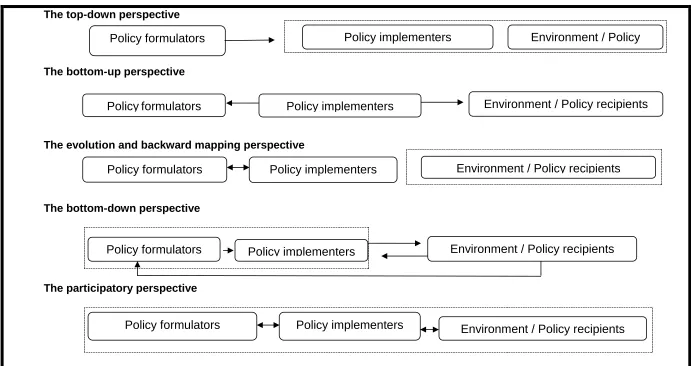
1.5.5 The second group of studies has focussed on developing the philosophy and theory of policy implementation. Historically, there are five major schools of thought regarding policy implementation theory (See Figure 1c). All these frameworks influence the outcomes of how policy is implemented and are therefore important in our understanding of community learning disability nurses’ involvement with public health policy implementation. It was therefore
31
Figure 1a: Perspectives of policy implementation – summaries (adapted from Linder and Peters (1987), and Tataw (2010).
The top-down perspective
The bottom-up perspective
The evolution and backward mapping perspective
The bottom-down perspective
The participatory perspective
Policy implementers
Policy formulators Environment / Policy
Recipients
Policy implementers
Policyformulators Environment / Policy recipients
Policy implementers
Policy formulators Environment / Policy recipients
Policy implementers
Policy formulators Environment / Policy recipients
Policy implementers
1.5.6 The first approach is the ‘top-down’ (bureaucratic) perspective to policy implementation, which is inherent in bureaucratic systems such as the NHS. According to Dunsire (1978) this approach takes the view that policy implementation has to be enforced through the management structures of organisations. Sabatier and Mazmanian (1979) have developed a model, which identified clarity of the policy statement itself; proposed implementation structures; managerial and political skills of policy implementers; and commitment of implementers to policy goals as key variables. Hogwood and Gunn (1984) have identified 10 pre-conditions necessary for effective policy implementation. These include sufficient time and resources; rationale for the policy and implementation strategy; an understanding of the policy objectives; identified implementing organisation with appropriate authority; and effective communication structures between policy formulators and policy implementers. Hill (1997) has criticised this model as utopian and simplistic. Another criticism of this model includes accusation of a lack of focus on organisational moderators of policy implementation outcomes (St Leger 1998). Thomas et al. (1998) have criticised the model as an unrealistic ‘perfect’ implementation model.
33
making process, and the policy implementation process. In reality the boundaries between the processes are at best blurred and difficult to identify. Community learning disability nurses work in bureaucratic organisations, and understanding how they enact their public health roles in such organisations was an important element of this study.
1.5.8 The second approach is the ‘bottom-up’ (democratic) perspective. The main assumption of this perspective is that policy implementation has to be negotiated between policy implementers and policy recipients at the ‘street
1.5.9 According to Lane (2000), bureaucratic models focus on organisational structures, planning and control, whilst the democratic models advocate that for effective policy implementation; flexibility, responsiveness, and problem solving are essential. However, it is clear that the complexity of policy formulation and implementation means that neither the bureaucratic nor the democratic approaches would be sufficient on their own (Crinson 2009). UK public health policies range from the very simple, single-aimed policy directives to the very complex. Many recent reports have highlighted how health policy implementation deficits affect healthcare delivery to people with learning disabilities (DRC 2006; Mencap 2007; Michael 2008; Parliamentary Health Ombudsman and Social Services Ombudsman 2009). In the UK, implementation of health policy is supposedly driven by local needs. Understanding how community learning disability nurses enact their public health roles in this ‘local approach’ to public health policy implementation was an important element of this study.
1.5.10 The third approach to explaining policy implementation is the ‘evolution and
35
1.5.11 The fourth perspective is the ‘from the bottom down’ (Mazmanian and Sabitier 1983). This was developed from the top-down approach. Although the approach focuses on centrally driven policy implementation, it highlights the importance of effectiveness and evaluation. The essence of this approach is structured delegation. This perspective was important to this study for a number of reasons. McDonnell et al. (2006) have pointed out that UK health policy is usually implemented and changed without evaluation. They noted that this has led to difficulties in conducting reliable studies on how policy is implemented and evaluated. Greenhalgh et al. (2004) have identified the need for action as articulated by opinion leaders in healthcare as having priority over effective and successful policy implementation.
1.5.12 Recent growing calls for consumer voice in public health and health promotion (Lee and Garvin 2003) has led to a ‘horizontal participatory’ perspective to policy implementation being put forward (Tataw 2010) (see
37
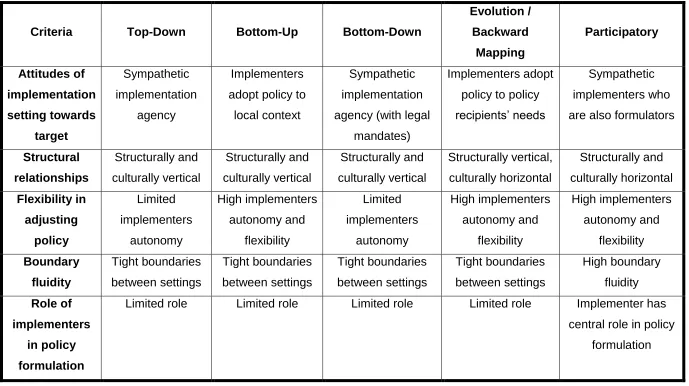
Table 1b: Perspectives of policy implementation - comparisons (Adapted from Linder and Peters (1987) and Tataw (2010)).
Criteria Top-Down Bottom-Up Bottom-Down
Evolution / Backward Mapping Participatory Attitudes of implementation setting towards target Sympathetic implementation agency Implementers adopt policy to
local context
Sympathetic implementation agency (with legal
mandates)
Implementers adopt policy to policy recipients’ needs
Sympathetic implementers who are also formulators
Structural relationships Structurally and culturally vertical Structurally and culturally vertical Structurally and culturally vertical Structurally vertical, culturally horizontal Structurally and culturally horizontal Flexibility in adjusting policy Limited implementers autonomy High implementers autonomy and flexibility Limited implementers autonomy High implementers autonomy and flexibility High implementers autonomy and flexibility Boundary fluidity Tight boundaries between settings Tight boundaries between settings Tight boundaries between settings Tight boundaries between settings High boundary fluidity Role of implementers in policy formulation
Limited role Limited role Limited role Limited role Implementer has central role in policy
It is clear that all the perspectives discussed here have their limitations. The absence of an all-encompassing theory of policy implementation makes the process of public health policy implementation difficult (Mafuba 2012b). What is important however is that all these perspectives highlight the importance of understanding the causes and failures of policy implementation. Furthermore, for the purposes of this study all the perspectives emphasise the importance of the roles played by policy makers, policy implementers, and policy recipients in the success or failure of policy implementation.
1.5.13 There are very few studies, which have evaluated the effectiveness of health policy implementation for people with learning disabilities. Some authors have noted that the evaluation of health policy implementation has been neglected (Hill 2003; O’Toole 2004). Northway et al. (2007) have pointed out that translating policy frameworks into operational policies for people with learning disabilities is complex. In addition, policy effectiveness is dependent on implementation (Barrett 2004), and staff involved (Northway et al. 2007; Lipsky 1980). Policy effectiveness is likely to impact on how implementers such as community learning disability nurses enact their public health roles. Research on how policy is implemented, and its impact on professional roles is therefore of significance (Fyson 2002).
39
The study was extensive and involved semi-structured interviews with staff at all levels in learning disability services. What was of interest to this current study among the findings by Fyson (2002) is the worrying extent of the local variations in interpretation of national policy frameworks. Understanding how these variations impacted on how community learning disability nurses interpreted national public health policy and enacted their public health roles was an important part of this present study.
1.5.15 Lin et al. (2004) have examined how healthcare policies were implemented for people with learning disabilities in Taiwan. The study identified a number of issues that affected the implementation of health policies for people with learning disabilities, which I considered to be relevant to this current study. The study observed that poor access to preventative health, lack of resources, and lack of coordination in the implementation of health policies negatively impacted on the effective implementation of health policies for people with learning disabilities. In addition, and perhaps a finding of greater significance for this current study was the negative effect of a lack of role clarity and professional conflicts regarding the implementation of health policy for people with learning disabilities.
1.6 Conclusion
41
Chapter 2: The Nature of Role Theory and Application to
Nursing
Introduction
This chapter commences with the exploration of the origins of role theory. This is followed by an analysis of cognitive and organisational role theories. The third section in this chapter explores role ambiguity and its impact on role enactment. Literature relating to developments of role theory in nursing is then explored. Finally, a detailed discussion of the importance of job descriptions, and person specifications in how learning disability nurses enact their roles is undertaken.
2.1 The origins of role theory