R E S E A R C H A R T I C L E
Open Access
The application of barbed suture during
the partial nephrectomy may modify
perioperative results: a systematic review
and meta-analysis
Yifei Lin
1†, Banghua Liao
1†, Sike Lai
2, Jin Huang
3*, Liang Du
3*, Kunjie Wang
1*and Hong Li
1Abstract
Background:Barbed sutures can avoid knot tying and speed the suture placement in the PN(partial nephrectomy). On account of the impact on clinical outcomes are ambiguous, this study is determined to identify the application of barbed suture during PN.
Methods:ClinicalTrials.gov, Cochrane Register of Clinical Studies, PubMed and EMBASE were searched for RCTs(randomized controlled trials) and cohort studies focusing on the comparison of barbed and traditional sutures in PN(last updated on Feb in 2015). According to Cochrane Library’s suggestion, quality assessment was performed. Review Manager was applied to analyze all the data and sensitivity analyses were performed through omitting each study sequentially.
Results: Eight cohort studies and none of RCTs proved eligible (risk of bias: moderate to low,431 patients). Warm ischemia time(MD =−6.55,95% CI -8.86 to −4.24, P< 0.05) decreased statistically in the barbed suture group, as well as operative time(MD =−11.29,95% CI -17.87 to-4.71, P< 0.05). Postoperative complications also reduced significantly(OR = 0.44, 95% CI 0.24 to0.80, P< 0.05). Unidirectional barbed suture resulted in fewer postoperative complications based on the subgroup analysis(OR = 0.48,95% CI 0.24 to 0.94, P< 0.05).
Conclusions: The barbed suture may be a useful surgical innovation which can modify perioperative results for surgeons and patients. Randomly-designed studies with longer follow up and larger sample sizes are in the need of to explore the applicability.
Keywords: Partial nephrectomy, Surgical technique, Systematic review
Background
Partial nephrectomy (PN) is regarded as the golden standard treatment for small-localized renal tumors cur-rently [1]. With the development of the surgical technol-ogy, larger (until 7 cm and more) cases may also be the appropriate candidates. Type of resection, type of suture
and the change of renal function usually play a signifi-cant role during the perioperative period of PN [2]. Generally, warm ischemia time (WIT), among many factors to predict renal function, is the only predictor that can be modified by the surgeon or surgical techniques [3–5]. Though several surgical and technological innova-tions have been invented to enhance the efficiency of renorrhaphy and decrease WIT, such as the application of hemostatic agents, or even the involvement of the robot assistance [6, 7], different approaches still had their own advantages and disadvantages.
Recently, an innovative of absorbable, the knotless barbed suture is applied for renal pelvicaliceal or/and parenchymal repair to diminish WIT in laparoscopic * Correspondence:[email protected];[email protected];
†Yifei Lin and Banghua Liao contributed equally to this work.
3West China Hospital, Sichuan University, Guoxuexiang 37, Chengdu 610041, Sichuan, China
1Department of Urology, Institute of Urology (Laboratory of Reconstructive Urology), West China Hospital, Sichuan University, Chengdu, Sichuan, People’s Republic of China
Full list of author information is available at the end of the article
© The Author(s). 2019Open AccessThis article is distributed under the terms of the Creative Commons Attribution 4.0
International License (http://creativecommons.org/licenses/by/4.0/), which permits unrestricted use, distribution, and
reproduction in any medium, provided you give appropriate credit to the original author(s) and the source, provide a link to the Creative Commons license, and indicate if changes were made. The Creative Commons Public Domain Dedication waiver
partial nephrectomy [8]. Initiated in 1964 [9], this ap-proach has been first reported in gynaecological and plastic surgery previously [10]. And then some system-atic reviews, in terms of radical prostatectomy [11–13], have confirmed equivalence of biocompatibility and ten-sile strength of knotless barbed suture compared to con-ventional sutures in urological field [14,15].
Since partial nephrectomy was one of the earliest uro-logical surgeries that adopted this advanced technology, various effects were reported. Nevertheless, the effect of length of intraoperative ischemia on renal function and life quality of patients after PN is a subject of signifi-cantly heated discussion. Thus, a meta-analysis and sys-tematic review was carried out for a more validated result on the application of knotless barbed sutures in PN comparing with the conventional sutures.
Methods Study selection
A comprehensive literature search, which addressed the topic of barbed suture in partial nephrectomy (“barbed” OR “knotless” AND “suturing” OR “suture”) was per-formed. The databases includede Cochrane Register of Clinical Studies, MEDLINE, EMBASE and clinical trials registered in Clinicaltrials.gov. Available studies from in-ception to Feb. 21st, 2015 were evaluated for inclusion.
Randomized controlled trials (RCTs) or observational controlled studies reporting comparative outcomes of pa-tients underwent partial nephrectomy using conventional suture or barbed suture were considered for inclusion. Ex-cluded studies inEx-cluded patients using other materials to compare with barbed suture like mesh or staple rather than continues smooth sutures. Studies, including reviews, abstracts, overlapped studies and those published in lan-guages other than English, were also excluded.
Data extraction and outcome measures
Search results were entered into a bibliographic soft-ware (EndNote X7) for further analysis. Two individ-ual investigators (YL, SL) screened all titles and abstracts collected from the search strategy for rele-vance and full text review.. Extracted data included family name of the first author, publication year, ori-ginal country, sample sizes, study design, and post-operative complications.
Warm ischemia time, operative time, estimated blood loss or change in hemoglobin level, perioperative blood transfusion, changes in renal function, hospital stay and postoperative complications were considered to be the main outcome measures for the meta-analysis. We also evaluated the heterogeneity of the outcomes to confirm the appropriateness of pooling studies.
Outcome definition
Operative time was defined as the total time of surgery. Warm ischemia time was determined from the minute of hilar clamping until the moment of unclamping which was the main procedure of partial nephrectomy. Esti-mated blood loss, change in hemoglobin level and peri-operative blood transfusion were defined as the loss of blood during the surgery and it was generally acquired from the surgeons’ operative reports or/and anesthesia records. After surgeries, postoperative complications of the suture and hospital stay were also recorded. We spe-cially evaluated the postoperative complications based on the modified Clavien classification [16]. Renal func-tion, including serum creatinine (sCr) and estimated glomerular filtration rate (eGFR), were measured using different measurement tools, for instance, CKD-Epi and RENAL nephrometry score system.
Quality assessment
Two authors (YL, SL) independently assessed the quality of each included study. Discrepancies were resolved by discussion and a consensus decision. For RCTs, the Cochrane risk of bias tools were used. Observational studies were evaluated using the Newcastle-Ottawa Scale to assess the risk of bias [17]. We included several cat-egories for cohort studies: ascertainment of partial neph-rectomy, representativeness of the barbed suture cohort, ascertainment of exposure to barbed suture, selection of the non-exposed cohort, demonstration that outcome of interest (i.e. warm ischemia time) was not reported at the beginning of study, comparability of study controls for important factors (e.g. adequate adjustment for con-founders or matching for important confounding fac-tors), assessment of outcome (e.g. adjudication and blinding assessment), and completeness of the follow up.
Statistical analysis
Results for each study were calculated using a fixed ef-fects model. (random efef-fects mode for high heterogen-eity) The existence of statistical heterogeneity was evaluated through the χ2 test and I2 test. Pooled stan-dardized mean difference (SMD) and mean difference (MD)are estimated to evaluate the continuous data, and the pooled odds ratios (ORs) were calculated for the evaluation of dichotomous data through Review Manager (Version 5.3). Sub group meta-analysis was performed based on different barbed suture (unidirectional and bidir-ectional barbed suture). Sensitivity analyses were also per-formed.P< 0.05 was considered significant.
Results
Study selection process and characteristics
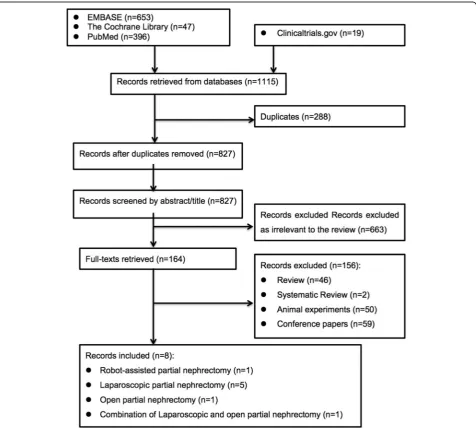
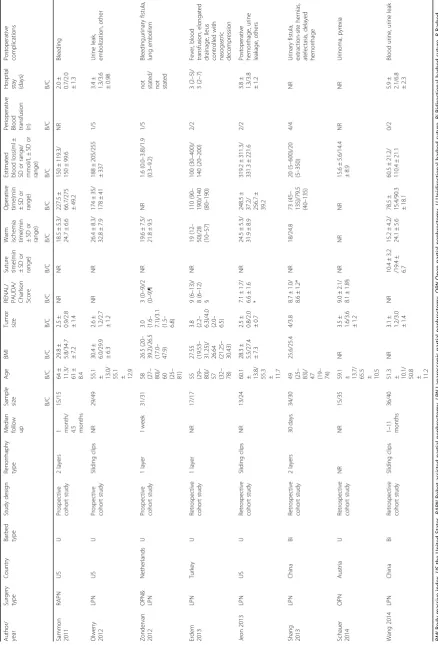
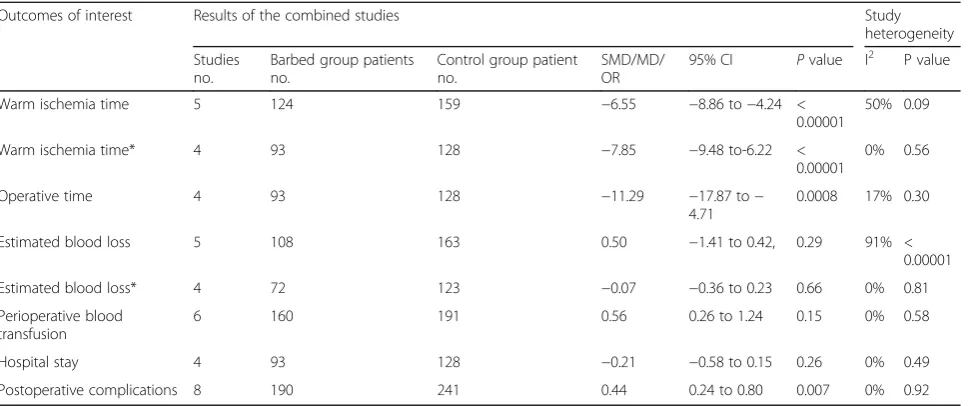
selection process is reported (Fig. 1). Table 1 shows the baseline characteristics and the results of all the eligible studies. All the data were comparable. Results of com-bined data comparing barbed suture versus conventional suture are presented in Table2.
Low to moderate risk of bias were considered among all the included studies (Additional file1: Table S1). Specific-ally, the participant population within a study was identi-fied from a same clinical setting comparing barbed suture with control. Ascertainment of patients performed partial nephrectomy was based on surgical records. A total of 3 studies have adjusted important confounding factors by matching pairs (body mass index and operative approach). No loss to follow-up in all studies.
Warm ischemia time
Of the 8 cohort studies, 5 reported the warm ischemia time of partial nephrectomy [18–20, 22, 25] (Fig. 2a). Due to the fact that the heterogeneity is high among the WIT (P= 0.09, I2= 50%), the random effects model was adopted instead of the fixed effects model. The pooling of raw data of these 283 cases suggested that patients with barbed suture versus conventional suture had a signifi-cantly shorter WIT. (MD =−6.55, 95% CI -8.86 to−4.24, P< 0.00001). Since Zondervan’s study recruited both lap-aroscopic and open surgeries whereas others only focused on laparoscopic partial nephrectomy, it was excluded for a sensitivity analysis. Therefore, the newly pooled results (221 cases) with low heterogeneity (I2= 0%,) indicated that
Table 1 Basic characteristics of all pooled studies in the meta-analysis Author/ year Surgery type Country Barbed type Study design Renorrhaphy type Median follow up Sample size
Age
BMI
Tumor size RENAL/ PAUDA/ Charlson Score Suture time(min ±S
D
o
r
range)
Warm ischemia time(min ±S
D
o
r
range)
Operative time(min ±S
D o r range) Estimated blood loss(ml ± SD or range/ mmol/L ± SD or range)
Perioperative Blood transfusion (n) Hospital stay (days) Postoperative complications B/C B/C B/C B/C B/C B/C B/C B/C B/C B/C B/C Sammon 2011 RAPN US U Prospective cohort study 2 layers
1 month/ 4.5 months
15/15 64 ± 11.3/ 61 ± 8.4 29.8 ±
5.8/34.7 ±7.2
2.5
±
0.9/2.8 ±1.4
NR NR 18.5 ± 5.3/ 24.7 ± 6.6 227.5 ±
66.7/275 ±49.2
150 ± 119.3/ 150 ± 99.6 NR 2.0 ±
0.7/2.0 ±1.3
Bleeding Olweny 2012 LPN US U Prospective cohort study Sliding clips NR 29/49
55.1 ± 13.0/ 55.1 ± 12.9
30.4
±
6.0/29.9 ±6.3
2.6
±
1.2/2.7 ±1.2
NR NR 26.4 ± 8.3/ 32.8 ± 7.9 174 ± 35/ 178 ± 41 188 ± 205/255 ± 337 1/5 3.4 ±
1.3/3.6 ±0.98
Urine leak, embolization, other Zondervan 2012 OPN& LPN Netherlands U Prospective cohort study 1 layer 1 week 31/31 58 (27 –
80)/ 60 (25
– 81) 26.5 (20 – 39.2)/26.5 (17.0 – 47.9) 3.0 (1.6 – 7.1)/3.1 (1.5 – 6.8) 3( 0 – 9)/2 (0 – 9)¶ NR 19.6 ± 7.5/ 21.8 ± 9.5 NR 1.6 (0.0 – 3.8)/1.9 (0.3 – 9.2) 1/5
not stated/ not stated
Bleeding,urinary fistula, lung embolism Erdem 2013 LPN Turkey U Retrospective cohort study 1 layer NR 17/17 55 (29 –
80)/ 57 (32
–
78)
27.55 (19.53
–
31.25)/ 26.64 (21.25
– 30.43) 3.8 (2.2 – 6.3)/4.0 (2.0 – 6.5) 9( 6 – 13)/ 8( 6 – 12) § NR 19 (12 – 50)/28 (10 – 57) 110 (90 – 190)/140 (80 – 190) 100 (30 – 400)/ 140 (20 – 200) 2/2 3 (2 – 5)/ 3( 2 – 7) Fever, blood transfusion, elongated drainage, Ileus controlled with nasogastric decompression Jeon 2013 LPN US U Retrospective cohort study Sliding clips NR 13/24
60.1 ± 13.8/ 55.3 ± 11.7
28.3
±
5.5/27.4 ±7.3
2.5
±
0.8/2.0 ±0.7
7.1 ± 1.7/ 6.6 ± 1.6 * NR 24.5 ± 5.3/ 31.9 ± 8.9 248.5 ± 37.2/ 256.7 ± 39.2 319.2 ± 311.3/ 331.3 ± 221.6 2/2 3.8 ±
1.3/3.8 ±1.2 Postoperative hemorrhage, urine leakage, others Shang 2013 LPN China Bi Retrospective cohort study 2 layers 30 days 34/30 49 (25 –
83)/ 47 (19
– 74) 25.6/25.4 4/3.8 8.7 ± 1.0/ 8.6 ± 1.2* NR 18/24.8 73 (45 – 135)/79.5 (40 – 135) 20 (5 – 600)/20 (5 – 350) 4/4 NR Urinary fistula, extraction-site hernias, atelectasis, delayed hemorrhage Schauer 2014 OPN Austria U Retrospective cohort study NR NR 15/35
59.1 ± 13.7/ 65.5 ± 10.5
NR
3.5
±
1.6/3.6 ±1.2
9.0 ± 2.1/ 8.1 ± 1.8§ NR NR NR 15.6 ± 5.6/14.4 ± 8.9 NR NR Urinoma, pyrexia Wang 2014 LPN China Bi Retrospective cohort study Sliding clips 1 – 11 months 36/40
51.3 ± 10.1/ 50.8 ± 11.2
NR
3.1
±
1.2/3.0 ±1.4
NR 10.4 ± 3.2 /19.4 ± 6.7 15.2 ± 4.2/ 24.1 ± 5.6 78.5 ±
15.4/90.3 ±18.1
60.5 ± 21.2/ 110.4 ± 21.1 0/2 5.9 ±
2.1/6.8 ±2.3
WIT in laparoscopic partial nephrectomy significantly de-creased. (MD =−7.85, 95% CI -9.48 to-6.22,P< 0.00001, Additional file1: Figure S1).
Operative time
Four studies of the laparoscopic partial nephrectomy re-ported data of operative time [18, 19, 22, 25] (Fig. 2b). The pooling of raw data presented a statistically signifi-cant association between the suture types (barbed su-tures vs. conventional susu-tures) and operative time based on 221 cases (MD =−11.29, P= 0.0008, 95% CI -17.87 to−4.71) with low heterogeneity (I2= 17%).
Estimated blood loss
Five studies reported outcomes of estimated blood loss [18,19,22,24,25] (hemoglobin level or volume of blood loss). (Figure2c) The pooling outcomes of the 271 cases did not present significantly benefits of barbed suture over conventional suture (SMD =−0.50, 95% CI -1.41 to 0.42, P= 0.29). This finding was, however, highly limited due to a very high level of heterogeneity with random ef-fect model (I2= 91%).
Since Wang’s study [25] account for the bidirectional barbed suture (Quill SRS), while others applied unidirec-tional barbed suture (V-Loc™180), we therefore excluded this study for a sensitivity analysis. And the newly pooled results (195 cases) showed the same result while with low heterogeneity. (SMD =−0.07, 95% CI -0.36 to 0.23, P= 0.66, I2= 0%, Additional file 1: Figure S2).
Perioperative blood transfusion
Six studies reported data of perioperative blood transfusion based on 351 participants. [19–23, 25]
(Fig. 2d). Pooling of these cohort studies did not suggest a statistically significant association between the suture types and perioperative blood transfusion (OR = 0.56, 95% CI 0.26 to 1.24, P= 0.15, I2= 0%). Moreover, subgroup analysis presented similar results, regardless of unidirectional or bidirectional barbed suture. (Additional file1: Figure S3).
Hospital stay
Four studies, with 221 patients recruited, reported about hospital stay [18, 19, 22, 25] (Fig. 2e). Pooling of those outcomes did not present a statistically sig-nificant association between the application of barbed suture and hospital duration. (MD =−0.21, 95% CI -0.58 to 0.15, P= 0.26, I2 = 0%).
Postoperative complications
Eight cohort studies reported raw event data postoperative complications [18–25] and the postoperative complications were evaluated based on the modified Clavien classifica-tion(Fig. 2f, Table 1) Pooling data of all the 431 cases showed that significantly fewer postoperative complications were found in patients with barbed suture versus conven-tional suture. (OR = 0.44,P= 0.007, 95% CI 0.24 to 0.80, I2 = 0%). Then the subgroup analyses (Additional file1: Figure S4) by barbed suture types showed: compared with unidir-ectional barbed suture (V-Loc™), the use of barbed suture statistically decreases the postoperative complications. (OR = 0.48, 95% CI 0.24 to 0.94,P= 0.03, I2= 0%); as for bidirec-tional barbed suture (Quill SRS), pooled data did not show significant differences between both groups (OR = 0.35, 95% CI 0.10 to 1.18,P= 0.09, I2= 0%).
Table 2Results of meta-analysis comparing barbed and control suture group
Outcomes of interest Results of the combined studies Study
heterogeneity
Studies no.
Barbed group patients no.
Control group patient no.
SMD/MD/ OR
95% CI Pvalue I2 P value
Warm ischemia time 5 124 159 −6.55 −8.86 to−4.24 <
0.00001
50% 0.09
Warm ischemia time* 4 93 128 −7.85 −9.48 to-6.22 <
0.00001
0% 0.56
Operative time 4 93 128 −11.29 −17.87 to−
4.71
0.0008 17% 0.30
Estimated blood loss 5 108 163 0.50 −1.41 to 0.42, 0.29 91% <
0.00001
Estimated blood loss* 4 72 123 −0.07 −0.36 to 0.23 0.66 0% 0.81
Perioperative blood transfusion
6 160 191 0.56 0.26 to 1.24 0.15 0% 0.58
Hospital stay 4 93 128 −0.21 −0.58 to 0.15 0.26 0% 0.49
Postoperative complications 8 190 241 0.44 0.24 to 0.80 0.007 0% 0.92
Changes in renal function
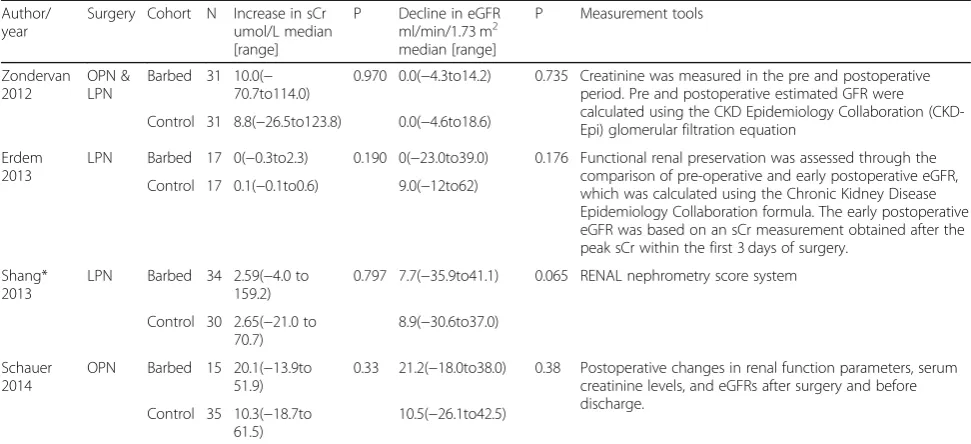
As the reflection of renal function, sCr and/or eGFR were reported by four studies [20, 21, 23, 24] (Table3). Measurement tools differed among four studies and only
median and range data were reported. Though not read-ily for pooling, all did not suggest that significant changes between two suture groups in terms of both renal function indicators.
Discussion
In this systematic review, we have included all the con-trolled studies to test the effects of barbed suture on PN. The pooling of all the cohort studies showed significant decreases in WIT, operative time, and postoperative complications in barbed suture group; the quality of included cohort studies was high to moderate. The subgroup analysis suggested that unidirectional barbed suture significantly minimized the postoperative com-plications, which seems to be safer than the trad-itional suture.
As the most important factor after partial nephrec-tomy, the pooled outcome of WIT witnessed an overall significant reduction in barbed suture groups, especially laparoscopic partial nephrectomies. This means barbed suture can effectively reduce the WIT during laparo-scopic partial nephrectomies so as to improve the post-operative renal function.
SCr and eGFR were the most commonly used tools to evaluate renal function after PN [1], but the change of these two indexes were only reported in four studies [20, 21, 23, 24]. Since all the raw data suggested no significant shift between both groups, many researchers believed that the results needed larger sample size [24] and longer follow up time to confirm, say at least 5-year follow up [21]. Besides, there are many ways to determine loss of renal function and evaluate the effects of surgery on renal function, such as renal scan and volumetric as-sessment of the kidney, which were not reported in the ar-ticles included [26, 27]. Moreover, as the concentrations of them are enormously influenced by age, gender, muscle
mass and so on [1,3], a more convincing way to evaluate renal function loss in the patients, such as renal scintig-raphy, needs to be focused on for future studies. Further-more, the statistical decrease of operative time in barbed group also indicated that barbed suture was effective in partial nephrectomy either by a robot-assisted, laparo-scopic, or open technique [28].
With regard to blood issue, both outcomes of esti-mated blood loss and transfusion were comparable. After performing the sensitivity analysis on the out-comes of estimated blood loss, the heterogeneity dropped from 91 to 0% with the pooled outcomes of still no significant difference. Similarly, the subgroup analysis of blood transfusion by different barbed suture did not suggest any difference from the overall effect. However, Zondervan et al [20]. reported that no difference was owing to the fact that hemostatic agents applied during surgery were not considered, thus this may be a confound-ing factor that need take into account in the future.
Meanwhile, number of postoperative complications was significantly minimized in barbed suture groups. Be-sides, subgroup analysis indicated that unidirectional barbed suture turned out to be safer than the convention suture while bidirectional barbed suture did not. How-ever, no human study concerned the safety and efficacy among different barbed sutures. Thus the feasibility and safety among different barbed sutures in vivo study need to take into consideration [29,30].
The pooled outcome in this study provides a reliable evidence for the relationship between the barbed suture and some important surgical indicators for PN.
Table 3Changes in renal function before and after PN (sCr & eGFR)
Author/ year
Surgery Cohort N Increase in sCr umol/L median [range]
P Decline in eGFR ml/min/1.73 m2 median [range]
P Measurement tools
Zondervan 2012
OPN & LPN
Barbed 31 10.0(− 70.7to114.0)
0.970 0.0(−4.3to14.2) 0.735 Creatinine was measured in the pre and postoperative period. Pre and postoperative estimated GFR were calculated using the CKD Epidemiology Collaboration (CKD-Epi) glomerular filtration equation
Control 31 8.8(−26.5to123.8) 0.0(−4.6to18.6)
Erdem 2013
LPN Barbed 17 0(−0.3to2.3) 0.190 0(−23.0to39.0) 0.176 Functional renal preservation was assessed through the comparison of pre-operative and early postoperative eGFR, which was calculated using the Chronic Kidney Disease Epidemiology Collaboration formula. The early postoperative eGFR was based on an sCr measurement obtained after the peak sCr within the first 3 days of surgery.
Control 17 0.1(−0.1to0.6) 9.0(−12to62)
Shang* 2013
LPN Barbed 34 2.59(−4.0 to 159.2)
0.797 7.7(−35.9to41.1) 0.065 RENAL nephrometry score system
Control 30 2.65(−21.0 to 70.7)
8.9(−30.6to37.0)
Schauer 2014
OPN Barbed 15 20.1(−13.9to 51.9)
0.33 21.2(−18.0to38.0) 0.38 Postoperative changes in renal function parameters, serum creatinine levels, and eGFRs after surgery and before discharge.
Control 35 10.3(−18.7to 61.5)
10.5(−26.1to42.5)
However, there are limitations of this study [1]. Even though two cohort studies adjusted their analyses via matching pairs, the pooled data may also be influenced by many factors, such as surgeons’ preference or learn-ing curves due to none of RCTs recruited [2]. Because not all the studies evaluated the tumor via RENAL, PAUDA or Charlson scores before surgeries, it is impos-sible to perform subgroup analyses based on those in-dexes and future studies should uniform the standards to evaluate renal tumors [3]. The literatures search was extensive, but the barbed suture only suggested for all T1 kidney tumors rather than some suitable T2-may be or T3 cases and still did not involve animal studies, let-ters to the editors, and conference publications; and [4] because only 8 studies were recruited, the risk of publi-cation bias could not be evaluated by the Begg’s funnel plots.
Nevertheless, our result renews a latest meta-analysis on barbed suture in PN. Based on what we know, this is to date the most comprehensive meta-analysis and sys-tematic review exploring the relationship between barbed and traditional suture in PN.
Conclusions
The barbed suture may be a useful surgical innovation which can modify perioperative results for surgeons and patients. Significant decline of suture time, operative time and postoperative complications were found using barbed suture during PN. Unidirectional barbed suture seemed to be safer. Because of the limitations of quality, especially that matched renal tumor complexity is not utilized, this state-of-the-art need to be proved by evi-dences with higher quality, and randomized-controlled studies with longer follow up and larger sample sizes will be needed to prove the findings of the present studies.
Additional file
Additional file 1:Figure S1.A forest plot of sensitivity analysis of warm
ischemia time with or without barbed suture.Figure S2.A forest plot of sensitivity analysis of Estimate blood loss with or without barbed suture. Figure S3.A forest plot of subgroup analysis of perioperative blood transfusion with or without barbed suture.Figure S4.A forest plot of subgroup analysis of postoperative complications with or without barbed suture.Table S1.Quality assessment of studies in the meta-analysis based on Newcastle-Ottawa Scale (NOS). (DOCX 92 kb)
Acknowledgements
Supported by Grant No. 81403276 from the National Natural Science Foundation of China and Grant No. JH20140066 from the Technology Support Program of Science and Technology Department of Sichuan Province.
Funding
Supported by Grant No. 81403276 from the National Natural Science Foundation of China and Grant No. JH20140066 from the Technology Support Program of Science and Technology Department of Sichuan Province. The funders had no role in the experimental design, data collection,
analysis, preparation of the manuscript, or decision to publish. Any opinions, findings, conclusions, or recommendations expressed in this article are those of the authors alone, and do not necessarily reflect the views of funders.
Availability of data and materials
All the data supporting your findings is contained within the manuscript.
Authors’contributions
YL, BL: Project development, data analysis and management, manuscript writing and editing. SL: Data collection, data analysis and management. LD: Data analysis and management, management manuscript writing and editing. JH, KW, HL: project development, manuscript writing and editing. All authors read and approved the final manuscript.
Ethics approval and consent to participate
Ethics was not required for our meta-analysis. And consent was not required from the patients/guardians as this meta-analysis only concerns patients whose details have already been published.
Consent for publication
This is not required for a meta-analysis of previously published information.
Competing interests
The authors report no proprietary or commercial interest in any product or concept discussed in the article.
Publisher’s Note
Springer Nature remains neutral with regard to jurisdictional claims in published maps and institutional affiliations.
Author details
1
Department of Urology, Institute of Urology (Laboratory of Reconstructive Urology), West China Hospital, Sichuan University, Chengdu, Sichuan, People’s Republic of China.2West China School of Medicine, Sichuan University, Guoxuexiang 37, Chengdu 610041, Sichuan, China.3West China Hospital, Sichuan University, Guoxuexiang 37, Chengdu 610041, Sichuan, China.
Received: 2 August 2017 Accepted: 26 December 2018
References
1. Volpe A, Blute ML, Ficarra V, Gill IS, Kutikov A, Porpiglia F, et al. Renal ischemia and function after partial nephrectomy: a collaborative review of the literature. Eur Urol. 2015;68(1):61–74.
2. Porpiglia F, Bertolo R, Amparore D, Fiori C. Nephron-sparing suture of renal parenchyma after partial nephrectomy: which technique to go for? Some best practices. Eur Urol Focus. In press.
3. Lane BR, Babineau DC, Poggio ED, Weight CJ, Larson BT, Gill IS, et al. Factors predicting renal functional outcome after partial nephrectomy. J Urol. 2008; 180(6):2363–8 discussion 8-9.
4. Becker F, Van Poppel H, Hakenberg OW, Stief C, Gill I, Guazzoni G, et al. Assessing the impact of ischaemia time during partial nephrectomy. Eur Urol. 2009;56(4):625–34.
5. Gao ZL, Gu GL, Wu JT, Wang L. Comparison of the transperitoneal and a semi-open retroperitoneal approach for right-sided laparoscopic donor nephrectomy. Ann Transplant. 2011;16(4):40–6.
6. Benway BM, Wang AJ, Cabello JM, Bhayani SB. Robotic partial nephrectomy with sliding-clip renorrhaphy: technique and outcomes. Eur Urol. 2009;55(3): 592–9.
7. Gettman MT, Blute ML, Chow GK, Neururer R, Bartsch G, Peschel R. Robotic-assisted laparoscopic partial nephrectomy: technique and initial clinical experience with DaVinci robotic system. Urology. 2004;64(5):914–8. 8. Seideman C, Park S, Best SL, Cadeddu JA, Olweny EO. Self-retaining barbed
suture for parenchymal repair during minimally invasive partial nephrectomy. J Endourol. 2011;25(8):1245–7 discussion 7-8.
9. Ruff GL. The history of barbed sutures. Aesthet Surg J. 2013;33(3 Suppl):12s–6s. 10. Warner JP, Gutowski KA. Abdominoplasty with progressive tension closure
using a barbed suture technique. Aesthet Surg J. 2009;29(3):221–5. 11. Bai Y, Pu C, Yuan H, Tang Y, Wang X, Li J, et al. Assessing the impact
radical prostatectomy: a systematic review and meta-analysis. Urology. 2015; 85(6):1368–75.
12. Li H, Liu C, Zhang H, Xu W, Liu J, Chen Y, et al. The use of unidirectional barbed suture for Urethrovesical anastomosis during robot-assisted radical prostatectomy: a systematic review and meta-analysis of efficacy and safety. PLoS One. 2015;10(7):e0131167.
13. Lin YF, Lai SK, Liu QY, Liao BH, Huang J, Du L, et al. Efficacy and safety of barbed suture in minimally invasive radical prostatectomy: a systematic review and meta-analysis. Kaohsiung J Med Sci. 2017;33(3):107–15. 14. Weld KJ, Ames CD, Hruby G, Humphrey PA, Landman J. Evaluation of a
novel knotless self-anchoring suture material for urinary tract reconstruction. Urology. 2006;67(6):1133–7.
15. Rashid RM, Sartori M, White LE, Villa MT, Yoo SS, Alam M. Breaking strength of barbed polypropylene sutures: rater-blinded, controlled comparison with nonbarbed sutures of various calibers. Arch Dermatol. 2007;143(7):869–72. 16. Dindo D, Demartines N, Clavien PA. Classification of surgical complications:
a new proposal with evaluation in a cohort of 6336 patients and results of a survey. Ann Surg. 2004;240(2):205–13.
17. Wells GA, Shea B, Peterson JEA, Welch V, Losos M, Tugwell P. The Newcastle-Ottawa scale (NOS) for assessing the quality of nonrandomised studies in meta-analyses; 2000.
18. Sammon J, Petros F, Sukumar S, Bhandari A, Kaul S, Menon M, et al. Barbed suture for renorrhaphy during robot-assisted partial nephrectomy. J Endourol. 2011;25(3):529–33.
19. Olweny EO, Park SK, Seideman CA, Best SL, Cadeddu JA. Self-retaining barbed suture for parenchymal repair during laparoscopic partial nephrectomy; initial clinical experience. BJU Int. 2012;109(6):906–9.
20. Zondervan PJ, Gozen AS, Opondo D, Rassweiler JJ, de la Rosette JJ, Laguna MP. Partial nephrectomy: is there an advantage of the self-retaining barbed suture in the perioperative period? A matched case-control comparison. World J Urol. 2012;30(5):659–64.
21. Erdem S, Tefik T, Mammadov A, Ural F, Oktar T, Issever H, et al. The use of self-retaining barbed suture for inner layer renorrhaphy significantly reduces warm ischemia time in laparoscopic partial nephrectomy: outcomes of a matched-pair analysis. J Endourol. 2013;27(4):452–8.
22. Jeon SH, Jung S, Son HS, Kimm SY, Chung BI. The unidirectional barbed suture for renorrhaphy during laparoscopic partial nephrectomy: Stanford experience. J Laparoendosc Adv Surg Tech A. 2013;23(6):521–5. 23. Shang JW, Ma X, Zhang X, Li HZ, Shi TP. Comparison of two different
renorrhaphy techniques in retroperitoneal laparoscopic partial nephrectomy for complex tumor. Chin Med J. 2013;126(24):4629–32.
24. Schauer I, Theimer O, Klatte T, Waldert M, Klingler HC, Margreiter M. Use of self-retaining barbed sutures decreases cold ischemia time in open nephron-sparing surgery. Wien Klin Wochenschr. 2014;126(11–12):329–34.
25. Wang K, Zhang YL, Lin CH, Liu DF, Men CP, Wang JM, et al. Application of self-retaining bidirectional barbed absorbable suture in retroperito- neoscopic partial nephrectomy. Int Braz J Urol. 2014;40(2):220–4.
26. Porpiglia F, Bertolo R, Fiori C. Words of wisdom: re: residual parenchymal volume, not warm ischemia time, predicts ultimate renal functional outcomes in patients undergoing partial nephrectomy. Eur Urol. 2016;69(1):176–7. 27. Bertolo RG, Zargar H, Autorino R, Fiori C, Kaouk JH, Russo P, et al. Estimated
glomerular filtration rate, renal scan and volumetric assessment of the kidney before and after partial nephrectomy: a review of the current literature. Minerva Urol Nefrol. 2017;69(6):539–47.
28. Campbell SC, Novick AC, Belldegrun A, Blute ML, Chow GK, Derweesh IH, et al. Guideline for management of the clinical T1 renal mass. J Urol. 2009; 182(4):1271–9.
29. Jordan MC, Holscher-Doht S, Jakubietz MG, Jakubietz RG, Meffert RH, Schmidt K. Suture material for flexor tendon repair: 3-0 V-Loc versus 3-0 Stratafix in a biomechanical comparison ex vivo. J Orthop Surg Res. 2014;9:72.