Licensed under Creative Common Page 206
http://ijecm.co.uk/
ISSN 2348 0386
THE ROLE OF SUPERVISORY AGENCY IN THE
IMPLEMENTATION OF THE IMPLEMENTATION OF GOOD
CORPORATE GOVERNANCE AND ITS IMPLICATIONS ON
LPD PERFORMANCE IN DENPASAR, INDONESIA
I Gusti Ngurah Agung Suaryana
Fakultas Ekonomi dan Bisnis, Universitas Udayana, Bali, Indonesia
Naniek Noviari
Fakultas Ekonomi dan Bisnis, Universitas Udayana, Bali, Indonesia
Abstract
Lembaga Perkreditan Desa (LPD) is a microfinancial institution with a mission to
encourage the economy of rural communities through the activities of collecting deposits
and saving deposits from villagers and then channeled into loans to villagers in need. LPD
performance can be seen from the level of LPD health. This level of health should be
maintained by LPDs in order to continue to grow and provide benefits for the village
community as a mediating body between those who need funds and the excess funds, and
support village development. Performance is the concern of LPD le aders, LPD supervisory
bodies, villagers, and the government as an institution for developing an LPD. Various
efforts are made to maintain and improve the performance of the LPD. One important
effort is to establish an LPD supervisory body. The LPD supervi sory body is responsible
for monitoring the operation of the LPD. The regulatory body is expected to improve the
implementation of good corporate governance (GCG) practices by LPDs. The application
of GCG principles is expected to improve LPD performance. The study sample was 35
LPDs in Denpasar City. Research respondents were LPD leaders. Data analysis was done
using Partial Least Square. Based on the empirical findings, study found that effective
Licensed under Creative Common Page 207 implementation of the principles of good corporate governance, the better the performance
of the LPD. Research does not prove the direct effect of the effectiveness of the regulatory
body on LPD performance.
Keywords: Corporate governance, supervisory bodies, performance, microfinancial institution
INTRODUCTION
The Bali Provincial Government issued Regional Regulation No. 3 of 2007, is a change to
Regional Regulation No. 5 of 2002 concerning Village Credit Institutions (LPD). LPDs are
important institutions in traditional villages. This is because the LPD was established to
encourage the economy of rural communities through activities to collect deposits and time
deposits from villagers. Funds obtained from will be distributed in the form of loans to villagers
who need it. The provision of loans to villagers aims to eradicate debt bondage and black
pledges, creating equity and business opportunities for villagers, increasing purchasing power,
increasing payment traffic and circulation of money in the village. This goal will be achieved if
the LPD carries out technical and management functions appropriately and consequently
(Novianti et al., 2014). LPDs must carry out business management rules appropriately in
accordance with the scope of the field of work carried out. The proper and consistent
implementation of functions and management is expected to improve LPD performance.
LPD performance can be seen from the level of LPD health. LPD health rate in
Denpasar City can be seen from LPD Trustees, namely the Bali Regional Development Bank
(BPD Bali). Based on LPD Head of BPD Bali Report, from 31 LPDs in Denpasar City, 25 LPD
are healthy and 6 LPD are healthy enough. This level of health should be maintained by LPDs
in order to continue to grow and provide benefits for the village community as a mediating body
between those who need funds and the excess funds, and support village development. The
soundness of LPDs is the concern of LPD leaders, LPD supervisory agencies, community
members, and the government as an LPD guiding institution. The soundness of LPDs is the
concern of LPD leaders, LPD supervisory agencies, community members, and the government
as an LPD guiding institution.
Various efforts are made to maintain and improve the performance of the LPD. One
important effort is to establish an LPD supervisory body. The LPD supervisory body is tasked
with monitoring LPD operations and the progress of LPD progress (Giri et al., 2014).
Supervision carried out by the supervisory body is carried out on operational management and
Licensed under Creative Common Page 208 community, monitoring the achievement of targets agreed upon in the work plan. This shows the
important role of the supervisory body in monitoring the role of LPD managers in carrying out
their duties.
The role of the supervisory body in carrying out its tasks is to ensure that the manager
manages the LPD in accordance with the interests of the community. This is in accordance with
the agency theory expressed by Jensen and Meckling (1976). Managers as agents will try to
maximize their interests. The interests of managers often conflict with the interests of villagers
who act as LPD principals. Villagers expect the LPD to perform well. Good performance is
expected to be obtained through an oversight mechanism by the LPD supervisory body. The
role of supervision in efforts to improve performance is stated by Perwitasari and Badera (2015)
and Wahyudi and Damayanthi (2015).
Increased regulatory bodies are expected to improve the application of the principles of
good corporate governance (GCG) applied in LPDs. A competent, independent supervisory
body that understands its role can increase the effectiveness of supervision in LPDs (Putra and
Rasmini, 2014). Supervision is an effort to improve the implementation of GCG. GCG
implementation can be seen from the four aspects of GCG assessment, namely transparency,
accountability, responsibility, independence, fairness and equality.
Good GCG is expected to improve LPD performance. Five aspects of GCG, namely
transparency, accountability, responsibility, independence, fairness and equity. GCG as a form
of good organizational management practitioners is expected to improve LPD performance.
Previous research has found that good GCG practices can improve organizational performance
(Setyawan and Putri, 2013; Dewi and Putri, 2014; Pratiwi and Putri, 2016; Bulandari and
Damayanthi, 2014; Sandraningsih and Putri, 2015; Pradnyaswari and Putri, 2016; Hindistari and
Putri, 2016; Sidney and Sari, 2016).
This study aims to examine the role of the regulatory body in an effort to improve LPD
performance. In an effort to improve LPD performance, the regulatory body will work to improve
GCG practices. GCG practices will improve LPD performance.
The results of this study are beneficial for the traditional village and the Government in
an effort to improve LPD performance. The important role of the LPD supervisory body in order
to improve corporate governance practitioners and their impact on improving the performance of
LPDs is expected to be the concern of indigenous communities and administrators in selecting
members of the regulatory body. The government is expected as a coach to formulate policies
that encourage the increased role of effective supervisory bodies and good corporate
Licensed under Creative Common Page 209 LITERATURE REVIEW
Agency Theory
Agency theory is a theory built on the working relationship between agents as management and
principals as owners. This agency relationship is defined as an agreement between one or more
principals who employ agents, agents are expected to be able to do work, such as managing
and making decisions related to the company on behalf of the principal. The main points
discussed in this agency theory are agency problems caused by conflicts of interest between
agents and principals (Jensen and Meckling, 1976). The Principal expects the agent to carry out
certain tasks related to the interests of the principal, such as maximizing the welfare of the
principal so that the agent must be responsible according to the principal's wishes, while on the
other hand, the agent generally acts based on the interests he has, namely maximizing the
welfare of the agent and indirectly will ignore the interests of the company. Without the
knowledge of the principal, the agent may know more about the actual condition of the company
than the principal so that in the agency relationship there can be a conflict of interest (Adhi and
Siti, 2012). The occurrence of conflicts of interest in the business organization causes the
performance of managers and companies to be an important aspect to note (Moradi, et al,
2012). Conflicts of interest may occur in the business organization because the principal as the
owner can not always supervise the management activities to ascertain whether the
management has worked in accordance with the principal want. Sometimes the information
submitted is not in accordance with the actual conditions of the company (Savitri, 2010). This
condition is called information asymmetry (information asymmetric). Ujiantho and Pramuka
(2007) state that the existence of such asymmetrical information may encourage management
(agents) to hide some information that is not known by the owner (principal) that is done in order
to maximize the profit of the agent. Agencies can be motivated to report non-actual information
to the principal, especially if the information is related to agency performance measurement.
Corporate governance is one of the most important internal control mechanisms of institutional
problems in reducing one of the effects of the agency relationship, namely information
asymmetry (Clemente and Labat, 2009).
The agency theory applied in this research is seen from the organizational structure in
LPD, the LPD management as the agent and krama desa (villagers) as the principal. Desa
pakraman (village) within the LPD is the owner of the LPD which commissioned the board to run
the LPD in order to maintain the economic stability in the village where the LPD is located. Seen
from the structure of the LPD management, the agency theory results from delegation of tasks
or authority given by the LPD leadership (agent) to the head of the principal, as well as the
Licensed under Creative Common Page 210 Krama desa as the principal of Lembaga Perkreditan Desa (LPD) and LPD managers as agents
is a union that must have good relationship to achieve the vision and mission of LPD itself. LPD
managers should avoid conflict with village manners as principals. LPD managers must be
responsible for the overall activities carried out in the LPD to the krama desa.
The Role of the LPD Supervisory Agency
The supervisory agency in the decision of the Governor of Bali Level I Number 491 of 1998
concerning the provisions for the establishment of a supervisory agency, stated that the duty to
carry out the internal supervision function of the LPD is the regulatory body. Supervision is a
coordinated activity and helps management to ensure that the results obtained are close to what
is planned. Supervision carried out on LPD activities will affect the smooth operation and can
prevent the occurrence of irregularities from errors that occur. Effectiveness is a term for the
quality of the attitude of the members of one profession to their profession and the degree of
knowledge and expertise they have. Based on the above explanation, it can be concluded that
the supervisory agency can also take a role in influencing LPD performance. Considering the
very importance of the existence of the supervisory agency, they are required to have an
independent attitude, professional expertise and work experience and training to support their
duties. In fact, most of the examiners on the supervisory agency still do not have the
competence to conduct audits, this results in an ineffective and inefficient audit conducted by
the supervisory agency (Iyos and Arifin, 2009: 2).
Good Corporate Governance
Good Corporarate Governance (GCG) is a process and structure used by organizations to
improve business success and corporate accountability. The GCG principle involves the
interests of shareholders (company owners), equal treatment of shareholders, the role of all
interested parties (stakeholders) in GCG, transparency and explanation, as well as the board of
commissioners and audit committee (Radjagukguk, 2014). GCG can also be interpreted as a
mechanism for managing the company to ensure that management actions will always be
directed for increasing the value of the company (Baridwan, 2003: 16). GCG is defined as a
process and structure used by companies (shareholders / owners, commissaries / supervisory
boards, and directors) to increase business success and corporate accountability to increase
the value of shareholders (company owners) in the long term while paying attention to the
interests of stakeholders. Others, based on legislation and ethical values. Based on the
Licensed under Creative Common Page 211 management acts in accordance with the interests of the owners and stakeholders around the
company, so that the company's objectives are based on ethical rules and values.
The Forum for Corporate Governance in Indonesia (FCGI) defines Corporate
governance as a set of rules governing the relationship between shareholders, stock managers,
creditors, government, employees and other internal and external stakeholders relating to their
rights and obligations to regulate and controlling the company. GCG according to Tangkilisan
(2003) is a system and structure for managing companies with the aim of increasing
shareholder value and allocating various parties with an interest in companies such as creditors,
suppliers, business associations, consumers, workers, government and the wider community.
Mark (2000) states that corporate governance is about building creativity, ensuring transparency
and accountability, and maintaining effective channels and information disclosure that will
encourage good corporate performance. In Indonesia all companies must implement the
principles of good corporate governance. Balinese people have four financial institutions that
can be used as funding sources. The four financial institutions are commercial banks, rural
banks, cooperatives and LPDs.
According to the 2006 National Committee on Governance Policy (KNKG), there are five
GCG principles, namely transparency, accountability, responsibility, independence, fairness and
equity. These five GCG principles are then abbreviated as TARIF. Transparency means that
companies must provide material and relevant information in a way that is easily accessible and
understandable to stakeholders. Companies should take the initiative to disclose, not only the
issues implied by legislation, but also important for decision-making by shareholders, creditors,
and other stakeholders. The implementation guidelines are (1) the company must provide
timely, adequate, clear, accurate, and comparable information that is easily accessible to the
stakeholders in accordance with its rights; (2) all information to be explained, including vision,
mission, business goals and corporate strategy, financial condition, composition and
compensation of management, controlling shareholder, share ownership by directors and board
of commissioners and their families, risk management system, supervisory and control system
internal, GCG systems and practices and their compliance level, and important events affecting
the company's financial condition, (3) the principle of disclosure held by the company does not
undermine the obligation to comply with the company's confidentiality requirements in
accordance with laws and regulations, personal, and (4) company policies should be written and
proportionally communicated to stakeholders.
Accountability means the company must account for its performance transparently and
fairly. The company must be managed correctly, measured, and in accordance with the
Licensed under Creative Common Page 212 and other stakeholders. Accountability is a prerequisite that is needed to achieve sustainable
performance.
Responsibility means that a company must comply with the laws and regulations and
carry out its responsibilities to the community and the environment, so as to obtain recognition
as a good corporate citizen. The main guidelines for implementation include (1) company
organs must adhere to prudent principles and ensure compliance with laws, company statutes
and regulations, and (2) enterprises should carry out social responsibility in the form of
community care and sustainability environment especially around the company.
Independence means companies must be managed independently, so that each company's
organs do not dominate each other and are not intervened by other parties. The basic guideline
for implementation is (1) each organ of the company must avoid the domination of any party, not
affected by certain interests, free from conflicts of interest and pressure, so that decision making
can be done objectively, (2) each organ carries out tasks and its function is in accordance with
the basic rules and legislation, does not dominate each other and throws responsibility between
one another, so that an effective internal control system is realized.
Fairness and equality means companies must always pay attention to the interests of
the owner and other stakeholders based on the principle of fairness and equality. The basic
guideline for implementation is (1) the company must provide opportunities for stakeholders to
provide input and express opinions for the interests of the company and open access to
information in accordance with the principles of transparency within the scope of their respective
positions, (2) the company must provide equal and fair treatment to stakeholders in accordance
with the benefits and contributions given to the company, and (3) the company must provide
equal opportunities in employee recruitment, career and carry out their duties professionally,
regardless of ethnicity, religion, race, gender, and physical condition.
Research Hypothesis
The Effect of the Effectiveness of the Supervisory Agency on LPD Performance
Agency theory explains the existence of a working relationship between principal and agent.
The principal authorizes the agent to manage the company on behalf of the company. The
problem that often arises in principal and agent relations is the difference between interests
between principals and agents (Jensen and Meckling, 1976). The Principal hopes that agents
act on behalf of principals to improve the welfare of principals, while on the other hand, agents
often act on the interests that they have, namely maximizing the welfare of agents and indirectly
ignoring the interests of the company. The Principal hopes that the agent will manage the
Licensed under Creative Common Page 213 related to the prosperity of the principal as the owner of the company. But often the agent as the
party given the authority to manage the company, seeks to maximize its interests. This creates
an effort to maximize the interests of agents who can harm the principal. Without the knowledge
of the principal, the agent may know more about the actual condition of the company than the
principal so that in the agency relationship there can be a conflict of interest (Adhi and Siti,
2012). The occurrence of conflicts of interest in the business organization causes the
performance of managers and companies to be an important aspect to note (Moradi, et al,
2012). Conflicts of interest may occur in the business organization because the principal as the
owner can not always supervise the management activities to ascertain whether the
management has worked in accordance with the principal want.
Agency theory explains the importance of monitoring activities to help principals in order
to oversee agent activities in managing the company. Monitoring aims to ensure the agent acts
on behalf of the principal, which is working in accordance with the interests of the principal.
Monitoring activities are carried out by parties who have adequate, independent and experience
competencies so that the Monitoring function can run well.
In the principal and agency relations, the LPD management acts as an agent, the
villager as the principal. The village in the LPD is the owner of the LPD that authorizes the board
to run the LPD to achieve the LPD goal of maximizing LPD performance. The conflict of interest
between the village and the LPD management was reduced by establishing a regulatory body.
The regulatory body is tasked with carrying out the internal supervision function of the LPD.
Supervision is a coordinated activity and assists management in ensuring that the results are
close to what is planned, so that the regulatory body plays an important role in improving the
performance of the LPD (Wahyudi and Damayanthi, 2015). The more effective the LPD
supervisory body is, the meal will be compared to the higher LPD performance.
Based on the explanation above, the research hypothesis can be formulated as follows.
H1 : The effectiveness of LPD supervisory bodies has a positive effect on LPD performance
Effect of Supervisory Agency Effectiveness on Good Corporate Governance Practices
An effective supervisory agency is proven to be able to improve LPD performance (Wahyudi
and Damayanthi, 2015). This is because the LPD supervisory agency is able to supervise the
LPD management, so that the LPD board is able to apply the principles of GCG well. The
principles of GCG, such as transparency, accountability, responsibility, independence, and
fairness and equality are able to be applied by LPD administrators with guidance by a
supervisory body that has competence, independence, and adequate experience in carrying out
Licensed under Creative Common Page 214 Based on the explanation above, the research hypothesis can be formulated as follows.
H2 :The effectiveness of the regulatory body has a positive effect on GCG practitioners in the
LPD
Effect of Good Corporate Governance Practices on LPD Performance
Mark (2000) states that corporate governance is building creativity, ensuring transparency and
accountability, and maintaining effective channels and information disclosure that will encourage
good corporate performance. Good corporate governance will improve the company's
performance. Implementation of good corporate governance has a relationship with internal
control of the company. The concept of good corporate governance can lead to good
performance for a company (Gozali, 2012). The application of good corporate governance can
drive performance, because it provides good direction in managing the company and ensuring
management actions, so that the effectiveness and efficiency of company management can be
achieved and create protection for all stakeholders' interests. Setyawan (2013) finds good
corporate governance able to influence financial performance positively and significantly. The
better implementation of good corporate governance in the same direction with the increase of
performance. Tjondro and Wilopo (2011) research proves that good corporate governance has
a significant positive influence on profitability indicators in banking sector companies. This
indicates that good corporate governance practices are accompanied by an increase in the
company's performance. LPD as a financial institution runs a good corporate governance
practitioner. Good corporate governance practices, such as transparency, accountability,
responsibility, independence, and fairness and equity will encourage the management of LPDs
to suit the best practitioners. This will improve LPD performance.
Based on the explanation above, the research hypothesis can be formulated as follows.
H3 : Good corporate governance practices have a positive effect on LPD performance.
RESEARCH METHOD
Location and Time of Research
The research location is a place or region where researchers conduct research. The location in
this study is LPD that located in the Denpasar, Indonesia.
Research Object
The object of research is to know character of the object determined by the researcher to be
studied and obtained from the conclusion (Sugiyono, 2013: 13). The object of research in this
Licensed under Creative Common Page 215 Data Source
Based on the source, the data used in this study is primary data is data that directly provide
data to the data collector (Sugiyono, 2007: 129). The primary data in this study are the answers
given by respondents to the questions in the questionnaire related to this study. Secondary data
is usually obtained in the form of finished, already collected and processed by other parties
(Sugiyono, 2007: 193). Secondary data in this research is general description of LPD, history of
LPD establishment, organizational structure, number of LPD and LPD financial report contained
in LPLPD Denpasar.
Data Type
The type of data used in this study is quantitative and qualitative data. Quantitative data such as
LPD performance. Qualitative data, such as the effectiveness of the regulatory body and good
corporate governance practices.
Sample Determination Method
The population in this study is the head of Lembaga Perkreditan Desa (LPD) in Denpasar.
Based on data from LPLPD recorded 35 LPD residing in Denpasar City. The samples used in
this study were selected by the saturated sampling method, that is the entire study population.
Research Variables
Research variable is an attribute of the nature or value of a person or activity that has a
variation that is determined to be studied and drawn conclusions (Sugiyono, 2013: 59):
a. Dependent variable is a variable that is affected or that becomes a result, because of the
independent variables (Sugiyono, 2013: 59). Dependent variable (Y) in this research is
performance of Lembaga Perkreditan Desa (LPD).
b. Independent variables are variables that influence or become the cause of changes or
the emergence of dependent variables (Sugiyono, 2013: 59). The independent variable
(X1) in this study is the effectiveness of the LPD supervisory body
c. Intervening variables are intermediate variables that are between independent and
dependent variables. Intervening variables in this study are practitioners of good
corporate governance.
Operational definition
Operational definition is a definition expressed in terms of terms that are specifically tested with
Licensed under Creative Common Page 216 a. The dependent / dependent variable in this study is the performance of rural credit
institutions. The performance of rural credit institutions is proxied by the level of soundness of
the soundness of the LPD basically assessed by a quantitative approach to five factors that
influence the condition and development of LPD as a financial institution, namely: (1) capital (2)
quality of earning assets (assets), (3) profitability (earnings), and (4) liquidity (liquidity). Use of
soundness as a performance measure is considered more comprehensive compared to one
indicator of financial performance measures, such as return on total assets used by
Pradnyaswari and Putri (2016). The level of health is more objective than the measurement of
performance as measured by the answers to statements used in Pradnyaswari and Putri (2016),
Sidney and Sari (2016), and Renitha and Putri (2016).
b. The independent variable of the study is the effectiveness of the supervisory body measured
by 9 statements that have been used by Wahyudi and Damayanthi (2015).
c. Intervening research variables are the application of good corporate governance principles,
namely transparency, accountability, responsibility, independence, and fairness and equality.
Measurement of the application of good corporate governance principles refers to a
questionnaire that has been used by Sidney and Sari (2016) and Pradnyaswari and Putri
(2016).
Data Analyses
Analysis data used in this research is Partial Least Square (PLS).
RESULTS AND DISCUSSION
General Description of Respondents
The population that became the object in this study were all Heads of Village Credit Institutions
in Denpasar City. Based on data from LPLPD recorded 35 LPD residing in Denpasar City. The
samples used in this study were selected by the saturated sampling method, that is the entire
study population. List of LPD names in Denpasar City is presented in Table 1.
Table 1. The names of LPDs recorded in Denpasar City
LPD Tonja LPD Pagan LPD Panjer LPD Oongan
LPD Tanjung Bungkak LPD Sidakarya LPD Ubung LPD Tembawu
Licensed under Creative Common Page 217 LPD Intaran
LPD Pohgading LPD Penatih Puri LPD Sanur LPD Peguyangan LPD Penatih LPD Renon LPD Peraupan LPD Laplap LPD Pohmanis LPD Pedungan LPD Cengkilung LPD Kesiman
LPD Padang Sambian LPD Sumerta LPD Pemogan LPD Denpasar LPD Yangbatu LPD Sesetan Source: http://www.bankdata.denpasarkota.go.id/
The questionnaire is returned entirely. All questionnaires returned are filled in completely and
meet the requirements so that no questionnaires are dropped. Here is a summary of the
shipment and return of the questionnaire.
Table 2. Summary of Shipping and Returning Questionnaires
Questionnaires Numbers
Questionnaire Spread Questionnaire Used
35 35
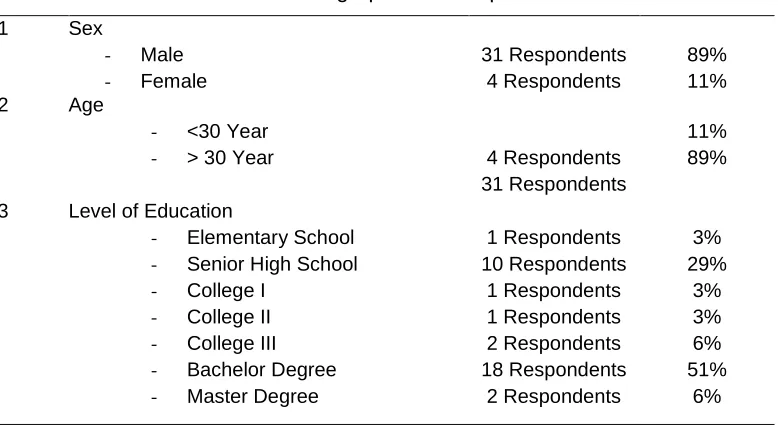
Demographic characteristics of respondents in this study is a profile of 35 respondents who fill
out this questionnaire. Characteristics of this respondent include gender, age, and level of
education (Table 3).
Table 3. Demographics of Respondents
1 Sex
- Male - Female 31 Respondents 4 Respondents 89% 11%
2 Age
- <30 Year
- > 30 Year 4 Respondents
31 Respondents
11% 89%
3 Level of Education
- Elementary School
- Senior High School
- College I
- College II
- College III
- Bachelor Degree
- Master Degree
Licensed under Creative Common Page 218 In this study of 35 study respondents, there are 31 people or 89% of male respondents, while
there are 4 people or 11% of female respondents. The proportion of age of LPD chairman in
Denpasar biggest is age group more than 30 years, that is equal to 89%. The highest education
level of LPD leaders is S1 for 18 people or 51%. Education level of LPD leaders of SMA or
equivalent amounted to 10 people (29%). Two LPD leaders are S2-educated, but there is still
one LPD leader with an elementary school education.
Descriptive statistics
This section discusses the average, median, highest score, and the lowest value of LPD
performance, the frequency distribution of respondents' answers to the research variable
indicators consisting of corporate governance and the effectiveness of the supervisory body.
LPD Performance (Y)
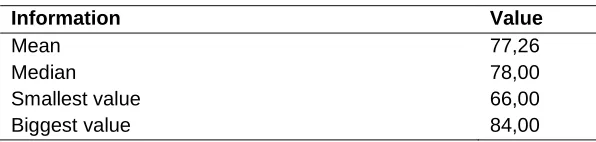
System quality is measured by the level of LPD health. The average is presented in the table
below.
Table 4. LPD Performance Descriptive Statistics
Information Value
Mean 77,26
Median 78,00
Smallest value 66,00
Biggest value 84,00
LPD performance in Denpasar City averaged 77.26, median was 78, the highest value was 84,
and the smallest was 66. The average value was 77.26, describing the performance of LPD in
Denpasar City which was quite healthy.
Effectiveness of the Supervisory Agency
Based on the respondent's answer to the statement submitted showing the respondent's answer
to the statement submitted was concentrated on the answer to agree and strongly agree,
whereas only a small proportion of respondents answered neutral. This indicates that
respondents rated the LPD as having an effective supervisory agency. However, some
respondents answered neutral on the four statements given. Efforts to increase the
effectiveness of the regulatory body need to be improved. The indicator that needs to be
considered by the regulatory body is the evaluation of employee performance on a regular
Licensed under Creative Common Page 219 Table 5. Respondent's Answer Distribution for the Effectiveness
of the Supervisory Agency variable
No. Statement STS TS N S SS
1 You know the clarity of the goals that lpd wants to achieve 0% 0% 3% 71% 23% 2 You have a strategy in achieving goals 0% 0% 0% 51% 46% 3 You provide guidance to managers in achieving goals 0% 0% 0% 66% 31%
4 You routinely supervise 0% 0% 3% 60% 34%
5 All credits that are disbursed by your permission 0% 0% 3% 54% 40% 6 You give advice in solving problems that’s experienced by
employees
0% 0% 9% 46% 43%
7 LPD facilities and infrastructure have supported employee work productivity
0% 0% 11% 57% 29%
8 Employees follow the procedure when doing task 0% 0% 6% 69% 23% 9 You evaluate employee performance regularly 0% 0% 26% 46% 26%
Annotation: STS = Strongly disagree, S = Agree, TS = Disagree, SS = Strongly agree, N = Neutral
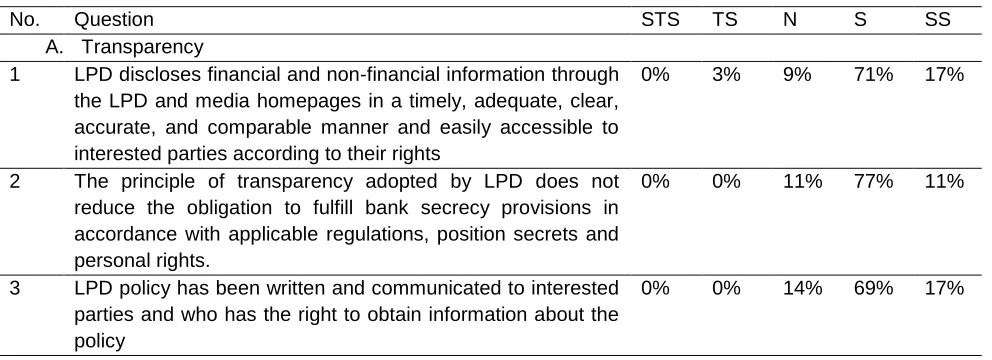
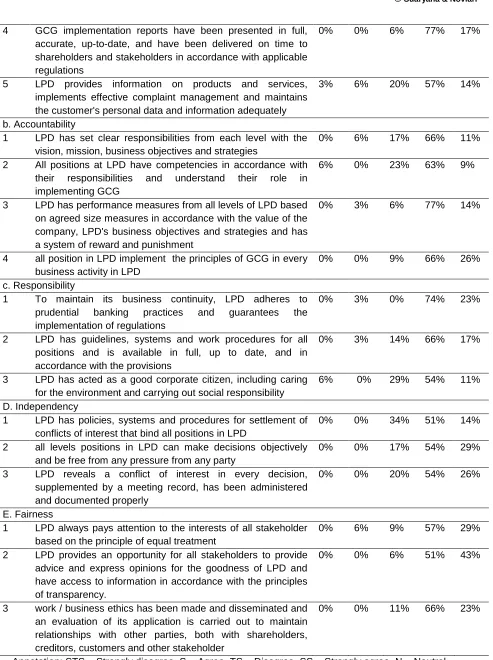
Corporate Governance Principal
The principles of corporate governance are measured by five elements, namely transparency,
accountability, accountability, independence and fairness. Respondents' answers to the
implementation of the principles of corporate governance in the LPD were concentrated on
agreeing and strongly agreeing answers. This illustrates the implementation of the principles of
good corporate governance that are already good in LPDs. However, there are still respondents'
answers that are neutral, disagree, and strongly disagree. This needs to get the attention of the
Head of the LPD to improve the implementation of the principles of corporate governance, for
example leaders must pay attention to the delivery of information on products and services,
implement management of customer complaints effectively and maintain adequate data and
personal information of customers.
Table 6. Respondents' Answer Distribution for Corporate Governance variables
No. Question STS TS N S SS
A. Transparency
1 LPD discloses financial and non-financial information through the LPD and media homepages in a timely, adequate, clear, accurate, and comparable manner and easily accessible to interested parties according to their rights
0% 3% 9% 71% 17%
2 The principle of transparency adopted by LPD does not reduce the obligation to fulfill bank secrecy provisions in accordance with applicable regulations, position secrets and personal rights.
0% 0% 11% 77% 11%
3 LPD policy has been written and communicated to interested parties and who has the right to obtain information about the policy
Licensed under Creative Common Page 220 4 GCG implementation reports have been presented in full,
accurate, up-to-date, and have been delivered on time to shareholders and stakeholders in accordance with applicable regulations
0% 0% 6% 77% 17%
5 LPD provides information on products and services, implements effective complaint management and maintains the customer's personal data and information adequately
3% 6% 20% 57% 14%
b. Accountability
1 LPD has set clear responsibilities from each level with the vision, mission, business objectives and strategies
0% 6% 17% 66% 11%
2 All positions at LPD have competencies in accordance with their responsibilities and understand their role in implementing GCG
6% 0% 23% 63% 9%
3 LPD has performance measures from all levels of LPD based on agreed size measures in accordance with the value of the company, LPD's business objectives and strategies and has a system of reward and punishment
0% 3% 6% 77% 14%
4 all position in LPD implement the principles of GCG in every business activity in LPD
0% 0% 9% 66% 26%
c. Responsibility
1 To maintain its business continuity, LPD adheres to prudential banking practices and guarantees the implementation of regulations
0% 3% 0% 74% 23%
2 LPD has guidelines, systems and work procedures for all positions and is available in full, up to date, and in accordance with the provisions
0% 3% 14% 66% 17%
3 LPD has acted as a good corporate citizen, including caring for the environment and carrying out social responsibility
6% 0% 29% 54% 11%
D. Independency
1 LPD has policies, systems and procedures for settlement of conflicts of interest that bind all positions in LPD
0% 0% 34% 51% 14%
2 all levels positions in LPD can make decisions objectively and be free from any pressure from any party
0% 0% 17% 54% 29%
3 LPD reveals a conflict of interest in every decision, supplemented by a meeting record, has been administered and documented properly
0% 0% 20% 54% 26%
E. Fairness
1 LPD always pays attention to the interests of all stakeholder based on the principle of equal treatment
0% 6% 9% 57% 29%
2 LPD provides an opportunity for all stakeholders to provide advice and express opinions for the goodness of LPD and have access to information in accordance with the principles of transparency.
0% 0% 6% 51% 43%
3 work / business ethics has been made and disseminated and an evaluation of its application is carried out to maintain relationships with other parties, both with shareholders, creditors, customers and other stakeholder
0% 0% 11% 66% 23%
Annotation: STS = Strongly disagree, S = Agree, TS = Disagree, SS = Strongly agree, N = Neutral
Licensed under Creative Common Page 221 PLS Analysis Results
This study applies PLS as an analytical tool. PLS analysis includes analysis of measurement
models and structural model analysis. Analysis of measurement models, including analysis of
the validity and reliability of each research variable. Structural model analysis includes analysis
of model validity and path coefficients.
Measurement Model Analysis
Measurement model analysis consists of testing the validity and reliability of instruments
(Hartono, 2011). Validity test assesses the ability of research instruments in measuring what
should be measured (Cooper et al., 2006). Reliability test measures the consistency of
measuring instruments or research instruments (Hartono, 2011). Validity test includes construct
validity test, which assesses the level of conformity of one measurement with the theories used
to define the construct (Hartono, 2011). Testing construct validity includes convergent validity
and discrimination validity.
Convergent validity measures the correlation between gauges from boarding.
Convergent validity is measured by loading factors (correlation between component scores and
contract scores). PLS measures convergent validity with the outer loading and average variance
extracted (AVE) scores.
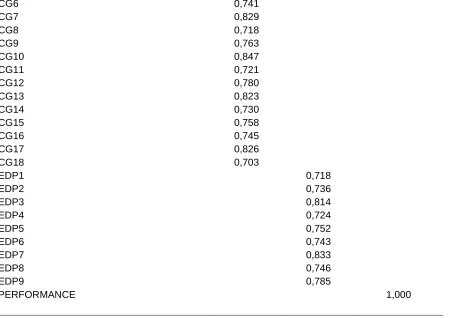
The measuring item is declared valid if the outer loading score must be greater than 0.7
and average variance extracted (AVE) greater than 0.5 (Chin, 1995). The test results for
convergent validity are as follows. Three constructs are tested, namely corporate governance
(CG), effectiveness of the supervisory body (EDP), and LPD performance (PERFORMANCE).
The outer loading score for corporate governance items (CG1 equals CG18) has the value of
outer loading greater than 0.7 in the CG contract. Score the outer loading measuring instrument
effectiveness of the regulatory body (EDP1 to EDP9) has the value of outer loading greater than
0.7 in the EDP construct. Score the outer loading performance measurement item LPD
(PERFORMANCE) has the outer loading value greater than 0.7 in the PERFORMANCE
contract.
Table 7. Convergent Validity Testing Results with Outer Loading
Construct CG EDP PERFORMANCE
CG1 0,718
CG2 0,795
CG3 0,760
CG4 0,774
Licensed under Creative Common Page 222
CG6 0,741
CG7 0,829
CG8 0,718
CG9 0,763
CG10 0,847
CG11 0,721
CG12 0,780
CG13 0,823
CG14 0,730
CG15 0,758
CG16 0,745
CG17 0,826
CG18 0,703
EDP1 0,718
EDP2 0,736
EDP3 0,814
EDP4 0,724
EDP5 0,752
EDP6 0,743
EDP7 0,833
EDP8 0,746
EDP9 0,785
PERFORMANCE 1,000
The average variance extracted (AVE) analysis results in a value greater than 0.5 in the
PERFORMANCE, CG, and EDP variables. Convergent validity test results show valid
measuring items.
Table 8. Convergent Validity Testing Results with AVE
Variabel AVE Information
PERFORMANCE 1,000 Valid
CG 0,603 Valid
EDP 0,581 Valid
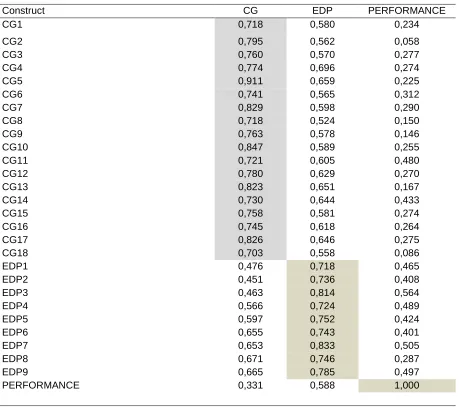
PLS tests the validity of discrimination with Cross loading. The rule of thumb used is a cross
loading score in one variable greater than 0.7 (Chin, 1995). The test results of the discriminant
validity are as follows. The results of the discrimination versatility analysis in Table 9 show that
measurement items have a cross loading value that is greater than 0.7 in the corresponding
construct.
Licensed under Creative Common Page 223 Table 9. Discriminant Validity Testing Results with Cross Loading
Construct CG EDP PERFORMANCE
CG1 0,718 0,580 0,234
CG2 0,795 0,562 0,058
CG3 0,760 0,570 0,277
CG4 0,774 0,696 0,274
CG5 0,911 0,659 0,225
CG6 0,741 0,565 0,312
CG7 0,829 0,598 0,290
CG8 0,718 0,524 0,150
CG9 0,763 0,578 0,146
CG10 0,847 0,589 0,255
CG11 0,721 0,605 0,480
CG12 0,780 0,629 0,270
CG13 0,823 0,651 0,167
CG14 0,730 0,644 0,433
CG15 0,758 0,581 0,274
CG16 0,745 0,618 0,264
CG17 0,826 0,646 0,275
CG18 0,703 0,558 0,086
EDP1 0,476 0,718 0,465
EDP2 0,451 0,736 0,408
EDP3 0,463 0,814 0,564
EDP4 0,566 0,724 0,489
EDP5 0,597 0,752 0,424
EDP6 0,655 0,743 0,401
EDP7 0,653 0,833 0,505
EDP8 0,671 0,746 0,287
EDP9 0,665 0,785 0,497
PERFORMANCE 0,331 0,588 1,000
Reliability testing in PLS uses two methods, namely Cronbach's alpha and composite reliability.
Cronbach's alpha measures the lower limit of the reliability value of a construct, while composite
reliability measures the true value of the reliability of a rent (Chin, 1995). Cronbach's alpha
values and minimal composite reliability are 0.7 (Hair et al., 2008). The results of the reliability
testing in Table 10 show the variables Performance, CG, and EDP have Cronbach's alpha
values and composite reliability greater than 0.7 so that the variable is reliable.
Table 10. Reliability Test Result
Variable Cronbach’s Alpha Composite Reliability
Information
PERFORMANCE 0,961 0,965 Reliable
CG 0,910 0,926 Reliable
Licensed under Creative Common Page 224 Structural Model Analysis
Structural models in PLS are evaluated using the coefficient of determination (R2) for the
dependent construct, path coefficient value (path) or statistical t value for path setup. R2 values
measure the degree of variation in variable changes to the dependent variable. The higher the
R2 value, the better the predictive model from the proposed research model. Model validity is
measured using the total determination coefficient (R2m). The total determination coefficient (R2
total) is the coefficient of determination of the overall endogenous variables with the following
formula: R2total = 1 – (1-R21).(1-R22)
Pe1 = 0,611 dan Pe2 = 0,389 consecutively is the value of the effect of the endogenous variable
error LPD Performance (PERFORMANCE) and Effectiveness of the Supervisory Agency (EDP).
R2total = 1 – (1-0,311).(1-0,389)= 0,762
Value of the total determination coefficient (R2 total) of 0.762 means that the information contained
in the 76.2% data can be explained by the analysis model of the relationship between variables as
illustrated in Figure 2, while the remaining 23.8% by other factors not included in this study.
Path Coefficient Analysis
The path coefficient or inner model value shows the level of significance in testing hypotheses.
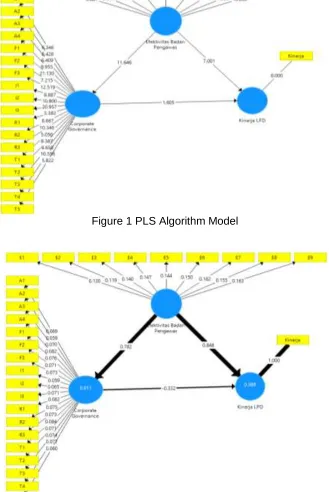
The results of the path coefficient analysis are presented in Figure 1, Figure 2 and Table 11.
Table 11. Path Coefficient Testing Results
Path Path Coefficient t Statistics P Value Information
EDPCG 0,782 11,427 0,000 Significant
EDPPERFORMANCE 0,848 7,044 0,000 Significant
CGPERFORMANCE -0,332 1,632 0,103 Not significant
Table 11 shows the results of testing the hypothesis proposed in Chapter II. The first hypothesis
of the study (H1) was accepted. The effectiveness of the supervisory board proved to have a
positive effect on good corporate governance practices at a significance of 0.05. The test results
show that the path coefficient is 0.782, the statistical value of t is 11.427 and the p value is
0.000.
The influence of the effectiveness of the supervisory board on LPD performance is
shown by the path coefficient of 0.848, the statistical value t for the application of accrual based
accounting is 0.16, the reluctance of the t statistic value is 7.044, and the p value is 0.000. The
effectiveness of the supervisory board has proven to have a positive effect on LPD
Licensed under Creative Common Page 225 The effect of implementing good corporate governance practices on LPD performance is -0.332, reluctant t statistic value is -1.632 and p value is 0.103. P value of 0.103 is greater than α =
0.05, so that good corporate governance practices have no statistical effect on LPD
performance. The research hypothesis (H3) which states that the application of technology has
a positive effect on the application of accrual-based accounting is rejected.
Figure 1 PLS Algorithm Model
Licensed under Creative Common Page 226 DISCUSSION
This section discusses the results of the path coefficient test which shows the results of the
research hypothesis testing. The discussion of the results of testing the hypothesis is as follows.
Effect of the Effectiveness of the Supervisory Agency on LPD Performance
The test results support the research hypothesis which states the effectiveness of the regulatory
agency in influencing LPD performance. The research results support the agency theory
explaining the existence of a working relationship between the principal and the agent. LPD
administrators act as agents, villager as principal. The village in the LPD is the owner of the
LPD that authorizes the board to run the LPD to achieve the LPD goal of maximizing LPD
performance. Conflict of interests between the village and the LPD management is reduced by
forming a supervisory body. The regulatory body is tasked with carrying out the internal
supervision function of the LPD. Supervision is a coordinated activity and assists management
in ensuring that the results are close to what is planned, so that the regulatory agency plays an
important role in improving the performance of the LPD (Wahyudi and Damayanthi, 2015). The
more effective the LPD supervisory agency is, the more it will respond to the higher LPD
performance. The effectiveness of the supervisory agency can be seen from the knowledge and
monitoring activities carried out by the LPD supervisory board to ensure that the LPD
management acts in accordance with the interests of village.
Effect of the Effectiveness of the Supervisory Agency on Good Corporate Governance Practices
The results of the study prove the influence of the supervisory board on LPD good corporate
governance practices. An effective supervisory agency is proven to be able to improve LPD
performance. The results of this study are in accordance with previous studies, namely Wahyudi
and Damayanthi (2015). This is because the LPD supervisory agency is able to supervise the
LPD management, so that the LPD board is able to apply the principles of GCG well. The
principles of GCG, such as transparency, accountability, responsibility, independence, and
fairness and equality are able to be applied by LPD administrators with guidance by a
supervisory agency that has competence, independence, and adequate experience in carrying
out their duties.
Effect of Good Corporate Governance Practices on LPD Performance
The results of the study did not support the influence of corporate governance practices on LPD
performance. The results of the study do not support Mark (2000) stating that corporate
Licensed under Creative Common Page 227 effective channels and information disclosure that will encourage good corporate performance,
and Ghozali (2012) which states that the concept of good corporate governance can lead to
performance good for a company The results of this study indicate that the implementation of
good corporate governance cannot encourage LPD performance.
CONCLUSIONS
This study aims to analyze the direct and indirect effects of the effectiveness of the supervisory
board on LPD performance. Effectiveness The good supervisory board is expected to improve
LPD performance. The effectiveness of a good supervisory board indirectly improves
performance through the implementation of corporate governance practices. The supervisory
board is expected to encourage the implementation of corporate governance practices in LPDs,
then the application of corporate governance practices improves the performance of LPDs.
The results of the testing found that the increase in the effectiveness of the LPD
supervisory board could improve LPD performance. Research finds a direct influence on the
effectiveness of the regulatory agency on performance. The results of the study found that the
effectiveness of the LPD supervisory board improved the implementation of good corporate
governance practices. The supervisory agency has proven to encourage the implementation of
good corporate governance practices in LPDs. However, this study failed to find the influence of
LPD good corporate governance performance.
SUGGESTIONS
Research results provide important value in order to improve LPD performance. The results of
the study found an important role of supervisory effectiveness bodies in order to improve LPD
performance and encourage the application of good corporate governance principles. Based on
the results of this study it can be suggested that adat villages should pay attention to the
effectiveness of the LPD supervisory board. The effectiveness of the data supervisory body is
enhanced by the selection of competent supervisory board members, implementing training
programs for the supervisory board, and willing to carry out supervisory activities on LPD
management in LPD managers. The selection of members of a competent supervisory board
will increase the effectiveness of supervision of LPD management. The competence of the
supervisory board can be increased by following a training program designed by LPDs and LPD
Trustees. The competence of the supervisory board must be supported by the willingness of
members of the supervisory board to carry out evaluations of LPD performance and provide
advice to LPD management to improve LPD performance. A routine evaluation program will
Licensed under Creative Common Page 228 The important role of the effectiveness of the supervisory board in order to improve the
performance of the LPD needs to get the attention of the local government and the LPD coach.
Local governments need to formulate policies related to the existence of the supervisory board
and the competence of the supervisory board so that monitoring is effective.
As for future studies we could expand our studies more on different types of financial
institution, since this LPD is a more specific form of financial institution. The supervisory board
might have different behavior than the ones in smaller institutions, so it would be interesting to
test the model.
REFERENCES
Arfan, Ikhsan. 2008. Metodologi Penelitian Akuntansi Keprilakuan. Edisi ke-1. Yogyakarta: Graha Ilmu.
Bulandari, I G.A.W. dan Damayanthi, I G.A.E. 2014. Pengaruh Prinsip-Prinsip Good Corporate Governance Pada Kinerja Keuangan Lembaga Perkreditan Desa Di Kabupaten Badung. E-Jurnal Akuntansi Universitas Udayana Vol.8, No..3, Hal.641-659.
Clemente, A. G. and B. N. Labat. 2009. Corporate Governance Mechanisms Ana Voluntary Disclosure. The Role Of Independent Directors In The Board Of Listed Spanish Firms. International Journal of Accounting Information Systems, 5, pp:5-24.
Dewi, K. dan Putri, I G.A.M.A.D. 2014. Pengaruh Penerapan Prinsip-Prinsip Gcg Pada Kinerja Keuangan Lembaga Perkreditan Desa Kabupaten. E-Jurnal Akuntansi Universitas Udayana No.7 Vol. 3, hal. 559-573.
Forum for Corporate Governnace in Indonesia. 2001. Peranan Dewan Komisaris dan Komite Audit dalam Pelaksanaan Corporate Governance. Seri tata kelola perusahaan, Jilid II. http//www.fcgi.org.id. Diunduh tanggal 20 Oktober 2016.
Giri, N.L.G, Zukhri, A., dan Meitriana, M.A. 2014. Efektivitas Fungsi Pengawas Sebagai Internal Auditor Dalam Pengawasan Operasional LPD Se-Kecamatan Pupuan. Vol: 4 No: 1.
Ghozali, Natalia. 2012. Dampak Penerapan Prinsip-Prinsip Good Corporate Governance Terhada Kinerja Perusahaan. Jurnal Ilmiah Mahasiswa Akuntansi, 1(4): 38-43.
International Journal of Economics and Finance, 4(6), pp:86. Adhi, N. dan M. Siti. 2012. Pengaruh Karakteristik Perusahaan Terhadap Luas Pengungkapan Sukarela Dan Implikasinya Terhadap Asimetri Informasi Studi pada Perusahaan Manufaktur yang Terdaftar di Bursa Efek Indonesia Tahun 2009. Doctoral dissertation, Fakultas Ekonomika dan Bisnis.
Jensen, M., and W. Meckling 1976. Theory of the Firm : Managerial Behavior, Agency, and Ownership Structure. Journal of Financial Economics.
Moradi, N. S., M. M. Aldin, F. Heyrani dan M. Iranmahd. 2012. The Effect of Corporate Governance, Corporate Financing Decision and Ownership Structure on Firm Performance: A Panel Data Approach from Tehran Stock Exchange.
Novianti, N.K., Yuniarta, G.A., dan Atmadja, A.T. 2014. Pengaruh Independensi, Motivasi, Pengalaman Kerja Dan Keahlian Profesional Badan Pengawas Terhadap Efektivitas Penerapan Pengendalian Intern Lembaga Perkreditan Desa (LPD) Di Kecamatan Kuta Selatan Kabupaten Badung, e-Journal S1 Ak Universitas Pendidikan Ganesha Jurusan Akuntansi Program S1 Vol. 2 No. 1.
Pradnyaswari, L.G.D.A., dan Putri, I G.A.M.A.D. 2016. Pengaruh Prinsip-Prinsip Good Corporate Governance Pada Kinerja Keuangan Koperasi Di Kabupaten Klungkung. E-Jurnal Akuntansi Universitas Udayana. Vol.14, No.2, Februari Hal.1064-1091.
Pratiwi, N.L.P.A. dan Putri, IG.A.M.A.D. 2016. Pengaruh Good Corporate Governance pada Kinerja Berbasis Balanced Scorecard. E-Jurnal Akuntansi Universitas Udayana Vol.15.2. Mei (2016): 832-846.
Licensed under Creative Common Page 229
Putra, P.B.S. dan Rasmini, N.K. 2014. Pengaruh Independensi, Kompetensi, Dan Ruang Lingkup Pekerjaan Audit Pengawas Pada Efektivitas Pengendalian Intern Koperasi. E-Jurnal Akuntansi Universitas Udayana. No.8, Vol..3, Hal. 371-384.
Renitha Ratu Hindistari, I Gusti Ayu Made Asri Dwija Putri. 2016. Pengaruh Penerapan Prinsip-Prinsip Good Corporate Governance Pada Kinerja Bank Perkreditan Rakyat Kabupaten Gianyar. E-Jurnal Akuntansi Universitas Udayana.Vol.16, No.1. Juli, Hal. 101-128.
Sandraningsih, N.K.B. dan Putri, dan I G.A.M.A.D. 2015. Pengaruh Prinsip-Prinsip Good Corporate Governance Pada Kinerja Keuangan Lembaga Perkreditan Desa Kecamatan Abiansemal. E-Jurnal Akuntansi Universitas Udayana Vol.11, No..3, Hal.878-893.
Savitri, R. 2010 Pengaruh Mekanisme Corporate Governance Terhadap Ketepatan Waktu Pelaporan Keuangan: Studi pada Perusahaan Manufaktur di BEI. Doctoral dissertation, Perpustakaan FE UNDIP.
Setyawan, Meitradi Komang dan Asri Dwija Putri. 2013. Pengaruh Good Corporate Governance Terhadap Kinerja Keuangan Lembaga Pengkreditan Desa Kecamatan Mengwi Kabupaten Badung. E-Jurnal Akuntansi Universitas Udayana 5.3 : 586-598.
Sidney, G.A. dan Sari, M.M.R.. 2016. Pengaruh Good Corporate Governance Pada Kinerja Lembaga Perkreditan Desa Denpasar Dengan Komitmen Organisasi Sebagai Pemoderasi. E-Jurnal Akuntansi Universitas Udayana. Vol.16, No.2., Hal. 865-894
Sugiyono. 2012. Metode Penelitian Bisnis. Bandung: Alfabeta.
Ujiyantho, M. A. dan B. A. Pramuka. 2007. Mekanisme Corporate Governance. Manajemen Laba dan Kinerja Keuangan. Simposium Nasional Akuntansi X, 26-28 Juli 2007.