Development Of Multiple Intelligences-Based
Learning Management Model
Rahmat Mulyono, Siti Partini Suardiman, Lantip Diat Prasojo
Abstract: This research aims to create a model of multiple intelligencies-based learning management and test its effectiveness. The research design consists of three stages: 1) preliminary studies including literature study, field study, questionnaire distribution and focused group discussion; 2) model development including model drafting, model draft validation by practicioners and expert team, and model revision; and 3) limited testing, small group testing, extended testing, and final model revision. The research result provide a model of multiple intelligences-based learning management that consists of (a) learning material adjustment to the students intelligence; (b) study group classification based on the students intelligence level and class grade; (c) thematic learning approach based on the multiple intelligences themes; (d) the use of multiple intelligences-based active learning; (e) learning evaluation on the process and result; (f) outing class arrangement; (g) establishing cooperation with parents and stakeholder; and (h) the charismatic headmasters who have a lot of ideas are able to implement the function of management for multiple intelligences based learning. The result of model content testing reaches score of 4.55 (91.58%) under very good category and the result of model applicability testing reaches the score of 4.61 (92.20%) under very good category.
Index Terms: focused group discussion, learning management, model testing, multiple intelligence-based learning, research and development
————————————————————
1 I
NTRODUCTIONEVERY human being has eight forms of intelligence and is relatively independent of each other. The best variety of intelligences are assessed in a contextual way [1]. Implementation of multiple intelligences in schools and classrooms can improve learning outcomes including interest and motivation, better recollection and deeper understanding, higher achievement, increased self-esteem, and more fun and enjoyable classroom experiences. For teachers, the implementation is a challenge that make them need more time, perseverance, more collegiality, and more management support planning [2].
Theory of multiple intelligences can be incorporated into primary school curriculum as a capacity to solve problems and obtain products of cultural value [3]. Furthermore, theory of multiple intelligences in the teaching process makes teachers able to improve skills and strengthen the natural talents of children [4]. Multiple intelligences will be more effective than the traditional teacher teaching patterns if applied in the learning process [5]. It also help learner process information well as they learn.
Other research also indicate the benefit of theory multiple intelligence in teaching learning process. Multiple intelligences can bridge the tedious learning process of mathematics into a fun learning experience [7]. It influences the orientation of learning because learners will more easily understand the lesson if the material is presented in accordance with their prominent intelligence students [8]. Therefore, teachers need to understand the theory of multiple intelligences to enrich their competencies in facilitating the achievement of educational objectives [9],[10].
Based on previous works, this study aims: (1) to map the practice of multiple intelligences based learning management
in elementary school level in DKI Jakarta, Central Java, East Java and Special Region of Yogyakarta; (2) to gain information of things needed in developing the model (3) to create multiple intelligences based learning management model; (4) and to find out information of the model effectiveness.
2
R
ESEARCHM
ETHODSThe research and development of Gall, Gall, and Borg [11] were developed into 3 stages: (1) Preliminary research stage to map the current situation and to find out the need for development, (2) model development, and (3) model product testing.
2.1 Development Model
Model multiple intelligences based Learning management can not stand alone but it is presented integrated in classroom learning at elementary school level to improve the quality of learners, learners can enjoy learning according to type of intelligence, explored type of intelligence / learning style and its potential.
2.2 Development Procedure
Model development is carried out through three stages: (1) pre-model development stage or preliminary study, (2) model development stage, and (3) validation stage or model testing. The preliminary study stage is conducted to determine the condition of multiple intelligences based learning management, and to know the expectation or requirement needed for development.
The literature study was conducted to collect the supporting materials in order to draft the model. The literature study is done through studying books, research journals and articles relevant to the title of this study. Preliminary study aims to find out the implementation of multiple intelligences based learning management today and to know the things needed for development. Preliminary studies include questionnaires, observations and interviews to obtain preliminary information; (2) Focus Group Discussion (FGD) with stakeholders to discuss the current learning conditions and the need for model development; and (3) through questionnaires by principals and teachers to gain ————————————————
Rahmat Mulyono holds doctoral degree in education from Yogyakarta State University and is currently lecturer in Universitas Sarjanawiyata Tamansiswa Yogyakarta, Indonesia. E-mail: [email protected] and [email protected] Siti Partini Suardiman and Lantip Diat Prasojo are currently lecturers
additional information about the current state and needs needed for the model developers. Research subjects at this stage consisted of 5 principals, 30 elementary school teachers.
There are several steps conducted in development stage. First is model draft arrangement. The formulation of multiple intelligences learning management model is built based on the result of information and input obtained through literature study, FGD, and questionnaire filling.
Second is validation model draft by practitioner and expert. Model draft validation was conducted by 14 prospective users (principals and teachers) and validation by 7 Expert Teams with background of management education expertise, multiple intelligences, and linguistics. This validation begins with the application of the draft model, FGD for inputs. After the FGDs were completed, participants were asked to provide an assessment of the systematic aspects of the model, the substance of the model, the language and the graphics. Research subjects at this stage consisted of 14 practitioners and a team of 7 experts.
Third is model draft revision. The model is revised based on inputs or directions from experts / teams of experts who have been appointed. Input from the expert team will refine the draft model, which is prepared for implementation testing.
2.3 Model Testing
The model was tested through three stages: a limited ttesting with 14 subjects consisting of 2 principals and 12 teachers from 6 elementary schools in DKI Jakarta and Central Java areas which organized multiple intelligences-based learning. Each respondent is given a model draft to apply in his school. After a period of one to two months they apply, then they are invited to discuss their experiences in applying the model, provide feedback for improvement and fill out the questionnaire for model assessment. The results of the questionnaire scores were analyzed to determine how far the model can be applied, whereas the inputs were discussed for model refinement.
A small group testing with 28 subjects consisted of 4 principals and 24 teachers from 4 elementary schools in East and Central Java that conducted multiple intelligences-based learning. Small group testing began with the implementation of the model draft in four elementary schools based on multiple intelligences that are considered fully commiteed to learning based on multiple intelligences and prioritize the development of multiple intelligences. The achievement of the questionnaire questionnaire scores was analyzed to find out how far the model can be applied. While the input delivered orally will be used as material for model revision.
The extended testing is carried out with the subjects of 49 people consisting of 7 principals and 42 teachers at 7 Multiple Intelligences based elementary schools in DKI Jakarta, Central Java and East Java. The extended testing will contribute the evaluation of model effectivity seen from the filled questionnaire while the written or oral inputs during FGD will be used to revise the model. Evaluation points on FGD of the limited testing, small group testing, and extended testing use the same questionnaire that consist of two parts. First part evaluates the model content including 8 items of model systematics, 4 items of model substance, 5 items of linguistics, and 6 items of graphics. Second part evaluates the model
implementation consisting of 8 statements or questions, as follows: is the model: (1) needed by the school, (2) important for the school, (3) useful for the school, (4) applicable, (5) simple for school, (6) practicable, (7) easy to apply, and (8) helpful for school. The collected data of the limited testing is ranged at score from 1 to 5. The higher the score achieved, the model is stated well or meet the need of the development of multiple intelligences based learning management model In contrast, if the score is low, it means the model does not meet the need. Score is analyzed for each item and the whole. The overall average score is then converted into percentage to find out whether it has met the need or not.
Furthermore, to simplify the data analysis, score result is converted into percentage. Then it is converted into category. There are four optional items for the score: A for score 4, B for score 3, C for score 2, and D for score 1 that converted into the following intervals 0-25% in very poor category, 26-50% in poor category, 51-75% in good category, and 76-100% in very good category while the five item score has the following options: A for score 5, B for score 4, C for score 3, D for score 2 and E for score 1 with the intervals: 0-20% in very poor category, 21-40% in poor category, 41-60% in fair category, 61-80% in good category, and 81-100% in very good category.
Besides the score, there is also data collected from inputs in descriptive form. These inputs will be used as the materials to revise the model that meet the need.
3 F
INDINGS ANDD
ISCUSSIONThe whole research and development was conducted in one year. It took from January to June 2016. Furthermore, observations and interviews were conducted to find out the implementation of multiple intelligences based learning management. Through observation and interviews, some information was found: (1) the implementation of multiple intelligences-based learning held in schools is various (2) learning materials adapted to the type of intelligence of students, (3) classification of study groups according to the type of intelligence and class level of learners, (4) ) schools and teachers need to optimize cooperation with parents in multiple intelligences-based learning, (5) schools need to optimize outing classes, (6) need strong commitment from school principals to prepare learners to enjoy learning according to type of intelligence, explored type intelligence and potential.
have a strong commitment to prepare learners to enjoy learning based on the type of intelligence, so it explores the type of intelligence and learners potential.
Furthermore the formulated model drfat is validated by practitioners and experts. The next step after being revised through the validation of practitioners and validation of expert teams, testing and FGDs to determine the level of applicability, and the last stage in this study is the final model
product revision. The results of the study are as follows. 1. Implementation of multiple intelligences based learning
management.
a. Learning materials based on multiple intelligences for learners are adjusted to the type of learner’s intelligence.
b. The classification of study groups is based on the type of intelligence and grade level.
c. Multiple intelligences based active learning method with themes of multiple intelligences appropriate to the type of intelligence of learners.
d. Multiple intelligences based learning methods are in the form of lectures, question and answer, assignment;
e. Assessment of multiple intelligences based learning for learners in the form of assessment conducted through learning result test (final exam of semester), assessment of school examination;
f. Organizing learning multiple intellegences based outing class;
g. Involving the role of parents and stakeholders; h. The role of the principal needs to be maximally
involved in the management of multiple intelligences-based learning.
2. What is needed for model development?
a. Learning materials that is appropriate to the type of intelligence of learners and learners’ potential; b. Classification of study groups that provides many
opportunities to learners; to learn based on the type of intelligence
c. A learning approach that can encourage learners to master competencies according to their type of intelligence, and an integrative functional thematic learning approach;
d. Learning methods that provide opportunities for learners to learn in accordance with learning styles and and explored competence in accordance with the type of intelligence;
e. Learning assessment by process and outcome assessment as well as portfolio.
f. Organizing an outing class with sufficient time; g. Involving the role of parents and stakeholders to be
able to provide input for the multiple intelligences based learning in accordance with the type of intelligence of learners;
h. The role of Principal who is committed to providing services according to the type of intelligence of learners, committed to implement management well, able to bring the school community in one vision and mission and committed to realize, able to build network with various government or private agencies.
3. Model of multiple intelligences based learning management
a. Models with learning materials that are appropriate to the type of dominant intelligence and learners’ potential;
b. Models with the classification of study groups that provide as many opportunities as possible to learners according to the type of intelligence and their potentials;
c. Model with a learning approach that can encourage children to master competence in accordance with the type of intelligence, and integrative functional thematic learning approach;
d. Model with the learning method that provides opportunities for learners to master the competence in accordance with the type of intelligence, the use of multiple intellegence based active teaching strategies; e. Model with learning assessment on process, outcome
and portfolio.
f. Model with the organization of outing class;
g. The model with the involvement of the role of parents in mutiple intelligences-based learning, planning the follow-up program after the child graduated from school, giving input to the learning materials based on multiple intelligences taught in accordance with the type of intelligence of learners;
h. Model with the role of pricipal who has commitment to provide services according to the needs of children, committed to implement management well, able to bring the school community in one vision and mission and committed to realize, able to build network with various government or private agencies.
4. Is the model of multiple intellegences based learning management applied effectively?
To answer question 4, the followings are presented Table 1 until 6.
3.1 Limited Testing
The result of limited testing is to provide an assessment of the model content as presented in Table 1 as follows
Table 1
Evaluation of Model Content in Limited Testing
No Aspect Average
Score Percentage
1 Model Systematics 4.55 91.00%
2 Model Substance 4.54 90.71%
3 Model Linguistics 4.67 93.33%
4 Model Graphics 4.58 91.67%
Average 4.58 91.68%
Source: Primary data.
This achievement shows that the aspects of model systematic, model substance, model linguistics, and model graphics reach a very high score. This means that all aspects are appropriate components to be used as material or content of multiple intelligences based learning model. Furthermore, there will be shown the testing results to assess the model applicability. Model applicabilty is intended to be how effective the model can be applied in schools and to find out that the application of the model will be measured using eight statement items that must be filled by the prospective user respondents.
The result of limited testing is to provide an assessment of the model applicability as presented in Table 2 as follows.
Table 2
Evaluation on Model Applicability in Limited Testing
No Aspects Average
Score
Percentage
1 Model is needed by school 5.67 93.33%
2 Model is essential for
school 4.92 98.33%
3 Model is expected by
school 4.58 93.33%
4 Model is beneficial for
school 4.67 93.33%
5 Model is helpful for school 4.67 93.33%
6 Model is simple for school 4,42 88.33%
7 Model is easily applied 4.75 95.00%
8 Focus on multiple
intellegences development 4.67 93.33%
Average 4.67 93.338%
Source: Primary data.
The score result of the limited testing to assess the model applicability of the aspect of model is needed by school reaches the score of 4.67 (93.33%), model is essential for the school reaches the score of 4.92 (98.33%), the model is beneficial for schools reaches the score of 4.67 (93.33%), model is helpful for school reaches 4.67 (93.33%), model is simple for school reaches 4.42 (88.33%), model is easily applied reaches score of 4.75 (95.00%) and focus on model development reaches the score of 4.67 (93.33). Average score is 4.67 (93.33%). These results indicate that multiple intelligences based learning management can be applied very well
3.2 Small Group Testing
Small group testing involved 28 participants which consisted of 4 principals and 24 teachers of 4 elementary scools in Central Java andEast Java. Testing was started by implementing the model and ended by filling the questionnaire containing four aspects with 23 items to evaluate model content and 8 items to evaluate model applicability. The result of small group testing to evaluate of the model content is presented in Table 3 as follows.
Table 3
Evaluation on Model Content in Small Group Testing
No Aspect Average
Score Percentage
1 Model Systematics 4.48 89.17%
2 Model Substance 4.43 88.57%
3 Model Linguistics 4.44 88.71%
4 Model Graphics 4.57 91.31%
Average 4.48 89.54%
Source: Primary data.
The result of the average score of questionnaire is as follows: systematic aspect of the model reaches an average score of 4.48 (89.17%), model substance reaches score of 4.43 (88.57%), linguistics aspect reaches score of 4.44 (88.71%), and graphics aspect reaches score of 4,.7 (91.31%). The average score reaches 4.48 (89.54%). This shows 89.54% under very good category.
In the other side, the result of small group testing to evaluate the model applicability is presented in Table 4 as follows.
Table 4
Evaluation on Model Applicability in Small Group Testing
No Aspects Average
Score
Percentage
1 Model is needed by school 4.61 92.14%
2 Model is essential for school 4.75 95.00%
3 Model is expected by school 4.50 90.00%
4 Model is useful for school 4.64 92.86%
5 Model is helpful for school 4.61 92.14%
6 Model is simple for school 4.50 90.00%
7 Model is easily applied 4.61 92.14%
8 Focus on multiple inttelegence
model development 4.54 90.71%
Average 4.58 91.67%
Source: Primary data.
The score result of the small group testing to assess the model applicability of the aspect of model is needed by school reaches the score of 4.61 (92.14%), model is essential for the school reaches the score of 4.75 (90.00%), the model is beneficial for schools reaches the score of 4.64 (92.86%), model is helpful for school reaches 4.61 (92.14%), model is simple for school reaches 4.50 (90.00%), model is easily applied reaches score of 4.61 (92.14%) and focus on model development reaches the score of 4.54 (91.67%). Average score is 4.58 (93.8%). These results indicate that multiple intelligences based learning management can be applied very well.
3.3 Small Group Testing
ended by filling out a questionnaire containing 4 aspects consisting of 23 items to assess the contents of the model, and 8 items to assess model applicability. The result of extended testing to evaluate of the model content is presented in Table 5 as follows.
Tabel 5
Evaluation on Model Content in Extended Testing
No Aspects Average
Score
Percentage
1 Model Systematics 4.45 89.06%
2 Model Substance 4.46 89.21%
3 Model Linguistics 4.52 92.37%
4 Model Graphics 4.47 89.39%
Average 4.48 89.39%
Source: Primary data.
The extended testing involved 49 participants including 7 principals and 42 teachers of elementary schools that had applied the model draft of multiple intellegences based learning management.
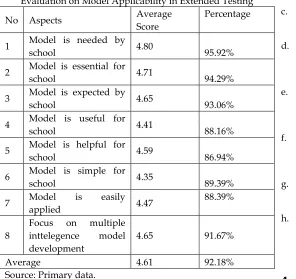
The average score of each aspect is as follows; model systematics reaches 4.45 (89.06%); model substance reaches 4.46 (89.21); linguistics aspect reaches 4.52 (92.37); and graphics aspect reaches 4.47 (89.39%). The average score of the whole aspects reaches 4.48 (89.39%); under very good category. Written suggestions and oral feedback in are used to revise the model of multiple intellegences based learning management. Table 6 is presented to determine the evaluation of model applicability.
Tabel 6
Evaluation on Model Applicability in Extended Testing
No Aspects Average
Score
Percentage
1 Model is needed by
school 4.80 95.92%
2 Model is essential for
school 4.71 94.29%
3 Model is expected by
school 4.65 93.06%
4 Model is useful for
school 4.41 88.16%
5 Model is helpful for
school 4.59 86.94%
6 Model is simple for
school 4.35 89.39%
7 Model is easily
applied 4.47
88.39%
8
Focus on multiple
inttelegence model
development
4.65 91.67%
Average 4.61 92.18%
Source: Primary data.
The average score reaches 4.61 (92.18%) under very good category. The percentage shows that the model is needed and simple for school.
From the tables presented above, it can be concluded the evaluation of model content as follows. Evaluation of model
content are:
a. The contents of the model seen from systematic aspect can be applied well. The results are indicated by the percentage score in the limited testing reaches 4.55 (91.00%); in small group testing reached 4.48 (89.17%); and in the extended testing reaches score of 4.45 (89.06%).
b. The model content seen from the substance aspect can be applied properly. The results are indicated by the percentage of score in the limited testing reaches 4.54 (90.71%); in small group testing reaches 4.43 (88.57%); and in the extended testing reaches score of 4.46 (89.21%).
c. The model content seen from the linguistic aspects can be applied well. The results are indicated by the percentage of score in the limited testing reaches 4.67 (93.33%); in small group testing reaches 4.44 (88.71%); and in the extended reaches 4.52 (92.37%).
d. The model content seen from the graphics aspect can be applied well. The results are indicated by the percentage of score in the limited testing reaches 4.58 (91.67%); in small group testing reaches 4.40 (88%); and in the extended testing reaches 4.67 (93.4%).
Model applicability can be explained as:
a. Model is needed by schools. It can be seen from the score of limited testing reaching 4.67 (93.33%); in small group testing reaches 4.61 (92.14%); and extended testing reaches4.80 (95.92%).
b. Model is essential for school. It is proven in the score of limited testing 4.92 (98.33%); in small group testing 4.75 (95.00%); and extended testing 4.71 (94.29%).
c. Model is expected by school. It is shown in limited testing score of 4.58 (91.67%); the score of small group testing 4.50 (95.00%); and extended testing 4.65 (93.06%). d. Model is useful for school. The score of limited testing
reaches 4.67 (93.33%); small group testing reaches 4.64 (92.86%); dan pada uji coba diperluas mencapai 4.41 (88.16%).
e. Model is helpful for school. It can be seen from the score of limited testing 4.67 (93.33%); small group testing reaches 4.61 (92.14); and extended testing reaches 4.59 (86.94%).
f. Model is simple for school. It can be seen from the score of limited testing 4.42 (88.33%); small group testing reaches 4.50 (90.00%); and extended testing reaches 4.35 (89.39%).
g. Model is applicable. It can be seen from the score of limited testing 4.75 (95.00%); small group testing reaches 4,54 (90,71%); and extended testing reaches 4.58 (91.58%). h. Model focuses on multiple intellegences model. It can be seen from the score of limited testing 4.67 (93.33%); small group testing reaches 4.58 (91.67%); and extended testing reaches 4.58 (91.58%).
4 C
ONCLUSIONand is oriented to the type of learners intelligence to be able to enjoy learning based on the type of intelligence and can be explored the potential.
Model of multiple intelligences-based learning management has been compiled through a long process ranging from needs analysis, formulation of model draft, model validation, model revision, testing, and revision to final model. Thus, the model has met the needs of prospective users because it has involved teachers, principals, parents of learners and related education stakeholders.
The model has following specifications:
a. Multiple intelligences based learning materials is tailored to the type of learners intelligence, so the students competence is appropriate to the type of learners’ intelligence;
b. classification of study groups based on the similarity of 3 dominant and class-based intelligence types;
c. The use of thematic learning process approach, using themes related to multiple intelligences;
d. The use of multiple intelligences teaching strategies; e. Organizing outing class;
f. Involving the role of parents in multiple intellegences learning; and
g. The existence of principlas role in implementing the management function well.
The implementation of the model of multiple intellegences based learning model can be optimum and has the following implications.
a. Principals must have a vision and mission and a strong willingness to bring learners to enjoy learning in accordance with the type of intelligence and explored the type of intelligence and potential by building cooperation with teachers and parents in optimally.
b. Schools have the courage to implement learning by prioritizing the development of multiple intelligences based learning and maximize outing class.
c. Using a modified curriculum by providing adequate multiple intelligences, tailored to the intelligence of learners, talents and potential learners.
d. Principals are able step out of routine learning into concrete steps to provide learners experience in multiple intelligences-based learning.
R
EFERENCES[1] H. Gardner and T. Hatch.“Multiple Intelligences Go to
School: Educational Implications of the Theory of
Multiple Intelligences”, American Educational Research. vol.
18, no. 8, pp. 4-10, Nov. 1989.
[2] J. Hanafin. “Multiple intelligences Theory, Action
Research, and Teacher Professional Development: The
Irish MI Project”, Australian Journal of Teacher Education,
vol. 39, no. 4, article 8, 2004.
[3] A.C. Brualdi Timmins. “Multipleintelligences: gardner's
theory”, Practical Assessment, Research & Evaluation, vol. 5,
no. 10. Available online:
http://PAREonline.net/getvn.asp?v=5&n=10.
[4] G. S. Eberle. (2015). “Playing with the Multiple
Intelligences How Play Helps Them Grow”, American
Journal of Play, vol. 4, no. 1, pp. 19-51, 2011.
[5] S. Gurbuzoglu Yalmanci, A. I. C. Gozum. “The Effects of
Multiple Intelligence Theory Based Teaching on Students’ Achievement and Retention of Knowledge (Example of
The Enzymes Subject)” International Journal on New Trends
in Education and Their Implications, vol. 4, no. 3, 27-36, 2013.
[6] B. M. Manner. “Learning Styles and Multiple Intelligences
in Students”, Journal of College Science Teaching,
March/April 2001. Retrieved from
https://www.nsta.org/publications/news/story.aspx?id=40 969
[7] A. Amir. “Pembelajaran Matematika dengan
Menggunakan Kecerdasan Majemuk (Multiple
Intelligences) [Learning Mathematics Using Multiple
Intelligence]. Jurnal Logaritma, vol. I, no. 1, pp. 1-14, 2013.
[8] A. Hamzah. “Teori Multiple Intelligences dan
Implikasinya Terhadap Pengelolaan Pembelajaran”, Tadris, vol. 4, no. 2, pp. 251-261, 2009.
[9] U. Hasanah. “Konsep Pembelajaran Berbasis Multiple
Intelligences dalam Perspektif Munif Chatib”. Jurnal Ilmiah Pendidikan, vol. 12, no. 2, pp. 209-232, 2015.
[10] H. Susanto. “Penerapan Multiple Intelligences dalam
Sistem Pembelajaran”, Jurnal Pendidikan Penabur, vol 4, no.
4, pp. 67-75, 2005.
[11] M. D. Gall, Joyce P. Gall, and W. R. Borg. Educational