Three Essays in Applied Regulation
Andres Gomez-Lobo
September 1997
ProQ uest Number: 10011232
All rights reserved
INFORMATION TO ALL U SE R S
The quality of this reproduction is d ep en d en t upon the quality of the copy subm itted. In the unlikely even t that the author did not sen d a com plete manuscript
and there are m issing p a g e s, th e se will be noted. Also, if material had to be rem oved, a note will indicate the deletion.
uest.
ProQ uest 10011232
Published by ProQ uest LLC(2016). Copyright of the Dissertation is held by the Author. All rights reserved.
This work is protected against unauthorized copying under Title 17, United S ta tes C ode. Microform Edition © ProQ uest LLC.
ProQ uest LLC
789 East E isenhow er Parkway P.O. Box 1346
A bstract
In th e last fifteen years, theoretical economists have reformulated th e theory of regulation using the tools of informational economics. Although theoretical advances in the field have been numerous, empirical work on th e subject has been sparse. The main objective of this thesis is to apply empirical techniques to different topics in the area of regulation. In agreement w ith th e new theory, in each of the essays special emphasis is placed on informational issues.
The first essay concerns demand side aspects of regulation. Recent regu latory reforms in the United Kingdom energy markets will result in impor ta n t changes in domestic energy tariffs. A demand system for the United Kingdom is estim ated using d ata firom the Family Expenditure Survey. The estim ation strategy takes into account problems raised by the non-linear na tu re of energy prices and unobserved consumer heterogeneity. The results are subsequently used to calculate the welfare consequences of changes in domestic gas tariffs. The results show th a t tariff rebalancing, sparked by the introduction of competition for the supply of gas, will most probably pose distributional conflicts. The results are not only useful for the design of welfare policy but also for the discussions surrounding regulatory reform.
types of auctions are examined. To the best of our knowledge, this is the first tim e in the applied regulation literature th a t an optimal second best contract has been characterised using information recovered exclusively by econometric methods.
C ontents
A b stra ct 1
A ck n ow led gem en ts 11
DeclcU'ation 13
A b b rev ia tio n s 15
1 In tro d u ctio n 17
1.1 B a c k g ro u n d ... 17
1.2 The regulatory m o d e l... 19
1.3 The optimal regulatory scheme... 23
1.3.1 Symmetric in fo rm a tio n ...24
1.3.2 Asymmetric in fo rm a tio n ... 24
1.3.3 R e m a rk s ... 30
1.3.4 Three essays in applied re g u la tio n ... 31
1.4 The resource allocation side of re g u la tio n ... 31
1.4.1 Linear prices with homogenous c o n s u m e r s ...33
1.4.2 Two-part tariffs with homogenous consum ers... 34
1.4.3 Two-part tariffs with heterogeneous consum ers... 36
1.4.4 Non-linear p ric in g ... 39
1.4.5 Pricing and regulation s c h e m e s ... 41
1.4.6 Empirical applications and the first e s s a y ...42
1.5.1 Implementation and menus of linear c o n t r a c t s ... 46
1.5.2 Price-cap regulation, rate of return regulation and profit sh a rin g ...48
1.5.3 Applicability of the optimal c o n t r a c t ... 50
1.5.4 Review of the empirical literature on regulation . . . . 53
1.5.5 The Norwegian bus transport s t u d y ...61
1.6 Rent extraction and auctions in r e g u la tio n ... 63
1.6.1 Auctioning incentive c o n tra c ts ... 64
1.6.2 Non-structural empirical studies of a u c t i o n s ... 67
1.6.3 Structural econometric models of a u c t i o n s ... 71
1.6.4 Asymmetric auctions and the tendering of refuse col lection contracts in E n g l a n d 86 1.7 C o n c lu s io n s ...88
1 R egulation: D em and issues
91
2 E n ergy D em an d M od ellin g and Tariff R eb alan cin g in th e U n ite d K in gd om G as M arket 93 2.1 In tro d u c tio n ... 932.2 Tariffs, price discrimination and the tax benefit system . . . . 97
2.2.1 Optimal T a r if f s ... 99
2.2.2 Tariffs and the tax-benefit s y s te m ... 102
2.3 Household energy demand m o d e l ...104
2.3.1 The QUAIDS demand system ... 104
2.3.2 Two-part tariffs and econometric e s tim a tio n ...107
2.3.3 D a t a ... 115
2.3.4 Estim ation re su lts... 118
2.4 Welfare C a lc u la tio n s ... 126
2.5 C o n c lu s io n s ... 135
II R egulation: S up p ly issues
139
3 E m pirical s tu d y o f th e N orw egian bus in d u stry 141
3.1 In tro d u c tio n ...141
3.2 Incentives in re g u la tio n ... 142
3.3 Regulatory practice in the Norwegian bus industry ... 148
3.4 The structural m o d e l ...151
3.4.1 D a t a ...158
3.4.2 Stochastic specificatio n ... 159
3.4.3 Estim ation and R e s u lts ... 160
3.5 Welfare calcu latio n s...163
3.6 C o n c lu s io n s ... 173
Appendix 3.A ... 175
III
R egulation: A u ctio n s
179
4 T endering o f refu se co llectio n co n tra cts in E nglan d 181 4.1 In tro d u c tio n ... 1814.2 History of O C T ... 183
4.3 D ata and descriptive s ta t i s t i c s ... 185
4.4 Preliminary d a ta analysis: do the number of bids m atter? . . . 189
4.4.1 Auction t h e o r y ... 189
4.4.2 Empirical s p e c ific a tio n ... 193
4.4.3 R e s u lts ...196
4.4.4 Conclusions of preliminary a n a l y s is ... 207
4.5 Structural a n a l y s i s ...209
4.6 Asymmetric private value a u c t i o n ... 214
4.7 Estim ation m e t h o d ... 216
4.8 Specification, estim ation and re s u lts ... 220
4.9 C o n c lu s io n s ... 231 Appendix 4.A ... 234
IV
C onclusions
237
5 F in al R em arks 239
List of Tables
2.1 Probit Estim ation of Gas Connection Equation ... 119
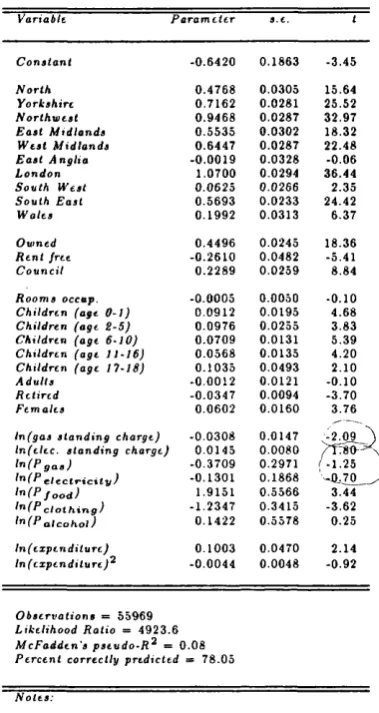
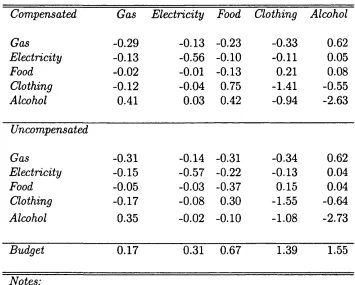
2.2 Gas and electricity share equations with symm etry imposed . 123 2.3 Weighted average of individual elasticities ...125
2.4 Welfare Effects of Tariff R e b a la n c in g ...128
2.5 Average compensating variation for different groups ... 131
2.6 Net welfare effects of tariff rebalancing (case 1) combined with cost r e d u c t i o n s ... 134
2.7 Food, Clothing and Alcohol share equations w ith symmetry im p o s e d ... 138
3.1 Structural cost function estim ation r e s u l t s ... 162
3.2 Results for different contracts and different costs of public funds at sample a v e r a g e ...167
3.3 Rents, transfers and welfare of an optimal a u c t i o n ...171
3.4 Rents, transfers and welfare of a Vickrey auction of fixed price c o n tra c ts ... 172
3.5 Summary statistics of d a ta for the Norwegian bus transport i n d u s t r y ... 175
3.6 Estim ation results w ith alpha 10% h ig h e r... 176
3.7 Estim ation results w ith alpha 10% l o w e r ... 177
4.1 Bidding and e x p e n d itu r e ...186
4.2 Differences related to political c o n tro l...188
4.4 Probability of DSO winning c o n t r a c t ...199
4.5 Cost reduction effects of the number of b i d s ... 200
4.6 Regressions of first differenced m o d e l ...203
4.7 Hausman specification t e s t s ...206
4.8 Probit estim ation of DSO success rate with endogeneity cor rection 208
4.9 Cost reduction effects of the number of bids implied by the first differenced m odel... 209
4.10 Binomial test for DSO success r a t e ...210
4.11 Summary statistics of cost p seu d o -sam p les...225
4.12 Test results for distribution d iffe re n c e s ... 227
4.13 Test for distribution differences (trimmed v a lu a tio n s ) ... 229
4.14 DSO success rate by s e m e s t e r ...232
List o f Figures
2.1 Expenditure shares of gas and ele ctric ity ...107
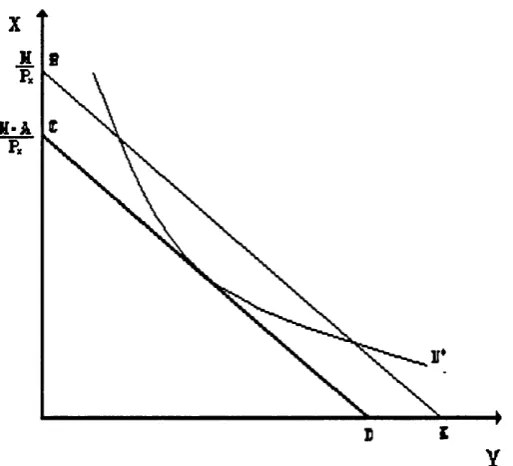
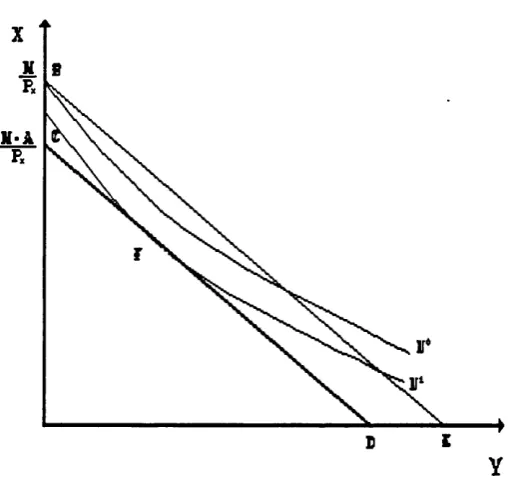
2.2 Budget constraint w ith two-part ta riff... 108
2.3 Corner solution with two-part t a r i f f ...109
2.4 Compensating variation and to tal expenditure (case 1)... 130
2.5 Frequency distribution of compensating variation (case 1). . . 132
3.1 Cost ratio vs O utput ratio for 1991 cross section (solid line above 45 degree line is predicted cost ratio from OLS regression). 160 3.2 Empirical distribution of th e ta ...165
3.3 F itted normal distribution... 166
3.4 Effort level as a function of type, cost of public funds = 0.3. . 168
3.5 Cost as a function of type, cost of pubhc funds = 0.3... 169
4.1 Pseudo costs and bids... 222
4.2 Distribution and density of costs for DSO...224
4.3 Distribution and density of costs for private firms... 225
A cknow ledgem ents
There is a long list of people and institutions th a t have supported me during the course of my doctoral studies. To all of them I would like to express my most sincere gratitude.
For financial support I would like to thank University College London for their Open G raduate Scholarship. Also, the Committee of Vice-Chancellors and Principals of the Universities of the United Kingdom (CVCP) for their Overseas Research Students Award (ORS), and again to University College London for supporting my ORS application. To the D epartm ent of Eco nomics, at University College London, for the Teaching Assist ant ship ap pointm ents for several years. Foremost, I am deeply indebted to the Institute for Fiscal Studies for their G raduate Scholar Award. To this last institution I am grateful for much more th an financial support. It provided marvellous fa cilities, a stimulating academic environment, and a very friendly atmosphere in which to do research.
My ten month visit to QREMAQ, Toulouse, France, was made possible thanks to the EN TER program of which UCL is a member. I thank Jaques Cremer, Tilman Borgers and Christian D ustm an for helping to arrange the visit. I would like to express my special thanks to Marc Ivaldi, for his advice and supervision when I was in Toulouse.
thank, especially Andrew Dilnot and Robert Markless. I am also indebted to James Banks and Ian Crawford for their invaluable help on many occasions and their patience w ith my constant interruptions. Early discussion with Phil Burns were also very useful. I would also hke to thank Dag Morten Dalen for th e many discussions regarding our joint work. My knowledge of COT, and parts of the d a ta used in chapter 4, is in large part due to the generous help of Stefan Szymanski.
Alan Turnbull and Sheela Vyas of the Departm ent of the Environment were very helpful in providing d ata for the final chapter. Desmond Yew’s help in making th e bidding dataset used in the final chapter was crucial. Material from the Family Expenditure Survey, made available by the Central Statis tical Office through the ESRC D ata Archive, has been used by permission of the Controller of HMSO. Neither the CSG nor the ESRC D ata Archive bears responsibility for the analysis or the interpretation of the data reported here.
D eclaration
1. No p art of this thesis has been presented to any University for any degree.
2. C hapter 3 was undertaken as joint work w ith Dag Morten Dalen.
A bbreviations
C C T Compulsory Competitive Tendering F E S Family Expenditure Survey
C hapter 1
Introduction
1.1
Background
Regulation can be defined as the industrial organisation side of public eco nomics. It deals w ith a wide range of issues th a t arise at th e interface between m arkets and the state. In the present study, the focus will be on the regu lation of natural monopolies. This topic has been of growing interest in the last decade, both to economist as well as policy makers.
From a political perspective, the interest in regulation has grown as the end of the cold war has changed the nature of economic debate between people from differing ideological camps. No longer are energies spent in pro tracted discussions about th e advantages or disadvantages of global economic systems (socialism versus capitalism). Now th a t there is a relative consen sus regarding th e advantages of a mixed m arket economy, debate focuses on the narrower topic of the size of the State, the privatisation or not of public assets, or the need for government intervention in the functioning of certain markets. Regulatory economics is the analytical scrutiny of th e case for State intervention and the optim al way to achieve this intervention. Therefore, it deals w ith issues th a t are in th e forefiront of current political debate.
fib-eralisation and privatisation programs. In most cases these reforms have heighten the role of markets and private firms in activities traditionally re served for public entities. Special among these experiences is th e privatisation of pubhc utihties in the United Kingdom. These reforms created a pressing need to answer many questions concerning the optimal regulation of private natural monopolies.
The growing practical interest in regulation has been paralleled by the expanding economic hterature in this field. The publication, in 1982, of the seminal work by Baron and Meyerson, marked the beginning of w hat has been called the “New Theory of Regulation” (Laffont (1994)). Unlike the received literature, the new theory of regulation reformulated th e regulatory problem using the tools of informational economics. This methodological change introduced the notion of asymmetric information between regulators and firms, the idea th a t firms may have some information th a t the regulator cannot observe. This information may be crucial for the design of regulatory policy, but firms will not in general have the incentive to reveal it to the regulator. Using tools of mechanism design and agency theory, the new economics of regulation has enabled researchers to characterise th e optimal regulation in such a situation. Furthermore, the analytical framework has provided a much deeper understanding of the welfare properties of different regulatory schemes and, therefore, their relative merits.
ticular theoretical result abound. The difficulty of obtaining adequate d a ta sets have also lim ited research in this area, as well as purely com putational difficulties related to the complexity of the models in question.
However, some progress in empirical industrial organisation has been achieved^. The m ain objective of this thesis is to apply empirical techniques to different topics in the area of regulation. Hopefully these essays are a contribution to th e bridge building th a t is required between theoretical de velopments in th e field of regulation and its empirical application.
In this chapter we will review the empirical literature on regulation, de scribe how th e three essays of this thesis fit into this hterature, and explain how they expand th e current knowledge in the field.
Before going into more detail about the specific essays presented below, it is convenient to develop a canonical model of regulation th a t serves to clarify and unify th e ensuing discussion. The model presented below relies heavily on Laffont and Tirole (1993).
1.2
T h e regulatory m odel
We assume a m arket for goods or services which can only be served effi ciently by one supplier. The justification for the one supplier constraint is th a t economies of scale, or scope, are strong enough to render the activity a natural monopoly.
The energy industries, such as gas and electricity, are prime examples of traditional n atural monopolies. Not all sections of these industries are n atural monopolies however. For example, scale economies may not be so severe in the extraction of natural gas or the generation of electricity. In these activities com petition may be feasible and desirable. Efficiency losses due to untapped scale economies, or th e duphcation of fixed assets, may be more th a n compensated by the benefits of competition. This observation
has informed many recent reforms in electricity industries around the world. Several countries have, by now, introduced competition and market forces in the generation side of the electricity market. Current wisdom is th at
^ only transportation and, arguably, final distribution to consumers are natural monopoly activities. The model presented below, then, would apply to these last activities.
We assume th at the cost structure of the industry is
C = C (^ ,e,q ) (1.1)
where 6 represents an intrinsic efficiency parameter of the firm, e is the amount of cost reducing effort applied by managers and q = (çi, ...,9n) is a vector of outputs. Higher levels of effort reduce costs for a given efficiency level and output vector. The opposite is true for 9. Conditional on effort and production, a higher 6 implies higher costs. These relationships are formalised as
dC
> 0
dC
< 0
dC
> 0.
The objective function of the firm is,
[/ = S + B(q) - C(^, e, q) - ^(e) (1.2)
where /?(q) is revenue, xp is the disutility of effort of the firm’s managers, and 5 is a subsidy (which can be positive or negative) provided by the regulator to the firm^. Since S is set by the regulator, we can assume, without loss of
^The ^ function is assumed to posses the following characteristics, i p ' > 0, i p " > 0, and
i P ' " > 0.
generality, the accounting convention th at the regulator receives R and pays the firm’s costs, C, and only gives a net transfer t to the firm,
U = t-x/j {e). (1.3)
Notice th at (1.2) assumes th at the firm is risk neutral. In this simple model both the firm and the regulator are assumed to be risk neutral.
The informational structure is the following. The firm knows 6 and it chooses e. The regulator, however, does not observe either. He only observes
jT '
overall ex-post costs, C, and has an imprecise knowledge of the possible values of 9. This last idea is formalised by assuming th a t the regulator’s beliefs can be represented by a distribution over 9, F{9) on 9 e [9_,9]. F(9)
has a continuous and positive density f[9) on the interval [^,9]. In contrast to efficiency and effort , the regulator is assumed to have full knowledge of the cost of effort function ■0. This may seem arbitrary. However, some limited form of uncertainty about the function 0 may be possible, as long as a suitable transform ation of variables allows the problem to be recast in the above structure, where the regulator only has asymmetric information regarding the cost function^.
The demand side will be left purposely vague for the moment. We will assume th at output, q, provides a social surplus of V(q). We will discuss further below what y (q ) is in each of several alternative situations.
The final ingredient is A, the social cost of public funds. In the present model we will interpret this parameter as the social cost of distortionary taxation needed to raise public funds. If we assume th a t the transfers to and from the industry being regulated are small relative to total tax revenues in the economy, it is reasonable to assume th at A is constant**. The purpose
^See Laffont and Tirole (1993) page 36. Other regulatory models assume that costs are known but the regulator has asymmetric information regarding the disutihty of effort function.
“^If the regulator is not allowed to make transfers to the firm, then A would no longer be constant. In this case any transfer given to the firm has to be funded by the firm’s
of introducing the social cost of public funds is to model the fact th at most regulators want to limit the rents earned by regulated firms. If there is a social cost to transfers, then a welfare maximising regulator will attem pt to limit rents.
Another reason for limiting rents is distributive. In this case the welfare of consumers has a higher weight in the regulator’s objective function than the firm’s profits. Taking this approach does not change the model significantly. A parameter analogous to A is introduced in the welfare function to reflect the relative weight given to consumer surplus vis-à-vis profits. Baron and Meyj^son (1982) cast their original model in this form^.
Both the cost of public funds approach and the distributive approach lead to qualitatively similar optimal contracts^. However, it is im portant to recog nise th a t both approaches penalise profits in the objective function. There is a very important reason for wanting the model to have this characteristic. If profits and consumer welfare have the same welfare weight, or there is no cost of public funds, then the first best (symmetric information) outcome can be implemented even when a regulator is faced with asymmetric infor mation regarding production costs (Loeb and Magat (1979)). In this case the regulator could give a transfer to the firm equal to net consumer surplus. Firms would then have an incentive to expand output to the socially optimal level. Needless to say, this is not a very popular regulatory mechanism^. In troducing a cost of public funds is a way to model the fact th at (benevolent) regulators try to minimise the rents they leave to firms.
A utilitarian regulator would try to maximise expected social welfare
revenues, which requires price distortions. In this case, the social cost of transfers will depend on the level of transfers and thus A will be endogenous.
^See also Armstrong, Cowan and Vickers (1994) for an exposition of regulatory theory using a distributional parameter in the objective function.
®In fact, except for the multiphers the formulas are identical.
^To be fair, Loeb and Magat (1979) propose auctioning the right to be the monopohst as an instrument to transfer the surplus back from firms to consumers. We postpone the discussion of auctions in regulation until later.
given by,
- (1 + q) + ^) + ( i 4 )
Je
Using equation (3.11) this can be expressed as,
= r [y (q) - (1 + A) (C (^, e, q) + V;(e)) - AU] /(^ )d ^ . (1.5)
Je
The objective function (1.5) forms the basis of the forthcoming analysis®. The maximisation of this objective function under symmetric and asymmetric information will reveal much about the nature of regulation and the structure of the optimal regulatory mechanism.
1.3
The optim al regulatory schem e
The maximisation of (1.5) is a problem in mechanism design. Although there is an adverse selection parameter, 9, and a moral hazard variable, e, the model is technically an adverse selection problem. This follows from the assumption that the regulator observes costs^. To see this, we can define
E = E (^ ,C ,q ) (1.6)
to be the level of effort required by a firm of efficiency 9, to produce q at the overall cost of C. By substituting (1.6) into the cost function and the disutility of effort function we can express the problem as a function of only one unobservable, the adverse selection parameter 9. Standard techniques in mechanism design are used to obtain the optimal regulatory contract^^.
^Notice that some assumptions must be made regarding consumer preferences to justify the above welfare function. In particular, as discussed in Baron and Meyirson (1982), consumers must be risk neutral for expected surplus to maximise welfare. In addition, consumers must have additively separable utility between the vector of products and other expenditure. i
^The Baron and M eytson (1982) model differs from the one presented above in that
costs not observable. .
^^Mid^Ms (1971) is the seminal work in the field of mechanism design. Fuidenberg and Tirole (1991), chapter 7, present a very useful review of the techniques and assumptions involved.
1.3.1
Sym m etric inform ation
It is useful to contrast the perfect information case with the asymmetric information case. Therefore, we will first examine what the optimal regula to ry contract would be in th e hypothetical case th a t the regulator knew the intrinsic efficiency of the firm, 9. In this case the regulator would instruct the firm to exert a level of effort and produce output q, conditional on 0, so as to maximise the integrand of (1.5). The first order conditions for this maximisation would be.
= ~ { 9 , e - , c C ) (1.8)
t = iP(e*). (1.9)
Condition (1.7) simply states th a t output should be such th a t the mar ginal social value is equal to the marginal social cost. This is th e tradi tional welfare maximising o u tput condition from microeconomics, except for a mark-up due to the cost of public funds. The social cost of production is higher th an private costs by a factor of (1 -H A).
The second condition states th a t effort should be exerted until the social marginal benefit, in term s of reduced costs, equals the marginal disutility of effort. The third condition states th a t transfers should be such th a t utility is zero for all types of firms. Due to the cost of public funds, rents left to th e firm are costly and th e regulator, in this ideal situation of perfect information, would set them equal to zero.
1.3.2
A sym m etric inform ation
States th at if there is an optimum strategy (as a function of efficiency type 6) for the firm facing a particular regulatow contract, then this contract can ^
also be implemented as a direct trutlQ ^vealing mechanism. To be more precise, in the model presented above there are n + 2 observable variables: n
outputs, C and t. Faced with a particular regulatory contract, a firm with efficiency 9 will find it optimal to produce a certain amount of output, at a certain cost and receive transfers, say {q*(^), C*(0), The regulator could just as well have asked the firm to announce an efficiency parameter,
9, and then commit to implement the policy {q*(0), Since the outcome for the firm from this direct contract is exactly equal to what the company would have received in the indirect case, it is in the firm’s interest to announce it’s true type. Thus the optimal announcement is 9 = 9.
Since the equilibrium of any indirect mechanism can be implemented by a direct tru th revealing mechanism, we can concentrate on finding the optimal contract within the class of direct tru th revealing mechanisms.
Denote U{9,9) the utility of a firm th at announces 9 when its true type is 9. A tru th revealing mechanism is a set {q(6^), C{9), t{9)}, as a function of the announcement 9, such that,
f/(0; 4) (7(6); 9) V 9 (E (!(:)
U { 9 ; 9 ) > 0 y 9 e [9,9]. (IR)
The firm announces an efficiency type 9, and the regulator commands the firm to produce q(^), at a cost of C{9), and gives the firm a transfer equal to t{9). The incentive compatibility (IC) constraint states that, for the mechanism to be tru th revealing, the utility of announcing the true effi ciency is higher than the utility from announcing a non-true type. Thus, a tru th revealing mechanism has to be designed so th at firms do not have the incentive to pretend to be more or less efficient than what they truly are.
/ The individual rationality (IR) constraint states that all firms obtain non- \negative utility. Otherwise, some types would refuse the contract altogether
and would not participate in the regulatory game.
Locally, the incentive compatibility constraint will hold if a firm has no incentive to pretend to be slightly less efficient than it really is. Looking at the firm’s utility, and substituting equation (1.6), we have,
[/(?; ^) = f(g) - ^(E (^, C(g), q(g)). (1.10)
The firm will make an announcement so as to maximise (3.14). In order for the (IC) constraint to hold, the first order condition, evaluated at an announcement equal to true efficiency, must be zero. Formally,
06
= 0.
By the envelope theorem, this implies th at the utility of firms must evolve according to,
-— = - 2jj'[E(6, C (6) , q (6))— < 0. (I l l )
Equation (1.11) states th at for the mechanism to be tru th revealing it must give higher utility (rents) to efficient types (low 6) than to inefficiency types (high 6). The intuition is the following: an efficient firm could pretend to be slightly less efficient, and it would therefore have to exert less effort to reach the same cost and output vector expected of the less efficient firm. This effort savings is ^ and the marginal cost of effort is ^'(e). Therefore, a firm of type 6 could obtain a utility of by declaring a slightly higher efficiency parameter. In order for the mechanism to give incentives for firms to reveal their true type, it must give them at least this utility for declaring their true type. Equation (1.11), required by incentive compatibility, is the source of the socially costly informational rents th at a regulator must give firms under asymmetric information.
Equation (1.11) is necessary but not sufficient for the (global) condition (IC) to hold. The local condition (1.11) is sufficient if, in addition, the mechanism is such th a t,
S > 0 (1.12)
g < 0 V i. (1.13)
These second order conditions imply th a t the mechanism must compel less efficient firms to produce less and also have higher costs^^.
Because incentive com patibihty requires more efficient firms to have higher utility, the individual rationality constraint (IR) will only be binding for th e most inefficient type (0). Since leaving rents to firms is welfare reducing, we are assured th a t the optim al contract will set utility as low as possible. Therefore, we can simplify th e (IR) constraint to U (Û) = 0.
We have characterised th e conditions th a t a tru th revealing mechanism must meet, and by th e revelation principle we know th a t a regulatory contract can be implemented by a direct tru th revealing mechanism. Therefore, to find th e optim al regulatory contract we need to find the direct mechanism th a t maximises expected social welfare (1.5). T h at is, the optim al contract will,
maXq(.)^e(-),[/(-) f (q) - ( l + /\) (G(g, e, q) + ^(e)) - XU] f ( e ) d 6 { l . U )
Je
subject to.
— ~ '0 ^ (^ )'^ (^ 5 ^ (^ » ^ 5 q ),q ) (IC)
U( B) = 0 (IR)
s ^ °
5 < 0 V i. (c4)
To solve program (3.13) it is best to maximise the objective function subject to the (IR) and (IC) constraint only and then examine whether the solution found satisfies condition (c3) and (c4). If it does, then th e solution is feasible and the optimal contract has been found^^.
Note th a t we have changed the control variables from q, C, t to q, e, U.
Equation (I.I) shows th a t once q and e are determined so is C, therefore it does not m atter which control variable is used. Also, by equation (3.11) once effort and utility are determined so is the transfer from the regulator.
Taking e and q as control variables and as a state variable, the first order conditions for program (3.13) are^^,
+ + / o r i = l , . . . , n (1.15)
-
“S
■ ( Ï T Â ) M(1.16)
Comparing these first order conditions with the case of symmetric infor m ation we see th a t the last term in each equation is an adjustm ent to the first best (symmetric information) conditions. These adjustm ent are due to the desire of the regulator to limit the informational rents accruing to firms. Rearranging equation (3.7) we obtain.
\F{e) — (1 + A) ~ f{6)
The right hand side of this equation is the social benefit of increasing effort (of a firm of type 0) by one unit. It is valued at (I H- A) since cost
i^ Ifit does not meet the conditions, the solution must be modified by "bunching" some types (see Guesnerie and Laffont (1984)).
reductions reduce th e necessary public transfers given to the firm to cover its costs. Also, it is m ultiplied by th e density associated with type 6 firms. The left hand side is th e extra rents th a t will have to be given to all firms th a t are more efficient th a n 6. If the effort exerted by a type 6 firm is increased, then more efficient firms will earn higher utility by pretending to be less efficient. Therefore, to m aintain incentive compatibihty, the mechanism has to award the extra utihty to efficient types. The cost of the extra transfer is valued at A and there are F{6) firms th a t are more efficient th an 6.
The optim al mechanism th en trades-off efficiency gains, by lowering effort to more inefficient firms, in order to extract informational rents from efficient types. The mechanism has the property th at, for the most efficient type, there are no additional efficient firms whose rents m ust be limited. Therefore the level of effort for the most efficient type is the first best level.
The adjustm ent to the resource allocation conditions (3.6) has a similar interpretation. The regulator may want to limit th e output produced by a firm of type 6, This would be the case if production affects the amount of effort th a t a more efficient type saves by pretending to be less efficient.
For th e rem ainder of this and th e following chapters, we will assume th a t the cost function has th e following form
C = C ( ? ( e - e ) , q ) , (1.17)
which am ounts to assuming th a t effort and the efficiency param eter are weakly separable from o u tput in the cost function. The attraction of this assum ption is th a t it is sufficient for the incentive-pricing dichotomy to hold (Laffont and Tirole (1990))^'*. Assumption (3.15) implies th a t.
and is independent of the cost level and the output vector. This assumption simplifies the analysis without losing any important insights. The optimal (second-best) mechanism would now be described by the following conditions,
^ = (1 + A ) ^ f o r i = l , . . . , n (1.18)
[ /( ^ ) = / y (1.20)
Je ^ y
The incentive-pricing dichotomy is so named because the optimal alloca tion or pricing condition (1.18) is the same under symmetric and asymmetric information. The complications th at arise due to asymmetric information are all dealt with in the “supply” side of the regulatory contract^^.
1.3.3
Rem arks
The canonical model presented above does not consider many important issues dealing with regulation, or the possible variants th at can be devel oped by relaxing some of the assumptions. Its purpose was to illustrate the basic problems facing regulators (asymmetry of information) and to charac terise the optimal second-best contract. This serves as a useful framework to analyse different regulatory schemes and to organise the discussion regarding the different dimensions of the regulatory task.
Many extensions to the model can be found in Laffont and Tirole (1993) and the references and bibliographical notes found therein. We will not discuss those models here, but some particular issues will be touched upon further below.
^^This not to say that output and prices would be the same under both informational scenarios. Since effort will be different under asymmetric information, so will marginal cost and therefore the optimal output will differ in both cases. Also, this result does not hold when costs are not observable as in the Baron and Meyerson (1982) model.
Of particular im portance is the extension of th e model to a multi-period setting and the introduction of dynamics. In a m ulti-period setting the in- abihty of regulators to commit to a particular regulatory contract has dire consequences for optim al regulation. The basic problem is th a t optim al tru th reveahng incentive contract derived above is no longer incentive compatible. If th e firm were to reveal its tru e efficiency type, 6, in the first period, th e regulator could use this information in a subsequent period to design a con tra c t th a t leaves no rent to the firm. Unless the regulator can commit not to change th e contract in the future, th e firm will be wary of revealing its tru e type.
1.3.4
T hree essays in ap plied regulation
All of the essays in this thesis deal w ith some aspect of the regulatory model presented above and with equations (1.18), (3.16) and (1.20). The first essay deals with resource allocation issues. Equation (1.18) shows th a t demand issues are central to the regulatory task. The second and th ird essay are concerned with th e supply side of regulation. In particular, th e design of an optim al contract and the rent extraction aspects of regulation. Each of these topics and the relation with the ensuing essays will be further elaborated below.
1.4
T h e resource allocation sid e o f regulation
Much intellectual effort was expended after the Second World War on determining optim al pricing and investment policies in public enterprises. Modern project appraisal techniques, peak-load pricing theory, and th e con cept of pricing at long-run marginal cost were developed at the time. Those theoretical advances had a direct influence on policy prescriptions -if perhaps not actual practice- in th e United Kingdom, as the 1961 and 1967 W hite Pa pers on the nationalised industries show.
Most of this h teratu re is still relevant to the New Theory of Regulation. In this section we will review th a t part of the pricing literature deahng w ith tariff structures^®. We will not cover dynamic or investment issues or peak-load pricing problems. Some extensions to the theory have also been developed to analyse issues raised by recent regulatory reforms. We will also briefly examine those results.
Before continuing it is necessary to state the conditions th a t make the pricing structures analysed below feasible. In most cases, optim al tariffs will involve positive price-cost margins and a declining average price for the regu lated goods. The regulated firm must then have some m arket power if positive price-cost margins are not to be eroded by competition. The assum ption of m arket power is usually th e reason why these companies are regulated in the first place, so this assum ption is imbedded in the original regulatory model. However, having m arket power, as in the case of a monopoly provider, is not enough to guarantee th e feasibility of tariff structures th a t imply some kind of quantity discount. In this case, there must also be some obstacle to ar bitrage between consumers. Otherwise, there would be a profit opportunity for one customer to buy large amounts at a discount and resell to smaller customers. A rbitrage possibilities between customers is prevented by the dif ficulty of storing some goods, such as the energy products of utifities such
as electricity or gas. In other cases, such as telecommunications, the idio syncratic nature of demand may make it difficult to estabhsh trade between consumers. My telephone calls are not generally at th e same of time, day, duration and distance as my neighbour’s calls. In th e case of telecommuni cation, however, technological change and deregulation has made arbitrage a real possibihty. An example is th e leasing of tru n k hnes by interm ediate providers. The increasing arbitrage possibilities in telecommunications would indicate th a t tariffs will increasingly be determined by competitive pressures. Later we will come back to this issue.
1.4.1
Linear prices w ith hom ogenous consum ers
Now we can go back and examine what V(q) is. The simplest case to analyse is to assume th a t all consumers have the same preferences and they have an additively separable utility function for the vector of products q and other expenditure. We can therefore speak of a representative agent. In addition, we assume th a t each output is sold at a constant price Pi per unit. The social value of production would be
K(q) = 5 ( q ) - p ( q ) q - h ( l - h A ) p ( q ) q
= 'S'(q)-|-A p(q)q
where S(q) is gross consumer surplus from output q, and p (q ) is a vector of inverse dem and curves. Revenue has a net social value since it reduces the am ount of distortionary taxation th a t needs to be raised. We will make the simplifying assumption th a t there are no cross price effects in the demand
curve of each good. Therefore, = pi and this case,
condition (1.18) would be,
A 1
( 1.21)
where rji is the demand elasticity of good i. The “Ramsey type” formula (1.21) states th a t price-cost mark-ups should be inversely proportional to demand elasticities^^.
In the present interpretation, price above marginal costs are due to the convenience of raising funds in this regulated industry rather th an through distortionary taxation. In particular, A, the cost of public funds, is exogenous to this partial equilibrium analysis. This case should not be confused with the case where a regulated firm is not allowed to receive direct transfers from the regulatory authority. In this later case, when there are increasing returns to scale the firm cannot cover all costs through the revenue received from marginal cost pricing. Therefore, to break even, the firm must increase prices above marginal costs. The optimal (welfare maximising) way to do this is by setting price-cost margins according to an equation identical to (1.21) except th at, in this case, A would be a Lagrangian multiplier associated w ith the firm’s budget constraint and would therefore be endogenous to the analysis.
The im portant point to note in this section is th a t it is socially optimal to set different price-cost margins for the different goods. If th e goods are defined as outputs for, say, different regional markets or different customer classes, optim al Unear pricing would indicate th at some price discrimination among regions or customer might be desirable.
1.4.2
Two-peirt tariffs w ith hom ogenous consum ers
Condition (1.21) is an optimal trade-off between the welfare reducing dis tortions caused by prices being above marginal costs (or ou tp u t lower than necessary) and the welfare enhancing benefits of lower distortionary taxation
in other p arts of the economy. However, welfare can be improved further if we relax th e linear price assumption and allow for a two-part tariff structure. In this case the customer pays a fixed charge, a», th a t is independent of th e units consumed, and a variable price, pi, for each unit consumed. Formally, a tw o-part tariff is an outlay schedule
Pi{qi)
= U iThe fixed charge can be used to raise revenue while allowing the unit price to be set equal to marginal cost, therefore reducing the distortions caused by price-cost markups.
W ith homogenous consumers and no income effects, the fixed charge acts as a non-distortionary lump-sum tax. Therefore, it is optimal to raise as much revenue as possible using the fixed charge. The social value of production is now.
K(q) = 5 ( q ) - p(q)q I -f (l-hA) ( ^ û i - H p ( q ) q
\t= l / \i= l /
= 5 (q )-h A p ( q ) q V (1.22)
i=l
Net consumer surplus is 5 ( q ) — Ya=i “ p (q )q . The maximum amount of revenue th a t can be raised with the fixed charges, consistent w ith consumers still purchasing some am ount of the goods would be,
n
^ a j = S ( q ) - p ( q ) q . i=l
S ubstituting this expression into (1.22), th e social value of production would then be,
It is easily checked that, in this case, the optimal pricing condition (1.18) requires marginal cost pricing,
Pi = (1.23)
OQi
It is interesting to note th at the above prices are exactly equal to what a perfectly discriminating monopoly would set (Oi (1971)). In both cases the firm extracts all of consumer surplus.
1.4.3
Two-part tariffs w ith heterogeneous consum ers
The assumption of homogenous consumers is obviously a fiction. Replacing this assumption with th at of heterogeneous consumers leads to different and interesting results. We must first clarify what is meant by heterogeneous con sumers. One interpretation is to group consumers according to an observable characteristic. For example, students, non-students and pensioners. The de mand behaviour of each customer group may be different and the optimal pricing question is: what would be the optimal charge to each group? This is a problem of third-degree price discrimination^*. It turns out th at the results of the last two sections apply to this case, provided that the subindex i is interpreted as indexing customer groups instead of products. For example, optimal linear prices would involve high price-cost margins for groups with low demand elasticity and vice-versa.
In contrast to observable customer groups, the focus below is on un observable heterogeneity. Preferences, and thus demand behaviour, varies across the population. The firm, however, cannot distinguish individuals by their observable characteristics. It does know, however, how preferences are distributed in the population as a whole. This problem is more akin to the second-degree pricing literature.
W ith heterogeneous consumers it may no longer be optimal to set the variable price equal to marginal cost. This holds for a welfare maximising
^®See Varian (1989).
regulator (Feldstein (1972); Ng and Weisser (1974); Auberbach and Pellechio (1978); Schmalensee (1981)) as well a for a profit maximising monopolist (Oi (1971); Schmalensee (1981)).
There are two sets of reasons why cost reflective prices may not be op timal. The first is distributional. The fixed charge acts hke a regressive lump sum ta x on consumers. If poorer consumers have a higher weight in the social welfare function th an richer consumers, then it would be welfare enhancing to trade-off some of the efficiency gains of a high fixed charge for the distributional benefits of lowering this charge.
Feldstein (1972) analysed the above situation and obtains the result th a t price-cost margins should be inversely proportional to the absolute value of the dem and elasticity (as in equation (1.21)) and negatively related to the covariance between consumption of the output and the social marginal util ity of income across households. If low income households consume less than average quantities of the output, then this covariance will be negative and, consequently, more revenue should be raised by increasing the price-cost m ar gin rath er th a n by the fixed charge. Auerbach and Pellechio (1978) extend Feldstein’s analysis to the case were m arket penetration is endogenous. T hat is, for a given fixed and variable price, not all consumers find it in their inter est to participate in the market. Feldstein’s result on the optimal price-cost margin is then adjusted for this market penetration effect.
T he second reason for not setting th e variable price equal to marginal cost does not rely on distributive arguments. W hen m arket participation is endogenous, lowering the fixed charge increases the consumer surplus for infra-marginal consumers. This positive welfare eflfect may compensate the negative im pacts of having to increase th e price-cost margin.
consumer type /? iis given by
V { 0 ) ^ U { 0 , q ) - a - p q (1.24)
where we have assum ed for simplicity th a t there is only one good. For a given marginal price and fixed charge, a consumer of type (3 will choose a consumption level th a t maximises (1.24). Indirect utihty is then,
y (/?,p ,a ) = U ( M m - a - p q ' { 0 ) . (1.25)
There is a consuimer type who is indifferent from purchasing positive amounts of th e gO)od and not purchasing at all. This type is found by solving
V{ P, p, a) = 0. Given certain regularity conditions on the way p affects the marginal utili ty of consumption, the marginal consumer will be a type P
such th a t ah ty p es (3 < (3 do not purchase the good while all /? > /? consume positive amounts of the product. q*{(3) is the consumption of level of the marginal consumer.
Assuming aw ay distributional issues, the optim al pricing conditions are
and
a (1 + A ) |5 ) ; ,| ^
where rj is th e price elasticity of demand holding /3 constant, and is the elasticity of th e niumber of consumers who purchase positive amounts of the good w ith respectt to the fixed charge.
from the purchases of the new consumer. Therefore, both pricing conditions can be regarded as Ramsey pricing formulas^
As in the case of hnear prices, equations (1.26) and (1.27) show th a t it may be socially optimal to set price-cost margins differently for different goods. If th e goods are defined as outputs for, say, different regional markets or different customer classes, optimal linear pricing would indicate th a t some price discrim ination among regions or customer might be desirable. However, in th e case of tw o-part tariffs, price margins not only differ across goods but also between the fixed charge and the variable price. T hat is, it may not be socially optim al to make tariffs cost reflective. A t the optimum, th e fixed charge may not necessarily reflect th e marginal customer costs and th e variable price th e marginal cost of output.
Equation (1.26) also shows th e im portance of heterogeneity for the design of tw o-part tariffs. If the demand of marginal consumers is equal to aver age consumption then there is no benefit from having a price different from marginal cost.
1.4.4
N on -linear pricing
Compared w ith hnear prices, optim al tw o-part tariffs cannot decrease th e level of welfare. This is because hnear prices are a special case of two-part tariffs. However, two-part tariffs are a special case of more general tariffs. Therefore, any welfare level achieved by tw o-part tariffs can also be achieved by more general m ulti-part tariffs and, usuahy, these last tariffs wiU be able to do better^®.
The highest level of welfare wiU be achieved by fully non-hnear prices.
Sometimes there are costs that are related to supplying a consumer independent of the amount purchased. An example is metering costs in the supply of gas and electricity. If is the marginal cost of supplying an additional consumer, then the numerator in the left hand side of equation (1.27) is a - ( | ^ — (p - ^ ) g * (/))).
whereby each consumer type faces a different price level. In many cases non linear prices are equivalent to continuous quantity discounts for th e purchase of the good. The quantity discount characteristics of two-part tariffs can be seen from th e fact th a t the average price paid for the goods decreases as the am ount purchased increases.
The optim al non-hnear tariff, P{q), in the case of one good and where consumers differ in ju st one dimension, is given by a very similar formula to (1.21)^^. To show this we will follow the formulation proposed by Wilson (1993). Wilson defines a dem and profile, N{p{q),q), as th e number of cus tomers th a t purchase the unit q of the good at the marginal price p{q) =
for th a t unit. Using the notation of the last section,
y ( ^ ) = [ / ( A g ) - f ( 9 ) .
Then, assuming th e Spence-Miirrlees condition holds, n a m e l y > 0, the demand profile can be defined as
N{p{q),q) = l - H 0 )
where p is given by ^ = ^ 0 , q) - p[q) = 0.
The advantage of using the demand profile is th a t the optim al non-linear pricing schedule is given by the simple condition
^(9) - f _ ^ L n 28)
p{q) 1 + A|7J^| ( '
where 777^ = N^iqfg) elasticity of the number of consumers th a t purchase the qth unit when th e marginal price for th e gth unit changes^^.
Equation (2.1) has th e same “Ramsey” property as th e other optimal pricing rules discussed above. One way to think about condition (2.1) is to
^^See Armstrong (1996) and Wilson (1993) for the more demanding case of multiple products and multi-dimensional consumer types.
consider each unit of g as a different good. Then the price cost margin should be inversely proportional to th e demand elasticity of each good, analogous to result (1.21) above.
1.4.5
P ricin g and regulation sch em es
All the above sections assume th a t the regulator can control prices, either directly in the case of a pubhc firm or indirectly through an optim al tru th telling mechanism. However, many recent regulatory proposals give private regulated firms flexibility to set prices within certain fimits. Price cap reg ulation is a case in point^^. The regulator sets the maximum average price th a t the firm can charge for a basket of goods. For example, when all the products of a firm are measured in the same units, say kilow att/hours, th e cap may take th e form of a limit on th e average revenues a firm can earn. Provided the firm meets the average revenue constraint, it is free to set prices for individual goods within the basket as it finds convenient.
An interesting question then arises: what are the characteristics of th e pricing structure th a t a profit maximising firm would set and w hat are its welfare properties? Armstrong and Vickers (1991), Sappington and Sibley (1992) and Armstrong, Cowan and Vickers (1995) analyse this issue.
Armstrong, et al. (1995) compare three possible tariff structures under average revenue regulation. The first is to force th e firm to charge a uniform tariff, th e second is to allow the firm to charge a non-linear tariff (provided th a t the average revenue constraint is m et), and th e th ird is to allow the firm to offer a non-hnear tariff but also giving customers th e possibility to buy at the uniform price.
The th ird case of optional tariffs is pareto improving over uniform prices. The welfare comparison between uniform prices and non-hnear tariffs (with out the uniform price option) is ambiguous. However, unless th e price cap is
set significantly above marginall cost, uniform pricing is to be preferred. On average, consumers are better off with a uniform tariff than with a non-linear tariff. This would indicate that regulators need to be careful when allowing a price-cap regulated firm to price discriminate.
This last result is relevant to issues discussed further below. The profit- maximising non-linear tariff, subject to an average revenue constraint, in volves marginal prices below marginal cost for the high (3 types. The result ing increase in demand from these types eases the revenue constraint and allows the firm to increase revenues from other types.
1.4.6
Empirical applications and th e first essay
The pricing theory reviewed above requires knowledge of, at least, the de mand elasticities for different goods and services. Therefore, demand studies that generate this information are an important prerequisite to apply the above pricing conditions.
In the first essay of this thesis a household level demand system is es tim ated for the United Kingdom. Special attention is placed on domestic energy goods, gas and electricity. The demand system is a Quadratic Almost Ideal Demand System (QUAIDS). This is a recent extension to the popular Almost Ideal Demand System (Deaton and Muellbauer (1980)) developed by Banks, Blundell and Lewbel (1997) that allows for quadratic Engel curves.
One of the novelties of the model is the use of dese^egated price data for the energy goods. These goods are sold in the Umted Kingdom using two- part tariffs. Information was obtained on the fixed and variable charges for gas and electricity. Standard microeconomic theory tells us th at the effects/ on consumer behaviour of a change in the variable price for a certain good will not be the same as the response to changes in the fixed charge. Therefore, to obtain consistent results, the model must distinguish between both prices. Two-part tariffs also raise interesting econometric issues which must be dealt
w ith in order to obtain consistent estimates.
The information provided by the estim ated model could be used for many purposes. For example, th e estim ated elasticities could be used to design optim al tariff structures along th e hnes discussed in the previous sections. However, in th e first essay th e model is used to address a different but related issue.
One of th e results of th e optim al pricing hterature is th a t some level of price discrimination may be justified on economic grounds. For exam ple, price mark-ups may differ according to the demand elasticities for each product. Also, the balance between th e fixed component of tariffs and the variable price should not necessarily reflect th e relative value of customer related costs and marginal costs.
In practice, tariffs in many regulated industries present some kind of discrimination or cross subsidy between consumer groups or between different services. These tariff structures may reflect optimal pricing considerations or they may be the result of historical and pohtical events. The im portant point, however, is th a t recent regulatory reforms have rendered many of these cross subsidies unsustainable. Therefore, in many industries there is currently a pressure to phase away cross subsidies and make prices more cost reflective.
Tariff rebalancing, however, may have undesirable welfare consequences. Many regulated industries such as gas and electricity provide services th a t are considered to be basic needs. In telecommunications, universal access is considered a legitimate social policy objective. Regulators and pohcy mak ers are therefore concerned for th e distributive and other effects th a t the elimination of cross subsidies may have. Few studies address these issues, a noticeable exception being Wolak (1996).
Wolak (1996) studies the telecommunications industry in th e United States^'*. He estimates two dem and systems (a QUAIDS and a Translog)
to analyse the impact th a t a rise in local rates, in tandem w ith a fall in long distance rates, would have on different groups of consumers. Until recently, long distance tariffs in th e United States have been used to cross subsidise local calls. However justified on economic or distributive grounds, these cross subsidies are becoming difficult to sustain in the face of technological change and intense competition among long distance carriers. These developments have increased the pressure to rebalance long-distance and local tariffs to reflect their underlying cost.
W olak’s results indicate th a t there would be little loss in welfare for house holds th a t are adversely affected by tariff rebalancing and th a t disconnections would not increase significantly. In the aggregate, net welfare gain is pos itive implying th a t those th a t gain from the tariff change can more than compensate those who lose.
T he demand system estim ated for the United Kingdom is used in a sim ilar fashion as Wolak (1996). Since April 1996, competition for the supply of domestic gas has been gradually introduced in the United Kingdom with electricity expected to follow in 1998. The introduction of competition in the domestic energy supply markets will entail a gradual elimination of ex isting cross subsidies. In particular, the fixed charge for gas and electricity
f is likely to rise while the variable price decreases. According to Hancock and f W addams-Price (1995), the potential welfare impact of tciriff rebalancing has p ^ ^ Ire a d y affected policy decisions by the gas regulator. Measuring these wel
fare effects are im portant to inform future policy decisions and, possibly, to design specific programs to curb the negative social effects th a t the changes in th e energy markets will have.
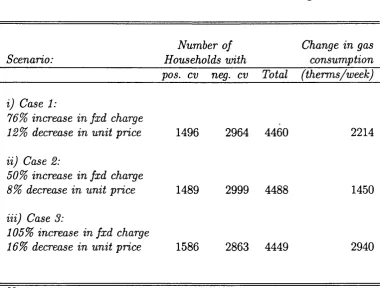
30%, and these costs reductions are translated into lower fixed charges, then almost all households stand to gain. However, if the potential cost savings th a t may be achieved in a competitive market are below this 20% to 30% range, then tariff rebalancing sparked by the introduction of competition does pose distributional conflicts.
The analysis of the welfare impacts of tariff changes is im portant in its own right. Results can be used to evaluate the need for special programs to alleviate negative distributional impacts and to help design these programs if required. But, welfare analysis may also have more direct policy implications for regulators. In some cases, the threat of adverse welfare consequences may be used by a monopoly incumbent as an argument against proposed regu latory reforms. Analysing the veracity of distributional and welfare claims -a s is attem pted in chapter 2 - may, therefore, be a vital input to regulatory reform in utility industries.
1.5
The supply side o f regulation
Pricing issues dominated much of the literature on utility regulation until two decades ago. Except for the A ver^h-Johnson effect (A ver^h and Johnson (1962)) incentive issues were not the focus of attention^^. In particular, the effects th a t ownership, or a particular regulatory scheme, might have on the incentives to reduce costs were not well developed themes in the regulatory literature. The idea of setting prices at an optimal margin -possibly zero-above marginal cost was well understood. However, nothing guaranteed th a t the marginal costs were the lowest possible.
/
This began to change as economist began realising th at incentive issues were probably more im portant th an pricing issues. As Newbery states:
^^The Averech-Johnson effect states that firms regulated with a rate of return scheme have an incentive to be more capital intensive than what efficiency considerations would dictate. This model assumes that the allowed rate of return is exogenously set higher than the cost of capital of the firm.
“...although the principles can guide pricing and investment deci sions provided the nationalised industries are efficiently managed and minimise cost of producing the desired levels of output, they do nothing to ensure th a t the industries are managed efficiently. Moreover, it is not difficult to argue th a t it is far more im portant to ensure th a t costs are minimised th an th a t prices are set at the correct level. Suppose the elasticity of demand facing a nation alised industry is unity; then, roughly spealdng, the welfare cost of setting the price 20 per cent too high or too low is no greater th an the welfare gain of cutting production costs by 2 per cent; whilst if price elasticities are lower th an unity, pricing errors are less costly. It is doubtful whether the disagreements over pric ing am ounted to more th a n 20 per cent, and I suspect th a t very few economists would have claimed th a t improved management, monitoring, or competitive pressure could not have been able to reduce costs by at least 2 per cent.”^®
The regulatory model presented above takes explicit account of incentive issues. It attem pts to model the fact th a t to increase efficiency the firm must exert costly effort and must therefore be given the incentive to do so. Also, it takes account of the fact th a t the regulator has an informational disadvantage vis-à-vis a private firm. Besides deriving th e optimal contract in such a situation, th e above model clarifies the properties of other regulatory schemes th a t are used in practice. T hat is the subject of the next section.
1.5.1
Im p lem en tation and m enus o f linear con tracts
Equation (3.16) and (1.20), together w ith (3.11), determine the level of effort, cost and transfer, all as a function of th e firm’s announcement of of the optimal regulatory contract.