United Kingdom Vol. V, Issue 6, June 2017
Licensed under Creative Common Page 519
http://ijecm.co.uk/
ISSN 2348 0386
DEVELOPING PSYCHOLOGICAL EMPOWERMENT
THROUGH KNOWLEDGE SHARING BEHAVIOR
Soheila Zolfaghari
Master of Information and Technology Management, University of Payame Noor, West Tehran Branch, Tehran, Iran
Masoome Ghorsi
Master Economy, Jawaharlal Nehru University (JNU), New Delhi, India
RezaDehestani
Master of Executive Management, University of Tehran, Tehran, Iran reza [email protected]
ShahamatNikpasand
Master of Executive Management, University of Payame Noor, Alborz Center, Iran
Abstract
In the knowledge-base era, knowledge management is one of the most critical tasks of the
leading organizations that try to take advantage of their employees’ knowledge sources as
sustainable competitive advantage. In this vein, the present study has investigated the effect of
knowledge sharing behavior on Psychological empowerment of employees. This applied
research used descriptive survey design. The population of interest consists of employees of a
service provider organization in Tehran, among whom 276 persons were randomly selected as
the statistical sample. The data was analyzed through path analysis technique using Lisrel
software. The results revealed that encouraging knowledge sharing behavior among the
employees has had significant positive effects on promoting their feeling of capability, a sense
of meaningfulness, sense of being effective and having autonomy.
Keywords: knowledge management, knowledge sharing, psychological empowerment, feeling of
Licensed under Creative Common Page 520 INTRODUCTION
In the current competitive businesses, the main concern and effort of the organizations is survival, development and comprehensive progress. In this vein, the managers tend to identify and take optimal advantage of resources, assets and capitals which requires a great deal of effort to be obtained. Effective use of such capitals may pave the way for the organizations to improve their productivity. Among these, human capital is the most valuable one. That’s because optimal utilization of other capitals is contingent on the capabilities of human capitals (Hansen, 2002).
Today, factors like rapid advances in information and communications technologies and the growing movement toward globalization have made the organizational environments very active and in turbulent. In such situations human capitals have vital role and significance in the success and effectiveness of the organizations. Hence, in orders to survive in this competitive world, the organizations have focused on the development of their strategic resources. This will help obtain sustainable competitive advantage using their resources, and intangible and non-imitable capabilities (Alavi & Lidner, 2001). The managers and the experts of management have always been concerned with findings ways to use their employees’ capabilities to achieve their organizations’ goals (Wallace and Storm, 2003:31). However, it seems that most organizations have failed to implement the techniques and methods of employee empowerment which they know very well. That’s may be due to the fact that they have not perceived empowerment as an organization goal.
In spite of all these, some employees feel that they are demotivated, they lack interest and experience in their workplace, their potentials are not actualized and the condition of their work exacerbate such problems (Abodollahi, 2003: 7). Issues such as communication blocks among the mangers and their employees, demotivation and employees’ conflicts (behavior field), centralized formal and complicated structure, inefficient equipment and facilities, disproportionate organization structure, inflexible organization structure disproportionate promotion and reward system (structural field) and lack of organizational innovation in chaotic condition (context field) are among the most essential factors bringing about such problems in public organizations (Abtahi &Abbasi, 2006).
Licensed under Creative Common Page 521 capabilities. Accordingly, knowledge sharing among the employees seems to lead to psychological empowerment of employees. In spite of this fact, the studies done in this respect are not comprehensive enough and very few have taken an empirical approach. Based on what was mentioned, this study was an attempt to identify the effect of knowledge sharing behavior on each of the psychological empowerment dimensions and propose some practical solutions to improve employees’ psychological empowerment through implicit knowledge sharing.
LITERATURE REVIEW
Empowerment
Human capital empowerment means developing required potentials in the employees which enables them to create added value in the organization and their effective performance (Babaee, 2002). Empowerment doesn’t equal to giving power to individuals; they already have much (in the form of knowledge and motivation) which help them to do their best. Empowerment means to emancipate this power (Jaafari Ghoshchi, 2001). In fact, empowerment is different from giving power to individuals. Power is directly allocated to individuals. Empowerment, however, needs some conditions in which individuals can make themselves empowered (Veten & Cameron, 2002). Empowerment means much more than merely giving authority to employees. At the time of empowerment not only task is asks assigned to employees but also helping them make decisions when needed (Aghayar, 2003). Blanchard defines empowerment as emancipating the power and potentials of people to help them make achievements. In his view, empowerment means giving power to individuals in order that they gain self-confidence, can overcome their weaknesses and also have enthusiasm to do their duties. Some advantages of empowerment include: improving the quality of the products and services, increasing the employees’ sense of commitment and mangers’ power, promoting efficiency synergy and sense of accountability; and in consequence of all these an increase in competitive advantage in the global market (Ansari et al., 2011).
Licensed under Creative Common Page 522 There are two perspectives regarding empowerment: the structural and the psychological view. The first defines empowerment as including others in the decision making processes and power resources. The second view is a psychological one which means creating an internal sense in people which make them act independently in decision makings throughout their careers (Abbasi and Taleghani, 2014).
Knowledge sharing
Dovenport and Prusack (2000) provided a definition of knowledge which has been widely advocated by the authors. They defined knowledge as a fluid mixture of experience, values, contextual information and technical perspective which provides a framework for evaluation and obtaining experience and information. To be more precise, individual knowledge cannot be directly shared since it is located in their minds and cannot be disentangled (Hendrik, 1999). To share knowledge the owner of knowledge should first externalize it to make it explicit and accessible to others. Explicit knowledge is objective and can be stored in knowledge stores (like databases and documents) or be circulated among people (Hendriks, 1999). On the other hand, those who seek knowledge have to internalize the knowledge received to be able understand and absorb it. Internalization can take different forms such as learning, summarization or trying to understand information based on existing knowledge and thinking which takes place while doing things. These factors can be the key to develop information into knowledge.
A review on the knowledge sharing process indicates that this can take the knowledge provider time and effort to code the knowledge. Individuals would not tend to share knowledge unless they deem it as important and valuable (Ryu et al., 2003). Hence, the organizations should know how to encourage the employees to share knowledge. To this end, Robertson (2002) indicates that sharing knowledge is a human activity and the first step to promote it is to know the people involved in this process. Some researchers have attempted to underpin the motives behind knowledge sharing behavior from different perspectives. Some researchers have taken knowledge sharing as a social correspondence and believe that the employees evaluate the potential costs (like losing the power of knowledge, trying to codify knowledge) and benefits (organization rewards, reciprocal relationship and feeling significance) of sharing knowledge. If they think that the benefits outweigh the costs, they will be willing to share knowledge.
Licensed under Creative Common Page 523
Psychological empowerment
Furthermore, it is ideal that the knowledge sharer be aware of the aim and use of knowledge sharing and also the needs and knowledge gaps of the recipient of the shared knowledge. Hislop (2002) points to the potential benefit of knowledge sharing in rewards and motivation. Motivation can act as an instrument to extract, increase and maintain knowledge sharing behavior of the employees. However, the study carried out by Wu and Zhu (2012) and Zhang and Ng (2012) revealed that the motives have no influence on the knowledge sharing behavior. They act just as a trigger to share knowledge and can’t be a force to maintain it to shape an individual’s perspective. In most conditions, organization factors like job involvement, job satisfaction, performance evaluation and knowing can act as triggers to increase knowledge sharing behavior of the employees.
Conceptual model of the research
Knowledge sharing is of a humanistic-social nature more than any other thing (Hislop, 2002). Empowering employees is one of the most influential management strategies which can lead to developing behaviors and perspectives that facilitates knowledge sharing. The employees expect the organization to create conditions for them to develop their potentials (Hislop, 2002). Knowledge employees who have the key role in knowledge management activities expect that they be able to use their own skills and knowledge and also develop them constantly (Robertson & O'Malley Hammersley, 2000; Vogt & Murrell, 1990).
Based on the literature presented, in this piece of research the cognitive factors of psychological empowerment is the dependent variables and knowledge sharing behavior is the independent one. The relation between these variable has been used based on the concept of psychological contract. This conceptual model is depicted in figure 1.
Figure 1: conceptual model of the research
Self-Efficacy
Meaningfulness
Self-Determination
having Impact
having trust
Licensed under Creative Common Page 524 Considering mentioned issues and conceptual model of research about the hypothesized relations among variables , the hypotheses developed in this study are as follow:
1. Knowledge sharing Behavior has a meaningful and positive effect on the sense of self-efficacy.
2. Knowledge sharing Behavior has a meaningful and positive effect on the sense of the meaningfulness.
3. Knowledge sharing Behavior has a meaningful and positive effect on the sense of self- determination.
4. Knowledge sharing Behavior has a meaningful and positive effect on the sense of having impact.
5. Knowledge sharing Behavior has a meaningful and positive effect on the sense of having trust in others.
METHODOLOGY
The Research typology
The research method is the quantitative, applied and descriptive-survey in terms of purpose, time dimension, type of data and data collection method respectively.
Population of interest and Sampling
The population of interest consists of the managers and staff of a private organization in Tehran who are 980 persons among whom 276 persons were selected randomly using sampling formula of limited population. In order to make sure of collecting sufficient questionnaires, 300 questionnaires were distributed among sample of interest.
Data collection tools
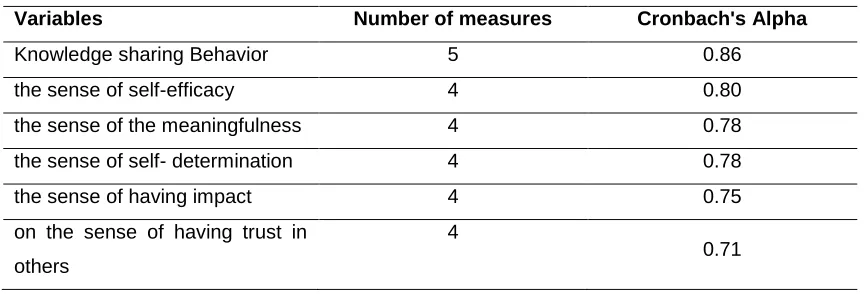
Data collection tool is a standard questionnaire containing 25 questions. The first 5 questions measure knowledge sharing behavior. In addition, 4 questions has been used for measuring each dimensions of psychological empowerment. Spreitzer model (Spretzer, 1992) was used to measure psychological empowerment dimensions. Knowledge sharing behavior, as well, was measured using the questionnaire developed by Akhavan et al, (2013).
Licensed under Creative Common Page 525 Table 1. Introducing the data collection tool
Variables Number of measures Cronbach's Alpha
Knowledge sharing Behavior 5 0.86
the sense of self-efficacy 4 0.80
the sense of the meaningfulness 4 0.78 the sense of self- determination 4 0.78
the sense of having impact 4 0.75
on the sense of having trust in others
4
0.71
Based on table 2, Cronbach's Alpha of all of the questions related to all of the variables is more than critical limit of 0.7; consequently, it could be stated that measuring models are at an acceptable level.
Data analysis approach
In order to analyze the collected data from samples and examine the relation among the concepts being studied in following research and their dimensions of confirmatory factor analysis and assess the assumptions of the research, structural equations modeling have been applied. Structural equations modeling have been utilized in order to analyze the data. In the mentioned model, we want to identify whether the relations among the hidden adjectives that have been extracted based on the theory would be confirmed considering the aggregated data of the sample or not (Kalantari, 2009). There are 25 apparent and 6 latent variables in this model. In order to assess significance of the predicted relations in the assumptions significant model and in order to assess the amount of effect the standard model has been applied.
RESULTS
Licensed under Creative Common Page 526 -1.96 and 1./96. In other words, in case a number would be between -1.96 and 1.96, that number would not be significant.
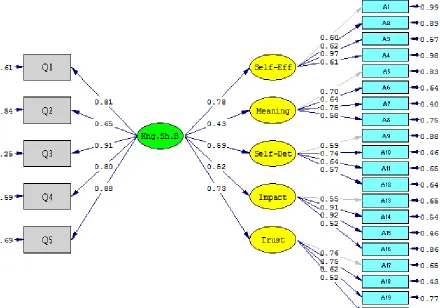
In order to assess the stated relations in the hypothesis, firstly, significance of the impact of each predicted relations was assessed using significance model and then, using standard model, the amount of each would be assessed. Based on the indexes mentioned in table 2, we are able to judge fitness model of the impact of knowledge sharing behavior on dimension of psychological empowerment. The results of the assessment of the significance of the predicted relations are presented in Figure 2.
Figure 2: the chart of the model of the impact of Social knowledge sharing behavior on psychological empowerment in the state of significance
Licensed under Creative Common Page 527 Table 2: indexes of the fitness model of the impact of knowledge sharing behavior
on psychological empowerment
Indexes Permissible limit Result Assessment
Ratio of chi-square to the degree of freedom 𝜒2/𝑑𝑓 <3 2.94 Appropriate
fitness
Root-mean square of adiabatic approximation (RMSEA) RMSEA>0.08 0.069 Appropriate fitness
The indexes of fitness of the mode, indicates convenience of the measuring model of the relevant variables; as the ratio of chi-square to the degree of freedom equals 2.94 and less than allowable amount of 3, and the amount of Root-mean Square error of approximation which is 0.069 equals permissible limit which is less than 0.08 and higher than 0.05. Based on this model, the impact of predicted relations is significant in all hypothesis as well; as their amount for hypothesis first to third equals 8.16, 4.25, 6.47, 5.86 and 7.33 respectively and all of them are higher than 1.96.
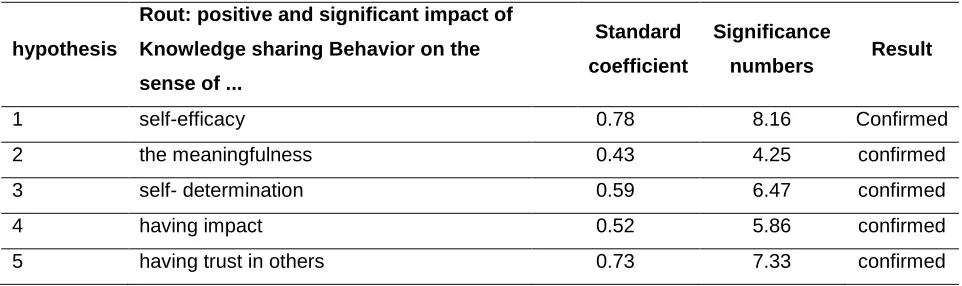
Licensed under Creative Common Page 528 In the standard state, the model indicates that the positive impact of the Social media on the triple components of the social capital is confirmable. Consequently, based on the results acquired from the significance and standard models, the results of the assessment of the hypothesis of the research could be summarized in table 3.
Table 3: the results of the assessment of the hypothesis
hypothesis
Rout: positive and significant impact of
Knowledge sharing Behavior on the
sense of ...
Standard
coefficient
Significance
numbers Result
1 self-efficacy 0.78 8.16 Confirmed
2 the meaningfulness 0.43 4.25 confirmed
3 self- determination 0.59 6.47 confirmed
4 having impact 0.52 5.86 confirmed
5 having trust in others 0.73 7.33 confirmed
General pattern of the relations among the variables in structural equation model were compatible with the stated hypothesis, all of the 5 investigated relations have been significant. Based on the acquired results knowledge sharing behavior has a significant impact on all of the investigated components of psychological empowerment. Furthermore, the most effect of knowledge sharing behavior has been on self-efficacy (0.78) and the least effect has been related to the meaningfulness (0.43).
DISCUSSION AND CONCLUSION
The present study investigated the effect of implicit knowledge sharing on the psychological empowerment dimensions in a service provider organization. The need for effective interaction of the employees with the costumers in service provider organizations makes their potentials and capabilities to have a key role in promoting their personal performance. The results of this study indicate that knowledge sharing behavior had significant positive effect on all dimensions of psychological empowerment of the employees which is in line the findings of the studies done by Amiri, et al., (2014), Kim & Joe (2008) Ahmadi, et al., (2011), Hasani & Sheikheslami (2016). The significant effect of knowledge sharing on the psychological empowerment of the employees can be justified by the fact that in the knowledge era, knowledge and learning can be critical in improving the capabilities and performance of the organizations.
Licensed under Creative Common Page 529 employees’ psychological empowerment. This can help the employees to meet the ever-changing needs of the customers and find solution to increase competitive advantage.
Knowledge management aims to crate, share and use knowledge in order to develop organization learning and the employees’ capabilities in their job performance. A valuable feature of knowledge is promoting its values by sharing of it. Greater achievement is achieved through knowledge than individual achievements (Renzle, 2008). Hence, one can say that service provider organization aspiring for excellent performance in providing services to the customers and preserving their loyalties should have special attention to the capabilities of their employees. Psychological empowerment of the employees can have critical impact in this respect. The employees who are in direct contact with the customers have a key role in the performance of such organizations. In the same vein, increasing their capabilities can promote the performance, benefits and gaining sustainable competitive advantage. Sharing knowledge among the employees of such organizations can increase their feeling of capabilities, having a meaningful job, having autonomy in decision makings and also the feeling of being effective in their work and developing interpersonal trust.
Sharing knowledge and getting involved in knowledge sharing activities with peers can enhance the feeling of capability in the employees. If that happen, their self-confidence to engage in work affairs and attempt to improve and change for better will also increase. This feeling can help the employees be successful relying on their internal capabilities and the self-confidence while being modest. For those who are self-confident, failure is the first step to be successful and past failures will not negatively influence their perspective and approach but become a guiding source for their future successes. Moreover, the feeling of capabilities make them believe that they have precious knowledge and experience to teach others and this may help improve the performance of other employees.
Sharing knowledge can make the employees aware of the different aspects of their career and enhance comprehensive perspective about the dimensions and the issues related to their work. In consequence, the feeling of being meaningful (significant) will be enhanced in the employees which can lead to promoting their internal motivation.
Licensed under Creative Common Page 530 Sharing knowledge can create synergy in knowledge and performance, better solutions of the work problems, avoid repeating the mistakes and help present new and useful ideas and solutions. This will enhance the feeling of being effective in the employees. In this way they will believe that they have the capability to make changes for better and have an impact on the existing conditions and the results. This belief will make the employees to feel that they own the work and are responsible for their work and have the constant concern to improve.
One of the prerequisite for high performance is high level of involvement and cooperation among the employees. Such involvement and cooperation will happen if the employees trust each other. Having friendly relations, encouraging the employees to help each other solve the problems, encouraging honesty, emphasizing keeping promises and commitments, paying special attention to meritocracy in the organization, penalizing destructive policies, effective management of the organization conflicts can create the trust needed for such involvement. Besides, involvement of the employees in knowledge haring behavior can also enhance the feeling of good will and integrity in the employees which will consequently result in the feeling of trust. This feeling of trust will act as glue which enhances trust among people.
Generally, it can be said that knowledge sharing can enhance the feeling of capability in the employees. Employees with knowledge, skill, experience and expertise will be more successful in effective interaction with the customers and convincing them to keep in touch with the organization. They have valuable work experience which they can share with other employees and increasingly enhance individual and organization performance.
LIMITATIONS AND FUTURE RESEARCH
Licensed under Creative Common Page 531 factors in future studies. Conduction of the similar research once at other organizations would assist in more complete understanding in this regard.
REFERENCES
Abbasi, T., Taleghani, GH. & Rajabzade, S.(2014). Studying the Relationship between Employees Empowerment and Innovation in Public Services, Quarterly Journal Public Administration, 7(4): 7431- 764. (in Persian)
Abtahi, S. & Abbasi, S. (2007). Empowering employers, Karaj. Institute of management researches and educations. (in Persian)
Agayar, S. (2003). Empowerment: New way in competitive environment. Monthly, Tadbi, 15(135): 28-33. (in Persian)
Ahmadi, P., Safarikohreh, M. & Nemati, S. (2011). Management of employees' empowerment. Second edition, Office of Cultural Researches Press. Tehran. (In Persian)
Akhavan, P., Rahimi, A. & Mehralian, G., 2013. Developing a model for knowledge sharing in research centers. The journal of information and knowledge management systems, 43(3), p. 357–393.
Alavi, M. and Leidner, DE (2001). Knowledge management and knowledge management systems: conceptual Foundations and research issues . MIS Quarterly , 25 (1) , : 107-136.
Ansari, M., Rahmani Youshanlouei, H., Oskuei, V. & Hosseini, A. (2011). Identifying the Factors and Developing the Human Resource Empowerment Conceptual Model in ICT Ministry (Case Study), Journal of Public Administration, 3(7): 23-40. (In Persian)
Babae, A.A (2002). Employee empowerment: without alternative capital. Monthly Tadbi, 1 (169): 86-97. (in Persian)
Davenport, Thomas Edge. Prusak, Lawrence. (2000). "Knowledge Management", translated by Rahman Seresht, Hussein. Sapco publications.
Hansen, M., 2002. Knowledge networks: explaining effective knowledge sharing in multiunit companies. Organization Science, 13(3), p. 232−248.
Hasani, K. and S. Sheikhesmaeili. 2016. Knowledge management and employee Empowerment. Kybernetes, 45 (2): 337-355.
Hislop, D. (2002). Linking Human Resource Management and Knowledge Management: A Review and Research Agenda. Employee Relations, 25 (2): 182-202.
Jafari Goshchi, B. (2001). The ways of Employee empowerment. Monthly Tadbir, 1 (119): 36-39. (in Persian)
McDermott, R., 1999. Why information technology inspired but cannot deliver knowledge management. California Management Review, 41(4), p. 103–17.
Robertson, S., 2002. A tale of two knowledge-sharing systems. Journal of Knowledge Management, 6(3), p. 295–308.
Ryu, S., H. Ho, and I. Han. 2003. Knowledge sharing behavior of Physicians in hospitals. Expert Systems with Applications 25 (1): 113-122.
Spreitzer, G. M. (1992). When organization dare: the dynamics of individual empowerment in the work place. Ph.D. dissertation, Univresity of Michigan.
Veten, Diodie. Kim S. Cameron. (2002). "Empowerment and devolution", translated by Oure’ii Yazdi,Badredin,Tehran, Institute of Management research and Education. 33