Centre
of
Excellence
for
Nuclear
Materials
Workshop
Materials
Innovation
for
Nuclear Optimized
Systems
December 5-7, 2012, CEA – INSTN Saclay, France
Yann De CARLAN
CEA (France)
Relationship between Microstructure and Mechanical
Properties in ODS Materials for Nuclear Application
Workshop
organized
by:
Christophe
GALLÉ,
CEA/MINOS,
Saclay
–
[email protected]
Workshop
Materials
Innovation
for
Nuclear
Optimized
Systems
December 5-7, 2012, CEA – INSTN Saclay, France
Relationship between Microstructure and Mechanical Properties in ODS
Materials for Nuclear Application
Yann De CARLAN
11
CEA-DEN-DMN, Service de Recherches Métallurgiques Appliquées, SRMA (Saclay, France)
Oxide Dispersion Strengthened ferritic/martensitic alloys are developed as prospective cladding materials for future Sodium-Cooled-Fast-Reactors (GEN IV) [1]. These advanced alloys present a good resistance to irradiation and a high creep rupture strength due to a reinforcement by the homogeneous dispersion of hard nano-sized particles (such as Y2O3 or YTiO). ODS alloys are
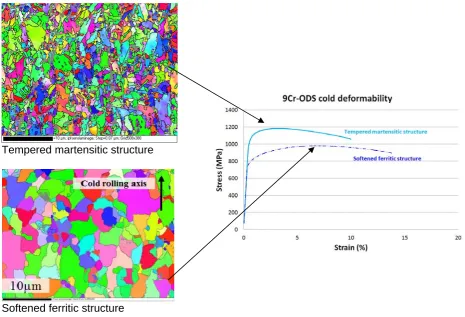
elaborated by powder metallurgy, consolidated by hot extrusion and manufactured into cladding tube using the pilger cold-rolling process [2, 3]. ODS alloys present usually low ductility and high hardness. The aim of this talk is to present the specificity of the metallurgy of ODS materials in relationship with the main mechanical properties (tensile and creep properties, toughness, transition temperature…). Two types of alloys will be presented: Fe-9Cr martensitic ODS and Fe-14Cr ferritic ODS alloys. Mechanical properties of the materials depend on the metallurgical state (fine grains, recrystallized, martensitic) and very different behaviors are observed as a function of final microstructure. For example, for a Fe-9CrODS alloy, tempered martensite lets obtaining material with high strength whereassoftenedferriteseefigure1[4] tolerates highdeformation levels.
Tempered martensitic structure
Softened ferritic structure
Fig. 1: Electron Backscatter Diffraction maps for a Fe-9Cr ODS associated with the tensile properties at room temperature.
Reactor fuel pin cladding. Journal of Nuclear Materials 428 (2012) 6–12.
[2] T. Narita, S. Ukai, T. Kaito, S. Ohtsuka, T. Kobayashi, Development of Two-Step Softening Heat Treatment for Manufacturing 12Cr–ODS Ferritic Steel Tubes. Journal of Nuclear Science and Technology, Vol. 41, No. 10, p. 1008–1012 (October 2004).
[3] S. Ohtsuka, S. Ukai, M. Fujiwara, T. Kaito, T. Narita, Improvement of 9Cr-ODS martensitic steel properties by controlling excess oxygen and titanium contents. Journal of Nuclear Materials 329-333(1): 372-376.
MINOS Workshop, Materials Innovation for Nuclear Optimized Systems December 5-7, 2012, CEA – INSTN Saclay, France
AND MECHANICAL PROPERTIES IN ODS
MATERIALS FOR NUCLEAR APPLICATION
Rapsodie
Beginning of the
studies on the Fast
Sodium Reactors to
produce electricity
First ODS
(SCK-CEN)
Phénix
First irradiated
tubes
Superphénix
Industrial
Production
(DourMetal)
ODS tubes in
Phenix reactor
Forum Gen IV : reactors
1967
1973
1985
1987
2000
1960
Materials
Optimization
of the
austenitic
steels
New reinforced
ferritic alloys :
ODS alloys
PHENIX
PHENIX
SPX
SFR
Need of
optimized
materials is still
ODS materials
Limited swelling under irradiation
Low thermal creep
Nano dispersion
(Oxide Dispersion Strengthened)
0 1 2 3 4 5 6 7 8 9 10
60 70 80 90 100 110 120 130 140 150 160 170 180 190
dose (dpa)
Average 316 TiFerritic-martensitic (F/M) steels ODS included
Average 15/15Ti
Best lot of 15/15Ti
Use limit for
Phenix reactor
S
w
e
lli
n
g
(%
)
0 0,5 1 1,5 2 2,5 3 3,5 4 4,5 50,0001 0,001 0,01 0,1 1 10 100 1000 10000 Temps (h) A llo ng em en t ( % )
180 MPa – 650°C
Conventional steel
ODS
SFR
Dose > 150 dpa
Stress ~ 100 MPa
nano-phases
(~2-4nm)
Complex manufacturing
ODS steels present low ductility and limited consolidation at room temperature
Low deformability
Ex:ODS steel
18 Cr-1W Ti 0,5 Y
2O
3Uniform distribution of
nano oxides
0 0,2 0,4 0,6 0,8 10 0,1 0,2 0,3 0,4 0,5 0,6 0,7 0,8 0,9 1
D in mm
W t (% ).
0.46 Y
0.3 Ti
0.85 W
Microprobe
Homogeneous microstructure
Fine ferritic grains
elongated
in extrusion direction
Longitudinal direction
Transverse direction
TEM
nano-oxides
50 nmTEM
SANS
TAP
Optical
DSM – LLB
Orphée
0 0,2 0,4 0,6
0 1 2 3 4 5 6 7 8 9 10
Rayon moyen (nm)
H
(r
)
*
fp
90×14×14 nm3
Y,YO and O
Clusters
Ti, TiO
8 10
23m
-31,8 nm
Texture
8 10
22m
-3φ
3 nm
1, 2
µ
m - 300nm
400 nm - 200 nm
f
p1,1%
GPM Rouen
O. Kalokhtina, B. Radiguet, Ph. Pareige
Plate
0 200 400 600 800 1000 1200 1400
0 1 2 3 4 5 6 7
ODS metallurgy
Conventional metallurgy
Temperature /°C
Ferritic grades
Fe -12/20Cr
Martensitic grades
Fe - 9 Cr
Large differences between both type of alloys as a function of their final
microstructure but generic creep behavior is noticed.
Ferritic Fe-14Cr ODS :
Extruded at 1100°C + 1h
at 1050°C (very difficult to
recrystallize)
Typical microstructures
10µm
Martensitic Fe-9Cr ODS :
Tempered martensite
(very high critical cooling rates)
austenite + ferrite
austenite + martensite
Martensitic grade: Fe-9Cr-1W-0.2Ti-0.3Y
2O
3CCT diagram
-
Transformation temperatures
-
Critical cooling rates ~ 1°C/s
Tensile properties
Creep properties
Ferritic (Fe-14 Cr ODS)
0 100 200 300 400 500 600
0 1 2 3 4 5 6 7 8 9 10
Allongement rationnel (%)
C
on
tr
ai
nt
e
vr
ai
e
(M
Pa
) 7.10-4 s-1
10-5 s-1
Martensitic (Fe-9Cr ODS)
L. Toualbi, Phd Thesis
Tensile properties in different metallurgical state :
- J95-M3, tempered martensite
- J95- M5, Softened ferrite
Tempered martensite
Ferritic (Fe-18 Cr ODS)
Extrusion direction
ODS plate
Extruded and annealed
Extrusion direction
SL
ST
S45
200 nm
Ferritic Fe-18 Cr ODS at 650°C 250 MPa
M. Ratti, Phd Thesis
0 0,2 0,4 0,6 0,8 1 1,2 1,4 1,6 1,8 2
0 1000 2000 3000 4000 5000 6000 7000
Temps (heures) Al lo ng em en t ( % )
Very low deformation rates
(Long-250 MPa : 7.10
-8h
-1).
almost no tertiary domain .
Different order of magnitude
on the rupture time as a function
of the orientation of the sample /
texture of the microstructure
Transvers
45
°
°
°
°
Ferritic ODS
A. Alamo et al. Journal of Nuclear Materials 329–333 (2004) 333–337
0
100
200
300
400
500
10
-110
010
110
210
310
410
5S
tr
e
s
s
(
M
P
a
)
Rupture Time (h)
MA957 - Fine grains
650°C
9Cr2MoVNb (EM12)
650°C
MA957 - Recryst.
700°C
MA957 - Recryst.
650°C
15/15Ti
700°C
Aust.15/15Ti
650°C
0
100
200
300
400
500
10
-110
010
110
210
310
410
5S
tr
e
s
s
(
M
P
a
)
Rupture Time (h)
MA957 - Fine grains
650°C
9Cr2MoVNb (EM12)
650°C
MA957 - Recryst.
700°C
MA957 - Recryst.
650°C
19
Martensitic Fe-9 Cr ODS
1
7
10
4
.
1
⋅
−
−
=
s
II
ε
&
1
10
10
1
.
1
⋅
−
−
=
s
II
ε
&
INTERGRANULAR
mechanism
Consistent with the macroscopic observations
ODS
9%Cr
ODS
14%Cr
•
Dislocation still pinned on oxides
•
Viscous motion
•
Activation of sources of
dislocations at the grain boundary
Fine grain
A. Alamo et al. Journal of Nuclear Materials 329–333 (2004) 333–337
DBTT (°C)
USE (J)
LT
TL
LT
TL
rod Ø36
-29
108
7.6
3.8
anisotropic impact behaviour
for the rod: higher USE and
lower DBTT under LT loading
extrusion
direction
TL
LT
diameter: 36mm
Fe-14Cr 1W ODS
“Fine grain
23
AL Rouffié et al. http://dx.doi.org/10.1016/j.jnucmat.2012.08.050
DBTT (°C)
USE (J)
LT
TL
LT
TL
rod Ø36
-29
108
7.6
3.8
anisotropic impact behaviour
for the rod: higher USE and
lower DBTT under LT loading
ED
notch
expected
propagation
plane
effective
propagation plane
For different samples,
tendency to delamination
The mechanical properties of nuclear F/M alloys depend strongly on the chemical composition
and the microstructure of the product
Tensile properties
-
Large dependence on the grain size / morphology / dislocation density / nano-precipitation
-
Collapse of the strength from 400°C
-
Strain rate effect on the ductility
Creep properties
-
No tertiary creep but high performances
-
Reduced fracture strain
-
Damage more severe at high temperature low strain rate / low stress =>
Intergranular
mechanism of failure
Impact properties
-
Low toughness and in general “low” Upper Shelf Energy and sometimes tendency to
delamination
-