Data Mining Temporal and Indefinite Relations
with Numerical Dependencies
Ethan Richard Collopy
U C L
A dissertation submitted in partial fulfillment
of the requirements for the degree of
Doctor of Philosophy
of the
University of London.
Department of Computer Science
University College London
ProQuest Number: 10608879
All rights reserved
INFORMATION TO ALL USERS
The qu ality of this repro d u ctio n is d e p e n d e n t upon the q u ality of the copy subm itted.
In the unlikely e v e n t that the a u th o r did not send a c o m p le te m anuscript and there are missing pages, these will be note d . Also, if m aterial had to be rem oved,
a n o te will in d ica te the deletion.
uest
ProQuest 10608879
Published by ProQuest LLC(2017). C op yrig ht of the Dissertation is held by the Author.
All rights reserved.
This work is protected against unauthorized copying under Title 17, United States C o d e M icroform Edition © ProQuest LLC.
ProQuest LLC.
789 East Eisenhower Parkway P.O. Box 1346
We propose that data mining, the search for useful, non-trivial and previously unknown infor
mation within a database, can be successfully performed with Numerical Dependencies (NDs), a
generalisation of Functional Dependencies (FDs), to model the data, together with resampling, a
computationally intensive statistical sampling process, which allows us to make inferences from
temporal and indefinite databases.
We use NDs to model relations containing temporal and indefinite information. We extend
the theory of NDs by presenting measures for data mining and generalise the chase procedure, a
method for updating a relation to satisfy a constraint set, for NDs. We motivate NDs in real-world
applications by introducing a database design tool.
The consistency problem, that of attempting to find a relation satisfying a set of FDs within
an indefinite relation, known to be NP-complete, is studied in the context of using NDs for ap
proximation. We employ resampling, based on taking samples of definite relations from indefi
nite ones, on incremental sample sizes until an approximate fixpoint is reached, denoting an upper
bound on the required sample size. Extensive simulations highlight that resampling to find upper
bounds in conjunction with the chase for indefinite relations returns valid approximate solutions.
We also study NDs in temporal sequences of relations for knowledge discovery purposes.
Each relation within a sequence is mined for a set of NDs which evolve with updates in data. We
introduce a temporal logic for the discovery of rules and properties within these sequences, or
subsequences, which includes statistical functions within the temporal operators for time series
analysis. We also show that time series data may be analysed using a restricted set of the logic.
We apply discovery algorithms to both sequences and resampled sequences, allowing smoothing
for trend detection. Investigations, presented herein, show these rules to provide interesting and
A
c k n o w l e d g e m e n t s
The work in this thesis was funded by the EPSRC via a quota award. Financial support from the
Department of Computer Science, UCL, and the UCL Graduate School is gratefully acknowl
edged.
I am indebted to my supervisor, Mark Levene, not only for his continual support, advice, and
encouragement, throughout the term of my research but also for the numerous stimulating discus
sions we have had on databases, data mining, and many other research issues. Similarly, thanks
go to Sean Holden, my second supervisor. I would also like to thank Jose Borges, Wilfred Ng,
Nadav Zin, and many other colleagues at UCL for making my studies here even more enjoyable.
Thanks to the various anonymous reviewers of our papers who have unknowingly improved
the content of this thesis.
I would like to thank my parents, to whom I dedicate this thesis, and without whose love
and support I would surely not now be in the position of writing these thesis acknowledgements.
1 Introduction 15
1.1 The Goal of the T h e s i s ... 15
1.2 Knowledge Discovery in Databases and this thesis ... 16
1.3 Main Results and C ontribution...22
1.4 Outline of the T h e s i s ... 23
1.5 N o tation... 24
2 Relational Database, Data Mining, and Statistical Theory 26 2.1 Database Theory for Data M i n i n g ... 26
2.2 Relational Database T heory...27
2.2.1 The Relational Model ... 27
2.2.2 Functional Dependencies... 28
2.2.3 Armstrong R e la tio n s ... 32
2.2.4 Relational Database D e s i g n ...33
2.2.5 The Chase P rocedure... 35
2.2.6 Numerical Dependency T h e o r y ...36
2.2.7 Indefinite R elations...38
2.2.8 Temporal Databases and Temporal D ependencies... 41
2.2.9 Time Series and Temporal Databases ... 44
2.3 Dependency and Temporal Data M in in g ...45
2.3.1 Functional Dependency Data M i n i n g ... 46
2.3.2 Temporal Dependency Data Mining: A r e v i e w ... 50
2.3.3 Similarity Measures for Functional Dependency s e t s ...53
2.3.4 Relational Database Sampling Procedures...57
2.3.5 Resampling in S ta tis tic s ... 58
2.4 Discussion... 60
3 Numerical Dependencies in Databases and Data Mining 61 3.1 Approximating FDs with N D s ... 61
3.1.1 The Lattice of N D s ...61
3.1.2 Similarity Measures and Numerical D e p e n d e n c ie s ... 63
3.1.3 Partitioning a Relation for Mean N D s ... 65
3.2 The Chase Procedure for N D s ... 66
3.3 Inferences for Numerical D ep en d en cies...67
3.3.1 ND A xiomatisation...67
Contents 5
3.3.3 Armstrong Relations for N D s ...71
3.4 Numerical Dependencies in Data M ining...72
3.4.1 Dependency Mining A p p licatio n s...72
3.4.2 Mining a relation for a set of N D s ...73
3.4.3 Mining a relation for a set of Mean N D s ... 74
3.5 Evolving Example Relations to Satisfy F D s ... 74
3.5.1 M o tiv a tio n ... 75
3.5.2 Mutating r e la tio n s ...76
3.5.3 An Algorithm for Evolving Relations to satisfy FDs ... 80
3.5.4 Simulation R e s u lts ... 80
3.6 Discussion... 84
4 The Consistency Problem in Indefinite Relations 86 4.1 Our Approach to the Consistency P ro blem ... 86
4.1.1 Intractability of the consistency problem ... 89
4.2 Indefinite Information in R elatio n s... 90
4.2.1 A p p lic a tio n s ... 90
4.3 Algorithm d e s ig n ... 91
4.3.1 The chase algorithm for indefinite re la tio n s ... 92
4.3.2 Resampling for the Consistency P r o b le m ... 93
4.3.3 The Bootstrap Process within Indefinite R elations...94
4.3.4 Resampling A lg o rith m s ...98
4.3.5 Finding an approximate solution to the consistency p r o b le m ... 99
4.3.6 The Chase and Hill-Climbing Algorithm ... 100
4.4 Simulations and R esults... 101
4.4.1 Use of our m e tric ... 102
4.4.2 R e s u lt s ... 103
4.4.3 Analysis of the Chase resu lts... 104
4.4.4 Changing Bias of indefinite inform ation...106
4.4.5 Finding a suitable sample s i z e ... 107
4.4.6 A Comparison with Jackknife Resampling... 109
4.4.7 Real-World A pplications...109
4.5 Discussion...I l l 5 Temporal Data Mining for Temporal Property Detection 113 5.1 Introduction... 113
5.2 Why do we need properties for Temporal Data M in in g ?... 115
5.3 Numerical Dependencies in a Temporal D a ta b a s e ... 115
5.3.1 Temporal Relation S e q u e n c e s ...115
5.3.2 Time Series Analysis and Numerical D ependencies...115
5.4 Time Series A n a ly s is ...116
5.4.1 Time Series Analysis: B asics...116
5.4.2 Time Series Analysis: D efin itio n s... 118
5.4.3 Catalytic Data M i n in g ... 120
5.4.4 Advantages of a logical a p p r o a c h ... 121
5.5.1 Temporal L o g ic ... 121
5.5.2 Syntax ... 123
5.5.3 Sem antics... 124
5.5.4 E x am p les... 127
5.5.5 Axioms of the lo g ic... 127
5.5.6 Querying our L o g ic...128
5.5.7 Expressiveness of N D L T L ... 130
5.6 Temporal Logic P ro p e rtie s ... 131
5.6.1 Application of Properties... 134
5.7 Discussion...134
6 Temporal Property Detection with Numerical Dependencies and Resampling 137 6.1 Introduction... 137
6.2 Property Discovery M o d e l ...139
6.2.1 The Generic Property Discovery A lg o rith m ...141
6.2.2 The Response Persistence Algorithm ... 142
6.3 Relational Sequence Data S e t s ... 142
6.3.1 R e s u lt s ... 143
6.3.2 The Moving Blocks B o o tstra p ...146
6.3.3 The Moving Blocks Bootstrap for Large Data S e t s ... 146
6.4 Time Series Data R e s u lts ...147
6.5 Case Study I ... 148
6.5.1 Original Data A n a ly sis... 148
6.5.2 Moving Average A n a ly s is ... 149
6.5.3 Differenced List A n a ly s is ... 150
6.5.4 Moving Blocks Bootstrap A n a ly s is ...151
6.6 Case Study I I ...151
6.6.1 Real-World A n a ly s is ...153
6.7 Moving Blocks Bootstrap for Large R e la tio n s...155
6.8 Critical Analysis ...156
6.9 Similarity Assessment ... 158
6.10 Discussion... 159
7 Summary and Conclusion 161 7.1 Contribution of this w o r k ... 161
7.2 Applications... 163
7.3 Directions for future research...164
7.3.1 Open P ro b lem s... 164
7.3.2 Further w o r k ... 164
7.4 The Evolution of Data M in in g ...165
7.5 Conclusions... 166
Contents 7
A The Consistency Problem: Supplemental Results 178
A .l Average Number of Worlds Required ...178
A.2 Average Proximity to FD s e ts ...179
A.3 Closest Proximity to FD s e t s ...181
A.4 Jacknife and Bootstrap Com parisons... 183
A.4.1 Bootstrap Variance R esu lts... 185
B Simulation Methodology 186 B.l Simulation Details: Evolving Relations ... 186
B.1.1 Simulation Range D e c isio n s... 186
B .l.2 Use of Random Number G eneration...187
B .l.3 C++ lib r a r ie s ... 187
B.2 Simulation Details: The Consistency P ro b lem ...187
B.2.1 Indefinite Information D ata... 187
B.2.2 A note on randomly generated re la tio n s ... 188
B.2.3 Bootstrap Parameter Size S e le c tio n ...189
B.2.4 Use of the Original Sample and Fixpoint S e le c tio n ...189
B.2.5 Using the Bootstrap to determine confidence intervals ... 189
B.2.6 Jackknife and Bootstrap Resampling...190
B.3 Simulation Details: Numerical Dependency Temporal L o g i c ...190
B.3.1 Sequence Size S e le c tio n ...191
B.3.2 Moving Average and Moving Block Size S e le c tio n ...191
1.1 Components of the Data Mining P ro c e ss ... 16
1.2 The Knowledge Discovery Application C y c l e ... 17
2.1 The Chase procedure for F D s ... 35
2.2 Max Quality for FD sets with 3 and 4 elements in c lo s u re ... 56
2.3 The Bootstrap Procedure as applied to an indefinite relation with a Bootstrap Replication size (BRS) B ... 59
3.1 Lattice of NDs for a relation of 2 FDs (not shown) and maximum domain size of 4 for each d ep end en cy ... 62
3.2 The improvement algorithm for N D s ... 63
3.3 The Chase procedure for N D s... 67
3.4 The ND mining algorithm ... 73
3.5 Results for mining Mean and standard NDs with arity of the lhs of each ND restricted upon the breast cancer d a t a s e t...74
3.6 The MUTATE procedure for evolving r e la tio n s ... 77
3.7 The ITERATE procedure for evolving r e la tio n s ... 80
3.8 Average states to absorption for sets F\ and F2, Domain sizes: 3, 6 ...82
4.1 Chase for Numerical Dependencies with forwards and backwards te s t s 92 4.2 The Bootstrap procedure applied to increasing sample sizes for an indefinite re lation ... 95
4.3 Average number of worlds to reach an approximate fixpoint of the mean boot strapped ND values in 10 and 20 tuple random relations... 97
4.4 The Bootstrap procedure for indefinite re la tio n s ...98
4.5 The Jackknife procedure for indefinite r e la tio n s ...98
4.6 The WORLD .LIMIT algorithm for incremental bootstrap sampling in indefi nite relations... 99
4.7 The CHECK.CONS algorithm for approximating solutions to the consistency p ro b le m ... 100
4.8 The ND_GEN algorithm for generating a possible w orld... 102
4.9 The CHASE-GEN algorithm for applying a chase method ra n d o m ly ...103
4.10 Closest Proximity for FD set F i across a number of different weighted relations 104 4.11 Closest and Average Proximity for FD set F 3 ...105
List o f Figures 9
4.13 Histogram of 2000 bootstrap replications of sample size 25 for a 20 tuple rela tion and 10 FDs, with lhs attributes definite and rhs attributes sparse (in FD set)
in indefinite c e l l s ...107
4.14 Empirical bootstrap percentile confidence limits shown to converge for the dis tance measure of ND s e t s ... 108
4.15 Average Number of Worlds given as upper bounds by the Bootstrap and Jack-knife techniques for a fixed domain size 5 ... 110
5.1 Sequence Inclusion, s ^ A ... 124
5.2 Sequence Ordering, s i < s2 ...124
5.3 All possible subsequences in a sequence containing 7 re la tio n s ... 129
5.4 A Classification of Temporal P r o p e rtie s ...134
6.1 A description of our Temporal Property Discovery S y s t e m ... 140
6.2 The Generic Property Data Mining A lg o rith m ...142
6.3 The Response Persistence A lgorithm ... 143
6.4 Original data values of mumps cases in Ohio and Alaska from 1957 - 1989 . . . 144
6.5 Moving Average data set values of two NDs from NFL season data 1989-1991. 145 6.6 All possible blocks of size 4 for a relation se q u e n c e ... 146
6.7 A large relation sequence and a resam ple... 147
6.8 Moving Average Data values for two window sizes, 3 and 1 2 ... 150
6.9 Time series of BP and Shell from 1 Dec. 1997 to 1 Nov. 1998 ... 154
6.10 Moving Average values for Debenhams and Arcadia Group since demerger on Jan 28 1998 ... 154
6.11 Reduced moving blocks samples for BP and Shell moving average data, 78 points from 11 regions and blocksize of 7 p o in ts ... 155
6.12 Reduced moving blocks samples for BP and Shell moving average data, 110 points from 5 regions and blocksize of 22 p o in ts ... 155
6.13 Time for discovery of response and persistence properties for varying small and large sequence sizes and small varying only (for a large sequence size) within a 398 point data s e t ... 157
A .l Average Number of Worlds Required by the chase and hill-climbing approach for FD set 15, domain sizes 3 - 9 , maximum indefinite cell arity 2 179 A.2 Average Number of Worlds Required for FD set 15, domain sizes 5 - 9 , max indefinite arity 4 - 6 ... 179
A.3 Average Number of Worlds Required for FD set 17, domain sizes 3 - 9 , max indefinite arity 2 ...179
A.4 Average Number of Worlds Required for FD set 17, domain sizes 5 - 9 , indefi nite cell arity 4 - 6 ...179
A.5 Average Number of Worlds Required for FD set 5, domain size 5 - 9 , indefinite cell arity 4 - 6 ...180
A.6 Average Number of Worlds Required for FD set 7, domain size 5 - 9 , indefinite cell arity 4 - 6 ...180
A.8 Average Number of Worlds required for FD set 6, domain size 5 - 9 , indefinite arity 4 - 6 ... 180 A.9 Average Proximity to FD set 15, standard and reduced right hand side indefinite
cell w eig h tin g ...181 A.10 Average Proximity to FD set 15, standard and reduced left hand side indefinite
cell w eig h tin g ...181 A. 11 Closest Proximity to FD set 15 for standard and reduced right hand side weight
ing of indefinite cells ... 182 A.12 Closest Proximity to FD set 15 for standard and reduced left hand side weight
ing of indefinite cells ... 182 A. 13 Average Proximity to FD set 7, domain size 7, max indefinite cell arity 6 . . . . 182 A. 14 Average Proximity to FD set 6, domain 5,7, indefinite arity 2 ... 182 A.15 Closest Proximity to FD set 15, varying domain sizes 5 - 9 , chase and naive
approaches, indefinite arity 4 ...183 A.16 Closest Proximity to FD set 6, domain size 5 - 9 , indefinite arity 4 ...183 A. 17 A comparison of Jackknife and Bootstrap mean ND set values iterated to an
approximate fixpoint of the mean using equivalent samples, for FD set 11, with a domain of 10,50 tuples and a maximum indefinite cell arity of 3 ... 184 A. 18 A comparison of Jackknife and Bootstrap mean ND set values iterated to an
approximate fixpoint of the mean using equivalent samples, for FD set 11, with a domain of 10,50 tuples and a maximum indefinite cell arity of 5 ... 184 A. 19 A comparison of Jackknife and Bootstrap mean ND set values iterated to an
approximate fixpoint of the mean using equivalent samples, for FD set 11, with a domain of 10, 25 tuples and a maximum indefinite cell arity of 3 ... 184 A.20 Bootstrap variance and standard deviation convergence, for FD set 11, with a
L
i s t
o f
T
a b l e s
2.1 r\ before the c h a s e ... 36
2.2 r i after the chase, T+ = T H C ...36
2.3 relation P L A N (Lecturer, C o u rs e )... 37
2.4 OR-object indefinite re la tio n ...41
2.5 Indefinite re la tio n ...41
2.6 Non-conforming possible w o r l d ...41
2.7 Conforming possible w o rld ... 41
2.8 An indefinite relation P L A N...41
2.9 Relation P L A N2 (Lecturer, Course, R o o m ) ...48
2.10 A comparison of FD Approximation Techniques ... 54
2.11 Frequency Table for relation PLAN ... 54
2.12 Company Data Relation... 59
3.1 Example relation for proof of axiom R6fc>m ...68
3.2 Relation to be chased by ND set N with a = X —>k A , X = { X\ , . . . , X m}, R \ XA = { B i , . . . , B m} and m = | R \ XA | 69 3.3 ri before CHASE p ro c e d u re ...70
3.4 Example CHASE(ri,N) after CHASE procedure ... 70
3.5 Counterexample CHASE(r2,N) after CHASE procedure ...70
3.6 Example relation for Case 1.1...78
3.7 A mutation of r shown in Table 3 .6 ...78
3.8 Example relation for Case 1.2...78
3.9 A mutation of r shown in Table 3 .8 ... 78
3.10 Example relation for Case 1.3...79
3.11 A mutation of r shown in Table 3 . 1 0 ... 79
3.12 Example relation for Case 2.1...79
3.13 A mutation of r shown in Table 3 . 1 2 ... 79
3.14 Example relation for Case 2.2...79
3.15 A mutation of r shown in Table 3 . 1 4 ... 79
3.16 Example relation for Case 2.3 ...80
3.17 A mutation of r shown in Table 3 . 1 6 ... 80
3.18 Simulation details for evolving relations s tu d y ...81
3.19 Mannila’s deterministic A R ... 83
3.20 An evolved AR with the same domain size ...83
3.21 An evolved AR with 9 tu p le s ...84
4.2 A satisfying world for AB —» C ... 93
4.3 Simulation details for the consistency problem ... 102
5.1 1997 student intake re c o rd s... 116
5.2 1998 student intake re c o rd s... 116
6.1 Results for 199 days of Arcadia and Debenhams G r o u p ...149
6.2 Results for 242 days of BP and Shell from Dec 1997 to Oct 1998 ... 152
6.3 Results for first 100 days trading of Halifax and Alliance & Leicester Banks . . . 153
A .l FD sets used in Figures A .l to A . 2 1 ... 178
B .l Depicting the range of indefinite cells in a relation... 188
S
y m b o l
I
n d e x
Symbol Meaning
X, Y, Z sets of attribute names A, B, C attribute names
DOM(A) the domain of an attribute A
R the set of attribute names in relation R
r (R) a relation r defined over attributes R t a tuple t in a relation
t[X] the projection of a tuple t onto a set of attributes X
7rx (r) the projection of a relation r onto a set of attributes X
r[X, x] partition of a relation r whose X value is x
X —>• Y X functionally determines Y
X - ^ Y X numerically determines up to
k
different Y valuesr |= a r logically implies o
r does not logically imply <r
r a indefinite relation r logically implies a
E a set of data dependencies
E+ the set of dependencies logically implied by E SAT(E) the set of all relations which satisfy E
ATT(d) the set of attributes appearing in an FD, denoted by d
= logical equivalence
X+ the closure of the set of attributes X DEP(X) the dependency basis of X
| X —>• Y | the size of an FD X —> Y
II ^ II
the sum of all the sizes of all the FDs in FFD Functional Dependency
ND Numerical Dependency
AR Armstrong Relation
(R)DBMS (Relational) Database Management System
ADS Active Domain Size
T the top of a lattice
_L the bottom of a lattice
\ s\
the cardinality of a set SV (S ) the powerset of a set S
nl the factorial of n
V universal quantification 3 existential quantification
O a at the next point in the future o
<J\U(? 2 until <J2
<t\Sg2 since <72
A temporal relation sequence or temporal database
s ■< A sequence s is contained in A
s i < s2 s i starts before s2 and s2 ends after s i s i > s2 s2 starts before s i and s i ends after s2
(A, r) \=w a relation r in A satisfies a over a moving average window of size w
(A, s) \=w <7 sequence r in A satisfies <7 over a moving average window of size w
B ncr all sequences of size n satisfy o
Om<7 some sequence of size n satisfies a
^ n Bm <7 some sequence of size n satisfies B m<7, where m < n
B nOm a all sequences of size n satisfy ^m a, where m < n
<7i <72 A sequence, say s i , satisfying <7i, starts before a sequence, say s2,
satisfying <7 2, and s2 ends after s i
<7i Ak 0 2 A sequence satisfies <7i and <72 and there is a maximum correlation
C
h a p t e r
1
Introduction
Knowledge Discovery in databases is currently a particularly fast growing area of computing re
search, not least because it can be said to be the hybrid of a number of other research disciplines
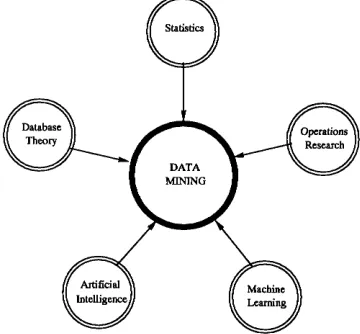
as shown in Figure 1.1, primarily statistics, machine learning, and database theory, with direct
real-world application.
In this thesis we propose a general approach to knowledge discovery problems in databases
which contain either indefinite or temporal information. Throughout we use Numerical Depen
dencies (NDs), a generalisation of the Functional Dependency (FD), and show how they are appli
cable in numerous domains. We also use and develop some resampling processes, which are com
putationally intensive statistical procedures, well suited to inferring information from databases
containing temporal and indefinite information.
In Section 1.1 we present the goal of the thesis, moving on to discuss knowledge discovery in
databases in 1.2, where we place our work in context and present a brief example for overview.
We detail the contribution of this work in Section 1.3 and outline the rest of the thesis in 1.4.
Lastly, we detail notation in Section 1.5.
1.1 The Goal of the Thesis
The ability to discover knowledge from a database which is not explicitly represented in the data
is clearly a desirable goal. We propose that such data mining can be achieved using NDs, gener
alisations of the FD, which themselves have a well-defined semantics for application within the
relational model. The application of NDs allow data mining principles to be exercised on cat
egorical data, often the bulk of many corporate databases, or a combination of categorical and
numerical data.
We show how relations containing indefinite or temporal data satisfy numerous ND sets, be
Statistics
Database
Theory OperationsResearch
Artificial '
Intelligence, MachineLearning
Figure 1.1: Components of the Data Mining Process
sets satisfied are obtained from an initial template of FDs which is supplied by the user; alter
natively, it would be possible to mine for ND set satisfaction. In the indefinite domain the ND
sets are satisfied in definite instances of the same indefinite relation. We show how resampling,
a computationally intensive sampling procedure, may be applied on increasing sample sizes to
determine an approximate fixpoint upon which a heuristic based hill-climbing algorithm is em
ployed to find a suitable ND set approximation to functional satisfaction. In the temporal domain
the ND sets may change over time for the same attributes; we show how resampling and other
time series statistics may be employed to determine properties which may hold over time, us
ing a logic we have developed. Our data mining framework thereby discovers information using
many ND set approximations upon which statistics are applied, varied for the domain in question,
to make further inferences from the data.
1.2 Knowledge Discovery in Databases and this thesis
The following widely accepted definition is due to (Fayyad et al., 1996d):
Definition 1.2.1 (Knowledge Discovery in Databases) Knowledge Discovery in Databases is
defined as the nontrivial extraction o f valid, previously unknown, potentially useful, and ulti
mately understandable information from a database. □
Knowledge Discovery may only provide potentially useful information given that it may fre
quently discover relations, possibly weak, between unconnected real-world information or even
relations that do not serve the interests of the user. This includes the possible discovery of re
dundant information. For instance, in a medical database a system may discover a dependency
pregnant—> fe m a le implying that all pregnant patients are female; obviously such information
spec-1.2. Knowledge Discovery in Databases and this thesis 17
DATA WAREHOUSE
DESI GN
IMPLEMI3NTATION
APPLI CATION
INTERACTION
ANAIJYSIS
R E S U L T S * INCORPORATION
DATA CLEANSING DATA MINING
EXPERT ANALYSIS
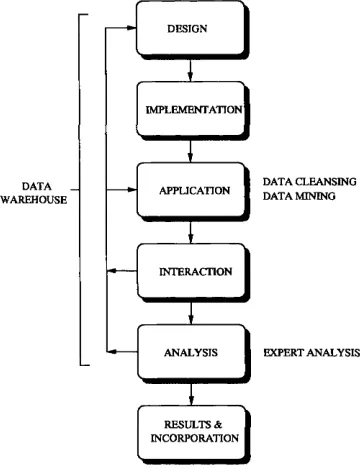
Figure 1.2: The Knowledge Discovery Application Cycle
ification of trivial associations before the mining process takes place and continuous interaction
with an expert, a much understated component of knowledge discovery, defined as data
archae-ology (Brachman and Anand, 1996), as well as provision of a dependency template upon which
knowledge is discovered.
Knowledge discovery comprises a number of component parts including data cleansing, de
sign, warehousing and mining as well as expert analysis, detailed in Figure 1.2. Databases within
data warehouses are now frequently designed with a view to data mining operations; where the
goal of the database is reliable storage the goal of the data warehouse is decision support (Fayyad,
1998b). The process of data cleansing includes collecting data from different sources and process
ing it into a homogeneous form. The design and implementation of a capable knowledge discov
ery tool will handle these stages. Figure 1.2 displays a generic cycle for knowledge discovery. It
highlights the requirement that interaction and analysis of the system may need to return to the
design stage if initial results suggest comparison with new data, which may have been omitted, or
the data cleansing stage has to be repeated with new error parameters, perhaps to adjust the error
and confidence for noise within the database. Recent work has included research on formalising
the data warehouse (Hammer et al., 1995; Inmon, 1996) as well as significant data cleansing re
search. Interesting as the issues of data cleansing and warehousing are, we do not consider them
Knowledge discovery refers to the process of extracting patterns and relationships from the
data whereas data mining refers to the actual process of applying these algorithms to the data,
though many of the boundaries are vague. In data mining applications a key requirement is the
preparation of data for analysis. In Figure 1.2, an example of a KDD application cycle, we assume
that the design and application components handle any required data cleansing. Many data min
ing algorithms may also divide the data into suitable training and validation subsets. Data Mining
encompasses a number of different approaches, such as clustering, data summarisation, learning
classification rules, finding dependency networks, and anomaly detection. Data Mining is seen as
a research frontier for both database research and machine learning. Many other AI based tech
niques, such as Natural Language Processing and Distributed AI methods, are also increasingly
included (Fayyad et al., 1996d). Machine Learning can be said to be the use of sophisticated al
gorithms to generate and then process information, for eventual understanding. (Hu, 1995) char
acterises learning from a database as a triple ( D, C, A ) where D is the data, C the concept biases,
and A the language in which to phrase the definitions. He also notes that as a database stores no
negative information induction should be performed cautiously to avoid over generalisation.
Data Mining has been defined as the application of algorithms, within the limits of com
putational efficiency, that produce a set of expressions E which represent patterns expressed in
a well-defined language over a data set F (Fayyad et al., 1996d). There are a number of ways
to represent E , including: association rules (Agrawal et al., 1993; Toivonen, 1996), rough sets
(Ziarko, 1991; Alagar et al., 1993), temporal logic (Padmanabhan and Tuzhilin, 1996; Berger
and Tuzhilin, 1998), and FDs (Kivinen and Mannila, 1995). This latter class consists itself of
many well-developed approximation techniques including Fuzzy FDs (Bose et al., 1994), PAC-
approximation (Akutsu and Takasu, 1994; Kivinen and Mannila, 1995), and probabilistic approx
imations (Piatetsky-Shapiro and Matheus, 1993; Pfahringer and Kramer, 1995; Huhtala et al.,
1998). To this category we add NDs for pattern expression (Collopy and Levene, 1998d). Their
suitability to this task is shown via their satisfaction of lattice properties from which measures for
approximation can be formed and the desirability of mining NDs from databases. Mined NDs,
expressed as cardinality constraints (equivalent to NDs with empty left hand sides), have recently
been used to reverse-engineer ER-models in (Soutou, 1998). We also develop a restricted tem
poral logic for discovery of patterns using NDs as our atoms (Collopy and Levene, 1998b).
To date knowledge discovery research has focused on application within relational databases
containing definite information. However, the advanced functionality of DBMSs extend the set
1.2. Knowledge Discovery in Databases and this thesis 19
tation (Lipski, 1979; Imielinski and Lipski, 1984), the most common interpretation being that a
value exists but we do not currently know what it is. The literature has extended this to handle in
definite or disjunctive information where a value might now be, for example, Tuesday or Wednes
day, implying that we know the value is one of a finite set (Imielinski et al., 1991; Vadaparty and
Naqvi, 1995). To allow DBMSs to handle scheduling and planning processing and querying di
rectly the ability to store indefinite information is paramount. Data Mining techniques will then
have to be extended to encompass these data types. We show for the case of NDs in (Collopy
and Levene, 1998d) how definite instances (or possible worlds) of an indefinite relation satisfy
different ND sets; other FD approximation methodologies can be applied similarly.
Data Mining algorithms are bounded both by potentially huge data sets and the limits of
a computationally efficient methodology. Therefore, sampling and the use of randomised algo
rithms for data mining have been utilised (Kivinen and Mannila, 1994; Gunopulos et al., 1997;
Collopy and Levene, 1998c). Sampling within data mining has been well studied (Kivinen and
Mannila, 1994; John and Langley, 1996); to this we include the use of resampling for data min
ing. Resampling is a computationally intensive sampling methodology for non-parametric data;
the distribution is unknown for most data sets. Its use allows for information about the distribu
tion of data to be made and has a wider range of application than standard sampling. Many data
mining algorithms seek to make inferences from sample data; classical statistics refers to this
as estimation. Our work incorporates resampling processes (Efron, 1979; Efron and Tibshirani,
1986; Efron and Tibshirani, 1993) to achieve this. Heuristics are often required for knowledge to
be discovered; in such cases randomised algorithms may allow the efficient processing of data for
discovery. Indeed for a theory to be verified without error the complete data set needs to be exam
ined though only one violating occurrence is required for falsification. Randomised algorithms
and sampling allow for efficient analysis to be achieved utilising this fact. We use randomised al
gorithms and resampling to find approximate solutions to the consistency problem, known to be
NP-complete, which is the problem of searching for a possible world within an indefinite relation
that satisfies a given FD set (Vadaparty and Naqvi, 1995; Collopy and Levene, 1998c; Collopy
and Levene, 1998d).
Temporal Databases have been a significant area of research in the last few years (Tansel
et al., 1993; Clifford and Tuzhilin, 1995), unsurprising given the need for temporal support in real-
world applications, particularly in the financial and medical domains. Building on this work is
the rapid rise of, and need for, temporal data mining applications. Much of Temporal Knowledge
Indeed, these goals are closely related to time series analysis, a well established research field in
statistics and econometrics (Enders, 1995; Nazem, 1988). Nearly all databases in use contain a
temporal component and there has been much recent data mining work on temporal knowledge
discovery (Agrawal et al., 1995; Padmanabhan and Tuzhilin, 1996; Bemdt and Clifford, 1996;
Berger and Tuzhilin, 1998).
Data mining and statistics have been substantially analysed (Fayyad et al., 1996a; Glymour
et al., 1997). One of the prime goals of data mining is that of predicting values and this is inher
ently related to the representation of temporal data and time series analysis. Time series analysis
when applied in a database is used for anything from identifying demand and modifying supply
accordingly or for calculating patterns and changes in salary over time to predicting the expense
of projects within different time periods. Until recently there was minimal use of time series anal
ysis techniques within temporal databases (Schmidt et al., 1995).
The Classic multiplicative model views time series as containing four parts, namely trend,
cycles, seasonal, and irregular patterns. Trends may be up or down and can be used to characterise
the time series over a long time irrespective of short term fluctuations. Cycles display a recurring
up and down movement around trend levels, including expansion and contraction. Seasonal pat
terns complete within a given time period. Finally, irregular patterns account for erratic changes
in a time series and may be modelled as noise in the data.
The above may be understood using many techniques including trend moving averages,
ratio-to-moving averages (for deriving the seasonal component), and difference equations for
model representation. Using these time series may be extrapolated. Related issues are (1) gran
ularity changes (2) application of moving windows, and (3) attribute value transformation. The
temporal logic we present, as well as the related work we survey (Faloutsos et al., 1994; Laird,
1993; Agrawal et al., 1995; Das et al., 1997; Das et al., 1998), is closely linked with many as
pects of (stationary) time series analysis. (Glymour et al., 1997) also tackles the issues of how
data mining is extending and not simply repeating previous statistical research. There have been
significant use of data mining algorithms incorporating statistical functions, not least in the scien
tific domain in applications as diverse as astronomical cataloguing through to geological sensing
for earthquake detection (Fayyad et al., 1996a).
Recently there have been a number of different approaches to temporal data mining, stem
ming from machine learning work on pattern matching (Laird, 1993; Agrawal et al., 1995). There
seems to be a demarcation between research based on data mining from temporal databases and
1.2. Knowledge Discovery in Databases and this thesis 21
approach allows for discovery from either or a combination of the two, given that in each case
only series of numbers change over time.
Temporal logic is used for temporal data mining in (Padmanabhan and Tuzhilin, 1996;
Berger and Tuzhilin, 1998). It has been shown to be sufficient for expressing temporal relation
ships that have been discovered. If more complex relationships are required, such as, say, corre
lation between two data sets temporal logic does not have the functionality to express this without
an explicit correlation function. Therefore we present a logic with statistical functionality so that
such values are embedded within the logic. Given that the sentences of the logic express results
of statistics we do not have to present confidence and frequency values (akin to work on associa
tion rules (Agrawal et al., 1993; Klemettinen et al., 1994; Holsheimer et al., 1995)) for the rules
that we discover as our rule discovery itself is representative of specific statistical values. Our
work on temporal relations is pattern focused; we do not attempt to discover a global model, the
undoing of many time series analysis studies, but logical rules which describe local behaviour on
subsequences of the temporal data set. Of course these can be, if desired, extended to global con
ditions. It is interesting to note that discovery in this sense is closely linked to the power of the
query language. Similarly, we may view rule discovery using temporal logic as directly depen
dent on the expressiveness of the logic. Patterns within a (temporal) database may be referred to
as properties which model the data. Temporal logic for property satisfaction is a well-researched
area within program verification. Properties used to express the correctness of a temporal sys
tem also have application in data mining where a database with many states may be viewed as a
temporal system. We claim that these properties are therefore suitable as candidate patterns for
potentially interesting knowledge discovery.
The real-world desire for ever more information and knowledge precludes data mining from
being anything but a significant research area. Many different mechanisms for expressing pat
terns have been developed and we believe that NDs, though not a panacea for expression within
data mining, are widely applicable and easily understood. To illustrate, an ND S T U D E N T —>5
C O U R S E in a timetable relation specifies that a student can take at most 5 different courses; it
is clear that such data may often need to be represented and in current DBMSs this data would
satisfy no built-in constraints. The progression towards a standardised query language for data
mining (Chaudhuri, 1998) would benefit from their inclusion as we note their utility in different
1.3 Main Results and Contribution
We provide a novel approach to data mining. We show how, in databases containing indefinite and
temporal information, given an FD set F we form sets of approximations to F which may be sat
isfied for different definite instances of the indefinite relation or over time in a temporal relation.
We choose to express these approximations as sets of NDs; other expressions may also be appro
priate, such as a probabilistic approximation (Piatetsky-Shapiro and Matheus, 1993). In either
indefinite or temporal databases we can use these sets to obtain statistics to determine how they
may change in the indefinite relation or over time. We show how resampling can be applied to
these sets to make inferences from the data. For indefinite relations we present a dynamic resam
pling process which allows for resampling on increasingly large sample sizes until an approximate
fixpoint is reached. This provides an upper bound on sample size which is then used in a heuristic
based hill-climbing algorithm. For temporal relation sequences we may take moving averages or
create resampled sequences to determine how patterns, expressed in the form of properties, are
satisfied at various time points.
We now outline our methodology as a general framework. We take a large set a of approx
imations to a given FD set and then apply resampling to a to draw conclusions on the nature of
the data in the database. The exact method of the application of resampling, and the use of other
statistical functions, differs with the type of data we are mining. This framework is applicable
to other domains, extending the traditional mining approaches of simply using approximations
to dependencies to infer information. Indeed, we assume that an FD set is provided by the user
as a template in both indefinite and temporal domains; this FD set may be modified by a system
user to compare results for different dependency sets. We shall demonstrate how it is possible
to utilise temporal and indefinite domains from which the approximations, in our case NDs, are
taken to make further discoveries from the relation which is being mined.
This thesis makes the following specific contributions:
1. NDs are shown to be effective and useful for data mining in that they provide a clear notion
of proximity to FDs. NDs are shown to be able to efficiently and accurately approximate
FDs in a relation with an easily understood semantics. An evolutionary database design
procedure is introduced as a motivation for real-world ND applications as a precursor to
their application in non-standard database domains. The lattice properties of NDs are ex
ploited to provide a metric for data mining which we use in this work.
2. We provide a detailed study on an approach which uses NDs to provide approximations
1.4. Outline o f the Thesis 23
that satisfies a set of FDs within a relation containing indefinite data.
3. Procedures for applying the Bootstrap, a resampling methodology (Efron and Tibshirani,
1993), within relations containing indefinite and temporal data are defined and shown to be
useful via extensive simulations. They include a dynamic procedure for application of the
bootstrap in indefinite relations for sample size determination.
4. A temporal logic for NDs is presented. This logic is then used for mining sequences of re
lations. We examine the sequences for proximity to FD set satisfaction, expressed as NDs,
and compare this to standard time series analysis. The logic is transferable to standard time
series and other linearly ordered numerical data sequences.
5. We present a model for the application of our temporal data mining system to a sequence of
temporal relations. Results using financial time series of stock prices from the oil, finance
and retail sectors are presented and analysed.
The thesis also presents a taxonomy of standard and temporal dependency data mining, plac
ing our work in context, as well as making suggestions for future research.
1.4 Outline of the Thesis
After this introduction, Chapter 2 formally introduces the required relational database theory so
that the remainder of the work is self-contained. All of the relevant theory presented is placed
in the context of this research and related work. Additionally, we survey related data mining re
search, focusing on three areas:
1. We examine functional dependency data mining and the methods used to find approxima
tions to FDs (Kivinen and Mannila, 1995; Akutsu and Takasu, 1994; Mannila and Raiha,
1992a; Savnik and Flach, 1993; Hale and Shenoi, 1995; Pfahringer and Kramer, 1995; Bell,
1995; Piatetsky-Shapiro and Matheus, 1993), of which using NDs is part of our contribu
tion, shown in Chapter 3.
2. We briefly examine work conducted on indefinite information, related to our study of the
consistency problem.
3. Temporal data mining research is discussed so that the reader is able to appreciate the con
tribution of the work in Chapters 5 and 6.
Chapter 2 concludes with a brief presentation of resampling in statistical applications, which is
Chapter 3 presents ND theory with regard to data mining, including a chase procedure for
NDs. The chase procedure may be used to modify a relation to satisfy a given ND set allowing
us to test whether or not an ND set implies a specific ND. We show how a data mining distance
function is used for assessment, related to approximation work presented in Chapter 2. Addition
ally, research on applying NDs for mining within relations is discussed and compared with other
approaches. We also present a practical database design tool for randomly evolving example re
lations which satisfy FD sets.
Chapter 4 then introduces the consistency problem and its applications. We present ran
domised algorithms which use NDs and the chase procedure for indefinite relations together with
a novel application of resampling to determine sample size. Results of extensive simulations ap
plied to randomly generated indefinite relations are examined. We also discuss the usefulness of
the chase procedure as a heuristic.
Chapter 5 moves on to temporal data mining. We motivate the need for rules in temporal
data mining, introduce our logic for temporal data mining, examine the logic and introduce the
notion of temporal properties which we use in our temporal data mining environment. This logic
is then assessed against a standard time series analysis which could be conducted on any time
series data set and also on any temporal sequence of relations satisfying ND sets in each state
over fixed intervals. Chapter 6 presents the details of our temporal rule discovery system, the use
of resampling, and results from data sets studied, concluding with a discussion of future work
together with an analysis of the utility of our temporal data mining approach.
Finally in Chapter 7 we give our concluding remarks and present a final discussion of the
work, introducing avenues for further research and stating the open problems that remain.
1.5 Notation
We presented an index of the symbols used at the beginning of the thesis in the symbol index.
This thesis adheres to the standard notational convention generally followed in relational
and deductive database texts, notably (Ullman, 1988). R refers to a relation schema, denoting a
finite set of attributes, and r to a relation over R, denoting a finite set of tuples. Uppercase letters
(possibly subscripted) refer to attributes if they are from the beginning of the alphabet such as
A, B, C and to attribute sets if they are from the end of the alphabet such as X, Y, Z. Tuples are
referred to by lowercase t and u (possibly subscripted).
Lowercase letters (possibly subscripted) refer to constants if they are from the beginning of
1.5. Notation 25
Predicate symbols (possibly subscripted) of arity > 0 are referred to by p, q and r . We use | X \
to refer to the cardinality of set X and simply X to denote the singleton set {X }. The nonempty
powerset of a set X is denoted by V{ X) . From the relational database literature, we refer to the
Relational Database, Data Mining, and
Statistical Theory
The aims of this chapter are to provide the requisite background to be able to read the thesis as a
self-contained body of work as well as enabling the reader to appreciate this research within the
wider fields of both relational database theory and data mining.
In Section 2.1 we present the relationship of this work to both database and data mining the
ory. In Section 2.2 we introduce the relational database theoretic concepts relevant to this thesis
and in Section 2.3 we introduce the area of data mining, concentrating firstly on dependency data
mining so that the reader can fully appreciate the context of Chapter 3 and then temporal data
mining for the background of Chapters 5 and 6. In later chapters we will refer to the definitions
presented in 2.2 and 2.3 as and when they are initially used.
2.1 Database Theory for Data Mining
There has been significant work in the data mining community on the mining of data dependen
cies, both in standard (Piatetsky-Shapiro and Matheus, 1993; Kivinen and Mannila, 1995) and
temporal environments (Bettini et al., 1996). Much of this concentrates solely on the discovery
process, in effect working totally within a machine learning (ML) context, i.e. (Shen, 1991); scant
regard is paid to the database theory upon which the dependencies are based. Though we do not
question the quality of this work because of this omission we believe that NDs which fit into the
relational model, both for design and, as we show in this thesis, data mining, are a valuable tool.
Until recently, much data mining research was disjoint from database theory, based within statis
tics or machine learning though there is now a body of work on unifying these areas (Chaud-
huri, 1998); this thesis requires an appreciation of both. We introduce the background material
on database theory in Section 2.2 to clarify later work on Armstrong relations and the chase pro
2.2. Relational Database Theory 27
for the consistency problem. Theoretical work on FD behaviour has directly led to the creation of
numerous data mining methodologies which we introduce in 2.3.1. Section 2.2 concludes with a
presentation of temporal databases and dependencies.
Section 2.3 introduces aspects of dependency data mining, including a discussion of the re
lationship to NDs. We provide a discussion of measures based on aspects of FD theory in 2.3.1.
We then introduce temporal databases and dependencies before moving on to temporal data min
ing and rule discovery from time series, closely related to work in Chapters 5 and 6. This section
concludes with a brief overview of sampling in data mining followed by an informal introduction
to resampling, useful for later work presented on indefinite and temporal relations.
2.2
Relational Database Theory
We now present the relational database theory required within this thesis. The reader is referred
to (Abiteboul et al., 1995; Atzeni and De Antonellis, 1993; Maier, 1983; Ullman, 1988) for a
complete coverage of the area.
2.2.1 The Relational Model
In 1970, E. F. Codd introduced the relational model (Codd, 1970), with relations as the data
structure, so that database users need not concern themselves with the physical storage of data.
This allowed independence between programs and their machine representations by providing a
sound basis for describing the structure of data and operations for data manipulation without the
need for consideration of the internal machine representation. Subsequently other data models
have been developed, including the Entity-Relationship model, for high level conceptual database
modelling, and object-oriented data models (Kim, 1990; Abiteboul et al., 1995). The latter were
primarily developed to combat the growing requirements for complex data manipulation; we do
not make further reference to these data models and remain within the confines of the relational
model in this thesis. Its universality and ease of data manipulation does not require further justi
fication. We now formalise the relational model.
Definition 2.2.1 (Universe) A universe U is a finite, fixed set of symbols that represent the col
umn names which can appear within a relation. They are referred to as attributes. □
Definition 2.2.2 (Attribute Domain) The domain of an attribute A e U , denoted by DOM(A),
is the countable set of possible values which can be members of A. This is the set of values which
can appear in a column of A. □
Definition 2.2.3 (Relation Schema and Relation) A relation schema R is a subset of the uni
element of DOM(Ai) x . . . x DOM(An), where x refers to the cartesian product. An instance
of a relation over R is a finite set of tuples defined over R. □
A relation consists of a finite set of tuples where each tuple represents an entity. A relation
is therefore simply an entity set. Each tuple can be considered a row if we assume the table rep
resentation of a relational database.
Definition 2.2.4 (Database Schema and Database) A Database Schema over R is a finite set of
relation schema { R i , . . Rn }. A database over R is a finite set d = { r i , . . . , r n} such that each
r t- E d is a relation over Rt E R. □
The relational algebra is presented by Codd (Codd, 1970) in the context of deriving desired
result relations from other relations. The operations include selection, projection, defined below,
join, union, difference, and renaming; all are defined in (Abiteboul et al., 1995; Atzeni and De An-
tonellis, 1993; Date, 1995; Maier, 1983; Ullman, 1988).
Definition 2.2.5 (Projection) The projection of an R-tuple t onto a set of attributes Y C R , de
noted by t[Y] (also called the Y-value of t), is the restriction of t to the attributes in Y. The pro
jection of a relation r onto Y, denoted as 7ry(r), is defined by ny (r) = { t[Y] 11 E r }. □
We now move on to the representation of constraints in the relational model required to
ensure the maintenance of integrity within a database. Data mining now often uses such con
straints and constraint approximations to discover previously unknown and non-trivial informa
tion (Fayyad et al., 1996d).
2.2.2 Functional Dependencies
Integrity constraints, or data dependencies, allow a database to have associated with it an intended
meaning or semantics for the tuples within the database. The most common constraint is the FD
introduced in (Codd, 1972), its prevailing application in practice is as a key dependency. FDs
were given a sound and complete axiomatisation in (Armstrong, 1974). We note that soundness
implies that each dependency, which is derived using a finite number of applications of an ax
iomatisation from a given set, holds. Completeness implies that valid each dependency which
holds can be derived using the axiomatisation. FDs are restricted first order logic (FOL) sentences
shown in (Sagiv et al., 1981) to be equivalent to Horn clause statements, relating determinations
to logical implication (Fagin, 1977; Lloyd, 1987; Makowsky, 1987). There has been extensive
work on the theory of FDs, of which some seminal contributions are (Armstrong, 1974; Fagin,
1977; Beeri and Bernstein, 1979; Sagiv et al., 1981). Although work on FD theory has some
2.2. Relational Database Theory 29
FDs (Mannila and Raiha, 1992a; Savnik and Flach, 1993; Bell and Brockhausen, 1995; Huhtala
et al., 1998).
Definition 2.2.6 (Data Dependency) A data dependency is a restricted integrity constraint in
corporating a (specified) property that is to be satisfied by all instances of the database schema.
□
Dependencies within the relational model allow for the incorporation of a more complex
semantics via meta-data representations. We now formalise the FD, its axiom system, and the
closure of FD attribute sets.
Definition 2.2.7 (Functional Dependency (FD)) A functional dependency over R (or simply an
FD) is a statement of the form X —>■ Y, where X, Y C R. □
F is known as a set o f FDs over R and X —> Y is a single FD over R. We denote logical
implication by |=. A key dependency is an FD of the form X —> R for some X C R.
Definition 2.2.8 (Satisfaction of an FD) Given r, a definite relation over R, an FD X —> Y is
satisfied in r, denoted by r J= X —> Y, whenever V ti, ^ 2 G r, if t\ [X] = £ 2 [X] then t\ [Y] = £ 2 [Y].
A set of FDs F is satisfied in r, denoted by r f= F, whenever V X —>• Y 6 F, r |= X ->• Y. □
FDs obey a set of axioms, shown to be sound and complete in (Armstrong, 1974), which are:
Definition 2.2.9 (Armstrong’s Axioms for functional dependencies) Given a relation schema
R and X,Y,Z C R:
Reflexivity If Y C X, then X -> Y
Augmentation If X —>■ Y then XZ —> YZ
Transitivity If X —> Y and Y -> Z, then X —>• Z □
Definition 2.2.10 (Closure of an attribute set) Given a set F of FDs over a set of attributes X
in schema R the closure of X under F, denoted X+ , is the set { A € R | F |= X —> A }. □
Xp refers to the closure of X with respect to F, that is the set of all attributes A G R such that
X —y A holds in F. We define F* to be the closure of F such that trivial FDs of the form X —>■ Y,
where Y C X , are excluded.
Definition 2.2.12 (Closure of a set of attribute sets) Given an FD set F we denote the closure
of all possible attribute sets under F by CL(F). This is defined as CL(F) = { X | X C R and Xp =
X }. □
Note that the schema R is always included in the closure of attribute sets for any FD set.
The next lemma shows that F* and CL(F) are equivalent in characterising a set of FDs F. The
non-trivial closure is relevant in data mining measures, discussed in Section 2.3.1.
Lemma 2.2.1 Given two sets of FDs, F and G, we then prove G * C F = CL(G) D CL(F)
Proof, (if) Assume, to the contrary, that CL(G) 2 CL(F). Therefore 3 X 6 CL(F) such that
X ^ CL(G), implying that X is not closed in G. Then X j = XY, for some attribute set Y. This
implies that X -> Y is in G but not in F, yet G *C F * , leading to a contradiction.
(only-if) Assume, to the contrary, that G* £ F*. Then 3 X —> Y 6 G* such that X —> Y ^
F*. Then Y C Xq but Y % X p , and so X j / X p . Given that CL(G) 2 CL(F) it must be the case
that any closed set in F must be closed in G, and so we have a contradiction. □
Definition 2.2.13 (Closure of a set of FDs) Given an FD set F we denote the closure of F by F + .
This is defined as
F+ = {X -> Y | XY C R and F |= X Y} □
An algorithm to compute the closure of a set of FDs is in (Abiteboul et al., 1995; Atzeni and
De Antonellis, 1993) which runs in time linear to the size of the set FDs. The concept of a maximal
set is now introduced; its data mining applications will be briefly discussed in Section 2.3.1 and
Chapter 3.
Definition 2.2.14 (Maximal Set) Given X, a subset of schema R, and A 6 X then a set Y C X is
a maximal set for A, if F ^ Y —> A and for any Z C X such that Y C Z we have F |= Z —> A. □
Definition 2.2.15 (The set of all maximal sets) maz(F,X,A) = { Y C X | Y i s a maximal set
such that F ^ Y —> A }. I f F i s understood from the context then it is written simply m a x(X ,A);
m a x(X) denotes the union of m ax(X ,A) where A 6 X. □
A maximal set is an attribute set X which for some attribute A is a largest possible set not
determining A. We also define generator sets. The generator function, GEN, omits those sets from
the closure of an attribute set which can be formed by the intersection of other sets in the closure
to obtain a more concise representation. Theorem 13.1 of (Mannila and Raiha, 1992a) shows that
2.2. Relational Database Theory 31
Definition 2.2.16 (The generator function) The generator function produces a set for X such
that GEN(X) = { Y E CL(X) | Y C f |{ W E CL(X) | Y C W }} □
We now define the cover of a set of dependencies, useful for discovering equivalent FD sets.
Definition 2.2.17 (Cover of a set of Dependencies) Given sets F and G of FDs, F is a cover of
G if F+ = G+ . A cover G is minimal for F if there does not exist a cover H of F such that | H | < |
G |. A minimal cover is necessarily nonredundant, that is, Vd E G we have G \{ d } \/= d, though
nonredundancy does not imply minimality. □
Example 2.2.1 From (Mannila and Raiha, 1992b), the set F = { A —> BC, B —> AD, CD —>■ E, E
—)■ CD } and the set G = { A —> BE, B —> A, CD —> E, E —> CD } are equivalent. This is proven
by showing that G |= F and F (= G. The non-trivial cases are showing that F \= A—> E and G |= {
A —> C, B —>• D }. To illustrate, A C may be shown to hold from G as we know A —> E holds,
by transitivity A -» CD holds, and therefore A —> C is known to be satisfied by G.
To test if two covers, F and G, are equivalent we can check that every X —> Y E F is satisfied
in G and vice versa. Using the algorithm presented in (Mannila and Raiha, 1992b) this can be done
in time 0 ( | F | | | G | | + | G | | | F | | ) , where || X || denotes the number of attributes in X including
repetitions. Alternatively, we can check for equivalence of the maximal sets. We now introduce
some notation to aid the reading of the next section.
Definition 2.2.18 (Agreement set of two tuples) Given a relation r over R, where t\ fa are two
tuples in r the agreement set is defined as ag(ti, £2) = { B E R | h[B] = ^[B]}.
The disagreement set is defined dually, disag(£i,£2) = R ? £2)• n
Given an attribute A in disag(a,b) let X be the disagreement set of all attributes for tuples a
and b apart from A, i.e. X = disag(a,b) \{A }. Then any set in the left-hand side of A must contain
at least one attribute of X. Why is this so? Let us assume that it does not hold and that for a member
of the left-hand side of A an attribute of X is not contained. This implies, however, that there exist
two tuples which disagree on A when they have the same left-hand side. Obviously this violates
F and so is not the case. X is therefore said to be a necessary set for A, used in dependency mining
(Mannila and Raiha, 1992a).
Definition 2.2.19 (Agreement set of a relation) Given a relation r over attribute set R, the
agreement set is defined as agr(r) = { a g ( ti,t2) | £i, £ 2 E r}. □
We now define Armstrong Relations (AR) and follow this with a discussion of database de
2.2.3 Armstrong Relations
(Armstrong, 1974) introduced the concept of an Armstrong relation :
Definition 2.2.20 (Armstrong Relation) An Armstrong relation for F is a relation r which sat
isfies F+ and is such that for every FD a ^ F+ for which F+ o, then r violates o. □
In theory, Armstrong relations (Fagin, 1982; Beeri et al., 1984; Demetrovics and Thi, 1995;
Gottlob and Libkin, 1990; Levene, 1995; Mannila and Raiha, 1986) serve as “ideal” example
relations, since they satisfy exactly the set of all logical consequences of the set of FDs specified,
say F. Thus an Armstrong relation provides an example for all FDs that are logically implied by
F and a counterexample for all those FDs that are not logically implied by F. One of the problems
with Armstrong relations is that, in general, their cardinality is exponential in the size of F and
the set of attributes, R, over which F is defined (Beeri et al., 1984). An Armstrong relation for a
set of FDs, if deterministically generated (Mannila and Raiha, 1992a), always provides the same
resulting relation. It would be highly desirable if varying Armstrong relations of different domain
and tuple sizes may be generated as a side effect of the forming of example relations.
(Fagin, 1982) presents a survey of Armstrong Databases including descriptions of the tech
niques for generating Armstrong Relations from a set of FDs. These are: (1) Use disjoint union
to create an isomorphic copy of each relation and then form the union of all of the tuples in all
of the relations. For each FD o which is not a logical consequence of the relations create a rela
tion rawhich obeys F but not a. Then form the union for all standard FDs, where the left hand
side is non-empty, to give an AR. (2) Create agreement sets. The agreement set is formed such
that GEN(F) C agr(r) C CL(F). (Beeri et al., 1984) construct an Armstrong relation by firstly
computing the closure of the FD set F, CL(F), and then constructing a relation such that agr(r)
= CL(F). (3) Direct products (used by (Grant and Minker, 1985b) to prove no Horn clause rep
resentation exists for NDs). A relation is created for each o outside of CL(F) which violates a
and satisfies CL(F). The direct product of these is then formed. (4) Use the chase procedure, pre
sented in Section 2.2.5. Given an Armstrong relation which obeys an FD set F and violates all
FDs outside of CL(F) form a model where all FDs are violated using the chase which can cause
new tuples and/or constants to be added to the database. We shall see in Chapter 3 how an evolu
tionary technique using mutation and guided by ND satisfaction may often generate Armstrong
relations (Collopy and Levene, 1996; Collopy and Levene, 1998a).
(Fagin and Vardi, 1983) shows that an Armstrong database may be generated for a set of in
clusion dependencies and standard FDs. An inclusion dependency states that if some combination