Indilln J. Plllllt Phys/ol., Vol. XXV. No.4. pp. 371-376 (December 1982)
PLANT TYPE -SOME STRUCTURAL CONSIDERATIONS FOR
HIGHER YIELD POTENTIAL IN RICE
B. VclllKATESWARlIJ AND T. L ACHARYULU All India Coordinated Rice Improvement Project
Rajendranager. Hyderabad-500 030, A. P .
. SUMMARY
The physical lengths, dry matter distri bution among the 'parts of phyto-' mers and diameter of internodes of Jaya· variety were compared. The leaf biade was 18-20 timas longer and the sheath length 2-~ times t"an the respec tive internode (5) in the main shoot which amounts to greater drain of biological energy. The lengths of peduncle and panicle formed 50% of the total height. The translocation of the assimilates take a long course to reach panicle as they pass through sheaths and stem from the blades. Appropriate dimensions were projected to avoid imbalanced organ growth, energy drain and to strengthen stem and shorten the route of assimilates.
INTRODUCTION
In recent times tailoring of morphological architecture with an appropriate blend of profuse tillering and short culm served as a route for increased yield potential. Further, short and erectofile orientation of leaves facilitated greater interception of solar radiation. However, it 'was only a shift from lousy tallness to active short stature resulting in" increased harvest index from 20-26 to 50%,
but the phytomer· dimensions and the distribution of the photosynthetic products among different organs did not receive adequate attention. This paper discusses
..
the recent efforts made on the phytomer analysis and their dry matter distribution with a focus on the idea' combinations for furthering the yield potential.MATERIALS AND METHODS
Jaya, a short statured variety representing medium duration group and possessing high yield potential. was grown under field conditions with a density of
372
...
",,'
r RE~ULTS,AND D1SCUSSION'
i . , ' . ". __ :! _ .'~' ~_~"' _' "';, '" ~~! 1: _ .' <-~_ _ : ' : :
In, general, 12-14' leaves were formed on the main shoots of rice from the time of germination and the, earlier form~ leav~s" i.,e,., 4-6 at planting gradually dried up and were not
co~sider~
in,heS~" st~dfes.
'Rice plant is an assemblage of phytomers of diffefenf~g~i:. ~~\ ph~,9mer~0"-sists'of
a
node (internode) with its respective sheath and the blade. The leaf blade iength (Figs. 1 and 2) gradually increased reaching maximumat
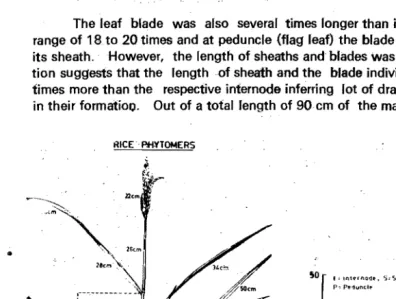
6th node (50 cm) and decreased while the length of the sheath did not alter much irrespective of the position. However, relatively the sheath is 12 times more than the 2nd internode and as the internode's length was increasing, the proportion of ' the'resjlective length of sheaths ranged 2.5 to 6.0 times, and the 7th and 8th nodes showed only an increase of 44 and 45%, 'respectively. THus; the sheath at one node elasps or extends1
to 6 times its respective internode a,nd as aresllit the'stem'is wrapped alternately ~ith sheaths till the pedun"leClnd ,dolllinate.the stem.The leaf blade was also several times longer than internodes exhibiting a range of 18 to 20 times and at peduncle (flag leaf) the blade was shorter by 12% of its sheath. However, the length of sheaths and blades was constant. This situa tion suggests that the length ,~f sheath and the blade individually showed several times more than the respective internode inferring lot of drain of biological energy in their forma1iOl;,l. Out of a total length of 90cm of the main shoot, the peduncle
RICE Pfi.YTOMERS
SO ~
40
E
u 30
.r:
c;. 20
c:
...J "
10
')
I Int.-rfHHI., 5:S"'~afl'l B,at.d" P":o P."unclt'
"
2 1 5 I)
PSB
, Main shoot phylOmers I JilI"a)
Fig. 1, 'Dimensions of rice pnytomers' (main shoot Fig, 2 ' of Jaya),
--
-_
.-~~~.~' -.?-">.-~'-.-':>--.~~"'E'.'11
--'I
iln~ tb~H~;an\~ W~~dc~~.Rq·&O%Qf .the.~elgh!.'P~dljlfl(Sle is ~he·r()!1gest stlltC!U~
(26 cm) followed by the ,p~icle
(2a
~m).',.:-'"e "
" " .
;', "'.cPrimordiaVinitiationoccurs around' 4th to 6th node after p1anting and ,there wt:!lUf(l-be setiolr!P~()mpetitiohfor the assimilates due to the synchronous develop menfof the'pank:le, stem; sheaths, leaves and roots, Hence, directed and balanced
sharing of the photosynthetic products would condition or determine the respective Jevels of growth and productivity.
Observa~ions on dry matter distribution among the three different organs
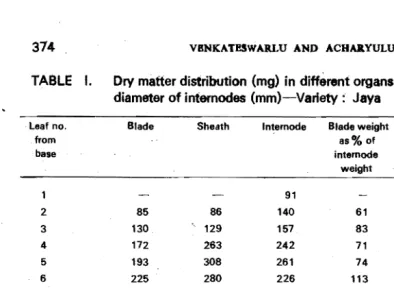
indicated that internodal weight increased upto fifth and started decreasing recording lower .value at peduncle (Table I). This shows although peduncle was several times longer (2 to
8
times) than the internodes, the weight was equal to 3rd internode and lower (158 mg) to 4th internode. The sheath weight also shoWed the saine trend while the blade weight showed a fall from sixth node -onwards. In general. the mean values indicated (Fig. 3) that the dry matter"ig.3.
DISTRIBUTION OF DRV MATTER IN MAIN
374 VBNKATHSWAJlLU AND ACHAIlYULU
TABLE I. Dry matter distribution (mg) in different organs of the main shoot and diameter of internodes (mm)-Varlety: Jaya
leaf no. Blade Sheath Internode Blade weight Sheath Internode
from as% of weightas% diameter
base internode of internode (mm) '1'
91 7.0
2 85 86 140 61 61 5.3
3 130 129 157 83 82 4.9
4 172 263 242 71 109 4.5
5 193 308 261 74 118 4.1
6 225 280 226 113 124 3.7
7 206 219 218 94 100 3.~
8 140 260 158* 89 164 2.3
Mean 168.7 220.7 186.6 83.6 108.0 4.38
*Peduncle
accumulation
was
greater in sheath (1545 mg) followed by the internode (1493mg), the blade (1181 mg) and lowest in panicle (420 mg). Greater size and weight of sheaths and blades amount to greater ~xpenditureof the assimilates in the structural formation. Hence, balanced development oriented for favoured panicle growth is essential for higher productivity.
Although rice plant depends on current photosynthetic products for yield (Yoshida and Ahn, 1968; Cock and Yoshida, 1972; Venkateswarlu et 81., 1977) considerable proportions of accumulated reserves also contribute to yield. Varietat differences in the utilization of accumulated reserves were also reported by
Yoshida and Ahn (1968) and Venkateswarlu et al. (1977) even among the same duration groups. It was fert that reserves buffer jn stress situations paying premium over those curtivars that do not maintain them. This means that for productivity purposes the photosynthetic products are to be translocated from the leaves to the panicle via sheaths and stems. This is a rong route. Further, as the contribution of the panicle to grain yield was very limited (8-23
%)
Enyi (1962) and (13.1 t()19.7%) Venkateswarlu (1976), the panicle depends heavily on the products from the shoot system. Therefore, a shorter translocation path would have apparent advantages for effective utilization of the assimilates. Moroover, in these obser vations stem emerged to be weak and depends heavily on the sheaths for its strength. This means that the sheath is a primary reservoir of assimilates and the stem only secondary. Considering the disease and pest complex, it is ~rso always advantagoous to have stronger stems irrespective of the size of the sheaths. How ever, development of a balanced phytomer is ideal. The diameter of the internodes . showed that it gradually decreased from the base (1.0 mm) towards the panicle
PLANT TYPE IN RICH
375
Peduncle
15c.m
--
....
_.':'-:----,
Oitl.
(7mml G
Umm)
5
ecm•
I
(tOmm) 4
8cm
40em•
•
•
•
(tOmm)
3
icm
(l2mmJ 2
USmm) 1
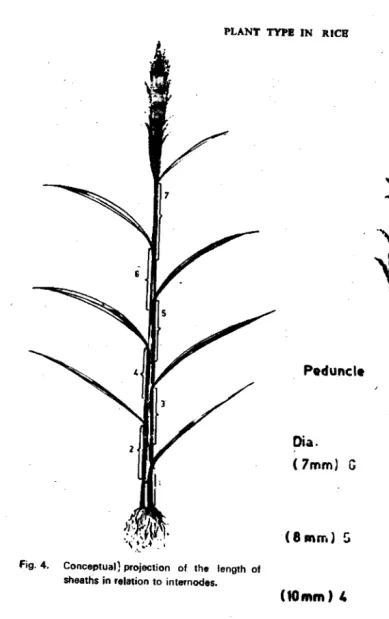
Fig. 4. Conceptual) projection of the length ofsheaths in relation to internodes.
376
In view of these observations, it was felt desirable to reduce the length of the sheaths to the ~ize of 25% more than its own internodal 'length. This retains the clasping margin~ covering nearly 25% of the succeeding internode. It is likely that such arrangement will cater to the requirements of strength of the plant (Fig. 4). Again diameter of the internodes could be more observing the pattern of the natural trend but preferring 15 mm
at
base and ending with 7 mm at the peduncle. Experience shows that there were some Varieties in the germplasm bank with varied sizes of stems Which calls for proper' identification and utirisation in the plant improvement programmes. The peduncle size could be less or reduced to around 15 cm and the panicle size increased proportionately. This means for the same height of the plant; the peduncle and the pal'l.icle sizes could be altered giving preference to panicle as shown in Fig. 5. It is well known that panicle develop ment depends on the assimilates gathered by the leaves 4, 5 and 6 after planting as reported by Tanaka (1961 a). Therefore, reduction in the size of the sheaths and increase in the diameter and weight of the internodes would be more advantageous for the production of larger panicle and greater number of spikelets. This also shortens the path of assimilates to the panicle Clnd promotes stem as a major reservoir. The present projection of the size of the panicle works out to 25% of the total length of the stem. Thus, a closer examination and qnalysis at the organ level may lead to the identification of ideal combinations to mirnmise drain of energy from imbalanced growth of organs and direct the assimilate supply for enhanced sink size raising the yield potential. Studies are in progress on the relevant organ organ relationships, optima and dimensions with different plant types.ACKNOWLEDGEM ENTS
The authors are grateful to Dr. R. Seetharaman, Project Director, All India Coordinated Rice Improvement Project, Rajendranagar, Hyderabad, for his critical comments on the manuscript.
REFERENCES .
Rnyi, B. A.
c.
(1962). The,contribution of different organs to grain weight in upland and swamp rice.Ann. Bot. N, S., 26 : 529-31.
CI I
CadI J. H. and Yoshida,S, \ 1972). Accumulates ot labelled carbohydrates before tlowering and subsequent redistribution and re'piration in the rice plant. Proc. Of the Crop Sci. Society
of Japan, 41: ·226-34.
Tanaka, A. (1861a). Studies on the nutria-physiology of leaves of rice plant. J. Pac. Agric., Hokkaido Univ .• 61 : 449-550.
Venkpteswarlu. B .• (1976), Source-sink interrelationships in lowland rice. Plant and Soil, 44 : 575-86. Venkateswarlu, B ... , Suryaprakasha Rao, J. and Rao, A. V. (1977), Relationship between growth duration
and yield parameters in irrigated rice (Oryza sativaL.).:, Indian J,P{&(lt:(lhysi'ql,?20::.69-76.- :.