ON THE HOPF CONJECTURES WITH SYMMETRY
Lee Kennard
A Dissertation
in
Mathematics
Presented to the Faculties of the University of Pennsylvania
in
Partial Fulfillment of the Requirements for the
Degree of Doctor of Philosophy
2012
Wolfgang Ziller, Professor of Mathematics
Supervisor of Dissertation
Jonathan Block, Professor of Mathematics
Graduate Group Chairperson
Dissertation Committee:
Acknowledgments
I’ll start with the core of my graduate school experience, my advisor Wolfgang Ziller. He taught me about manifolds and algebraic topology, he spent countless hours listening, advising, and working with me, and he has been a friend and mentor. He most recently has given my wife and me a chance to spend the last seven months in Rio de Janeiro. This year has been unforgettable.
I also want to thank Chris Croke for helping me prepare for orals and for meeting with me while Wolfgang was away in Fall 2009, as well as Will Wylie, Jonathan Block, and Julius Shaneson for all of their help in the process.
Next in line mathematically are Marco, F´abio, Jason, Ricardo, John, Chenxu, and Martin. I learned a lot from, and have enjoyed getting to know, all of them. I especially enjoyed spending this past year in Rio with Marco and F´abio. I appre-ciated their showing me around this massive city and for speaking for me at times when I had to say something less trivial than “frango com arroz, por favor.”
talking, eating, and watching soccer games and election results with them. Paul, Sohrab, Torcuato, and Aditya’s friendship made it especially hard to move away from Philadelphia. I also want to thank Matthew, Aaron, Shea, and Clay for their advice. It was nice to have them turn on the lights in the hallway of the future.
A special paragraph gets devoted to Janet, Monica, Robin, and Paula. I appre-ciate all of their help. I’m pretty sure the building would collapse if any one of them weren’t there to hold it together.
Many of the people who entered my life before moving to Philadelphia were just as significant to my success and happiness as those I met once here. My thanks goes to my high school mentor Diane Ross, who convinced me a little place like Kenyon College would suit me well, to my college mentors Judy Holdener, Bob Milnikel, and Ben and Carol Schumacher, and to my close college friends Eddie, Jeff, Matt, Andres, and Dave for making those four years on the hill memorable.
ABSTRACT
ON THE HOPF CONJECTURES WITH SYMMETRY
Lee Kennard Wolfgang Ziller, Advisor
Contents
1 Introduction 1
1.1 Summary of results . . . 1 1.2 Grove’s research program . . . 4 1.3 Methods . . . 9
2 Cohomological consequences of the connectedness theorem 15
2.1 Periodic cohomology and Theorem D . . . 15 2.2 From Theorem D to the periodicity theorem . . . 30
3 Proof of Theorem A 40
4 Griesmer’s bound from the theory of error-correcting codes 51
5 Theorem P 55
6 Proof of Theorem B 70
List of Tables
1.1 Timeline of the symmetry rank assumptions which imply that an
even-dimensional, positively curved n-manifold hasχ >0. . . 8
1.2 Timeline of other symmetry assumptions which imply that an even-dimensional, positively curved n-manifold hasχ >0. . . 9
1.3 Logical structure of this thesis . . . 14
2.1 Proof sketch for Theorem C. . . 31
5.1 Summary of notation in the proof of Lemma 5.3. . . 60
6.1 Dimensions of spheres . . . 72
6.2 Classical irreducible simply connected compact symmetric spaces not listed in Lemma 6.1 . . . 73
Chapter 1
Introduction
1.1
Summary of results
Positively curved spaces have been of interest since the beginning of global Rie-mannian geometry. Unfortunately, there are few known examples (see [39] for a survey and [25, 9, 15] for recent examples) and few topological obstructions to any given manifold admitting a positively curved metric. In fact, all known simply con-nected examples in dimensions larger than 24 are spheres and projective spaces, and all known obstructions to positive curvature for simply connected manifolds are already obstructions to nonnegative curvature.
two and four by the theorems of Gauss-Bonnet or Bonnet-Myers (see [4, 7]), but it remains open in higher dimensions.
In the 1990s, Karsten Grove proposed a research program to address our lack of knowledge in this subject. The idea is to study positively curved metrics with large isometry groups. This approach has proven to be quite fruitful (see [37, 13] for surveys). Our main result falls into this category:
Theorem A. Let Mn be a closed Riemannian manifold with positive sectional curvature and n ≡ 0 mod 4. If M admits an effective, isometric Tr-action with
r ≥2 log2n, then χ(M)>0.
Previous results showed thatχ(Mn)>0 under the assumption of a linear bound
on r. For example, a positively curved n-manifold with an isometric Tr-action has
positive Euler characterisic ifnis even andr≥n/8 or ifn ≡0 mod 4 andr≥n/10 (see Table 1.1 on page 8 for a summary).
The assumption of the existence of an isometricTr-action is equivalent to
comparison with previous results).
Another well known conjecture of Hopf is that S2 × S2 admits no metric of
positive sectional curvature. More generally, one might ask whether any nontrivial product manifold admits a metric with positive curvature. It is easy to see that, if M and N admit nonnegative curvature metrics, then M ×N with the product metric has nonnegative curvaure. This generalized conjecture is open.
Another way to generalize this conjecture of Hopf is to observe that S2 ×S2 has the structure of a rank two symmetric space. The rank one symmetric spaces are Sn,
CPn, HPn, and CaP2, and all of these admit positive sectional curvature. Higher rank symmetric spaces includeSU(n)/SO(n),Sp(n)/U(n), the Grassmann manifolds, and products of these and the other irreducible symmetric spaces. Not one symmetric space of rank greater than one is known to admit a positively curved metric. Moreover, no such space is known not to. It has been conjectured that the only simply connected, compact symmetric spaces which admit positively curved metrics are the rank one spaces. Our second main result provides evidence for this conjecture under the assumption of symmetry:
Theorem B. SupposeMnhas the rational cohomology of a simply connected,
com-pact symmetric space N. If M admits a positively curved metric invariant under a
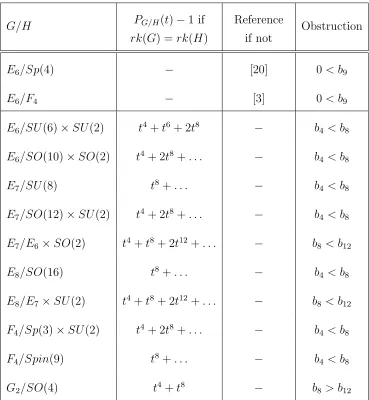
In the irreducible case, product manifolds are excluded, so the only possibilities are that N has rank one or thatN is a rank two or rank three real Grassmannian. Aside from more general classification results which assume much larger sym-metry rank, the author is unaware of previous work on this specific question. In addition to weakening the symmetry rank assumption, the author would be partic-ularly interested in methods which would exclude products and the rank two and rank three Grassmannians from the conclusion. The obstruction (see Theorem P in Chapter 5) we prove in order to obtain Theorem B is at the level of rational cohomology in low degrees. Since taking products with spheres does not affect co-homology in low degrees, and since the Grassmannians SO(2 +q)/SO(2)×SO(q) and SO(3 +q)/SO(3)×SO(q) have the same rational cohomology ring in low de-grees as the complex and quaternionic projective spaces, respectively, our methods cannot exclude them.
1.2
Grove’s research program
The precursor to Grove’s research program was the 1990 thesis of Kleiner. The main result is contained in [19]: If M4 is a simply connected closed manifold, and
if M admits a positively curved metric invariant under a circle action on M, then M is homeomorphic to S4 or
CP2.
An immediate application to Hopf’s conjecture onS2×S2 is that the isometry
A flurry of work followed [19]. As explained in [21], it follows from earlier work ([11, 12, 24]) that the conclusion can be improved to a diffeomorphism classification. Moreover, it has recently been anounced that Grove and Wilking have improved the conclusion to an equivariant diffeomorphism classification. In [22, 31], there are similar classifications under the more general assumption of nonnegative sec-tional curvature. And in [38] and [18], it was shown that χ(M)≤ 7 or χ(M) ≤5, respectively, if a large enough Zp or Zp×Zp acts effectively by isometries.
Moving beyond dimension four, Grove proposed the study of positively curved metrics which admit large isometry groups. To put it another way, in order to study manifolds with positive curvature, one might assume something about the symmetry of the metric and try to conclude something about the topology of the manifold. The proposal was purposefully vague so as to allow flexibility. The work on positively curved 4-manifolds with symmetry illlustrates an example of this.
The first higher dimensional result in this direction is due to Grove and Searle (see [14]): If Mn is a closed, positively curved manifold which admits an isometric,
effective r-torus action, thenr ≤n+1
2
with equality only if M is diffeomorphic to Sn,
CPn/2, or a lens space Sn/Zm. In particular, closed n-manifolds with postive
curvature and symmetry rank at least n/2 are classified up to diffeomorphism. In dimension five, the Grove-Searle result implies that the presence of an isomet-ric T3-action on a positively curved, simply connected closed manifold M5 implies
if only a T2 is assumed to act. Dimensions 6 and 7 contain lots of examples, so no classification is complete, unless maximal symmetry rank is assumed. In dimen-sions 8 and 9, Fang and Rong (see [10]) prove that a 3-torus or a 4-torus action, respectively, implies M is homeomorphic to the 8- or 9-sphere,CP4, or HP2.
In the early 2000s, a postdoc at Penn named Burkhard Wilking gave new life to the Grove program. Most significantly, he developed a tool which he called the connectedness lemma. I will upgrade the status of the result to a theorem, as we will use it frequently in this thesis. See Theorem 2.9 for a statement. Wilking used the connectedness theorem to prove the following classfication theorem for positively curved manifolds with large isometry group:
Theorem (Wilking, [35, 36]). Let Mn be a simply connected closed manifold with
positive sectional curvature.
1. If the symmetry rank is at least n4 + 1 and n ≥ 10, then M is homotopy equivalent to a rank one symmetric space.
2. If the symmetry degree is at least 2n −6, then M is tangentially homotopy equivalent to a rank one symmetric space or isometric to a homogeneous space
which admits positive sectional curvature.
3. If the cohomogeneity k satisfies 1≤ k < pn/18−1, then M is tangentially homotopy equivalent to a rank one symmetric space.
ob-tained a classification assuming the symmetry rank is at least n6 + 1. In dimensions n ≡0,1 mod 4,Mnhas the integral cohomology ofSn,
CPn/2, or HPn/4. In dimen-sions n≡ 2,3 mod 4, the conclusion is that, for all primesp, H∗(M;Zp) is that of
Sn,CPn/2,S2×HP(n−2)/4, orS3×HP(n−3)/4. Note that the integral cohomology of M may not agree with any of these spaces. However, for alln, the conclusion implies that the rational cohomology is that of a rank one symmetric space, S2 ×
HPm, or S3×HPm. One might compare this to Theorem P in Chapter 5, which implies the following: Given n ≥ c ≥ 2 and a positively curved, simply connected closed manifoldMn, ifb
3(M)≤1 and the symmetry rank is at least 2 log2n+
c
2, then the
rational cohomology up to degree c is that of Sn, CPn/2, HPn/4, S2 ×HP(n−2)/4, or S3×
HP(n−3)/4.
positive sectional curvature (see [9, 15]). Examples are so difficult to find that this has been one of the great achievements of the Grove program.
We conclude this section with a remark about Hopf’s conjecture thatχ(M)>0 for all even-dimensional, positively curved Riemannian manifolds M. Many of the results we have discussed imply that the Hopf conjecture in the presence of symme-try. Tables 1.1 and 1.2 together provide a timeline of results on this conjecture in
Year Symmetry rank r Dimension restriction Source 1994 r≥ n
2 − [14]
2001 r≥ n
4 −1 − [27]
2003 r≥ n
6 + 1 n ≥6000 [35]
2005 r≥ n−4
8 n6= 12 [30]
2008 r≥ n−2
10 n≡4 0 and n >20 [32] r≥ n+ 4
12 n≡200,4,12 andn >20
2012 r≥2 log2n n≡4 0 Theorem A
Table 1.1: Timeline of the symmetry rank assumptions which imply that an even-dimensional, positively curved n-manifold has χ >0.
Cohomogeneity k is small, or Dimension
Year symmetry degree d is large restriction Source
1972 k = 0 − [34]
1998 k ≤1 − [26]
2001 k ≤5 − [27]
2006 k <pn/18−1 or d≥2n−6 − [36] 2012 k ≤n−(4 log2n)2 ord≥(4 log
2n)2 n≡0 mod 4 Corollary 7.1
Table 1.2: Timeline of other symmetry assumptions which imply that an even-dimensional, positively curved n-manifold has χ >0.
many of the entries in the table are trivial consequences of much stronger theorems.
1.3
Methods
A key tool is Wilking’s connectedness theorem, which relates the topology of a closed, positively curved manifold with that of its totally geodesic submanifolds of small codimension. Since fixed-point sets of isometries are totally geodesic, this becomes a powerful tool in the presence of symmetry.
we refine this periodicity in some cases. For example, we prove:
Theorem (Periodicity Theorem). Let Nn be a closed, simply connected, positively curved manifold which contains a pair of totally geodesic, transversely
intersect-ing submanifolds of codimensions k1 ≤ k2. If k1 + 3k2 ≤ n, then H∗(N;Q) is gcd(4, k1, k2)-periodic.
It follows from [35] that, under these assumptions, H∗(N;Q) is gcd(k1, k2
)-periodic. For a closed, orientablen-manifoldN and a coefficient ringR, we say that H∗(N;R) isk-periodic if there existsx∈Hk(N;R) such that the mapHi(N;R)→
Hi+k(N;R) induced by multiplication by x is surjective for 0 ≤ i < n−k and
injective for 0 < i≤n−k.
To illustrate the strength of the conclusion of Theorem 1.3, we observe the following:
• If gcd(4, k1, k2) = 1, then N is a rational homology sphere.
• If gcd(4, k1, k2) = 2, then N has the rational cohomology of Sn orCPn/2.
• If gcd(4, k1, k2) = 4 and n 6≡ 2 mod 4, then N has the rational cohomology
ring of Sn,
CPn/2, HPn/4, or S3×HP(n−3)/4.
When gcd(4, k1, k2) = 4 and n ≡ 2 mod 4, the rational cohomology rings of Sn,
CPn/2, S2×HP(n−2)/4 and
are 4-periodic, but we do not know whether other examples exist in dimensions greater than six. This uncertainty is what prevents us from proving Theorem A in all even dimensions (see Chapter 7).
The main step in the proof of Theorem 1.3 is the following topological result:
Theorem C. If Mn is a closed, simply connected manifold such that H∗(M;
Z) is k-periodic with 3k≤n, then H∗(M;Q) is gcd(4, k)-periodic.
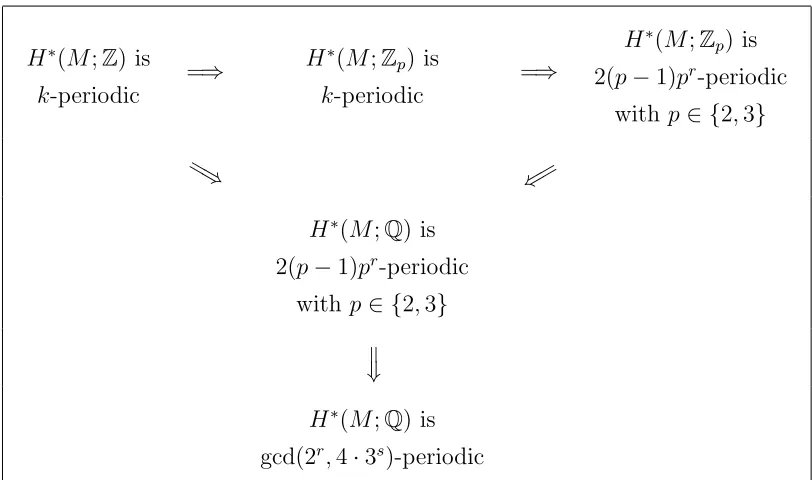
To prove Theorem C, we note that the assumption implies the same periodicity with coefficients in Zp. We then use the action of the Steenrod algebra for p = 2
and p = 3 to improve these periodicity statements with coefficients in Zp. When
combined, this information implies gcd(4, k)-periodicity with coefficients in Q. See Theorem D for more general periodicity statements with coefficients in Zp, which
together can be viewed as a generalization of Adem’s theorem on singly generated cohomology rings (see [2]).
With the periodicity theorem in hand, we briefly explain some of the tools that go into the proofs of Theorems A and B.
First, the starting point for the proof of Theorem A is a theorem of Lefschetz which states that the Euler characteristic satisfies χ(M) = χ(MT), where MT is
the fixed-point set of the torus action. Since M is even-dimensional with positive curvature, MT is nonempty by a theorem of Berger. Writing χ(MT) = P
χ(F) where the sum runs over components F of MT, we see that it suffices to show
An important tool is a theorem of Conner, which states that, if P is a manifold on whichT acts, then bodd(PT)≤bodd(P), where bodd denotes the sum of the odd
Betti numbers. The strategy is to find a submanifoldP on which a subtorusT0 ⊆T acts such that bodd(P) = 0 and such that F is a component of PT
0
.
In order to find such a submanifoldP, we investigate the web of fixed-point sets ofH ⊆T, whereH ranges over subgroups of involutions. These fixed-point sets are totally geodesic submanifolds on which T acts, so, under the right conditions, we can induct over dimension. In addition, studying fixed-point sets of involutions has the added advantage that we can easily control the intersection data by studying the isotropy representation at a fixed-point of T.
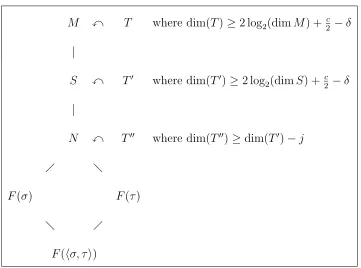
In order to apply the periodicity theorem, we must find a transverse intersection in the web of fixed-point sets of subgroups of involutions. To strip away complication while preserving the required codimension, symmetry, and intersection data, we define an abstract graph Γ where the vertices correspond to involutions whose fixed-point sets satisfy certain codimension and symmetry conditions. An edge exists between two involutions if the intersection of the corresponding fixed-point sets is not transverse. We then break up the proof into several parts, corresponding to the structure of this graph.
For Theorem B, we first prove Theorem P, which we state and prove in Chapter 5. Theorem P implies that a closed, simply connected, positively curvedn-manifold which admits an isometric Tr-action with r ≥ 2 log
2n+
c
inclusion P ,→M such that P has 4-periodic rational cohomology ring. In partic-ular, the Betti numbers of M satisfy 1≥ b4 and bi = bi+4 for 0< i < c−4. Since
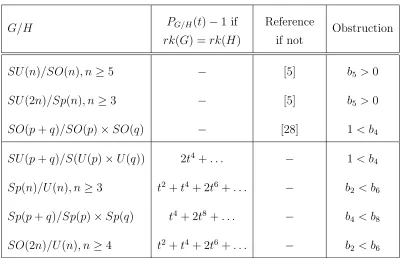
symmetric spaces are classified and their rational cohomology is known, this easily implies Theorem B. Chapter 6 contains the proof of Theorem B using Theorem P. In addition to the techniques explained above to prove Theorem A, we use, following [35], the theory of error-correcting codes to prove the existence of fixed-point sets of small codimension. In particular, we use the Griesmer bound for linear codes to find submanifolds which are simply connected and whose inclusions into M are highly connected.
We summarize in Table 1.3 how our two main tools – the action of the Steenrod algebra on cohomology, the connectedness theorem, and the Griesmer bound – fit into the logical structure of this thesis.
Steenrod operations =⇒ Theorem D
⇓
Theorem C
⇓
Connectedness Theorem =⇒ Periodicity Theorem =⇒ Theorem A
=⇒ ⇓
Griesmer bound =⇒ Theorem P
⇓
Theorem B
Chapter 2
Cohomological consequences of
the connectedness theorem
In this chapter, we define a notion of periodicity in cohomology, discuss its basic properties, and explain how it arises in the context of positively curved Rieman-nian manifolds. We will then study the action of the Steenrod algebra on spaces with periodic cohomology and prove a generalization of Adem’s theorem on singly generated cohomology rings. Finally, we will combine our main topological result with the connectedness theorem to prove the periodicity theorem.
2.1
Periodic cohomology and Theorem D
Definition 2.1. For a topological space M, a ring R, and an integer c, we say that x ∈ Hk(M;R) induces periodicity in H∗(M;R) up to degree c if the maps
Hi(M;R) → Hi+k(M;R) given by multiplication by x are surjective for 0 ≤ i <
c−k and injective for 0< i≤c−k.
When such an elementx∈Hk(M;R) exists, we say thatH∗(M;R) isk-periodic
up to degree c. If in addition M is a closed, orientable manifold and c= dim(M), then we say that H∗(M;R) is k-periodic.
We remark thatH∗(M;R) is triviallyk-periodic up to degree cwhenk ≥c. By a slight abuse of notation, we also say that H∗(M;R) is k-periodic if 2k ≤ c and Hi(M;R) = 0 for 0 < i < c. One thinks of 0 as the element inducing periodicity. This convention simplifies the discussion.
To motivate the discussion in this section, we give an example of how periodicity in this sense arises in the study of positively curved manifolds. Suppose Mn is a simply connected, closed, positively curved manifold which contains a pair of totally geodesic submanifolds Nn−k1
1 and N
n−k2
2 with k1 ≤k2. If the pair intersects
transversely, then the connectedness theorem implies H∗(N2;Z) is k1-periodic.
Observe that the definition implies dimRHik(M;R) ≤ 1 for ik < c when R is
a field and M is connected. In particular, if x ∈Hk(M;R) induces periodicity up
Theorem (Adem’s theorem). Let M be a topological space, and let p be a prime. Assume H∗(M;Zp) is isomorphic to Zp[x] or Zp[x]/xq+1 with q ≥p. Let k denote
the degree of x.
1. If p= 2, then k is a power of 2.
2. If p >2, then k = 2λpr for some r≥0 and λ|p−1.
As a corollary, if H∗(M;Z) is isomorphic to Z[x] or Z[x]/xq+1 with q ≥ 3,
then the degree of x is 2 or 4, corresponding to the case where M is complex or quaternionic projective space.
The main step in the proof of the periodicity theorem is the following general-ization of Adem’s theorem:
Theorem D. Let M be a topological space, and let p be a prime. Assume x ∈
Hk(M;
Zp) is nonzero, induces periodicity up to degree pk, and that k = deg(x) is
minimal among all such elements x.
1. If p= 2, then k is a power of 2.
2. If p >2, then k = 2λpr for some r≥0 and λ|p−1.
Before starting the proof, we prove the following general lemma about period-icity:
Lemma 2.2. Let R be a field. If x ∈ Hk(M;R) is a nonzero element inducing
periodicity up to degree c with 2k ≤ c, and if xr = yz for some 1 ≤ r ≤ c/k with
In particular, if x=yz with 0<deg(y)< k, then y induces periodicity.
The way in which we will use this lemma is to take an element x of minimal degree that induces periodicity, and to conclude that the only factorizations of xr
are those of the form (axs)(bxt) where a, b ∈ R are multiplicative inverses and r =s+t.
Proof. Use periodicity to write y =y0y00 and z =z0z00 where y00 and z00 are powers of x, 0<deg(y0)< k, and 0<deg(z0)< k. Sincex generates Hk(M;R), it follows
that y0z0 = ax for some multiple a ∈ R. If a = 0, then xr = (ax)y00z00 = 0, a
contradiction to periodicity and the assumption that x 6= 0. Supposing therefore that a 6= 0, we may multiply by a−1 to assume without loss of generality that
x=y0z0. Since y00 is a multiple ofx, we note that it suffices to show that y0 induces periodicity up to degree c. Let k0 = deg(y0).
Since multiplying by x is injective from Hi(M;
Z2) → Hi+k(M;Z2), and since
this map factors as multiplication by y0 followed by multiplication by z0, it follows that multiplication by y0 from Hi(M;Z2) → Hi+k
0
(M;Z2) is injective for 0 < i ≤
c−k. In addition, to see that multiplication by y0 is injective from Hi(M;
Z2) →
Hi+k0(M;
Z2) forc−k < i ≤c−k0, consider that multiplying by y0 and then byx
from
Hi−k(M;Z2)→Hi−k+k
0
(M;Z2)→Hi+k
0
is the same as multiplying by x and then byy0 from
Hi−k(M;Z2)→Hi(M;Z2)→Hi+k
0
(M;Z2).
Since the first composition is injective, and since the first map in the second is an isomorphism, we conclude that multiplication by y0 is injective from Hi(M;
Z2)→
Hi+k0(M;Z2) for all 0< i≤c−k0. The proof that multiplication byy0 is surjective
in all required degrees is similar.
We proceed to the proof of the first part of Theorem D. The key tool in the proof is the existence of Steenrod squares, so we review some of their properties now. The Steenrod squares are group homomorphisms
Sqi :H∗(M;Z2)→H∗(M;Z2)
which exist for all i≥0 and satisfy the following properties: 1. If x∈Hj(M;
Z2), thenSqi(x)∈Hi+j(M;Z2), and
• if i= 0, then Sqi(x) = x,
• if i=j, thenSqi(x) =x2, and
• if i > j, thenSqi(x) = 0.
2. (Cartan formula) Ifx, y ∈H∗(M;Z2), thenSqi(xy) = P0≤j≤iSq
j(x)Sqi−j(y).
composi-tions of Steenrod squares:
SqaSqb =
ba/2c
X
j=0
b−1−j a−2j
Sqa+b−jSqj.
A consequence of the Adem relations is the following: If k is not a power of two, there exists a relation of the form Sqk =P
0<i<kaiSqiSqk−i for some constants ai.
Indeed, if k = 2c+dfor integers cand d≡0 mod 2c+1, then we can use the Adem
relation with (a, b) = (2c, d).
The first application of the Steenrod squares in the presence of periodicity is to show the following:
Lemma 2.3. Suppose x ∈ Hk(M;Z2) is nonzero and induces periodicity up to
degree c with 2k ≤c. If x =Sqi(y) for some i > 0, then x factors as a product of
elements of degree less than k.
Combined with Lemma 2.2, we conclude that if i > 0 and if x = Sqi(y) ∈
Hk(M;Z2) is nonzero and induces periodicity up to degree c with 2k ≤ c, then
there is another nonzero element x0 inducing periodicity up to degree c with 0 < deg(x0)< k.
Proof. Leti >0 be maximal such thatx=Sqi(y) for some cohomology elementy.
Using the Cartan relation, we compute x2 as follows: x2 =Sqi(y)2 =Sq2i(y2)−X
j6=i
Now Sqj(y) and Sq2i−j(y) commute, so the sum over j 6= i is twice the sum over j < i. Hence x2 =Sq2i(y2).
Next, Sqi(y) = x 6= 0 implies i ≤ deg(y). Moreover, i = deg(y) implies that
x factors as y2. Suppose then that i < deg(y). Since k = i+ deg(y) < deg(y2), it follows from the surjectivity assumption of periodicity that y2 = xy0 for some
y0 with 0 < deg(y0) < deg(y). Using periodicity again, observe that Sqj(x) for
0 ≤ j < k can be factored as xxj for some xj ∈ Hj(M;Z2). Applying the Cartan
formula again, we have
x2 =Sq2i(xy0) =X
j≤2i
xxjSq2i−j(y0).
The injectivity assumption of periodicity implies we may cancel anx and conclude x = xjSq2i−j(y0) for some j ≤ 2i. Because i was chosen to be maximal, we must
havej >0, that is, we must have thatx factors as a product of elements of degree less than k.
We proceed to the proof of the first part of Theorem D:
Proof of Theorem D when p= 2. Suppose x ∈ H∗(M;Z2) is nonzero, induces
pe-riodicity up to degree c with 2k ≤ c, and has minimal degree among all such elements. Assume k is not a power of 2. We will show that xfactors nontrivially or that x=Sqi(y) for some i >0, which contradicts Lemmas 2.2 and 2.3.
The first step is to evaluate the Adem relation Sqk = P
0<i<kaiSq
iSqk−i on x.
we obtain
x2 =Sqk(x) = X
0<i<k
aiSqi(xxk−i) =
X
0<i<k
ai
X
0≤j≤i
xxjSqi−j(xk−i).
Using the injectivity assumption of periodicity, we can cancel anxto conclude that
x= X
0<i<k
X
0≤j≤i
aixjSqi−j(xk−i).
Now periodicity and our assumption that x is nonzero imply that Hk(M;Z2)Z2
and is generated by x. It follows that x = xjSqi−j(xk−i) for some 0 < i < k and
0≤j ≤i. If j >0, we have proven a nontrivial factorization of x, and if j = 0, we have proven that x = Sqi(xk−i) for some i > 0. As explained at the beginning of
the proof, this is a contradiction.
We now proceed to the proof of the second part of Theorem D, which we restate here for easy reference:
Proposition. Let p be an odd prime. Suppose x ∈ Hl(M;Zp) is nonzero and
in-duces periodicity in H∗(M;Zp) up to degree c with pl ≤c. If x has minimal degree
among all such elements, then l = 2λpr for some r ≥0 and λ|p−1.
The proof uses Steenrod powers. These are group homomorphisms
Pi :H∗(M;Zp)→H∗(M;Zp)
for i≥0 that satisfy the following properties:
• if i= 0, then Pi(x) =x,
• if 2i=j, then Pi(x) =xp, and
• if 2i > j, then Pi(x) = 0.
2. (Cartan formula) Forx, y ∈H∗(M;Zp),Pi(xy) =
P
0≤j≤iP
j(x)Pi−j(y).
3. (Adem relations) For a < pb,
PaPb = X
j≤a/p
(−1)a+j
(p−1)(b−j)−1 a−pj
Pa+b−jPj. (2.1.1) Despite the similarity of the statements of Theorem D when p= 2 and p > 2, the proof in the odd prime case is more involved. We proceed with a sequence of steps.
We first study the structure of the Adem relations to obtain a specific relation in the Zp-algebra A generated by{Pi}i≥0 modulo the Adem relations. This lemma
does not use periodicity.
Lemma 2.4. Let k = λpa +µ where 0 < λ < p and µ ≡ 0 mod pa+1. For all
1≤m≤λ, there exist Qi ∈ A such that Pk=Pmp
a
◦Qa+
P
i<aP pi
◦Qi.
Proof. We induct over k. For k = 1, the result is trivial. Suppose the result holds for all k0 < k. Write k = λpa+µ where 0 < λ < p and µ ≡ 0 modpa+1, and let
1≤m≤λ. If µ= 0 andm =λ, thenPk =Pmpa
is already of the desired form. If not, then mpa < p(k−mpa) and we have the Adem relation (see Equation 2.1.1)
c0Pk =Pmp
a
Pk−mpa− X
0<j≤mpa−1
For 0 < j ≤mpa−1, k−j is less than k and not congruent to 0 modulo pa. Hence the induction hypothesis implies that eachPk−j term is of the formP
i<aPp
i
Qi. It
therefore suffices to prove that c0 6≡0 modp.
For this, we use the following elementary fact: If x = P
i≥0xip
i and y =
P
i≥0yipi are base p expansions (where p is prime), then the modulo p binomial
coefficients satisfy xy≡Q xi
yi
modp. Hence we have that
±c0 =
(p−1)(k−mpa)−1 mpa
≡
(p−1)(λ−m)pa−1 mpa
≡
p−(λ−m)−1 m
,
which is not congruent to 0 modulo p since 0 ≤ m ≤ p−(λ−m)−1 < p. This completes the proof.
To simplify the remainder of the proof, we assume throughout the rest of the section the following:
Assumption 2.5. Assume that x ∈ Hl(M;Zp) is nonzero and that x induces
periodicity up to degree c with pl ≤ c. Also assume that l = deg(x) is minimal among all such elements.
In particular, Lemma 2.2 implies that the only factorizations ofaxr witha 6= 0
and r ≤pare of the form (a0xr0)(a00xr00) witha0, a00∈Zp and r =r0+r00. The next
step is to prove an analogue of Lemma 2.3:
Lemma 2.6. No nontrivial multiple of x is of the form Pi(y) with i >0.
Proof. Without loss of generality, we may assumexitself is equal toPi(y) for some
i > 0. Set d = deg(y). Our first task is to write some power of x as Pi1(y
0< deg(y1)< d. Because x6= 0, we have 2i ≤d, which implies deg(yp) ≥l. Let r
be the integer such that l+d >deg(yr)≥l. Lemma 2.2 implies a strict inequality
here. Using periodicity, write yr =xy
1 with 0< d1 < d.
We next calculate ther-th power of both sides of the equation x=Pi(y) using the Cartan relation:
xr=Pri(yr)−Xcj1,...,jrP
j1(y)· · ·Pjr(y)
where thecj1,...,jr are constants and the sum runs over j1 ≥ · · · ≥jr with j1+. . .+
jr =ri and (j1, . . . , jr)6= (i, . . . , i). Observe that j1 > i, so Pj1(y) =xzj1 for some zj1 ∈ H
2(j1−i)(p−1)(M;
Zp). Using yr = xy1, the first term on the right-hand side
becomes
Pri(yr) = Pri(xy1) =
X
k0+k=ri
Pk0(x)Pk(y1) =x
X
k0+k=ri
xk0Pk(y1)
for some xk0 ∈H2k 0(p−1)
(M;Zp). Combining these calculations, and using
periodic-ity to cancel the x, we obtain
xr−1 = X
k0+k=ri
xk0Pk(y1) +
X
cj1,...,jrzj1P
j2(y)· · ·Pjr(y).
Now r − 1 < p, so periodicity implies that xr−1 generates H(r−1)l(M;
Zp). By
Lemma 2.2 therefore, every term of the form zj1P
j2(y)· · ·Pjr(y) vanishes since
0<deg(Pjr(y))<deg(Pi(y)) = l. Similarly, all terms of the form x
k0Pk(y1) vanish
unless Pk(y
1) is a power of x. Hence some power of x is of the form Pi1(y1), as
We now show that, given an expression xrj = Pij(y
j) for some j ≥ 1 with
0 < deg(yj) < d, there exists another expression xrj+1 = Pij+1(yj+1) with 0 <
deg(yj+1)< d. Moreover, it will be apparent thatl+ deg(yj+1) = deg(yj) +mjdfor
some integer mj. First, among all such expressions xrj = Pij(yj), fix yj and take
rj (or, equivalently, ij) to be minimal. Next, note that Pij(yj) = xrj 6= 0 implies
pdeg(yj)≥rjl, which together with pd≥l implies
pdeg(yjyp−rj) =pdeg(yj) + (p−rj)pd≥pl.
Hence we can choose an integer mj ≤ p−rj satisfying l ≤deg(yj) +mjd < l+d.
Once again, Lemma 2.2 implies both inequalities are strict. Using periodicity, we can write yjymj =xyj+1 with 0<deg(yj+1)< dand l+ deg(yj+1) = deg(yj) +mjd.
We now calculate
xrj+mj =Pij(y
j)Pi(y)mj =Pij+mji(yjymj)−
X
Pk0(y
j)Pk1(y)· · ·Pkmj(y)
where the sum runs over (k0, . . . , kmj)6= (ij, i, . . . , i) with k0+. . .+kmj =ij+mji.
As when we calculated xr above, we are able to factor an x from each term on the right-hand side and use periodicity to cancel it. Using that xrj+mj−1 is a generator
and Lemma 2.2, together with the assumption thatrj is minimal, we conclude that
x is a nonzero multiple ofPij+1(y
j+1), as claimed.
We therefore have a sequence of cohomology elements (yj) with 0<deg(yj)< d
andl+ deg(yj+1) = deg(yj) +mjdfor some integermj for all j ≥1. This cannot be.
for 1≤j ≤d−1 yields
ld+ deg(yd) = (r+m1+. . .+md−1)d,
which implies that deg(yd) is divisible by d. But 0 < deg(yd) < d, so this is a
contradiction.
Lemma 2.6 easily implies the following:
Lemma 2.7. No nontrivial multiple of xr with1≤r≤p is of the form Pi(y)with 0< i < 2(pl−1).
Proof. Indeed, the bound on i implies deg(y) = ml− 2i(p− 1) > (m −1)l, so periodicity impliesy=xm−1z for somez with 0<deg(z)< l. Applying the Cartan
formula and periodicity, we obtain xm = Pj(xm−1)Pj0(z) for some j +j0 = i. By Lemma 2.2, Pj0(z) is a power of x. But since deg(Pj(xm−1))≥(m−1)l, we must
have x=Pj0(z). Since deg(z)< l, we have a contradiction to Lemma 2.6.
At this point, we combine what we have established so far. Recall that we are assumingx∈Hl(M;Zp) is nonzero and induces periodicity up to degree 2l≤cand
that x has minimal degree among all such elements. Observe that p > 2 implies x3 6= 0. Hence l= 2k for some k.
Lemma 2.8. Suppose l = 2k and k = λpa +µ for some 0 < λ < p and µ ≡
0 mod pa+1. For all 1 ≤ m ≤ λ, there exists r < p, 0 < j ≤ mpa, and z ∈
H2pa(rλ−m(p−1))
Moreover, j ≡ 0 modpa and 0 ≤ deg(z) < l with deg(z) = 0 only if rk = (p−1)mpa.
Proof. Letl,k, andmbe as in the assumption. Evaluating the expression in Lemma 2.4 on x yields
xp =Pk(x) =Pmpa(Qa(x)) +
X
i<a
Ppi(Qi(x)).
Using periodicity, we can write Qi(x) =xzi for i < a,Qa(x) =xp−rz for some 1≤
r < p such that 0≤ deg(z)< l, Pj(x) = xyi for all j, and Pmp
a−j
(xp−r) = xp−rwj
for all j.
Using this notation and the Cartan formula, we have
xp =xp−r X
j≤mpa
wjPj(z) +x
X
i<a
X
j≤i
yjPp
i−j
(zi).
Using periodicity again, we obtain
xp−1 =xp−r−1 X
j≤mpa
wjPj(z) +
X
i<a
X
j≤i
yjPp
i−j
(zi).
Periodicity implies xp−1 is a (nonzero) generator of H(p−1)l(M;
Zp), hence a
non-trivial multiple of xp−1 isxp−r−1wjPj(z) for somej ≤mpa or yjPp
i−j
(zi) for some
j ≤i < a. In the second case, we have a contradiction to Lemma 2.2 or Lemma 2.7 since pi −j ≤ pa−1 < l/2(p−1). Similarly, we have a contradiction to Lemma 2.2
in the first case unless wj is a power of x. Moreover, deg(wj) = 2(p−1)(mpa−j)
implies j =ipa for some 0≤i≤m.
Using periodicity to cancel powers of x, we conclude that xr = Pj(z) for some
Using this result, we are in a position to prove Theorem D for p > 2, that is, we are ready to show that l= 2λpr for some r ≥0 and someλ|p−1:
Proof of Theorem D when p > 2. Suppose x∈Hl(M;Zp) is nonzero, induces
peri-odicity up to degreecwithpl≤c, and has minimal degree among all such elements. Sincep >2, we havel = 2k for some k. Write k=λpa+µwhere 0< λ < p and
µ ≡ 0 modpa+1. Let g = gcd(λ, p−1). Our task is to show that µ = 0 and that g =λ. We prove this by contradiction using three cases.
Suppose first thatµ >0. Takem= 1 in Lemma 2.8. Then we havexr =Ppa
(z) with deg(z)>0 since
rk≥k ≥µ≥pa+1 >(p−1)mpa. Because
pa= (pa+pa+1)/(p+ 1) < l/2(p−1), we have a contradiction to Lemma 2.7.
Second, suppose that µ = 0 and 1 = g < λ. Choose 1 ≤ m < λ such that m(p−1) ≡ −1 mod λ. Lemma 2.8 implies the existence of r < p, 0 < j ≤ mpa
with j ≡ 0 modpa, and z ∈ H2pa(rλ−m(p−1))(M;Zp) with 0 ≤ deg(z) < l such that
xr =Pj(z). Our choice of m and the conditions on deg(z) imply deg(z) = 2pa. In
addition, xr 6= 0 impliesj ≤pa, so the conditions on j imply j =pa. Putting these
Finally, suppose that µ= 0 and 1 < g < λ. Taking m = 1 yields xr = Ppa(z) with deg(z)>0 since g < λimplies
(p−1)mpa= (p−1)pa6=rλpa=rk. Raising both sides to the (λ/g)-th power, we obtain
xrλ/g =Pλpa/g(zλ/g)−XPi1(z)· · ·Piλ/g(z)
where the sum runs over i1+. . .+iλ/g = λpa/g with (i1, . . . , iλ/g) 6= (pa, . . . , pa).
Observe that deg(zλ/g) is a multiple of l= deg(x) while 0<deg(z)< l, so Lemma 2.2 implieszλ/g = 0. Now g ≥2 andrl−2(p−1)pa= deg(z)< l impliesrλ/g < p,
so xrλ/g is nonzero and generates Hlrλ/g(M;
Zp). This implies xrλ/g is a nontrivial
multiple of Pi1(z)· · ·Piλ/g(z) for some (i
1, . . . , iλ/g). Using Lemma 2.2 again, we
conclude that each Pij(z) is a power ofx. But the degrees of x and z implies that
this is only the case if ij ≥pa for all j. Since there is no such term in the sum, we
obtain a contradiction.
2.2
From Theorem D to the periodicity theorem
In this section, we use Theorem D to prove Theorem C in the introduction. We then pull together Theorem C and the connectedness theorem to prove the periodicity theorem.
goal is to show that H∗(M;Q) is gcd(4, k)-periodic. We proceed to the proof, the summary of which is included in Table 2.1.
H∗(M;Z) is k-periodic
=⇒ H
∗(M;
Zp) is
k-periodic
=⇒
H∗(M;Zp) is
2(p−1)pr-periodic
with p∈ {2,3}
=⇒ ⇒ =
H∗(M;Q) is 2(p−1)pr-periodic
with p∈ {2,3}
=
⇒
H∗(M;Q) is gcd(2r,4·3s)-periodic
Table 2.1: Proof sketch for Theorem C.
Proof of Theorem C. Note that if x is a torsion element, then periodicity implies that M is a rational homology sphere. Since H∗(M;Q) is then trivially gcd(4, k)-periodic, we may assume xis not a torsion element. By periodicity, Hk(M;
Z)∼=Z and is generated by x.
Consider the nonzero image x2 ∈ Hk(M;Z2) of x under the reduction
homo-morphism Hk(M;
Z)→Hk(M;Z2). It follows by the Bockstein sequence
· · ·−→·2 Hi(M;Z)−→ρ Hi(M;Z2)−→Hi+1(M;Z)−→ · · ·
Hl(M;Z2) the element of minimal degree which induces periodicity. Theorem D
says l is a power of 2.
We claim that l divides k. If not, there exists a cohomology element y0 with 0<deg(y0)< l such that ym =x2y0 for some integer m. By Lemma 2.2, it follows
that y0 also induces periodicity, a contradiction to the minimality of l. We have then that l |k. Moreover, periodicity implies yk/l =x
2.
Next we show thatycomes from an integral element ˜y∈Hl(M;Z) such that the mapHi(M;
Z)→Hi+l(M;Z) induced by multiplication by ˜yhas finite kernel for all 0< i < n. Letρ:Hl(M;
Z)→Hl(M;Z2) be the map induced by reduction modulo
2. Consider first that (via multiplication by y) 0 = H1(M;Z2) ∼= H1+l(M;Z2),
which implies bl+1(M)≤bl+1(M;Z2) = 0. Next consider the following portion
Hl(M;Z)→Hl(M;Z2)→Hl+1(M;Z)→Hl+1(M;Z)→Hl+1(M;Z2)
of the Bockstein sequence. We see that that Hl+1(M;Z)→Hl+1(M;Z) is a surjec-tion and hence an isomorphism since Hl+1(M;
Z) is finite. Using exactness again, we conclude ρ :Hl(M;
Z)→ Hl(M;Z2) is surjective, so that we can choose some
˜
y ∈ Hl(M;Z) with ρ(˜y) = y. Now Hk(M;Z) is generated by x, so ˜yk/l = mx for some m ∈Z. Applying ρ to both sides yields
mx2 =ρ(˜yk/l) =yk/l=x2 6= 0,
hence m6= 0. This proves that multiplication by ˜y has finite kernel.
under the coefficient mapHl(M;Z)→Hl(M;Q), induces periodicity inH∗(M;Q). A completely analogous argument using Theorem D with p = 3 shows that H∗(M;Q) ism-periodic with m= 4·3s. Taking m to be minimal, it follows again
that m | k. At this point it is clear that the Betti numbers of M are gcd(k, l, m)-periodic and hence gcd(4, k)-m)-periodic.
To conclude that H∗(M;Q) is gcd(4, k)-periodic, consider the set D of all pos-itive integers d such that H∗(M;Q) has an element in degree d which induces periodicity. Clearly k, l, m ∈ D. We claim that d1, d2 ∈ D with d1 > d2 implies
d1−d2 ∈D. Indeed suppose z1 ∈Hd1(M;Q) andz2 ∈Hd2(M;Q) induce
periodic-ity in H∗(M;Q). Since z2 induces periodicity, there exists z3 ∈Hd1−d2(M;Q) such thatz1 =z2z3. Sincez1 induces periodicity, Lemma 2.2 implies thatz3 does as well.
Since the difference of any two elements in Dlies in D, it follows that gcd(k, l, m), and hence gcd(4, k), also lies inD.
We now prove the periodicity theorem using Theorem C and the connectedness theorem. We recall the statement of the connectedness theorem:
Theorem 2.9(Connectedness Theorem, [35]). SupposeMnis a closed Riemannian
manifold with positive sectional curvature.
1. If Nn−k is connected and totally geodesic inM, thenN ,→M is (n−2k+ 1)-connected.
2. If Nn−k1
1 and N
n−k2
(n−k1 −k2)-connected.
Recall an inclusion N ,→M is called h-connected if πi(M, N) = 0 for all i≤h.
It follows from the relative Hurewicz theorem that the induced map Hi(N;Z) →
Hi(M;Z) is an isomorphism for i < h and a surjection for i = h. The following is a topological consequence of highly connected inclusions of closed, orientable manifolds (see [35]):
Theorem 2.10. Let Mn and Nn−k be closed, orientable manifolds. If N ,→ M is
(n−k−l)-connected withn−k−2l >0, then there existse ∈Hk(M;Z)such that the maps Hi(M;
Z)→Hi+k(M;Z) given byx7→ex are surjective for l ≤i < n−k−l and injective for l < i≤n−k−l.
Combining these results with Theorem C, we will prove in this section the following slightly stronger version of the periodicity theorem.
Theorem 2.11. Let Nn be a closed, simply connected Riemannian manifold with
positive sectional curvature. Let Nn−k1
1 and N
n−k2
2 be totally geodesic, transversely
intersecting submanifolds with k1 ≤k2.
1. Ifk1+3k2 ≤n, then the rational cohomology rings ofN, N1,N2, and N1∩N2
are gcd(4, k1, k2)-periodic.
2. If 2k1 + 2k2 ≤ n, then the rational cohomology rings of N, N1, N2, and
3. If 3k1+k2 ≤ n and if N2 is simply connected, then the rational cohomology
rings of N2 and N1 ∩N2 are gcd(4, k1)-periodic.
We make two remarks. First, all three codimension assumptions imply thatN1
is simply connected and that N1 ∩N2 is simply connected if N2 is. This follows
by the connectedness theorem since the bounds on the codimensions imply that the inclusions N1 ,→ N and N1 ∩N2 ,→ N2 induce isomorphisms of fundamental
groups. Similarly the first two assumptions imply that N2 is simply connected, but
the third condition does not.
Second, in the proof of Theorem A, we will use the following consequence of Theorem 2.11:
Corollary 2.12. Let Nn be a closed, positively curved manifold with n ≡0 mod 4. LetNn−k1
1 andN
n−k2
2 be totally geodesic, transversely intersecting submanifolds with
2k1+ 2k2 ≤n. Then bodd(N) =Pb1+2i(N) = 0.
Proof of Corollary 2.12. Letπ : ˜N →N denote the universal Riemannian covering. The submanifoldsπ−1(N
i)⊆N are transversely intersecting, totally geodesic, (n−
ki)-dimensional submanifolds of the closed, simply connected, positively curved
manifold ˜N. Since 2k1+ 2k2 ≤n, Theorem 2.11 implies H∗( ˜N;Q) is 4-periodic.
Observe that 4-periodicity and Poincar´e duality imply bodd( ˜N) = 0 since ˜N
ele-ments under the action of π1(N) on H∗( ˜N;Q). Since bodd( ˜N) = 0, it follows that
bodd(N) = 0.
We proceed now to the proof of Theorem 2.11. Recall that we have a closed, simply connected Riemannian manifold Nn with positive sectional curvature. We
also have totally geodesic, transversely intersecting submanifoldsNn−k1
1 and N
n−k2
2
with k1 ≤ k2. As discussed above, we may assume that N1, N2, and N1 ∩N2 are
simply connected and therefore orientable.
Observe that we have 3k1+k2 ≤ n in all three cases. By the corollary to the
connectedness theorem,H∗(N2;Z) isk1-periodic since the intersection is transverse.
The bound on the codimensions implies 3k1 ≤ dim(N2), hence Theorem C implies
H∗(N2;Q) isg-periodic, whereg = gcd(4, k1). SinceN1∩N2 ,→N2is dim(N1∩N2
)-connected, H∗(N1 ∩N2;Q) is g-periodic as well. This concludes the proof of the
third statement.
Assume now that 2k1 + 2k2 ≤ n. We claim that H∗(N;Q) is g-periodic. Let j :N2 ,→N be the inclusion map, and let x0 ∈Hg(N2;Q) be an element inducing
periodicity in H∗(N2;Q). Because n−2k2 ≥ 2k1 ≥ g, the connectedness theorem
implies j∗ : Hg(N;
Q) → Hg(N2;Q) is an isomorphism. Let x ∈ Hg(N;Q) satisfy j∗(x) = x0. By the first part of the connectedness theorem, the inclusion N1 ,→N
is n−k1−(k1−1) connected, so there exists e1 ∈ Hk1(N;Z) such that the maps
Hi(N;
Z)→Hi+k1(N;Z) given byy 7→e1y are isomorphisms fork1 ≤i≤n−2k1.
note that e1 satisfies the corresponding property with rational coefficients.
Note thate1 is some nonzero multiple ofxk1/g. This follows since (x0)k1/g
gener-atesHk1(N
2;Q), and sincej isn−2k2+ 1≥2k1+ 1 connected. Replacinge1 by any
nonzero multiple preserves the multiplicative property ofe1, so suppose without loss
of generality that e1 =xk1/g. We prove in three cases the claim that multiplication
by xinduces isomorphisms Hi(N;
Q)→Hi+g(N;Q) for all 0< i < n−g:
• For 0 < i < 2k1−g, the claim follows since N2 ,→ N is n −2k2 connected
and n −2k2 + 1 ≥ 2k1 + 1. For n −2k1 < i < n− g, one uses the cap
product isomorphisms given by x together with Poincar´e duality to conclude the claim.
• For 2k1 < i < n−2k1−g, one choosesl≥1 such that k1 < i−lk1 ≤2k1 and
uses the fact that multiplication by e1 induces isomorphisms in some middle
degrees and that e1 and x commute.
• For 2k1−g ≤i≤2k1 orn−2k1−g ≤i≤n−2k1, one factors multiplication
by e1 as multiplication by xk1/g−1 followed by multiplication by x and uses
the previous two cases.
Hence x induces g-periodicity in N, as claimed.
Next letg0 =g if k1+ 3k2 > n andg0 = gcd(4, k1, k2) ifk1+ 3k2 ≤n. Our proof
will be complete once we show that N, N1,N2, andN1∩N2 are g0-periodic. First,
If k1+ 3k2 > n, then H∗(N;Q) is already g0-periodic. Suppose then that k1+
3k2 ≤n. By the corollary to the connectedness theorem, there existse2 ∈Hk2(N;Q)
such that the maps Hi(N;
Q) →Hi+k2(N;
Q) induced by multiplication by e2 are
isomorphisms for k2 ≤ i ≤ n−2k2. Given that x and e2 commute, we conclude
that e2 induces periodicity in H∗(N;Q). Indeed, suppose 0 < i < k2. Choose
j ≥ 0 with k2 ≤ i +jg ≤ n − 2k2. Observe that Hi(N;Q) → Hi+k2(N;Q),
induced by multiplication by e2, composed with the isomorphism Hi+k2(N;Q) → Hi+k2+jg(N;
Q), induced by multiplication byxj, is the same as the composition of isomorphisms
Hi(N;Q)→Hi+jg(N;Q)→Hi+jg+k2(N; Q)
induced by multiplying in the other order. It follows that multiplication by e2
induces isomorphisms Hi(N;
Q) → Hi+k2(N;Q) for 0 < i < k2. Checking the
other required periodicity conditions requires similar arguments. Hence we have that H∗(N;Q) is g0-periodic.
Using this periodicity, we now conclude that the rational cohomology rings of N1, N2, and N1∩N2 are g0-periodic.
First, since 4k1 ≤2k1+ 2k2 ≤n,N1 ,→N induces isomorphisms on cohomology
up to half of the dimension of N2. Using Poincar´e duality, it follows from the fact
that N is rationally g0-periodic that N1 is too.
Second, observe thatN2 ,→N isn−2k2+1≥2k1+1 periodic. HenceH∗(N2;Q)
N2 is rationallyg-periodic, it follows thatN2 is rationallyg0-periodic by arguments
similar to those above.
Finally,N1∩N2 ,→N2is dim(N1∩N2)-connected, soN1∩N2is clearlyg0-periodic
Chapter 3
Proof of Theorem A
Before we begin, we state three well known theorems for easy reference:
Theorem 3.1 (Berger). If T is a torus acting by isometries on an compact, even-dimensional, positively curved manifold M, then the fixed-point set MT is
nonempty.
Theorem 3.2 (Lefschetz). If T is a torus acting on a manifold M, then the Euler characteristic satisfies χ(M) =χ(MT).
Theorem 3.3 (Conner). If T is a torus acting on a manifold P, then the sum of the odd Betti numbers satisfies bodd(PT)≤bodd(P).
We also pause to make a definition:
dimension of the kernel of the induced action on N.
Observe that if dim ker (T|N) =d, then one can find a codimensiond subtorus
T0 ⊆T whose Lie algebra is complementary to the kernel of the induced T-action on N. It follows thatT0 acts almost effectively on N.
We recall the setup of Theorem A. We are given a closed, positively curved Rie-mannian manifold M with dim(M)≡0 mod 4, and we have an effective, isometric action by a torus T with dim(T) ≥2 log2(dimM). By Theorems 3.1 and 3.2, MT
is nonempty and χ(M) = χ(MT), hence it suffices to show that bodd(F) = 0 for all
components F of MT.
Fix a componentF ofMT. Our goal is to find a submanifoldP withF ⊆P ⊆M
and bodd(P) = 0 such that T acts on P. It would follow that F is a component of
PT, and hence Theorem 3.3 would imply b
odd(F) = 0.
In order to find such a submanifold P, the first step is to set up a sort of induction argument. To do this, we look at our situation from the point of view of F. We consider all closed, totally geodesic submanifolds Nn with F ⊆ Nn ⊆ M
such that
(∗)
n≡0 mod 4, and there exists a subtorus T0 ⊆T acting almost effectively on N with dim(T0)≥2 log2(n).
minimal n satisfying F ⊆N ⊆M and property (∗).
We make a few remarks before continuing with the proof. First, observe thatF is a component of the fixed-point set NT0. This follows since F ⊆ N ⊆M and T0
acts almost effectively onN. Since our goal is to show bodd(F) = 0, and since we will
do this by finding a submanifold F ⊆P ⊆N on which T0 acts with bodd(P) = 0,
we may forget about M and T and instead focus on N and T0.
Second, since we are focused only on the action of T0 onN, we may divide T0 by its discrete ineffective kernel to assume without loss of generality that T0 acts effectively onN. Third, it will be convenient to adopt the following notation (recall that F is fixed):
Definition 3.5.
1. For a submanifoldN0 ⊆N, let cod(N0) denote the codimension of N0 inN. 2. For a subgroup H ⊆ T0, let F(H) denote the component of the fixed-point
set NH of H which contains F. If H is generated by σ ∈ T0, we will write F(σ) for F(H).
Finally, the following lemma is a consequence of our choice of N. It is one of the two places where the logarithmic bound appears. We will refer to it frequently.
Lemma 3.6. For a non-trivial subgroup H ⊆ T0 with dimF(H) ≡ 0 mod 4, we have dimF(H)> n/2d/2 where d= dim kerT0|
Proof. Indeed, if dimF(H) ≤ n/2d/2, then the remark following Definition 3.4 implies the existence of a codimensiondsubtorusT00 ⊆T0 acting almost effectively on F(H) with
dim(T00) = dim(T0)−d≥2 log2(n)−d≥2 log2(dimF(H)).
Hence F(H) satisfies property (∗). But since the action of T0 on N is effective, dimF(H)< n, a contradiction to our choice of N.
We now proceed with the second part of the proof, in which we study the array of intersections of fixed-point sets of involutions in T0. The strategy is to find F ⊆ P ⊆ N such that dim(P) ≡ 0 mod 4 and such that P contains a pair of transversely intersecting submanifolds. This takes work and is the heart of the proof. Once we find this transverse intersection, we will apply Lemma 3.6 to show that the two codimensions are small enough so that the periodicity theorem applies. Corollary 2.12 will then imply bodd(P) = 0, as required.
To organize the required intersection, codimension, and symmetry data, we de-fine an abstract graph which simplifies the picture while retaining this information:
Definition 3.7. Define a graph Γ by declaring the following
• An involution σ ∈T0 is in Γ if codF(σ)≡4 0 and dim ker T0|F(σ)
≤1, and
for some H ⊆T0, so we will only need to show that bodd(P) = 0. We separate the
proof into five cases, according to the structure of Γ.
Lemma 3.8 (Case 1). Let r = dim(T0). If Γ does not contain r−1 algebraically independent involutions, then bodd(N) = 0.
Proof. Let 0≤j ≤r−2 be maximal such that there existι1, . . . , ιj ∈Γ generating
a Zj2. We wish to show that bodd(N) = 0.
Consider the isotropy T0 ,→ SO(TxN) for some x ∈ F. Choose a basis of
the tangent space so that the image of the Zr2 ⊆ T0 lies in a copy of Zn/2 2 ⊆
Tn/2 ⊆ SO(T
xN). Let Zr2−1 denote a subspace of the kernel of the composition
Zr2 → Z
n/2
2 → Z2, where the last map is given by (τ1, . . . , τn/2) 7→ Pτi. It follows
that every σ∈Zr−1
2 has codF(σ)≡0 mod 4.
Since j ≤ r−2, there exists ιj+1 ∈ Z2r−1 \ hι1, . . . , ιji. Choosing ιj+1 to have
minimial codF(ιj+1) ensures that dim ker T0|F(ιj+1)
≤ 2. Moreover, because j is maximal, we cannot have ιj+1 ∈Γ. Hence dim ker T0|F(ιj+1)
= 2. This implies the existence of an involution ι ∈ T0 such that F(ιj+1)⊆ F(ι) ⊆M with all inclusion
strict. It follows that F(ιj+1) is the transverse intersection of F(ι) and F(ιιj+1).
Moreover, Lemma 3.6 implies dimF(ιj+1)> n2, which implies
2 codF(ι) + 2 codF(ιι1) = 2 codF(ιj+1)< n.
Lemma 3.9 (Case 2). If dim ker T0|F(hσ,τi)
≥ 3 for some distinct σ, τ ∈ Γ, then bodd(F(τ)) = 0.
Proof. Let H =hσ, τi. Since dim ker T0|F(H)
≥3 and dim ker T0|F(τ)
≤1, there exists a 2-torus that acts almost effectively on F(τ) and fixes F(H). Restricting our attention to the action on F(τ), we may divide by the kernel of this action to conclude that a 2-torus acts effectively on F(τ) and fixes F(H). This implies the existence of an involution ι such that F(H)⊆F(ι)⊆ F(τ) with all inclusions strict. Since F(H) is the F-component of the fixed-point set of the σ-action on F(τ), it follows that F(H) is the transverse intersection inside F(τ) of F ι|F(τ)
and F ισ|F(τ)
.
Lemma 3.6 implies dimF(τ)≥n/√2>2n/3 and similarly for dimF(σ). Hence codF(τ)F(ι|F(τ)) + codF(τ)F(ισ|F(τ)) = codF(τ)F(σ|F(τ))≤codF(σ)<
1
2dimF(τ). Corollary 2.12, together with the observation
dimF(τ) = n−codF(τ)≡0 mod 4,
therefore implies bodd(F(τ)) = 0.
Lemma 3.10 (Case 3). If there exist distinct σ, τ ∈ Γ with no edge connecting them, then bodd(F(τ)) = 0.
Proof. Let H = hσ, τi. We may assume that dim ker T0|F(H)
exists between σ and τ means thatF(σ)∩F(τ) is transverse. Since 2 codF(σ) + 2 codF(τ) = 2 codF(H)< n,
Corollary 2.12 implies bodd(F(τ)) = 0.
Lemma 3.11 (Case 4). If there exist distinct σ, τ ∈ Γ such that στ 6∈ Γ, then bodd(F(τ)) = 0 or bodd(N) = 0.
Proof. It follows from the isotropy representation that
codF(στ)≡codF(σ) + codF(τ) modulo 4, so στ 6∈ Γ implies dim ker T0|F(στ)
≥ 2. On the other hand, the fact that F(H)⊆F(στ) implies
dim ker T0|F(στ)
≤dim ker T0|F(H)
,
and the proof in Case 2 implies that we may assume dim kerT0|F(H) ≤2,hence we
have dim ker T0|F(στ)
= 2.
This implies the existence of an involutionρ∈T0 satsifyingF(στ)⊆F(ρ)⊆M with all inclusions strict, which in turn implies F(στ) is the transverse intersection inM ofF(ρ) andF(ρστ). Additionally dim ker T0|F(στ)
= 2 implies dimF(στ)> n/2 by Lemma 3.6. Hence
2 codF(ρ) + 2 codF(ρστ) = 2 codF(στ)< n,
We pause before considering the last case. By the proof of Cases 3 and 4, we may assume that Γ is a complete graph and that the set of vertices in Γ is closed under multiplication. Adding the proof of Case 1, we may assume, in fact, that Γ is a complete graph on Zm2 for somem ≥dim(T0)−1. The last case considers this possibility.
We make a minor modification to our definition ofF(ρ). If ρ∈T0 and H ⊆T0, then ρacts on F(H). LetF(ρ|F(H)) denote theF-component of the fixed-point set
of theρ-action onF(H). Observe thatF(ρ|F(H)) =F(H0) whereH0is the subgroup
generated by ρand H.
Lemma 3.12(Case 5). SupposeΓis a complete graph onZ2m withm ≥dim(T0)−1. There exists H ⊆T0 such that bodd(F(H)) = 0.
Proof. Set l =m2+1. Choose subgroups Zm2 ⊇Z
m−1
2 ⊇ · · · ⊇Z
m−(l−1) 2
and
ρi ∈Z
m−(i−1)
2 \ hρ1, . . . , ρi−1i
for 1≤i≤l according to the following procedure:
• Choose ρ1 ∈Zm2 such that k1 = codF(ρ1) is maximal.
• Given Zm
2 ⊇ · · · ⊇ Z
m−(i−1)
2 and ρj ∈Z
m−(j−1)
2 for 1 ≤ j ≤i, choose Z
m−i
2 ⊆
Zm2−(i−1) such that every ρ∈Z
m−i
2 satisfies
where Ri =F (hρ1, . . . , F(ρi)i), and then chooseρi+1 ∈Zm2−i such that
cod (F (ρi+1|Ri),→Ri) = ki+1
is maximal.
We claim that our choices imply
1. dim(Rh)≡0 mod 4 for all h,
2. kh ≥2kh+1 for all h, and
3. kl = 0.
The first point follows by observing that dim(Rh) = n−(k1+. . .+kh) by definition
and that ki ≡0 mod 4 for all i by our choices.
To prove the second claim, fix h ≥ 1. Observe that ρh ∈ Z
m−(h−1)
2 and ρh+1 ∈
Zm2−h ⊆Z
m−(h−1)
2 , so ρhρh+1 ∈Z2m−(h−1) as well. By maximality then, we have
kh ≥ cod (F(ρh+1|Rh−1),→Rh−1) =kh+1+a, and
kh ≥ cod (F(ρhρh+1|Rh−1),→Rh−1) =kh+1+ (kh−a)
where a = cod Rh+1,→F (ρhρh+1)|Rh−1
. Adding these inequalities shows that kh ≥2kh+1.
Finally, the third claim follows from the second claim together with the estimate
l =
m+ 1 2
≥
dim(T0) 2
and the fact that k1 < n/
√
2 by Lemma 3.6.
We now use these facts to find a transverse intersection. Let 0 < j ≤ l be the smallest index such thatkj = 0. For 1≤i≤j−1, letli be the number of (−1)s in
the image of ρj inSO(TxRi−1 ∩νxRi). Geometrically,li is the codimension of
F(ρi|Ri−1)∩F(ρj|Ri−1),→F(ρiρj|Ri−1).
By replacing ρj by ρj−1ρj if necessary, we can ensure that lj−1 ≤
kj−1
2 . Observe
that this may change li for i < j −1. Next, replace ρj by ρj−2ρj if necessary to
ensure that lj−2 ≤
kj−2
2 . Observe again that the li may have changed for i < j−2,
but that lj−1 does not. Continuing in this way, we may replace ρj byρρj for some
ρ∈ hρ1, . . . , ρj−1i to ensure that li ≤ k2i for all i < j.
Now some of thelj−1, lj−2, . . . may be zero, but they cannot all be zero because
the action of T0 is effective and ρj 6∈ hρ1, . . . , ρj−1i. Let 1 ≤ i ≤ j−1 denote the
largest index where li >0. Observe that li ≤ k2i impliesli >0 and ki−li >0.
Consider now the transverse intersection of F(ρj|Ri−1) and F(ρjρi|Ri−1) inside Ri−1. The intersection isRi (by choice ofi), and the codimensions areli andki−li.
We wish to apply Corollary 2.12 to this intersection to conclude bodd(Ri−1) = 0.
First, observe thatk1 ≤n−√n2 < n/2 by Lemma 3.6. Also recall thatkh ≥2kh+1
for all h. Hence
2li+ 2(ki−li) = 2ki ≤
n
2i−1 =n−
i−1
X
h=1
n
2h ≤n− i−1
X
h=1
kh = dim(Ri−1).
Ri−1 =F(H) whereH =hρ1, . . . , ρi−1i, this concludes the proof in this case.
We have shown in all five cases the existence of a submanifold F ⊆ P ⊆N on which T0 acts such that bodd(P) = 0. As explained at the beginning of the proof,
Chapter 4
Griesmer’s bound from the theory
of error-correcting codes
In this chapter, we consider a Riemannian manifoldMn and an isometricTr-action
on M fixing a point x ∈ M. We assume r is bounded below by a logarithmic function ofn. We use the Griesmer bound from the theory of error-correcting codes to prove an estimate on the codimensions of fixed-point sets of involutions in Tr.
This estimate will be used in the next section.
Proposition 4.1. Let n ≥4, and assume Tr acts effectively by isometries on Nn
with fixed point x. Let c be a nonnegative integer.
1. If r > log2n + 2c + 1.5, then there exists an involution σ ∈ Tr satisfying codF(σ)≡0 mod 4 and codF(σ)≤ n−c−1