EFFECT OF ANXIETY AWARENESS ON LISTENING COMPREHENSION Bahman Gojian
Department of TEFL, Abadan Branch, Islamic Azad University, Abadan, Iran
Abstract
This study focused on how to reduce learners’ anxiety and hopefully improve later listening comprehension. It was the intent of the study to show that through lexical and grammatical awareness listening comprehension can improve. For this purpose, 60students at the Pre-intermediate English proficiency level participated in the study. They were divided into experimental and control groups. The experimental group was exposed to anxiety awareness of listening comprehension while the control group participated in conventional listening comprehension classroom. Quantitative findings indicated a negative association between listening anxiety and linguistic knowledge. The study lasted for four weeks and the treatment was applied to learners in experimental group. The sixty participants were given a pre-test and post test following a foreign language listening anxiety questionnaire to answer. The results showed a notable improvement in learners’ listening comprehension and reducing their anxiety due to receiving lexical and grammatical awareness.
Key words: effect of anxiety, awareness, listening comprehension
1. INTRODUCTION
Anxiety has been found to interfere with many types of learning but when it is associated with learning a second or foreign language it is termed as second or foreign language anxiety. Gardner and MacIntyre (1993, p. 5) describe the concept of foreign language anxiety as the apprehension experienced when a specific situation requires the use of a second language in which the learner is not fully proficient. Horwitz and Cope (1986) proposed that a specific anxiety construct which they called Foreign Language Anxiety was responsible for student’s uncomfortable experiences in language classes and offered an instrument, the Foreign Language Classroom Anxiety Scale (FLCAS), to measure this anxiety.
Foreign Language anxiety is important because it can represent an emotionally and physically uncomfortable experience for some students. If the students are very anxious in class, they are probably not fully engaged or engaged at all. It is indicated that foreign language anxiety can negatively affect learners’ performance (Chen & Chang, 2004). Pappamihiel (2002) also argues, learners who feel anxious in their learning tend not to engage in situations which can make them feel anxious, while learners’ active involvement is essential for them to be successful in the context of foreign language learning (Palacios, 1998).
The affective filter is a mental obstacle that keeps learners from completely using the comprehensible input they receive for language acquisition (Krashen, 1985). Comprehensible input is necessary for language acquisition, but it is not sufficient. The affective filter is up when learners are unmotivated, lacking in self- confidence or anxious; because they consider their weakness are revealed in the language class. In contrast, when learners are not worried about their failure and consider themselves the potential members of the learners, the affective filter is down (Krashen, 1985). Therefore, to help language learners to learn effectively, language teachers should provide comprehensible input and lower affective filter.
In Iran, students learn English in guidance school or at institutes. In spite of this fact, who has ever taken a foreign language course in school can declare the fact that it is not always an easy task. Listening is probably the least explicit of the four language skills, making it the most difficult skill to learn. Both language teachers and students tend to overlook the importance of listening comprehension
skill because in one hand their attention is fixed on the speaking, and on the other hand listening comprehension is an invisible mental process and not subject to direct and external observation and correction. Even at colleges, listening comprehension is not allocated much teaching time and skill of listening is downplayed, which, in combination with other factors, frustrate students when they are listening to English speech. There are many factors affecting listening comprehension of the learners. Perhaps the most important factors hindering this ability are affective variables, among which anxiety stands out as one of the main blocking factors.
Anxiety plays an important role in a foreign language (FL) through which students’ classroom may perform in many situations. A precise definition of foreign language anxiety is offered by Horwitz, Horwitz, and Cope (1986) as a distinct complex of self-perceptions, beliefs, feelings, and behaviors related to classroom language learning arising from the uniqueness of the language learning process” (p. 128). It may arise from self-doubt, frustration, and perceived (or fear of) failure. Language learners have reported high degrees of anxiety in foreign language classes and as Horwitz, Horwitz and Cope (1986) claimed that language classes are the most anxiety- provoking situations for students. Horwitz, (2000, 2001) declare that anxiety has many aspects, which can be both a cause and a consequence of poor language learning (Horwitz, 2001, p. 256) and the fact that it can interfere with learning and performance is one of the most accepted phenomena in psychology and education.
Listening anxiety is a specific anxiety reaction, meaning that an individual's reactions and feelings are due directly to the scenario of learning a language (Richards, 983). Unlike chronic anxiety sufferers whose anxiety a number of variable factors, people with listening comprehension anxiety, causes may only feel the effects of the anxiety when the situation is directly related to learning the language. Improving students’ listening skills effectively is strongly related to being aware of the factors, which have an effect on their listening performance. As mentioned earlier, learners’ linguistic knowledge is another essential factor that could affect understanding of the foreign language (Richards, 1983; Christine & Christa, 1995). Therefore, to be more precise, the major purpose of this study is to provide statistical information concerning the effects of lexical and grammatical awareness on anxiety, especially foreign language listening proficiency as it relates to grade effects. It aims to determine the predictability of the variables on foreign language listening proficiency. The research question was to discover if lexical and grammatical awareness affect EFL learners’ anxiety reduction and promote the listening comprehension.
2. METHODOLOGY 2.1. Subjects
The study was conducted at Azad University of Ahvaz. Sixty pre-intermediated EFL students participated in this investigation. They were chosen among 90 Iranian EFL students at the B.A level majoring in English language translation based on non-random judgment sampling. A researcher-made homogeneity test was given to the participaants to indicate the students level of proficiency as well as to make sure of their linguistic homogeneity where put them in pre- intermediate level. The test includes 15 items which its reliability was computed through KR-21 formula (r=.89). Those students whose performances or marks were one standard deviation above the mean and one standard deviation below the mean were chosen for the study. Then they were randomly divided into two groups; one of the groups was randomly selected as the control group and the other one as an experimental group based on the test of language proficiency they had passed.
2.2. Instrumentation
The homogeneity test containing the actual test items was administered to the participants before treatment in order to determine how well the participants are uniform. Both groups were required to complete homogeneity tests in the classes in terms of difficulty level but in the same amount of time under the supervision of the researcher. The participants were asked to answer 15 multiple-choice items in 10 minutes selected from Interchange Placement Test. The reliability coefficient of the proficiency-test in this research was calculated by Kuder-Richardson formula (KR-21). Independent
Samples t-test was run to observe the homogeneity level of the participants. Observed t was 1.303 with df=58 which showed there was not a significant difference between the experimental and control groups.
Two tests ( pre-test and post-test) were used in this study. The first one (pre-test) was a listening comprehension test include a 40 item multiple-choice test from the book Developing tactics for listening (Jack C. Richards, 2003) for testing the ability to understand oral texts. The reliability of the test was (r=.89) based on KR-21 formula. The second one (post-test) was another listening comprehension test include a 40 item multiple- choice test from the same books for testing the ability
to understand oral texts after teaching lexical and grammatical points.
Elkhafaifi (2005) originally develops foreign Language listening Anxiety scale (FLLAS). The questionnaire consisted of 20 items. The scale is a self-report measure of language learners’ feelings of anxiety in relation to the listening skill in the foreign language classroom. FLLAS is based on a Likert-type scale with five possible responses to each of the questions. The scale ranges from 1(Strongly Disagree) to 5 (Strongly Agree). The answer indicating the highest degree of anxiety receives five points, whereas the answer indicating the least anxiety is one point. To measure the reliability of the scale, Cronbach’s alpha coefficient was calculated and it was found as (α=.84). This finding indicates that this instrument has high reliability to be used for the purposes of the study.
2.3. Procedure
In this study, the data was collected by means of a 50-item paper-based simulated language homogeneity test (Richards, 2007), FLLAS, pretest and post-test as well as classroom observations. Those students whose marks in proficiency test were one standard deviation above the mean and one standard deviation below the mean were chosen for the study. Then they were randomly divided into two groups; one of the groups was selected as the control group and the other one as an experimental group. Their pre-test was conducted at the first session following the completion of the FLLAS. The participants listened to a listening passage and completed a 40 multiple-choice listening comprehension test. This forty-item-test was selected from lexical and grammatical items picked out meticulously from the course chapters.
Exactly after listening test, they were asked to answer the FLLAS questionnaire and returned it to their class instructor. The questionnaire copies were coded to observe the students’ privacy. The learners in the experimental group received awareness of lexical and grammatical points and control group received conventional teaching without any explicit teaching of these points. At the end of 10 sessions post-test was employed just as the pre-test. Then they were asked to complete the FLLAS for another time in order to find out whether there was a relationship between their anxiety and final grades of achievement in the listening exam and the amount of anxiety experienced by the students in experimental group and control group.
3. RESULTS
3.1. Descriptive statistics
Descriptive statistics including minimums, maximums, means, and then standard deviations of pre-test and post-tests of control group were respectively computed. The results indicated they had not considerable progression in the post- test as they are presented in Table 1.
Mean N Std. Deviation Std. Error Mean
Pair 1 Listening (pre-test) 13.7667 30 2.062 .37656
Listening (post-test) 13.6333 30 3.643 .66520
Pair 2 Anxiety level (pre-test)
70.4333 30 17.260 3.15124
Anxiety level (post-test)
69.0667 30 16.271 2.97071
Table. 1 Descriptive statistics (Control group)
Table 1 shows descriptive statistics of the pre and post-tests of the listening comprehension and the anxiety level of the learners during the test administration among the control group. Since the descriptive statistics could not determine the significant effect of the anxiety awareness on listening comprehension. Then the descriptive statistics of the pre and post-tests of the experimental group was presented in Table 2.
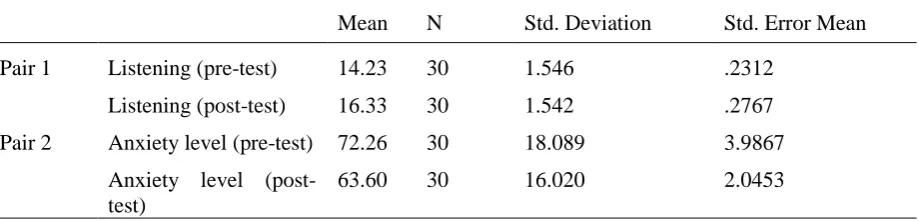
Mean N Std. Deviation Std. Error Mean
Pair 1 Listening (pre-test) 14.23 30 1.546 .2312
Listening (post-test) 16.33 30 1.542 .2767
Pair 2 Anxiety level (pre-test) 72.26 30 18.089 3.9867
Anxiety level (post-test)
63.60 30 16.020 2.0453
Table 2. Descriptive statistics (Experimental group)
Table 2 shows descriptive statistics of the pre and post-tests of the listening comprehension and the anxiety level of the learners during the test administration among the experimental group. Since the descriptive statistics could not determine the significant effect of the anxiety awareness on listening comprehension, a paired samples t-test was run on the scores of the anxiety level and the listening comprehension in the control and experimental groups to see whether the observed difference between the tests was significant or not.
t df Sig. (2-il d)
Pair 1 Listening (pre-test) vs. .194 29 .848
Listening (post-test)
Pair 2 Anxiety level (pre-test) vs. 1.159 29 .256
Anxiety level (post-test)
Table 3. Paired Samples t-test (Control group)
Table 3 shows that there are not significant differences between the pre and post-test taken by the participants who were given a foreign language listening anxiety questionnaire and also the pre-test performed. The experimental groups’ scores are also calculated through Paired Samples t-test to find any significant difference between the pre and post-test of the anxiety level and the listening comprehension. The results are presented in Table 4.
t df Sig. (2-il d)
Pair 1 Listening (pre-test) vs. 3.823 29 .001
Listening (post-test)
Pair 2 Anxiety level (pre-test) vs. 4.924 29 .000
Anxiety level (post-test)
Table 4. Paired Samples t-test (Experimental group)
Table 4 shows that both the anxiety level in the experimental group was decreased while listening comprehension improved significantly. In other words, the participants in the experimental group outperformed in the listening comprehension test and showed a reduction in their anxiety level in the post-test questionnaire. Results also showed that the experimental group returned a large mean on the listening comprehension test than the control group. The result of the independent t- test shows that the difference between the mean scores of the groups on the listening test is significant. This implies that providing students with the meaning of the lexical items and teaching grammatical rules help students have a better performance on the tests.
4. DISCUSSION
Actually, the finding of the negative role of listening anxiety suggests that students at low level of proficiency may have less confidence and self-esteem to perform well on listening comprehension. Most of them feel embarrassed and tense when they face a listening comprehension text and as a result, their level of proficiency decreases. In addition, EFL learners exhibit anxiety when doing listening comprehension tests. Usually high anxiety can make learners get discouraged, lose faith on their abilities and even give up the effort to listen a text completely. Therefore, learners with high anxiety often get low proficiency. Consequently, relaxed learners will be able to score higher on listening comprehension tests. Certain studies in the past have shown a negative relationship between foreign language anxiety and general language proficiency (e.g. Elkhafaifi, 2005). If we consider how the language comprehension system works, it is obvious that a number of different types of knowledge are involved: both linguistic knowledge and non-linguistic knowledge.
Although anxiety influences learners’ abilities, there are other factors that contribute to second or foreign language listening comprehension, among them lexical and grammatical knowledge plays an important role (Hasan, 2000). This is also emphasized by Wipf (1984) who recognized that to be a good listeners, the capability to discriminate between sounds, understand vocabulary and grammatical structures, interpret stress and intonation, understand intention and retain and interpret this within the immediate as well as the larger socio-cultural context of the utterance is a necessity.
Based on the results of the study it can be inferred that the higher the learners’ awareness of the text features, and the higher their second language proficiency, the better performance on L2 listening comprehension task will be and vice versa. Put another way, learners who have knowledge about vocabulary and grammatical structures demonstrate better comprehension of the listening text. There are few studies conducted on the relationship between listening proficiency and lexical and grammatical awareness (Mecartty, 2000). The study reveals that there was a positive correlation between grammar and writing as well as reading, but the correlation was negative for speaking and listening. To test the second research question, an Independent t-test was calculated. The mean score of anxiety of the control group was higher than the experimental group, implying that there is a significant difference in the degree of anxiety between them because of the effect that lexical and grammatical awareness have on the listening comprehension proficiency. The results of the present study are in conformity with the study conducted by Mecartty (2000) regarding the enhancement of aural proficiency through lexical and grammatical awareness. As mentioned earlier, listening comprehension is the result of interaction between two types of processes; top-down or higher level process and bottom-up or lower level processes. These terms refer to the order in which the different types of knowledge are applied during comprehension.
It can be said that less skilled listeners tend to use the bottom-up model. The Bottom-up model is text based; the listener relies on the language in the message, that is, the combination of sounds, words, and grammar that create meaning. Among of the education practitioners, the role of the bottom-up model in enhancing communicative competence is still in controversy. Some state the bottom-up is an ineffective model for language comprehension. Others believe the bottom-up model still needed for language comprehension. Bottom-up processing has two important roles. First, it is the initial stage in listening comprehension where listeners concentrate on identifying the many elements in the aural input to extract meaning. Second, it can be supporting model for top-down model. Top-down model in certain situation sometime needs to back to bottom-up model to get more information of the text to achieve comprehension. Listening comprehension depends upon lexical knowledge (vocabulary). The meanings of words contribute to the meanings of sentences, which make up much of oral communication. The same skills are used during reading individual words as a foundation for text comprehension. When students hear a familiar word, they automatically decode its meaning in what is known as a semantic representation. If a student has good vocabulary, he or she will also be able to work out the meanings of related words in a surrounding network. Therefore, students with good vocabulary will be at an advantage during listening for two reasons: first, they know the meanings of the individual words they decode. Second, these words aid in explaining contexts for them, and these in turn help them to develop coherent representations of the text. Since listeners can develop richer representations of texts containing familiar words, it follows that direct instruction in vocabulary will enhance listening comprehension. Moreover, teaching the meaning of a single word can further clarify the meaning of related words and therefore bring about additional benefits.
In the case of grammatical knowledge, it can be said that comprehension at the sentence level (and beyond) depends upon having good grammatical skills. Grammar is a system of rules that specifies the order in which words can be used in sentences (syntax), and how word order is used to convey meaning. Formally, grammar is made up of morphology as well as syntax. Successful comprehension depends upon being able to break the sentence down into verb, noun, and adjective and so on. Complex constructions can therefore pose an obstacle to comprehension. In the case of grammatical knowledge we can say that grammatical competence has significant correlation to both reading and listening skills Mecartty (2000, p. 337).
In order to see whether the variable lexical and grammatical awareness had any impact on the performance of the learners on the anxiety reduction and listening comprehension proficiency an independent samples t-test was computed between pre-tests and post-tests of both the control and experimental groups. The results indicated that participants in the experimental group performed significantly better on test questions that had lexical and grammatical knowledge of it. Although both groups showed some level of anxiety, they indicated significant difference on listening proficiency post-tests. It can be said that if the teacher can improve the learners’ lexical and grammatical knowledge of English, then their listening performance will be improved. In sum, the results of the study investigated the relationship between anxiety and listening comprehension indicating that anxious students had difficulty grasping the content of the target language message. In sum, this study has illustrated that lexical and grammatical knowledge are two essential factors that may exert considerable influence on listening comprehension.
5. CONCLUSION
This study presents recommendations for further research, which were not focused here since the departure point of this study was fixed on specific learners, but they may be taken up as the starting point for further studies. The results of this study clearly indicate the existence of high levels of language anxiety in most of the learners who are learning English. Although this study has addressed some issues regarding the role of anxiety in foreign language listening, some other questions deserve further consideration in more detail regarding its nature, causes, impact and treatment. In addition, the following issues emerged which require due attention of the future researchers (Oxford, 1999). It suggests that there may be some cultural reasons behind the anxiety reactions of some learners. All the participants in this study came from the same university, this research can be done in other universities
by using different curriculums and different text books in different proficiency levels to see if the same findings hold true given new samples of people for study (Buck, 2001). All of these above mentioned differences might have an influence on the level of students’ foreign language listening anxiety. The multiple-choice format of listening comprehension was used in the study to evaluate students’ listening comprehension performance. All the possible responses were provided for the students to choose from after listening to a particular question (Vandergrift, 1999). An open-ended test format, however, often requires in-depth answers, and this format might increase students’ level of anxiety. Future research could explore the relationship between an open-ended listening test format and the listening anxiety level.
The study has demonstrated that knowledge of vocabulary and grammar is significantly associated with Iranian university EFL learners’ listening comprehension. Several studies have investigated the relation between foreign language anxiety and language course grades. For example, Young (1999), Aida (1994); and MacIntyre and Gardner (1994), have all shown a negative correlation between language anxiety and grades in a variety of foreign language courses. Anxiety reduction alone might make a student feel better and improve the chances of future success, but it would not guarantee the recovery of material not previously learned. For this reason, attempts to reduce language anxiety must be based on the assumption that anxious students will possess a relatively smaller knowledge base than relaxed students because of the cognitive effects of anxiety arousal at all three stages of language learning. Therefore, anxiety reduction should be accompanied by efforts to re-input information that may be missing or improperly processed.
5.1. Limitations of the Study
Several limitations to this study must be noted. First, the number of the subjects who participated in the study was small for justifying a generalization about all Iranian students learning English in Iran. Second, the allocated time for the researcher at the university was limited; therefore, she had to perform her study in certain few days. In addition, since a self-reported measure instrument was used in this study (FLLAS), the results depended on the participants’ abilities and willingness to respond accurately to items.
5.2. Potential Questions for Further Research
This study presents recommendations for further research which were not focused here since the departure point of this study was fixed on specific learners, but they may be taken up as the starting point for further studies. The results of this study clearly indicate the existence of high levels of language anxiety in most of the learners who are learning English. Although this study has addressed some issues regarding the role of anxiety in foreign language listening, some other questions deserve further consideration in more detail regarding its nature, causes, impact and treatment. In addition, the following issues emerged which require due attention of the future researchers. Though the study did not aim to compare the participants’ responses on language anxiety on the basis of their cultures. It suggests that there may be some cultural reasons behind the anxiety reactions of some learners.
All the participants in this study came from the same university, this research can be done in other universities by using different curriculums and different textbooks in different proficiency levels to see if the same findings hold true given new samples of people for study. All of these above-mentioned differences might have an influence on the level of students’ foreign language listening anxiety. The multiple-choice format of listening comprehension was used in the study to evaluate students’ listening comprehension performance. All the possible responses were provided for the students to choose from after listening to a particular question. An open-ended test format, however, often requires in-depth answers, and this format might increase students’ level of anxiety. Future research could explore the relationship between an open-ended listening test format and the listening anxiety level.
REFERENCES
Aida, Y. (1994). Examination of Horwitz, Horwitz, and Cope’s Construct of Foreign Language Anxiety: The Case of Students of Japanese. The Modern Language Journal. 78. p. 155- 168.
Buck, G. (2001). Assessing Listening. Cambridge, UK: Cambridge University Press.
Chen, T-Y. & Chang, B. Y. (2004). The relationship between foreign language anxiety and learning difficulty. Foreign Language Annals. 37. p. 279-289.
Christine, J., & Christa, H. (1995). The Effect of Prior Knowledge on EAP Listening Test Performance. Language Testing. 12(1). p. 99–119.
Elkhafaifi, H. (2005). Listening Comprehension and Anxiety in the Arabic Language Classroom. The Modern Language Journal. 89. p. 206-220.
Gardner, R. C., & MacIntyre, P. D. (1993). A Student’s Contributions to Second Language Learning. Part II: Affective Variables. Language Teaching. 26. p. 1-11.
Hasan, A. S. (2000). Learners’ Perception of Listening Comprehension Problems. Language,Culture, and Curriculum. 13(2), 137–153.
Horwitz, E.K. (2001). Language Anxiety and Achievement. Annual Review of Applied Linguistics. 21. p. 112– 126.
Horwitz, E. K., Horwitz M., & Cope. J. (1986). Foreign language classroom anxiety. The Modern Language Journal. 70. p. 125-132.
MacIntyre, P. D., & Gardner, R. C. (1994). The Subtle Effects of Language Anxiety on Cognitive Processing in the Second Language. Language Learning. 44. p. 283-305
Mecartty, F. H. (2000). Lexical and Grammatical Knowledge in Reading and Listening Comprehension by Foreign Language Learners of Spanish. Applied Language Learning. 11(2). p. 323–348.
Krashen, S. D. (1985). The Input Hypothesis: Issues and Implications. New York: Longman.
Oxford, R.L. (1999). Anxiety and the Language Learner: New Insights. In J. Arnold (Ed.), Affect in Language Learning. Cambridge: Cambridge University Press.
Palacios, L. M. (1998). Foreign Language Anxiety and Classroom Environment: A Study of Spanish University Students. Unpublished doctoral dissertation, The University of Texas, Austin.
Pappamihiel, N.E. (2002). English as a Second Language Students and English Language Anxiety. Issues in The Mainstream Classroom. Proquest Education Journal. 36(3). p. 327-355.
Richards, J. C. (1983). Listening comprehension: Approach, design, procedure. TESOL Quarterly. 17(2). p. 219–240.
Vandergrift, L. (1999). Facilitating Second Language Listening Comprehension: Acquiring Successful Strategies. ELT Journal. 53(3). p. 168–176.
Wipf, J. (1984). Strategies for Teaching Second Language Listening Comprehension. Foreign Language Annals, 17. p. 345-348.
Young, D.J. (Ed.). (1999). Affect in Foreign Language and Second Language Learning: A practical guide to creating a low-anxiety classroom atmosphere. Boston: McGraw Hill.