Page 228
DETERMINING THE VIEWS OF HIGH SCHOOL STUDENTS ABOUT NATURAL DISASTERS
Caner Aladağ1, Baştürk Kaya2
1Department of Geography Teaching, Ahmet Keleşoğlu Faculty of Education,
Necmettin Erbakan University, Turkey
2Department of Biology Teaching, Ahmet Keleşoğlu Faculty of Education,
Necmettin Erbakan University, Turkey
Abstract
In this study, the answers given for the key concept of "natural disaster” by the 9th grade high school students were evaluated and their opinions were tried to be revealed. Qualitative research method and case study pattern from qualitative research approaches were used in this study. The data were obtained with the participation of a total of 35 9th-grade high school students. Free word association test was used to collect the data. The obtained data were subjected to content analysis; similar answer words were brought together and categories were created. Repeated words are given in the text under the relevant category.
After the obtained data about the key concept was examined, 5 categories were formed by using the answer words. These categories are named as "disaster types", "institutions and organizations working during a disaster",” the relationship between disaster and human ", " the definition of the disaster" and "other concepts". According to the results of the study, it was observed that the students had a certain level of information about natural disasters, but there were some lack of information on some issues. Most of the sentences they wrote about natural disasters contain scientific and academic information, but there are also some sentences containing superficial information and misconceptions.
Key words: high school students, natural disasters, word association test, students’ views
1. INTRODUCTION
Page 229
(WAT) is one of the oldest and most common techniques used to determine the cognitive structure of learners and the connections between concepts in this structure, to analyze the knowledge network and to determine whether the relationships between the concepts in the long-term memory are sufficient (Özatlı & Bahar, 2010). The great advantage of using the word association test as both a measurement assessment tool and a diagnostic tool is that it is easy to prepare and can be applied within 5 minutes (Bahar et al. 2010).
2. OBJECTIVE
The aim of this study is to determine the perceptions that high school students have about the concept of "natural disaster" and to reveal the conceptual framework related to the definition of "natural disasters" in their minds. Revealing the misconceptions that students already have about the concept of "natural disasters" is another aspect of the study.
3. MATERIALS AND METHOD 3.1 Research Model
Qualitative research method and case study pattern from qualitative research approaches were used in this study. Qualitative research can be defined as a method in which qualitative data collection methods such as observation, interviews and document analyzes are used and a qualitative process in which the perceptions and events are presented in a natural environment realistically and holistically. In other words, qualitative research is an approach that investigates social phenomena in the environment to which they belong with an understanding to create a theory (Yıldırım & Şimşek, 2011).
3.2 Working group
The working group consists of 35 9th grade students studying in Akören Ali Aşık Multi-Program High School. The common feature of students participating in the research is that they have learned the subjects about natural disasters in the lessons they have taken.
3.3 Data Collection and Data Analysis
Word association test (WAT) was used as a data collection instrument in this research. Word association test (WAT) is one of the oldest techniques used to determine the cognitive structure of learners, the connections between concepts in this structure and to analyze the knowledge network. In this technique student writes what key concept -given for any subjects- brings to his mind as an answer at a certain period of time (Bahar & Özatlı, 2003).
The data of the research consist of the answer words of 35 (22 girls, 13 boys) high school students given for the key-concept of “natural disaster”. The concept of “natural disaster” was written ten times on a page and they were all under the other. A sample page layout about “natural disaster” is given below.
Natural disaster ---
Natural disaster ---
Natural disaster ---
-
-
-
Page 230
The aim in writing a key word under the other 10 times is to provide students’ returning to key concept again after they write each word.
Bahar & Özatlı (2003)reveal the reason of writing a key concept under the other ten times is to prevent the risk of chain-responses. Because, student will write the words that brought to his mind by a concept which he wrote as a response instead of concept unless he/she returns to the key-concept while writing the key-concept every time. And this will give harm to the objective of the test.
Word association test consists of two stages. These stages were explained below. First, students were informed about WAT and 30 seconds were given for the concept of “natural disasters”. While applying the word association test related to the key-concept of natural disaster, thirty seconds were used as a duration, which adopted by Bahar & Özatlı (2003: 77).
After the answer words were written by students, they were asked to write meaningful sentences between the key-concept and answer words evoked by the key concept and the sentences written for each word in the analysis phase of the data are examined one by one. According to Bahar et al. (2006), the answer word that was associated with the key concept may be in just a recalling level and may be an associated product which does not have a meaningful relationship with key concept.
While evaluating the data collected by free word association test, content analysis from qualitative research methods was used.
Content analysis is to interpret similar data by integrating it within the framework of certain concepts and themes so as to make the readers understand (Yıldırım & Şimşek, 2006). The first stage of the content analysis is called as "categorical analysis". This analysis provides the classification of the “meaning substances” (items) and the determination of their frequencies. Due to the use of certain metrics, numbers and categories, it is a "taxonomic" method (Bilgin, 2006).
For the analysis of the data, students' answer sheets of the word-association test were numbered from 1 to 35. Then, in order to evaluate the results of the WAT, the answer words given to the concept of natural disaster were grouped by referring to an expert opinion according to the alphabetical order and it was determined how many times the words were repeated. The most frequently repeated answer words were analyzed according to semantic relation technique. All the answers given for the key concept were examined one by one and frequency tables were formed to indicate how many times the concepts or answer words were repeated for the key concept of "natural disaster". Categories were formed by coding the data obtained. While these categories were being constructed, the answer words were grouped according to semantic relations and each category was associated with an appropriate title.
4. FINDINGS
A total of 5 categories have been created from the answer words obtained by applying the free word association test for the key word of natural disaster. The answer words in each category are tabulated under the relevant title and the frequencies of the answer words were calculated one by one and totally. If these words have been repeated once, they are not written in the table but written in text in the related category. If the words are not relevant and meaningful, they are not included in the categories but are also mentioned in the text. A total of 77 answer words were produced by the students for the key concept of natural disaster. The frequency of these words is 301. The number of answer words in 5 categories is 36 and repeated 260 times. Of these 5 categories 41 answer words were repeated once and their frequency is 41.
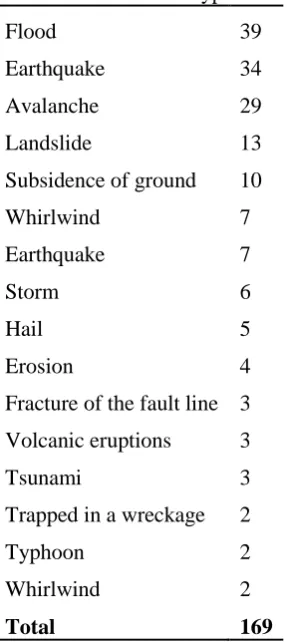
The first category is named as disaster types (Table 1). The total frequency of this category is 169. Students produced 17 answer words for this category. Of these answer words, the ones which have the highest frequencies are; “flood” (39), “earthquake” (34) and “avalanche” (29). The region students are
Page 231
expressed. But the frequency of many of them is quite low. It means just a few students could remember some kinds of natural disasters. This reveals that students have lack of information about natural disasters. In this category some answer words were repeated just once. These are: typhoon, drought, lava, quake, collapse, strong wind, heavy rainfall and lightning.
Table 1. Disaster types
Flood 39
Earthquake 34
Avalanche 29
Landslide 13
Subsidence of ground 10
Whirlwind 7
Earthquake 7
Storm 6
Hail 5
Erosion 4
Fracture of the fault line 3
Volcanic eruptions 3
Tsunami 3
Trapped in a wreckage 2
Typhoon 2
Whirlwind 2
Total 169
The second category is named as institutions and organizations working during the disaster (Table 2). There are 7 answer words in this category. The frequency of this table is 37 and mostly repeated word is; rescue team. Then fire department (6), ambulance (6) follows. In these kind of situations some words must come first but their frequencies are quite low such as; RedCrescent (3), AFAD (Disaster and Emergency Management Authority) (4), AKUT (Search and Rescue Association) (4) and students couldn’t remember these words much. This result shows that students couldn’t learn the meaning of natural disasters thoroughly and they cannot associate the disaster with institutions and organizations working during the disaster. In addition, words such as "112, health team, to be rescued, help!, siren voice" are repeated once in this category.
Table 2. Institutions and organizations working during the disaster
Rescue Team 9
Fire Department 6
Ambulance 6
AFAT 5
Page 232
Hospital 4
Red Crescent 3
Total 37
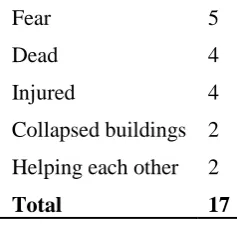
The third category is named as the relationship between disaster and human. There are 5 answer words in this category and their frequency is 17 (Table 3). Fear was repeated for (5) times in this category. The words such as dead (4) and injured (4) are the results of natural disasters which effect people negatively and these words are the second so this shows that natural disasters leave negative traces to people. These low frequency words are followed by collapsed buildings (2), and helping each other (2). 14 answer words were repeated for once in this category. These words are; help, loss of life, people’s being damaged, ruined, people in difficulties, concrete jungle, unawareness, living things, migration, chaos, tear, human, hysterics and hue and cry.
Table 3. The relationship between disaster and human
Fear 5
Dead 4
Injured 4
Collapsed buildings 2
Helping each other 2
Total 17
The fourth category is determined as the category of defining natural disaster identification (Table 4). There are two answer words in this category and the frequency of these words is 4. Two students in this category expressed natural disaster as catastrophe and two students likened natural disasters to doomsday. Both words are important in that they show destructive and frightening dimensions of natural disasters.
Table 4. The definition of disaster Catastrophe 2
Doomsday 2
Total 4
Because the fifth category is composed of different answer words which are not included in the categories above, and are not about disaster but may turn into disasters, it has been combined under the heading of other concepts (Table 5). There are five words in this category and their frequency is 33. The word fire has been repeated for 22 times. The fire can occur naturally or with human factors. It can be expressed as a human disaster because it causes loss of property and life. It seems that there are some contradictions in the minds of students about this subject. The other concept is forest fire, and this concept has been repeated 3 times. This concept takes place naturally or with human factors. The tree cut has been repeated 3 times. This word is not a natural disaster, but its effects can cause short and long-term natural disasters such as flooding, erosion. Two students have associated the
Page 233
ozone layer, accident, accident victim, Hiroshima, scene, south wind. Words such as gendarme, snow, fire can be associated with different dimensions of natural disasters.
Table 5. Other concepts
Fire 22
Forest Fire 3
Tree cut 3
Police 3
Match 2
Total 33
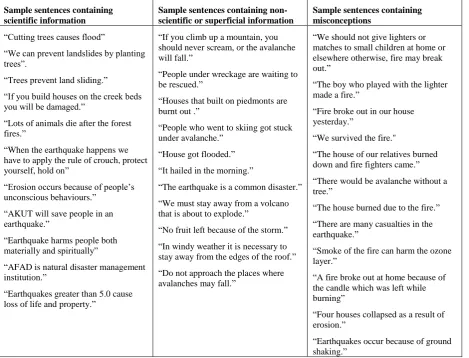
Some sample sentences written by ninth grade high school students in relation to the concept of "natural disasters" are given in Table 6. It is seen that the students have written sentences related to all categories. And also it is seen that some of these sentences are containing scientific information. But there are also sentences containing non-scientific or superficial information related to key concept of natural disaster. It is also seen that some of the sentences contain misconceptions.
Table 6. Sample sentences that written by students related to the concept of "natural disaster"
Sample sentences containing scientific information
Sample sentences containing non-scientific or superficial information
Sample sentences containing misconceptions
“Cutting trees causes flood”
“We can prevent landslides by planting trees”.
“Trees prevent land sliding.”
“If you build houses on the creek beds you will be damaged.”
“Lots of animals die after the forest fires.”
“When the earthquake happens we have to apply the rule of crouch, protect yourself, hold on”
“Erosion occurs because of people’s unconscious behaviours.”
“AKUT will save people in an earthquake.”
“Earthquake harms people both materially and spiritually”
“AFAD is natural disaster management institution.”
“Earthquakes greater than 5.0 cause loss of life and property.”
“If you climb up a mountain, you should never scream, or the avalanche will fall.”
“People under wreckage are waiting to be rescued.”
“Houses that built on piedmonts are burnt out .”
“People who went to skiing got stuck under avalanche.”
“House got flooded.” “It hailed in the morning.”
“The earthquake is a common disaster.” “We must stay away from a volcano that is about to explode.”
“No fruit left because of the storm.”
“In windy weather it is necessary to stay away from the edges of the roof.”
“Do not approach the places where avalanches may fall.”
“We should not give lighters or matches to small children at home or elsewhere otherwise, fire may break out.”
“The boy who played with the lighter made a fire.”
“Fire broke out in our house yesterday.”
“We survived the fire."
“The house of our relatives burned down and fire fighters came.”
“There would be avalanche without a tree.”
“The house burned due to the fire.” “There are many casualties in the earthquake.”
“Smoke of the fire can harm the ozone layer.”
“A fire broke out at home because of the candle which was left while burning”
“Four houses collapsed as a result of erosion.”
Page 234
5. RESULT AND DISCUSSION
This study aimed to reveal the conceptual structures of the 9th grade high school students about "natural disaster". The concept of "natural disaster" was given to the 9th grade high school students as a keyword and the students' cognitive structures about this subject, their opinions about this concept and misconceptions were tried to be determined by word association test. 5 categories were created as a result of the evaluation of the answer words given for the concept of "natural disaster". Four of these categories are related to natural disasters from different perspectives. The last one contains words that weren’t categorized even if they are related to natural disaster because they were used just once or they are unrelated and having misconceptions and this category named as other concepts. The category of “disaster types” is the dominant category and it has the highest number of words and its total
frequency is also high. The number of words in this category is 17 and the total frequency is 169. Then the category of “institutions and organizations working during a disaster” comes with 7 words and 37
frequency. Another category is named as “the relationship between disaster and human”. There are 5 answer words in this category and its frequency is 17. Other category is “the definition of the disaster”. It has just 2 words and its frequency is very low; 4. The last category was created with the
name of “other concepts”. The words in the last category contain words that are unrelated to natural disasters and having misconceptions. The first category has the maximum number of answer words, but the number of answer words produced for the last three categories is not sufficient. It is seen that while the students have included important concepts about natural disasters in these categories, there is a significant amount of words that they cannot remember and cannot relate to natural disasters.
It seems that it is difficult to structure the words in all the categories and the words that are difficult to remember in their minds. Because, even if the answer words are correct, their frequencies are still very low. Some words have never been mentioned by students. Especially the words such as; fire, forest fire, tree cutting, scene, police, match, etc., show that there are contradictions in the minds of students.
When the sample sentences related to the key concept of "natural disaster" are examined, it is seen that the sample sentences containing scientific information are adequately expressed. This result indicates that students have knowledge about natural disasters at a certain level. This shows that students can learn some concepts related to the concept of natural disasters at academic level. Some sample sentences containing scientific information are; Cutting trees causes flood,Trees prevent land sliding, When the earthquake happens we have to apply the rule of crouch, protect yourself, hold on, Erosion occurs because of people’s unconscious behaviours, AKUT will save people in an earthquake, AFAD is natural disaster management institution.
It is also seen that students have created sentences containing non-scientific or superficial information. Under this category, students tried to explain natural disasters using simple and non-scientific expressions. Some sentences are simple and have non-scientific information even if they are correct such as; If you climb up a mountain, you should never scream, or the avalanche will fall,People under wreckage are waiting to be rescued, Houses that built on piedmonts are burnt out, It hailed in the morning, No fruit left because of the storm.
It is also understood from students’ sentences that they have misconceptions at a significant level. Some sentences are far from scientific knowledge and contain misconceptions such as; We should not give lighters or matches to small children at home or elsewhere otherwise fire may break out, The boy who played with the lighter made a fire, The house of our relatives burned down and fire fighters came, There are many casualties in the earthquake, Smoke of the fire can harm the ozone layer, Four houses collapsed as a result of erosion.
Page 235
future surveys (Turan & Kartal, 2012). In addition, it will be beneficial to review the secondary education geography curriculum to increase the gains and activities on the issue of natural disasters.
It is clear that in learning about of natural disasters, teacher candidates often prefer visual learning. This situation shows that demonstrations, field studies, applied geography courses will be more productive in terms of students (Özgen et al. 2011).
REFERENCES
Bahar, M. & Özatlı, S. (2003). Investigation of cognitive structures of first grade high school students for the basic components of livestock with word communication test method, Balıkesir University, Journal of Science Institute, 5 (1), 75- 85.
Bahar, M.,Nartgün, Z., Durmuş, S. & Bıçak, B. (2006). Traditional and Alternative Assessment Teacher Handbook, Pegem Publishing. Ankara.
Bilgin, N. (2006). Content Analysis in Social Sciences, Siyasal Publishing, Ankara.
Güneş, H.& Gözüm, İ. C. (2013). Using the word association method or detection of the effect of ecology knowledge learned in primary education on readiness of 10th grade students Journal of
Research in Education and Teaching, 2 (3), 252-264.
Işıklı, M.,Taşdere, A. & Göz, N. L. (2011). Investigation Teacher Candidates’ Cognitive Structure About Principles of Ataturk Through Word Association Test, Uşak University Journal of Social Sciences, 4 (1), 50–72.
Özgen, N.,Ünaldı, Ü. E. &Bindak, R. (2011). Determining the Teacher Candidates’ “Effective Learning Styles” on Natural Disasters, Ahi Evran University, Journal of Kırşehir Faculty of Education (KEFAD), 12(4), 303-323.
Polat, G. (2013). Identification of the 9th grade students' cognitive structures about environment by the technique of word association, Necatibey Faculty of Education, Journal of Electronic Science and Mathematics Education (EFMED), 7(1) 97-120.
Şahin, C. (2010). Geography in General, Gündüz Education and Publishing, Ankara.
Şahin, C.& Doğanay, H. (2010). Geography of Turkey, Gündüz Education and Publishing, Ankara. Turan, İ. & Kartal, A. (2012). Misconceptions of 5th grade primary school Students about the concept of natural disasters, Ahi Evran University, Journal of Kırşehir Faculty of Education (KEFAD), 13 (3), 67-81.
Yıldırım, A.& Şimşek H. (2011). Qualitative Research Methods In Social Sciences, Seçkin Publishing, Ankara.
Özatlı, N.S. & Bahar, M. (2010) Revealing students’ cognitive structures regarding excretory system by new techniques, Journal of Abant İzzet Baysal University, 10(2), 9-26.