www.ocean-sci.net/6/263/2010/
© Author(s) 2010. This work is distributed under the Creative Commons Attribution 3.0 License.
Ocean Science
Preface
Operational oceanography in the Mediterranean Sea:
the second stage of development
N. Pinardi1and G. Coppini2
1Corso di Scienze Ambientali, University of Bologna, Ravenna, Italy
2Gruppo Nazionale di Oceanografia Operativa, Istituto Nazionale di Geofisica e Vulcanologia, Bologna, Italy
1 Introduction
The papers of this special issue overview some of the sci-entific results of the second phase of development of the Mediterranean Forecasting System (MFS) realised during the EU project “Mediterranean ocean Forecasting System: Toward Environmental Predictions-MFSTEP” that started 1 March 2003 and ended in June 2006. The MFS oceano-graphic service that is now operational in the Mediterranean Sea was developed, implemented and quality assessed during MFSTEP. MFS is composed of: a) a near real time observ-ing system with satellite and in situ elements; b) a numeri-cal ocean forecasting system at basin snumeri-cale, assimilating all data available in real time, and a set of limited area forecast-ing models in different sub-regional and shelf areas; c) bio-chemical models for algal biomass forecasting; d) a product dissemination system. Moreover, the products of MFS are used to develop downstream services, such as oil spill drift and dispersion, sediment transport in the coastal areas and fish stock assessment that demonstrate the value of the oper-ational service for end-users.
MFSTEP contained several phases of development and re-alised a demonstration exercise, the so-called Targeted Op-erational Period-TOP that started in September 2004 and ended in March 2005. During TOP all possible observing platforms were active, the numerical models were capable to assimilate the observations and the all models were run-ning in forecast mode, from the basin scale to the shelf ar-eas. The deployed observing and modelling components of MFS are now part of a sustained operational oceano-graphic service for the Mediterranean Sea, so-called Mediter-ranean Operational Oceanography Network (MOON, http: //www.moon-oceanforecasting.eu).
Correspondence to: N. Pinardi ([email protected])
2 The challenge of operational oceanography
Operational oceanography is nowadays the branch of ocean science that routinely makes available high quality observa-tional and model data for both fundamental studies and prac-tical applications. The high variability of ocean currents and the need for the assessment of the state of the marine envi-ronment require a continuous monitoring of the ocean en-vironment at unprecedented resolution and quality. On the other hand, scientific discoveries require continuous obser-vations of the essential state variables of the system in order to detect new basic mechanisms and processes. Operational oceanography will produce such basic flow of information worldwide, from the collection of ocean observations follow-ing international standards to their mappfollow-ing and forecastfollow-ing for all users.
wherever they are needed and where there is competence to use them and control them. This approach requires a com-prehensive information system based on a network of centres delivering selected information needed for the value adding chain. Such network was consolidated during MFSTEP and it has never stopped since then, making this volume a very valuable source of information about the system components, their scientific validation and their usage in applications.
3 MFSTEP results in synthesis
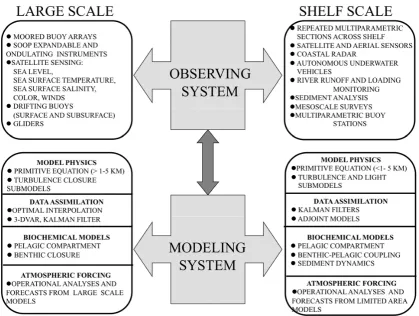
The methodology for implementation of operational oceanography in the Mediterranean Sea, developed and demonstrated by MFSTEP, follows a multi-scale, multiplat-form observing and modelling system approach schematised in Fig. 1. The project had the goal of developing, implement-ing and demonstratimplement-ing some of the components presented in Fig. 1 and the activities can be synthesized in 5 working areas:
1. the real time observing system upgrade and deployment;
2. the numerical ocean forecasting system and its atmo-spheric forcing development and demonstration; 3. the biochemical numerical modelling development
and scientific validation;
4. the data dissemination and information system set up; 5. the end-user applications and services demonstration. In the following we will overview each working areas results.
4 The real time observing system
The MFSTEP observing system is composed of in situ and satellite elements only at the basin scale (see Fig. 1). For the in situ observing system element the sub-components are:
1. a Ship Of Opportunity Program (SOOP), composed of 9 tracks with 12 nautical miles resolution and full pro-file transmission (Manzella et al., 2007). The prob-lems connected to the XBT temperature recording sys-tem were critically assessed (Reseghetti et al., 2007) and new technology was developed, a multiple launcher for XBT (Zappal`a et al., 2007) and a new expandable probe that can collect temperature and fluorescence data (Mar-celli et al., 2007).
2. a network of Mediterranean Multidisciplinary Moored Array (M3A) stations with Real Time collection and dissemination of data (Nittis et al., 2007 and Petihakis et al., 2007).
ture of the basin (Emelianov et al., 2006). The float sampling scheme and the impact of temperature and salinity assimilation on the quality of the model anal-yses have been analysed with Observing System Sim-ulation Experiments (Raicich et al., 2006 and Griffa et al., 2006);
4. a Fishery Observing System-FOS that allowed the col-lection of combined fish stock and temperature data (Falco et al., 2007);
5. a glider repetitive track monitoring in the Ionian Sea, collecting for several months temperature and salinity profiles down to 200 m and profiles down to 1000 m for few weeks (P. Testor and U. Send, personal communi-cation).
For the satellite observing element the sub-components are: 1. altimeter near real time products from Topex/Poseidon
and Jason-1 missions together with re-processed ERS-1 and ERS-2 altimeter signals;
2. real time daily Sea Surface Temperature (SST) products and re-analyses (Marullo et al., 2007);
3. near real time analysis of scatterometer winds produc-ing daily optimal estimates of surface winds (Bentamy et al., 2007);
5 The numerical ocean forecasting system and its atmospheric forcing
The numerical ocean forecasting system developed by MF-STEP is composed of:
1. a basin scale forecasting model (Tonani et al., 2008) at 6.5 km resolution. The model was set in operational mode during TOP and never stop since then, producing daily ten days forecasts;
2. a daily data assimilation system for the basin scale (Do-bricic et al., 2007). In addition, ARGO float position as-similation was developed for the first time (Taillandier and Griffa, 2006) as well as assimilation of local data in nested models (Vandenbulcke et al., 2006);
Figure 1. The operational oceanographic system elements for the observational and modelling
components of the Mediterranean Forecasting System
Fig. 1. The operational oceanographic system elements for the observational and modelling components of the
Mediterranean Forecasting System.
Two of the shelf scale models are described in this issue: the northern Aegean Sea (Kourafalou et al., 2007) and the South-eastern Levantine Sea (Zodiatis et al., 2008). The ocean forecasting activities were partially supported by a dedicated limited area atmospheric model run in operational mode (Broˇzkov´a et al., 2006). This issue contains also some novel scientific interpretations of model results (Jordi et al., 2006; Ahumada and Cruzado, 2007; Olita et al., 2007) and a quantitative assessment of the operational forecast quality during TOP (Tonani et al., 2009).
6 The ecosystem numerical modelling
In MFSTEP a numerical model for the marine food web has been developed (Vichi et al., 2007) to be coupled with the oceanographic forecasting models and one example of such model is reported (Petihakis et al., 2009). Moreover data as-similation of chlorophyll data has been studied (Crispi et al., 2006) and proven to be effective in a large scale biochemi-cal model implementation in the Eastern Mediterranean Sea (Triantafyllou et al., 2007). MFSTEP has put the scientific
basis for the future forecasting models of marine biochem-istry that are now working in real time.
7 The data dissemination and information system
The observed and model collected data have been organ-ised in a network of Thematic Expert Data Centres (TEDC) mainly composed of Web Portals for the discovery and view-ing of the MFS products and activities. The data formats and system architecture was done to be convenient for real time data downloading via ftp protocols both for the system ex-pert teams and the end-users. The basic portal network is still working now and it forms the basis of the MOON Web Portal encompassing the most recent developments in the ob-serving and modelling system after MFSTEP.
8 The end-user applications and services
tion to fish stocks and integrated coastal zone management. In this issue we report of operational modelling of sediment transport in a northern Aegean Gulf (Krestenitis et al., 2007) and the hazard mapping for oil spill pollution (Pizzigalli and Rupolo, 2007). New modelling requirements for applications such as wave-current coupling in coastal areas are also ex-plored (Jord`a et al., 2007).
9 Conclusions
A short term forecasting system for the Mediterranean basin scale and its coastal areas has been developed that provides continuous monitoring of the flow field evolution in the re-cent past and daily 10 days forecasts. Generic, all-purpose, high quality oceanographic information is nowadays deliv-ered by the operational integrated system developed during MFSTEP.
The MFSTEP project is a general example of how to deploy an operational oceanographic system in a relatively large area of the world ocean. The Mediterranean Sea is a semi-enclosed concentration basin that is forced by intense air-sea fluxes of momentum, heat and water typical of the open ocean. The shelf area of the basin are complex, a mix-ture of narrow and extended shelves, both Regions Of Fresh water Influence (ROFI) and areas affected by open ocean transports. Examples of such diverse shelf/coastal condi-tions are given in details in Pinardi et al. (2006) together with ecosystem and sedimentary differentiations. This diversity is not unique to the Mediterranean but rather common to many ocean basins. An operational oceanographic system that will be of high quality will have to consider different processes, monitor at different space and time scales for each different shelf area. Thus a fast communicating network of monitor-ing and modellmonitor-ing centres, downscalmonitor-ing from the basin to the shelf areas of interest, is required. The key issue is to be able to use the information from a given spatial and tempo-ral scale to help build the successive scale and processes in a chain that preserves correctly the information and helps the higher resolution, multi-process nesting.
This special issue overviews some of the crucial under-standings and technical tools required to demonstrate that forecasting from the basin scales to the shelf areas is prac-tical with present day technology. It is believed that the free, unrestricted access to these products will allow in the near future to improve our basic scientific understanding of the ocean system.
Contract no. EVK3-CT-2002-00075. A particular thank is given to the program officers, Alan Edwards and Gilles Ollier, for their support to the project and technical guidance.
References
Ahumada, M. A. and Cruzado, A.: Modeling of the circulation in the Northwestern Mediterranean Sea with the Princeton Ocean Model, Ocean Sci., 3, 77–89, 2007,
http://www.ocean-sci.net/3/77/2007/.
Bentamy, A., Ayina, H.-L., Queffeulou, P., Croize-Fillon, D., and Kerbaol, V.: Improved near real time surface wind resolution over the Mediterranean Sea, Ocean Sci., 3, 259–271, 2007, http://www.ocean-sci.net/3/259/2007/.
Broˇzkov´a, R., Derkov´a, M., Belluˇs, M., and Farda, A.: Atmospheric forcing by ALADIN/MFSTEP and MFSTEP oriented tunings, Ocean Sci., 2, 113–121, 2006,
http://www.ocean-sci.net/2/113/2006/.
Chassignet, E. P. and Verron, J.: Ocean Weather Forecasting. An in-tegrated view of Oceanography, Springer-Verlag, 557 pp., 2006. Chiggiato, J. and Oddo, P.: Operational ocean models in the
Adri-atic Sea: a skill assessment, Ocean Sci., 4, 61–71, 2008, http://www.ocean-sci.net/4/61/2008/.
Crispi, G., Pacciaroni, M., and Viezzoli, D.: Simulating biomass assimilation in a Mediterranean ecosystem model using SOFA: setup and identical twin experiments, Ocean Sci., 2, 123–136, 2006,
http://www.ocean-sci.net/2/123/2006/.
Dobricic, S., Pinardi, N., Adani, M., Tonani, M., Fratianni, C., Bonazzi, A., and Fernandez, V.: Daily oceanographic analyses by Mediterranean Forecasting System at the basin scale, Ocean Sci., 3, 149–157, 2007,
http://www.ocean-sci.net/3/149/2007/.
Emelianov, M., Font, J., Turiel, A., Millot, C., Sol´e, J., Poulain, P.-M., Juli`a, A., and Vitri`a, M.-R.: Transformation of Levantine Intermediate Water tracked by MEDARGO floats in the Western Mediterranean, Ocean Sci., 2, 281–290, 2006,
http://www.ocean-sci.net/2/281/2006/.
Estournel, C., Auclair, F., Lux, M., Nguyen, C., and Marsaleix, P.: “Scale oriented” embedded modeling of the North-Western Mediterranean in the frame of MFSTEP, Ocean Sci., 5, 73–90, 2009,
http://www.ocean-sci.net/5/73/2009/.
Falco, P., Belardinelli, A., Santojanni, A., Cingolani, N., Russo, A., and Arneri, E.: An observing system for the collection of fishery and oceanographic data, Ocean Sci., 3, 189–203, 2007, http://www.ocean-sci.net/3/189/2007/.
Gaberˇsek, S., Sorgente, R., Natale, S., Ribotti, A., Olita, A., As-traldi, M., and Borghini, M.: The Sicily Channel Regional Model forecasting system: initial boundary conditions sensitivity and case study evaluation, Ocean Sci., 3, 31–41, 2007,
http://www.ocean-sci.net/3/31/2007/.
Griffa, A., Molcard, A., Raicich, F., and Rupolo, V.: Assessment of the impact of TS assimilation from ARGO floats in the Mediter-ranean Sea, Ocean Sci., 2, 237–248, 2006,
Jordi, A., Basterretxea, G., Orfila, A., and Tintor´e, J.: Analysis of the circulation and shelf-slope exchanges in the continental mar-gin of the northwestern Mediterranean, Ocean Sci., 2, 173–181, 2006, http://www.ocean-sci.net/2/173/2006/.
Jord`a, G., Bola˜nos, R., Espino, M., and S´anchez-Arcilla, A.: As-sessment of the importance of the current-wave coupling in the shelf ocean forecasts, Ocean Sci., 3, 345–362, 2007,
http://www.ocean-sci.net/3/345/2007/.
Kourafalou, V. and Tsiaras, K.: A nested circulation model for the North Aegean Sea, Ocean Sci., 3, 1–16, 2007,
http://www.ocean-sci.net/3/1/2007/.
Krestenitis, Y. N., Kombiadou, K. D., and Savvidis, Y. G.: Mod-elling the cohesive sediment transport in the marine environment: the case of Thermaikos Gulf, Ocean Sci., 3, 91–104, 2007, http://www.ocean-sci.net/3/91/2007/.
Manzella, G. M. R., Reseghetti, F., Coppini, G., Borghini, M., Cruzado, A., Galli, C., Gertman, I., Gervais, T., Hayes, D., Mil-lot, C., Murashkovsky, A., ¨Ozsoy, E., Tziavos, C., Velasquez, Z., and Zodiatis, G.: The improvements of the ships of opportunity program in MFS-TEP, Ocean Sci., 3, 245–258, 2007,
http://www.ocean-sci.net/3/245/2007/.
Marcelli, M., Di Maio, A., Donis, D., Mainardi, U., and Manzella, G. M. R.: Development of a new expendable probe for the study of pelagic ecosystems from voluntary observing ships, Ocean Sci., 3, 311–320, 2007,
http://www.ocean-sci.net/3/311/2007/.
Marullo, S., Buongiorno Nardelli, B., Guarracino, M., and Santo-leri, R.: Observing the Mediterranean Sea from space: 21 years of Pathfinder-AVHRR sea surface temperatures (1985 to 2005): re-analysis and validation, Ocean Sci., 3, 299–310, 2007, http://www.ocean-sci.net/3/299/2007/.
Nittis, K., Tziavos, C., Bozzano, R., Cardin, V., Thanos, Y., Peti-hakis, G., Schiano, M. E., and Zanon, F.: The M3A multi-sensor buoy network of the Mediterranean Sea, Ocean Sci., 3, 229–243, 2007,
http://www.ocean-sci.net/3/229/2007/.
Olita, A., Sorgente, R., Natale, S., Gaberek, S., Ribotti, A., Bo-nanno, A., and Patti, B.: Effects of the 2003 European heatwave on the Central Mediterranean Sea: surface fluxes and the dynam-ical response, Ocean Sci., 3, 273–289, 2007,
http://www.ocean-sci.net/3/273/2007/.
Petihakis, G., Drakopoulos, P., Nittis, C., Zervakis, V., Christodoulou, C., and Tziavos, C.: M3A system (2000–2005) – operation and maintenance, Ocean Sci., 3, 117–128, 2007, http://www.ocean-sci.net/3/117/2007/.
Petihakis, G., Triantafyllou, G., Tsiaras, K., Korres, G., Pollani, A., and Hoteit, I.: Eastern Mediterranean biogeochemical flux model – Simulations of the pelagic ecosystem, Ocean Sci., 5, 29–46, 2009, http://www.ocean-sci.net/5/29/2009/.
Pinardi, N. and Woods, J. D.: Ocean Forecasting: conceptual basis and applications, Springer-Verlag, 472 pp., 2002.
Pinardi, N., Allen, I., Demirov, E., De Mey, P., Korres, G., Las-caratos, A., Le Traon, P.-Y., Maillard, C., Manzella, G., and Tziavos, C.: The Mediterranean ocean forecasting system: first phase of implementation (1998–2001), Ann. Geophys., 21, 3–20, 2003, http://www.ann-geophys.net/21/3/2003/.
Pinardi, N., Arneri, E., Crise, A., Ravaioli, M., and Zavatarelli, M.: The physical, sedimentary and ecological structure and variabil-ity of shelf areas in the Mediterranean Sea, The Sea Vol. 14,
edited by: Robinson, A. R. and Brink, K., Harvard University Press, Cambridge, USA, 1243–1330, 2006.
Pizzigalli, C. and Rupolo, V.: Simulations of ARGO profilers and of surface floating objects: applications in MFSTEP, Ocean Sci., 3, 205–222, 2007, http://www.ocean-sci.net/3/205/2007/. Poulain, P.-M., Barbanti, R., Font, J., Cruzado, A., Millot, C.,
Gert-man, I., Griffa, A., Molcard, A., Rupolo, V., Le Bras, S., and Petit de la Villeon, L.: MedArgo: a drifting profiler program in the Mediterranean Sea, Ocean Sci., 3, 379–395, 2007,
http://www.ocean-sci.net/3/379/2007/.
Raicich, F.: The assessment of temperature and salinity sampling strategies in the Mediterranean Sea: idealized and real cases, Ocean Sci., 2, 97–112, 2006,
http://www.ocean-sci.net/2/97/2006/.
Reseghetti, F., Borghini, M., and Manzella, G. M. R.: Factors affecting the quality of XBT data results of analyses on pro-files from the Western Mediterranean Sea, Ocean Sci., 3, 59–75, 2007,
http://www.ocean-sci.net/3/59/2007/.
Sofianos, S. S., Skliris, N., Mantziafou, A., Lascaratos, A., Zodi-atis, G., Lardner, R., Hayes, D., and Georgiou, G.: Nesting oper-ational forecasting models in the Eastern Mediterranean: active and slave mode, Ocean Sci. Discuss., 3, 1225–1254, 2006, http://www.ocean-sci-discuss.net/3/1225/2006/.
Taillandier, V. and Griffa, A.: Implementation of position assimila-tion for ARGO floats in a realistic Mediterranean Sea OPA model and twin experiment testing, Ocean Sci., 2, 223–236, 2006, http://www.ocean-sci.net/2/223/2006/.
Tonani, M., Pinardi, N., Dobricic, S., Pujol, I., and Fratianni, C.: A high-resolution free-surface model of the Mediterranean Sea, Ocean Sci., 4, 1–14, 2008,
http://www.ocean-sci.net/4/1/2008/.
Tonani, M., Pinardi, N., Fratianni, C., Pistoia, J., Dobricic, S., Pen-sieri, S., de Alfonso, M., and Nittis, K.: Mediterranean Fore-casting System: forecast and analysis assessment through skill scores, Ocean Sci., 5, 649–660, 2009,
http://www.ocean-sci.net/5/649/2009/.
Triantafyllou, G., Korres, G., Hoteit, I., Petihakis, G., and Banks, A. C.: Assimilation of ocean colour data into a Biogeochemical Flux Model of the Eastern Mediterranean Sea, Ocean Sci., 3, 397–410, 2007,
http://www.ocean-sci.net/3/397/2007/.
Vandenbulcke, L., Barth, A., Rixen, M., Alvera-Azcarate, A., Ben Bouallegue, Z., and Beckers, J. M.: Study of the combined ef-fects of data assimilation and grid nesting in ocean models – application to the Gulf of Lions, Ocean Sci., 2, 213–222, 2006, http://www.ocean-sci.net/2/213/2006/.
Vichi, M., Pinardi, N., and Masina, S.: An advanced model of pelagic biogeochemistry for the global ocean ecosystem. Part I: theory, J. Mar. Syst., 64, 89–109, 2007.
Zappal`a, G., Reseghetti, F., and Manzella, G. M. R.: Development of an automatic multiple launcher for expendable probes, Ocean Sci., 3, 173–178, 2007,
http://www.ocean-sci.net/3/173/2007/.
Zodiatis, G., Lardner, R., Hayes, D. R., Georgiou, G., Sofianos, S., Skliris, N., and Lascaratos, A.: Operational ocean forecasting in the Eastern Mediterranean: implementation and evaluation, Ocean Sci., 4, 31–47, 2008,