Solid Earth, 10, 1355–1383, 2019 https://doi.org/10.5194/se-10-1355-2019
© Author(s) 2019. This work is distributed under the Creative Commons Attribution 4.0 License.
Fault-controlled dolomitization in the Montagna dei Fiori Anticline
(Central Apennines, Italy): record of a dominantly
pre-orogenic fluid migration
Mahtab Mozafari1, Rudy Swennen2, Fabrizio Balsamo1, Hamdy El Desouky2,3, Fabrizio Storti1, and Conxita Taberner4
1NEXT – Natural and Experimental Tectonics Research Group – Department of Chemistry, Life Sciences and Environmental Sustainability, University of Parma, Italy
2Department of Earth and Environmental Sciences, KU Leuven, Leuven, Belgium 3Geology Department, Faculty of Science, Menoufia University, Menoufia, Egypt 4Shell Global Solutions International B.V., Amsterdam, the Netherlands
Correspondence:Mahtab Mozafari ([email protected]) Received: 15 December 2018 – Discussion started: 3 January 2019
Revised: 26 May 2019 – Accepted: 17 July 2019 – Published: 20 August 2019
Abstract. The Lower Jurassic platform and basinal de-posits exposed in the Montagna dei Fiori Anticline (Central Apennines, Italy) are pervasively affected by dolomitization. Based on the integration of field work, petrography, and geo-chemistry, two fault-related dolomitization events were rec-ognized and interpreted as having occurred before and dur-ing the Apenninic orogeny. Fluid inclusion analysis indicates moderate to elevated salinity values of 3.5 to 20.5 and 12.8 to 18.6 eq. wt % NaCl in the first and the second event, respec-tively. The estimated salinities, in combination with δ18O values and87Sr/86Sr ratios, suggest significant involvement of evaporitic fluids in both events, most likely derived from the underlying Upper Triassic Burano Formation. In addi-tion, the87Sr/86Sr ratios up to 0.70963 suggest the circula-tion of deep-sourced fluids that interacted with siliciclastic rocks and/or the crystalline basement during the dolomitiza-tion events.
Two major dolomite types (D1 and D2) were recognized as pertaining to the first event, both postdated by high-amplitude bed-parallel stylolites, supporting a syn-burial pre-layer-parallel shortening dolomitization. A possible geody-namic framework for this dolomitization event is Early Juras-sic to Late JurasJuras-sic rift-related extensional tectonism. The second dolomitization event (D3, D4, and D5) is charac-terized by a temperature upturn (up to 105◦C) and inter-preted as associated with the inflow of hydrothermal fluids, possibly related to major changes in the permeability
archi-tecture of faults during early- to syn-thrusting and folding activity. Based on the timing of deformation in the Mon-tagna dei Fiori Anticline, the second dolomitization event likely occurred in Late Miocene to Pliocene times. The find-ings regarding characteristics and timing of dolomitization here illustrates the long-term controlling role of the evap-oritic detachments in the dolomitization process. This study shows that the Mg-rich fluids that were most likely derived from evaporites may prime the tectonically involved succes-sions for repeated dolomitization, and hence the formation of potential reservoirs during sequential tectonic modifications (extensional vs. compressional).
1 Introduction
1356 M. Mozafari et al.: Fault-controlled dolomitization in the Montagna dei Fiori Anticline
Clemenzi et al., 2015; Ferraro et al., 2019). It follows that the mutual interplay between fault activity and fluid–rock in-teraction can trigger dolomitization of carbonates when ex-posing to Mg-saturated or oversaturated fluids and, conse-quently, variations in physicochemical properties of fluids through time and space.
Leaking or sealing behaviors of fault zones during defor-mation are key controls for fault-related fluid circulation. A detailed understanding of such an interplay is thus necessary to improve our capability of making reliable predictions of fault-related dolomitization in carbonate reservoirs. Studying outcrop analogs provides fundamental support to meet this requirement and the opportunity to assess the spatial distribu-tion of dolomitized zones, and individual diagenetic events, in 3-D (e.g., Swennen et al., 2012; Dewit et al., 2014; Bistac-chi et al., 2015).
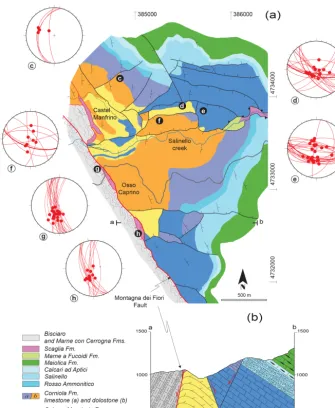
The Lower Jurassic to Lower Cretaceous Umbria-Marche passive margin carbonate succession, in the Central Apen-nines (Italy), is intensely affected by localized dolomitization both in the onshore fold-and-thrust belt and in the offshore foredeep and foreland areas (e.g., Murgia et al., 2004; Pieran-toni et al., 2013). The dolomitized intervals which are the fo-cus of this study are well exposed in the core of the Montagna dei Fiori Anticline, where the dolomitized Lower Jurassic in-tervals (Calcare Massiccio, Bugarone, and Corniola forma-tions) and their relationships with fault zones allow us to study the mutual influence between deformation structures and dolomitized intervals (Fig. 1). These intervals, known as the Castel Manfrino dolostones (Crescenti, 1969; Mat-tei, 1987; Koopman, 1983), have been previously studied by Ronchi et al. (2003) only at its reference section, exposed at the Castel Manfrino location (Fig. 1b) in the central sector of the Montagna dei Fiori Anticline (Fig. 2). A fault-controlled dolomitization model and the relative timing of dolomitiza-tion were proposed by the latter authors based on the ho-mogenization temperatures obtained from microthermome-try of the fluid inclusions, and their relation with the ther-mal history of the area studied. However, no clear relation between dolomitization and structural evolution of the Mon-tagna dei Fiori Anticline on a local scale was provided to confidently link the occurrence of dolomitization to a par-ticular tectonic event. Moreover, the nature and origin of the dolomitizing fluids were not well constrained. Recent re-evaluation of dolostone distribution in the Montagna dei Fiori Anticline (Storti et al., 2017a) showed that the dimension of the dolomitized geobodies (Fig. 2) is much more significant than what was previously mapped by Mattei (1987). Dolo-stones are distributed within fault damage zones and in the laterally adjacent carbonate rocks, and in intersection areas between fault sets, for a total area in map view of more than 1.5 km2(Storti et al., 2017a).
The structural pattern of the Montagna dei Fiori Anticline documents the overprinting of extensional and contractional deformation along major fault zones. The preserved struc-tural framework in this anticline provides an opportunity to
study the direct but complex regional tectonic controls on dolomitization in carbonate successions undergoing multi-ple deformation events, from rifting to folding and thrust-ing. This contribution integrates new petrographic, geochem-ical, and microthermometric analyses with structural stud-ies (Storti et al., 2018) to characterize the temporal record of fault-controlled diagenetic phases and, more specifically, dolomitization in the carbonatic succession outcropping in the Montagna dei Fiori Anticline. These findings might be of relevance for exploration and reservoir quality prediction in the region of the Apennines and the Southern Alps, both onshore and offshore. Moreover, this work provides addi-tional evidence of the potential influence of fluids derived from evaporitic detachment levels in modifications of geo-chemical trends and petrophysical properties of the overlying carbonate rocks.
2 Geological setting
The Montagna dei Fiori Anticline is a NNW–SSE-striking thrust-related fold located at the mountain front of the Cen-tral Apennines (Fig. 1). The geodynamic evolution of the Apennines has been proposed to be the result of the super-position of NE–SW compression (in present-day geographic coordinates), related to the convergence of the Eurasian and African plates since Late Cretaceous times (Elter et al., 1975; Dewey et al., 1989; Patacca et al., 1992), on a rifting-related tectonosedimentary architecture produced by Early Jurassic extension (e.g., Centamore et al., 1971). In such a framework, the Central Apennines developed during Miocene to “Plio-Pleistocene” times (e.g., Parotto and Praturlon, 1975; Barchi et al., 1998; Mazzoli et al., 2002; Bollati et al., 2012).
M. Mozafari et al.: Fault-controlled dolomitization in the Montagna dei Fiori Anticline 1357
1358 M. Mozafari et al.: Fault-controlled dolomitization in the Montagna dei Fiori Anticline
Figure 2. (a, b)Geological map of the central sector of the Montagna dei Fiori Anticline and cross section oriented parallel (a–b) to the hinge line representing the tectonostratigraphic architecture of the faulted anticline (modified after Storti et al., 2017a). The stereonets (Schmidt equal area projection lower hemisphere) provide the attitude of the extensional faults. The locations of the corresponding field sites are indicated by letters. (c) At this location, well exposed N–S-striking extensional fault zones offset the dolomitized Corniola Formation. The fault zone is characterized by near-horizontal stylolites localized in the footwall damage zone (4 fault data). (d, e, and f) These locations consist of mostly∼E–W-striking extensional fault zones. Particularly the boundary fault zones delimiting Calcare Massiccio Formation in the main horst block is evident (site d: 20 fault data; site e: 24 fault data; site f: 9 fault data). (g and h) At these locations, dip-slip slickenlines support major extensional movements related to the Montagna dei Fiori Fault. Contractional deformation structures are preserved in the bed-perpendicular stylolites, shear surfaces, and tension gashes arranged as S–C arrays (site g: 21 fault data; site h: 14 fault data). Equal area projection, lower hemisphere.
The deposition of the Calcare Massiccio Formation (Het-tangian to Sinemurian), with a total thickness varying be-tween 300 and 700 m (Pialli, 1971), records an important ex-tension pulse in the evolution of Tethyan rifting. The lower part of this formation, which was interpreted as having been deposited in a peritidal environment, consists of peloidal pack- to grainstones in alternation with peloidal wacke- to packstones including horizons of algal bindstones (Calcare Massiccio A; Brandano et al., 2016). The upper part is made
M. Mozafari et al.: Fault-controlled dolomitization in the Montagna dei Fiori Anticline 1359
sediments include pelagic limestones of the Bugarone and Corniola formations. Condensed pelagic limestones of the Bugarone Formation (Lower Pliensbachian to Lower Titho-nian; “Bugarone Group” in Pierantoni et al., 2013) occur at the top of the Calcare Massiccio Formation where it formed fault-controlled highs marking the regional drown-ing of the carbonate platform (Santantonio and Carminati, 2011). The pelagic limestones of the Corniola Formation (Sinemurian to Toarcian; Colacicchi et al., 1975; Morettini et al., 2002; Bosence et al., 2009; Marino and Santantonio, 2010; Brandano et al., 2016) occur within the fault-controlled (half)grabens in lateral continuation with the Calcare Mass-iccio Formation. The Corniola Formation in the lower part consists of turbiditic lobes which originated from tectonic brecciation of the Calcare Massiccio Formation. The upper part consists of a well-bedded pelagic mudstone with chert nodules (Di Francesco et al., 2010).
Structural framework
The Montagna dei Fiori Anticline is intersected by two ma-jor fault categories (Storti et al., 2018), which based on the chronological order include the following. Firstly, ∼ E–W-and ∼N–S-striking fault zones showing extensional kine-matics bounding the major outcrops of Calcare Massiccio and dominantly affecting the Jurassic rocks older than the Maiolica Formation (Fig. 2a; e.g., sites 1 to 4). Overprint-ing relations indicate that∼E–W deformation structures are systematically younger than the∼N–S ones. Similar trends were observed in syn-rift fault zones in other anticlines of the Central Apennines (e.g., Cooper and Burbi, 1986; Alvarez, 1989; Chilovi et al., 2002). Such a tectonosedimentary inher-itance was involved in the growth of the Montagna dei Fiori Anticline, which initiated during the Late Miocene (Mazzoli et al., 2002; Artoni, 2003) and progressively evolved into the upper thrust sheet of a well-developed antiformal stack until Plio-Pleistocene times (e.g., Mazzoli et al., 2002; Calamita et al., 1994; Artoni, 2013). The second set of faults is a ma-jor structural feature trending parallel to the Montagna dei Fiori Anticline and dissecting it is the Montagna dei Fiori Fault, a NNW–SSE-striking extensional fault system cutting at a high angle through the folded footwall rocks, typically at the forelimb–crest transition (Figs. 1, 2). This fault con-sists of two partially overlapping main fault zones with an ex-tensional stratigraphic separation exceeding 900 m, and jux-taposes intensely deformed Late Miocene sediments in the hanging wall against dolomitized and undolomitized Lower Jurassic and Cretaceous limestones in the footwall (Figs. 1 and 2). The development of the Montagna dei Fiori Fault has been alternatively interpreted as either a pre-folding (e.g., Calamita et al., 1994; Mazzoli et al., 2002; Scisciani et al., 2002) or late-folding (Ghisetti and Vezzani, 2000) feature. More recently, the origin of the Montagna dei Fiori Fault has been ascribed to the mutual interaction between hori-zontal shortening and uplift and episodic gravitational
re-equilibration during antiformal stacking underneath the an-ticline during Plio-Pleistocene times (Storti et al., 2018). The dolomitized intervals are exposed in the damage zones of both aforementioned fault categories.
3 Methodology
The fieldwork covered an area of over 4 km2 to delineate the distribution of dolostones. The stratigraphic and defor-mational features of dolostones were analyzed in more than 60 outcrops. The distribution of dolomitized intervals as well as their cross-cutting relationships with bedding planes, sty-lolites, veins, and faults was documented and sampled. For petrographic analyses, 130 polished thin sections were stud-ied with standard petrographic methods (transmitted and UV-fluorescent light microscopy). Dolomite crystal morphology and texture is based on the classification proposed by Sibley and Gregg (1987).
The rock slabs and thin sections were stained using Alizarine Red S and potassium ferricyanide (Dickson, 1966) to discriminate dolomite from calcite and evaluate their iron content. Cold-cathode cathodoluminescence (CL) mi-croscopy was carried out on representative thin sections (n= 80) at KU Leuven university (Belgium) using a Technosyn cathodoluminescence device (8–15 kV, 200–400 µA gun cur-rent, 0.05 Torr vacuum, and 5 mm beam width).
δ13C andδ18O analysis were carried out on 117 samples. To ensure the sampling quality and avoid physical mixing of different diagenetic phases, the thin section images were mapped and the sampling targets were determined. Neverthe-less, some diagenetic phases could not be isolated due to their sequential overgrowth and small size. Powder samples (150– 200 µg) were obtained by applying a New Wave Research mi-cromilling device and a dental drill at KU Leuven university (Belgium). The analysis was conducted at Parma University (Italy) and the Friedrich-Alexander-Universität (Erlangen-Nürnberg, Germany) laboratories using Finnigan DeltaPlus V and Thermo Finnigan 252 mass spectrometers, respec-tively. The carbonate powders were reacted with 100 % phos-phoric acid at constant temperature of 75◦C. Several addi-tional CO2 reference gases (NBS18, NBS19, MAB99, and a pure Carrara marble) with known isotopic ratios were an-alyzed during the measurements to determine theδ13C and
1360 M. Mozafari et al.: Fault-controlled dolomitization in the Montagna dei Fiori Anticline
A total number of 21 samples were analyzed for their 87Sr/86Sr ratios. The analyses were conducted at the De-partment of Analytical Chemistry, Ghent University (Bel-gium) and at the Vrije Universiteit Amsterdam (the Nether-lands). NIST SRM 987 was used as the international Sr standard in both labs. At Ghent University, 15 sample pow-ders (20 mg) were collected using a dental drill device. The 87Sr/86Sr ratio measurements were performed using a Thermo Scientific Neptune multi-collector inductively cou-pled plasma mass spectrometer (MC-ICP-MS) instrument. Within the external precision, repeated analyses of the in-ternational Sr standard yielded an average87Sr/86Sr ratio of 0.710271±0.000023 (2 SD,n=43), in agreement with the accepted87Sr/86Sr ratio of 0.710248 for this reference sam-ple (Thirlwall, 1991). At Vrije Universiteit Amsterdam, six sample powders (2–3 mg) were collected using a New Wave Research micromilling device. Analyses were performed us-ing a Thermo Electron Triton plus thermal ionization mass spectrometry (TIMS) instrument. In order to monitor and document the system’s performance, repeated analyses of the international Sr standard (n=58) were carried out on load sizes of 10 and 100 ng which yielded average87Sr/86Sr ra-tios of 0.710245±0.000022 (2SD) and 0.710242±0.000008 (2SD), respectively. In both labs mass discrimination cor-rection was performed via internal normalization using Rus-sell’s exponential law and the accepted value (0.1194; Steiger and Jager, 1977) of the invariant86Sr/88Sr ratio.
Fluid inclusion microthermometry analysis was performed on 11 doubly polished wafers (80–130 µm in thickness). Measurements were carried out at Parma University (Italy) using Linkam THMSG-600 and Linkam MDS-600 heating– cooling stages coupled with a Leica DM 2500 microscope. The final melt (Tmice) and homogenization temperatures (Th) were reproducible within 0.5 and 5◦C, respectively. The stages were calibrated by synthetic Syn Flinc™ fluid in-clusion standards. A 100× objective was used during the microthermometry runs of the small inclusions. The mi-crothermometry data were collected following the fluid in-clusion assemblage (FIA) approach described in Goldstein and Reynolds (1994) for carbonate minerals. The inconsis-tent homogenization temperatures and salinities obtained for these fluid inclusions, within the framework of an individ-ual fluid inclusion assemblage (FIA) described by Gold-stein and Reynolds (1994), indicate possible re-equilibration (stretched) of these inclusions and thus are not used in the interpretations. It is common for small inclusions (< 3 µm) to remain in an all-liquid monophase at room temperature due to their metastability (Goldstein and Reynolds, 1994). Thus, to eliminate the possible role of metastability, the samples were placed in a freezer for several days following the proce-dures described in detail by Goldstein and Reynolds (1994). All-liquid inclusions remained unchanged and no vapor bub-ble was developed within them, which discards the metasta-bility effect. In order to properly observe the phase tran-sitions and determine the final melting temperature of ice
in the all-liquid inclusions, they were rapidly heated up to ∼ 200◦C to stretch and nucleate a bubble at room temper-ature (Goldstein, 1990). The salinities are reported in equiv-alent weight percent NaCl (eq. wt % NaCl) and were calcu-lated based on the equation of Bodnar (1993). The homog-enization temperatures obtained in all-fluid inclusion assem-blages indicate the minimum temperatures at which the flu-ids could have been trapped (Goldstein and Reynolds, 1994). No correction was made for pressure effects on entrapment temperatures since no data regarding the exact depth and pressure of entrapment are available. In the absence of inde-pendent thermal indicators such as the Conodont Alteration Index (CIA) and vitrinite reflectance (VR), the accuracy of pressure correction cannot be well constrained (Slobodník et al., 2006), and thus no correction was made for pressure ef-fects on homogenization temperatures.
In order to perform high-resolution petrography, ning electron microscope (SEM) and back-scattered scan-ning electron microscope (BSEM) analyses were conducted using a JEOL 6400 scanning electron microscope (SEM) equipped with an Oxford EDS (energy dispersive system). Operating conditions were 15 kV and 1.2 nA, electron beam about 1 µm in diameter, and 100 s counting time; errors are ±2 %–5 % for major elements and ±5 %–10 % for minor components. The analysis focused mainly on detecting pos-sible dolomite crystals inside the bed-perpendicular stylolites affecting the Cretaceous Scaglia Formation.
4 Results
4.1 Field observation and distribution of the dolomitized bodies
There is no evidence of dolomitization in the overlying and immediate surrounding successions of the Calcare Massic-cio, Bugarone, and Corniola formations (e.g., Maiolica and Scaglia formations), though the base of Maiolica Formation is reported as dolomitized in the Central Apennines onshore (e.g., Pierantoni et al., 2013) and offshore areas (Murgia et al., 2004).
M. Mozafari et al.: Fault-controlled dolomitization in the Montagna dei Fiori Anticline 1361
Figure 3. (a)Field photograph showing the deformed Scaglia Formation in the hanging wall (HW) and brecciated, dolomitized Calcare Massiccio Formation in the footwall (FW) of the Montagna dei Fiori Fault. The red arrow indicates the sense of fault movement.(b)A hand specimen from the deformed Scaglia Formation showing abundant pressure solution seems (TS), indicated by arrows, cross-cutting calcite veins (C2).(c)A transmitted light photomicrograph of the dolomitized, brecciated Calcare Massiccio Formation. Note all the breccia fragments are composed of dolomite (D4 here).
The lateral extent of dolomitization is gradual. In some outcrops, dolomitization fronts show irregular outlines fol-lowing, but also cross-cutting, bedding surfaces (Fig. 5). Dolomitized intervals vary in thickness from a few meters to hundreds of meters affecting the totality of the exposed Calcare Massiccio and the lower part of Corniola Formation, where no clay interlayers are present. In the Calcare Mass-iccio Formation, dolomitization does not follow a systematic pattern. In the northern side of the Osso Caprino hill (Fig. 2), the top of formation is dolomitized but moving toward the Salinello creek and a thick non-dolomitized limestone is ex-posed. The same situation occurs on the opposite side of the creek and to the east of Castel Manfrino.
Dolomitized intervals in the Corniola Formation have a darker color relative to the host rock and are systematically more fractured than the hosting limestone. High-amplitude (> 1 mm) bed-parallel stylolites are clearly visible in both limestones and dolostones (Fig. 5). However, in some dolo-stones only ghosts of stylolite traces can be seen. No ap-parent porosity could be observed in host rock limestones
but the dolostones locally contain porosity, appearing as millimeter- to centimeter-sized pores. Dolostone breccias in fault cores are typically clast supported, with angular and millimeter- to centimeter-sized fragments (Fig. 3c), chang-ing to crackle breccia (Woodcock and Mort, 2008) away from the main slip surface. In the proximity of the main slip surface, dolostone fragments are sporadically cross-cut by millimeter-sized dolomite veins. The breccia fragments, where cemented, are commonly surrounded by calcite ce-ment.
4.2 Petrography
4.2.1 Early calcite cementation
1362 M. Mozafari et al.: Fault-controlled dolomitization in the Montagna dei Fiori Anticline
Figure 4. Field photographs (Corano Quarry) showing the field relations between dolostones (only D3 here), host limestones, and the Montagna dei Fiori Fault.(a)Panoramic view showing the spatial relationship between limestones and dolostones (orange) in the damage zone of the Montagna dei Fiori Fault (F). Note that the limestones and including dolostones of the Calcare Massiccio and Bugarone formations on the footwall (FW) and marly limestones of the Scaglia Formation on the hanging wall (HW) are intensely deformed.(b)Plan view of the dolomitized Calcare Massiccio limestone in the footwall damage zone, intersected by calcite veins (C1) which are partially dolomitized and affected by bed-perpendicular stylolites (arrows).(c)Distinct transition (dashed line) between dolomitized and undolomitized Calcare Massiccio limestone in the footwall damage zone.
cements (FC) riming the bioclasts, mostly in the peloidal facies of the Calcare Massiccio Formation (Fig. 6a). These cements are dark-brown to non-luminescent under cathodo-luminescence; (2) mosaic cements (MC) commonly fill the intergranular pore spaces (Fig. 6b) and also occur as syntax-ial overgrowths on echinoderm fragments. They exhibit de-formation twinning and show a well-developed brown and orange concentrically zoned cathodoluminescence pattern (Fig. 6c and d). They contain only monophase all-liquid in-clusions. All of these cements are postdated by dolomites and high-amplitude bed-parallel stylolites (Fig. 6b).
4.2.2 Dolomitization
All the dolomite types are nonferroan and dominantly fabric destructive. Dolomitization developed in all the facies types of the Calcare Massiccio and the overlaying Bugarone for-mations, but only at the lower part of the Corniola Formation
which consists of resedimented Calcare Massiccio breccias (turbiditic lobes).
The two first dolomite types (D1 and D2) are the domi-nant dolomite types in the studied outcrops. These dolomites are distributed within the damage zones of the∼N–S and E– W Jurassic rift-related extensional faults and, in places, dis-placed by them (Fig. 2a, site 1). The third and fourth dolomite types (D3 and D4) are mainly observed within the damage zone of the Montagna dei Fiori Fault (NNW–SSE) and ap-pear only as dolomitic pockets locally replacing the host rock and overgrowing D1 and D2 at the proximity of the∼N–S and E–W extensional faults. The fifth dolomite type (D5) is found only within the brecciated zones associated with the Montagna dei Fiori Fault damage zone. The distinctive pet-rographic features of the recognized dolomite types are sum-marized below:
M. Mozafari et al.: Fault-controlled dolomitization in the Montagna dei Fiori Anticline 1363
1364 M. Mozafari et al.: Fault-controlled dolomitization in the Montagna dei Fiori Anticline
Figure 6.Undolomitized and dolomitized Calcare Massiccio Formation in field site d.(a)Transmitted light image showing a micritic peloid rimmed by fibrous cements (FC) which are overgrown by mosaic cements (MC).(b)Transmitted light image showing mosaic cements (MC) in a peloidal limestone overprinted by high-amplitude bed-parallel stylolites (dotted white line). Note the core of some of the peloids is partially cemented as well.(c, d)Transmitted light and corresponding cathodoluminescence image, respectively, of FC and MC cements.
(e)Transmitted light photomicrograph showing D1 crystals (arrows) lining a fracture which is cemented by C1. The fracture is in turn affected by a bed-parallel stylolite.(f)Cathodoluminescence image showing D1 scattered in the host rock and riming the fracture.(g, h)
M. Mozafari et al.: Fault-controlled dolomitization in the Montagna dei Fiori Anticline 1365
rims fracture walls cemented by calcite (Fig. 6e and f). D1 postdates the micritic envelopes and early calcite cements, and predates high-amplitude bed-parallel stylolites (Fig. 6g and h). The crystals are fine-to-medium sized (< 350 µm) with planar-e and planar-s textures consisting of relatively turbid (rich in host rock solid inclusions) well-developed crystals. They show red luminescence when viewed under cathodoluminescence.
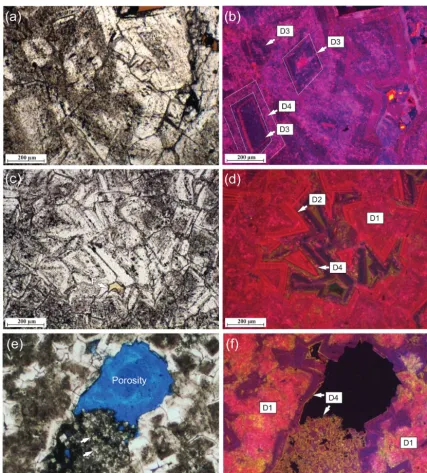
Dolomite 2 (D2) is a replacive dolomite (Fig. 7a and b), infrequently occluding existing pore spaces. Like D1, it also predates high-amplitude bed-parallel stylolites (Fig. 6g and h). D2 generally exhibits a closely packed texture with no or little intercrystalline porosity. The crystals are medium-to-coarse sized (≤500 µm) with planar-s to nonplanar tex-tures. They include a turbid core followed by a transpar-ent rim and trace quantities of saddle dolomite developing sweeping extinction. In some crystals, one additional turbid zone rich in host rock solid inclusions and fluid inclusions of mostly monophase is present. Cathodoluminescence ob-servations enabled us to recognize the presence of D1 in their turbid cores. D2 crystals are characterized by zones of bright red-pink luminescence separated by purple lumines-cence zones (Fig. 7b).
Dolomite 3 (D3) is present as small localized bodies in the Calcare Massiccio (at the Castel Manfrino reference section), in the Corniola Formation (at the Osso Caprino road), and in the Calcare Massiccio and Bugarone formations (at the Corano Quarry) (Figs. 1b and 2a). In the Corano Quarry the dolomitized Bugarone and Calcare Massiccio formations are in the footwall of the Montagna dei Fiori Fault; juxtaposed to the undolomitized, intensely foliated Scaglia Formation in the hanging wall. The SEM and BSEM analyses performed on the samples from the immediate adjacent Scaglia Forma-tion within the aforemenForma-tioned fault damage zone do not in-dicate the presence of any dolomite in this formation. Within the Bugarone Formation in this fault damage zone, D3 lo-cally cements the millimeter-sized angular breccias that are in turn affected by fault-parallel stylolites (Fig. 7c and d). D3 crystals are fine-to-medium sized (< 300 µm) exhibit-ing planar-e to nonplanar textures, with minor development of saddle morphologies of larger crystals (> 500 µm) with planar-c texture (Fig. 7e to h). The replacive crystals display a faint core, which compared to previous dolomite types has fewer solid inclusions. The saddle crystals are occasionally replacive. They display typical curved and slightly serrated crystal terminations with sweeping extinction. These saddle dolomites were only observed in the Castel Manfrino refer-ence section. D3 generally exhibits a dark purple color with bright orange zones and subzones in core and/or rims when viewed under cathodoluminescence (Fig. 7e to h).
Dolomite 4 (D4) appears as a matrix replacive and dolomite cement surrounding porosity, and locally replac-ing D1 and D2 (Fig. 8a to f). D4 also occludes bed-parallel shear fractures and appears along the bed-parallel stylolites (Fig. 9a to d). In the Castel Manfrino reference section, some
intercrystalline vuggy porosity is filled with fine dolomite rhombs including D4 with relics of D2 within their core (Fig. 8e and f). This porosity may be preserved or partially-to-completely filled by calcite (C4). D4 crystals have a tur-bid, solid-inclusion-rich core and transparent rim. They are fine-to-medium sized (< 200–350 µm), presenting planar-s and infrequent nonplanar textures. D4 exhibits a distinct lu-minescence pattern including a purple zone and an irregular green subzone.
Dolomite 5 (D5) occurs as crystals cementing microveins that cross-cut precursor dolomite types including dolomitic breccia fragments. In cemented breccias, D5 is postdated by C3. D5 presents a planar-c texture and is characterized by a bright red luminescence (Fig. 9e and f).
4.2.3 Late calcite cementation
Four generations of calcite postdating dolomitization and distributed only within the fault damage zones have been identified (Figs. 10 and 11):
Calcite 1 (C1) occurs only in Calcare Massicio lime-stones and dololime-stones and is represented as centimeter-sized veins with thicknesses that do not exceed 1.5 cm. It is not clear whether the fracture opening and calcite precipitation was simultaneous (as shown in Ukar and Laubach, 2016). These veins are strata-bound bed-perpendicular with irreg-ular fracture walls, exhibiting white color in the outcrops. They are present within the syn-rift-related extensional fault damage zones, postdating the first dolomite type (D1) and abutted by high-amplitude bed-parallel stylolites. C1 usu-ally shows blocky to elongated crystal morphologies and dis-plays well-developed deformation twinning planes (Type II of Burkhard, 1993). This calcite exhibits concentric zonation and brown zones alternate with orange luminescence zones (Fig. 11a and b).
Calcite 2 (C2) exclusively occurs in the intensely de-formed Scaglia Formation within the fault damage zones (Fig. 11b, c and d) and correspond to tension gashes asso-ciated with stylolites (sensu Nelson, 1981). The thicknesses of these veins do exceed 1 cm. They are usually discontin-uous and branch to several microveins (thickness < 1 mm) when their tips are not intersected by stylolites. C2 veins are mostly recorded in foliated shear deformation zones with well-defined S–C fabrics, exhibiting blocky, elongated to fi-brous shapes with strongly developed tightly spaced defor-mation twinning planes (Type II of Burkhard, 1993). C2 dis-plays brown-to-orange luminescence with locally darker sec-tor zones. The brown-to-orange luminescence characteris-tic of C2 is similar to those of encasing Scaglia host rocks (Fig. 11c and d).
1366 M. Mozafari et al.: Fault-controlled dolomitization in the Montagna dei Fiori Anticline
M. Mozafari et al.: Fault-controlled dolomitization in the Montagna dei Fiori Anticline 1367
1368 M. Mozafari et al.: Fault-controlled dolomitization in the Montagna dei Fiori Anticline
Figure 9.Photomicrographs showing transmitted light and corresponding cathodoluminescence images of D4 and D5 in relation to stylolites and fracturing.(a, b)D4, exploiting a bed-parallel stylolite that cross-cuts D1 and D2 sampled from dolomitized Calcare Massiccio Formation in field site d.(c, d) A subhorizontal fracture cemented by D4 sampled from dolomitized Corniola Formation in field site f.(e, f)D5 microveins (arrows) intersecting all the predating dolomite types in the footwall brecciated zone of the Montagna dei Fiori Fault, sampled from dolomitized Calcare Massiccio Formation in Castel Manfrino site.
angular fragments of host rock limestones, dolostones, and earlier calcites. In the brecciated zones, C3 always passively overgrows D5 in fractures and never cuts it. C3 exhibits a translucent white color in hand specimen. The crystals are blocky with no or weakly developed deformation twinning planes and are characterized by a dark-orange-to-brown lu-minescence with distinct darker sector zones (Fig. 11e and f). Calcite vein 4 (C4) exists as centimeter-sized isolated veins, pore filling, and breccia cements postdating all the pre-ceding dolomites and calcites in the Montagna dei Fiori main
M. Mozafari et al.: Fault-controlled dolomitization in the Montagna dei Fiori Anticline 1369
Figure 10.Field photographs showing the major calcite vein settings observed in Montagna dei Fiori.(a)Cross-sectional view of bed-normal calcite vein 1 (C1) abutting bed-parallel stylolites in folded beds of the Calcare Massiccio Formation.(b)Plan view of the calcite vein 2 (C2) intensely affecting the deformed Scaglia (Rossa) Formation.(c, d)Cross-sectional view of the Scaglia Formation intensely affected by pressure solution seams of tectonic origin crossed over by populations of bed-perpendicular calcite veins (C3) in en echelon extensional arrays.
Table 1.Stable carbon and oxygen isotopes,87Sr/86Sr ratios, and fluid inclusion microthermometry data (not pressure corrected) of host rocks and diagenetic phases in the Montagna dei Fiori Anticline. Stable carbon and oxygen isotopes values are expressed in ‰ V-PDB and salinity values in eq. wt % NaCl.
Stable isotopes Sr isotopes Fluid inclusion microthermometry
δ13C δ18O 87Sr/86Sr Th (◦C) Salinity n
Calcare Massiccio Fm. +2.4 to+3.1 −1.6 to 0.0 0.70766 – – Corniola Fm. +2.0 to+2.5 −3.1 to−1.4 0.70725 – – Scaglia Fm. +1.0 to+3.1 −2.2 to−1.0 0.70784–0.70791 – – D1 +2.5 −1.9 0.70789 ≤40–50 3.5 to 11.3 27 CV1 +1.6 to+2.1 −4.7 to−2.7 0.70773 – – – D2 – – – ≤40–50 to 71 7.9 to 20.5 37 D3 +2.0 to+2.6 −2.8 to−1.9 0.70859–0.70964 70 to 73 9.2 to 16.9 9 D4 +2.4 to+2.5 −3.0 to−2.5 0.70790 79 to 105 12.8 to 18.6 7 CV2 +1.2 to+3.1 −1.7 to−1.6 0.70779–0.70787 – – CV3 +0.5 to+2.4 −2.2 to 0.0 – ≤40–50 4.5 to 9.7 9 CV4 +3.8 to+4.9 −9.4 to−9.1 – ≤40–50 0.17 to 3.0 19
4.3 Geochemistry
4.3.1 Carbon and oxygen stable isotopes
The carbon and oxygen stable isotopic data (δ13C andδ18O) of host rocks, dolomites, and calcites are given in Table 1 and
1370 M. Mozafari et al.: Fault-controlled dolomitization in the Montagna dei Fiori Anticline
M. Mozafari et al.: Fault-controlled dolomitization in the Montagna dei Fiori Anticline 1371
δ18O values of the marine dolomites are known to be 3 ‰– 4 ‰ V-PDB more enriched than those of cogenetic marine limestones (Land, 1980; Major et al., 1992; Horita, 2014). In order to avoid data ambiguity due to physical mixing, this analysis was not separately performed on early calcite cements (FC and MC). The δ13C and δ18O values were measured on bulk samples of host rock limestones. Both
δ13C andδ18O values of the host rocks are within the ex-pected range of the Lower Jurassic marine limestones but the Corniola host rocks show slightly lower values comparing to those of Calcare Massiccio. In the Calcare Massiccio host rocks, theδ13C values plot between+2.4 ‰ and+3.1 ‰ and
δ18O values are within the range of−1.6 ‰ and 0.0 ‰ V-PDB. Theδ13C values in the Corniola host rocks are+2.0 ‰ and+2.5 ‰ while theδ18O values are −3.1 ‰ to−1.4 ‰ V-PDB. Theδ13C andδ18O values of the Scaglia host rocks range between+1.0 ‰ and+3.3 ‰ forδ13C and−2.2 ‰ to −1.0 ‰ V-PDB forδ18O. The values obtained are charac-terized in the mean range of Upper Cretaceous to Paleogene marine limestones (Veizer et al., 1999; +1.0 ‰ to+4.5 ‰ forδ13C and−4.0 ‰ to+2.0 ‰ V-PDB forδ18O).
Theδ13C values of C1 are between+1.6 ‰ and+2.1 ‰, which plot within the range of reference values (Jurassic) but are slightly lower than the surrounding host rock values. The
δ18O values are between−4.7 ‰ and−2.7 ‰ V-PDB, which are lower than those of reference and host rock values.
Theδ13C values of all dolomite types (+0.6 ‰ to+3.4 ‰) fall within the range of host rocks and Jurassic marine lime-stones (Veizer et al., 1999). Theδ18O shows a wider range of values, overlapping but also lower than host rocks (−4.5 ‰ to−0.9 ‰ V-PDB) and those expected for the Lower Juras-sic marine dolomites. The majority of values plot between −3.5 ‰ and−1.5 ‰ V-PDB. The small size and overgrowth nature of certain dolomite types (e.g., D2 and D5) limit their proper isolation for geochemical analyses. Only one sample from D1 dolomite could be measured forδ13C andδ18O val-ues, showing+2.5 ‰ and−1.9 ‰ V-PDB, respectively. The
δ13C andδ18O values of D3 dolomite range from+2.0 ‰ to +2.6 ‰ and−2.8 ‰ to−1.9 ‰ V-PDB, respectively, with values lower than those of the host rock.
D4 dolomite has δ13C values between +2.4 ‰ and +2.5 ‰, and δ18O values of −3.0 ‰ to −2.5 ‰ V-PDB. Theδ13C andδ18O values of C2 are+1.2 ‰ to+3.1 ‰ and −1.7 ‰ to−1.7 ‰ V-PDB, respectively. Theδ13C values of C3 are between +0.5 ‰ and+2.4 ‰, and theδ18O values cover a range of −2.2 ‰ to 0.0 ‰ V-PDB. Theδ13C and
δ18O values of C4 are+3.8 ‰ to +4.9 ‰ and −9.4 ‰ to −9.1 ‰ V-PDB, respectively. Theδ13C values are slightly higher but theδ18O values are considerably lower compared to preceding calcite generations and the measured values from host rocks.
Figure 12.Overview of theδ13C andδ18O values of dolomites
1372 M. Mozafari et al.: Fault-controlled dolomitization in the Montagna dei Fiori Anticline 4.3.2 87Sr/86Sr ratios
Samples from host rocks (i.e., Calcare Massiccio and Corniola formations), dolomites (D1, D3, and D4), and the Scaglia Formation in juxtaposition with the dolostones were analyzed for their87Sr/86Sr isotopic ratios. The obtained ra-tios versusδ18O values of the analyzed samples are shown in Fig. 12c. The87Sr/86Sr ratios obtained from the Calcare Massiccio and Corniola limestones are 0.70766 and 0.70725 (n=2), respectively, which is in agreement with the values of the Lower Jurassic marine carbonates (0.70704–0.70768) reported by McArthur et al. (2012). CV1 shows a value equal to 0.70773.
All the dolomite types display higher 87Sr/86Sr ratios when compared to the host rocks and reference values of the Lower Jurassic marine carbonates. D1 (replacive) and D4 cements show a similar narrow range with values between 0.70784 and 0.70790. The two D3 samples (replacive and ce-ment) display higher87Sr/86Sr ratios (0.70858 and 0.70963, respectively). The87Sr/86Sr ratios obtained for dolomites do not show covariation with correspondingδ18O values. The radiogenic Sr analysis was not performed on D2 and D5 since the physical mixing with other dolomite types could not be avoided.
The 87Sr/86Sr ratios of the three marly limestone sam-ples of Scaglia Formation are 0.70784 to 0.70790. The C2 veins in Scaglia Formation show similar ratios of 0.70779 and 0.70787. These values fit within the limits of values as-signed by McArthur et al. (2012) for the Cenomanian to Bar-tonian (Scaglia age) marine carbonates (0.70730–0.70790).
4.4 Fluid inclusion microthermometry
The overview of microthermometry measurements is given in Table 1 and Fig. 13a to c. All the measured fluid inclusions are primary and occur in growth zones. Based on optical and fluorescence microscopy analysis of wafers, all the in-clusions are aqueous monophase (liquid) or have two phases (liquid and vapor) with relatively consistent L:V ratios of 10 %–15 % within a single FIA (fluid inclusion assemblage). Special care was taken to avoid the samples that occasionally displayed scattered mottled luminescence that may indicate recrystallization.
D1 contains dominantly monophase aqueous inclusions with sizes greater than 5 µm. All the inclusions froze at−65 to−49◦C. The first melting (Te) was detected between−22 and−19.3◦C. The final ice melting (Tm) appeared at tem-peratures between−7.7 and−2◦C. Applying the equation of Bodnar (1993), the obtained final melting temperatures cor-respond to salinity ranges of 3.5 to 11.3 eq. wt % NaCl.
D2 is characterized by the presence of monophase and in-frequent two-phase inclusions generally within their growth zones. The homogenization temperature of two-phase in-clusions varies between 58 and 71◦C. Upon cooling, a complete freezing of the fluid phase is reached at −56 to
−40◦C. The first ice melting temperature was distinguished at −22◦C. The final ice melting temperatures fall within −17.5 and −5◦C, corresponding to salinities between 7.9 and 20.5 eq. wt % NaCl.
D3 is commonly inclusion poor. The measurable inclu-sions were detected and examined only in saddle dolomite crystals. These crystals contain only two-phase aqueous in-clusions. Their homogenization temperatures are within the narrow range of 70 to 73◦C. The complete freezing and first ice melting temperatures could not be distinguished but the final ice melting temperature occurred at temperatures be-tween −13 and −6◦C equal to salinity ranges of 9.2 to 16.9 eq. wt % NaCl. The first melting temperatures of fluid inclusions in D1, D2, and D3 were about−21◦C, suggesting a H2O-NaCl fluid system.
D4 contains only two-phase aqueous inclusions. The ho-mogenization temperatures in D4 vary between 79 and 105◦C. Complete freezing of inclusions occurred at tem-peratures between −86 and −54◦C. The first ice melting was detected from −35 to−40◦C indicating the possible presence of divalent cations such as Ca2+ and/or Mg2+ in the fluids (Shepherd et al., 1985; Goldstein and Reynolds, 1994). The final ice melting temperatures fall within a range of−15 and−9◦C corresponding to salinities of 12.8 to 18.6 eq. wt % NaCl. A couple of inclusions show ho-mogenization temperatures exceeding 120◦C with salinities higher than 20 eq. wt % NaCl.
No measurable fluid inclusion could be identified in C1 and C2 due to intense deformation twinning. C3 and C4 contain only primary monophase aqueous inclusions, indi-cating an entrapment temperature of below about 40–50◦C (Goldstein and Reynolds, 1994). A complete freezing of the inclusions in C3 occurred at temperatures between−40 and−52.5◦C. The first melting temperature was detected at about −21 to −22◦C, suggesting a H2O-NaCl compo-sition. The final melting temperatures range between−6.4 and −2.7◦C, corresponding to salinities between 9.7 and 4.5 eq. wt % NaCl. The majority of the values cluster be-tween 7.8 and 5 eq. wt % NaCl.
The complete freezing temperatures of the inclusions in C4 fall within−46 and−35.5◦C. The first melting temper-ature could not be determined with confidence but the final melting temperatures were reached at about−0.1 to−1.8◦C, corresponding to salinities of 0.17 to 3.0 eq. wt % NaCl.
5 Discussion
5.1 Stable and radiogenic isotopic composition of the parental fluids
M. Mozafari et al.: Fault-controlled dolomitization in the Montagna dei Fiori Anticline 1373
Figure 13.Overview of microthermometry analysis of primary inclusions in Montagna dei Fiori.(a)Frequency distribution of the Tmice (◦C) in dolomite types.(b)Frequency distribution of the Th (◦C) in dolomite types.(c)Salinity (eq. wt % NaCl) versus Th (◦C) of dolomite and calcite phases.(d)Isotopic fractionation diagram from Land (1983) used to determine the isotopic composition (‰ V-SMOW, Vienna Standard Mean Ocean Water) of parental fluids in equilibrium with dolomites in Montagna dei Fiori.
rocks as well as Jurassic marine reference values but more depleted when compared to the presumable Jurassic ma-rine dolomites. The relatively depletedδ18O dolomite values could indicate the contribution of heated fluids in dolomitiza-tion process, although they could also relate to recrystalliza-tion of a precursor dolomite by fluids at higher temperature or 18O-depleted dolomite (Land, 1980, 1985). The absence of distinctive textural evidence in the analyzed samples such as enlarged crystal size and/or systematic mottled cathodolu-minescence pattern, and their covariation withδ18O values, do not confirm recrystallization (Mazzullo, 1992, and refer-ences therein).
The oxygen isotope fractionation relation between wa-ter and dolomite (Land, 1983) was used to dewa-termine the most plausible parental fluids. In order to avoid erroneous results due to rock-bufferedδ18O values, only theδ18O val-ues of dolomite cements, especially from the bed-parallel veins containing D4 were used. These values may provide the closest approximation to theδ18O signature of the parental fluids (Barker and Cox, 2011). Accordingly, a δ18O value of ≈ +2.5 ‰ to +4 ‰ V-SMOW (Vienna Standard Mean
Ocean Water) was calculated for D3, while this values in-crease to≈ +5 ‰ to+7.5 ‰ V-SMOW for D4 (Fig. 13d). The higherδ18O composition of the dolomitizing fluids rela-tive to the Mesozoic seawater, which is estimated at−1.2 ‰ to −1 ‰ V-SMOW (Shackleton and Kennett, 1975; Mar-shall, 1992; Saelen et al., 1996), is compatible with fluids derived from or that had interacted with siliciclastic rocks, crystalline basement (Taylor, 1997) and/or evaporite-derived brines.
stud-1374 M. Mozafari et al.: Fault-controlled dolomitization in the Montagna dei Fiori Anticline
ied intervals as the basal detachment has 87Sr/86Sr ratios between 0.70774 and 0.70794 (Boschetti et al., 2005), the 87Sr/86Sr ratios (D1 and D4) can partially be explained by their contribution. However, this contribution cannot justify much higher87Sr/86Sr ratios recorded in D3, being higher than values reported for Phanerozoic seawater (McArthur et al., 2012), and the values obtained for the adjacent basi-nal deposits (i.e., Corniola and Scaglia formations). There-fore, parental fluids most likely originated from or had in-teracted with the siliciclastic rocks underlying the Burano Formation (Verrucano Formation), if present, and/or with the crystalline basement with common elevated87Sr/86Sr ratios (0.71500–0.72650; Del Moro et al., 1982). The significantly higher87Sr/86Sr ratios in D3 in comparison with other stud-ied dolomites indicates a higher influence of87Sr/86Sr-rich fluids either due to major changes in the permeability archi-tecture of faults or availability of such fluids. The lack of any ferroan diagenetic phase minimizes the interaction of fluids produced by clay transformation or dewatering (i.e., smectite to illite transformation; Boles and Franks, 1979).
C1 is characterized byδ13C andδ18O values lower than the host limestones (i.e., Calcare Massiccio), while its87Sr/86Sr ratio is similar to them. The salinity and composition of the parental fluids cannot be inferred here since no mea-surable fluid inclusions were found within this cement. The 87Sr/86Sr ratio being within the range of the corresponding host rocks and the reference values, points to a rock-buffered system for87Sr/86Sr.
The δ13C and δ18O values obtained for C2, as well as 87Sr/86Sr ratios, fall within the range of the Scaglia host rocks, thus reflecting their rock-buffered nature. This inter-pretation is further supported by the similar luminescence characteristics of C2 with that of encasing Scaglia host rocks. The fluids from which C2 calcite precipitated, as expected for tension gashes, were most likely derived from carbonate dis-solution during pressure dis-solution and stylolitization of host rock, pointing to a closed fluid system in contrast with the subsequent vein generations.
C3 is characterized by δ13C values within the Jurassic marine values but are generally lower than the host rocks, while their δ18O values partially overlap both the hosting limestones and dolostones. Microthermometry of fluid in-clusions revealed only monophase aqueous inin-clusions and thus precipitation at relatively low temperature (≤40–50◦C) with moderate salinity (4.5–9.7 eq. wt % NaCl). Such levels of salinity can be assigned to evaporated seawater, residual brines or fluids derived from evaporite dissolution, and thus makes it difficult here to interpret their exact origin with the available data.
C4 is the latest calcite phase, and records the δ13C and
δ18O values, respectively enriched and significantly depleted when compared to their hosting rocks and preceding diage-netic products. Generally, the enrichment of13C could sug-gest CO2outgassing due to evaporation or pressure changes (Friedman, 1970; Hendry et al., 2015) or bacterial
fermenta-tion (methanogenesis) of organic matter (Hudson, 1977) in low-temperature diagenetic environments. The homogeniza-tion temperature of C4, being below about 40–50◦C, could support any of these processes. Their lowδ18O values and fluid inclusions with salinities similar to, but also signifi-cantly lower than, seawater reflect the contribution of me-teoric fluids during precipitation of this calcite.
5.2 Origin of the dolomitizing fluids
The contribution of brines that derived from highly evap-orated seawater or evaporites is suggested by the elevated salinity values obtained from microthermometry of the fluid inclusions (3.5 to 20.5 eq. wt % NaCl). Accordingly, two sources that could potentially provide such fluids can be pro-posed: (1) fluids related to the Late Messinian evaporites, associated with the overlying Upper Miocene Laga Forma-tion, and their possible downward percolation through fault zones by density driven flow and/or seismic pumping mecha-nisms (Sibson, 1981; McCaig, 1988, 1990); or their tectonic involvement into the Apenninic thrust wedge during its prop-agation (underthrusting; Lobato et al., 1983); and (2) fluids related to the underlying detachment horizon of the Burano evaporites (Upper Triassic) and their upward flow through fault zones during development of the Montagna dei Fiori Anticline. The first scenario is valid if the dolomitization would have occurred only from the Upper Miocene time onwards. Moreover, several researchers (e.g., Vai and Ricci Lucchi, 1977; Bassetti et al., 1998; Roveri et al., 2001) have shown that the occurrence of primary shallow-water evapor-ites, which were dominantly gypsum, was limited only to the western and central parts of the northern Apennines consist-ing of thrust-top marginal basins (Roveri et al., 2001). Hence, the evaporitic horizons existing within the Laga Formation corresponds to resedimentation (gypsum debris) of those pre-viously precipitated in the marginal basins. This interpre-tation makes the Messinian evaporites an unlikely source of Mg-rich brines. Taking into account that the maximum burial-related temperature of the Calcare Massiccio Forma-tion did not exceed 80◦C in the Montagna dei Fiori region (Ronchi et al., 2003), it is unlikely that the downward perco-lation of relatively low-temperature brines derived from the Messinian evaporites, located at higher stratigraphic levels, could reach or exceed the high temperatures recorded in fluid inclusions of the studied dolomites (D4; up to 105◦C), given that the homogenization temperatures reflect the minimum entrapment temperatures (Goldstein and Reynolds, 1994). Deep circulation of these brines, if they existed, can also be excluded by the fact that their limited involvement in the thrust wedge was confined merely to the offshore side of the Montagna dei Fiori region (Artoni, 2013).
postevap-M. Mozafari et al.: Fault-controlled dolomitization in the Montagna dei Fiori Anticline 1375
orite brines associated with them (Carpenter, 1978; McCaf-frey et al., 1987). The fluctuations in salinity may argue for a diverse range of fault connectivity, different degrees of rock– water interaction, and contribution of pore waters of lower salinity (e.g., marine or meteoric).
5.3 Timing and structural controls on the evolution of parental fluids
A generalized paragenesis and the relative chronology of dolomitization in relation to the structural evolution of the Montagna dei Fiori Anticline are illustrated in Figs. 14 and 15. The structural episodes are based on the evolution-ary stages of the Montagna dei Fiori Anticline suggested by Storti et al. (2018). The paragenesis is constructed on the ba-sis of direct evidence recorded during observations at out-crop scale and microscopic observations (e.g., cross-cutting relationships between diagenetic phases, stylolites, fractures, and other structural kinematics), and indirect evidence (e.g., regional geodynamics and burial history).
The occurrence of micritic envelopes and fibrous cal-cite cements (FC), in grain-supported stratigraphic levels of the Calcare Massiccio Formation, is interpreted to be of eogenetic origin (i.e., marine phreatic diagenesis; Moore, 1989), reflecting an early diagenesis shortly after deposition. The well-developed brown-and-orange concentric cathodo-luminescence pattern of the succeeding mosaic calcite ce-ment (MC) suggests a progressive shift to more reducing conditions during precipitation in a phreatic diagenetic en-vironment (as shown in Li et al., 2017). High-amplitude bed-parallel stylolites postdate both cements, which confirm their precipitation before significant burial. The observations made here are in agreement with earlier work by Giacometti and Ronchi (2000), interpreting that the Calcare Massiccio Formation was cemented during the early diagenetic stages.
D1, C1, and D2 are cut by well-developed high-amplitude parallel stylolites. The presence of D1 and C1 in bed-perpendicular veins typically cut by these stylolites (see Fig. 6e to h) support the interpretation that the first dolomiti-zation event (D1 and D2) took place before significant burial and stylolite development. The latter and bed-perpendicular veins are dynamically compatible within the same stress field, which is characterized by a vertical load-related max-imum principal axis of the stress ellipsoid (Fig. 15a). The dominantly monophase fluid inclusions within D1 and D2 are in agreement with precipitation temperatures below about 40–50◦C, suggesting a relatively shallow to intermediate burial environment and hence supporting a pre-Apenninic orogeny age of precipitation from a mix of formational and extra-formational fluids with elevated 87Sr/86Sr ratios. The distribution of D1 and D2 localized near the rifting-related ∼N–S- and E–W-striking extensional faults and even their displacement along them (Fig. 2a; e.g., site 1) point to the possible contribution of these faults in occurrence of D1 and D2. These faults dominantly affect the Jurassic rocks older
than the Maiolica Formation which is attributed to post-rift deposits, therefore suggesting a pre-Maiolica age for these dolomite types. Although an absolute age cannot be pro-vided, based on the evidence discussed above, the circulation of Mg-rich fluids during this dolomitization event was most likely controlled by rifting-related Jurassic extensional fault zones cutting through the crystalline basement. Precipitation of D1 and D2 at the lower part of Corniola Formation, which is known as the syn-rift deposit, discards a pre-rift origin for these dolomites. The displacement of dolomites along the aforementioned faults is possibly related to their prolonged activation during the Early Jurassic to Late Jurassic. In addi-tion to the role of these faults in channelizing the fluids, their mobilization must have been intensified by some deriving mechanisms. A thermal convection system derived from high hit flux during rifting was interpreted by Hollis et al. (2017) to be responsible for circulation of seawater in a syn-rift dolomitization case in the Hammam Faraun fault block (Suez Rift, Egypt). In such a scenario, the salinity of the fluids and their87Sr/86Sr ratios are expected to be more or less within the range of seawater. Furthermore, this scenario seems un-likely in the studied area given the lack of a deep aquifer to accommodate the fault tips and promote the lateral fluid flux from basin to the rift shoulders and vice versa. Taking into account that D1 and D2 are the volumetrically more relevant dolomites within the studied intervals, and assum-ing the likely role of syn-rift extensional faults (Early Juras-sic to Late JurasJuras-sic) in their precipitation, a dominantly syn-rift dolomitization process is proposed for the dolostones in the Montagna dei Fiori Anticline. Although the CL zonation pattern observed in D2 may indicate changes in flow con-dition or fluid composition, the lack of physical disruptions such as multiple fracturing suggests external regional con-trols rather than slip along the same faults (Eichhubl and Boles, 2000). The absence of pervasive syn-dolomitization fracturing and brecciation as well as zebra fabrics in these dolomites perhaps indicate a relatively calm tectonic period during dolomite development (e.g., Hollis et al., 2017).
mi-1376 M. Mozafari et al.: Fault-controlled dolomitization in the Montagna dei Fiori Anticline
Figure 14. Generalized paragenesis of diagenetic phases in relation to deformational stages and burial history of the Calcare Massiccio Formation in the Montagna dei Fiori Anticline. The deformational stages are from Storti et al. (2018) and the burial curve is based on Ronchi et al. (2003). The burial curve was made based on paleodepth, paleotemperatures, sedimentation rate, and paleoheat flow.
nor second stage of dolomite precipitation may possibly be related to the Late Miocene to post-Miocene compressional tectonics recorded in this region (e.g., Mazzoli et al., 2002; Artoni, 2013; Storti et al., 2018).
Dolostones containing D3 and D4 appear commonly as clast-supported breccias along fault zones pertaining to the Montagna dei Fiori Fault, then overprinted by fault-parallel stylolites (Figs. 3 and 7). Accordingly, the occurrence of these dolomites was probably synchronous with the incipi-ent stages of fault developmincipi-ent, predating fault buttressing (Storti et al., 2018). Homogenization temperatures recorded in D4 (up to 105◦C), much higher than the maximum tem-peratures recorded in the host rocks (below about 80◦C;
M. Mozafari et al.: Fault-controlled dolomitization in the Montagna dei Fiori Anticline 1377
1378 M. Mozafari et al.: Fault-controlled dolomitization in the Montagna dei Fiori Anticline
migration, the excess of pore pressure at the base of the thrust ramp in the fold hinge and during fold tightening could promote the localization of the fractures (Smith and Wiltschko, 1996; Ghisetti and Vezzani, 2000), with fluid mi-gration within this zone and eventually dolomitization. These fractures could have been corridors that later on formed the incipient NW–SE Montagna dei Fiori Fault. Their localiza-tion at the back limb, cross-cutting the core, best explains the distribution of D3 and D4 at this locality. The presence of only D5 within the damage zone of the Montagna dei Fiori Fault, postdating dolostone brecciation and, in places, ce-menting breccia fragments, suggests that D5 dolomite pre-cipitation was associated with the late-stage evolution of the Montagna dei Fiori Fault, predating late-stage calcite precip-itation. The shift from dolomite to calcite precipitation can be ascribed to attenuation of Mg-rich fluids and/or calcite satu-ration. This condition was perhaps initiated during the late stages of anticline evolution due to changes in fault conduc-tivity sealing the upward migration of Mg-rich fluids.
The presence of several generations of bed-perpendicular stylolites bounding and intersecting C2 veins (Fig. 10) sup-ports the postulation that late-stage calcite cements precip-itated in close association with the deformation history of the Scaglia Formation in the hanging wall of the Montagna dei Fiori Fault (Fig. 3). This deformation occurred during buttressing against Calcare Massiccio and Corniola forma-tions in the footwall and related to the positive inversion event induced by thrust-sheet stacking at depth (Storti et al., 2018). Precipitation of C3 and C4 is interpreted to have oc-curred during uplift and cooling as revealed by their rel-atively low homogenization temperatures (≤40–50◦C) of fluid inclusions trapped within these cements. Deformation twinning is either absent or weakly developed, reflecting the lack of significant tectonic deformation after calcite precip-itation. These cements postdate the dolomitization events, high-amplitude bed-perpendicular and parallel stylolites, and are precipitated as cements bounding the breccia fragments within the damage zone of the Montagna dei Fiori Fault. Salinities calculated from their fluid inclusions, particularly in C4, suggests precipitation from meteoric waters, which should have been favored during the late evolutionary stages of antiformal stacking beneath the Montagna dei Fiori Anti-cline and eventual late extensional slip along the Montagna dei Fiori Fault (Storti et al., 2018). The results obtained in this study are in relative agreement with the earlier work by Ronchi et al. (2003) and Murgia et al. (2004) in the Central Apennines, assigning dolomitization phases to the pre- and syn-orogenic deformations, although they did not specify the direct relation between the local structures and the different types of dolomite.
The textures of the studied dolomites vary from planar-e to nonplanar; thplanar-e prplanar-epondplanar-erancplanar-e of planar dolomitplanar-e, as in D4, creates a rock with interesting poroperm characteristics (e.g., Woody et al., 1996; Wilson and Ruppel, 2007; Wenzhi et al., 2012). This case-study is certainly relevant for many
potential reservoirs elsewhere in the world. Similar multi-stage burial dolomitization events enhancing the reservoir quality have been reported from the carbonate successions of the Jurassic in the Kopet Dagh Basin, north eastern Iran (Ad-abi, 2009), and Devonian of the Rainbow subbasin, western Canada (Qing and Mountjoy, 1989; Lonnee, 1999).
6 Conclusions
The Lower Jurassic limestones outcropping at the core of the Montagna dei Fiori Anticline (Central Apennines, Italy) are massively affected by dolomitization in damage zones of the pre-orogenic faults inherited from the Tethyan rifting and the ones formed during the Apenninic orogeny. Cross-cutting re-lationships between deformation structures, and results from optical and cold-cathode cathodoluminescence petrography, fluid inclusion microthermometry, and isotope geochemistry, support the occurrence of two major dolomitization events. The first event is interpreted as having developed during the late stages of Tethyan rifting in the Jurassic and resulted in volumetrically significant dolostone geobodies. These dolo-stones are largely matrix replacive and their precipitation ini-tiated prior to the significant burial as reflected in their cross-cutting relationship with bed-parallel stylolites, and by ho-mogenization temperatures in fluid inclusions that are dom-inantly below about 40–50◦C. The second dolomitization event corresponds to volumetrically less relevant replacive dolomite and dolomite cements occluding fractures. These dolomites precipitated during hydrothermal fluid circulation associated with contractional tectonics during the Apenninic orogeny, possibly at the onset of the growth of the Montagna dei Fiori Anticline (Late Miocene).
Dolomitizing fluids in both events were most likely sourced from evaporitic brines associated to the underly-ing Burano evaporites and their interaction with siliciclastic rocks and/or the crystalline basement.
Data availability. The data used in this research are not publicly available. The data were provided based on a collaboration between Parma and KU Leuven universities.
M. Mozafari et al.: Fault-controlled dolomitization in the Montagna dei Fiori Anticline 1379
Competing interests. The authors declare that they have no conflict of interest.
Acknowledgements. This research was performed thanks to a col-laboration between Parma and KU Leuven universities in the frame-work of a research project (PT12432 and GFSTE 1100942) funded by Shell Global Solutions International (Carbonate Research Team, now Geology and New Reservoir Types team). We thank Enri-comaria Selmo (Parma University) and Michael M. Joachimski (University of Erlangen, Germany) for the stable carbon and oxy-gen analysis. Gareth Davis (VU Amsterdam, the Netherlands) is thanked for the strontium isotope analysis. Andrea Comelli and Her-man Nijs are kindly thanked for the careful preparation of the wafers and thin sections. Luca Barchi is gratefully appreciated for his help in SEM analysis. We acknowledge Anton Koopman for the con-structive discussions during field work. We appreciate Daniel Smith (Energie Beheer Nederland, the Netherlands) for the careful review-ing of the article. We are very grateful to reviewers Jim Hendry and Estibalitz Ukar for their suggestions that allowed us to significantly improve the article.
Financial support. This research has been supported by the Shell Global Solutions International (Carbonate Research Team) (grant nos. PT12432 and GFSTE 1100942).
Review statement. This paper was edited by Elias Samankassou and reviewed by Jim Hendry and Estibalitz Ukar.
References
Adabi, M. H.: Multistage dolomitization of upper jurassic mozdu-ran formation, Kopet-Dagh Basin, NE Imozdu-ran, Carbonate. Evapor-ite., 24, 16–32, https://doi.org/10.1007/BF03228054, 2009. Alvarez, W.: Evolution of the Monte Nerone Seamount in the
Umbria-Marches Apennines; I, Jurassic-Tertiary stratigraphy, B. Soc. Geol. Ital., 108, 3–21, 1989.
Amieux, P.: La cathodoluminescence: méthode d’étude sédimen-tologique des carbonates, B. Cent. Rech. Expl., 6, 437–483, 1982.
Artoni, A.: Messinian events within the tectono-stratigraphic evo-lution of the Southern Laga Basin (Central Apennines, Italy), B. Soc. Geol. Ital., 122, 447–466, 2003.
Artoni, A.: The Pliocene-Pleistocene stratigraphic and tec-tonic evolution of the central sector of the Western Pe-riadriatic Basin of Italy, Mar. Petrol. Geol., 42, 82–106, https://doi.org/10.1016/j.marpetgeo.2012.10.005, 2013. Banner, J. L.: Radiogenic isotopes: systematics and
applica-tions to earth surface processes and chemical stratigraphy, Earth. Sci. Rev., 65, 141–194, https://doi.org/10.1016/S0012-8252(03)00086-2, 2004.
Barchi, M., Minelli, G., and Pialli G.: The CROP 03 profile: a syn-thesis of results of deep structures of the Northern Apennines, Mem. Soc. Geol. It., 52, 383–400, 1998.
Barker, S. L. and Cox, S. F.: Evolution of fluid chemistry and fluid-flow pathways during folding and faulting: an example from
Tae-mas, NSW, Australia, Geol. Soc. London Spec. Publ., 359, 203– 227, https://doi.org/10.1144/SP359.12, 2011.
Bassetti, M. A., Ricci Lucchi, F., Roveri, M., and Taviani, M.: Messinian facies in a critical section of northern Apennines (Montepetra-Perticara, Pesaro), Giorn. Geol., 60, 261–263, 1998. Bistacchi, A., Balsamo, F., Storti, F., Mozafari, M., Swennen, R., Solum, J., Tueckmantel, C., and Taberner, C.: Photogrammetric digital outcrop reconstruction, visualization with textured sur-faces, and three-dimensional structural analysis and modeling: Innovative methodologies applied to fault-related dolomitization (Vajont Limestone, Southern Alps, Italy), Geosphere, 11, 2031– 2048, https://doi.org/10.1130/GES01005.1, 2015.
Bathurst, R. G. C.: Deep crustal diagenesis in limestones: Revista del Instituto de Investigaciones Geologicas, Deputacion Provin-cial, Universidad Barcelona, 34, 89–100, 1980.
Bernoulli, D., Kälin, O., and Patacca, E.: A sunken continental mar-gin of the Mesozoic Tethys: The Northern and Central Apen-nines, Symposium Sédimentation jurassique W Européen, Spec. Publ. Ass. Sedim. Francis, 1, 179–210, 1979.
Bodnar, R. J.: Revised equation and table for determining the freezing point depression of H2O-NaCl solutions, Geochim. Cosmochim. Ac., 57, 683–684, https://doi.org/10.1016/0016-7037(93)90378-A, 1993.
Boles, J. R. and Franks, S. G.: Clay diagenesis in Wilcox Sandstone of southwest Texas: Implications of smectite di-agenesis and sandstone cementation, J. Sediment. Petrol., 49, 55–70, https://doi.org/10.1306/212F76BC-2B24-11D7-8648000102C1865D, 1979.
Bollati, A., Corrado, S., and Marino, M.: Inheritance of Juras-sic rifted margin architecture into the Apennines Neogene mountain building: a case history from the Lucretili Mts. (Latium, Central Italy), Int. J. Earth Sci., 101, 1011–1031, https://doi.org/10.1007/s00531-011-0694-7, 2012.
Bosence, D., Procter, E., Aurell, M., Kahla, A. B., Boudagher-Fadel, M., Casaglia, F., Cirilli, S., Mehdie, M., Nieto, L., Rey, J., Scherreiks, R., Soussi, M., and Waltham, D.: A dominant tec-tonic signal in high-frequency, peritidal carbonate cycles? A re-gional analysis of Liassic platforms from western Tethys, J. Sed-iment. Res., 79, 389–415, https://doi.org/10.2110/jsr.2009.038, 2009.
Boschetti, T., Venturelli, G., Toscani, L., Barbieri, M., and Mucchino, C.: The Bagni di Lucca thermal waters (Tus-cany, Italy): an example of CaSO4 waters with high Na/Cl and low Ca/SO4 ratios, J. Hydrol., 307, 270–293, https://doi.org/10.1016/j.jhydrol.2004.10.015, 2005.
Brandano, M., Cornacchia, I., Raffi, I., and Tomassetti, L.: The Oligocene-Miocene stratigraphic evolution of the Majella car-bonate platform (Central Apennines, Italy), Sediment. Geol., 333, 1–14, https://doi.org/10.1016/j.sedgeo.2015.12.002, 2016. Burke, W. H., Denison, R. E., Hetherington, E. A.,
Koep-nick, R. B., Nelson, H. F., and Otto, J. B.: Variation of seawater 87Sr/86Sr throughout Phanerozoic time, Geology, 10, 516–519, https://doi.org/10.1130/0091-7613(1982)10<516:VOSSTP>2.0.CO;2, 1982.