Boundary Characteristic Bernstein Polynomials Based
Solution for Free Vibration of Euler Nanobeams
Somnath Karmakar and Snehashish Chakraverty *
Department of Mathematics, National Institute of Technology Rourkela, Rourkela 769008, India; [email protected]
* Correspondence: [email protected]; Tel.:+91-661-246-2713
Received: 14 August 2019; Accepted: 8 November 2019; Published: 13 November 2019
Abstract: This paper is concerned with the free vibration problem of nanobeams based on Euler–Bernoulli beam theory. The governing equations for the vibration of Euler nanobeams are considered based on Eringen’s nonlocal elasticity theory. In this investigation, computationally efficient Bernstein polynomials have been used as shape functions in the Rayleigh-Ritz method. It is worth mentioning that Bernstein polynomials make the computation efficient to obtain the frequency parameters. Different classical boundary conditions are considered to address the titled problem. Convergence of frequency parameters is also tested by increasing the number of Bernstein polynomials in the simulation. Further, comparison studies of the results with existing literature are done after fixing the number of polynomials required from the said convergence study. This shows the efficacy and powerfulness of the method. The novelty of using the Bernstein polynomials is addressed in detail and solutions obtained by this method provide a better representation of the vibration behavior of Euler nanobeams.
Keywords: nonlocal elasticity; nanobeams; Rayleigh-Ritz method; Bernstein polynomials
1. Introduction
Nanomaterials are those for which a single unit is sized between 1 and 100 nm. In the present time, nanomaterials are used in many sectors, e.g., information technology, solar panels, optical and electronics, medical and health care applications, etc. Small-scale effects and the atomic forces are admissible to get the acceptable accuracy from nanoresonators [1] and nanoactuators [2]. Research on nanobeams show that the classical beam theories could not capture the small-scale effect in the mechanical properties of nanobeams [3]. The ignorance of small-scale effect may cause a completely incorrect solution in nano-designing fields and hence it causes improper designs. Wang and Hu [4] showed that classical beam theories could not able to predict the decrement of phase velocities of wave propagations in a carbon nanotube when the wavenumber is so large that the microstructure has a significant influence on the flexural wave dispersion. In this regard, the nonlocal elasticity theory has been introduced by Eringen [5]. Various beam theories including Euler–Bernoulli and Timoshenko beam theories have been reformulated using the nonlocal differential constitutive relations by Reddy [6]. The author derived the equation of motion considering the nonlocal theories and also provided the corresponding analytical solution of bending, buckling, and vibration of beams.
The nonlocal elasticity has been used for the analysis of nanostructures like nanobeams, nanoplates, nanorings, carbon nanotubes, etc., because forces between atoms and internal length scale are considered in this theory [7–9]. A nonlocal beam theory to investigate the bending, buckling and free vibration of nanobeams was proposed by Aydogdu [10]. Wang et al. [11] solved the free vibration problem of Euler–Bernoulli nanobeams by analytical methods. Authors have compared the frequency parameters
for different scaling effect parameters and for various boundary conditions such as, Simply Supported (S-S), Clamped-Simply Supported (C-S), Clamped-Clamped (C-C) and Cantilever beams.
Phadikar and Pradhan [12] solved equations for bending, buckling, and vibration of Euler nanobeams by finite element analysis. The authors computed results for nanobeams with various boundary conditions viz. Simply Supported, Clamped, and Free. Few authors have used different methods viz. the finite element method [13], Chebyshev polynomials in the Rayleigh-Ritz method [14], meshless method [15], differential quadrature method [16], and differential transform method [17] to study vibration analysis of nanostructures. Further, free vibration of Euler nanobeams has been investigated by using the Rayleigh-Ritz method with boundary characteristic orthogonal polynomials with different boundary conditions [18–22]. Fernandez-Saez J et al. [23] solved the bending of Eule–Bernoulli beam considering the Eringen’s integral formulation. Authors formulate the problem of the static bending of Euler–Bernoulli beam using the nonlocal integral equation.
In the present paper, we have used Bernstein polynomials in the Rayleigh-Ritz method to analyze the free vibration of Euler nanobeams. The Bernstein polynomials are helpful for implementation in computer programs since it satisfies various recurrence relations for differentiation as well as integration [24]. In this work, we study the vibration analysis of Euler nanobeams with different boundary conditions (S-S, C-S, C-C). The numerical results are compared with previous records and we found a very good agreement. Furthermore, this computational procedure takes less time than the previous methods by using Bernstein polynomials. Here we have used Simple Bernstein polynomials (SBPs) and further, we also orthogonalize the SBPs by using the Gram–Schmidt orthogonalization process to get Orthogonal Bernstein polynomials (OBPs). The OBPs are also used to find the frequency parameters of Euler nanobeams. The advantage of using Bernstein polynomials has been about less computation time compared to other polynomials as shape functions. Further, the orthogonalized Bernstein polynomials have also advantage compared to simple Bernstein polynomials as in the former case the generalized eigenvalue problem transforms to standard eigenvalue problem thereby reducing computational complexity. Further, a new convergence theorem has been developed here to show the theoretical convergence of displacement function with respect to the said polynomials.
2. Theoretical Formulation
The strain displacement relation based on Euler–Bernoulli beam theory is given by,
εxx =−zd
2w
dx2 (1)
wherexis the longitudinal coordinate measured from the left end of the beam,εxxis the normal strain,
zis the coordinate measured from the mid-plane of the beam, andwis the transverse displacement. LetUbe the strain energy, which is given by Reference [18]
U= 1
2 L
Z
0
Z
A
σxxεxxdAdx (2)
whereσxx is the normal stress,Ais the area of the cross-section of the beam, andLbe the length of the beam.
The bending moment is given by,
M=
Z
A
We use Equations (1) and (3) in Equation (2), then the maximum strain energy may be expressed as [15]
Umax=−1
2 L
Z
0
Md
2w
dx2dx (4)
Assuming the free harmonic motion, the maximum kinetic energy is obtained as [18]
Tmax= 1
2 L
Z
0
ρAω2w2dx (5)
whereωis the circular frequency of the vibration andρbe the mass density of the material of the beam. The governing equation of motion is given by Reference [25] (we consider the harmonic vibration and effects of rotary inertia is neglected)
d2M
dx2 =−ρAω
2w (6)
For an elastic material in the one-dimensional case, Eringen’s nonlocal constitutive relation may be written as [10]
σxx−(e0a)2
d2σ
xx
dx2 =Eεxx (7)
whereEis Young’s modulus,e0ais the scale coefficient that incorporates the small-scale effect. Here,a
is the internal characteristic length (e.g., lattice parameter, C-C bond length, and granular distance) ande0is a constant appropriate to each material. The magnitude ofe0 may be determined from
experiments or approximated by matching the dispersion curves of plane waves with those of atomic lattice dynamics.
Now multiplying Equation (7) byzdAand integrating over the areaA, we obtain
M−(e0a)2d
2M
dx2 =−EI
d2w
dx2 (8)
whereIis the second moment of area.
Substituting Equation (6) in Equation (8), we get,
M=−EId
2w
dx2 −(e0a)
3. Solution Methodology
The vibration equation of Euler nanobeam has been solved by using Rayleigh-Ritz method, with Bernstein polynomials as the basis function. For this, we introduce the following non-dimensional terms
X= x
L W= w
L α= e0a
L =scaling effect parameter Bernstein Based Rayleigh-Ritz Method
Here, the displacement function is assumed as
W(X) = n
X
i=0
ciφi (10)
whereci’s are the unknowns (to be determined) andnis the order of the approximation. The shape functionsφi’s are chosen as
φi(X) =ηbBi,n(X) (11)
whereBi,n(X)’s are the Bernstein polynomials [21]
Bi,n(X) = (in)Xi(1−X) n−i
(12)
where(n i) =
n!
i!.(n−i)!; i=0, 1,. . .n. Andηbis the non-dimensional boundary polynomial for nanobeam
with different boundary conditions which may be written as
ηb=Xp(1−X)q (13)
wherepandqtake the values of 0, 1, or 2 according to Free, Simply Supported, or Clamped, respectively. Thus, we can easily handle the boundary conditions of the problem by using various values ofpandq.
In the Rayleigh-Ritz method, we have
Umax= Tmax (14)
Substituting the Equation (10) into the Equation (14) and differentiating partially with respect to unknown coefficientsci’s, we get a generalized eigen value problem as
where,λ2= ρAEIω2L4 =frequency parameter,{Y}= [c0c1. . . . .cn]Tand the matricesM, andKare the mass and stiffness matrices respectively, which are given below
K= 1 R 0 φ00 0φ 00 0dX 1 R 0 φ00 1φ 00
0dX . . . 1 R 0 φ00 nφ 00 0dX 1 R 0 φ00 0φ 00 1dX 1 R 0 φ00 1φ 00
1dX . . . 1 R 0 φ00 nφ 00 1dX :: :: :: :: 1 R 0 φ00 0φ 00 ndX 1 R 0 φ00 1φ 00
ndX . . .
1 R 0 φ00 nφ 00 ndX M= 1 R 0
(φ0φ0−α 2 2φ0φ
00 01−α
2 2φ
00 0φ0)dX
1 R
0
(φ1φ0−α 2 2φ1φ
00 0−α
2 2φ
00
1φ0)dX . . . 1 R
0
(φnφ0−α 2 2φnφ
00 0−α
2 2φ
00 nφ0)dX
1 R
0
(φ0φ1−α 2 2φ0φ
00 1−α
2 2φ
00 0φ1)dX
1 R
0
(φ1φ1−α 2 2φ1φ
00 1−α
2 2φ
00
1φ1)dX . . . 1 R
0
(φnφ1−α 2 2φnφ
00 1−α
2 2φ
00 nφ1)dX
:: :: :: ::
1 R
0
(φ01φn−α 2 2φ0φ
00 n−α
2 2φ
00 0φn)dX
1 R
0
(φ1φn−α 2 2φ1φ
00 n−α
2 2φ
00
1φn)dX . . .
1 R
0
(φnφn−α 2 2φnφ
00 n−α
2 2φ
00 nφn)dX
whereφ00i = dXd22(Bi,n(X).ηb(X))
4. Method of Solution Using Orthogonal Bernstein Polynomials (OBPs)
We express the displacement function as
W(X) = n
X
i=0
ciφˆi (16)
where ˆφi’s are now Orthogonal Bernstein Polynomials (OBPs), which are may be obtained by using the Gram–Schmidt orthogonalization process.
The procedure works as follows
θi=ηbBi,n(X),
whereBi,n(X),ηbare defined in Equations (12) and (13), respectively. ˆ
φ0=θ0
ˆ
φi=θi− i−1
X
j=0
βi jφˆj (17)
whereβi j=
<θi,θj>
<φˆj, ˆφj>.
Here, the inner product<,>is defined as<φˆi, ˆφj >=
1
R
0
ˆ
φi(X)φˆj(X)dX, and the norm can be written as
||φˆi||=<φˆi, ˆφi>1/2=
1 Z 0 ˆ
φi(X)φˆi(X)dX
1/2 (18)
5. Convergence Theorem
Let us consider the Equation (10),
W(X) = n
X
i=0
ciφi=c0φ0+c1φ1+. . . .+cnφn, wherec
0
is are scaler(real). (19)
whereφi’s are given in Equation (10).
It is known that the Bernstein polynomials form a partition of unity [17], i.e.,
n
X
i=0
Bi,n(X) =1, X∈[0, 1] (20)
Now using Equation (11) in the Equation (19), we have
W(X) =ηb n
X
i=0
ciBi,n=ηb[c0B0,n+c1B1,n+. . .+cnBn,n] (21)
Let us supposeck =max{c0,c1,. . . . .,cn}, then we can write,
W(X)≤ηbck[B0,n+B1,n+. . .+Bn,n] (22)
Utilizing Equation (20) one may get,
W(X)≤ηbck (23)
whereηb=Xp(1−X)q.
Since the values ofp,qare any of {0, 1, 2} which implies the right-hand side of the inequality (23) is convergent. Hence,W(X)is also convergent by comparison test.
6. Numerical Results and Discussions
The frequency parameterλhas been obtained by solving Equation (15) using the Matlab program developed by the authors.
In the numerical evaluation, we have taken single-walled carbon nanotube (SWNT) with the properties:
diameterd=0.678 nm; lengthL=10 d; Young’s ModulusE=5.5 TPa;G= [2(1E+v)]; Poisson’s ratiov=0.19 andI=πd4/64,α=0.5 [11].
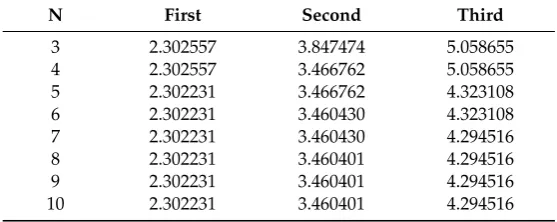
In Table1we represent the convergence of first three frequency parameters for Simply Supported beam taking the Bernstein polynomials as shape function.
Table 1.Convergence of first three frequency parameters for Simply Supported beam.
N First Second Third
3 2.302557 3.847474 5.058655
4 2.302557 3.466762 5.058655
5 2.302231 3.466762 4.323108
6 2.302231 3.460430 4.323108
7 2.302231 3.460430 4.294516
8 2.302231 3.460401 4.294516
9 2.302231 3.460401 4.294516
Further, the orthogonal Bernstein polynomials ˆφi’ is defined in Equation (17), have been used to find frequency parameters. In Table2, the convergence of first three frequency parameters for Simply Supported nanobeam is compared by using orthogonal Bernstein polynomials as well as Simple Bernstein polynomials withα=0.5.
Table 2. Comparison of the convergence of first three frequency parameters for Simply Supported nanobeams using Bernstein polynomials and Orthogonal Bernstein polynomials.
Frequency Parameters First Second Third
N Orthogonal Simple Orthogonal Simple Orthogonal Simple
3 2.3026 2.3026 3.8475 3.8474 5.0587 5.0586
4 2.3026 2.3026 3.4668 3.4668 5.0587 5.0586
5 2.3022 2.3022 3.4668 3.4668 4.3231 4.3231
6 2.3022 2.3022 3.4604 3.4604 4.3231 4.3231
7 2.3022 2.3022 3.4604 3.4604 4.2945 4.2945
8 2.3022 2.3022 3.4604 3.4604 4.2945 4.2945
9 2.3022 2.3022 3.4604 3.4604 4.2941 4.2941
10 2.3022 2.3022 3.4604 3.4604 4.2941 4.2941
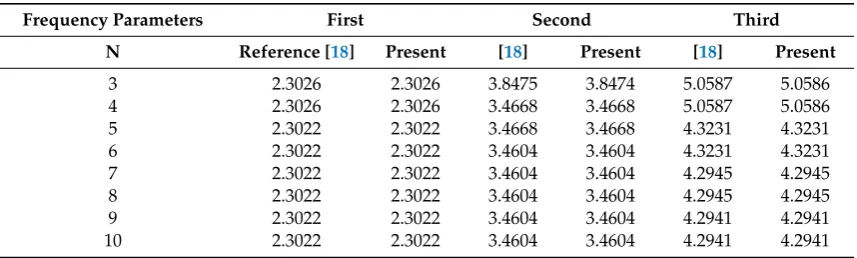
In Table3we compare our numerical results with Behera and Chakraverty [18]. The results are found to be in good agreement. We observed that the number of approximations is same but the computational time is less while using orthogonal Bernstein polynomials. We observed that for N=10 the run time is 6.743 s and for orthogonal Bernstein polynomial, it is 6.170 s by using Matlab programming.
Table 3.Comparison of the convergence of Frequency Parameters with the results of Reference [18].
Frequency Parameters First Second Third
N Reference [18] Present [18] Present [18] Present
3 2.3026 2.3026 3.8475 3.8474 5.0587 5.0586
4 2.3026 2.3026 3.4668 3.4668 5.0587 5.0586
5 2.3022 2.3022 3.4668 3.4668 4.3231 4.3231
6 2.3022 2.3022 3.4604 3.4604 4.3231 4.3231
7 2.3022 2.3022 3.4604 3.4604 4.2945 4.2945
8 2.3022 2.3022 3.4604 3.4604 4.2945 4.2945
9 2.3022 2.3022 3.4604 3.4604 4.2941 4.2941
10 2.3022 2.3022 3.4604 3.4604 4.2941 4.2941
Table 4.First three frequency parameters taking Laguerre polynomials as shape functions (S-S,α=0.5).
N First Second Third
3 2.3026 3.8475 5.0587
4 2.3026 3.4668 5.0587
5 2.3022 3.4668 4.3231
6 2.3022 3.4604 4.3231
7 2.3022 3.4604 4.2945
8 2.3022 3.4604 4.2945
9 2.3022 3.4604 4.2945
10 2.3022 3.4604 4.2941
11 2.3022 3.4604 4.2941
From Table4, we may observe that we need at least 11 terms for the convergence of first three frequencies whereas in the case of orthogonal Bernstein polynomials, it starts converging from 10th term. It is worth mentioning that for getting the converged third frequency only, orthogonal Bernstein polynomials are a winner by one term in this particular case. So, in general, we may see that the number of terms for both the polynomials needs similar but as said earlier that orthogonal Bernstein polynomials have less computational complexity.
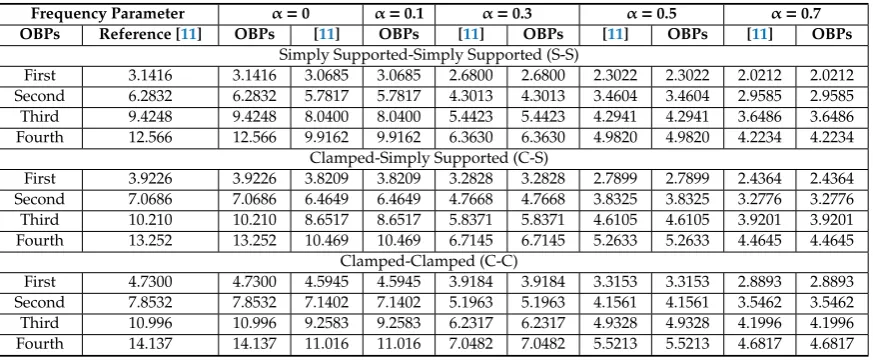
In Table5we compare first four frequency parameters with different scaling parameters and different boundary conditions with the result of Wang et al. [11]. The results are found to be in good agreement.
Table 5.Comparison of first three frequency parameters for Simply Supported nanobeam with different scaling parameters
Frequency Parameter α=0 α=0.1 α=0.3 α=0.5 α=0.7 OBPs Reference [11] OBPs [11] OBPs [11] OBPs [11] OBPs [11] OBPs
Simply Supported-Simply Supported (S-S)
First 3.1416 3.1416 3.0685 3.0685 2.6800 2.6800 2.3022 2.3022 2.0212 2.0212 Second 6.2832 6.2832 5.7817 5.7817 4.3013 4.3013 3.4604 3.4604 2.9585 2.9585 Third 9.4248 9.4248 8.0400 8.0400 5.4423 5.4423 4.2941 4.2941 3.6486 3.6486 Fourth 12.566 12.566 9.9162 9.9162 6.3630 6.3630 4.9820 4.9820 4.2234 4.2234
Clamped-Simply Supported (C-S)
First 3.9226 3.9226 3.8209 3.8209 3.2828 3.2828 2.7899 2.7899 2.4364 2.4364 Second 7.0686 7.0686 6.4649 6.4649 4.7668 4.7668 3.8325 3.8325 3.2776 3.2776 Third 10.210 10.210 8.6517 8.6517 5.8371 5.8371 4.6105 4.6105 3.9201 3.9201 Fourth 13.252 13.252 10.469 10.469 6.7145 6.7145 5.2633 5.2633 4.4645 4.4645
Clamped-Clamped (C-C)
First 4.7300 4.7300 4.5945 4.5945 3.9184 3.9184 3.3153 3.3153 2.8893 2.8893 Second 7.8532 7.8532 7.1402 7.1402 5.1963 5.1963 4.1561 4.1561 3.5462 3.5462 Third 10.996 10.996 9.2583 9.2583 6.2317 6.2317 4.9328 4.9328 4.1996 4.1996 Fourth 14.137 14.137 11.016 11.016 7.0482 7.0482 5.5213 5.5213 4.6817 4.6817
J. Compos. Sci. 2019, 3, x 9 of 11
(a)
(b)
(c)
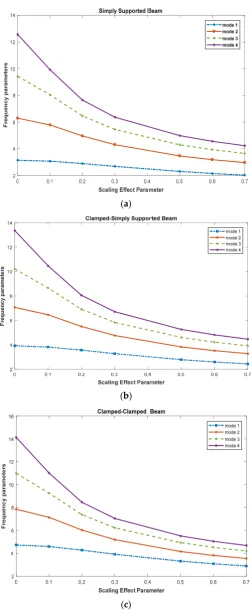
Figure 1. Variation of frequency parameters (first four) with changes of scaling effects for different
boundary conditions ((a) for Simply Supported (S-S), (b) for Clamped-Simply Supported (C-S), (c) for Clamped-Clamped (C-C)).
We observed that the frequency parameters are becoming smaller when the scaling effect parameters are increased. However, it is interesting to note that the deflection is high with respect to scaling effects for higher modes with various boundary conditions. Thus we may conclude that the nanobeams are more flexible due to small scale effects.
7. Conclusions
In this investigation, an efficient numerical technique has been developed for the study of vibration of Euler–Bernoulli nanobeam using Eringen’s nonlocal theory and considering the Bernstein polynomials as base functions. Bernstein polynomials are easy to handle different boundary conditions and also it takes less computational time. The convergence study of frequency parameters are studied in terms of tables. Furthermore, the results are in good agreement with Wang et al. [11]. Here we also introduce the Orthogonal Berstein Polynomials and we found that the number of approximations is same but the computational time is less while using orthogonal Bernstein polynomials. Further comparisons have also been made with other polynomials as shape functions viz. that of Laguerre polynomials. It is demonstrated that Laguerre polynomials take more terms with respect to particular frequency but the requirement of the number of terms compared to orthogonal Bernstein polynomials is not so significant. The main value of the use of the Bernstein polynomials takes less time in computation and simple computer implementation. A new convergence theorem has been developed here to show the theoretical convergence of displacement function with respect to the Bernstein polynomials.
Finally, we may conclude that this method may easily be extended to other nanostructures related vibration problems.
Author Contributions: Conceptualization, S.K. and S.C.; methodology, S.C and SK; software, S.C. and S.K.; validation, S.C.and S.K.; formal analysis, S.C. and S.K.; investigation, S.C. and S.K.; data curation, S.C. and S.K.; writing—original draft preparation, S.C. and S.K.; writing—review and editing, S.C. and S.K.; visualization, S.C. and S.K.; supervision, S.C.; project administration, S.C.
Funding:This research project does not get any external funding. Conflicts of Interest:The authors declare no conflict of interest.
References
1. Peng, H.B.; Chang, C.W.; Aloni, S.; Yuzvinsky, T.D.; Zettl, A. Ultrahigh frequency nanotube resonators.
Phys. Rev. Lett.2006,97, 087203. [CrossRef] [PubMed]
2. Dubey, A.; Sharma, G.; Mavroidis, C.; Tomassone, M.S.; Nikitczuk, K.; Yarmush, M.L. Computational studies of viral protein nano-actuators.J. Comput. Theor. Nanosci.2004,1, 18–28. [CrossRef]
3. Ruud, J.A.; Jervis, T.R.; Spaepan, F. Nanoindentation of Ag/Nimultilayered thin films.J. Appl. Phys.1994,
75, 4969. [CrossRef]
4. Wang, L.F.; Hu, H.Y. Flexural wave propagation in single-walled carbon nanotubes. Phys. Rev. B2005,
71, 195412. [CrossRef]
5. Eringen, A.C. Nonlocal polar elastic continua.Int. J. Eng. Sci.1972,10, 1–16. [CrossRef]
6. Reddy, J.N. Nonlocal theories for bending, buckling and vibration of beams.Int. J. Eng. Sci.2007,45, 288–307. [CrossRef]
7. Wang, C.M.; Kitipornchai, S.; Lim, C.W.; Eisenberger, M. Beambending solution based on nonlocal Timoshenko beam theory.J. Eng. Mech. ASCE2008,134, 475–481. [CrossRef]
8. Wang, Q. Wave propagation in carbon nanotubes via nonlocal continuum mechanics.J. Appl. Phys.2005,
98, 124301. [CrossRef]
9. Zhang, Y.Q.; Liu, G.R.; Xie, X.Y. Free transverse vibrations of double-walled carbon nanotubes using a theory of nonlocal elasticity.Phys. Rev. B2005,71, 195404. [CrossRef]
10. Aydogdu, M. A general nonlocal beam theory: Its application to nanobeam bending, buckling and vibration.
Low Dimens. Syst. Nanostruct.2009,41, 1651–1655. [CrossRef]
12. Phadikar, J.K.; Pradhan, S.C. Variational formulation and finite element analysis for nonlocal elastic nanobeams and nanoplates.Comput. Mater. Sci.2010,49, 492–499. [CrossRef]
13. Eltaher, M.A.; Emam, S.A.; Mahmoud, F.F. Free vibration analysis of functionally graded size-dependent nanobeams.Appl. Math. Comput.2012,218, 7406–7420. [CrossRef]
14. Mohammadi, B.; Ghannadpour, S.A.M. Energy approach vibration analysis of nonlocal Timoshenko beam theory.Procedia Eng. 2011,10, 1766–1771. [CrossRef]
15. Roque, C.M.C.; Ferreira, A.J.M.; Reddy, J.N. Analysis of Timoshenko nanobeams with a nonlocal formulation and meshless method.Int. J. Eng. Sci.2011,49, 976–984. [CrossRef]
16. Pradhan, S.C.; Murmu, T. Application of nonlocal elasticity and DQM in the flapwise bending vibration of rotating nanocantilever.Physica E Low Dimens. Syst. Nanostruct.2010,42, 1944–1949. [CrossRef]
17. Jena, S.K.; Chakerverty, S. Free vibration analysis of Euler–Bernoulli Nanobeam using differential transform method.Int. J. Comput. Mater. Sci. Eng.2018,7, 1850020. [CrossRef]
18. Behera, L.; Chakraverty, S. Free vibration of Euler and Timoshenko nanobeams using boundary characteristic orthogonal polynomial.Appl. Nanosci.2014,4, 347–358. [CrossRef]
19. Singh, B.; Chakraverty, S. Use of characteristic orthogonal polynomials in two dimensions for transverse vibration of elliptic and circular plates with variable thickness.J. Sound Vib.1994,173, 289–299. [CrossRef] 20. Behera, L.; Chakraverty, S. Static analysis of nanobeams using the Rayleigh-Ritz method.J. Mech. Mater. Struct.
2017,12, 603–616. [CrossRef]
21. Chakraverty, S.; Behera, L.Static and Dynamic Problems of Nanobeams and Nanoplates, 1st ed.; World Scientific Publishing Co.: Singapore, 2016.
22. Chakraverty, S.Vibration of Plates; CRC Press: Boca Raton, FL, USA, 2009.
23. Fernández-Sáez, J.; Zaera, R.; Loya, J.A.; Reddy, J.N. Bending of Euler-Bernoulli beams using Eringen’s integral formulation: A paradox resolved.Int. J. Eng. Sci.2016,99, 107–116. [CrossRef]
24. Joy, K.I.Bernstein Polynomials, On-Line Geometric Modeling Notes; Computer Science Department, University of California, Davis: Davis, CA, USA, 2000.
25. Civalek, O.; Akgoz, B. Free vibration analysis of microtubules as cytoskeleton components: Nonlocal Euler–Bernoulli beam modeling.Sci. Iran. Trans. B Mech. Eng.2010,17, 367–375.