Development Artificial Neural Network Model
to Study the Influence of Oxidation Process and
Zinc-Electroplating on Fatigue Life of Gray Cast
Iron
Asst. Prof. Dr. Ali S. Hammood, Haider Mahdi lieth
Abstract
--
The fatigue behavior of Gray Cast Iron is affected to its microstructure, strength, ductility, residual stress and surface roughness etc…. In general, fatigue life increase as the magnitude of surface roughness decrease or the surface hardness increases by surface treatment.As the consequence of conducted high temperature oxidation in subsurface layer of cast iron pores have been creating, coating by zinc-electroplating were filed with new phase and in this way the new zone with different properties was obtained. The aim of this study is to develop an artificial neural network (ANN) model for estimating the fatigue life of Gray cast iron after oxidation process and zinc-electroplating.
Amulti-layer model was used the oxidation time, oxidation temperature, coating thickness, the surface roughness, hardness as inputs and the fatigue life as the output of the model. a variety of samples were prepared in different conditions of heat treatment cycle. The obtained experimental results were used for training the neural network. Efficiency test of this model showed reasonably good agreement between experimental and numerical results.
Index Term --- High Temperature Oxidation, Fatigue Behavior, Zinc-Electroplating.
I. INTRODUCTION
Gray cast iron (GCI) is traditionally chosen in many industrial applications because of its flexibility of use, good castability, low-cost (20–40% less than steel) and wide range of achievable mechanical properties. The structure of GCI depends on chemical composition before the casting process, and cooling conditions [1]. Recently, there has been an increasing interest in cast irons as structural components in the wind power industry, e.g., rotor hubs or nacelles [2, 3]. Gray cast iron is a broad term used for a number of cast irons whose microstructure is characterized by the presence of flake graphite in the ferrous matrix. Such castings often
contain 2.5 to 4% carbon, 1 to 3% silicon and some manganese, ranging from 0.1 to 1.2%.Fatigue failures in components usually occur from geometrical features which cause local stress concentration: notches, holes, corners, etc. It is well known that the fatigue behavior of a notch or other stress-concentration feature is not uniquely defined by the local maximum stress but depends also on other factors determined by notch geometry and local stress distribution
[4].
Which have many ways to improve the mechanical properties of gray cast iron especially the fatigue behavior such as changes in chemical composition [5], riddance the geometrical defects, improvements the surface conditions. This paper present a study and develop artificial neural network model to estimating the fatigue behavior of gray cast iron after improvement the surface condition of the specimens by using oxidation process ,graphite voids from sub-surface layer and zinc-electroplatingto filled the pores in sub-surface layer .the combining of zinc-electroplating coating of cast iron with previous high temperature oxidation makes possible creation of sub-surface layer with composite character and in this way riddance the geometrical defects and increase the compressing stress and then improved the fatigue behavior of gray cast iron .
II. EXOERIMENTALPROCEDURE
The experimental materials was made with 100 Kg contain scrap of iron and steel, chemical composition of the gray cast iron is given in the Table I.
Fifty samples were cast in the form of cylinder with dimensions of 6cm diameter X40cm length. Those samples were cast at the Basra machining workshop at Basra city, Iraq. Using turning machine to make the tensile and fatigue samples with dimension according to ASTM A48 and E8
[6,7] is shown in Figure 1.
Asst. Prof. Dr. Ali S. Hammood is serving in Kufa University, College of Engineering, Mat. Eng. Department
[email protected] Haider Mahdi al jabery is serving in
Basra University, College of Engineering, Mech. Eng. Department [email protected]
TABLE I
Chemical composition of gray cast iron , Wt.%
C Si Mn P S Cr Ni Al Cu
Fig. 1. Shape and Dimensions of Tensile and Fatigue Test The preferred sample for microstructure test is a section cut from an actual casting that is being evaluated. Grinding and polishing may follow the usual accepted metallographic procedures according to ASTM A247 and E3 standards [8, 9].
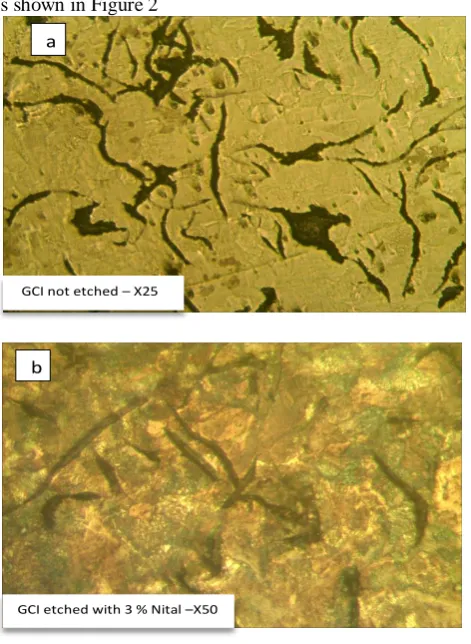
The microstructure of Gray cast iron without any treatment is shown in Figure 2
GCI not etched – X25
a
GCI etched with 3 % Nital –X50 b
Fig. 2. Microstructure of Gray cast iron, a) not etched, b) etched with 3 % Nital
The fatigue specimens were prepared by machining from gray cast cylinder. The samples were put to furnace chamber to oxidize. The experiment was led in two temperatures
850,900oC. Samples have been taken out from the furnace separately after 1,2,3,4 and 5 hours (seven specimen of each case). Before oxidation and after cooling dawn samples were measured, hardness and surface roughness.
The scale layer was removed in two stage procedure mechanically by sand blasting as well as chemically by dipping in solution of oxalic acid.
After scale layer removed the coating by zinc-electroplating process has carried out to increase the compression stresses. The scale layer process increasing of zinc adhesion to cast iron.
Fatigue tests were performed up to complete specimens fracture. Using this experimental data, S-N curve of gray cast iron were obtained in different conditions. Frequency of test was 60 Hz and the stress amplitude (σmax /2) was selected between 80 to 200 Mpa.
III. ARTIFICIAL NEURAL NETWORKS
The processing and development of materials are complicated. Although scientific investigations on materials have resulted in understanding the underlying phenomena, there are many problems in quantitative and statistical studies of materials. For example, whereas dislocation theory can be used to estimate the yield strength of a microstructure, it is not yet possible to predict the strain hardening coefficient of engineering alloys [10]. Moreover, tensile strength, elongation, fatigue life, creep life and toughness, which are important engineering design parameters, cannot even be estimated using dislocation theory [11]. In Table II, a more comprehensive list of these parameters is presented.
TABLE II
Some Mechanical Properties that need to be Expressed in quantitative Models as a Function of large numbers of variables [10]
Property Relevance
Yield strength All structural applications
Ultimate tensile strength All structural applications
YS/UTS ratio Tolerance to plastic
overload
Elongation Resistance to brittle
fracture
Toughness Tolerance to defects
Fatigue Cyclic loading
Creep strength High temperature services
Elastic modulus Deflection, stored energy
Neural networks are extremely useful models in such cases, not only in the study of mechanical properties but wherever the complexity of the problem exceeds by fundamental concepts and simplification is inadmissible. Therefore, there is growing interest for development of intelligent dynamic systems based on practical data.
The basic part of a neural network is called „„cell‟‟. In general, biologic cells sum signals received from several sources in different ways and then perform a nonlinear treatment on results to establish the outputs. Neural networks mostly have an input layer, one or few hidden layers and an output layer. Each input is multiplied by its related weight and in the simplest state, these quantities and bioses are combined together [13]; then cross through activation functions to produce the outputs. Figure 3 shows the data processing in a cell.
Fig. 3. Data processing in a neural network cell
The most common training algorithm is back-propagation one. In this method, the neural network is trained through adjusting the middle layers weights and these changes are stored as defaults of the network. Mean Square Error (MSE) and Root Mean Square (RMS) as statistical criterions are utilized to evaluate results accuracy according to following equations:
(1)
(2)
Where t and o are target (desired, measured) and output (predicted) values respectively. Also n is the number of the network outputs [14-15].
IV. RESULTS AND DISCUSSION
TENSILE TEST AND SURFACE HARDNESS
The tensile test is popular since the properties obtained could be applied to design different components. The tensile test measures the resistance of material to static or slowly applied force [16].
Three samples of gray cast iron were tested .the mean value was calculated, the value of tensile strength is 238.4 Mpa. The fatigue life increases as the magnitude of the surface hardness increase as in the case of oxidation heat treatment or coating by zinc with oxidation.
The high temperature oxidation leads to creation not only the scale layer and subsurface porous layer but also causes the change of microstructure from pearlitic phase to ferritic and high carbon austenite phase.
Figure 4 show the change in the hardness of fatigue specimens which have been oxidation according‟s to different temperature.
A slightly drop in the hardness takes place in specimens when the time of oxidation in increase , As temperature
increases the high carbon austenite decomposes to ferrite and cementite thus decreasing the hardness.
Fig. 4. Change of hardness with different oxidation conditions After removing the scale layer by sandblasting as well as chemically by dipping in solution of oxalic acid. The zinc coating has carried out.as shown in Figure 5 the surface hardness increase after coating because the zinc coating is increase the compressing stress and the zinc coating were filed the subsurface layer of cast iron which led to create a new phase with good hardness properties was obtained.
Fig. 5. Comparison of hardness between coating and without coating at 850oC
FATIGUE BEHAVIOR
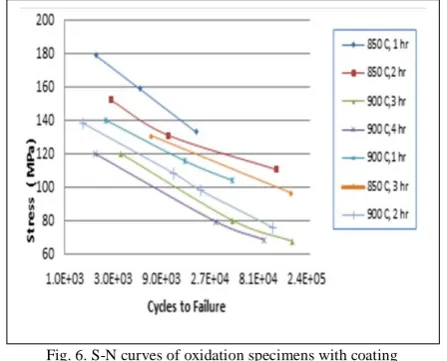
Figure 6 shows the fatigue behavior of gray cast iron specimens after applying oxidation process to the standard fatigue specimens .according‟s to the results in figure 6, the maximum fatigue strength of the gray cast iron corresponds to the temperature and time of oxidation and it‟s directly depend on the value of hardness.
Fig. 6. S-N curves of oxidation specimens with coating
MODELING RESULTS
output functions are linear . 20 data were randomly select from 60 experimental data and used for network training. The 5 data were used for network accuracy testing. The parts of data used for network are given in Table III.
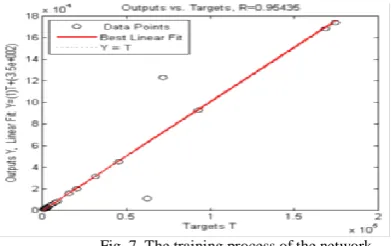
Figure 8 show the training process of the network for this study and figure 9 and 10 show the estimated fatigue life by the model and the actual fatigue value. The output of the model can be used in practice with good accuracy.
Fig. 7. The training process of the network
Table III ,Part of Data Used in Network Training
Temperature (
o
C ) 900 850 900 900 900 850 850 850 850 850 850 850
time (hr) 3 2 4 3 4 1 2 1 5 4 4 2
load (N) 15.2 29.4 15.4 18 17.8 29.8 29.4 35.6 30 24.3 40.3 34.1
stress (Mpa ) 67.736 131.02 68.628 80.214 79.323 132.8 131.02 158.6456 133.6901 108.289 179.59 151.9611
hardness(before
coating ) 87 156.25 85.33 87 85.33 162.33 156.25 162.33 118 111.5 111.5 156.25
hardness (after
coating ) 140.83 189.14 138.67 140.83 138.67 215.87 189.14 215.87 126 136.5 136.5 189.14
cycle rate (Hz) 60 60 60 60 60 60 60 60 60 60 60 60
Ra (µm) 3.12 3.4 3.17 3.58 2.94 3.64 3.4 2.98 3.26 3.17 2.85 3.46
Rz (µm) 13.09 13.85 11.33 12.88 12.17 13.94 13.85 11.17 11.92 12.06 11.78 12.03
thickness of
coating (µm) 17.73 14.339 18.553 18.275 18.141 2.8803 14.339 2.7551 18.5704 10.4123 9.7145 13.9188
Fig. 8. The testing process of the network
Fig. 9. comparison of actual value (hollow circles) with network
V. CONCLUSION
The fatigue life of gray cast iron can be improved by oxidation process and coating by zinc because in this way can be increase the compressing stress in the surface. At constant oxidation temperature, increasing the oxidation time decrease the fatigue life because the phase transformation can be offer from pearlitic to ferritic and high carbon austenite.
The coating by zinc is directly effect on the surface hardness of the specimens and fatigue life after oxidation process because the zinc coating is increase the compressing stress and the zinc coating were filed the subsurface layer of cast iron which led to create a new phase with good hardness properties was obtained.
Multi-layer artificial neural network was developed to estimate the fatigue life of gray cast iron parts by using 60 samples with the same as-cast microstructure and different oxidation temperature and time and/or coating by zinc .
REFERENCES
[1] L. Collini , G. Nicoletto , R. Konecna
: Microstructure and mechanical properties of pearlitic gray cast iron; Materials Science and Engineering 2008 ; A 488 ; 529–539.
[2] R. O‟Rourke, “Cast iron: The engineered metal,” Advanced Materials & Processes, vol. 159, pp. 65-68, Jan. 2001.
[3] D. Veldkamp, “A probabilistic evaluation of wind turbine fatigue design rules,” Wind Energy, vol. 11, pp. 655-672, 2008.
[4] D. Taylor, P. Bologna, K. Bel Knani :
[5] M. Petrenec, H. Tesaová, P. Beran, M. Šmíd, P. Roupcová: Comparison of low cycle fatigue of ductile cast irons with different matrix alloyed with nickel; Procedia Engineering 2010; 2; 2307-2316.
[6] ASTM: Standard Specification for Gray Iron Castings; ASTM international 2000;annual book of ASTM standards A 48/A 48M.
[7] ASTM: Standard Test Methods for Tension Testing of Metallic Materials; ASTM international 2002;annual book of ASTM standards E 8 – 01.
[8] ASTM: Standard Test Method for Evaluating the Microstructure of Graphite in Iron Castings; ASTM international 1998;annual book of ASTM standards A 247 – 67.
[9] ASTM: Standard Guide for Preparation of Metallographic Specimens; ASTM international 2001;annual book of ASTM standards E 3 – 01.
[10] Monideepa M., Shiv Brat S.: Artificial Neural Network: some applications in physical metallurgy of steels; materials and manufacturing processes;2009;24:2;198-208.
[11] HaMiD P., Hamed P., Zhila A., Mohammad B.: Development a multi-layer perceptron artificial neural network model to estimate the Vickers hardness of Mn–Ni–Cu–Mo austempered ductile iron;2012;35;782-789.
[12] Bhadeshia HKD: Neural networks in materials science; ISIJ Int.; 2006;39(10);966–979.
[13] Sha W, Edwards KL: The use of artificial neural network in materials science based research. Mater Des 2007;28;1747– 1752.
[14] Hill EV, Israel PL, Knotts GL: Neural network prediction of aluminum–lithium weld strengths from acoustic emission amplitude data. J Mater Eval; 1993;51:1040–1051.
[15] Demuth H, Beale M, Hagan M.: Neural network toolbox TM user‟s guide, Ver6.0.4 (Release 2010a). The Math Works Inc.; 2010.