*Corresponding Author: Sujit Biswas,
Department of Pharmacy, Jahangirnagar University, Savar, Dhaka-1342
Email: [email protected]
Research Article
Development of Formulation and
In-vitro
Evaluation of Physicochemical
Properties of Cefixime Trihydrate Tablet
Sujit Biswas, Sharif Md. Anisuzzaman, Md. Sohel Rana
Department of Pharmacy, Jahangirnagar University, Savar, Dhaka-1342
1. INTRODUCTION
Cefixime is an orally active semi synthetic third generation cephalosporin antibiotic. Chemically, it is (6R, 7R)-7-{[2-(2-amino-1, 3-thiazol-4-yl (carboxymethoxyimino) acetyl] amino}-3-ethenyl-8-oxo-5-thia-1-azabicyclo-[4.2.0]oct-2-ene-2-carboxylicacid trihydrate. Clinically it is used in the treatment of susceptible infections including gonorrhoea, otitis media, pharyngitis, tonsillitis, lower respiratory-tract infections such as bronchitis, and urinary-tract infections1, 2.
Preparations of this molecule are available both in solid and liquid dosage forms, for instance as oral suspension, tablets and capsules. More than 60 companies are manufacturing the products of cefixime in Bangladesh. In Bangladesh, most of the pharmaceutical companies manufacture only capsules in solid dosage forms. But among solid dosage forms tablet is the most stable and cost effective dosage form. Beside this, BP and USP do not introduce the capsule formulation of cefixime molecule; only tablet form is introduced and evaluated in USP3. During development of tablet dosage form, it is essential to ensure the optimum pharmacokinetics profile, efficacy, and safety of the products.
Previous study revealed that Cefixime trihydrate containing coprocessed superdisintegrant exhibited quick disintegration and improved drug dissolution. Coprocessed superdisintegrant consisting of crospovidone and SSG (Sodium starch glycolate) exhibited good flow and compression characteristics4.
Floating matrix tablets of Cefixime were developed to prolong gastric residence time, increase its bioavailability and patient
compliance. Rapid gastro-intestinal transit could result in incomplete drug release from the drug delivery system above the absorption zone leading to diminished efficacy of the administered dose. The tablets were prepared by direct compression technique, using polymers such as HPMC K 100 LV, HPMC K4M, HPMC K15M and HPMC K100M, alone or in combination and other standard excipients 5.
The degradation behavior of cefixim e trihydrate was also investigated under different stress conditions of acidic hydrolysis, alkaline hydrolysis and oxidation using spectrophotom etry. Stability indicating spectrophotometric methods were developed that could separate the drug from its degradation products formed under these stress conditions 6.
The comparative bioavailability of two oral formulations of cefixime, 200mg tablet (test formulation) and the novel 200mg sachet (reference formulation), was investigated in a single-dose crossover study in 18 healthy male volunteers. Clinical and biological tolerability was excellent for both formulations 7.
The challenge for formulation pharmacist is to formulate a dosage form comprising Cefixime, which would have a bioavailability similar to that of a suspension comprising Cefixim e, but without the attendant disadvantages of suspension. This study was designed to formulate and develop the tablet formulation of cefixime trihydrate 200 mg tablet and its in-vitro quality evaluation study.
2. MATERIALS AND METHODS
2.1 Drug
Cefixime Trihydrate USP Micronized and Compacted (Nectar life sciences Ltd. India).
2.2 Excipients
Pregelatinized starch 1500 BP (Colorcon Asia Pvt Ltd), Microcrystalline cellulose BP or Avicel PH 102 (Mingtai chemical
Abstract
This study was designed to formulate and develop the tablet formulation of cefixime trihydrate 200 mg tablet and its in-vitro quality evaluation study. Dry granulation method was adopted for preparation of tablet using different excipients namely; cross-linked povidone, spray dried lactose, colloidal anhydrous silica, microcrystalline cellulose, pregelatinized starch, sodium lauryl sulphate, anhydrous calcium hydrogen phosphate, sodium stearyl fumerate and magnesium stearate in five different formulations (F-1 to F -5). The granules for tabletting were evaluated for angle of repose, bulk density, compressibility index, total porosity and drug content etc. The tablets were also subjected to thickness, hardness, friability and in vitro release studies. Among the formulations, formula F-5 showed the satisfactory tablet properties and complied with the USP pharmacopoeial standard requirements for uniformity of dosage units and friability. The results of disintegration and dissolution studies indicated that formulations containing pregelatinized starch, microcrystalline cellulose and sodium lauryl sulphate showed lower disintegration time and higher percentage of dissolution at 45 minutes in comparison with other formulations and marketed products. But same formulation (F-5) with compacted grade of active ingredients exhibited lower percentage of dissolution and disintegration time than tablets prepared from micronized grade of active ingredients. Formula F- 5 possessed good stability both in accelerated and long term storage condition for six months study.
ISSN (Online) 2249-6084 (Print) 2250-1029
International Journal of Pharmaceutical and
Phytopharmacological Research (eIJPPR)
[Impact Factor – 0.7826]
Journal Homepage: www.eijppr.com
Article info
Article History: Received 2 Jun 2013 Accepted 29 Aug 2013
Keywords:
Co. Ltd. Taiwan), Sodium lauryl sulphate BP (PM Pharma Marketing ), Collidon Sillicon Dioxide BP (Degussa, Belgium), Sodium starch glycolate (Yung Zip Chemical Ind. Co. Ltd, Taiwan), Sodium stearyl fum erate BP (JRS Pharma GmbH and Company.KG, USA), Magnesium Stearate BP (Peter Greven Nederland C.V. Netherlands), Anhydrous Calcium Hydrogen phosphate (Shijiazhuang No.2 Pharmaceuticals Factory, Chaina), Spray dried lactose (Lactose Company of Newzeland Ltd), Purified Talc (MERCK KGaA, Germ any) and Crospovidone (BASF Germany).
2.3 Coating Materials
Opadry – OY-S-38921 (White) Ph grade (Colorcon Asia Pvt Ltd).
2.4 Solvent and Reagents
Purified water BP, Potassium Dihydrogen Phosphate (KH2PO4) and Sodium Hydroxide. Methanol (HPLC Grade), 0.1M Sodium acetate, Acetic acid, 2M Sodium Hydroxide, Distilled water and Acetonitrile.
2.5 Equipments
Sartorius electronic weighing balance (Germany), Sejong G.R.C rotatory slugging and compression machine(Korea), Greatitide coating machine ( Taiwan ), Erweka electronic hardness tester (Germany), Shimadzu UV Spectrophotometer(Japan), Erweka
disintegration tester (Germany ), Pharma test friability tester (Germany), Pharma test dissolution tester (Germany ), Pharma test stability chamber (Germany ), PC based high performance liquid chromatography (Auto sampler, Shimadzu, Japan), Yenchen Power mill( Taiwan), Sieve (18 mesh ) and screen (3mm), UV-VIS spectrophotometer (SHIMADZU, Japan), Electronic balance, Mechanical Shaker, Volumetric flask, Pipette, Measuring cylinder, HPLC (SHIMADZU,Japan), Ultrasonic bath and PH Meter.
2.6 Preparation of Core Tablets
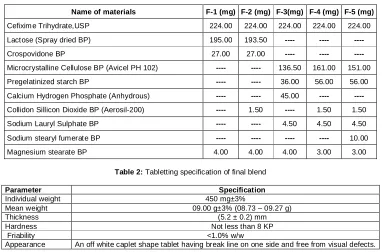
Core tablets were prepared by dry granulation method. The calculated amount of active ingredient was weighed and manually sieved through 18 mesh screen and taken in a polybag. All other excipients except rest quantity of Magnesium Stearate BP was sieved 30 mesh screen and was taken in previous polybag. Mixture was manually blended for 5 minutes. Then the blend was slugged and crushed using Yenchen power mill unit fitted with 3mm screen. The material was blended with the rest quantity of magnesium stearate in the previous polybag by sieving through 30 mesh screen for 5 minutes. Finally the powder was compressed through a compression machine following tabletting specification of final blend in table -2. Formulations of core tablets are shown in the following table-1.
Table 1: Proposed five formulations of Cefixime trihydrate, USP 200 mg tablet
Name of materials F-1 (mg) F-2 (mg) F-3(mg) F-4 (mg) F-5 (mg)
Cefixim e Trihydrate,USP 224.00 224.00 224.00 224.00 224.00
Lactose (Spray dried BP) 195.00 193.50 ---- ---- ----
Crospovidone BP 27.00 27.00 ---- ---- ----
Microcrystalline Cellulose BP (Avicel PH 102) ---- ---- 136.50 161.00 151.00
Pregelatinized starch BP ---- ---- 36.00 56.00 56.00
Calcium Hydrogen Phosphate (Anhydrous) ---- ---- 45.00 ---- ----
Collidon Sillicon Dioxide BP (Aerosil-200) ---- 1.50 ---- 1.50 1.50
Sodium Lauryl Sulphate BP ---- ---- 4.50 4.50 4.50
Sodium stearyl fumerate BP ---- ---- ---- ---- 10.00
Magnesium stearate BP 4.00 4.00 4.00 3.00 3.00
Table 2: Tabletting specification of final blend
Parameter Specification
Individual weight 450 mg±3%
Mean weight 09.00 g±3% (08.73 – 09.27 g)
Thickness (5.2 ± 0.2) mm
Hardness Not less than 8 KP
Friability <1.0% w/w
Appearance An off white caplet shape tablet having break line on one side and free from visual defects.
2.7 Coating of Core Tablets
After preparing tablets from above formulations which formula meet the optimization level, those were filmy coated with white colored opadry - OY – 38921 (white) Ph. Grade followed by preparing coating suspension with purified water considering 1- 2.5% weight gain. Before starting coating, the coating pan was warmed at about 450 C. During coating operation following parameters were controlled and maintained (Table -3).
Table 3: The set parameters range of greatide coating machine for coating operation
Parameter Unit Set range
Inlet air temperature 0 C 65-75
Pan Speed rpm 1.5-5
Spray gun atomizing air pressure bar 1-3 Inlet Damper position degree 0 Exhaust Damper position degree 30-60
Spray rate gm / min 60-120 Gun distance from tablet bed cm 20-24
2.8 Evaluation of Tablets
The prepared matrix tablets were evaluated for hardness, weight variation, thickness, friability, content uniformity.
2.8.1 Disintegration Test
Six tablets were placed into 6 tubes of disintegration testing apparatus. Disc was added to each tube and suspended the tubes in a 1000 ml beaker having 800ml of purified water maintaining temperature of water from 36.5 ˚c to 37.5 ˚c. 800 ml of water is require to maintain that the wire mesh at its highest point is at least 25 mm below the surface of water and the lowest point is at 25mm above the bottom of the beaker.
2.8.2 Dissolution
concentration against absorbance constructed in the dissolution media. A mechanical shaker has been used. According to USP absorbance of both standard and sample was measured at 288nm
(λmax).
2.8.3 Drug Content Assay
Drug content of formulated tablets was measured by following USP method.
2.8.4 Performance of Chromatographic (HPLC) System
In chromatographic system 4.6 mm x 12.5 cm column containing 4 µm packing L1 (ODS) was used. Flow rate was about 10 µL/ minute. Wavelength was 254 nm. 40˚c was column temperature. Column efficiency was not less than 4000 theoretical plates. Tailing factor for the analyte peak was not less than 0.9 and not m ore than 2.0. RSD for replicate injections was not more than 2.0%.
2.8.5 Stability Testing
Stability test was carried out for both short term and long term storage condition. Tablets were packed in Alu- Alu blister format and tested in accordance with the storage condition and test was done as per valid test method. The samples were taken out of the store prior to the scheduled testing date and kept at normal condition (not more than 30ºC) until the time for analysis. The analytical work was concluded not more than 2 weeks after the samples have been out of storage. The total microbial count for bacteria, yeasts and moulds were carried out at zero time, six, twelve and thirty six months. Tests include appearance, moisture content, average filled weight, disintegration time, dissolution rate, chemical Assay (Cefixim e content) were performed . Storage condition and sampling intervals are showed in below table -4.
Table 4: Storage condition and sampling intervals
Storage condition Sampling intervals
Long term storage (30ºC+2 and 65% RH+
5%) 0,3,6,9 months
Accelerated (40ºC+2 and75% RH+ 5% ) 0,1,3,6 months
3. RESULT AND DISCUSSION
3.1 Evaluation of Tablets Physicochemical Properties
Among formulations F-1 showed extensive sticking and layer separation problem. During slugging for dry granulation and compression, blend materials blocked the feed frame due to high moisture content (7.86%). So, F-1 was not undertaken for further studies. The tablets of the proposed formulations (F-2 to F-5) were subjected to various evaluation tests like thickness, hardness, weight variation test, friability test, DT and dissolution.
Table 4.1 Average value of hardness, thickness, individual weight, friability and DT of proposed formulation F-2, F-3, F-4 and F-5.
Formulation Hardness Thickness Average
weight Friability DT (min.) F-2 10.5±1.40 5.00±0.60 446.24 0.51% 4.52 F-3 10 ± 1.50 5.20±0.33 446.44 0.38% 2.47 F-4 11±1.50 5.29±0.02 448.03 0.06% 2.43 F-5 10.15±1.0 5.24±0.03 448.38 0.013% 2.40
Comparison of tabletting parameters
0 2 4 6 8 10 12 14
F-2 F-3 F-4 F-5
Formulations
Thickness(mm) Hardness(Kp)
Disintegration Time (min.) Friability (%)
Fig 4.1: Comparison report of thickness, hardness, disintegration time and friability result of proposed formulations from F-2 to F-5.
Table 4.2 Average dissolution (%) of proposed formulation F-2, F-3, F-4 and F-5.
Formulation F-2 F-3 F-4 F-5
Dissolution (%) 84.00% 100.13% 99.23% 100.89%
Dissolution (% )
70 75 80 85 90 95 100 105 110
F-2 F-3 F-4 F-5
Formulations
D
is
s
o
lu
ti
o
n
(
%
)
Dissolution (%)
In formulation F-5, during compression the tabletting param eters were observed at different hardness for justify the appropriate param eters in order to achieve optimum value of successful operation and to meet good tablet properties.
Table 4.3 Hardness, thickness and disintegration time parameters obtained from these are sequentially showed in the below tables
F-5.
Sample
No. Hardness Diameter Thickness
Disintegration time (Six tablets)
01 9.8 16.17 5.22
2 min. 40 seconds
02 9.7 16.18 5.21
03 11.1 16.17 5.27
04 9.2 16.18 5.22
05 9.5 16.18 5.24
Statistically these parameters can be shown in table 4.4.
Table 4.4 Statistical value of hardness, diameter and thickness of table of 4.3
Hardness Diameter Thickness
Minimum 9.2 Min. 16.17 Min. 5.21 Maximum 11.2 Max. 16.18 Max. 5.27 Difference 1.9 Diff. 0.01 Diff. 0.06 Average 9.9 Avg. 16.18 Avg. 5.23 Std.Dev. 0.7 Std.Dev. 0.01 Std.Dev. 0.02
Table 4.5 The tabletting param eters of F-5 at greater hardness than table no.4.3
Sample
No. Hardness Diameter Thickness
Disintegration time(Six tablets)
1 17.4 16.12 5.12
3 min. 10 seconds
2 15.5 16.16 5.13
3 15.0 16.16 5.14
4 15.9 16.16 5.16
5 16.8 16.15 5.14
Table 4.6 Statistical value of hardness, diameter and thickness of table of 4.5
Hardness Diameter Thickness
Minimum 15.0 Min. 16.12 Min. 5.12 Maximum 17.4 Max. 16.16 Max. 5.16 Difference 02.4 Diff. 0.04 Diff. 0.04 Average 16.1 Avg. 16.15 Avg. 5.14 Std.Dev. 1.0 Std.Dev. 0.02 Std.Dev. 0.01
By increasing more hardness than value in table 4.8, following parameters were found in table 4.9
Table 4.7 The tabletting param eters of F-5 at greater hardness than table no.4.5
Sample
No. Hardness Diameter Thickness
Disintegration time(Six tablets)
01 21.0 16.14 4.95
6 min. 30 seconds
02 23.5 16.14 4.96
03 18.3 16.16 4.94
04 20.3 16.14 4.95
05 18.3 16.15 4.93
Table 4.8 Statistical value of hardness, diameter and thickness of table of 4.7
Hardness Diameter Thickness
Minimum 18.3 Min. 16.14 Min. 4.93
Maximum 23.5 Max. 16.16 Max. 4.96
Difference 5.3 Diff. 0.02 Diff. 0.03
Average 20.3 Avg. 16.15 Avg. 4.95
Std.Dev. 2.2 Std.Dev. 0.01 Std.Dev. 0.01
From the above data and statistics considering hardness, thickness, friability and disintegration, the tabletting parameters from table no. 4.3 may be the most acceptable among others formulations and the average result at different hardness at a glance is given in the below table.
Table 4.9 Average hardness, thickness and disintegration time from table 4.4, 4.6 and 4.8 of proposed formulation F-5.
S. No. Hardness average(KP)
Thickness
average(mm) Corresponding DT
1 9.9 5.20 2 min. 40 seconds
2 16.1 5.14 3 min. 10 seconds
3 20.3 4.95 6 min. 30 seconds
Corelation between Hardness,Thickness and DT
0 5 10 15 20 25
1 2 3
Hardness (Kp) Thickness (mm) Disintegration time (Min.)
Fig 4.3: Thickness average and Disintegration at various hardness of formulation F-5.
Table 4.10 Friability result of tablets from proposed formulation F-5 at different rpm.
No. of tablet
Initial Weight
No. of revolutions
Final
weight Friability
10 4.5318 100 4.5312 0.013
10 4.5318 200 4.5309 0.019
Friability at different revolutions
0.013
0.019
0.079
0
0.01
0.02
0.03
0.04
0.05
0.06
0.07
0.08
0.09
100
200
300
No. of revolutions
%
o
f
fr
ia
b
il
it
y
Friability
Fig 4.4: Friability (%) of proposed formulation F-5 at different revolutions.
4.1.6 Dissolution Result
Dissolution result of the formulated good tablet of cefixime trihydrate, USP 200 mg tablet according to previously discussed USP method in materials and method chapter is given as follows.
Table 4.11 The dissolution (%) of six tablets of proposed formulation at six points of dissolution test apparatus.
No. of sample Absorbance of standard Absorbance of Sample % of dissolution Average Limit
01 0.525 0.597 100.74
100.89 Not less than 75%
02 0.525 0.601 101.42
03 0.525 0.584 98.55
04 0.525 0.598 100.91
05 0.525 0.604 101.93
06 0.525 0.603 101.76
Dissolution (%)
96
97
98
99
100
101
102
103
1
2
3
4
5
6
No.of sample
%
o
f
d
is
s
o
lu
ti
o
n
3.2 Assay Result
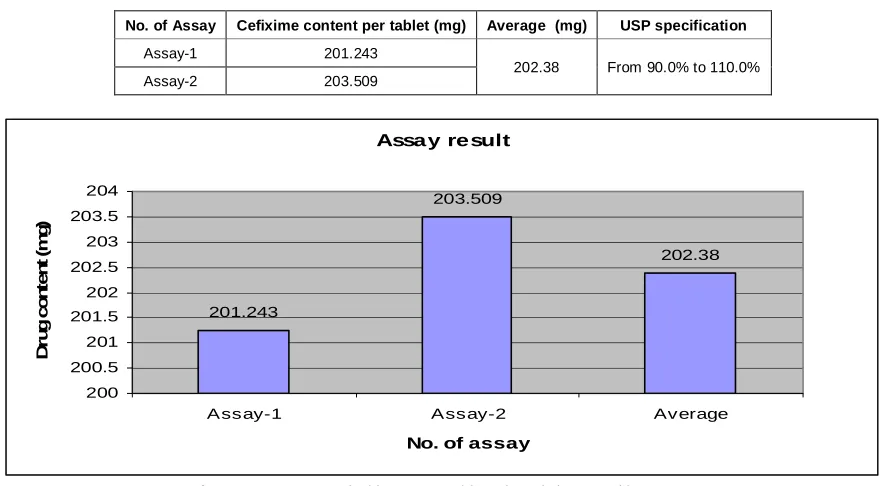
Assay result of the tablet following USP procedure Cefixime 200mg tablet is listed in below table.
Table 4.12 Cefixime content of tablets from proposed formulation F-5.
No. of Assay Cefixime content per tablet (mg) Average (mg) USP specification
Assay-1 201.243
202.38 From 90.0% to 110.0%
Assay-2 203.509
Assay result
201.243
203.509
202.38
200 200.5 201 201.5 202 202.5 203 203.5 204
Assay-1 Assay-2 Average
No. of assay
D
ru
g
c
o
n
te
n
t
(m
g
)
Fig 4.6: Drug content of tablets prepared from formulation F-5 with average
3.3 Comparison with the Innovator Drug and Marketed Tablet
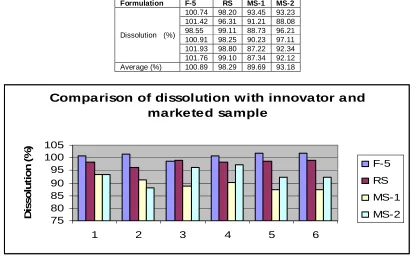
This formulated tablet was compared with two marketed product and innovator drug which were collected from three different manufaturer and here, available marketed samples were presented as MS-1, MS-2 and innovator drug, 200 mg tablet was denoted as RS (Reference standard). The data is presented in below table.
Table 4.13 Comparison of individual weight, drug content, thickness, DT, friability %(at 100 rpm) and hardness of tablets from formulation F-5 with patent drug and marketed product.
Formula Individual Wt.(mg) Actual drug content (mg) Thickness
(mm) DT (Min.) Friability (%) Hardness(Kp)
F-5 448.4± 1.5 202.38 5.24±0.03 2.40±0.02 0.013 10.2±1.00
RS 448.5±0.2 199.35 4.20±0.01 3.10±0.02 0.003 11.14±0.50
MS-1 452.0± 3.0 191.22 4.21±0.13 5.18±0.02 0.351 15.87±0.41
MS-2 447.0± 2.0 198.03 4.16±0.01 4.47±0.03 0.025 12.84±0.30
Comparison with patent and market sample
0 2 4 6 8 10 12 14 16 18
F-5 RS MS-1 MS-2
Name of sample
Hardness (Kp) Thickness (mm)
Disintegration time (Min.)
Table 4.14 Comparison of dissolution result of innovator and marketed product with the proposed formulation F-5 at six points.
Formulation F-5 RS MS-1 MS-2
Dissolution (%)
100.74 98.20 93.45 93.23 101.42 96.31 91.21 88.08 98.55 99.11 88.73 96.21 100.91 98.25 90.23 97.11 101.93 98.80 87.22 92.34 101.76 99.10 87.34 92.12 Average (%) 100.89 98.29 89.69 93.18
Comparison of dissolution with innovator and
marketed sample
75
80
85
90
95
100
105
1
2
3
4
5
6
D
is
s
o
lu
ti
o
n
(
%
)
F-5
RS
MS-1
MS-2
Fig 4.8: Comparison of dissolution (%) of formulation F-5 with innovator and marketed sample at six points.
Average dissolution(%)
84 86 88 90 92 94 96 98 100 102
F-5 RS MS-1 MS-2
Name of sample
D
is
s
o
lu
ti
o
n
(
%
)
Fig 4.9: Comparison of average dissolution (%) of F-5 with innovator and marketed sample.
3.4 Comparison of Physicochemical Parameter of Tablet Produced from Micronized Grade and Compacted Grade of Cefixime trihydrate, USP Powder
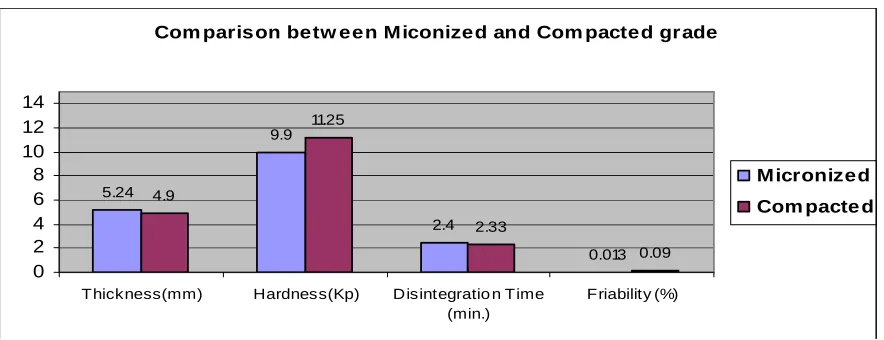
Tablets were prepared by following same procedure and same excipients content of tablets from formula F-5. Marked difference in dissolution was observed between two grade materials of active ingredients of same formulation. The tabletting parameter and dissolution data were showed in below table 4.17.
Table 4.15: The tabletting param eter and dissolution data of tablet with micronized and compacted grade of active ingredients of formulation F-5.
Grade of active ingredients Hardness Thickness Average weight Friability DT (min.) Dissolution (%)
Micronized 10.15±1.00 5.24±0.03 448.38 0.013% 2.40 100.89
Com parison betw een Miconized and Com pacted grade
5.24
9.9
2.4
0.013 4.9
11.25
2.33
0.09
0
2
4
6
8
10
12
14
Thickness(mm) Hardness(Kp) Disintegratio n Time (min.)
Friability (%)
Micronized
Com pacte d
Fig 4.10: Comparison of tabletting param eter between micronized and compacted grade of active ingredients in formulation F-5.
Comparison of dissolution
70
75
80
85
90
95
100
105
Micronized
Compacted
Grade of Active ingr e die nts
D
is
s
o
lu
ti
o
n
(
%
)
Fig 4.11: Comparison of dissolution (%) between micronized and compacted grade of active ingredients of formulation F-5.
3.5 Stability Studies
The stability studies were carried out at 40°C ±2°C and 75% RH ± 5% RH for accelerated condition in Alu- Alu blister pack according to ICH guide line. The samples were tested initially and the stability test has been completed up to 06 months at accelerated condition and the stability test has been completed up to 09 months at long term condition.
Table 4.16 Long term stability study report of Cefixime Trihydrate tablet at 30°C ± 2°C and 65% RH ± 5% RH.
Parameter Test result
Average weight Initial After 3 Months After 6 Months Specification
448.37 448.39 448.91 450 mg±3%
LOD (%) 7.48 7.53 7.64 Not more than 10%
Friability (%) 0.059 0.063 0.079 Less than 1%
Disintegration 3 min and 40 second 3 min and 04 second 2 min and 48 second NMT 15 minutes
Average dissolution (%) 100.89 100.31 98.88 Not less than 75 %
Drug content 202.38 199.221 197.304 180 mg – 220 mg/Tablet(90-110%)
Table 4.17 Accelerated stability study report of Cefixime Trihydrate tablet at 40°C ± 2°C and 75% RH ± 5% RH.
Parameter Test result
Average weight After 1 Month After 3 Months After 6 months
448.44 448.76 449.61
LOD (%) 7.69% 7.73% 8.03%
Friability (%) 0.059 0.130 0.191
Disintegration 3 min and 11 seconds 2 min 35 second 2 min 04 second
Dissolution (%) 97.09 93.47 88.89
4. DISCUSSION
For the formulation and development of Cefixime trihydrate tablet, different formulations with different excipiens and their different quantity were used in the formulations. Every formulation contains approximately 50 % active ingredients and other 50% comprises the used excipients. For achieving good tablet properties, the advantage of dry granulation method is applied due to high moisture content of cefixime and poor compressibility as well as process cost consideration. Dry granulation technique reduce the processing time which must be balanced against the uniformity requirements for the finished product as well as this can eliminate defects of the product and reduced processing times can improve productivity in manufacturing.
Flow properties of the powder can be judged from the angle of repose and Carr’s compressibility index. The powder flow depends on 3 general areas: (1) the physical properties of the particle (eg, shape, size, compressibility): (2) the bulk powder properties (eg, size distribution, compaction); and (3) the processing environment (eg, storage, humidity).The results revealed hat the granules exhibited passable and good flow from the view point of USP. Addition of 1.5 % of colloidal anhydrous silica (Aerosil-200) to the formulation and therefore, granulation is recommended to improve flow.
Pregelatinized starch, microcrystalline cellulose was used for developing rapidly disintegrating tablets and used sodium lauryl sulphate for improving dissolution of active pharmaceutical ingredients from solid dosage forms. The use of sodium stearyl fumerate with magnesium stearate as 10 % improved sticking problem. The combined effect of pregelatinized starch, microcrystalline cellulose and sodium lauryl sulphate provide fast disintegration and improved dissolution of active pharmaceutical ingredients. Moreover, compressibility of the formulation is an important attribute. To improve compressibility, the primary blend comprising active pharmaceutical ingredients with excipients except rest amount of lubricant were compressed on a fifteen-punch tablet machine (D-type) using the 22mm round punch and relatively high compaction pressure for slugging purpose. Formula F-2 containing Crospovidone and spray dried lactose formed thinner tablets (5.00 mm), while formula F-4 and F-5 containing microcrystalline cellulose and pregelatinized starch formed relatively thicker tablets (5.29, 5.24 mm respectively) [Table 4.1]. The diam eter of the tablets was 16.15 mm [Table 4.5]. The results of thickness measurement reveal that crospovidone exhibits better compressibility but shows severe sticking.
Dry granulation was employed to prepare tablets. In the slugging stage formula from F-1 to F-5, active ingredients with binder, diluent and disintegrant [Lactose (Spray dried), Microcrstalline cellulose, Crospovidone, Pregelatinized starch and Colloidal anhydrous silica, 50 % of lubricant (Magnesium stearate and Sodium stearyl fumerate)] were used for preparation of 22mm (diameter) round tablet. Then the prepared tablet was milled by passing through 3mm screen and then finally blended with rest amount of lubricant. In the preliminary trials, formula F-1and F-2 were prepared using crospovidone and spray dried lactose.This tablets containing extragranular disintegrant of either batch were prepared. The crushing strength, friability and disintegration time of this tablet were not satisfactory. But the tablets prepared using pregetinized starch showed a relatively faster disintegration time. Therefore, it was chosen for further studies.
The granules of formula F-3 to F-5 showed better flow. Here mentionable that active ingredients and excipients were all sieved through 18 mesh sieve and crushed through 3mm screen after slugging. So, it can be concluded that particle size distribution of the of excipients would be kept the same to avoid any tableting problem that is dependent on the flow of granules from hopper to die cavity.
One of the primary requirements of immediate release preparation is faster disintegration. It is well known to formulation scientists that the tablets with higher crushing strength show longer disintegration time.4 Table 4.9 reveals that tablets of formula F-5 showed longer disintegration time with the increase the hardness. So, it can be concluded that lower crushing strength shows faster disintegration time which complies primary requirem ents of immediate release preparation.
Tablets of formula F -5 were prepared and evaluated for crushing strength, percentage friability, and percentage friability has reduced from the previous formula (F-2 to F-4).
Table 4.1 and figure 4.3 reveals that the friability percentage F-5 < F-4 < F-3 < F-2. The reason may be due to incorporation of disintegrant and replacement of calcium hydrogen phosphate with colloidal anhydrous silica. The results shown in Table 4.1 demonstrates that the percentage friability reduction of the prepared tablets of F-5 were higher when the disintegrant and glidant (colloidal anhydrous silica) was added. The probable reasons could be facilitated flow and densification of the granule in die.
The tablets of formula F-5 exhibited acceptable crushing strength (10.5 Kp), satisfactory friability (0.013%),and fast disintegration (2 min 40 seconds). The in vitro dissolution study of tablets of formula F-5 revealed that complete drug release was obtained in 45 minutes (100.89%). The in vitro dissolution study of innovator, Suprax 200 mg tablet revealed that complete drug release was noticed in 45 minutes (98.13%) [Table 4.14].
Table 4.14 also revealed that the dissolution of F-5 was higher from the two market sample designed as MS -1(89.69%) and MS -2 (93.18%)). From the results of in vitro dissolution study of formula F -5 and Innovator’s tablet and marketed sample, it is evident that there is no noticeable difference in dissolution rate. The dissolution of formula F-5 was higher may be due to increased solubility of active ingredients by adding sodium lauryl sulphate, is surfactant acts as solubilizing agent.
Table 4.15 showed that the tablet prepared by compacted grade active ingredients exhibit lower dissolution and disintegration time than tablets prepared by micronized grade materials in formulation F-5.It can be said that small particles of active ingredients showed better dissolution result than compacted grade of active ingredients. A bioequivalence study was carried out using the tablets comprising Cefixime with a mean particle size between 20 μ and 120 μ against the commercially available oral suspension “Suprax” using six healthy volunteers gave a T/R ratio for AUC of about 100% indicating that the chewable tablet in this case had bioavailability equal to that of the suspension formulation. It may comply with that study.
Table 4.16 and 4.17 revealed that the formula F-5 showed good stability result after six month study at both long term and accelerated storage condition. The reason may be that each film coated tablet of formula F-5 are tightly packed in alu-alu blister pack with proper leak proof sealing which protect the tablet from light and environmental degradation.
The areas where further work can be done include process through wet granulation using a fluid bed dryer or microwave dryer for drying granules and preparation of tablets through direct compression technique using different excipients like binder and disintegrant in different ratios and using other combinations of superdisintegrants.
REFERENCES
1) Sweetman S.C. and Martindale, 1999. The Complete Drug Reference, 32nd ed., Pharmaceutical Press, London, 165-166.
2) Adam D, Hostalek U, Tröster K. (1995). "5-day cefixime therapy for bacterial pharyngitis and/or tonsillitis: comparison with 10-day penicillin V therapy". Infection 23 (Suppl 2): S83–6.
3) United States Pharmacopoeia, 30th ed, Rockville, M.D. USP convention Inc; 2007. p.1654.
4) Gohel MC, Jogani PD. A review of co-processed directly compressible excipients. J Pharm Pharm Sci. 2005; 8:76-93.
5) Manish P. Patel et al. Formulation and optimization of controlled released floating matrix tablets of cefixime.J. of Pharmacy Research. 2009; 2(6), 1110 - 1112.
6) Gandhi SP, Rajput SJ. Study of degradation profile and development of stability indicating methods for cefixime trihydrate. Indian J Pharm Sci 2009; 71:438-42