Online Credit Card Fraud Prevention
Sanket Bunage Garima Pandey
Terna Engineering College, Nerul (Navi Mumbai) Terna Engineering College, Nerul (Navi Mumbai)
Sonal Avhad Sarvesh Navandhar
Terna Engineering College, Nerul (Navi Mumbai) Terna Engineering College, Nerul (Navi Mumbai)
Prof. V. B. Gaikwad
Professor
Terna Engineering College, Nerul (Navi Mumbai)
Abstract
Security is the state of being free from danger or threat. In information technology, security is the protection of information assets through the use of technology, processes, and training. The cyber space is increasingly used by organized criminal groups to target credit cards, bank account and other financial instruments for fraudulent transactions. There are various processes through which we can keep our assets secure but the thing that differentiates us from fraudster is the access to the key call password. We set up our password as complex as we can that consist of lowercase and uppercase characters along with special characters to make our account and various information secure, but what if someone knows this password, are we secure then? The different procedures and legal status involved also suggests that the fraudsters are keenly aware of the different risks, if banks are to protect themselves transactions that are irreversible must be made hard to repudiate. To achieve this we have come with a solution PASSTAB SYSTEM. PASSTAB is TABular PASSword based tracking and central user login control system within the browser where we can add up different accounts we want to access securely. PASSTAB SYSTEM will not only secure the login for the account ID’s we add, but will also maintain a log of user activities for the same. This web-app will act as an intermediate layer of security between user and site’s traditional login; allowing users to access the account securely. PASSTAB SYSTEM’s login system will be different from the existing one’s i.e Username and Password; it will allow the user to login to system via a unique concept of Table based password, eliminating the use of keyboard thus guarding against various key logger viruses, phishing etc. There are many more features such e-statement, OTP, IP address tracing, face recognition in the system. Securing the secured is the main aim of this system.
Keywords: Secure Login, Key-Logger, Phishing, Tabular Password, credit card frauds, Web-App, face recognition ________________________________________________________________________________________________________
I. INTRODUCTION
Today technology is basic mandatory need of human. Just look around and you will know why. Literally, at every instant of time, you are surrounded by technology. Today there is no such place where technology is not present. Due to technology communication is easy and quick, travel is fast, and movements are also fast. There are lots of advantages of technology, but with that it causes online Fraud also. Fraud is behavior of human which is out of rule and causes crime.
One of the biggest facility provided by technology is that we can able do a shopping using various facility provided by bank e.g. Credit Card, Debit Card, Internet Banking etc. Here is major chance for fraud. Credit card becomes the most popular mode of payment for both online as well as regular purchase so mostly frauds happen in Credit Card System. A Credit Card Fraud is a transaction that is complete with your credit card by someone else.
Credit card fraud happens when someone steals your credit card, credit card information, or Personal Identification Number (PIN), and uses it without your permission to make purchases in stores, online or by telephone, or to withdraw money from an automated bank machine (ABM).
Many modern techniques based on Artificial Intelligence, Data mining, Neural Network, Bayesian Network, Fuzzy logic, Support Vector Machine, Decision Tree, Genetic Programming etc., has evolved in detecting various credit card fraudulent transactions. Each method is having its own pros & cons.
II. THREATS TO CURRENT LOGIN SYSTEM
Preliminaries:
There are two types of card related frauds. First is online fraud and second is offline fraud. Offline fraud is done by using a stolen physical credit card. In Online fraud only the card details are required. It can be done by internet, phone shopping or cardholder not- present.
Frauds:
Phishing:
Phishing is a financial crime that starts with massive numbers of deceptive spam e-mails.
Key Logger:
is a piece of software or, even scarier, a hardware device that logs every key you press on your keyboard. It can capture personal messages, passwords, credit card numbers, and everything else you type.
Stolen Cards:
When a credit card is lost or stolen, it may be used for illegal purchases until the holder notifies the issuing bank and the bank puts a block on the account. Most banks have free 24-hour telephone numbers to encourage prompt reporting. Still, it is possible for a thief to make unauthorized purchases on a card before the card is cancelled. Without other security measures, a thief could potentially purchase thousands of dollars in merchandise or services before the cardholder or the card issuer realizes that the card has been compromised.
Shoulder Surfing:
It refers to using direct observation techniques such as looking over someone's shoulder, to get information. It is commonly used to obtain passwords, PINs security codes.
Site Cloning:
Site cloning is where fraudsters clone an entire site or just the pages from which you place your order. Customers have no reason to believe they are not dealing with the company that they wished to purchase goods or services from because the pages that they are viewing are identical to those of the real site. The cloned or spoofed site will receive these details and send the customer a receipt of the transaction via email just as the real company would. The consumer suspects nothing, whilst the fraudsters have all the details they need to commit credit card fraud.
False Merchant Sites:
These sites often offer the customer an extremely cheap service. The site requests a customer’s complete credit card details such as name and address in return for access to the content of the site. Most of these sites claim to be free, but require a valid credit card number to verify an individual’s age. These sites are set up to accumulate as many credit card numbers as possible. The sites themselves never charge individuals for the services they provide. The sites are usually part of a larger criminal network that either uses the details it collects to raise revenues or sells valid credit card details to small fraudsters.
Credit Card Generators:
Credit card number generators are computer programs that generate valid credit card numbers and expiry dates. These generators work by generating lists of credit card account numbers from a single account number. The software works by using the mathematical Luhn algorithm that card issuers use to generate other valid card number combinations. The generators allow users to illegally generate as many numbers as the user desires, in the form of any of the credit card formats, whether it be American Express, Visa or MasterCard.
III. FRAMEWORK AND OVERVIEW OF PROPOSED SYSTEM: PASSTAB SYSTEM
The primary purpose of this PASSTAB system is to protect the login gateway from unauthorized access. With Increase in number of cyber-crimes taking necessary precautions has become necessary. Even after implementation of these security steps, sites are vulnerable to various attacks. Various steps have been undertaken as an effort to increase the security level but still none of the methods implemented achieve higher success.
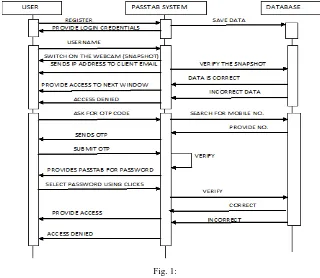
PASSTAB System stands for TABular PASSword based tracing and Login SYSTEM. It’s a Central Login System that acts as an intermediate security layer between user and sites traditional login system. Once logged in to the PassTab system user can add up different accounts he want to access securely. PASSTAB SYSTEM will not only secure the login for the account ID, but will also maintain a log of user activities for the same. This Login system comprises of username and password, also various sites forces user to follow certain guidelines while setting up user id and password. Various sites also have their own inbuilt security mechanism to prevent leakage of data.
As soon as user sets up a new account for PassTab system he will be asked to allow his webcam to capture his face to store it as password. After successfully completion of this step the password will be stored in the database. That’s the one part of this login, as discussed above about inbuilt security mechanism PassTab system will also have some more. Now the question arises is what if an user doesn’t have an webcam? In this case he will be forced to use Tabular Matrix system for Login (discussed later in this paper). The Same tabular matrix method of login will be used as PassTab System’s Main Login Option.
given a set of few tabular matrix and she/he will have to enters the right sequence of Accepting Clicks and Rejecting Clicks, which she/he has previously selected. User will also have the option of setting up normal password rather than setting up accepting click.
Fig. 1:
IV. WORKING MECHANISM OF LOGIN SYSTEM
As stated at the start of this paper most of the site makes use of normal login i.e username and password and that is one of the major reason why such sites are easy target for attackers as these passwords can be captured by various key logger viruses and also by other tricks. Taking this into consideration we have made use of Tabular Matrix Based Login. In this mode a tabular matrix of specified size will be used allowing the user to set up a password consisting of special characters, numbers or alphabets.
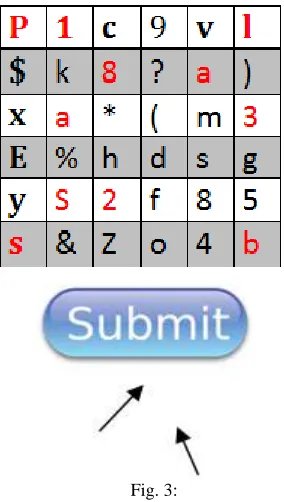
During the time of login a tabular password of specified size will be displayed to the user having random letters, numbers or special characters, now user have to accept the tabular matrix if it contains all the characters of user password or else he simply has to reject it. Out of all tabular matrix displayed by the system for login, only one will contain all the characters of the right password. Even the acceptance and rejection will not be keyboard based as it can be captured, instead mouse clicks will be used. The Acceptance and rejection of right or wrong matrix will be based on the Accepting clicks and Rejecting Clicks.
Example:
Case 1:
Fig. 2:
Rejecting Click: Left Click-Right Click:
In this case the matrix of 6 X 6 does not contain all the characters of the user defined password, So the user has to reject this one in order to tell the system that this is not the correct one. This rejection will be performed by the user using Rejection Clicks. In current scenario let us assume rejecting click sequence first Left click and then Right click. This click sequence will be used for rejecting a matrix. There’s a strong possibility that the password shown might not be right i.e. it might not have all characters of the user’s defined password in such case user has to reject it, this will be done by Reject Clicks. Rejecting a tabular password will display another password that might contain the right set of characters. The use of Accepting and Rejecting clicks will ensure that any guess attempts to login to the system will not be as easy as compared to a single click for accepting and rejecting a matrix. It will create a large of probabilities for the right sequence along with the right matrix.
Case 2:
Fig. 3:
Accepting Click: Right Click-Left Click:
This Click pattern will be used to accept the right password i.e. selecting the tabular password that has all the characters of the user’s defined password. Accepting clicks refer to the sequence of mouse clicks. For Instance- Assume user has defined the password for his/her main login as “PASSWORD” and has defined AP as “Right Click, Left Click”. Then at the time of login a password will be displayed to the user, if the table consists of all the characters of the password i.e. “PASSWORD” the user simply has to click the right sequence of Accepting Click set by him. Wrong sequence will keep the user at the same screen, thus securing the profile.
V. HOW THE PASSTAB IS SECURE
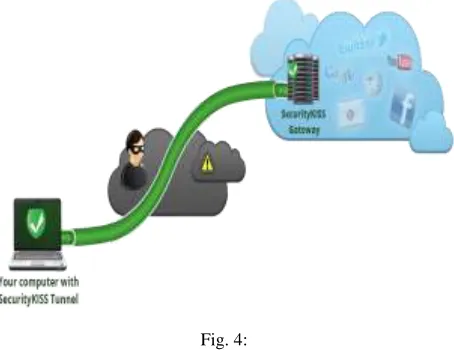
This entire system is very secure as it makes use of all these various security features. It increases the level of security when compared with the existing implemented security steps. The use of Matrix for entering the right password along with the use of Accepting Clicks and Rejecting Clicks makes it very difficult to guess the password of the user even if the person is looking at the screen while user enters the password. Even if by any mean the password is revealed, the large number of possibility of click sequence will make it difficult for the attacker to get in to the main system easily. The use of Dead and Login mode after successful matrix login also levels up the security. Not only has this PassTab System also provided Track Log feature which will keep a log of all the user activities on the accounts in the secure list. It will capture the screens without user’s awareness for the purpose of record keeping. Both of this – Screenshots as well Logs of user activities will be mailed to the user’s registered mail id. Thus even in the rare case of security breach all the activities of the user will be captured.
Fig. 4:
VI. INTENDED AUDIENCE AND READING SUGGESTIONS
The different types of reader that the document is intended for are the Project guide, Project Mentor and Professors. The rest of this SRS contains the overall description of the application also functional
VII.PRODUCT SCOPE
The entire system enables a strict security. Threats from Key-Logger Virus, Rats, Dictionary Attack and many others will not be possible. This System thus accomplishes its motto of providing security to the Security.
VIII. FEASIBILITY ANALYSIS
Since the system to be deployed is cross-browser and cross-OS compatible, it can be used for wide range of purposes by various enterprises where there is need for the secure login. As the system to be developed doesn’t need any licensed software or product for its making, the system is financially viable. It can be sold to the clients in low price.
Since the system to be deployed is cross-browser and cross-OS compatible, it can be used for wide range of purposes by various enterprises where there is need for the secure login. As the system to be developed doesn’t need any licensed software or product for its making, the system is financially viable. It can be sold to the clients in low price.
IX. ADVANTAGES OF PROPOSED MODEL
1) Lost and stolen card feature makes it easier to stop fraudulent transactions
2) Credit card validation checks detects errors in a sequence of numbers, hence detects valid an invalid numbers easily 3) IP tracking gives details of customer’s country
5) Repeated IP (RIP) check restricts customer from using a card within small interval of time
6) Security code provides protection from skimmers. Security code ensures that the person submitting the transaction is in possession of the actual card.
X. CONCLUSION
As far as developing countries are concerned, they have not yet designed any hard and fast secure payments with credit card fraud prevention. The proposed system provides the ability to prevent fraudulent and legitimate transactions. The proposed system is user friendly and secure. The proposed system provides the ability only to the legitimate user to execute transaction. The entire system enables a strict security. Threats from Key-Logger Viruses, Rats, Dictionary Attack and many others will not be possible. This System thus accomplishes its motto of providing security to the Security.
REFERENCES
[1] Linda Delamaire, Hussein Abdou and John Pointon, “Credit Card Fraud and Detection Techniques”, bank and bank systems, vol.4,no.2,pp.57-68, 2009. [2] Clifton Phua, Kate Smith-Miles, Vincent Cheng-Siong Lee and Ross Gayler, “Resilient Identity Crime Detection”, IEEE Transactions on Knowledge and
Data Engineering, vol.2, no. 3,pp.533-546, 2012.
[3] Experian Detect: Application Fraud Prevention System, Whitepaper, http://www.experian.com/products/pdf/experian_detect.pdf, 2008. [4] ID Analytics, “ID Score-Risk: Gain Greater Visibility into Individual Identity Risk, “Unpublished, 2008.
[5] Richard J.Boltan and David J.Hand, “Statistical Fraud Detection”, pp.1-54, 2002.
[6] I. Witten and E. Frank, “Data Mining: Practical Machine Learning Tools and Techniques with Java” , Morgan Kauffman, 2000. [7] International Journal of Scientific and Research Publications, Volume 5, Issue 4, April 2015 1 ISSN 2250-3153
[8] W. Wong, A. Moore, G. Cooper and M. Wagner, “Bayesian Network Anomaly Pattern Detection for Detecting Disease Outbreaks”, Proc.20th Int‟l Conf. Machine Learning, pp.808-815, 2003.
[9] P. Brockett, R. Derrig, L. Golden, A. Levine and M. Alpert, “Fraud Classification Using Principal Component Analysis of RIDITs”, The J.Risk and Insurance, vol.69, no. 3, pp.341-371, 2002.