Page 25 www.ijiras.com | Email: [email protected]
Autistic Learners' Inclusion In The Universal Basic Education
Programme In Nigeria
Obasi, Kenneth Kelechi (Ph.D.)
Faculty of Education, University of Port Harcourt, Choba, Rivers State, Nigeria
I. INTRODUCTION
The right to education as espoused by the United Nations 1948 Universal Declaration of Fundamental Human Rights, provided the leverage for a series of conventions and other fora that have been at the vanguard of this all-important course. The World Conference on Education for All (EFA) held in Jomtien, Thailand in 1990, with the title ―World Declaration on Education for All and Framework for Action to meet Basic Learning Needs‖ is a case in point. The 1990 Declaration, gave a definitive directive to the cause of education as a fundamental human right. This right stems from the invaluable contributions of education to the life of an individual. The United Nations General Assembly in its introduction of the Declaration, stated inter alia ―whereas recognition of the inherent dignity and of the equal and inalienable rights of all members of the family is the
foundation of freedom, justice and peace in the world (Olakanmi, 2007:17).
Education is critical to the development of the latent capacities in the human person for the improvement of his productive capacity and also to participate actively in the society. Education, is therefore, the key to freedom from subjugation, fear and want. It is an effective weapon to fight poverty, both of the mind and material. It saves lives and gives people the chance to improve their lives and also gives people a voice. Education increases a nation‘s productivity and competitiveness and also instrumental for social and political progress (UNESCO, 2002). Ipso facto, the denial of this basic right is a crime to the individual because, such a denial, on whatever pretext, technically excludes him or her from living a fulfilled life and self-actualization. It is on this premise, and sequel to that 1948 momentous Declaration, that Nigeria, in 1999, universalized education at the basic level (primary and junior secondary), made it free and compulsory.
Abstract: The study titled Autistic Learners Inclusion in the Universal Basic Education Programme in Nigeria, investigated the level to which children with autistic spectrum disorder (ASD) are provided for in the Universal Basic Education programme in Nigeria. Out of the six geo-political zones of the country that make up the 36 states, two zones (South South and South East with 11 states), were sampled for the study. A sample size 342 respondents (33 staff of the UBE Board and 309 Head Teachers of the UBE schools) were used. Stratified simple random technique was adopted. The instruments for the generation of data were Questionnaire, Interview and Observation. The questionnaire was adequately validated and the reliability was established at 0.84 through the test, re-test method using Pearson Product Moment Correlation. Mean and z-test were used to analyze the data. The study, among other things, revealed the following: policy provision on the education of children with autism is grossly inadequate. Again, children with autism, are not provided for in the regular schools. On the strength of the findings, the study therefore recommended that the government and the relevant agencies should make comprehensive policies that can guarantee that children with autism are effectively provided for in the UBE programme. Also, children with autism should be adequately provided for in the regular schools and private schools based on the choices of parents and other social considerations.
Page 26 www.ijiras.com | Email: [email protected] The basic objective of the Universal Basic Education
(UBE) programme include ensuring that every Nigerian child acquires appropriate levels of literacy, numeracy, communicative and life skills, as well as the ethical, moral and civic values needed for laying a solid foundation for lifelong learning (FRN, 2014). Obviously, the UBE programme is a critical strategy designed and packaged to ensure that every Nigerian child of school age has unhindered access to basic education, irrespective of the child‘s circumstance in life, such as gender, physically ability and capacity, religion or socio-economic background.
The logical consequence of the programme is that the learning needs of every Nigerian child must be given adequate consideration without any form of discrimination. The obvious implication is that the principles and practice of inclusive education must be invoked in the implementation of the UBE programme. This is in tandem with the UNESCO convention against Discrimination in Education (1960) and other human right treaties. They prohibit any exclusion from, or limitation to educational opportunities on the basis of socially ascribed or perceived differences such as gender, ethnic origin, social origin, economic condition, ability etc (UNESCO, 2013). Hence, the practice of inclusive education guarantees the equalization of access to education. Access to education guarantees everyone entitled to education to receive it. It implies the right or opportunity of making education available within the reach of every citizen of a nation. It presupposes that every child shall have the right to equal educational opportunity, irrespective of any real or imagined disabilities (Enaohwo, 2009). The Federal Republic of Nigeria (2014), in her National Policy on Education (NPE), was very specific on the provision of inclusive education. The policy in specifying the objectives of ‗special education‘, stated among other things, to give concrete meaning to the idea of equalizing educational opportunities for all children, their physical, sensory, mental, psychological disabilities, notwithstanding. It aims to provide adequate education for all people with special needs, in order that they may fully contribute their own quota to the development of the nation. In the same vein, the Republic of South Africa, in her White Paper on Special Needs Education for the promotion of inclusive education recommended that differences in children have to be acknowledged and respected, no matter the health status, gender, class or disability of the child (Mentz & Barret, 2011).
‗Inclusive education‘, is therefore, a process of addressing and responding to the diversity of needs of all learners, through increasing participation in learning. It involves changes and modifications in content, approaches, structures and strategies with a common vision which covers all children, and it is the responsibility of the regular system to educate all children (UNESCO, 2005). Toeing the same line, Florida State University Center for Prevention and Early Intervention Policy (2002), described ‗inclusive education‘ as the effort to make sure students with disabilities go to school along with their friends and neighbours while also receiving whatever specially designed instruction and support they need to achieve standards and succeed as learners. This position corroborates the descriptions of ‗inclusive education‘ by the National Center on Education Restructuring and Inclusion as cited in FUS (2002). According to the Center, ‗inclusive
education‘ entails providing to all students, including those with significant disabilities, equitable opportunities to receive educational services with the needed supplementary aid and support services in age appropriate classrooms in their neigbhourhood schools, in order to prepare students for productive lives as full members of the society.
Basically, ‗inclusive education‘ is comprehensive with the capacity to accommodate and address the diverse needs of the learners. It is on this premise that McManis (2017) stated that when all students, regardless of any challenges they may have, are placed in age-appropriate classes that are in their own neighbourhood schools to receive high quality instruction interventions and supports that enable them to meet success in the core curriculum. The school and classroom operate on the premise that students with disabilities are as fundamentally competent as students without disabilities. Hence, all students can be full participants in their classrooms and in the local school community. It is concerned with the provision of the learning needs, in formal and non-formal educational system of a society. Rather than being a marginal concept on how some learners can be integrated in the mainstream education, inclusive education is an approach that looks into the best way to transform education systems in order to respond to the diversity of learners. The purpose is it to enable both the teachers and the learners to be comfortable in diversity and to manage it as a challenge and enrichment in the learning environment, rather than a problem (UNESCO, 1996). The journey to becoming an inclusive school may be long and challenging at times, but ultimately, this journey can strengthen a school community and benefit all children. The process of inclusion must incorporate fundamental change in the way the school community supports and addresses the individual needs of each child. Hence, effective models of inclusive education not only benefits students with disabilities, but also create an environment in which every student, including those who do not have disabilities has the opportunity to flourish. One of the most important principles of inclusive education is that no two learners are alike, and so, inclusive schools place great importance on creating opportunities for students to learn and assessed in a variety of ways. Inclusive education for students with disabilities can only be successful when those students feel that they are truly a part of school community (Inclusive School Network, 2017). The systematic failure to adopt this approach would definitely lead to exclusion which is discriminatory in its nature and tantamount to the violation of an individual‘s fundamental right. The global issue has become very urgent and critical with more than one billion people around the world of whom about 95 million are children, live with some form of disability. Societies misperception of different forms and types of disability and the limited capacity of social actors to accommodate special needs, often place people on the margin (UNESCO, 2013).
Page 27 www.ijiras.com | Email: [email protected] described autism as a complex developmental disability which
manifests during the first three years of a person‘s life. This condition is as a result of neurological disorder which affects the normal functioning of the brain and consequently, impacts negatively on the person‘s communication and social interaction skills. Persons with autistic spectrum disorder have issues with non-verbal communication, and wide range of social interactions and also activities that involve an element of play and or banter. It further observed that if the symptoms of ASD are not severe, the individual may seem socially clumsy, sometimes offensive in his/her comments or out of synch with everyone else. However, if symptoms are severe, the person may seem not to be interested in other people at all. Durand (2004:2) defined autism as ―a pervasive developmental disorder characterized by varying degrees of impairment in language and communication skills, social interactions, restricted, repetitive and stereotyped pattern of behaviour‖. The National Institute of Mental Health (2016), clearly highlighted some of the basic characteristic, signs, symptoms, strengths and abilities of people with autism, which have some implications for their education. The characteristics include difficulty in communicating and interacting with others, repetitive behaviours as well as limited interests, symptoms that hurt the individual‘s ability to function socially at school. Some of the signs and symptoms include the repetition of certain behaviours or having unusual behaviours, having overly focused interests such as with moving objects, having a lasting, intensive interest in certain topics, such as numbers, details or facts. In their social communication/interaction behaviours, they get upset by a slight change in the routine or being placed in a new or overly stimulating setting. Also, they have little or inconsistent eye contact, rarely share enjoyment of objects or activities by pointing things to others, they fail to or slowly respond to someone calling their name or other verbal attempts to gain attention, they have facial expressions, engage in movements and gestures that do not match what is being said. Their strengths and abilities, according to the institute include being able to learn things in details and remember information for long periods of time, being strong, visual and auditory learner and they excel in Mathematics, science and music.
The proper understanding of the common characteristics of individuals with autistic spectrum disorder is critical to their education. To that extent, Autism Speaks (2016) remarked that each individual with autism is unique. However, many of the individuals with autism spectrum have exceptional abilities in visual skills, music and academic skills. Since all children with autism have social communication problems, American Speech – Language – Hearing Association (ASHA) (2016) recommended the use of augmentative and alternative communication (AAC) such as sign language, gestures, pictures, photos, objects, or videos, written words, computer, tablets or other electronic devices. Hensley (2016) provided some teaching strategies in the education of autistic children. They include the use of task analysis – being very specific, presenting tasks in sequential order; the use of simple and concrete language; give fewer choices. For instance, if a child is asked to pick a colour, give him two to three choices only to pick from. The more choices, the more confused an autistic child becomes, avoid the use of idiomatic expressions, give
very clear choices and try not to leave choices open ended. For instance, instead of asking an autistic child ―what do you want to do now?‖; ask him/her ―Do you want to read or draw?‖; repeat instructions and checking understanding. Use short sentences to ensure clarity of instructions, provide warning of any impending change of routine or switch of activity, use different means of presentation – visual, physical guidance, peer modeling etc; strive to link work to the pupil‘s particular interests, explore word-processing and computer-based learning for literacy. To ensure that the right and adequate support is provided, the National Autistic Society (2015) cautioned that children and young people with autism are likely to have special education needs (SEN) or additional support needs (ASN). Consequently, they are entitled to extra help and support in school. It is therefore important for a school to ensure that all staff are aware of a child or young person‘s needs and the strategies and interventions to be used with them. Children with autism feel more comfortable when they have a routine with clear structures and minimal deviations from their predicted schedule. Make sure the learning environment and lesson plans are structured in a manner that tells the students as well as educators what is to be done, for how long or how much, when it needs to be done, for how long or how much, when it needs to be done, when it is to be completed and what comes next. You need to help children with ASD develop the knowledge and skills required for social interaction, both at home and in school (Jandyala, 2017).
II. THE PROBLEM
The introduction of the Universal Basic Education (UBE) programme by the government of the Federal Republic of Nigeria over one and half decades ago, is a deliberate effort in safeguarding the fundamental right to education irrespective of a child‘s circumstance in life and also for human capacity building. One critical strategy in ensuring the equalization of access to basic education is the adoption of ‗inclusive education‘, which is a deliberate process of addressing and responding to the diverse learners‘ needs. However, the researchers are bothered about the level of inclusion of a particular group of children who are challenged by autism spectrum disorder (ASD), a psycho-social developmental provision. Very sadly, many of the children with autism who are of school age are left at home, some are in and out of schools, while others are found in private special schools. The researchers therefore ask: what is the level of their inclusion in the UBE programme? Are there provisions made for their inclusion in the regular schools in terms of physical facilities, teacher provision and administrative strategies for their effective management?
Page 28 www.ijiras.com | Email: [email protected] Specifically, the objectives of the study were to find out the
following:
The policy provisions on the education of children with autism in the UBE programme.
How children with autism are provided for in the UBE programme.
The special instructional materials provided for the education of children with autism in the UBE programme.
The administrative strategies adopted in the management of autistic children in the UBE schools.
The challenges inhibiting the effective education of autistic children in the UBE programme.
IV. RESEARCH QUESTIONS The following research questions guided the study:
What are the policy provisions for the education of children with autism in the UBE programme?
How are children with autism provided for in the UBE programme?
What are the special instructional materials provided for the education of children with autism in the UBE programme?
What are the administrative strategies adopted in the management of autistic children in the UBE schools? What are the challenges inhibiting the effective education of autistic children in the UBE programme?
V. HYPOTHESES
This hypothesis was tested at 0.05 alpha level of significance.
There is no significant difference among the states of Nigeria with respect to the how children with autism are for in the UBE programme.
VI. METHODOLOGY
The study adopted the descriptive survey design. The population was all the 36 states of Nigeria. The population of the respondents was all the management staff of all the State Universal Basic Education Board (SUBEB), and the Principals and Head Teachers of the basic education schools. The sample of the study was the South – South and South East geo-political zones of Nigeria which are made up of 11 states. A sample size of 342 respondents (33 staff of the UBE Boards and 309 Head Teachers of UBE schools) were used. Stratified random sampling technique was adopted. The instruments for data collection were self-structured questionnaire, interview and personal observation. The questionnaire was properly validated and the reliability established at 0.84 through the test, re-test method using Pearson Product Moment Correlation. The data generated were analyzed using mean and z-test.
VII. RESULTS
S/N ITEMS MEAN SD
1 Policy provisions on the education of children with autism in the UBE
programme
a There are policies on how children with autism are to be provided for in
the UBE programme
2.78 2.96
b There are policies on the responsibilities of schools towards
children with autism
3.50 3.21
c There are policies on the provision of special teachers for children with
autism
3.48 3.11
d There are policies on the provision of support staff for children with
autism
2.27 0.82
Table I: The mean responses on the policy provisions on the education of autistic children in the UBE programme Table I shows that out of the four areas identified for policy provision, the responses show that items a and c are provided for with mean values of 2.78 and 3.48 which are above the criterion mean of 2.50. However, the data show that items b and d with mean values of 2.25 and 2.27 are not provided for by the policies.
S/N ITEMS MEAN SD
2 How children with autism are provided for in the UBE
programme
a Children with ASD are provided for in the regular schools
1.83 2.83 b Children with ASD are provided for
in the special schools
3.25 3.15 c Children with ASD are provided for
in both the regular and special schools
2.26 1.44
Table II: The mean responses on how children with autism are provided for in the UBE programme
Table II reveals that item b was accepted with a mean of 3.25 which is above the criterion mean. Items a and c with mean values of 1.83 and 2.26 respectively were not accepted as their values are below the criterion mean.
S/N ITEMS MEAN SD
3 The following instructional materials are provided for the education of
children with ASD in the UBE programme
i Real object 3.48 3.11
ii Colour photographs 3.25 3.15
iii Colour pictures 3.62 3.00
iv Black and white pictures 3.25 3.15
v Line drawings 2.53 1.40
vi Graphic symbols 2.78 2.96
vii Written language 2.98 2.95
viii Software packages for quick access to
visual aids and symbols
2.00 2.06
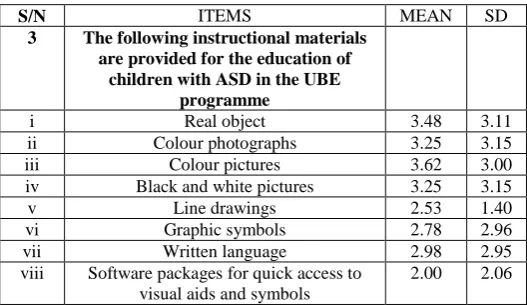
Table III: The mean responses on the special instructional materials provided for the education of children with autism in
Page 29 www.ijiras.com | Email: [email protected] Table III shows that items i, ii, iii, iv, v, vi and vii with
mean values of 3.48, 3.25, 3.62, 3.25, 2.53, 2.78 and 2.98 respectively are adequately provided, but item viii with a mean value of 2.00 is not.
S/N ITEMS MEAN SD
4 The administrative strategies put in place in the management of children with ASD in the UBE programme
a Teachers with special training in
working with students with autism that support classroom teachers are provided
3.00 1.67
b Speech and language pathologists are
provided to take care of the communication needs of the children
with autism
1.90 1.89
c Teacher assistants are assigned to work
in classes with students with autism
2.80 1.90
d Training is regularly organized for staff
that look after children with autism
3.10 1.80
e All the children are meant to develop an
understanding of the medical challenges and the special needs of the other
children with autism
2.98 2.87
f There is an individual education plan
(IEP) for children with autism
1.90 1.89
g The IEP is developed through
collaboration by a team of experts
2.98 2.95
h There is a platform for collaboration
between the school and the home for the management of children with autism
2.83 2.76
i There is open communication channel
between the school and the parents to know what they think will help their child feel more comfortable in school
3.62 3.00
Table IV: The mean responses on the administrative strategies adopted in the management of autistic children in the UBE
programme
Table IV reveals that of the nine identified management strategies, items a, c, d, e, g, h and I with mean values of 3.00, 2.80, 3.10, 2.98, 2.98, 2.83 and 3.62 respectively are adopted. Items b and f with mean values of 1.90 and 1.90 respectively are not utilized.
S/N ITEMS MEAN SD
5 The following challenges inhibit the effective education of children
with autism in the UBE programme
i Poor/inadequate policy provision 2.76 2.09 ii Inadequate qualified teachers 2.65 1.82 iii Inadequate support staff 2.54 1.71 iv Inadequate instructional materials 2.59 1.78
v Lack/ inadequacy of speech and language pathologists
2.61 1.98 vi Social pressure on families forcing
them to keep back their children with autism
2.72 2.01
vii Poor collaboration between the school and the home
2.98 2.11 viii Poor awareness on the management
of children with autism on the part of the parents
3.33 2.41
Table V: The mean responses on the challenges inhibiting the effective education of autistic children in the UBE programme Table V identified eight different possible challenges. The data show that all those challenges with mean values of 2.76, 2.65, 2.54, 2.59, 2.61, 2.72, 2.98 and 3.33 actually impede the effective education of children with autism.
N Mean SD df z-cal z-crit
Sign Level
Remark
Head Teachers
309 2.45 2.56 340 0.079 1.96 0.05 Accepted
UBE Staff
33 2.47 2.42
Table VI: Z-test of difference with respect to how children with autism are provided for in the UBE programme Table VI shows that the hypothesis was accepted because the z – calculated (0.079) is below the z – critical which is 1.96.
VIII. DISCUSSION OF FINDINGS
On the provision of policies to ensure that children with autism are catered for, the study showed that though children with autism are not specifically captured. The policy was on all children without discrimination as espoused in the National Policy on Education. It stated that every Nigerian child shall have equal educational opportunities irrespective of any real or imaginal disabilities according to his or her ability. Also, the policy stipulated that teacher education shall continue to be expanded to alsso cater for the requirements of special education (FRN, 2004). The study also showed that children with autism spectrum disorder; together with other children with disabilities are not provided for in the regular schools. Rather, special schools are set up for them. Many of them are also found in private special schools with little government support. However, this is contrary to the United Nations Standard Rules on the Equalization of opportunities for persons with disabilities. It stated that all governments, should as a matter of law or policy adopt the principle of inclusive education, enrolling all children in regular schools unless there are compelling reasons for doing otherwise (UNESCO, 1994). The study revealed that in these special schools, most of the basic instructional materials are adequately provided to ensure the effective education of children with autism and the other children with autism and the other children with special needs. This corroborates with the recommendations of the American Special – Language – Hearing Association (2016). It recommended the use of augmentative and alternative communication (ACC) such as sign language, pictures photos, objects, written words, tablets, computers and other electronic devices.
Page 30 www.ijiras.com | Email: [email protected] Finally, the study identified some of the challenges
inhibiting the effective education of children with autism such as poor policy provision, dearth of qualified teachers and ignorance among some parents in managing the education of their children with autism.
IX. CONCLUSION
The study made the following conclusions on the basis of the findings:
Policy provisions on the education of children with autism in the UBE programme is grossly inadequate.
Children with autism are not provided for in the regular schools in the UBE programme.
Most basic instructional materials that can facilitate the education of children with autism are adequately available.
Some international best practices strategies for the management of the education of children with autism are adopted in the special schools.
Some of the challenges that inhibit the effective education of the children with autism in the UBE programme include: poor policy provision, inadequacy of qualified teachers and support staff, social pressure of homes that have children with autism.
X. RECOMMENDATIONS
Based on the findings of the study, the following recommendations were made:
The government and the relevant agencies should make comprehensive policies that ensure that children with autism are adequately provided for in the UBE programme.
Children with autism should be adequately provided for both in the regular schools and special school based on the choice of parents and other social considerations.
More teachers, and support staff should be adequately trained and continuously retrained for the effective education of children with autism.
There should be proper orientation of all staff and other students/pupils on the awareness of the special needs of children with autism.
Parents who, out of social pressure, impede their children from accessing basic education should be prosecuted according to the provisions of the UBE Act.
REFERENCES
[1] American Speech – Language – Hearing Association (2016). Autism. Retrieved from: http://www.asha.org/ public/speech/disorders/Autism/#SIX
[2] Anyanwu, S. C. (2011). Management of children with autism spectrum disorders in special schools in Rivers State. Unpublished M.Ed. Thesis, University of Port Harcourt.
[3] Autism Speaks (2016). What is autism. Retrieved from: https://www.autismspeaks.org/what-is- autism
[4] Durand, V. (2004). Abnormal psychology: an integrative approach. New York: Thompson Wadsworth
[5] Enaohwo, J. O.(2009). Access, cost and quality in Nigerian education. In B.G. Nworgu & E.I. Eke(Eds.) Access, quality and cost in Nigerian education: The Nigerian Academy of Education(3-19). Abuja: NERDC [6] Federal Republic of Nigeria (2014). National policy on
education. Lagos: NERDC
[7] Florida State University Center For Prevention and Early Intervention Policy. (2002). What is inclusion. http://www.cpeip.fsu.edu/ resource
[8] Hensley, P. (2016). Tips for teaching students with autism spectrum disorder http://teaching.monster.com/benefits/ articles/8761-22-tips-for-teaching-students-with-autism-spectrum-disorder
[9] [9] Inclusive Schools Network (2017). Together we learn better: inclusive Schools benefit all children. Retrieved from: https://inclusiveschools.org/together-we-learn-better-inclusive-schools-benefit-all-children
[10] Jandyala, D.(2017). 10 tips for teaching young children with autism spectrum disorder. Retrieved from: blog.stageslearning.com/blog/10-tips-for-teaching-young-children—with-autism-spectrum-disorder
[11] Medical News Today (2015). What is autism http://www.medical news today.com/info/autism
[12] McManis, L. D. (2017). Inclusive education: what it means, proven strategies, and a case study. Retrieved from: https://educationcu-portland.edu/blog/classroom-resources/inclusive-education
[13] National Autistic Society(2015).Autism:a resource pack
for school staff. Retrieved from:
www.autism.org.uk/teacherpack
[14] [14] National Institute of Mental Health (2016). Autism Spectrum Disorder: http:www.nimh.nih.gov/health/topics/ autism-spectrum-disorders-asd/index.shtml
[15] Olakanmi,O.(2007). Handbook on human rights. Abuja:LawLords
[16] UNECSO (1994). The Salaman Statement and Framework for Action on Special Needs Education. Retrieved from http://www.unesco.org/edu/pdf/ SALAMANCAE_PDF
[17] UNESCO (2005). Guidelines for Inclusion: Ensuring Access to Education for all. Retrieved from http://unescodoc.unesco.ord/images/0014/001402/14022e. pdf