AFFINE INVARIANT DESCRIPTORS AND
RECOGNIZING
OF 3D OBJECTS USING STATISTICS
METHODS
1M. ELHACHLOUFI , 1A. EL OIRRAK, 2D. ABOUTAJDINE , 1M.N. KADDIOUI
1 Faculty Semlalia , Department of Informatics, Marrakech, Morocco
2 Faculty of Science, LEESA-GSCM, BP 1014, RABAT
E-mail: [email protected] , [email protected], [email protected], [email protected]
ABSTRACT
The increasing number of objects 3D available on the Internet or in specialized databases which require the establishment of methods to develop description and recognition techniques to access intelligently to the contents of these objects. In this context, our work whose objective is to present the methods of invariant description [1,2,3] and recognition of 3D objects based on statistical methods: analysis of data (AD) and the principal component analysis (PCA). The objective of this studies is to determine an invariant description [4,5] of a 3D object using a coefficients vector of canonical correlations from the data analysis. This vector is invariant against affine transformation of the 3D object and recognize the object (s) of a database (3D objects) similar(s) to a given object (query object) using the descriptor vectors extracted from these 3D objects by the principal component analysis.The 3D objects of this database are transformations of 3D objects by one element of the overall transformation. The set of transformations considered in this work is the general affine group. The measure of similarity between two objects is achieved by a similarity function using the Euclidean distance.
Keywords: Invariants Descriptors, Recognizing, 3D objects, Multiple Regression, Principal Component
Analysis, Affine Transformation
.
1. INTRODUCTION
With the advent of the Internet, exchanges and the acquisition of information, description and recognition of 3D objects have been as extensive and have become very important in several domains.
On the other hand, the size of 3D objects used on the Internet and in computer systems has become enormous, particularly due to the rapid advancement technology acquisition and storage which require the establishment of methods to develop description and recognition techniques to access intelligently to the contents of these objects.
In fact, several approaches are used: in terms of statistical approaches, the statistical shape descriptors for recognition in general consist either of calculating various statistical moments [6] [7] and [8], or of estimating the distribution of the measurement of a given geometric primitive, when either deterministic or random.
Among the approaches by statistical
distribution, we mention the specter of 3D shape (SF3D) [9] which is invariant to geometric
transformations and algebraic invariants [10], which provide global descriptors, which are expressed in terms of moments of different orders.
For structural approaches, approaches representative of the object segmentation in 3D plot of land and performances by adjacency graph are presented in [11] and [12]. Similarly, Tangelder and al [13] have developed an approach based on representations by interest points.
In transform approaches a very rich literature emphasizes any interest in approaches based transform Haugh [14], [15] and [16] which consists in detecting different varieties of dimension (n-1) immersed in the space.
2.
METHOD 1 : AN AFFINE
DESCRIPTION INVARIANT OF 3D OBJECTS BY THE CANONICAL CORRELATION COEFFICIENTS2.1 Representation of the 3D objects
Consider 3D object represented by a set of
points denoted , where
, arranged in a matrix . Under the action of an affine
transformation, the coordinates are
transformed into other coordinates by
the following procedure:
With invertible matrix
associated with the infinite, and is a vector
translation in .
2.2 The canonical analysis of two vectors: and
Let and
are two vectors. The principle of this analysis is to search at the
first a couple of variables which
is a normalized linear combination
of variables ( is jth column of X) and
a normalized linear combination of
variables ( is kth column), such that
and are correlated as possible, i.e: that
maximizes the quantity available
.
Then we search the normed pair
where as being a linear
combination of uncorrelated to , i.e.:
, and
linear uncorrelated to i.e.:
, witch and
are correlated as possible, i.e.: maximizes
the quantity available .
And so on...
The canonical analysis product p of pairs of
variables where s = 1... p. The variables are
an orthogonal basis of the space generated by
. The variables is e an orthogonal space
generated by . The couples ,
particularly the first of them, reflect the linear connections between two groups of initial
variables. The variables are are called
canonical variables. Their successive correlations (decreasing) are called canonical correlation coefficients (or canonical correlations). The canonical correlation
coefficients are invariant quantities
over an affine transformation and are all equal to 1 in this case.
2.3 Results and evaluation
We consider two 3D objects and
related by an affine transformation (figure 1 and 2). The calculation of canonical correlation coefficients from these objects requires computing the first a pairs of canonical variables
of and then the
coefficients of canonical correlations from these couples.
Figure 4 shows the values of canonical correlation coefficients are all equal to 1. Figures 3 shows that the canonical variables of origin objects and its transformed are the same which
leads us to conclude that is an affine
transformation of according to the procedure
of canonical analysis.
94
3. METHOD 2: RECOGNITION 3D OBJECT PRINCIPAL COMPONENT ANALYSIS NORMALIZED
3.1 Principal component analysis
The principal component analysis is a method factorial analysis of multidimensional data [18]. It determines a decomposition of a random vector with uncorrelated components, orthogonal and adjusting to better distribution of . In this sense the components are called principal components and are arranged in descending order according to their degree of adjustment.
The calculation of normalized principal components of the vector is carried out initially by calculating the covariance matrix as follows:
Where transposed of
. Then we passes to extract
eigenvalues and eigenvectors
associated to by the following process
1-
2-
and are eigenvalues and eigenvectors associated .
The eigenvalues and eigenvectors associated are and
where and is the number
of line of . The reconstruction of
from vector is doing as
follows , we say that
the vector is a vector characteristic of , so we write :
3.2 Representation of 3D objects
Consider a 3D object represented by a set of
points denoted with
, arranged in a matrix ,
i.e: where and
are the matrix and vector transposed and .
Under the action of an affine transformation, the
coordinates of are transformed into other
coordinates of by the following procedure:
where and are scalar.
Let function defined as follows:
where is un 3D object , and are the
mean and variance .
We have :
Then is called an invariant function.
Remarque:
(a)- If then .
(b)- We suppose: then
. According to (a)
we obtain : , thus is an
invariant against affine transformation. (c)- According to (2) we concluded that:
Figure 3: Representation of the canonical variables of 3D object original as function of the 3D object transformed
If is a vector characteristic
of , i.e :
then is a descriptor of
in the sense that the invariance check is only
relative to the first component and the
reconstitution requires the use of ,
and as shown in equation (4).
3.3 Principle of description and recognition proposed method
3.3.1 Step 1: learning system
It can be decomposed into two phases: extraction of vector descriptor and recognition. The role of the first phase is to associate each object to learn the vector descriptor
. This vector will be used later in the recognition system.
Registration vector descriptors are Phase 2. The diagram of learning system is shown in figure 5.
3.3.2 Step 2 : Recognition system
For each characteristic vector (first component) of the object database vector descriptor, we calculate the error resulting from the difference between this vector and that of the object (query object) to recognize. We recognize the object that produced the error is almost zero.
This operation is illustrated in figure 6.
3.4 Results and evaluation
Consider two 3D objects (object of a
database) and (query object) related by an
affine transformation ( figures 1 and 2).
After extraction of vector descriptors of
of we move to calculate the error vector
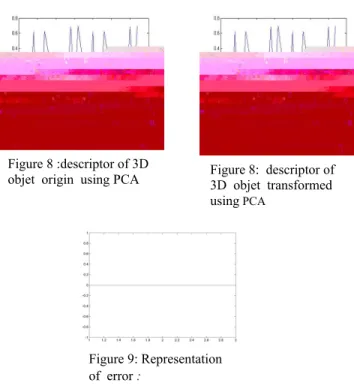
According to the graph of the error (figure 9) we
found that , which verifies the invariant
96 Figure 5 : Learning System
Input object
( )
f
X
X X
X
f X
Extraction of feature vector
associate forthis object
X
( ),
X
var( )
X E X
X
Database
(
, , )
f f
X
XX
X
Evaluate
Y
Unkhown
object Calculation
of
Extraction of feature vector associate forthis object
Database
Evaluation of
i
i X Y
err
If not , this object is not recognized as an
affine transformation of the object Xi
If then this object is recognized as an
affine transformation of the object Xi ,
we write
of this vectors as shown in figure 8 and figure 9.
So is an affine transformation of .
4. COMPARISON OF RESULTS
According to figures below we can see that the error1 - corresponds to the difference between the invariants of the object origin and its transformation by an affine transformation-calculated by our methods (figures 9) is smaller than those obtained by the methods of Fourier transform and Moments (figures 10 and 11). In addition, the computing time of our method is less than the method of Fourier transform and Moments. This leads us to conclude that our method applied to these objects is more efficient than Fourier transform and Moments, in term of error.
5. CONCLUSION
In this work we presented two methods of invariant description and recognition of 3D objects based on statistical methods: analysis of data (AD) and the principal component analysis (PCA).
The first method consists of calculating the canonical correlations coefficients vector from the canonical variables couples of the object origin and it’s transformed. The components of this vector are all equal to 1 and the canonical variables values are equal which leads us to conclude that the first object (origin) is an affine transformation of the second (its transformed).
In the second method, the vector descriptor is formed by the characteristic vector extracted using PCA from the object origin and its transformed, this vector is invariant against an affine transformation.
The recognition is doing by measuring the similarity between the descriptor vectors extracted from the two objects: the request object and those belonging to a database of objects using the metric euclidean distance as described above for each method.
Experimental results show the validity and utility of these methods.
REFERENCES
[1] A. El Oirrak, M. Daoudi, D. Aboutajdine:
Affine invariant descriptors for color
images using Fourier series. Pattern
Recognition Letters 24(9-10): 1339-1348 (2003)
[2] A. El Oirrak, M. Daoudi, D.Aboutajdine:
Estimation of general 2D affine motion
using Fourier descriptors. Pattern
Recognition 35(1): 223-228 (2002)
[3] A.El Oirrak, M. Daoudi, D.Aboutajdine:
Affine invariant descriptors using Fourier
series. Pattern Recognition Letters 23(10):
1109-1118 (2002)
[4] M. Petrou and A. Kadyrov. Affine
invariant features from the trace transform. IEEE Transactions on Pattern Analysis and Machine Intelligence, 26(1):30{44, 2004.
Figure 8 :descriptor of 3D
objet origin using PCA Figure 8: descriptor of 3D objet transformed using PCA
[5] A. Choksuriwong, H. Laurent & B. Emile. A Comparative Study of Objects Invariant Descriptor. ORASIS, 2005.
[6] T. Murao, "Descriptors of polyhedral data
for 313- shape similarity search", Proposal P177, MPEG-7 Proposal Evaluation Meeting, UK, Fév. 1999.
[7] M. Elad, A. Tal, S. Ar, "Directed search
in a 3D objects database using SVM", Hewlett-Packard Research Report HPL-2000-20R1, 2000.
[8] C. Zhang, T. Chen, "Efficient feature
extraction for 2D/3D objects in mesh representation", Proc. of the International Conference on Image Processing (ICIP 2001), 2001.
[9] T. Zaharia, F. Prêteux, "3D-shape-based
retrieval within the MPEG-7 framework", Proc. SPIE Conf. On Nonlinear Image Processing and Pattern Analysis XII, Vol. 4304, pp. 133-145, San Jose, Etats-Unis, Janv. 2001.
[10] Taubin et D.B. Cooper, "Object
recognition based on moment (or algebraic) invariants", J.L. Mundy and A. Zisserman, editors, Geometric Invariants in Computer Vision, pp. 375-397, MIT Press, 1992.
[11] S. J. Dickinson, D. Metaxas, A. Pentland,
"The role of model-based segmentation in the recovery of volumetric parts from range data", IEEE Trans. On PAMI, Vol. 19, No. 3, pp. 259-267, Mars 1997.
[12] S. Dickinson, A. Pentland, S. Stevenson,
"Viewpoint-invariant indexing for content- based image retrieval", Proc. IEEE Int. Workshop on Content-Based Access of Image and Video Database, pp. 20-30, Janv. 1998.
[13] J.W.H. Tangelder, R.C. Veltkamp,
"Polyhedral model retrieval using
weighted point sets", Rapport
technique no UU-CS-2002-019, Universitd de Utrecht, Pays-Bas, 2002. [14] P. V. C. Hough, "Method and means for
recognizing complex patterns", U.S. Patent 3069 654, 1962.
[15] D. H. Ballard, "Generalizing the Hough transform to detect arbitrary shapes," Pattern Recognition, Vol. 13, No. 2, pp. 111-122, 1981.
[16] J. Illingworth et J. Kittler, "A survey of the Hough transform", Computer Vision,
Graphics and Image Processing, Vol. 44, pp. 87-116, Oct. 1988.
[17] Bouroche, J.M. et G. Saporta (2006), L’analyse de données, Presses Universitaires de France, Collection Que sais-je ?, 9ème édition, 128p. 2006
[18] Saporta, G. (2006), Probabilités, analyse
des données et statistiques, Techniques,
2ème édition, 622 p, 2006