Page 11 www.ijiras.com | Email: [email protected]
Effectiveness Of Structured Teaching Programme On Knowledge
Regarding LASIK Eye Surgery Among The Students In Arts
College
Mr. Manish Kumar Goyal
Assistant Professor, Rama Nursing College, Pilkhuwa, Hapur, Uttar Pradesh, India
I. INTRODUCTION “Eyes are the window to soul.”
Solomon “The research that I wish I would have done and the
questions I wish I would have asked before I let them cut on
my eyes”. Joe Tye
The human eye is an organ that reads to light and has severe purposes. As a consciousnesses organ, the mammalian eye allows vision. Rods and cons cells in the retina allow conscious light perception and vision including color differentiation and perception of depth. The human eye can distinguish about 10 million color’s.
LASIK commonly referred to as laser eye surgery or laser vision correction is a type of refractive surgery for the correction of myopia, hypermetropia. The LASIK is performed by an ophthalmologist who uses a laser or microkeratome to reshape the eyes cornea in order to improve visual activity for most patient, LASIK provide a permanent alternative eyeglasses or contact lenses. For many people, LASIK has been a blessing.
LASIK is most similar to another surgical corrective procedure, photorefractive keratectomy (PRK, similar to LASEK) and both present advances over radial keratomy in the surgical treatment of refractive moderate to high myopia or thin corneas which cannot be treated with LASIK and PRK the Phallic intra ocular lens is analternative.
As of 2011, over 11 million LASIK that of the Russian scientist, procedure have been performed in the us as of 2003 over 28 million have been worldwide, in this 1950 the microkeratome and keratomileusis technique were developed in Bogota, Colombia by the Spanish ophthalmologist Jose Baroque. This work was followed by svyatoslab fyodorov (1920-2000), who developed the radial keratomy (RK) in the 1970 and designated the first posterior chamber implantable contact lenses (phallic intraocular lens) in the 1980. implantable contact lenses (phallic intraocular lens) in the 1980.
On 20 june 1989, Gholam A. pyeman was granted a US patient for LASIK. it was, ”a method and apparatus for modifying the curvature of a love cornea via use of an excimer laser, the live cornea has a thin layer removes there from, leaving an exposed internal surface there on thin either the Abstract: A pre-experimental study was conducted to evaluate the effectiveness of structured teaching program me on knowledge LASIK eye surgery among the student‟s in selected art‟s college. Data was collected from 80 student‟s selected by simple Random sampling in table method techniques. The mean of overall pre test knowledge score was 9.425 ±4.609 Which is 37.70% of maximum score and the mean of overall post test knowledge score was 20.537±3.410 which is 82.14% of maximum score. Improvement in the knowledge score of the student‟s from the pre test to post test is tested for statistical significance using student‟s paired “t” –test („t‟=7.343),show significance difference between pre and post –test score.(p<_0.05).
Page 12 www.ijiras.com | Email: [email protected] surface or thin layer exposed to laser along a predetermined
pattern to a ablate replaced onto the surface. Ablating a central area of the surface or thin layer makes the cornea curved, while ablating annular area spaced from the center of surface or layer makes the cornea more curved. The desire predetermined pattern is formed by use of a variable diaphragm a rotating orifice of variable size, a movable mirror or a movable fiber optic cable through which the laser team is directed towards the exposed interval surface or removed thin layer.
The excimer laser that was used for the first LASIK surgeries by I. Pallikaris suggested a flap of cornea could be raised by microkeratome prior to the performing of PRK with the excimer laser. The addition of a flap to PRK became known as LASIK.
II. OBJECTIVES
To assess the preexisting knowledge of the art’s students regarding LASIK eye surgery.
To develop a structured teaching programme regarding LASIK eye surgery.
To reassess the post-test knowledge of the art’s students regarding LASIK eye surgery after administering structured teaching programme.
To determine the effectiveness of structured teaching programme on LASIK eye surgery by comparing mean pre test and post test knowledge scores of art’s students. To determine the association of pre test knowledge score
of art’s students regarding LASIK eye surgery with their selected demographic variables.
III. REVIEW OF LITERATURE
Renesto Ada C, Lipener C (2005): A study was conducted to regarding the evaluate the fitting and use of contact lens in patients submitted to refractive surgery. This was a retrospective study in 53 patients submitted to refractive surgery who later startsed to use contact lens, from 1999 to 2003. The parameters were: previous ametropia, refractive surgery procedure, ametropia after surgery, postoperative spherical equivalent, postoperative keratometry, base curve of fitted contact lens, contact lens design, final visual acuity with spectacles after surgery, final visual acuity with contact lens, complications and the reason for stopping the use. The follow-up of patients ranged from 1 month to 84 months (average of 42.5 months).Result are finding that Of 53 evaluated patients, 19 patients had undergone LASIK (Laser Assisted in Situ Keratomileusis), 29 patients had undergone RK (radial keratotomy), 4 patients had undergone PRK (photorefractive keratectomy) and in one patient it was not possible to know which surgery was performed. 61.29% of the patients (57 eyes of a total of 93 eyes) were fitted with rigid gas-permeable lenses. There was an improvement of visual acuity in 60.21% of the cases (VA>20/40), with few complications.
IV. METHODOLOGY
RESEARCH APPROACH: Evaluative approach
RESEARCH DESIGN: Pre experimental one group pre test post test design
SETTINGS OF THE STUDY: St. Xaviers P. G. College Phagi, Jaipurs & S. S. G. Parrek College, chanpole, jaipur, india.
SAMPLE: The sample of the present study was the Students age groups between 18>23 years studying in selected art’s college in Jaipur.
SAMPLE SIZE: 80
SAMPLING TECHNIQUE: Simple Random sampling technique
CRITERIA FOR SELECTION OF SAMPLES:
Inclusion Criteria
The study includes student:
Those who are willing to participate in the study. Those who are available at the time of data collection.
Exclusion Criteria
The study excludes student:
Those who are not willing to participate.
V. HYPOTHESIS
H1 -There will be a significant difference between pre-test
and post-test knowledge scores of the art’s students regarding LASIK eye surgery.
H2 - There will be a significant association of pre- test
knowledge score of the art’s students with their selected demographic variables.
VI. TOOL AND DATA COLLECTION
The tool was prepared and validated by the experts.
TOOL I: Demographic data like age, Gender, Religion, Residence Area, Marital status, year of B.A degree, Types of family, Monthly income of family member’s (Rs), use of glass or contact lens and Source of information in LASIK eye surgery.
TOOL II: Structured knowledge questionnaire comprised
of 25 items divided into 3 sections. Questions of multiple choice Section I comprised of 10 questions of general information in LASIK eye surgery. Section II comprised of 08 question in indication, criteria & techniques of LASIK eye surgery and Section III contained 07 items procedure, self care, advantage, disadvantage & complication of LASIK eye surgery.
VII. RESULTS
Page 13 www.ijiras.com | Email: [email protected] Major finding of the study revealed that 30 (37.5%)
student are in the age group of 18-20 year, 20 (25%) student are in age group 21-23 yrs. & remaining 30 (37.5%) student are in the age group more than 23 yrs. The 60 (75%) males & 20 (25%) females student’s participated in the research study. The 70 (87.5%) student’s were Hindu, 10(12.5%) student’s were Muslim &(0%) non of the student were Christian & others. The 40 (50%) student’s in urban, 20 (25%) student’s in rural, 20 (25%) student’s in Semi urban & (0 %) none of the student’s in semirural. The 30 (37.50%) of the student’s were married, 45 (56.25%) student’s were unmarried, 05 (6.25%) student’s in divorce & (0%) none of the student’s in widow/widowee. The 25 (31.25%) art student’s B.A. 1st years,
30 (37.50%) art student’s B.A.2nd years & 25 (31.25%) art student’s in B.A. 3rd years. The 40 (50%) art Student’s in joint
family, 20 (25%) art student’s in nuclear family & 20 (25%) art student’s in extended family. (0%)Non of the art student’s in monthly income family member’s <5000. The 20 (25%) student’s monthly income in family member’s (RS) 50001-10000 , 20 (25%) student’s in monthly income of family member’s (RS) 10001-15000 & 40 (50%) student’s monthly income in family member’s (RS) >15000. The 50 (62.50%) art student’s used glass or contact lens & 30 (37.50%) art student’s no used in glass or contact lens participated in the research study. Non of the art student’s source of LASIK eye surgery newspaper / magazine / books, electronic media & health personal. The 1 (10%) art student’s source of LASIK eye surgery in friends/relatives/ neighbor & 9 (90%) art student’s source of LASIK eye surgery is unknown in participated in the research study. The maximum participated in the research study in source of LASIK eye surgery is not knowing LASIK eye surgery.
N=80
Table 1: Comparison between pre & post test knowledge score of student’s regarding LASIK eye surgery
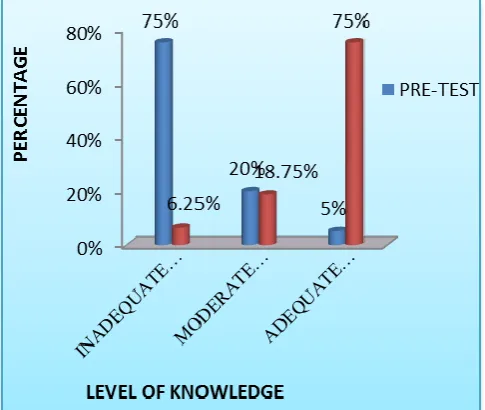
The table: 1& graph:1 comparision between pre-test & post-test knowledge among arts student’s regarding LASIK eye surgery. The pre-test was conducted that 60(75%) of student’s inadequate knowledge, 16 (20%) moderate knowledge & 05 (5%) of the student’s in adequate knowledge and score ranged between 21-4 but post-test was conducted that 05 (6.25%) inadequate knowledge,15 (18.755%) moderate knowledge & 60 (75%) adequate knowledge of the art student’s and score ranged between 25-11.
Figure 1: Bar diagram showing level of pre test and post-test knowledge of students regarding LASIK eye surgery N=80 S. N. Area of LASIK eye surgery Max .Pos sible scor e
Pre-test (x) Post-test (y) Effecti
veness (y-x) Mean± S.D. Mean % Mean±S .D. Mean % Mean %
1. Area :A 10 4.962±
2.249 19.84 % 8.375±1. 552 33.50 % 15.66%
2. Area :B 08 3.463±
1.507 13.85 % 6.837±1. 115 27.34 % 13.49%
3. Area :C 07 1±
1.423
4% 5.325±1.
412
21.30 %
17.30%
4. Total 25 9.425±
4.069 37.70 % 20.537± 3.96 82.14 % 44.44 %
Table 2: Significance of the difference between pre-test and post-test knowledge scores on LASIK eye surgery KEYWORDS: Area: A General information of LASIK eye surgery, Area: B Indication, Selection Criteria, Risk, Cost and Techniques of LASIK eye surgery Area :C Procedure, Self care, Advantage, Disadvantage and Complication of LASIK eye surgery
Table 2: are show comparison of area wise mean and SD of the knowledge score depict that in the area of “general knowledge on LASIK eye surgery” the pre-test mean % was only 19.84 whereas the post-test mean was 33.50% show a difference 15.66. In the area of Indication, Selection, Criteria, Risk, Cost & Techniques of LASIK eye surgery pre-test mean% 13.85% where as post-test mean was 27.34% show a different 13.49% . The pre-test mean% in Procedure, Self Care, Advantage, Disadvantage, and Complication of LASIK eye surgery 4% where as post-test 21.30% show difference 17.30%.
However all overall finding reveled that the percentage of post-test score was higher when compared to the pre-test knowledge scores and effectiveness was highest (17.30%) in the area of Procedure, Self care, Advantage, Disadvantage and Complication of LASIK eye surgery and lowest ( 13.49%) in the area of Indication, Selection, Criteria, Risk, Cost and Techniques of LASIK eye surgery. Hence, it can be interpreted that the STP was effective in all the areas.
S.N. Level of
knowledge
Pre-test Post- test
No Percentage
(%)
No Percentage
(%)
1. Inadequate
(<50%)
60 75% 05 6.25%
2. Moderate
(51-75%)
16 20% 15 18.75%
3. Adequate
(>75%)
Page 14 www.ijiras.com | Email: [email protected] N=80
Parameter Mean S.D. Range Mean
%
t-value Result
Pre-test 9.425 4.609 21 - 4 37.70%
17.343 ***
HS P<0.00
1 df=79
Post-test 20.537 3.410 25 - 11 82.14%
Improveme nt
11.112 -1.119 ….. 44.44%
NOTE: ***denote significant a* 0.001 level (highly significant).
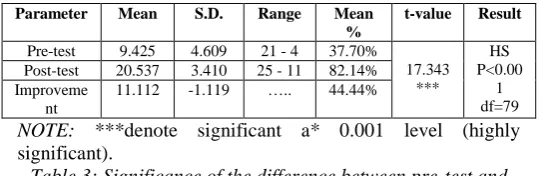
Table 3: Significance of the difference between pre-test and post-test knowledge scores on LASIK eye surgery Finding of the paired t-test to analyze the effectiveness of STP on LASIK eye surgery for selected students was found to be significant. It reveals that the STP was effective in improving the knowledge of student’s on LASIK eye surgery.
The chi-square and Yates correction computed between pre-test knowledge score s and selected demographical variables showed that there was significant relationship between the level of knowledge and selected demographic variables such as age, gender and uses of glass or contact lens.
VIII. DISCUSSION
The finding of the study shows that knowledge level of student’s who significantly low in the pre-test with the overall mean % of pre-test knowledge score (37.70%) when compared to the mean % post-test knowledge score (82.14%).The mean pre-test knowledge score was 9.425 with S.D. 4.069 which is similar to the finding of the study conducted by Srinivas Marmamula Chandra Sekhar L V Ravuri Mei Ying Boon, Rohit C Khanna et.al.to on knowledge of elderly regarding the major cause of the visual impairment and prevalence had low level of knowledge when compared with the score of expert panel. The study concluded that increase the knowledge of eye disease and LASIK eye surgery.
The present study that the knowledge score overall mean% of pre-test 37.70% ,the mean 9.425 with S.D. 4.069 when compared the overall mean% of post-test 82.14% ,mean 20.537 with S.D.3.965. The finding of the study shows that the structured teaching programme for knowledge regarding LASIK eye surgery was effective. The effective mean % 44.44%.
IX. IMPLICATIONS NURSING PRACTICE
With increasing advances in health sciences, including nursing science, there is a rising need for constant updating of new information to develop new skills in order to provide best knowledge to students. To fulfill this need, students need ongoing development in their careers in order to remain updated with current knowledge and skills.
The adult has great the responsibility to protect the health of self.
Appropriate knowledge to various health care setting.
Adult need to take up the responsibility to create the awareness among adult regarding knowledge on LASIK eye surgery.
Dr. & Health personal use wide variety of intervention for LASIK eye surgery.
Nursing practice in various health care setting should focus on knowledge regarding LASIK eye surgery. NURSING EDUCATION
The following recommendations are made for nursing education:
The study emphasize the need for the developing good teaching skills among students on LASIK eye surgery. The nurse educator should arranged for in service
educator programme (seminar, workshop) for students regarding LASIK eye surgery.
Raise nursing students interest in research so as to keep them updated with current practice.
As a nurse educator, there is abundant opportunity to educate people regarding the prevention of myopia, hyper myopia & astigmatism.
The nursing curriculum should consist of increased depth, content and activities which help to develop knowledge and attitude skill among art’s student’s in prevention of myopia, hyper myopia & astigmatism.
NURSING ADMINISTRATION:
The following recommendations are made for nursing administration:
Improve nursing students interest in administration and management so as to keep them updated with current knowledge.
Nurse & health personal should be guide & monitor the student’s regarding knowledge on LASIK eye surgery. Nurse as an administrator plays an important role in
educating the professional & in policy making.
The nurse administrator can take parts in developing protocols, standing orders related to design of the health education programme to update nursing personnel’s knowledge regarding prevention of myopia, hypermyopia & astigmatism among students.
The nurse administrator can mobilize the available resource personnel towards the health education of the art’s students regarding LASIK eye surgery. They should take interest in providing information on selected aspects. They should be able to plan and organize programmes, taking into consideration of cost effectiveness and carry out successful educational programmes.
NURSING RESEARCH
The essence of research is to build a body of the knowledge in nursing.
Nursing research maintain by which the nursing professional is growing.
Page 15 www.ijiras.com | Email: [email protected] The generalization of the study result can be made by
replicated of the study. The researcher can include practice by the strong research.
This research will help to evaluate the existing and the improvement of students knowledge on LASIK eye surgery. There is a need for extended and intensive nursing research.
This study will motivate other investigators to conduct further studies regarding effectiveness of structured teaching programme on LASIK eye surgery analysis in various setting.
X. RECOMMENDATIONS
Following were the recommendations:
The study can be replicated on a large sample, there by finding can be generalized for a large population.
A similar study can be conducted to assess the knowledge level of the science college regarding LASIK eye surgery among arts student’s.
XI. CONCLUSION
The present study, the over all post test mean value 20.537, SD 3.410, range 25-11 & mean % 82.14% are higher than overall mean pre test 9.425, SD 4.609, Range 21-04 & mean % 37.70%. The t- test value 17.34.
The association pre test knowledge with there selected demographical variables like as age, gender & use of glass or contact lens is significant.
REFERENCES
[1] Joyce M Black and Jone Hokanson (2006) Text book of Medical Surgical Nursing, 8(3):123-125
[2] Gupta AK (1993) current topics in ophthalmology. [3] Lewis SM, Heitkemper MM, Dirksen SR. Medical
surgical nursing. 6th edition. Missouri; Mosby by publications; 2008: P 428.
[4] Royal college of Ophthalmologists. Cataract surgery guide lines. London: Rco, 2001.
[5] American Optometric Association, optometric clinical practice guideline: care of the patient with LASIK eye surgery, vol: 60, Issue: 5, Pp: 320-323.
[6] Basvanthappa BT "Nursing Research”, jaypee publication 2001; 2[1]; 49-50
[7] Javaloy J, Vidal MT, Ruiz-Moreno JM, Alió JL,
Confocal microscopy of the cornea in photorefractive surgery, Arch Soc Esp Oftalmol. 2005 Sep; 80(9):497-509
[8] Srinivas Marmamula Chandra Sekhar L V Ravuri Mei Ying Boon, Rohit C Khanna “visual impairment in elderly population” 2013; 20(7) www.safety of LASIK eye surgery.com