Original Research Article
Incidence and Severity of Oral Mucositis in Patients of Head and Neck
Cancers Receiving Definitive Radiotherapy with or without Chemotherapy:
A Hospital Based Study
Pardeep Garg
1*, Parveen Kaur
2, Rajesh Vashistha
3, Rupinder Singh
4, Ishu Sharma
51*Associate Professor, Department of Radiotherapy, GGS Medical College Hospital, Faridkot, Punjab, India. 2Senior Consultant and Head, Department of Radiotherapy, Fortis Hospital, Ludhiana, Punjab, India.
3Senior Consultant and Head, Department of Oncology, Max Superspeciality Hospital, Bathinda, Punjab, India. 4Head of Dentistry, MD Oswal Cancer Treatment and Research Foundation, Ludhiana, Punjab, India.
5Consultant and Incharge, Department of Radiotherapy, MD Oswal Cancer Treatment and Research Foundation, Ludhiana, Punjab, India.
ABSTRACT
Background: Head and neck cancers are among the ten most
frequent cancers in the world and constitute 5% of all cancers worldwide. In developing countries like ours, cancer of the head and neck is among one of the commonest cancers. They account for one fourth of male and one-tenth of female cancers in India. Radiotherapy, with or without chemotherapy, is the mainstay of the treatment and oral mucositis is one of the major complaint and side-effect of the treatment in head and neck cancer patients.
Material and Method: The present study comprised of total of 150 head & neck cancer patients receiving treatment at MD Oswal Cancer Hospital were enrolled in this study. Any Head and Neck Squamous cell carcinoma (AJCC Stage I-IV, M0 vide appendix no. I) patient receiving Radiation dose more than or equal to 56 gray, weekly concomitant chemoradiation in the form of Cis-platinum, Gemcitabine or Paclitaxel alternating with Gemcitabine were enrolled in this study.
Results: Oral mucositis incidence was noted in 100% of the patients with chemo-radiation & was irrespective of chemotherapy used. The frequency of severe oral mucositis was 50% in radiotherapy alone group while 54.03% in chemoradiation group. Incidence of mucositis grade IV was more with cis-platinum being used as radio-sensitizer (62.9%)
and was seen least in the gemcitabine arm (41.4%). Mean treatment time in all patients was almost same and around 59 days and it was not affected by the chemotherapy used. Conclusion: Severe oral mucositis (grade III and IV) was observed more in smokers, alcoholics, diabetics, opium addicts and patients having bad ODH. Mucositis resolves within 4-5 weeks period after the completion of treatment.
Keywords: Head and Neck Cancer, Radiotherapy, Mucositis,
Chemotherapy.
*Correspondence to:
Dr. Pardeep Garg,
Associate Professor, Department of Radiotherapy, GGS Medical College Hospital, Faridkot, Punjab, India. Article History:
Received: 18-02-2017, Revised: 01-03-2017, Accepted: 23-03-2017
Access this article online
Website:
www.ijmrp.com
Quick Response code
DOI:
10.21276/ijmrp.2017.3.2.043
INTRODUCTION
Head and neck cancers are among the ten most frequent cancers in the world and constitute 5% of all cancers worldwide. In developing countries like ours, cancer of the head and neck is among one of the commonest cancers. They account for one fourth of male and one-tenth of female cancers in India. These are common in regions with high tobacco and alcohol consumption. Tobacco use in various forms, heavy alcohol consumption and poor diet causes over 90% of head and neck cancers. Bidi smoking is the most popular form of tobacco consumption in 54% cases and is the most common etiology in Head and Neck Carcinomas. ICMR data suggests the male predilection and its increasing incidence in age groups more than 50 year. A potential
etiological role for Human Papilloma viruses cannot be excluded.1,2 The standard treatment for patients with locally
advanced head neck cancer has been surgery followed by postoperative radiotherapy. Head and neck cancers are relatively chemo-sensitive. The concomitant administration of chemotherapy and radiotherapy has been the most hopeful strategy in recent years. Chemotherapy given concomitantly with radiotherapy leads to a better outcome than radiotherapy alone.3-6 A definite course
swallow and worsens the patient’s Quality of Life (QoL) at the
same time.7 The term oral mucositis and stomatitis are often used
inter- changeably at the clinical level, but do not reflect identical process. Oral mucositis describes inflammation of oral mucosa resulting from chemotherapeutic agents or ionizing radiations. It typically manifests as erythema or ulcerations. Stomatitis refers to any inflammatory condition of oral tissue, including mucosa, dentition / periapices and periodontium. Stomatitis thus includes infections of oral tissue, as well as mucositis as defined above. Virtually all patients who receive radiotherapy to the head and neck area develop oral complications. Direct stomatotoxicity is usually seen 5-7 days after the administration of radiation.8-10
Radiation and chemotherapy are effective activators of several injury producing pathways in endothelia, fibroblasts and epithelia. These signaling molecules participate in an inflammatory response with a positive-feedback loop that amplifies the original effects of radiation and chemotherapy.9 The Aim of the study was
to observe incidence of mucositis in head and neck cancer patients receiving radiotherapy alone or chemo-radiotherapy (concomitant). Mucositis grade IV is more common in patients receiving chemo-radiotherapy than radiotherapy alone.
MATERIAL AND METHODS
The present study was conducted at Mohan Dai Oswal Cancer Treatment and Research Foundation, Ludhiana & is a single center prospective study. A total of 150 Head & neck cancer patients receiving treatment at MD Oswal Cancer Hospital patients were enrolled in this study. Any Head and Neck
Squamous cell carcinoma (AJCC Stage I-IV, M0 vide appendix no. I) patient receiving radiation dose more than or equal to 56 gray, weekly concomitant chemoradiation in the form of Cis-platinum, Gemcitabine or Paclitaxel alternating with Gemcitabine were enrolled in this study. A signed written informed consent, ECOG performance status = 0-3 (vide appendix no. II), No distant metastases (M0) were included in the study. Patient receiving cytoreduction either in the form of neoadjuvant chemotherapy or surgery, Thyroid Carcinoma Patients, Distant metastasis were excluded. Signed written informed consent forms were obtained from the patients. Patients particulars were noted, a thorough history of the disease was taken. Any history of addiction to smoking, alcohol, opium and tobacco consumption was taken. History of diabetes mellitus was noted. A complete physical examination with assessment of ECOG performance score, pretreatment oral assessment, primary tumor size and regional lymph nodes was carried out for all the patients in the study. Routine investigations like CBC, RFT, TSP, DSP, CXR-PA view, ECG were noted and ECHO was done where required. Mucositis was determined weekly while the patient was on chemo-radiation or radiation. Grading of mucositis was recorded till first (after 15 days of completion of treatment) and second follow-up (after 30 days of completion of treatment). For each group master charts were made showing all the categories and continuous variables. Results were displayed as mean ± standard deviation or
percentage. The independent sample “t-test” was used to assess
group differences for continuous variables. The statistical significance was defined as a two sided p value less than 0.05.
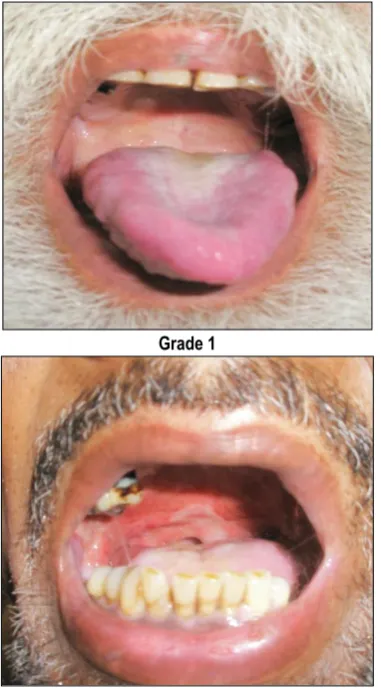
Grade 1 Grade 2
Grade 3 Grade 4
RESULTS
Only 40% patients presented in our hospital directly, out of these 66.67% were presented in dental OPD and 25% in ENT OPD. Five patients presented directly in Radiotherapy OPD. Out of the total 150 patients in the present series, 74 % were male and 26% female. In the studied series, most female patients were in the age group 41-70 years (81.57%), the age group of 41-50 years has 23.68% females and 61.54% females were more than 50 years of age. Most of the male patients (69.64%) were in the age group 41-70 years. 71.17% males were more than 50 years of age. Only one female and two males were observed in age group less than 30 years. Maximum number of patients 43(28.67%) presenting in OPD were in the range of 51- 60 years age group. The youngest patient included in the present series is 24 years whereas the oldest patient is 92 years old. Minimum number of patients i.e. 3(2%) were in the age group of less than 30 years. Median age in female was 55 years lower than found in males i.e. 58 years. Overall median age was found to be 57 years. Mucositis incidence was noted in 100% of the patients with chemo-radiation & was irrespective of chemotherapy used. The frequency of severe mucositis was 50% in radiotherapy alone group while 54.03% in chemoradiation group. Incidence of mucositis grade IV was more with cis-platinum being used as radio-sensitizer (62.9%) and was seen least in the gemcitabine arm (41.4%). Mean treatment time in all patients was almost same and around 59 days and it was not affected by the chemotherapy used. In radiotherapy alone arm, as radiation dose in range of 68-72 Gy was used so treatment time came almost equal to that in the RT plus chemotherapy arm. Hospitalization days were an average 3.269 days for radiotherapy
alone arm to a maximum of 4.037 days, in RT plus cis-platinum arm. All patients were called for follow-up after the 15 and 30 days of the completion of treatment schedule. Most of the patients turned up for first follow up between 15 and 18 day; maximum delay for first follow-up was 22 days. Most patients were seen with the grade I and II mucositis at first follow-up. After one month of completion, most of the patients recovered from mucositis. Some patients were presented with complaints of the pooling saliva, otherwise there were no significant complaints regarding mucositis. At first follow-up in the RT alone arm, all patients presented with mucositis, with 18 out of 26 patients in grade II, during 2nd follow up resolution of mucositis was observed in 12
patients while 13 patients showed mucositis grade I. At first follow-up, in RT plus Gemcitabine weekly arm, 15/ 41 patients presented in grade I mucositis and 24/41 in grade II, 2 patients were having grade III mucositis. During 2nd follow up, 28 patient’s mucositis
resolved and 13 presented in grade I mucositis. At first follow-up, in RT plus weekly alternate sequential regimen of Paclitaxel and Gemcitabine, 5/ 56 patients presented with mucositis grade III, 14/ 56 patients were having grade I mucositis and 37/ 56 showing grade II mucositis. During 2nd follow up, 35 patients mucositis
resolved and remaining 21/56 were having grade I mucositis. Development of grade IV mucositis was observed in 23/39 (59%) females and 57/111 (51%) males at some stage of treatment.40/71 (56.34%) patients in age group more than 60 years developed the mucositis grade IV. In 41-59 years age group, 31/61 (50.82%) patients developed grade IV mucositis. In age group below 40 years, only 9/18 (50%) patients developed the mucositis grade IV.
Table 1: Age and sex distribution of 150 patients with head and neck cancer
Age groups Number of patients Percentage (%) Percentage of males Percentage of females
<30 3 2 1.78 2.63
31 - 40 15 10 8.93 13.15
41 - 50 30 20 18.75 23.68
51 - 60 43 28.67 28.57 28.90
61 - 70 35 23.32 22.32 28.90
> 71 24 16 19.64 5.20
Table 2: Incidence of grade IV mucositis in patients receiving radiotherapy and concurrent chemoradiotherapy
RT alone RT + CCT
Number of patients 26 124
Mucositis Grade IV 13 (50%) 67(54.03%)
Table 3: Incidence of mucositis seen with various chemo-radiation regimens
RT+CCT No. of cycles No. of patients Incidence of mucositis Grade IV
RT + Cisplatinum 5-8 27 17/27(62.9%)
RT + gemcitabine 5-8 41 17/41(41.4%)
RT + Paclitaxel/gemcitabine alternate weekly
2-4 of each 56 33/56(58.9%)
Table 4: Incidence of mucositis during 1st and 2nd follow up in RT alone arm
No. of patients No Mucositis Gr. I Gr. II Gr. III Gr. IV
RT alone 1st F/U 26 0 4 18 4 0
Table 5: Incidence of mucositis during 1st and 2nd follow up in RT plus cis-platinum alone
No. of patients No Mucositis Gr. I Gr. II Gr. III Gr. IV
RT + Cis 1st F/U 27 0 6 21 0 0
RT + Cis 2nd F/U 27 17 10 0 0 0
Table 6: Incidence of mucositis during 1st and 2nd follow up in RT plus Gemcitabine arm.
No. of patients No Mucositis Grade I Grade II Grade III Grade IV
RT + gem 1st F/U 41 0 15 24 2 0
RT + gem 2nd F/U 41 28 13 0 0 0
Table 7: Incidence of mucositis during 1st and 2nd follow up in Rt plus Paclitaxel Gemcitabine alternate arm.
No. of patients No Mucositis Grade I Grade II Grade III Grade IV
RT + Pac/gem 1st F/U 56 0 14 37 5 0
RT + Pac/gem 2nd F/U 56 35 21 0 0 0
Table 8: Incidence of grade IV mucositis in males and females
Males Females
Total number 111 39
Grade IV mucositis 57 23
Table 9: Age wise incidence of grade IV mucositis
Total number Grade IV
< 40 years 18 9
41 – 59 61 31
>60 71 40
DISCUSSION
The study was conducted with the primary aim to know the incidence and severity of mucositis with the different regimens of chemotherapy being used as radiosensitiser in our institute. Total of 150 patients were enrolled in this single center prospective study with primary in head and neck region and studied from the day of start of treatment to one month after completion of same. All patients were treated on Theratron 780 cobalt unit with immobilization cast made for stabilization. Conventional fractionation regimen i.e. one fraction daily was given with five days a week was used and most of the patients complete their treatment on daily outdoor basis with admission for mucositis and weekly concomitant chemotherapy. Most patients presented in stage II or in stage III, when tumor was large and started showing symptoms associated with it. 89 (60%) patients presented with neck nodes. As per our hospital protocol, we give gap of one week in our patients after completion of 36-42 Gy so as to settle the mucositis reaction and improve the nutrition status so that we can complete treatment on time after the gap with cord sparing. Mucositis scoring was done from day of start of treatment to one month after completion of same and for first two follow ups as per WHO mucositis scoring. Mucositis was seen in 100% of the patients. Silvermann et al11,12 has noticed grade I/ II mucositis in
100% of the patients receiving radiotherapy. Grade IV mucositis was noticed in the 50% patients of radiotherapy alone group and 54.08% patients in chemo-radiation arms. A meta-analysis study by Trotti et al comprising of more than 6000 patients was suggestive of the finding that by addition of weekly chemotherapy
to radiotherapy alone arm increases the mucositis incidence from 34% to more than 43%.13 Mucositis grade IV was highest, 63%
when the concurrent weekly cis-platinum was used. It was 59% in the group where weekly chemotherapy used in the form of weekly alternate sequential regimen comprised of paclitaxel and gemcitabine. All our patients completed their treatment with in nine weeks (59 days, or 8.5 weeks) and the patients were admitted as per their need and for chemotherapy weekly. The days of hospitalization for mucositis only included the days when patient was admitted with severe mucositis that is grade III/ IV mucositis and discharged. The criteria for discharging the patients were either a reduction in grade of mucositis to grade II or when patient started taking adequate diet. The maximum number of hospitalization was seen in RT plus concurrent cis-platinum weekly arm i.e. 4 days as against the radiotherapy alone arm where it was 3 days. The RTOG 90-03 trial where no gap was given between phase I and phase II of treatment i.e. when cord sparing is done, the treatment time was same in radiotherapy alone and radiotherapy plus concurrent weekly chemotherapy arm.14 All patients were asked for follow-up after the fifteen days
and the most patient turned up for same after 18 days with maximum time for first follow-up was 22 days. Most patients were seen with the grade I/II mucositis at the time of follow-up. Mucositis subsided by the time of 2nd follow up in all arms. Only
study group. However no statistically significant data could be drawn. After 60 years of age group, mucositis grade IV incidence was seen to increase from 50% in below 60 year age group to 56.33%. However no statistically significant data could be drawn in favor of any age group. The meta-analysis study by Trotti et al13
showed higher association of severe mucositis in young age group. In diabetics, the prevalence of sever mucositis was more (64.28%) as compared to the non-diabetic group (52%). Statistical significance could not be drawn but diabetes was certainly leading to the higher frequency of mucositis grade IV in study. Various authors have described the positive impact of diabetes in development of mucositis.15,16
CONCLUSION
Severe mucositis was observed more in smokers, alcoholics, diabetics, opium addicts and patients having bad oral dental hygiene. Mucositis resolves within 4-5 week period after the completion of treatment. Thus, oral dental hygiene should be maintained during the treatment to decrease the incidence of severe mucositis.
REFERENCES
1. Jamel A et al. Cancer statistics 2002. CA Cancer J Clin; 52(1): 23-47, 2002. Shaha AR et al. Head and Neck Cancer. In: Lenhard RE Jr et al eds. The American Cancer Society's Clinical Oncology 2001: 297-329.
2. Indian Council of Medical Research (ICMR); Data showing head neck cancer incidence and epidemiology.
3. Toohill RJ et al. Cisplatin and 5-FU as neoadjuvant chemotherapy in SCCHN. archotolarygol head & neck surg 1987; 113: 758-761.
4. The department of Veterans Affairs Laryngeal Cancer Study Group. Induction chemotherapy plus radiation compared with surgery plus radiation in patients with advanced laryngeal cancer. NEJM 1991; 324: 1685-1690.
5. Lefebvre JL et al. Larynx preservation in pyriform sinus cancer: preliminary results of a European Organization for Research and Treatment of Cancer phase III trial. EORTC Head and Neck Cancer Cooperative Group. J Natl Cancer Inst 1996; 88: 890-899. 6. Schuller DE et al. Preoperative chemotherapy in advanced resectable head & neck cancer, Final report of south west oncology group. Laryngoscope 1988; 98:1205-1211.
7. Landuyt KK et al. Effect of actinomycin and radiation induced reactions of lip mucosa of mice. IJRO 1985; 11: 1503-1512.
8. Sonis ST. mucositis as a biological process: a new hypothesis for the development of chemotherapy induced stomatotoxicity. Oral Oncol 1998; 34(1): 39-43.
9. Sonis ST. The pathobiology of mucositis. Nat Rev 2004; 4: 277-284.
10. Sonis ST. Oral complications of cancer therapy. In: DeVita JVT, Hellman A, Rosenberg SA, eds. Cancer Principles and Practice in Oncology. Philadelphia, Pa: JB Lippincott 1993: 2385-2394.
11. Silverman S. Radiation and chemotherapy injury: Pathophysiology, diagnosis and treatment. Crit Rev OncolHematol 1993; 15: 63-67.
12. Silverman S. Oral cavity toxicity secondary to chemotherapy and radiation injury; in John M (ed): Chemoradiation. Philadelphia, Lea Febiger, 1993.
13. Andy Trotti et al. Mucositis incidence, severity and associated outcomes: a systematic literature review. Radiotherapy and Oncology 2003; 66: 253-262.
14. Fu KK. (RTOG 90-03): a phase III randomized study to compare twice daily hyperfractionation, accelerated hyperfractionation with concomitant boost to standard fractionation radiotherapy for squamous cell carcinoma of head and neck. Data on file, Radiation Treatment oncology Group, Philadelhia, Pa, 1993.
15. Donnelly JP et al. Antimicrobial therapy to prevent or treat oral mucositis. Lancet Infect Dis 2003; 3(9): 598.
16. MacPhail L et al. Mechanism of Radiation Induced Mucositis and the Consequences. Cancer Nursing 2003; 26(3): 222-229.
[
Source of Support: Nil. Conflict of Interest: None Declared. Copyright: © the author(s) and publisher. IJMRP is an official publication of Ibn Sina Academy of Medieval Medicine & Sciences, registered in 2001 under Indian Trusts Act, 1882. This is an open access article distributed under the terms of the Creative Commons Attribution Non-commercial License, which permits unrestricted non-commercial use, distribution, and reproduction in any medium, provided the original work is properly cited.
Cite this article as: Pardeep Garg, Parveen Kaur, Rajesh Vashistha, Rupinder Singh, Ishu Sharma. Incidence and Severity of Oral Mucositis in Patients of Head and Neck Cancers Receiving Definitive Radiotherapy with or without Chemotherapy: A Hospital Based Study. Int J Med Res Prof. 2017; 3(2):212-16.