Student Well-Being: Unravelling School Climate and Parenting Styles Influence
Durrotunnisa Postgraduate
Universitas Negeri Malang Email: [email protected]
Negeria
Marthen Pali Postgraduate
Universitas Negeri Malang Negeria
Adi Atmoko Postgraduate
Universitas Negeri Malang Negeria
Muh. Irtaji Postgraduate
Universitas Negeri Malang Negeria
Abstract
Student well-being is conceptualized as positive affect interpersonal and positive affect interpersonal indicated by eagerness, gratitude, and contentment upon these as well as the others. Student well-being is influenced by social contexts such as school climate and parenting style. This study employed 118 VIII Graders in Junior High School in Malang, East Java, and Indonesia. The entire samples demanded to fill three research scales consist of six items for student well-being scale, 14 items for school climate scale, and nine items for parenting style scale. To test and examine the causality relationship among the variables, Structural Equation modeling analysis (SEM) using AMOS program version 20 was employed. The overall findings reveal that parenting style contributes higher compare to school climate in constructing student well-being.
Keyword: Student well-being, school climate, parenting style
1. Introduction
Why is this problem important?
In a general perspective, well-being is defined as a conceptual record to measure individual condition and their status (Ben-Arieh, 2014: 2). Student well-being (SWB) or students prosperity, according to Encyclopedia of Quality of Life and Well-Being Research, is quality in which the individual feeling well within school environment (De Fraine, Van Landeghem, Van Damme, & Onghena, in Micholas, 2014: 7104). Oishi (in Diener, 2009: 11) states that feeling well is correlated with emotional norm transferred to students experience through willingness for accounting students emotion and enforces to remember emotional feeling experiences.
While negative affect represents individual experiences during negative emotional condition. (Watson in Snyder & Lopez, 2002: 107).
In accordance with the above-mentioned matter, perspective regarding student well-being occurs such as individual context perspective, prosperity context-specific perspective, and prosperity role-specific perspective (Micholas, 2014:7103-7104). In this research, the researcher was intrigued by prosperity context-specific perspective in which student’s positive emotion and experiences are examined through educational setting obtained by the students both in school and home. Additionally, social context plays as an important element within this research since it is believed that student well-being is significantly influenced by both elements above.
The positive psychological approach was employed in this research since, methodologically; it is firmly grounded in terms of systematic and concerned on scientific inquiry (Myers, (2001) in Gilman, Huebner, & Furlong, 2009: 150).
How does the study relate to previous work in the area?
Research related and concerned on well-being, in fact, has been taken into account by several researchers by correlating another diverse variable. Reviewing from diverse dimension of well-being, several researchers suggesting the correlation (Konu & Rimpela, 2002, P. 734; Adams, et al., 2000, p.166; Adams et al., 2010, p.166; Soutter, 2012, p.34; and Awartani, et al., 2008, p. 59). It can be epitomized that well-being dimension is spiritual, physical, social, psychological, intellectual, emotional, health, and mental.
In relation to internal aspects of the students, several types of research related the well-being with emotional regulation, motivation, demography, coping, positive attitude towards school, contentment, and life satisfaction, as well as social context. Frailon (2004), Frydenberg & Lewis (2009) and Ruus (2007, pp.926-932) expose that emotional regulation influence the well-being. Several researchers who correlate well-being and motivation are Burton et al., 2006; Chirkov & Ryan, 2001; Eryilmaz, 2011; Engels et al., 2004; Gunnel et al., 2014). While Kassen, et al., 2009; Hair et al., 2005; Mathews et al., in Lippman et al., 2011; McNally, 2005, in Lippman, 2011; and Lippman, Moore, McIntosh, 2011 examine social context, positive support from school climate and family which is urgent in the process of students well-being construction.
According to the previous studies and researches conducted by several scholars before, the researcher found no specific paper concerning on the school climate and parenting style employed as a primary variable of the research which is believed to be significantly correlated with student’s well-being. Identical research has been conducted by Chirkov and Ryan (2001) regarding parent and teacher support. However, the researcher found no answer concerning the contribution to the physical condition of school and schoolmates from social context. Hence, the researcher was interested in examining the social context perspective underlying that student well-being of junior high school is influenced by parenting style and school climate.
What are the primary and secondary hypotheses?
How do the hypotheses and research design relate to one another?
School climate is believed to be contributive to the student's prosperity. Suldo (in Ben-Arieh, 2014: 810) exposes that combination of school climate and individual difference measurement contributes a variant of 41% to school satisfaction of the students. School climate is predicted to influence student’s prosperity. The result of the research discovered by Brown and Elias (2012, in Thapa 2013: 370 ) admit that school climate could improve and reform holistically learning and teaching process, and the moment the learning-teaching process is well-established students may accomplish a prosperity. Cohen dan Hamilton(2009: 104-119) in Chicago Journal argue that the school is expected to provide a necessity regarding social, emotional, civic, and intellectual aspect for the students within the school community since school’s role is not limited only to qualify students learning the process.
De Fraine, et al., (2005) discover that school takes a role in neither improving nor declining students prosperity up to 4,3 % (Opdennaker & Van Damme, 2000). The influence is constructed from the students-teachers relationship in which teachers’ attitude significantly affects students’ prosperity.
Ben-Arieh (2014:810) explains that several important key aspects are related to the student's prosperity such as the school environment and the involvement of parents in school. In this case, the example of parent’s involvement could be in the form of how parents select the school for their children (Fan & William, 2010). Supplementary, it also contributes significantly to the academic achievement of the children as well as the outcome obtained (Jeynes, 2005: 237). Furthermore, the involvement of the parents in the form of emotional approach as a way of parents expressing their love contributes significantly to the children prosperity (Vedder, Boekaerts, & Seegers, 2005).
What are the theoretical and practical implications of the study?
The theoretical implication of this research is to contribute state-of-the-art ideas which propose that parental involvement is not solely done by neither providing support in learning nor just teaching children to achieve. The children's necessity toward parents is in the form of complete parenting involving all the dimensions of parenting. Whereas, the practical implication of this study is to discover the existence of a constructed theory is applicable in the real world.
1.2 Explore Importance of the Problem
It is important to know how much the influence of the school climate and parenting style on the student well-being. The theoretical study between both variables can be observed from the following description.
School Climate
Some research initiated various dimensions of school climate, including safety, relationships, instruction and learning, institutional environment (Cohen, 2009; Thapa, 2013). Other arguments raised the school's security climate, school academic climate, school social climate, school physical climate, and school ownership climate (Zullig, et al., 2010).
The relationship is a paramount element of the relationship between the feelings of one person to another: between students, and students with the teachers, as well as the attachment to school (Thapa, 2013). Positive relationships of teacher-student can be identified from the attitudes of teachers who are respectful, prudent, and could take a role as companions (Soutter et al., 2012), however within the culture of collectivism, positive relationships is also demonstrated by the teacher's role as parents for students (Durrotunnisa, 2015) , preferably by the students (Davis & Lease, 2007), joy and carefree (Hagenauer, et al., 2015), and be able to establish trust (Lee, 2007), which can improve the prosperity of the students (Yunusa, Osmana, and Ishaka 2011: 2637; Lee, 2007: 209; Argyle, in Carr, 2004: 25).
Teaching and learning, associated with cooperative learning strategy, group cohesiveness, and trust, service learning (if the student can choose and have a project servicing learning itself, self-concept and understanding on tolerance of diversity will increase (Thapa, 2013). Qualified learning process can be identified through the good quality of teachers who teach and give greater attention to the students (Hascher, 2008), the teacher's value system and attitudes received by students, psychological conditions and psychological well-being of students, their academic success (Ruus et al., 2007 ), as well as the ability of teachers to solve student learning problems (Vedder, Boekaerts, & Seegers, 2005), which contribute in constructing student prosperity.
Aspects of the teaching-learning and relationship initiate the researcher to bring academic support and safety aspects. Academic support and safety can be obtained by students through the teacher and their friends at school.
Institutional environment, it is categorized as a) the involvement of school b) physical layout and around the school (Thapa, 2013). School involvement can be identified through school readiness to provide opportunities for students to engage in preferred activities, since preferred activities can improve well-being (Guerin, 2013: 1), reduce stress, and promote social interaction (Hagarti & Currie, 2012: 1). The institutional environment also includes the school's physical climate, due to a positive school climate is free of a) bullies or distractions while the learning process is in progress, b) clean and comfortable classroom atmosphere thus students will more likely feel at their home (Maxwell, in Micholas, 2014: 946). The comfortable physical building of the school contributes to student motivation and reduces violence (Haynes, in Micholas, 2014: 946).
The researcher identifies aspects of the school environment in accordance with the Indonesian context. It is based on the Regulation of the Minister of National Education no. 24 of 2007 on standard Infrastructures of Junior High School (SMP), and which is considered essential to the safety aspect is associated with classrooms, school laboratories, and libraries.
Parenting Styles
Parenting style is defined as style employed by parents in nurturing and educating their children. Parenting style consists of three dimensions, namely, involvement, social support, and psychological autonomy granting (Suldo and Huebner, 2004). While Steinberg (in Gilman et. al., 2009:248) presents three dimensions, namely, acceptance or involvement, behavior control, and psychological autonomy granting.
Peneliti menjabarkan ketiganya sebagai berikut. 1) Parental warm & acceptance.
can be indicated from the way the parents give a material support to their children as a form of parents attention (Atree, 2005: 235; Kristjansson et. al., 2011).
2) Strictness or parental control
Behavior control from parents to children is conducted by controlling all activities done by children (Sternberg &Silk in Bornstein, 2002: 113) and controlling children’s behavior in accordance with parents standard of limitation (Krause & Dailey, 2009: 343). In addition, control can be conducted by developing parenting capacity in resolving adolescent issues (Miller & Sambel, 2003: 36), enriching source of information regarding parenting styles (Stepherd & Roker, 2005: 264; Moran & Ghate, 2005: 334), deciding school program to be followed by the children (Fan & William, 2010), and promoting parents-children relationship through direct intervention of parenting styles program (Woodhead, James, & Thomas, 2005: 262; Bockneck et. al., 2009).
3) Psychological autonomy granting
Psychological autonomy granting or psychological control is part of the autonomous concept initiated by Sternberg (in Bornstein, 2002: 113), which is indicated by the control of the child's opinions, feelings, and thoughts. Families that habituate the verbal rules of "give and take", and give the child a chance to express his disagreement with something, then the child is already accustomed to autonomous within themselves (Sternberg, in Bornstein, 2002: 113).
In accordance with the above-mentioned descriptions, the researcher takes this reference for making modifications to parenting styles measurements, involving all three dimensions that have been described, but the items are adapted to the Indonesian context.
Student Well-Being
Student well-being is a degree in which students feel comfortable in school. The context-specific perspective of the welfare states that student well-being in schools and educational settings associated with the subjective experience of students, positive emotions and cognitive evaluation of the school setting (Micholas, 2014: 7104). The concept developed in this research concerns the comfort by involving positive effect. This concept was originally conceived by Watson and Clark (Snyder & Lopez, 2007: 131). Both develop a positive and negative affect (PANAS-X).
In the concept of positive psychology, affect is defined as a person's immediate, psychological response to a stimulus and it is typically based on an underlying sense of arousal. In other words, it is a person who immediately gives a psychological response to a stimulus and is typically based on the understanding of "taste to bring up something". For example: with regard to mood, "I'm glad when it's praised" or "I'm angry when I'm sworn". Affect deals with the most basic elements of feeling and often involves an evaluation of a stimulus, for better or worse (Snyder & Lopez, 2007: 147).
Mood and emotions, cooperatively labeled as affect, which represents the evaluation directly to someone to events that happened in his/her life (Diener et al., 1999: 276). In the context of the school, it means that students directly evaluate events that have occurred, particularly those related to life in school.
1.3 Describe Relevant Scholarship
Previous findings are very beneficent for researchers in formulating concrete ideas and concrete steps of this research. The findings are also served as the basis of the researcher's foothold to establish the dimension of the variables that will be examined by raising specifications that show the uniqueness of student well-being, school climate and parenting styles in Indonesia.
1.4State Hypotheses and Their Correspondence to Research Design
This study employed non-experimental research design, since it does not provide any treatment of the variables studied (Gall., Gall., & Borg., 2003: 288-325). The design used causal relationship study since its primary purpose is to identify the causes and effects of paramount educational phenomena (Gall., Gall., & Borg., 2003: 323-325). Educational phenomena in this research are referred to student well-being as the dependent variable, while the parenting styles and school climate take a role as independent variables. This research was conducted to 1) find an empirical model of student well-being for junior high school in Malang city, Indonesia. 2) Find a causal relationship between the school climate and parental care for the student well-being. 3) Find a correlation between school climate and parenting styles.
2. Method
2.1 Identify Subsections
The population of this research was the students of State Junior High School in Malang. Population size required the researchers to discover ways to identify all the members within; therefore, the researchers need to rely on published data, called the sampling frame, of the interesting population. Sampling frames using published data can be used to select a random sample (Gall., Gall., & Borg., 2003: 168). Preliminary data on the population and sample of this study was obtained through one of the staff of the Education Office of Malang City in October 2017. The population of class VIII students who targeted the study amounted to 7,660 students. The reason for taking a sample of VIII graders is because they are sufficiently qualified to give an evaluation of life in their junior high school after having undergone more than a year in their learning process.
2.2Participant Characteristic
These samples of this research were 118 students of Junior High School (SMPN) spread over four districts (56 male, 62 female; M gender = 1.52, SD gender = 0.50). The participants are students of VIII graders consisting of 4
schools, where everyone school represents one district area in Malang city; Klojen district as many as 32 students (25.42%), Lowokwaru district 29 students (24.57%), Blimbing district 28 students (23, 72%), and Sukun district 29 students (24.57%). The sample was determined by cluster random sampling.
2.3Sampling Procedures
2.3.1 Sample Size, Power, and Precision
The large population numbers required the researchers to determine the study sample. The method of sample determination is two-stage cluster random sampling in each cluster which was determined by area (Gall., Gall., & Borg., 2003: 173), thus giving the opportunity for all students to be involved in the research. The step was to determine the cluster (junior high school), then select the individual within each cluster (school selected). The sampling method was done randomly.
Stages of the implementation of sampling are as follows.
1) Identifying the population of State Junior High School sampling, which is 27 State Junior High School in Malang city
2) Arranging the cluster category of area or district based on the data from Education Office of Malang City, then 4 districts were taken as a sample at random based on a lottery. After 4 districts with 21 schools were selected, the sample proportion was determined by 10% of the number of State Junior High School in each district. Only selected schools and those who allow their students to be selected as samples were taken as a sample by the researchers.
3) After State Junior High School in each district was elected, then a class for research sample was randomly selectedd. The implementation of theis research conducted according to the agreement that has been determined by the school and the researchers. Some students did not go to class for ill reasons, and some students had permission to attend school activities.
In accordance with the sampling technique used, respondents as a sample are shown in the following Table.
Table 1. State Junior High School Population (N SMPN), State Junior High School Sample (n SMPN), and Respondents in Each District
No. District N
SMPN
N SMPN Respondent
1. Klojen 7 1 32
2. Sukun 4 1 29
3. Lowokwaru 6 1 29
4. Blimbing 4 1 28
Total 21 118
Source: http//malang.siap-ppdb.com, accessed 20 November 2016, processed for total data of State Junior High School (N SMPN).
2.3.2 Measures and Covariates
The method used for data collection in this research was a questionnaire. There are three instruments employed. All three instruments have been corrected and approved by five validators who meet the scientific criteria, one professor in the field of psychology studies and four others hold doctoral degrees in psychology and counselling.
of student well-being has a range of 6 to 24, where a higher score indicates a student well-being height measured with a high desire, gratitude, and happiness to oneself or others. On the other hand, the low score means the student lacks desire, gratitude, and happiness to oneself and others. The student well-being scale has reliability Alpha Cronbach 0.715 (high reliability) and composite reliability of 0.69 (acceptable) (Hair, 2014).
School climate. The school climate scale is self-designed by researchers using 14 items of measurement; 6 items measuring the dimensions of the physical environment, 4 items measuring the dimensions of the teacher, and 3 items measuring the dimensions of the fellow students (e.g., "My classroom has an adequate window for lighting", "My teacher greets kindly to the students before teaching", "My friend generally smiled at me in school. "The scale contains 14 items is scored from 1 (never) to 4 (always). the total score of a school climate has a range of 14 to 56, where a high score on a scale of school climate shows that students gain a comfort and academic support from teachers, fellow students, and the physical environment. In contrast, low school climate scores indicate that students lack the comfort and academic support of the physical environment, teachers and fellow students. The school climate scale has the reliability of Alpha Cronbach of 0.759 and composite reliability of 0.74, It means its reliability is high.
Parenting styles. Parenting styles scales are made by the researchers referring to the concept of parenting initiated by Huebner & Suldo (2004). It consists of 9 items; 3 items measuring the warmth & acceptance, 3 items measuring the strictness or parental control, 3 items measuring the psychological autonomy granting (eg, "My parents consider my request of origin in accordance with the interests of learning", "My parents forbid me to say rude to both" "My parents teach me to be grateful for the life I am experiencing"). These 9 scale items are scored from 1 (never) to 1 (always). Total score has a range of 9 to 36, where higher score indicates that parents have a child looking at the response to the child's will, nurture them with love, involvement in children's learning task, applying the rules and restrictions for children, monitoring of the activities of the child and control the child's behaviour, giving a boost to express the individuality of the children, and reinforcing to accept the real conditions faced.
In contrast, low scores on the parenting scale indicate that children perceive parents to take care of them by ignoring warmth and love, unclear rules and limitations, lack of monitoring activities and controlling behaviour toward children, and tend not to be encouraged to express individuality or accept real conditions of the children. Parenting style scale has the reliability of Alpha Cronbach of 0.730 and composite reliability of 0.66 (acceptable) (Hair, 2014).
2.3.3 Research Design
Every student who has been selected randomly to be a participant is entitled to follow the research. Participants fill out the research questionnaires that have been prepared in each class. The researcher leads them to fill in the entire item that has been printed in the booklet.
2.3.4 Analysis
Furthermore, multivariate outlier detection was done by checking the existing distance of Mahalanobis on the output of the analysis results with AMOS. The value of chi-square table at degrees 8 (number of dimensions) at a significance level <0.05 (χ²α 0.05; 8) of 15.507 is used as a critical value. Respondents who rated χ²> 15,507 were 10, and they were symptoms of multivariate outliers.
Goodness-of-Fit (GOF) testing to the model with chi-square test used Goodness of fit index (GFI), Root Mean Square Error of Approximation (RMSEA), and Tucker-Lewis Index (TLI). GFI (Goodness of Fit Index) is a measure of non-statistical value ranges from a value of zero (poor fit) to 1.0 (perfect fit). High GFI values indicate a better fit. Many researchers advocate a value above 90 as a measure of good fit (Hair et al., 2014: 579).
RMSEA (Root Mean Square Error of Approximation) is a measure of the tendency to try improving the chi-square statistic in rejecting a model with a large number of samples. RMSEA values received ranged from 0.05 to 0.08 (Hair et al., 2014: 579). TLI (Tucker Lewis Index) is conceptually used to compare the chi-square with zero models and the model specification. The value ranges from 0 to 1, the closer to 1 means the model is stated fit (Hair et al., 2014: 580).
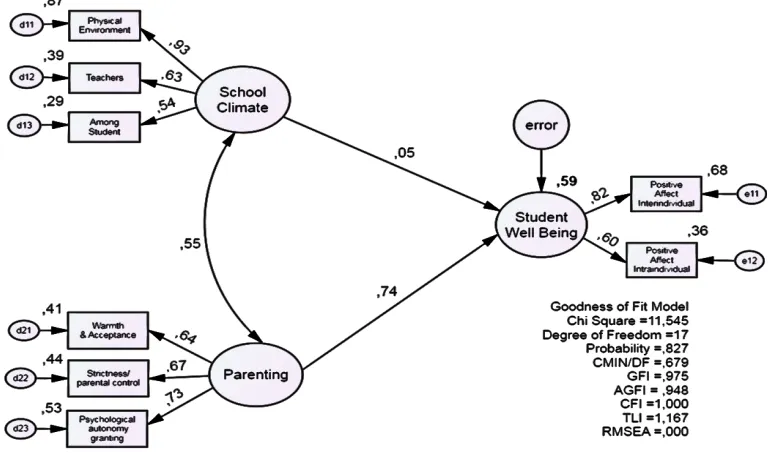
Figure 1. Structural Model of Student Well-Being
3. Result
The result of descriptive analysis regarding the score of student well-being, school climate and parenting style are shown in table 1. The direct relationship between research variables is exposed in table 2.
TLI sebesar 1,167 dan RMSEA sebesar 0.000 menunjukkan bahwa model dinyatakan fit/baik. Besarnya masing-masing indeks GOF dilaporkan pada tabel 3.
The result on the path through SEM analysis for the major hypothesis in the proposed model is reported in Figure 1. The value of chi-square obtained at 11 545 (N = 118), p = 0. 827, indicating that the null hypothesis is accepted, which means the structural model proposed is identical to the empirical model. The GFI index reached 0. 975, the TLI obtained1.167 and the RMSEA obtained 0.000 which indicates that the model is stated fit or good. The magnitude of each of the GOF indexes is reported in Table 3.
Table 2. Low and High Score Scale of Respondents (N=118)
Variable Category Total
Student
Percentage SD M
Student Well-Being High 115 97.45 % 2.54 21.24
Low 3 2.54 %
School Climate High 102 86.43 % 5.87 47.76
Low 16 13.55 %
Parenting Styles High 116 98.30 % 3.66 30.82
Low 2 1.69 %
Table 2 presents that the dominant student is in the high group category for student well-being, perceptions of school climate, and parenting styles. This indicates that students who have a positive student well-being are 97.54%, and students who have student well-being negative are 2.54 students. Positive perceptions are measured through positive affect interpersonal and positive affect intrapersonal.
Students also perceive the school climate positively. It is indicated by high scores that obtained 86.43% percentage, which means they see that the convenience and academic support in schools can be obtained from the physical environment, teachers, and among students. While students who perceive the school climate negatively was 13, 55% which means that they do not obtain optimal comfort and academic support both from the physical environment, teachers, and among students.
Parenting styles are also perceived positively by the students. This was indicated by the percentage of 98.30%, which means students have a positive perception related to warmth & acceptance, strictness or parental control, as well as psychological autonomy granting. While students who perceive parenting negatively were 1.69%, which means they receive less warmth & acceptance, strictness or parental control, as well as psychological autonomy granting.
Table 3. Direct Influence between Variable
Independent Dependent Direct Total
School Climate SWB 0.046 0.046
Parenting SWB 0.743 0.743
The result of minor hypothesis testing1 and 2 are shown in table 3. In table 3, there is a direct parenting effect on student well-being of 0.743 with the significance of 0.000 which is higher than direct school climate influence toward student well-being of 0.046 with the significance of 0.739. This means that parental influence is significant, while the influence of school climate is not significant to student well-being.
Indonesia. Parents install positive values to their children at home; while teachers, other students, and the physical environment in schools provide academic comfort and support for students to accomplish their well-being and prosperity.
Tabel 4. Goodness-of-Fit Indices for the Proposed Model
Model χ² DF p GFI TLI RMSEA
Proposed 11.545 17 0.827 .975 1.167 0.000
Note. GFI= Goodness of Fit Index ; TLI= Tucker Lewis Index; and RMSEA= Root Mean Square Error of Approximation
Discussion
People express different reactions regarding experiences related to well-being (e.g when they feel affects of comfort) (Diener,2009:10). The research of the last two decades showed that SWB involves frequent pleasant emotion, infrequent unpleasant emotions and life satisfaction (Diener, 2009: 10).
The phenomenon that occurs in State Junior High School students in Malang, East Java, Indonesia, also shows the same thing. The student well-being construct has been assuredly confirmed by empirical data. The descriptive data indicates that students who have high student well-being category are those who have high interindividual positive affect (positive desire to change bad habits of other students, grateful when they can help their friends solving problems, and happy when seeing others smiling) and positive Affect interindividual high (students want themselves to succeed in life, grateful to the advantages possessed, happy when they become a first-ranked in class).
The three items covered in interpersonal positive affect have a loading factor value of 0.822 with the coefficient of determination (R² = 0.676). This means that student well-being can be explained by the positive dimension of affecting interpersonal by 68%. The three other items covered in the intrapersonal positive affect have a loading factor value of 0.604 with the coefficient of determination (R² = 0.365). This means that student well-being can be explained by the intrapersonal intrapersonal positive affect of 36%. It can be concluded that student well-being is internally more able to be identified from interpersonal positive affect than intrapersonal positive affect.
It was remarked that the findings of quantitative research related to well-being are still minor when it is linked to culture (Diener, 2009: 11). The researcher will explain the research findings that have been conducted. Observed from the side of culture, students in Indonesia grew up in an Eastern culture which is laden with collective culture. Positive affect interpersonal with the value of R² = 0.676 indicates that the student in Indonesia has a higher positive affect related to their relationship with others compared with a positive effect on themselves. There are positive values associated with others who contribute significantly to the desire to change the bad habits of other students, be grateful when they can help their friends solving problems, and be happy when they see others smiling.
Furthermore, the intrapersonal positive affect with the value of R² = 0.365 indicates that State Junior High School students in Indonesia also desired to accomplish successfully in life, grateful to the advantages they possessed, happy when becoming a first-ranked student in class. There are positive values related to selfhood that also contribute to the construction of student well-being. This is in line with the findings of Riff and Singer (1998, in Diener 2009: 11) stating that there are universal characteristics of well-being that can be found in all cultures, including purpose in life, quality of the relationship, and self-regard.
(0.743> 0.046). The descriptive findings (note: table 1) indicated that Indonesian students are raised in parenting styles that emphasize warmth & acceptance, strictness or parental control, and psychological autonomy granting. This affects the emotional closeness of the parents, hence the construction of positive values and positive character of the child starts with the student's first social environment, which is parenting.
Parenting styles are explained by warmth and acceptance of 41%, strictness or parental control by 44%, and psychological autonomy granting by 53%. The biggest contribution is psychological autonomy granting and it is followed by strictness or parental control, and the last is warmth and acceptance. Psychological aspects of autonomy granting on parenting of children in Indonesia is performed by encouraging children to be brave in expressing their own opinions and teach the children to be grateful for the life they experienced. The strictness or parental control aspect is carried out by parents by reminding the child to keep the family's good name, forbidding the child to say rude to the parents, calling the child when it is late returning home, and advising the child to be polite to an elderly. The warmth and acceptance aspect of parents by considering the child's demand is adjusted to the learning interests, showing the love of the child by expressing pride the moment their children accomplish successfully in school and taking the time to help the child's difficulties while doing the task from the teacher.
Descriptive findings exposed that 107 students (90.68%) live with both parents, 8 students (6.8%) live with one of both parents, and 3 students (2.5%) live with relatives from their family. This indicates that family integrity could be reasonably expected to contribute to the high correlation of parenting styles to student well-being. These findings support the findings of Wentzel (2002, in Meece & Eccles, 2010) which shows that the parenting dimensions of rules, expectations, and controls affect the emotional well-being.
The results of the minor hypothesis testing found that the school climate did not significantly affect the student well-being students of State Junior High School in Malang, Indonesia. The empirical data showed that the climate construction schools can be explained by the characteristics of the latent physical environment of 0930 with R ² = 0865 by; 0. 626 with R ² = 0392 by teachers, p = 0.001; and 0538 with R ² = 289 by a fellow student, p = 0.001. This means that the school climate in student perceptions is explained further by the comfort and academic support of the physical environment. Furthermore, it is followed by the comfort and academic support of the teacher, and finally from fellow students. These findings have an identical pattern to Chirkov and Ryan (2001: 629) findings regarding students well-being in his research on American and Russian samples aged 14 to 19, where parent autonomy support (PAS) suggests more causal relationships higher value than the teacher autonomy support (TAS) (0.83> 0:11), p = 0.001.
References
Adams, T.B., Bezner, J.R., Drabbs, M.E., Zambarano, R.J., & Steinhardt, M.A. 2000. Conceptualization and Measurement of the Spiritual and Psychological Dimensions of Wellness in a College Population. Journal of American College Health (2000), published online 2010. 48:4, 165-173, DOI: 10.1080/07448480009595692. Di akses 5 Februari 2015.
Adams, T.B., Bezner, J.R., Drabbs, M.E., Zambarano, R.J., & Steinhardt, M.A. 2010. Conceptualization and Measurement of the Spiritual and Psychological Dimensions of Wellness in a College Population. Journal of American College Health. Routledge: London. Diakses 4 Februari 2015.
Awartani, M., Whitman, C.V., & Gordon, J. 2008. Developing Instruments to Capture Young People’s Perceptions of how School as a Learning Environment Affects their Well-Being. European Journal of Education,Vol. 43, No. 1, 2008, 51-70. Di akses 18 Desember 2014.Baumrind, 2005.
Awartani, M., Whitman, C.V., & Gordon, J. 2008. Developing Instruments to Capture Young People’s Perceptions of how School as a Learning Environment Affects their Well-Being. European Journal of Education,Vol. 43, No. 1, 2008, 51-70. Di akses 18 Desember 2014.
Ben-Arieh, A., Casas, F., Frones, I., & Corbin, J.E. 2014. Handbook of Child Well-Being; Theories, Methods, and Policies in Global Perspective.New York: Springer Reference.
Bockneck, E.L., Brophy-Herb, H.E., & Banerjee, M. 2009. Effect of Mental Supportiveness on Toddlers’ Emotion Regulation Over The First Three Years of Life in A Law-Income African-American Sample.Infant Mental Health Journal, 30 (5): 452-476.
Bornstein, M.H. 2002. Handbook of Parenting. Vol. 1 Children and Parenting. London: Lawrence Erlbaum Associates, Publishers.
Burton, K.D., Lydon, J.E., D’Alessandro, D.U.D., Koestner, R. 2006. The Differential Effects of Intrinsic and Identified Motivation on Well-Being and Performance: Prospective, Experimental, and Implicit Approaches to Self-Determination Theory. Journal of Personality and Social Psychology, Vol. 91, No. 4, 750–762.
Byrne, B.M. 2010. Structural Equation Modeling with AMOS Basic Concepts, Applications & Programming. Second Ed. New York: Routledge Taylor & Francis Group.
Carr, A. 2004. Positive Psychology The Science of Happiness and Human Strengths. New York: Brunner-Routledge.
Chirkov, V.I & Ryan, R.M. 2001. Parent And Teacher Autonomy-Support In Russian And U.S. Adolescents Common Effects On Well-Being And Academic Motivation. Journal of Cross-Cultural Psychology 32: 618.
Cohen, J., & Hamilton, R. O. 2009. Caring for the Individual Student and the Community of Learners Interlocking Relationships and Comprehensive School Climate Improvement. Schools: Studies in Education, vol. 6, no. 1., 104-116.
De Fraine, B., Landeghem, G.V., Van Damme, J., & Onghena, P. 2005. An Anaysis of Well-Being in Secondary School with Multilevel Growth Curve Models and Multilevel Multivariate Models. Quality & Quantity (2005) 39: 297-316.
Diener, Ed. 2009. Culture and Well-Being The Collected Works of Ed Diener. New York: Springer Sciences + business Media.
Durrotunnisa. 2015. Teacher-Students Positive Relationship. Proceeding- International Conference on Education and Training (ICET)Faculty of Education State University of Malang Collaborated with International Journal of Innovation in Education, pp. 419-424. Malang: Indonesia.
Engels, N., Aelterman, A., Petegem, K.V., & Schepens, A. 2004. Factor Which Influence The well-Being of Pupils in Flemish Secondary Schools. Educational Studies, Oktober 2004, 127-143, DOI: 10.1080/0305569032000159787.
Eryilmaz, E. 2011. Satisfaction of Needs and Determining of Life Goals: Amodel of Subjective Well-Being for Adolescents in High School. Educational Sciences: Theory & Practice - 11(4), 1757-1764.
Fan, W. & William, C.M. 2010. The Effects of Parental Infolvement on Students’ Academic Self Efficacy, Engagement and Intrinsic Motivation. Educational Psychology 30 (1): 53-74.
Fraillon, J. 2004. Measuring Student Well-Being in The Context of Australian Schooling: Discussion Paper. Carlton South: The Australian Council for Educational Research. Diakses 4 Februari 2015.
Frydenberg, E., & Lewis, R. 2009. Relations Among Well-Being, Avoidant Coping, And Active Coping In A Large Sample Of Australian Adolescents. Psychological Reports, 2009, 104, 745-758. Diakses 5 Februari 2015.
Gall, M.D., Gall, J.P., & Borg, W.R. 2003.Educational Research and Introduction. Boston: Pearson Education, Inc.
Gilman, R., Huebner, E.S., & Furlong, M.J. 2009. Handbook of Positive Psychology in Schools. New York: Routledge.
Gilman, R., Huebner, E.S., & Furlong, M.J. 2013. Handbook of Positive Psychology in the Schools. New York: Taylor and Francis.
Guerin, E., Fortier, M.S., & Williams, T. 2013. “I Just Need to Move...”: Examining Women’s Passion for Physical Activity and Its Relationship With Daily Affect and Vitality. Psychology of Well-Being: Theory, Research and Practice, 3:4, 1-24.
Gunnel., K.E., Crocker, P.R.E., Mack, D.E., Wilson, P.M., & Zumbo, B.D. 2014. Goal Content, Motivation, Psychological Need Satisfaction, Well-Being and Physical Activity: A Test of Self-Determination Theory over 6 Months. Psychology of Sport and Exercise 15 (2014), 19-29.
Hagarty, D., & Currie, J. 2012. The exercise class experience: an opportunity to promote student wellbeing during the HSC. Journal of Student Wellbeing, Vol. 5(2), 1–17.
Hagenauer, G., Hascher, T., & Volet, S.E. 2015. Teacher Emotions in The Classroom: Associations with Students’ Engagement, Classroom Discipline & The Interpersonal Teacher-Student Relationship. Eoropean Journal of Psychological Education, DOI 10.1007/s 10212-015-0250-0, h. 1-19.
Hascher, T. 2008. Quantitative and qualitative research approaches to assess student well-being. International Journal of Educational Research 47 (2008) 84–96. Diakses 5 Februari 2015.
Suldo, S.M., & Huebner, E.S. 2004. The Role of Life Satisfaction i The Relationship between Authoritative Parenting Dimensions and Adolescent Problem Behavior. Social Indicatos Research, 66: 165-195.
Jeynes, W.H. 2005. A Meta-Analysis of The Relation of Parental Involvement to Urban Elementary School Student Academic Achievement. Urban Education, Vol. 40 No. 3, May 2005 237-269. DOI: 10.1177/0042085905274540 © 2005 Corwin Press, Inc.
Kassen, S., Cohen, P., Chen, H., Johnson, J.G., & Crawford, T.N. 2009. School Climate and Continuity of Adolescent Personality Disorder Symptoms. Journal of Child Psychology and Psychiatry 50:12 (2009), h. 1504–1512.
Konu, A., Alanen, E., Lintonen, T., & Rimpela, M. 2002. Factor Structure of The School Being Model. Health Education Research Vol.17 no.6 2002 Theory & Practice, 732–742.
Krause, P.H., & Dailey, T.M. 2009. Handbook of Parenting Styles, Stresses and Strategies. New York: Nova Science Publishers, Inc.
Kristjanson, A.L., Sigfusdottir, I.D., Karlsson, T., & Allegrante, J.P. 2011. The Perceived Parental Support (PPS) Scale: Validity and Reliability in The 2006 Youth in Europe Substance Use Prevention Survey. Child Ind Res2011 (4): 515-528.
Lee, S-J. 2007. The Relations Between The Student-Teacher Trust Relationship and School Success in The Case of Korean Middle School.Educational Studies, Vol. 33, No. 2, 209-216.
Lippman, L.H., Moore, K.A., McIntosh. 2011. Positive Indicators of Child Well-Being: A Conceptual Framework, Measures, and Methodological Issues. Applied Research Quality Life (2011) 6:425–449 DOI 10.1007/s11482-011-9138-6.
Meece, J.L., & Eccles, J.S. 2010. Handbook of Research on Schools, Schooling and Human Development. New York: Routledge Taylor & Francis Bacon.
Micholas, A.C. 2014. Encyclopedia of Quality of Life and Well-Being Research. New York: Springer Science.
Miller, S., & Sambell, K. 2003. What do Parents Feel they Need? Implications of Parents’ Perspectives for the Facilitation of Parenting Programmes. Children & Society Volume 17 (2003), 32–44. Published online 25 July 2002 in Wiley InterScience (www.interscience.wiley.com). DOI: 10.1002/CHI.726.
Moran, P.,& Ghate, D. 2005. The Effectiveness of Parenting Support. Children and Society, vol. 19, 329-336.
Ruus, V.R., Veisson, M., Leino, M., Ots, L., Pallas, L., Sarv , E.S., & Veisson, A. 2007. Students’ Well-Being, Coping, Academic Success, and School Climate. Social Behavior and Personality, 2007, 35 (7), 919-936.
Snyder, C.R. & Lopez, S.J. 2002. Handbook of Positive Psychology. Oxford: Oxford University Press.
Snyder, C.R., & Lopez, S.J. 2007. Positive Psychology The Scientific and Practical Explorations of Human Strengths. London: Sage Publications, Inc.
Soutter, A.K., O’Steen, B., & Gilmore, A. 2012. Students’ and teachers’ perspectives on wellbeing in a senior secondary environment. Journal of Student Wellbeing March 2012, Vol. 5(2), 34–67.
Stepherd, J., & Roker, D. 2005. The Parenting of Young People:Using Newsletters to Provide Information and Support. Children & Society Volume 19, 264–277.
Suldo, S.M., & Huebner, E.S. 2004. The Role of Life Satisfaction in The Relationship between authoritative Parenting Dimensions and Adolescent Problem Behavior. Social Indicator Research, 66: 165-195.
Thapa, A., Cohen, J.,Guffey, S., & Higgins-D Alessandro, A. 2013. Review of School Climate Research. Review of Educational Research September 2013, Vol. 83, No. 3, 357–385. Diakses 18 Desember 2014.
Vedder, P., Boekaerts, M., & Seegers, G. 2005. Perceived Social Support and Well Being in School; The Role of Students’ Ethnicity. Journal of Youth and Adolescence, Vol. 34, No. 3, 269–278.
Woodhead, M., James, A., & Thomas, N. 2005. Parenting and parenting support. Children & Society Volume 19 (2005), 261–263.
Yunusa, M., Osmana, W.S.W., & Ishaka, N.M. 2011.Teacher-student relationship factor affecting motivation and academic achievement in ESL classroom. Procedia Social and Behavioral Sciences 15, 2637–2641.
Zullig, K.J., Koopman, T.M., Patton,J.M., & Ubbes,V.A. 2010. School Climate: Historical Review, Instrument Development & School Assesment. Journal of Psychoeducational Assesment 28 (2), 139-152. https:www//researchgate.net/publication/23385309.
Zullig, K.J., Huebner E.S., & Patton, , J.M. 2011. Relationship Among School Climate Domains and School Satisfaction. Psychology in The School, Vol 48 (2), 133-145.