Nita Rajvaidya
Lecturer
Department of Civil Engineering
Truba Institute of Engineering and Information Technology Bhopal, M. P., India
Abstract
In the conventional analysis of a multi-storey building frame we consider the frame as an isolated structure which is not affected by the nature of soil, but practically the building frame rests on a settable soil mass. So it is necessary to consider the differential settlement of the foundation which may change the forces of the structural member significantly. In the soil structure interaction analysis, the building frame, foundation and soil mass consider as a complete structure which is subjected to different types of loads like dead load, live load, wind load, seismic load etc. Seismic load is essential in case of multi-storey building.In the present work, the linear interaction analysis of a three-bay eight-storey plane building frame-homogeneous soil system under seismic loading has been carried out using the software ANSYS based on finite element method. The frame and the soil mass both have been considered to act in a linear elastic manner. The change in axial forces and bending moments in the columns due to differential settlements of the soil mass is investigated.
Keywords: Conventional Frame Analysis, Finite Element Method, Plane Frame, Soil Structure Interaction, Linear Interaction Analysis, Differential Settlement
________________________________________________________________________________________________________
I.
I
NTRODUCTIONIn the conventional method of analysis of a building frame the foundation loads are obtained without considering soil structure interaction or soil settlement. In this method the soil mass considered as perfectly flexible material. So it is assumed that there is no differential settlement occurs in the structure. Such an analysis gives unrealistic solutions and sometimes leads to failure of structure.
In reality, a small differential settlement of structure may also alter the forces of the structure significantly. So it is necessary to consider the building frame, foundation and soil mass as single integral compatible unit for realistic analysis. Finite element method is a powerful tool for numerical analysis of any soil-structure interaction problem. ANSYS software solves the structures using finite element method.
II.
R
OBLEM FOR INVESTIGATIONAn eight-storey unsymmetrical RCC framed building with isolated footings resting on homogeneous soil mass has been considered in this study. The building is subjected to dead load, live load and lateral seismic forces. In the conventional analysis plane frame is analysed without considering the interaction effect. Whereas in linear interaction analysis the plane frame, footings and soil mass are considered as a single compatible structural unit. Super-structure, foundation, as well as soil are considered to behave in linear elastic manner.
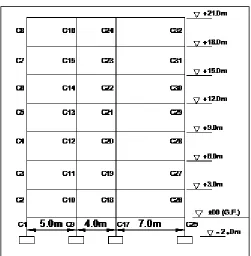
Geometrical and Material Properties of the Frame: A.
Fig. 1: Geometrical Details of Frame under Analysis Table -1
Geometrical and Material Properties of the Structure and Soil
S. No. Structural components Properties and size of components
1 All floor and plinth beam 0.30m x 0.50
2 Columns 0.50m x 0.50m
3 Footings 3.0m x 3.0m x1.0m
4 Number of bays 3
5 Number of storeys 8
6 Floor beam and plinth beam uniformly distributed loading 40 kN/m
7 Depth of soil 10.0 m
8 Modulus of elasticity of
concrete (N/mm2) 2.17 x 10
7 kN/m2
9 Poisson’s ratio of concrete 0.17
10 Elastic Modulus of soil 14700 kN/m2
11 Poisson’s ratio of soil 0.35
Loading On the Frame: B.
The floor beams and plinth beams carry total uniformly distributed load of 40 kN/m as dead load and live load. The seismic loads have been calculated by static method as per IS 1893 (Part-I):2002 considering seismic zone V of India. The parameters used for calculation of seismic forces are given in the Table 2 and estimated seismic forces are provided in Table 3. The seismic forces are acting from left of the frame.
Table- 2
models suited for the problem under consideration. Table 4 shows the different elements used for descritization of different structural elements.
Table -4
Different Types of Elements Used For Descritization S. No. Structural elements Element Name
1 Column Beam188
2 Beam Beam188
3 Footing Solid45
4 Soil mass Solid45
Conventional Frame Analysis (CFA): A.
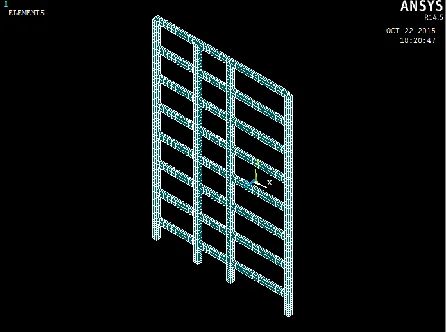
The conventional analysis of plane frame is carried out without considering the structure-soil interaction. The combination of dead load, live load and seismic load (DL+LL+EL) is considered for analysis. Figure 2 shows the descritized model of building frame.
Fig. 2: Descritized Model of Building Frame Used In CFA
Linear Interaction Analysis (LIA): B.
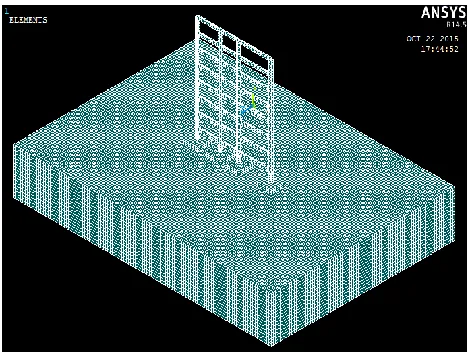
Fig. 3: Descritized Model of Building Frame and Soil Used In LIA
IV.
R
ESULTS AND DISCUSSIONSThe results are discussed to highlight the effect of soil-structure interaction. Thus, axial forces and bending moments of the columns C1 to C32 are tabulated in the Table 5. Due to interaction effect, differential settlements take place in the footings, which results in redistribution of axial forces and moments in the columns.
Table-5
Axial Forces And Bending Moment In The Columns With And Without Taking Interaction Effect Column
Position Column No.
Axial Force (kN) % Difference Bending Moment (kN-m) % Difference
CFA LIA (4)-(3) CFA LIA (6)-(8) (7)-(9)
(1) (2) (3) (4) (5) (6)
Bottom (7) Top
(8) Bottom
(9) Top
(10) Bottom
(11) Top
Left End Columns
C1 282.78 549.04 94.2 -150.7 -28.47 5.65 107.4 * *
C2 247.11 512.31 107.3 -109.27 62.98 5.21 33.95 * -46.1
C3 237.13 467.50 97.1 -79.25 74.25 -30.41 31.45 -61.6 -57.6
C4 227.01 416.81 83.6 -68.71 73.41 -19.6 27.45 -71.5 -62.6
C5 210.79 360.02 70.8 -55.27 67.86 -8.82 22.35 -84.0 -67.1
C6 184.3 293.44 59.2 -36.45 57.51 9.28 12.62 * -78.1
C7 142.59 212.06 48.7 -10.8 45.18 34.72 1.87 * -95.9
C8 79.80 108.6 36.1 26.41 -14.16 74.72 -80.04 182.9 465.3
Left Interior column
C9 1273.6 1104.3 -13.3 -195.2 82.80 6.90 130.7 * 57.9
C10 1118.0 977.87 -12.5 -231.06 197.34 -215.07 190.5 -6.9 -3.5
C11 967.56 851.66 -12.0 -221.0 214.23 -150.00 158.8 -32.1 -25.9
C12 817.18 721.54 -11.7 -205.52 207.8 -148.03 152.0 -28.0 -26.9
C13 664.25 589.14 -11.3 -184.18 192.45 -127.3 137 -30.9 -28.8
C14 507.64 453.21 -10.7 -153.08 168.67 -97.66 114.02 -36.2 -32.4
C15 346.07 312.53 -9.7 -108.3 128.76 -53.90 76.7 -50.2 -40.4
C16 177.42 165.58 -6.7 -56.22 89.41 3.55 14.90 -106.3 -83.3
C17 2109.7 1656.00 -21.5 -169.6 18.53 16.50 313.2 * 1590.2
C18 1834.8 1431.3 -22.0 -166.5 132.70 -178.23 207.5 7.0 56.4
1) The axial forces and bending moment in the columns of the frame due to interaction effect is considerably different from the conventional frame analysis.
2) Significant increase in the axial forces is found in the end columns (left and right), whereas the decrease in the axial forces is found in the interior columns.
3) The interaction effect causes a significant decrease in bending moments of the left side columns (end and interior both), whereas a significant increase in bending moments is found in right side columns.
4) Reversal in the sign of bending moments is generally found in the columns below the ground level and the left end columns.
5) The interaction analysis can be effectively used to evaluate axial forces and the bending moments for a multi- storey building frame for better and efficient building design.
R
EFERENCES[1] A.I.M. Aljanabi, B.J.M. Farid, and A.A.A. Mohamed, Interaction of plane frames with elastic foundation having normal and shear moduli of subgrade reactions, Comput. Struct., 36(6), 1990, 1047-1056.
[2] Ramakant Agrawal, M.S. Hora, Nonlinear interaction behaviour of plane frame-layered soil system subjected to seismic loading, Int. J. Struct. Eng. Mech.,
41(6), 2012
[3] Ramakant Agrawal, M.S. Hora, Coupled finite-infinite elements modelling of building frame-soil interaction system , ARPN Journal of Engineering and
Applied Sciences., 41(6), 2012, 711-734.
[4] Agrawal R. and Hora M.S., Effect of differential settlements on nonlinear interaction behaviour of plane frame-soil system. ARPN Journal of Engineering
and Applied Sciences. 5(7), 2010, 75-87.
[5] D. K. Jain, M. S. Hora, Interaction analysis of space frame-shear wall-soil system to investigate foundation forces under seismic loading, ARPN Journal of
Engineering and Applied Sciences., 9(8), 2014, 1267-1281.
[6] M. Hora, Nonlinear interaction analysis of infilled building frame-soil system, J. Struct. Eng., 33(4), 2006, 309-318.
[7] Ramakant Agrawal, Vivek Garg, M.S. Hora, Collapse load assessment for infilled frame-soil media interaction system, Int. J. Civil Eng., 1(2), 2009,
101-109.
[8] Garg Vivek and Hora M.S., Interaction effect of space frame-strap footing-soil system on forces in superstructure, ARPN Journal of Engineering and Applied Sciences, 7(11), 1402-1415.
[9] IS 1893 (Part 1): 2002. Criteria for Earthquake Resistant Design of Structures. (Part 1: General Provisions and Buildings) (5th Revision).