A Review on MATLAB based Platform for the
Evaluation of Modulation Techniques using
Multiuser MIMO-OFDM for Visible Light
Communications using MATLAB
Payal Soni Shikha Singh
M. Tech Student Assistant Professor
Department of Electronics & Communication Engineering Department of Electronics & Communication Engineering Dr. C.V. Raman University Bilaspur, C.G., India Dr. C.V. Raman University Bilaspur, C.G., India
Abstract
Visible light communication is innovative and active technique in modern digital wireless communication. In this paper, we describe a new innovative vlc system which having a better performance and efficiency to other previous system. We used multiple input multiple output (MIMO) with orthogonal frequency division multiplexing (OFDM) technique which is enhance the data rate of wireless data transmission. Since we know the multiple transmitter and receiver having different links distances, having different temporal delays, complex channel gain and phase differences is resulting when frequency domain have transformed. In OFDM each subcarrier, the calculation of corresponding pre-coding matrix in the frequency domain for elimination of multiple interference. We first considered phase information in frequency domain, where precoding are uses of complex matrices, real, channel matrices. Which is used for reduces the channel correlation for achieve better performance. This paper describes a detailed survey of (1) VLC system and characteristics of transmitter and receiver, (2) Modulation methods, (3) SISO, MIMO, MIMO-OFDM, (4) VLC sensing and applications, (5) VLC system architecture design and programming platform.
Keywords: Multiple-input multiple-output (MIMO), multiuser, orthogonal frequency-division multiplexing (OFDM), precoding, visible light communication (VLC)
________________________________________________________________________________________________________
I. INTRODUCTION
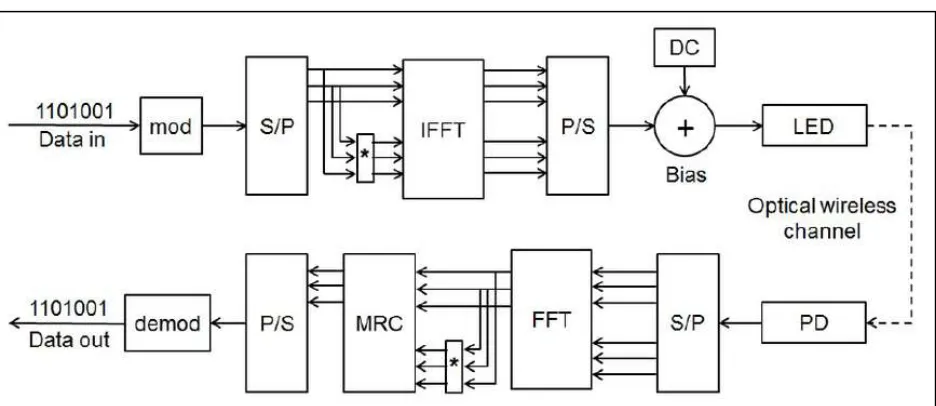
Fig. 1: (a) LED Based Indoor Visible Light Communications Block Diagram II. OBJECTIVE
Our objective is in this paper, that we describe the implementation and investigation of the different topologies of the VLC based wireless optical transmission technique. In this work we analyze the SISO (Single input single output) and MISO (Multiple input and single output) topologies in modulation scheme. We have verified the technique, use of an analog modulation system. In our case OFDM (Orthogonal frequency division multiplexing) is to use for increasing the capacity of link and used for achieve the high data rate figures. We have spread spectrum schemes, which offer some advantages to the links of wireless optical. This wireless optical links suffer from fading and the multipath effect degrading of their performance. Some of other topologies to overcome of these effects, which is introduced for the different transmission techniques than the standard single input single output used in most of the communication techniques. In radio frequency communication system, we have used multiple antennas basically mimo (multiple input multiple output) have been proven the capable of increasing through, which is as well as eliminating the fading effects and multipath communication system.
III. REVIEW WORK
In past of few years, vlc wireless optical communication has attracted increasing the attention from both industry and educational areas. The vlc has much advantage, such as wide bandwidth which is unregulated, high security with low cost system [2], [1]. It has been considered for a technique to using a raddio frequency communications in the fiftth generation (5G technologies) and wireless communication used in indoor communication. While in indoor wireless communications system using vlc system, light emitting diodes are use for illumination and data transmission during at the same time. This is energy efficient. for low cost of implementation of visible light communication system typically used for utillize the intensity of modulation with direct signal detection, Where the information is transmitted through the leds and data signal is detected by photodiodes at the receiver points.
support multiuser service [8], [9]. In [10], a MIMO-OFDM VLC system is investigated, but it requires an imaging diversity receiver , which is distinguish signals from different of LEDs, which is infeasible for multiuser and high data rate scenarios.
In this paper, we describe multiuser MIMO-OFDM for indoor Visible Light Communication systems. We considering in indoor communication, the distances are different of the multiple transmitter-receiver links, and their temporal delays are also be different, resulting in complex channel high gain and phase is differences when signal is transformed to the channel frequency domain. The phase is difference cannot be neglected when the wide-band systems are assumed, especially for the data transmission the subcarriers with high frequency bandwidth. Therefore, in our proposed schemes, calculation of the precoding matrix is for each subcarrier in OFDM topologies to eliminate multiuser interference in the channel. Different from of the state-of-the-art schemes, complex rather than real-channel matrices can be used for precoding calculation, which helps to reduces the channel correlation with one more degree of freedom and helps to improves the system performance.
IV. VISIBLE LIGHT COMMUNICATION
Visible Light Communication (VLC) is a innovative communication technology in modern wireless communication which is capable to achieve high speed data transmission during the indoor wireless communication. Thus, VLC attracts extensive attentions worldwide of communication technology. The carrier of information in visible light communication system uses optical wavelengths of light, and we know the Light Emitting Diodes (LEDs) emitted high speed flicker optical signals for transmitting of information, while the Photodetector (PD) or other optoelectronic transform devices such as phototransistor, photo-resistor receive the modulated optical signal and convert it to electrical signal. Compared to the standard RF communication and the other optical communications, Visible light communication has many advantages such as high transmitted data rate, high gain and power, non-electromagnetic interference means no any medium can affect the signal. The goal of this paper for indoor VLC is to achieve the high data rate of wireless non- electromagnetic transmission [4], but in the modulation bandwidth of the white LED is just about 20 MHz [5], which is too limited to realize high speed data wireless transmission in Single Input Single Output system. When Multiple Input Multiple Output topology is applied in indoor visible light communication, it could be potentially increasing the scope of the wireless communication links.
V. VLC BASED SYSTEM MODEL AND APROACES
The proposed system contains various stages as image acquisition, preprocessing, number plate localization, character segmentation, character recognition. VLC system has mainly three parts namely transmitter, receiver and channel. Every kind of light source can theoretically be used as transmitting device for VLC. However, some are better suited than others. The receiver consists of an optical element to collect and concentrate the radiation onto the receiver photo detector. This converts the radiation into photocurrent, which is then pre and post-amplified before data recovery. Receivers typically employ either long pass or band pass optical filters to attenuate ambient light. Long pass filters can be thought of as essentially passing light at all wavelengths beyond the cutoff wavelength. They are usually constructed of colored glass or plastic, so that their transmission characteristics are substantially independent of the angle of incidence. Long pass filters are used in almost all present commercial infrared systems.
SISO System:
In the visible light communication system a SISO system, that is, the transmitter of the light communication system includes only one single data light emitting unit, and the single receiver unit includes only one single photosensitive element is used in this system. This system has low efficiency and performance of high error rate during wireless transmission.
MIMO System:
The ideas of using multiple transmit and multiple receiver antennas has emerged as one of the most significant technology in modern digital wireless communications. MIMO is the used the multiple antennas in both. The multiple transmitter and multiple receiver to improve the wireless communication performance. MIMO technology has innovative features which is attracted attention in wireless communications, it offers significant increases in data rate in transmission and link range also without requiring additional transmit power or channel bandwidth. This feature achieved cause of higher spectral efficiency and having of link reliability or diversity.
OFDM
multipath propagation. Moreover, the techniques can adapt modulation to the quality of service and the requested data rates of uplink or downlink (UL/DL). Also, any multiple access schemes can be combine in OFDM.
MIMO –OFDM for VLC System
In existing SISO, MIMO VLC systems, the single-carrier modulations are utilized with the limited bandwidth [8]–[10]. Therefore, the precoding matrices is conducted in time domain and only the DC channel gain in (1) is considered. Since the distances of the multiple transmitter-receiver links are different, their temporal delays are also different, resulting in the complex channel high gain and phase is differences when conversion of the frequency domain. The time-domain channel response from the qth LED unit to the pth user in (1) can be [11]rewritten as:
Where denotes the Dirac delta function and c is the speed of light. Correspondingly, the frequency-domain channel response for the kth subcarrier is given by
Where B is denotes the system signal bandwidth, and N is the size of fast-Fourier transform (FFT). j is the imaginary unit, and . It can be seen that the phase of the frequency-domain channel gain are proportional to the bandwidth. Moreover, when the temporal delay is assume, the frequency-domain channel response is complex-valued, which provides an extra dimension and reduces the channel correlation with the phase differences of multiple links. However, in order to achieve up to 100 GBps high data rate of wireless transmission [11]–[13], wide bandwidth optical components are used, and the phase in the complex channel gain cannot be neglected anymore. Therefore, MIMO-OFDM scheme is proposed for Visible light communication system and precoding is performed on different frequencies individually.
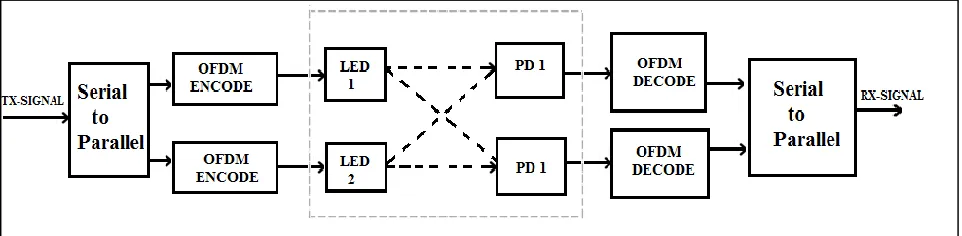
Fig. 2: MIMO-OFDM System Model Using Spatial Diversity VI. CONCLUSION
In this paper, different method are is studied for VLC systems, MIMO-OFDM use in our system which considers the phase differences of channel matrices in the light frequency domain induced by the distance differences between the multiple transmitter and receiver links. In this paper, we can design signal surface using ofdm. And create a distance between surfaces. We also adjust the incident angle of light beam which enters in optical tube.
VII.EXPECTED OUTCOMES
We expected that we can be transmitting high speed data using vlc without any signal loss and overlapping of signal. This system will be use in indoor communication. This system can be resolving the many of the previous issue of systems.
ACKNOWLEDGEMENT
REFERENCES
[1] Q. Wang [2015], “Layered ACO-OFDM for intensity-modulated direct-detection optical wireless transmission,” Opt. Exp., vol. 23, no. 9, pp. 12382– 12393.
[2] Q. Wang, Z. Wang, and L. Dai [2015], “Asymmetrical hybrid optical OFDM for visible light communications with dimming control,” IEEE Photon. Technol. Lett., vol. 27, no. 9, pp. 974–977.
[3] G. L. Stuber [2004]., “Broadband MIMO-OFDM wireless communications,” Proc. IEEE, vol. 92, no. 2, pp. 271–294.
[4] M. Jiang and L. Hanzo [2007], “Multiuser MIMO-OFDM for next-generation wireless systems,” Proc. IEEE, vol. 95, no. 7, pp. 1430–1469.
[5] A. H. Azhar, T. Tran, and D. O'Brien [2013], “A gigabit/s indoor wireless transmission using MIMO-OFDM visible-light communications,” IEEE Photon. Technol. Lett., vol. 25, no. 2, pp. 171–174.
[6] A. C. Boucouvalas, K. Yiannopoulos, and Z. Ghassemlooy [2014], “100 Gbit/s optical wireless communication system link throughput,” Electron. Lett., vol. 50, no. 17, pp. 1220–1222.
[7] D. Tsonev, S. Videv, and H. Haas [2015], “Towards a 100 Gb/s visible light wireless access network,” Opt. Exp., vol. 23, no. 2, pp. 1627–1637.
[8] A. Gomez [2015], “Beyond 100-Gb/s indoor wide field-of-view optical wireless communications,” IEEE Photon. Technol. Lett., vol. 27, no. 4, pp. 367– 370.
[9] Q. H. Spencer, A. L. Swindlehurst, and M. Haardt [2004], “Zero-forcing methods for downlink spatial multiplexing in multiuser MIMO channels,” IEEE Trans. Signal Process., vol. 52, no. 2, pp. 461–47.
[10] Q. H. Spencer, C. B. Peel, A. L. Swindlehurst, and M. Haardt [2004], “An introduction to the multi-user MIMO downlink,” IEEE Commun. Mag., vol. 42, no. 10, pp. 60–67.
[11] S. D. Dissanayake and J. Armstrong [2013], “Comparison of ACO-OFDM, DCO-OFDM and ADO-OFDM in IM/DD systems,” J. Lightw. Technol., vol. 31, no. 7, pp. 1063–1072.
[12] J. Armstrong and A. J. Lowery [2006], “Power efficient optical OFDM,” Electron. Lett., vol. 42, no. 6, pp. 370–372.
[13] Z. Yu, R. J. Baxley, and G. T. Zhou [2013], “Multi-user MISO broadcasting for indoor visible light communication,” in Proc. IEEE ICASSP, Vancouver, BC, Canada,pp. 4849–4853.
[14] J. Ding, Z. Xu, and L. Hanzo [2015], “Accuracy of the point-source model of a multi-LED array in high-speed visible light communication channel characterization,” IEEE Photon. J., vol. 7, no. 4, Art. ID 1600714.
[15] J. Grubor, S. C. J. Lee, K.-D. Langer, T. Koonen, and J. W. Walewski [2015], “Wireless high-speed data transmission with phosphorescent white-light LEDs,” in Proc. ECOC, 2007, pp. 1–2.