e
-ISSN: 2278-067X,
p
-ISSN: 2278-800X, www.ijerd.com
Volume 6, Issue 6 (March 2013), PP. 01-05
Multi Tenancy supported Service Process Architecture for
business process customization in cloud
B. Sunil Kumar, D. Priyanka,SrinivasuluChinna, A. Santosh Kumar
Abstract:- Now a days business processes of most organizations are automated to support the advanced workflow management systems. Day to day changes in market conditions forces the need for frequent updates or development of new process creations of current systems, which leads to high cost, resources, infrastructure and long development time of application. Due to these problems, business organizations become as process consumers and looking for ready to use and shared business processes from IT providers for on demandrequirements. This is the reason to develop Cloud Computing and Business ProcessOutsourcing with the development of new concept Process as a Service (PaaS) under the scope of SOA based Software as a Service(SaaS). Business policies are different from organization to organization, so process providers are unable to share non customizablebusiness processes among cross-organizational service consumers in SOA. To overcome this problem, in this paper we are introducing a new framework Multi Tenancy supported Service Process Architecture(MTSPA)is an extension for SOA architecture with multi-tenancy capabilities in cloudcomputing. This framework is designed with an architectural style to support the sharing ofbusiness processes for cross organizational consumers or tenants in process development,particularly on service processes in SOA. Our framework implementation allows the consumers for process customization and policy definitionsto improve the performance of business cloud with new service PaaS.
Keywords:- Process as a Service, Cloud Computing, Business Processes, Multi-tenancy, SOA.
I.
INTRODUCTION
Cloud computing describes a broad movement toward the use of wide area networks (WANs), such as the Internet, to enable interaction between information technology (IT) service providers of many types and consumers. Service providers are expanding their offerings to include the entire traditional IT stack, ranging from foundational hardware and platforms to application components, software services (SaaS),and whole software applications.Service-Oriented Architecture (SOA) is a business-centric IT architectural style [11], which aims to use various computing services as basic building blocks to rapidly construct low-cost and high performance applications. It improves the reusability of developed services, which may come from different service providerswhen a new business process arises, also as a way of business collaboration between organizations.Business process is a collection of interrelated tasks or activities, which are designed todeliver a particular result or complete a business goal [5]. A business process could bebroken down into several sub-processes mapping to activities of the overall process.
framework is designed with an architectural style to support the sharing ofbusiness processes for cross organizational consumers or tenants in process development,particularly on service processes in SOA.The business policies regarding business processes would be addressed byon-the-fly process customization through runtime governance. In this approach we designed two extensions are, i)allowing process consumers to customize (Process governability) existed policies to expresstheir own business policies, and ii)coordination framework implementation to enforcethe process execution by process providers for consumers through a coordination protocol. We can observe the logical diagrams of current web services and our multi tenants supporting framework as shown in diagram.Fig.1.a represents the existed web services mechanism which can share a common business process among different consumers without process customization. Fig.1.b represents the new multi tenancy supporting application, which share among various users and every user can customize the application according to their required polices. Our approach at runtime, weave the provider given predefined policies with consumer policies and runs a separate customized instance for each user as shown in Fig.1.b.
Fig.1.a. Traditional web service architecture.Fig.1.b. MTSPA architecture for process customization.
II.
RELATED WORK
In this section we give the brief discussion of related topics, which are utilized in this approach.In following, we describe the background and related work in relation to different domains and architectures.
SOA:Service Oriented Architecture (SOA) redefines IT facilities as flexible, reusable components that can be deployed as parts of business processes and maintained as self-contained units of well-defined functionality, independent of underlying technology.SOA builds on computer engineering approaches of the past to offer an architectural approach for enterprise systems, oriented around the offering of services on a network of consumers. A focus of this service-oriented approach is on the definition of service interfaces and predictable service behaviors.
Software as a service (SaaS) This definition relies on the cloud for access to what would traditionally be local desktop software.Software as a Service (SaaS) is a model of software deployment where an application is hosted as a service provided to customers across the Internet. One advantage of this approach is that the application can be continuously updated by the application provider without issuing and shipping new installation disks. Each time the user logs in to the site, the user will get the latest version of the application.By eliminating the need to install and run the application on the customer’s own computer, SaaS alleviates the customer’s burden of software maintenance, ongoing operation, and support.
Outsourcing to cloud providers: Commercial cloud computing effectively outsources portionsof the IT stack, ranging from hardware through applications, to cloud providers. Cloud computing allows a consumer to benefit by incrementally leveraging a more significant capital investment made by a provider. The consumers also benefit significantly by being able to dynamically scale their demand of the cloud services.
Service oriented business processes: Business processes are defined by service composition in SOA.The
service composition is a key concept in SOA. It realizes the business process by combining individual business services in composite services. It also realizes business collaboration through composite services from different business partners.Depending on human involvement in composition processes,there are three types of composition methods:Manual composition,Automatic composition and Semi-automatic composition. In cloud computing PaaS offers a deployment platform, such as a BPEL engine for business processes of clients. Sample work introduces a BPEL engine compliance interface that allowsenterprises to gather process evidence from a BPEL engine as well as enforcing ruleson the process.
fees, quicker accessto new functionality, etc. Many SaaS vendors have pointed out that multi-tenancy is arequirement of any SaaS system.
III. MULTI TENANCY SUPPORTED SERVICE PROCESS ARCHITECTURE(MTSPA)
We introduced a new architectural framework as a solution to address the above issues for theProcess as a Service. It consists of a multi tenancy support capability to extend the SOA style, and a supported architecture framework (MTSPA) designed forthe specific style. The proposed SPA style has a defined principle for the goal of processcustomizability and adaptability on process design and development with providers. MTSPA is the extension of SOA have the extensions to i)allowing process consumers to customize (Process governability) existed policies to expresstheir own business policies, and ii)coordination framework implementation to enforcethe process execution by process providers for consumers through a coordination protocol. MTSPA is a framework for distributed computing that promotes sharing of large programs or serviceprocesses for different tenants. Service processes are the programs or applications in our context. Oneobjective of the MTSPA style is an attempt to provide a plug and play Enterprise Application Integration solution for businessprocesses for enterprise-wide collaboration.MTSPA is under the scope of the code mobility concept, allowing relocation of the computing units which are available for process governance to the computationenvironments external to the process consumers’ side. It defines a principle -Process governability to advocate this relocation for business processes of providers on system design.
Process governability:Components are the primary building blocks of architectures. MTSPA identifies two different basic computational components based on behaviors and responsibilities for programsand tenants in different computation environments for governance, i.e., process providerand process consumers in the context of business processes. It is modeled as a tuple:
MTSPA =<< BP, PG >,CP>, where,
BP is a business process, CP is a consumer process and PG is a process governance. A business process bp∈ BP is a SOA service process or subprocess component in the cloud. Process components on the process provider side offer business processes. Theyexecute business activities within the process logic to serve a particular goal, andhold process runtime information resource need for policy evaluation or weaving.
PG = PGe U PGi , where,
pge∈ PGe is a process governance component external to the provider ofa bp, or owned by external consumers. This is the consumer policy which represents the consumer specific business process customization.pgi∈ PGiis a process governance component internal to the provider ofa bp.Governance components govern the business processes runtime for process consumers with various policies. They holdthe policies of process consumers and evaluate or weave the policies and another component cp∈ CPis a coordination protocol within a service or process contract defines the connectorsand behavior between any process and governance components.
Initially the process components send process runtime information resources to the governancecomponents for a governance request as is defined by the contract. Governance components respond with guidance actions or decisions which are defined by the contract to govern process execution after policy weaving (means wrapping the provider policy with consumer given customized information). The governance components could be viewedas autonomic managers which have the functions of Sensors and Effectors from the perspective of an autonomic computing architecture.The process components are not tiedto any governance components but comply with coordination protocols. One governancecomponent is responsible for one process consumer that has a separate set of policies. Theconnections from any governance component to any process component are dynamic ondemand through coordination protocols to offer a mess architectural topology betweencomponents.It supports three different implementation patterns for meeting various business scenario needs:
i) Consumer driven pattern (pg∈PGe) - The policies are implemented by externalprocess consumers. Each consumer freely defines their own policies for the businessprocess.
ii) Provider driven pattern(pg∈PGi) - The policies are implemented by the processprovider. The process provider defines policies for different process consumers.
iii) Hybrid (Consumer & Provider) driven pattern(pg1∈PGe^ pg2∈ PGi)– Thepolicies are implemented by both consumers and providers. For example, in additionto applying the process internally, the process also provides this service for externalcustomers.
customize according to the user requirements and which is not supported by current web services applications.After analyzing the problem we identified the need and implementation of a framework to extend the capabilities of SOA. In somecases, two architectural styles may look similar, but should not be mixed as their focus orcontribution areas are different.The SOA[1] style can package business processes into composite services and expose themto process consumers. However, how the business process can be an interoperable processfor consumers with different policies is not addressed by SOA, or any other architectural.
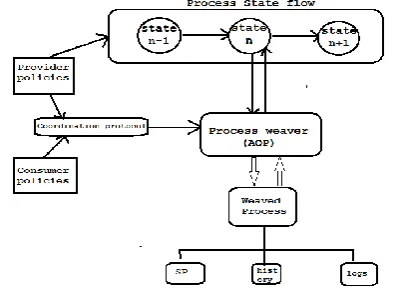
Our architecture style focused ongoverning developed applications at runtimefor application tenants’ various requirements or policies, but also addresses the issues withcurrent approaches we observed.This framework architecture style defined for sharing largeprograms or processes for multiple tenants who might have various requirements regardingthe programs, to offer a solution of process as a service for software designstyle.This frame work have various components to work to achieve on-the-fly process governance as shown in below diagram.
Fig 1. Policy Governance(weaving) framework model
Process state flow is a process runtime execution instance derived froman activity based process instance defined by the coordination protocol. In business process applications we have to customize a particular state based on consumer requirement. In above diagram state n is selected for process customization by consumer. The selected process execution is now controlled by process weaver, which is an AOP application to weave the customized policies with provider processes. To synchronize the provider defined policies with consumer policies we have the coordination protocol and this will produces a new policy set by aggregating consumer and provider data. Newly defined policy set is wrapped around the selected process and this will override the existed policy set of that process. Weaved processes are executed by weaved process executor and it will save every changed state and process flow in log file for debugging. History of every weaved process and execution order will save in history and the service provider given data will store in SP.
ProcessWeaver(AOP):Aspects are required to be integrated into the business process in order to address the separate concerns implemented by aspects for the business process, i.e. the aspect or process weavingmechanism in the AOP concept. An AOP process interceptor will dynamically weave occurs at runtime [9] and the change and deployed aspects do not affect the deployedtarget program.This is an especially important factor in the multi-tenancy environmentwhere modifying or redeploying the business process is not allowed, as it could affect othercurrent process consumers. It is able to find the pointsof program execution where an aspect is involved.The aspects of a processconsumer should be exclusively weaved for the consumer only, but should not be involvedwith any other process consumers.Aspect weaving relies on the coordination protocol, as ourAOP model is likewise designed to comply with. The aspect weaving feature is upgradedinto the policy weaver component, and the weaver still remains in process governance components due to the multi-tenancy requirement.
Coordination Protocol:For a business transaction requested by a process consumer, there are a number of activities including those from subprocesses within a process that will participate in the transaction. TheWS-Coordinationspecifications such as [2] [8], are designed for transactions of distributed Web services rather than transactions of business processes. But this protocol includes defined protocols as contracts for all participants for any businesstransactions of business processes. This coordination model is inspired by the WS-Coordination and XACML policy framework, and is redefined for the specific need of our coordination protocol and mechanismfor policy enforcement. Protocol will synchronize the consumer policies with provider as Coorc∪
conversation.The process consumer then sends a process request to the provider or business processcontaining the Coorcontext.The Coorcontext is extracted from the SOAP message and passed to the protocol service Xp at Coorp.
At this point, the protocol service Xc service reference is known bythe protocol service Xp, and the
communication between the protocol services canbe established.Depending on the result of cached coordination data, the communication between theprotocol service Xc and Xp may occur at the point of process execution.The
protocol cache is updated through the cache service if it is required.
III.
EXPERIMENTS
The generate policies from above framework are deployed in a PolicySet, and are integrated with previouspolicies, so that the above policy aspects are integrated intoand managed by our XML policy model. Any business policies already expressed in ourXML policy model will still apply to business processes. The same test case based approachis used, and the result shows that all policies are enforced. All policy decisions or provideractions are combined as managed by our XML policies.We compared our results with the previous non-customizable process environments as shown below.
Policy Approach Policy Focus Consumer Policies Provider policies Mutual Agreement XACML Service Not available Available No
Business Rules Process Not available Available No WS-Policy Service Available(little) Available Required MTSPA Service Available Available Not Required
We can see that with both XACML and the business rules approach, the policies aredefined by process providers. The policies do not represent the requirements of externalprocess consumers or multiple consumers. With WS-Policy approaches, only mutuallyaccepted policies will be enforced on the provider side. Moreover, WS-Policy only focuseson policies with service components rather than business processes. In our approach, theexternal process consumers could define their own policies on business processes. Theprovider could also define policies for internal consumers.
V. CONCLUSION
Automated business processes are important for organizations operations. The SOA style,RAs and frameworks do not address the problem of business process or service processsharing between cross organizations consumers, which is significantly highlighted with theemergence and growing of cloud computing and BPO.Our work is designed to share business processes as Web services. It is a distinct problem to be positioned in a different cloud layer compared with the closed work of businesssprocesses or BPEL in cloud computing.For business processes as software componentsin the form ofWeb services that are available to be shared on the Internet[4], the overall architectural design and development needs a solution, which we have provided. Our solutionconsists of an architectural style and a supported architecture framework and experiments show that our approach will allows on-the-fly process customization in business processes according to the user requirements.
REFERENCES
[1] Ali Arsanjani, Liang-Jie Zhang, Michael Ellis, Abdul Allam, and Kishore Channabasavaiah. S3: A service-oriented reference architecture. IEEE IT Professional, 9(3):10–17, 2007.
[2] Oasis web services coordination (ws-coordination), 2009. http://docs.oasis-open.org/ws-tx/wscoor/2006/06.
[3] ThanhThoa Pham Thi, Markus Helfert, Fakir Hossain, and Thang Le Dinh. Discovering business rules from business process models.
[4] Paul Grefen, RikEshuis, NikolayMehandjiev, GiorgosKouvas, and Georg Weich-hart. Internet-based support for process-oriented instant virtual enterprises. IEEE Internet Computing, 13(6):65–73, 2009. [5] RikEshuis and Alex Norta. A framework for service outsourcing using process views. In IEEE
International Enterprise Distributed Object Computing Conference,2010.
[6] AnisCharfi and Mira Mezini. Ao4bpel: An aspect-oriented extension to bpel. World Wide Web Journal, 10(3):309 – 344, 2007.
[7] Chang JieGuo, Wei Sun, Ying Huang, Zhi Hu Wang, and Bo Gao. A framework for native multi-tenancy application development and management. In IEEE International Conference on E-Commerce Technology.