Page 4 www.ijiras.com | Email: [email protected]
Effects Of Processing Methods On The Water Purifying Efficacy Of
Moringa Oleifera Leaves
Adeyolanu, A.S.
Department of Agricultural and Bio-Environmental Engineering, The Oke-Ogun Polytechnic, Saki.
Okanlawon, M.A.
Department of Agricultural Technology, The Oke-Ogun Polytechnic, Saki.
I. INTRODUCTION
Moringa oleifera is the most widely cultivated species of monogeneric family, the Moringaceae, which is indigenous to south Asia, where it grows in the Himalayan foothills from northeastern Pakistan to Northern West Bengal, India (Sharma
et al., 2011). It has been introduced and become naturalized in
other parts of India, Pakistan, Afghanistan, Bangladesh, Sri Lanka, Southeast Asia, West Asia, the Arabian peninsula, East and West Africa, Southern Florida, throughout the West Indies, and from Mexico to Peru, Paraguay and Brazil. In Puerto Rico, it is grown chiefly as an ornamental and in fencerows and hedges and has become naturalized along roadsides on the coastal plains and lower foothills. The rapid growing tree was utilized by the ancient Romans, Greeks and Egyptians; it is now widely cultivated and has become naturalized in many locations in the tropics (Fahey, 2005; Sachan et al., 2010).
Moringa oleifera is the best known of the thirteen species in the genus Moringa of family Moringaceae. These are Moringa oleifera, M. arborea, M. borziana, M. concanensis, M. drouhardii, M. hildebrandtii, M. longituba, M. ovalifolia, M. peregrine, M. pygmaea, M. rivae, M. ruspoliana and M. stenopetala (Mahmood et al., 2010).
This fast-growing tree is grown for human food, medicine, dye, fodder and water clarification. It has an impressive range of medicinal uses with high nutritional value. In addition to its compelling water purifying powers and high nutritional value, M. oleifera is very important for its medicinal value. All parts of the Moringa tree are edible and have long been consumed by humans. According to Fuglie (1999) the many uses for Moringa include: alley cropping (biomass production), animal forage (leaves and treated seed-cake), biogas (from leaves), domestic cleaning agent (crushed leaves), blue dye (wood), fencing (living trees), fertilizer (seed-cake), foliar nutrient (juice expressed from the leaves),
Abstract: This study examined the effects of different processing methods on the efficacy of using Moringa oleifera leaves as a purification technique for water. This study also focuses on a simpler, safer and cheaper way of purifying water using Moringa oleifera leaves as acclaimed in some previous studies. 5 grams each of the pounded fresh leaves and the powder were administered into 500mls of the water samples for treatment and it was left for 24 hours for sedimentation to take place before eventual decantation of the treated water samples were done. The treated water samples and the control experiment of freshly taken sample were then transferred into a double-cork sampling bottles and taken to the laboratory immediately for physical, chemical and bacteriological analysis.
Processing the leaves of Moringa oleifera by drying with different methods and applying the processed products directly showed that the water samples characteristics are more adversely affected than getting ameliorated thus making the samples not as purified as expected. It is suggested from the findings of this study that dried Moringa leaves and seed should not be applied directly as a water purifier but extracts from the processed products can be used in subsequent studies.
Page 5 www.ijiras.com | Email: [email protected] green manure (from leaves), gum (from tree trunks), honey
and sugar cane juice-clarifier (powdered seeds), honey (flower nectar), medicine (all plant parts), ornamental plantings, biopesticide (soil incorporation of leaves to prevent seedling damping off), pulp (wood), rope (bark), tannin for tanning hides (bark and gum), water purification (powdered seeds) (Adebayo et al., 2011). In the West, one of the best known uses for Moringa is the use of powdered seeds to flocculate contaminants and purify drinking water (Berger et al., 1984; Gassenschmidt et al., 1995). Various parts of this plant such as the leaves, roots, seed, bark, fruit, flowers and immature pods act as cardiac and circulatory stimulants, possess antitumor, antipyretic, antiepileptic, anti-inflammatory (Kumar et al., 2009), antiulcer, antispasmodic, diuretic, antihypertensive, cholesterol lowering, antioxidant, antidiabetic, hepatoprotective, antibacterial and antifungal activities and are being employed for the treatment of different ailments in the indigenous system of medicine, particularly in South Asia (Anwar et al., 2007; Fakurazi et al., 2008; Paliwal et al., 2011a). It is generally known in the developing world as a vegetable, a medicinal plant and a source of vegetable oil (Bennett et al., 2003; Paliwal et al., 2011b). In the light of aforementioned properties of drumstick tree the following review highlights its vernacular names, distribution, economic and commercial importance along with traditional medicine and culinary uses.
Moringa is widely adapted to the tropics and subtropics. Optimum leaf and pod production requires high average daily temperatures of 25-30°C (77-86°F), well-distributed annual rainfall of 1000-2000 mm (40-80 in), high solar radiation and well-drained soils (Odee, 1998). Growth slows significantly under temperatures below 20°C (68°F). Ideal elevation is less than 600 m (1, 970 f). Moringa is relatively tolerant of drought and poor soils and responds well to irrigation and fertilization. Moringa tolerates a wide range of soil types and pH (4.5-9) but prefers well-drained soils in the neutral pH range.
A low-cost water purification technique that uses extracts from seeds of the Moringa oleifera tree can produce a 90.00% to 99.99% bacterial reduction in previously untreated water (Lea, 2010). The method could help drastically reduce the incidence of waterborne disease in the developing world.
Moringa tree seeds, when crushed into powder, can be used as
a water-soluble extract in suspension, resulting in an effective natural clarification agent for highly turbid and untreated pathogenic surface water. As well as improving drinkability, this technique reduces water turbidity (cloudiness) making the result aesthetically as well as microbiologically more acceptable for human consumption. This technique does not represent a total solution to the threat of waterborne disease.
This study focuses on verifying a simpler, safer and cheaper way of purifying water using Moringa oleifera leaves as acclaimed in some previous studies. It also assesses the effects of processing methods on the efficacy of the purification.
II. MATERIALS AND METHODS
DEFINITION OF GOAL AND DESCRIPTION OF THE STUDY SITE
This study developed different processing methods on leaves of Moringa oleifera and determined the effects of these processing methods on the efficacy of its water purification ability. The study was carried out in the processing laboratory of Agricultural Engineering department of The Polytechnic, Ibadan, Saki Campus while the water samples were taken from a tributary Oge river in Saki town that is impounded for municipal water supply.
SAMPLING PROCEDURES
The various processing methods employed in this study include:
Moringa oleifera powder from sun-dried leaves.
Moringa oleifera powder from oven-dried leaves.
Moringa oleifera recipe from pounded fresh leaves. The end products of the different processing methods were then used to treat directly three of the water samples from the river while the fourth one was not treated serving as the control experiment.
The three treated water samples are coded A (treated with pounded fresh leaves), B (treated with powder from oven-dried leaves), C (treated with powder from sun-oven-dried leaves), and D (untreated as control experiment) before being put into the sampling bottles.
SAMPLE PREPARATION AND ANALYSIS
5 grams each of the pounded fresh leaves and the powder were administered into 500mls of the water samples for treatment and it was left for 24 hours for sedimentation to take place before eventual decantation of the treated water samples were done. The treated water samples and the control experiment freshly taken sample were then transferred into a double-cork sampling bottles and taken to the laboratory immediately for analysis. The samples were analysed for its physical, chemical and bacteriological characteristics to access the purification effects of the Moringa oleifera products administered and the eventual effects of the processing methods of these products on the purification efficacy on the water samples.
The physical characteristics analysed are appearance and colour and odour and while the chemical characteristics are pH, Acidity, Alkalinity, Chloride, Total Solids (TS), Total Dissolved Solids (TDS), Phosphate, Sulphate, Dissolved Oxygen (DO), Biochemical Oxygen Demand (BOD5),
Chemical Oxygen Demand (COD), Iron, Lead, Cadmium, Manganese and Zinc. Total Viable count (TVC), Total Coliform count (TCC), Total Fungi count (TFC), Staphylococcus count (SC) and Eschericia Coli count (E.coli) were analysed as the bacteriological characteristics.
DATA ANALYSIS
Page 6 www.ijiras.com | Email: [email protected] III. RESULTS AND DISCUSSIONS
PHYSICAL CHARACTERISTICS OF THE WATER SAMPLES
The result of the physical characteristics is presented in Table 1. The physical characteristics are appearance and colour and odour. The appearance and colour was found to be relatively clearer than when treated with the processed Moringa leaves. For the recipe, the sample appeared greenish and more turbid than when freshly collected with slight odour. For the sun-dried and oven dried leaves powder, the treated water samples also became relatively more turbid with slightly greenish and slightly brownish colour respectively that reduce over time with subsequent sedimentation process. The odour became more pronounced for all the treated samples from the products of the processed Moringa leaves, though not irritating.
CHEMICAL CHARACTERISTICS OF THE WATER SAMPLES
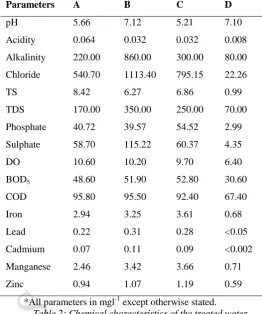
Table 2 revealed the result of the chemical characteristics. For the chemical characteristics, the pH was found to be 7.10 for the untreated sample and ranged from 5.00 to 7.12 when treated with the processed Moringa leaves. The acidity increased from 0.008mg/l for the untreated sample to 0.064mg/l for the sample treated with recipe from pounded Moringa leaves. Alkalinity ranged from 80.00mg/l to 860.00mg/l for the sample treated with powder from sun-dried Moringa leaves. The Dissolved Oxygen (DO), Biochemical Oxygen Demand (BOD5) and Chemical Oxygen Demand also
follow the same trend with the acidity and alkalinity increasing from 6.40mg/l, 30.60mg/l and 67.40mg/l for the untreated samples to 10.60mg/l, 52.80mg/l and 95.80mg/l respectively. Other chemical properties follow the same trend increasing from the control experiment to the treated samples. Chloride ranged from 22.60mg/l for the untreated sample to 1113.60mg/l for the treatment with sun-dried Moringa leaves powder. Total Solids ranged from 0.99mg/l – 8.42mg/l, Total Dissolved Solids from 70.00mg/l – 350.00mg/l, Phosphate from 2.99mg/l – 54.52mg/l, Sulphate from 4.35mg/l – 115.22mg/l. The micro nutrients are also not excluded in the trend. Iron ranged from 0.68mg/l to 3.61mg/l, Lead ranged from less than 0.05 – 0.31mg/l, and Cadmium from less than 0.002 to 0.11mg/l, Manganese from0.71 to 3.42mg/l and zinc from 0.59 to 1.19mg/l.
Parameters A B C D
Apperance and Colour
Greeni sh and turbid
Slightly greenish and turbid
Slightly brownish and turbid
Relatively clearer in colour than others
Odour Slight
odour
Slight odour
Slight odour
Relatively odourless than others
Table 1: Physical characteristics of the treated water samples
Parameters A B C D
pH 5.66 7.12 5.21 7.10
Acidity 0.064 0.032 0.032 0.008
Alkalinity 220.00 860.00 300.00 80.00 Chloride 540.70 1113.40 795.15 22.26
TS 8.42 6.27 6.86 0.99
TDS 170.00 350.00 250.00 70.00
Phosphate 40.72 39.57 54.52 2.99
Sulphate 58.70 115.22 60.37 4.35
DO 10.60 10.20 9.70 6.40
BOD5 48.60 51.90 52.80 30.60
COD 95.80 95.50 92.40 67.40
Iron 2.94 3.25 3.61 0.68
Lead 0.22 0.31 0.28 <0.05
Cadmium 0.07 0.11 0.09 <0.002
Manganese 2.46 3.42 3.66 0.71
Zinc 0.94 1.07 1.19 0.59
*All parameters in mgl-1 except otherwise stated.
Table 2: Chemical characteristics of the treated water samples
BACTERIOLOGICAL CHARACTERISTICS OF THE WATER SAMPLES
Table 3 presented the bacteriological parameters of the water samples. The bacteriological characteristics like most of the chemical follow trend of increasing from the untreated sample to those treated with the processed Moringa products. The Total Viable count as a bacteriological parameter was 1.2x10⁵cfu/ml for the untreated sample and 4.8x10⁵cfu/ml for treatment with powder from oven-dried Moringa leaves. Total Coliform count from 0.2x10⁵cfu/ml to 0.8x10⁵cfu/ml, Total Fungi count from 0.1x10⁵cfu/ml to 0.2x10⁵cfu/ml, Staphylococcus count ranged from 0.4x10⁵cfu/ml to 1.5x10⁵cfu/ml while Escherichia Coli count ranged from 0.1x10⁵cfu/ml to 0.4x10⁵cfu/ml.
EFFECTS OF THE PROCESSED MORINGA LEAVES ON WATER SAMPLES
Page 7 www.ijiras.com | Email: [email protected] permissible concentration in the World Health Organization
(WHO) standards for drinking water as presented in Table 4. Another example is an increase in the biochemical oxygen demand of the water samples from 30.60mg/l to 51.90mg/l. The bacteriological characteristics are also increased but not as much as the chemical characteristics revealing that the effects are not felt on the bacteriological characteristics as on the chemical characteristics. For example, the Total viable count was increased from1.2x105cfu/ml for the untreated sample to 4.9x10⁵cfu/ml. Total coliform count was also raised from a value of 0.2x10⁵cfu/ml to 0.9x10⁵cfu/ml while Eschericia coli count increased from a relatively lower value of 0.1x10⁵cfu/ml for the untreated water sample to 0.4x10⁵cfu/ml.
Parameters A B C D
TVC 3.9x10⁵ 4.2x10⁵ 4.8x10⁵ 1.2x10⁵ TCC 0.8x10⁵ 0.5x10⁵ 0.5x10⁵ 0.2x10⁵ TFC 0.2x10⁵ 0.2x10⁵ 0.2x10⁵ 0.1x10⁵ SC 1.1x10⁵ 1.0x10⁵ 1.5x10⁵ 0.4x10⁵ E. Coli 0.4x10⁵ 0.2x10⁵ 0.3x10⁵ 0.1x10⁵
*All parameters in cfuml-1 except otherwise stated.
Table 3: Biological characteristics of the treated water samples
Parameters WHO Standards
Zinc 3
Manganese 0.5
Cadmium 0.003
Lead 0.01
Iron 0.3
Chloride 250
Nitrate 50 (Total nitrogen)
Sulphate 500
Phosphate No guideline
Turbidity Not mentioned
pH Neutral
*All parameters in mgl-1 except otherwise stated.
Source:WHO (2006)
Table 4: World Health Organization (WHO) Standards for drinking water
IV. CONCLUSIONS
This study examined the effects of different processing methods on the efficacy of using Moringa oleifera leaves as a purification technique for water. Earlier studies on the uses of the tree for water purification has only revealed the purification technique using the extracts from pounded fresh seeds and not direct introduction of the processed pounded seeds into the water sample (Lea, 2010 and Bergstedt, 2011). Processing leaves of Moringa oleifera by drying with different methods and applying the processed products directly showed that the water samples characteristics are more adversely affected than getting ameliorated thus making the samples not as purified as expected. It is therefore suggested from the findings of this study that dried Moringa leaves should not be applied directly as a water purifier but extracts from the processed products can be used as a further research.
REFERENCES
[1] Adebayo, A.G., H.A. Akintoye, A.O. Olufolaji, O.O. Aina, M.T. Olatunji and A.O. Shokalu, 2011. Assessment of organic amendments on vegetative development and nutrient uptake of Moringa oleifera lam in the nursery. Asian J. Plant Sci., 10: 74-79.
[2] Anwar, F., S. Latif, M. Ashraf and A.H. Gilani. 2007.
Moringa oleifera: A food plant with multiple medicinal
uses. Phytother. Res., 21: 17-25.
[3] Bennett, R.N., F.A. Mellon, N. Foidl, J.H. Pratt, M.S. DuPont, L. Perkibns and P.A. Kroon. 2003. Profiling glucosinolates and phenolics in vegetative and reproductive tissues of the multi-purpose trees Moringa
oleifera L. (Horseradish Tree) and Moringa stenopetala
L. J. Agric. Food Chem., 51: 3546-3553.
[4] Berger, M.R., M. Habs, S.A. Jahn and S. Schmahl. 1984. Toxicological assessment of seeds from Moringa oleifera
and Moringa stenopetala, two highly efficient primary
coagulants for domestic water treatment of tropical raw waters. East Afr. Med. J., 61: 712-716.
[5] Bergstedt M. 2011. Moringa oleifera seeds for water
treatment in water-stressed areas.
www.Chenected.aiche.org.
[6] Fahey, J.W. 2005. Moringa oleifera: A review of the medical evidence for its nutritional, therapeutic and prophylactic properties. Part 1. Trees Life J., Vol. 1. [7] Fakurazi, S., U. Nanthini and I. Hairuszah. 2008.
Hepatoprotective and antioxidant action of Moringa
oleifera Lam.against acetaminophen induced
hepatotoxicity in rats. Int. J. Pharmacol., 4: 270-275. [8] Fuglie, L.J. 1999. The Miracle Tree: Moringa oleifera,
Natural Nutrition for the Tropics. Church World Service, Dakar, Senegal, Pages: 68.
[9] Gassenschmidt, U., K.D. Jany, B. Tauscher and H. Niebergall. 1995. Isolation and characterization of a flocculating protein from Moringa oleifera Lam. Biochemical Biophysical Acta., 1243: 477-481.
[10] Kumar, A.K., M. Chalamaiah, R.R. Kumar and K.N. Babu. 2009. Preliminary studies on biotransformation of drumstick (Moringa oleifera) and watermelon (Citrullus
lanatus) seed oils using Baker's Yeast. Asian J. Biol. Sci.,
2: 118-123.
[11] Lea, M. 2010. Bioremediation of Turbid Surface Water Using Seed Extract from Moringa oleifera Lam. Tree. In: Current Protocols in Microbiology.
[12] Mahmood, K.T., T. Mugal and I.U. Haq, 2010. Moringa
oleifera: A natural gift-A review. J. Phar. Sci. Res., 2:
775-781.
[13] Odee, D. 1998. Forest biotechnology research in drylands of Kenya: The development of Moringa species. Dryland Biodiversity, 2: 7-12.
[14] Paliwal, R., V. Sharma, Pracheta, S. Sharma, S. Yadav and S.H. Sharma, 2011. Antinephrotoxic effect of administration of Moringa oleifera lam in amelioration of dmba-induced renal carcinogenesis in swiss albino mice. Biol. Med., 3: 25-35.
Page 8 www.ijiras.com | Email: [email protected] [16] Sharma, V., R. Paliwal, Pracheta and S. Sharma. 2011.
Phytochemical analysis and evaluation of antioxidant activities of hydro-ethanolic extract of Moringa oleifera
Lam. Pods. J. Pharm. Res., 4: 554-557.