Secure Data Deduplication using Efficient
Convergent Key Management
D. Jeyakumari D. Suganthi
Associate Professor Assistant Professor
Department of Electronics & Communication Engineering Department of Information Technology
RVS College of Engineering & Technology, Coimbatore, RVS College of Engineering & Technology, Coimbatore, Tamil Nadu, India Tamil Nadu, India
S. Anitha Vindhyamol. C.V
Department of Information Technology Department of Information Technology
RVS College of Engineering & Technology, Coimbatore, RVS College of Engineering & Technology, Coimbatore, Tamil Nadu, India Tamil Nadu, India
Abstract
In cloud computing, data deduplication is used to reduce the amount of duplicate files. Data deduplication is a specialized data compression technique for eliminating duplicate copies of repeating data. To protect the confidentiality of sensitive data convergent encryption technique is used. Privileges are provided to users for accessing the cloud storage. Initially tags are generated for each data copies to be uploaded in the cloud server. User who has the tag can only access the data copies in the cloud storage. Cloud Service Provider performs duplicate check by comparing the contents of two files. Duplicate files are detected to reduce the storage space in cloud server.
Keywords: Deduplication, convergent encryption algorithm, authorized duplicate check, confidentiality, hybrid cloud ________________________________________________________________________________________________________
I. INTRODUCTION
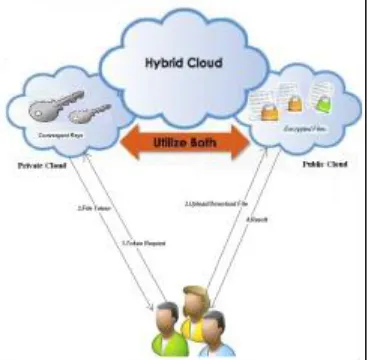
Cloud computing is a type of computing that relies on sharing computing resources rather than having local servers or personal devices to handle applications. Cloud computing services can be private, public or hybrid. Here we are using hybrid cloud. Hybrid cloud is a combination of public cloud services and on-premises private cloud – with orchestration and automation between the two. In the administration of a multi-user computer system, a privilege is an identified right that a particular user has to a particular system resource, such as a file folder, the use of certain system commands, or an amount of storage. Generally, a system administrator or, in the case of network resources such as access to a particular device, a network administrator assigns privileges to users. System software then automatically enforces these privileges.
Data deduplication is a method of reducing storage needs by eliminating redundant data. Only one unique instance of the data is actually retained on storage media, such as disk or tape. Redundant data is replaced with a pointer to the unique data copy. Data security is another area of increasing importance in modern storage systems and, unfortunately, deduplication and encryption are, to a great extent, diametrically opposed to one another. Deduplication takes advantage of data similarity in order to achieve a reduction in storage space.
Convergent encryption, also known as content hash keying, is a cryptosystem that produces identical cipher text from identical plaintext files. This has applications in cloud computing to remove duplicate files from storage without the provider having access to the encryption keys.
II. LITERATURE SURVEY
Jin Li, Yan Kit Li, Xiaofeng Chen, Patrick P.C.Lee, and Wenjing Lou[1] proposed a method for advanced deduplication system supporting authorized duplicate check. It is secure because the private keys for privileges will not be issued to users directly, which will be kept and managed by the private cloud server instead. In this way, the users cannot share these private keys of privileges, which mean that it can prevent the privilege key sharing among uses in the above straight forward construction. To get a file, the user needs to send a request to the private cloud server. The motive of this research is to address the problem of authorized data deduplication.
Paul Anderson, Le Zhang [2] proposed and investigated an algorithm to increase the speed of backups, and reduce the storage requirements. It also supports a unique feature which allows immediate detection of common subtrees, avoiding the need to query the backup system for every file.
time. Although based on convergent encryption, ClouDedup remains secure thanks to the definition of a component that implement an additional encryption operation and an access control mechanism.
III. PROBLEM DEFINITION
Assume that large numbers of same data copies are stored in the cloud after deduplication is done. This system issue corresponding privileges to each user, who will perform duplication check based on privilege keys and file. This system cannot prevent the privilege private key sharing among the users. Same private keys are issued for same privileges by the user. If the system is subject to brute force attack that can recover files falling into a known set. That is, the deduplication system cannot prevent the security of predictable files. One of critical reason is that traditional convergent encryption system can only protect semantic security of unpredictable files.
Objective
To eliminate the redundant data in the cloud and to increase the storage space. This technique is used to improve storage utilization and can also be applied to network data transfers to reduce the number of bytes that must be sent. In the deduplication process, unique chunks of data, or byte patterns, are identified and stored during a process of analysis. As the analysis continues, other chunks are compared to the stored copy and whenever a match occurs, the redundant chunk is replaced with a small reference that points to the stored chunk. Given that the same byte pattern may occur dozens, hundreds, or even thousands of times the amount of data that must be stored or transferred can be greatly reduced.
IV. SYSTEM ANALYSIS
Existing System
In this system symmetric encryption algorithm is used, which uses a common secret key to encrypt and decrypt information. Data deduplication systems, the private cloud is involved as a proxy to allow data owner/users to securely perform duplicate check with differential privileges. Such architecture is practical and has attracted much attention from researchers. The data owners only outsource their data storage by utilizing public while the data operation is managed in private cloud. For file level deduplication, it eliminates duplicate copies of the same file. Deduplication can also take place at the block level, which eliminates duplicate blocks of data that occur in non-identical files.
Drawbacks
- Each user will be issued private keys for security but there is a chance to get a duplicate key from the user to open the same file.
- Traditional encryption, while providing data confidentiality, is incompatible with data deduplication. - Identical data copies of different users will lead to different cipher texts, making deduplication impossible. - User’s sensitive data are susceptible to both inside and outside attacks. Some times deduplication impossible.
Proposed System:
Decreasing of duplicate data in cloud storage and save the server space. It decreases size of occupation and decreases bandwidth. One critical challenge of cloud storage services is the management of the ever increasing volume of data. We enhance our system in security in this paper. Specifically, we present an advanced scheme to support stronger security by encrypting the file with differential privilege keys. In this way, the users without corresponding privileges cannot perform the duplicate check. Furthermore, such unauthorized users cannot decrypt the cipher text even collude with the S-CSP. Security analysis demonstrates that our system is secure in terms of the definitions specified in the proposed security model.
Convergent encryption allows cloud storage services to deduplicate data, without the service having access to the encryption keys used to protect customer files. It provides better privacy than traditional cloud storage.
Advantages
- Maximizing the final revenue of the cloud providers and satisfying the users with reasonable prices. - The user is only allowed to perform the duplicate check for files marked with the corresponding privileges. - We present an advanced scheme to support stronger security by encrypting the file with differential privilege keys. - Reduce the storage size of the tags for integrity check.
- To enhance the security of deduplication and protect the data confidentiality.
V. SYSTEM DESIGN
Methodology
example if two data copies are same then their tags are same. To detect duplicate the user first sends the tag to the server side to check the whether the duplicate copy is present or not. The private cloud checks duplicate data copies by checking the content of files. If the file is not a duplicate one then it should be stored in the cloud. These operations are performed by the users who have privileges based on job position and time.
System Architecture
This system is mainly for enterprise network, consisting of a group of affiliated clients who uses the S-CSP and store data with deduplication technique [1]. Data deduplication is frequently used for data backup and disaster recovery. There are three entities in our system that is user, private cloud and S-SCP in public cloud. The S-SCP performs deduplication by checking the contents of two files, if duplicate occurs it stores one of them.
Access right is the set of privileges given to the users. Privileges are the level of access granted in computer security. Privileges which allow an agent to access an object that it does not have permission to access and it allows agent to perform maintenance function such as restart the computer. There are different types of privileges. They are privileges based on job position, example director, engineer and project lead. And time based privileges example “access right valid on 26-04-2016”. If a person is accessing the system who should have both privileges. For each privilege a token is provided to modify changes in the data copies.
CSP: Cloud Service Provider is an entity which offers the customer storage or software service available via private and public network. It means the storage and software is access via internet. Cloud providers are sometimes referred to as cloud service providers or CSPs.
Users: User wants to store their data in S-CSP (Cloud Service Provider) to access later. This system uses deduplication to reduce the storage of redundant data in the cloud server. Deduplication reduces the number of bytes to be sent. User has to get token from the private cloud to access the data copy. Certain privileges are set to the users to modify the data copies stored in the cloud.
Public cloud: A public cloud is one based on standard cloud computing model, in which service provider makes resources such as application and storage available to general public over internet. Examples of public cloud include Amazon Elastic Compute Cloud (EC2), IBM’s Blue cloud, Sun cloud, Google AppEngine and Windows Azure Services Platform.
Private cloud: A private cloud is one in which the services and infrastructure are maintained on a private network. It provides greater level of security and control for our software and infrastructure, which reduces the cost savings. Private cloud manages the private keys for the users who are having the privileges. This allows the user to submit the files and data copies securely in the cloud. It allows the user if the private key and token of the privileges are matched. For example, some public cloud companies are now offering private versions of their public clouds. Some companies that only offered private cloud technologies are now offering public versions of those same capabilities. Examples of private cloud include one drive, Amazon Virtual Private Cloud (Amazon VPC), VMware private cloud.
Fig. 5.1: Architecture for authorized deduplication
VI. SYSTEM IMPLEMENATION
Authentication
- Authentication is the process of confirming the identity of a person. It might involve validating their identity documents. - Access control is based on the identity of user who request access to recourse.
- Unauthorized user and denied access to that user.
- If the user has not account yet, then they have to register login.
Convergent Key Generation
- Convergent encryption [4], [5] provides data confidentiality in deduplication.
- Convergent encryption is a cryptosystem that produces identical cipher text from identical plain text files.
- This system computes cryptographic hash of a plain text. The system then encrypts the plain text by using its hash key. - The hash value is stored in the private cloud. Finally it is encrypted with a key chosen by the user.
- In this module, if users want to upload a file then the user needs to get key from private cloud.
Fig. 6.2: key generation
File uploading
- This module presents data providers who add, edit, update and delete the software details. And view the end user request then response to them.
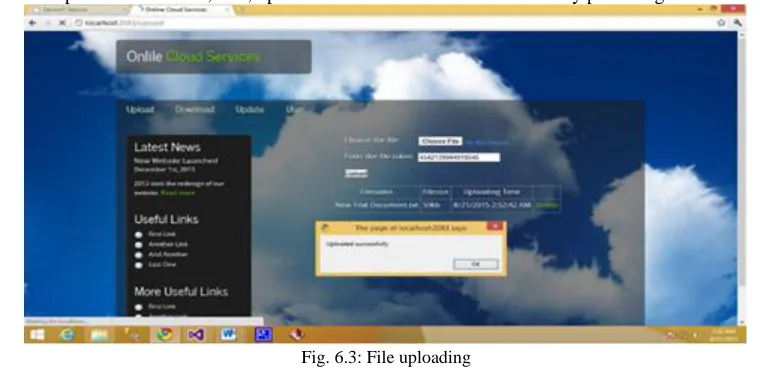
- User can upload a file into the private cloud by using convergent key.
- The user performs operations like add, edit, update and delete the software details by providing the file token.
Fig. 6.3: File uploading
Authorized Duplicate Check Scheme (Ads)
- In authorized deduplication system each user is issued a set of privileges during system initialization.
- Each file uploaded to the cloud bounded by a set of privileges to specify which kind of users is allowed to perform the duplicate check and access the files.
- Before submitting his duplicate check request for a file, the user needs to take this file and his own privileges as input. - The user is able to find duplicate for this file if and only if there is a copy of this and a matched privilege stored in cloud. - The public cloud performs duplicate check directly and tells the user if there is any duplicate.
Database Design Structure
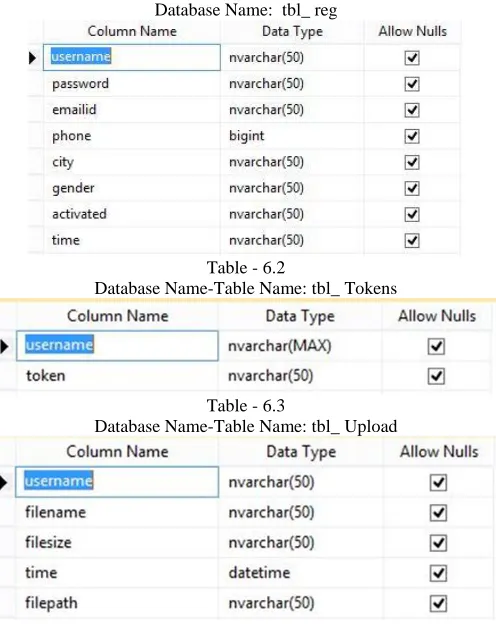
- Database design is the process of producing a detailed data model of a database.
- This logical data model contains all the needed logical and physical design choices and physical storage parameters needed to generate a design in a Data Definition Language, which can then be used to create a database.
- A fully attributed data model contains detailed attributes for each entity. Table - 6.1 Database Name: tbl_ reg
Table - 6.2
Database Name-Table Name: tbl_ Tokens
Table - 6.3
Database Name-Table Name: tbl_ Upload
VII. PERFORMANCE ANALYSIS
To evaluate the effect of number of stored files in the system, we upload 10,000 10 MB unique files to the system and record the breakdown for every file upload. Token checking is done with a hash table and a linear search would be carried out in case of collision.
Fig. 7.1 Time breakdown for different number of stored files
Fig. 7.2 Time breakdown for different privilege set size
VIII. CONCLUSION AND FUTURE ENHANCEMENTS
Conclusion
Authorized data deduplication is to protect the data security by including differential privileges of users in the duplicate check. Here we proposed new duplication system for secure authorized duplicate check in hybrid cloud. In this system, tokens are generated by the private cloud with the private key for duplicate check. The S-CSP performs deduplication by checking if the contents of two files are the same and stores only one of them [1].
This system avoids the attacks from insiders and outsiders of an organization.
Future Enhancement
It excludes the security problems that may arise in the practical deployment of the present model. Also, it increases the national security. It saves the memory by deduplicating the data. Thus provide us with sufficient memory. It provides authorization to the private firms and protects the confidentiality of the important data.
REFERENCES
[1] Jin Li, Yan Kit Li, Xiaofeng Chen, Patrick P.C.Lee, and Wenjing Lou, A Hybrid cloud approach for secure authorized deduplication, in: IEEE Transactions on parallel and distributed systems, May 2015.
[2] P.Anderson and L.Zhang, “Fast and secure laptop backups with encrypted de-duplication,” in Proc. 24th Int. Conf. Large Installation Syst. Admin, 2010,
pp.29-40.
[3] Pasquale puzio secludit and eurecom, refik molva eurecom, and melek o nen eurecom, “Cloudedup: secure deduplication with encrypted data for cloud storage,”
[4] MBellare, S.Keelveedhi, and T. Ristenpart, “Message-locked encryption and secure deduplication,” in Proc. 32nd Annu. Int. Conf. Theory Appl.
Cryptographic Techn., 2013, pp.296-312.