Page 560 www.ijiras.com | Email: [email protected]
Effects Of Elliptical Texture On Journal Bearing Characteristics
Under Steady Operating Conditions And Optimization Of Dimple
Depth And Area Density
Nayanjyoti Das
L. Roy
Department of Mechanical Engineering, National Institute of Technology Silchar, Silchar, India
NOTATION R radius of journal (m) D diameter of the bearing (m) L length of bearing (m) C radial clearance (m) O center of bearing bush
O’ center of shaft about which it rotates e, eccentricity (m), eccentricity ratio N journal rotation speed (rpm)
Journal angular speed (rad/s) U linear speed of moving surface (m/s) W load carrying capacity of bearing or applied load at the shaft
Attitude angle (rad)
h, lubricant film thickness (m), non- dimensional film thickness
Non-dimensional coordinates, x/R, y/h and z/L/2, measured from the top of bearing and at the mid-plane of groove
Shear stress along circumferential and axial direction (N/m2)
F friction force due to the viscosity of lubricant (N)
Wr ,Wt load carrying components along line of
centres and perpendicular to the line of centers (N)
Non-dimensional non dimensional load Abstract: In this present work an attempt has been made to theoretically examine the influence of elliptical texture on non-dimensional load carrying capacity, friction variable, flow coefficient of textured journal bearing. In which the performance parameters are estimated by varying the textured height, textured area density and eccentricity ratio. A non-dimensional analysis is carried out to analyze the performance characteristic of elliptical texture on journal bearing using finite difference method. The optimum value of textured depth and textured area density is obtained. The optimum parameters obtained for maximization of flow coefficient, minimization of friction variable, maximization of non-dimensional load capacity, and minimization of multi-objective function derived combining all the three individual objective functions using Genetic Algorithm. It has been found that incorporation of elliptical texture inside the bearing surface improves the friction and lubrication performance of the bearing. The results using genetic algorithm are compared with sequential quadratic programming (SQP).It is observed that textures acts as secondary reservoir which decreases the friction variable as well as increases the flow co-efficient. At an eccentricity ratio 0.9, dimple depth 0.1 and dimple area density 0.598 gives the optimum value of friction variable, flow co-efficient and non dimensional load carrying capacity.
Page 561 www.ijiras.com | Email: [email protected] carrying capacity
2
2 6
WC UR L
Coefficient of friction Friction variable =
S Sommerfeld number =
I. INTRODUCTION
Hydrodynamic journal bearings are machine elements used since the beginning of the industrial revolution for the support of rotating shafts. It is used in turbo machinery, vehicles, and power plants. In general all mechanical systems with rotating shafts subjected to high surface speeds and/or applied loads. The purpose of bearing is to support a load. Deflection of the journal within the bearing can adversely affect the load carrying ability of the bearing. This deflection can be greatly reduced by increasing the diameter of the journal and decreasing its length. Now days the human beings are very much concerned about the energy saving by reducing the failure of the component with lower initial cost. The friction between the machine components produces wear and heat is generated due to which energy is losses. The success of modern journal bearings is due to the understanding that lubrication, the function of which is to separate the surfaces, is an integral part of journal bearing design. A journal bearing may be subject to Hydrodynamic, hydrostatic, boundary film lubrication. However, only hydrodynamic and boundary lubrication will be considered utilizing either liquid or gas lubricant. The primary function of lubricant is to separate surfaces, reduce friction and absorb heat. Secondary responsibilities include regulating temperature, flushing contaminants, and controlling corrosion. With introduction to the surface texture on bearing surface improves the lubricating properties. Surface texture is well defined micro dimples in different form on bearing which improves the different properties of bearing. Surface texturing technology is a newly explored technology in tribology community. It is a method of improving the friction and lubrication performance of various mechanical components. The concept of surface texturing first developed in 1990 using laser technology. After that many techniques namely Photolithography techniques, etching, Novel dressing technique, Mechanical indentation is introduced for surface texturing.
Etsion [1] observe that the improvement of load carrying capacity, friction coefficient and wear resistance of the tribological component can be improved by micro-surface texture in form of micro dimple on their surface by the help of Laser surface texturing and reviewed the current effort being made worldwide on surface texturing in general and on laser surface texturing (LST) in particular and describes some fundamental on-going research around the world with LST and describes LST is starting to gain more and more attention in the Tribology community. Priest and Taylor [2] demonstrated the technology of surface texturing is expected to be important component in future structure design.Tala-Ighil et al. [3] used finite difference numerical model to study the effect of surface textures on the lubrication of a journal
Page 562 www.ijiras.com | Email: [email protected] lubricants. Design variables, which optimize the objective
function given by a linear summation of temperature rise and supply lubricant quantity with respective weighting factor, are determined for a wide range of journal rotational speeds under various constraints. Bo-Suk Yang and Choi.B[11] have used enhanced artificial life algorithm for the optimum design of short journal bearings. The optimized results were compared with those of genetic algorithm and successive quadratic programming. All the results have the same tendency. The artificial life algorithm only uses the function value and doesn’t need derivatives calculated analytically or numerically and so it has a strong possibility for being used for other optimization problems. Boedo and Eshkabilov[12] this paper describes an implementation of a genetic algorithm scheme suitable to the optimal shape of finite iso-viscous suitable to the optimal shape design of finite-width, iso-viscous, fluid film journal bearings under steady load carrying and steady journal rotation. Optimal bearing geometry is found to offer a small improvement in non-dimensional load carrying capacity and a substantial improvement in oil flow over purely cylindrical designs. John McCall [13] has presented Genetic algorithms (GAs) a heuristic search and optimization technique inspired by natural evolution. They have been successfully applied to a wide range of real-world problems of significant complexity. Hirani andSuh[14]describe the optimum design methodology for improving operating characteristics of fluid-film steadily loaded journal bearings. This methodology consists of (1) a simplified closed form solution to accelerate the computation, (2) finite difference mass conserving algorithm for accurate prediction of lubricant flow and power loss, (3) Pareto optimal concept to avoid subjective decision on priority of objective functions, (4) a genetic algorithm to deal with multimodal nature of hydrodynamic-bearing and develop a Pareto optimal front, (5) fitness sharing to maintain genetic diversity of the population used in genetic algorithm, and (6) axiomatic design to provide inside of objective functions and design variables. In the optimum design of journal bearings, the design variables such as radial clearance, length to diameter ratio, groove geometry, oil viscosity and supply pressure are used to simultaneously minimize oil flow and power loss. A step-by-step procedure, graphs and tables are presented to demonstrate the concept and effectiveness of suggested design methodology. The Reynolds equation is solved numerically in a finite difference grid satisfying the appropriate boundary conditions. Determination of optimum performance is based on maximization of non-dimensional load, flow coefficient, and minimization of friction variable using genetic algorithm.
II. THEORY
For steadily loaded journal bearing the non-dimensional form of Reynolds Equation is
(1) For single axial groove journal bearing, the non-dimensional load carrying components along the line of centres and its perpendicular direction are found out from: (2)
(3) Therefore the non-dimensional load carrying and attitude angle are
(4)
ɸ = tan-1 (5)
The bearing end flow is calculated from:
The flow rate in the dimensionless form can be written as: = , , θ = x/R and =
flow rate in the dimensionless form can be written as (6) Friction force can be found from:
(7) This can be written as:
(8) The friction variable is given by:
= (9)
Sommerfeld Number
where (10) OPTIMIZATION TECHNIQUE
Page 563 www.ijiras.com | Email: [email protected] function can be handled with no extra burden. This allows
GAs to be applied to a wide variety of problems. Another advantage with a population-based search algorithm is that multiple optimal solutions can be captured in the population easily, thereby reducing the effort to use the same algorithm many times. Genetic algorithms perform a multiple directional search by maintaining a population of potential solutions. The population-to-population approach attempts to make the search escape from local optima GAs is very helpful when the developer does not have precise domain expertise, because GAs possesses the ability to explore and learn from their domain.
Genetic Algorithm (GA) is one of the most popular stochastical method used to find the optimum solution for all kind of problem. Since it is multi-directional search method it always ensures a global optimum solution even the computational time is very high compared with the other optimization method.
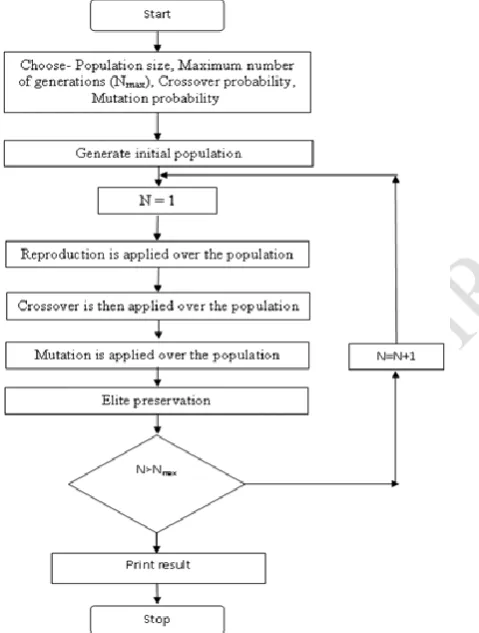
Figure 1: Flow chart for real coded Genetic Algorithm Genetic algorithms belong to the larger class of Evolutionary Algorithms (EA), which generate solutions to optimization problems using techniques inspired by natural evolution, such as selection, crossover, mutation and inheritance. Real coded GA is capable of handling real numbers where GA is working basically on binary numbers. The genetic algorithm (GA) for optimization starts from an initial set of solutions called chromosome. In this problem two variables called genes will form chromosome. A set of chromosome is called population. With uniform probability distribution all chromosomes in the population are initialized. The population of each generation will have feasible design variables in terms of their allowable ranges but may be
Infeasible otherwise. The main steps involved in the genetic algorithm are discussed below and shown in flow chart (fig.1)
Real coded GA comprises of mainly six steps:
Step 1: There are mainly four user defined parameters in the program, population size, maximum number of generation, cross over probability and mutation probability. From the trail run the best value of population size and generation size is obtained as 40 and 100 respectively. It is found that the program is converging very fast with these values. Cross over probability and mutation probability are more sensitive parameters for this program.
Step 2: In this program a population size of 50 is used. Second stage of program is to initialize the population size. So 50 chromosomes where initialize using random probability for each variable span.
Step 3: The selection operator involves randomly choosing members of the population to enter a mating pool. The operator is carefully formulated to ensure that better members of the population (with higher fitness) have a greater probability of being selected for mating, but that worse members of the population still have a small probability of being selected. Having some probability of choosing worse members is important to ensure that the search process is global and does not simply converge to the nearest local optimum. Selection is one of the important aspects of the GA process, and there are several ways for the selection.
Step 4: In GA recombination is carried out through crossover and mutation operation. The crossover operator is a method for sharing information between chromosomes. It ensures that the probability of reaching any point in the search space is never zero. The crossover operator is the main search operator in the GA. The search power of a crossover operator is defined as a measure of how flexible the operator is to create an arbitrary point in the search space. Crossover is useful in problems where building block exchange is necessary. It is suggested that GAs may work well with large crossover probability and with a small mutation probability. A single point crossover preserves the structure of the parent string to the maximum. From a set of crossover operator, linear, blended cross over and simulated binary crossover operators, it is found from trial run the simulated binary crossover gives better convergence in limited time.
Page 564 www.ijiras.com | Email: [email protected] Step6: Elite preservation forms a new population from
initial population and mutated one. This operator is responsible for convergence of the fitness by allowing better value to pass to the next generation.
The problem is framed with three objectives. The variables used in these problems are (two chromosomes) eccentricity ratio (Ɛ) and dimple height ( ), and other case the two chromosomes are eccentricity ratio (Ɛ) and dimple area density ( ). The objectives are minimization of friction variable , Equation 9, maximization of non-dimensional load capacity , Equation 4, maximization of flow coefficient Equation 6. Objective
III. RESULTS AND DISCUSSION
Function framing is the same for both the cases and variable bounds are shown in Table 1 and Table 2.
Case Variables Lower
bound
Upper bound
Dimple height ( ) 0 0.1
II Dimple height ( ) 0 0.1
Table 1: Variable bounds for the bearing problem for Dimple depth ( )
Case Variables Lower
bound
Upper bound
I
Eccentricity ratio (Ɛ) 0.1 0.9 Dimple area density ( ) 0 0.6 II Dimple area density ( ) 0 0.6 Table 2: Variable bounds for the bearing problem for Dimple
area density ( ) Formulation of Multi objective function:
Objective 1: minimization of the frictional variable of the elliptical texture bearing
Objective 2: maximization of the flow co-efficient of elliptical texture bearing
Objective 3: maximization of the non-dimensional load carrying capacity of elliptical texture bearing
Weighted sum method is used to handle three objectives at a time. Three different weightages , and are considered for objective 1, objective 2 and objective 3 respectively.
(11) Validation of the result for the textured journal bearing for length to diameter ratio (L/D=1) and the eccentricity ratio Ɛ=0.1 are given in the table 3, the dimensional value are almost same as given in [15] and small validation of the present result has been seen when compared with[15]
Characteristics Elliptical textured bearing
[15]
Load capacity (W) 12707 N 12600 N
Sommerfeld Number (S) 0.1199 0.1210
Eccentricity Ratio (Ɛ) 0.600 0.601
Attitude Angle (ɸ) 50.531 50.4
Table 3: Validation of result for textured journal bearing [15] In table 3 it has been shown that value for load carrying capacity for elliptical texture bearing Comes out to be 12707
N for eccentricity ratio 0.6, considering texture depth ( ) 0.01 and texture density ( ) 0.5 , a very less difference is observed in the attitude angle and Sommerfeld number.
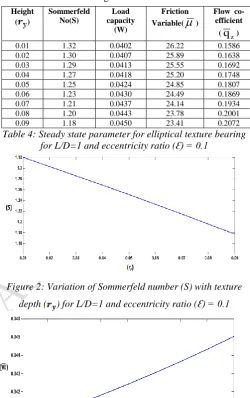
Table 4: Steady state parameter for elliptical texture bearing for L/D=1 and eccentricity ratio (Ɛ) = 0.1
Figure 2: Variation of Sommerfeld number (S) with texture
depth ( ) for L/D=1 and eccentricity ratio (Ɛ) = 0.1
Figure 3: Variation of Non-dimensional load ( ) with texture
depth ( ) for L/D=1 and eccentricity ratio (Ɛ) = 0.1
Figure 4: Variation of friction variable ( ) with texture depth
( ) for L/D=1 and eccentricity ratio (Ɛ) = 0.1
Height ( )
Sommerfeld No(S)
Load capacity
(W)
Friction Variable(
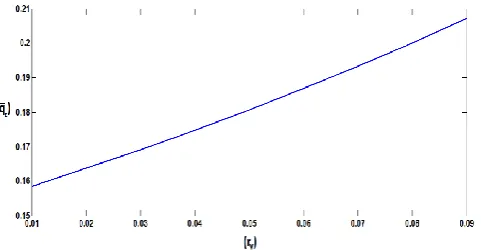
)Page 565 www.ijiras.com | Email: [email protected] Figure 5: Variation of flow co-efficient ( ) with texture depth
( ) for L/D=1 and eccentricity ratio (Ɛ) = 0.1 From fig.2 it has been found that the Sommerfeld number of elliptical bearing decreases with the increase in texture depth. It means that lower the value of the Sommerfeld number higher will be the load carrying capacity, so the load carrying capacity will increase with the increase in the texture depth as shown in fig.3 it is because the texture provide the more surface area to increase the non-dimensional load carrying capacity.The friction variable of elliptical textured journal bearing decreases with increase in texture depth it has been found from fig.4, it means that higher the value of texture depth more will be the friction variable. It happens because of texture act as secondary reservoir which provides more lubricant between the sliding surfaces.In fig.5 the flow co-efficient of elliptical textured increases with increase in textured depth. It has been found that because textured provide more hydrodynamic effect inside the bearing.
The obtained results from (GA) have been compared with the results obtained using sequential quadratic programming (SQP). The optimum value of fitness function obtained corresponding to minimization of friction variable has been tabulated for both GA and SQP in Table 5 for result dimple depth ( ) and Table 6 for result dimple area density ( )
Eccentricity ratio(Ɛ) GA results SQP results
0.1 23.0337 23.0337
0.2 11.1371 11.1371
0.3 7.0788 7.0788
0.4 4.9801 4.9801
0.5 3.6642 3.6642
0.6 2.7356 2.7356
0.7 2.0234 2.0234
0.8 1.4323 1.4323
0.9 0.8871 0.8871
Table 5: Comparison of GA and SQP results for dimple depth
( )
Eccentricity ratio(Ɛ) GA results SQP results
0.1 26.0869 26.0869
0.2 12.6718 12.6718
0.3 8.0942 8.0942
0.4 5.7179 5.7179
0.5 4.2251 4.2251
0.6 3.1680 3.1680
0.7 2.3479 2.3479
0.8 1.6467 1.6467
0.9 0.9710 0.9710
Table 6: Comparison of GA and SQP results for dimple area
density ( )
Similarly maximum load, maximum flow values are also found to match both methods. It has been observed as stated above that the results using both methods are found to be same.
The upper bound and lower bound of two variables eccentricity ratio and Dimple depth is shown in the Table 7
Variable Lower bound Upper bound
Eccentricity ratio (Ɛ) 0.1 0.9
Dimple depth ( ) 0 0.1
Table 7: Variable bounds
It has been shown in the previous section that various steady state parameters like non-dimensional load capacity ( ), flow coefficient (
q
Z), and frictional variable ( ), changes with the change of dimple depth ( ). In view of this, an attempt has been made to determine the optimum performances in terms of the three parameters mentioned above.If the two variables namely eccentricity ratio (Ɛ) and dimple depth ( ) are taken as chromosome (Case-I) in Table 7. The optimum results obtained for friction, flow and load is shown on Table 8.
Objective function
Optimum value
Eccentricity ratio(Ɛ)
Dimple depth( ) Minimization of
friction variable
0.8871 0.9 0.1
Maximization of flow
co-efficient
0.3391 0.899 0.1
Maximization of load carrying
capacity
0.2197 0.9 0.1
Table 8: Optimum value considering eccentricity ratio and dimple depth as chromosomes
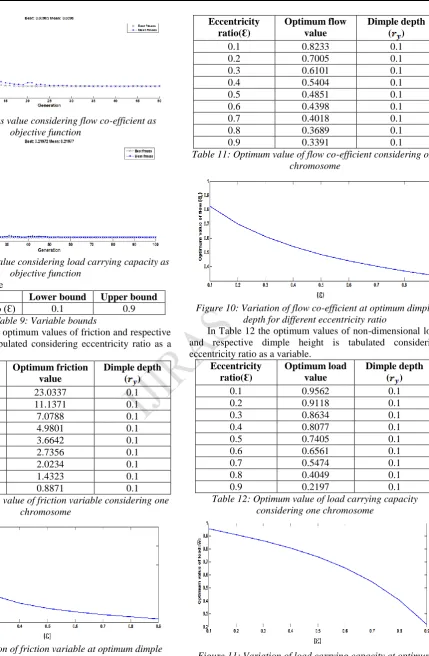
The optimum results obtained for friction, flow and load is shown in Figures 6, 7 and 8. The figures include plots of best fitness as well as mean fitness. Genetic algorithm works on a population of individuals. So, mean is the mean fitness for the entire population at a particular iteration.
Page 566 www.ijiras.com | Email: [email protected] Figure 7: Fitness value considering flow co-efficient as
objective function
Figure 8: Fitness value considering load carrying capacity as objective function
For one variable
Variable Lower bound Upper bound
Eccentricity ratio (Ɛ) 0.1 0.9
Table 9: Variable bounds
In Table 10 the optimum values of friction and respective dimple height is tabulated considering eccentricity ratio as a variable.
Eccentricity ratio(Ɛ)
Optimum friction value
Dimple depth ( )
0.1 23.0337 0.1
0.2 11.1371 0.1
0.3 7.0788 0.1
0.4 4.9801 0.1
0.5 3.6642 0.1
0.6 2.7356 0.1
0.7 2.0234 0.1
0.8 1.4323 0.1
0.9 0.8871 0.1
Table 10: Optimum value of friction variable considering one chromosome
Figure 9: Variation of friction variable at optimum dimple depth for different eccentricity ratio
In Table 11 the optimum values of flow and respective dimple height is tabulated considering eccentricity ratio as a variable.
Eccentricity ratio(Ɛ)
Optimum flow value
Dimple depth ( )
0.1 0.8233 0.1
0.2 0.7005 0.1
0.3 0.6101 0.1
0.4 0.5404 0.1
0.5 0.4851 0.1
0.6 0.4398 0.1
0.7 0.4018 0.1
0.8 0.3689 0.1
0.9 0.3391 0.1
Table 11: Optimum value of flow co-efficient considering one chromosome
Figure 10: Variation of flow co-efficient at optimum dimple depth for different eccentricity ratio
In Table 12 the optimum values of non-dimensional load and respective dimple height is tabulated considering eccentricity ratio as a variable.
Eccentricity ratio(Ɛ)
Optimum load value
Dimple depth ( )
0.1 0.9562 0.1
0.2 0.9118 0.1
0.3 0.8634 0.1
0.4 0.8077 0.1
0.5 0.7405 0.1
0.6 0.6561 0.1
0.7 0.5474 0.1
0.8 0.4049 0.1
0.9 0.2197 0.1
Table 12: Optimum value of load carrying capacity considering one chromosome
Figure 11: Variation of load carrying capacity at optimum dimple depth for different eccentricity ratio
Page 567 www.ijiras.com | Email: [email protected] flow variable gives maximum value and load gives the
maximum values, it is due to effect of texture. When texture depth increases Sommerfeld number decreases which leads to increase in load and the texture increases the lubrication so flow co-efficient also increases.
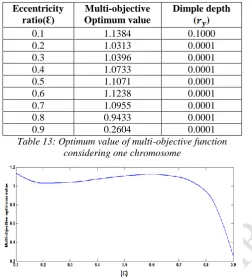
Again by combining all the objective functions at a time of the plot is shown below.The optimum values has been obtained considering minimization of the multi-objective function formed by combining all the objectives at a time as discussed in section 4.5
Eccentricity ratio(Ɛ)
Multi-objective Optimum value
Dimple depth ( )
0.1 1.1384 0.1000
0.2 1.0313 0.0001
0.3 1.0396 0.0001
0.4 1.0733 0.0001
0.5 1.1071 0.0001
0.6 1.1238 0.0001
0.7 1.0955 0.0001
0.8 0.9433 0.0001
0.9 0.2604 0.0001
Table 13: Optimum value of multi-objective function considering one chromosome
Figure 12: Variation of Multi-objective optimum value for different eccentricity ratio at optimum dimple depth From the fig.12 it is clear that at eccentricity ratio 0.9, the objective optimum value gives optimum, as the multi-objective function is minimization type. The upper bound and lower bound of two variables eccentricity ratio and Dimple area density is shown in the Table 14
Variable Lower bound Upper bound
Eccentricity ratio (Ɛ) 0.1 0.9
Dimple area density ( )
0 0.6
Table 14: Variable bounds
It has been shown in the previous section that various steady state parameters like non-dimensional load capacity ( ), flow coefficient (
q
Z), frictional variable ( ), changes with the change of dimple area density ( ). In view of this, an attempt has been made to determine the optimum performances in terms of the three parameters mentioned above.If the two variables namely eccentricity ratio (Ɛ) and dimple area density ( ) are taken as chromosome in Table.14. The optimum results obtained for friction, flow and load is shown on Table 15.
Objective function Optimum value
Eccentricity ratio(Ɛ)
Dimple area density
( ) Minimization of
friction variable
0.9710 0.9 0.598
Maximization of flow co-efficient
0.4269 0.9 0.598
Maximization of load carrying
capacity
0.2429 0.9 0.598
Table 15: Optimum value considering eccentricity ratio and dimple depth as chromosomes
The optimum results obtained for friction, flow and load is shown in Figures 13, 14 and 15. The figures include plots of best fitness as well as mean fitness.
Figure 13: Fitness value considering friction variable as objective function
Figure 14: Fitness value considering flow co-efficient as objective function
Figure 15: Fitness value considering load carrying capacity as objective function
Variable Lower bound Upper bound
Eccentricity ratio (Ɛ) 0.1 0.9
Table 16: Variable bounds (Case II)
In Table 17 the optimum values of friction and respective dimple area density is tabulated considering eccentricity ratio as a variable.
Eccentricity ratio(Ɛ)
Optimum friction value
Dimple area density ( )
0.1 26.0869 0.591
Page 568 www.ijiras.com | Email: [email protected]
0.3 8.0942 0.591
0.4 5.7179 0.170
0.5 4.2251 0.169
0.6 3.1680 0.167
0.7 2.3479 0.600
0.8 1.6467 0.598
0.9 0.9710 0.598
Table 17: Optimum value of friction variable considering one chromosome
Figure 16: Variation of friction variable at optimum dimple area density for different eccentricity ratio
In Table 18 the optimum values of flow and respective dimple area density is tabulated considering eccentricity ratio as a variable.
Eccentricity ratio(Ɛ)
Optimum flow value
Dimple area density ( )
0.1 0.8626 0.505
0.2 0.7598 0.505
0.3 0.6798 0.505
0.4 0.6159 0.591
0.5 0.5635 0.591
0.6 0.5199 0.591
0.7 0.4829 0.598
0.8 0.4517 0.598
0.9 0.4269 0.598
Table 18: Optimum value of flow co-efficient considering one chromosome
Figure 5.17 Variation of flow co-efficient at optimum dimple area density for different eccentricity ratio
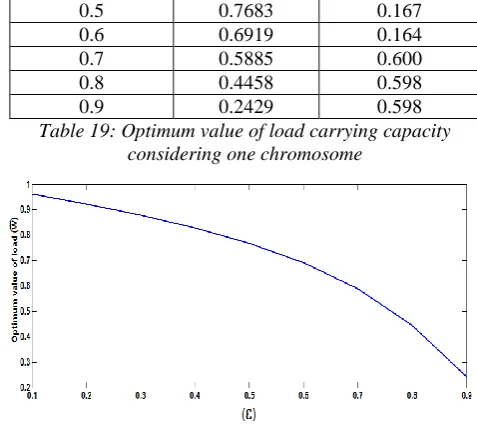
In Table 19 the optimum values of load and respective dimple area density is tabulated considering eccentricity ratio as a variable.
Eccentricity ratio(Ɛ)
Optimum load value
Dimple area density ( )
0.1 0.9612 0.591
0.2 0.9217 0.591
0.3 0.8789 0.277
0.4 0.8287 0.167
0.5 0.7683 0.167
0.6 0.6919 0.164
0.7 0.5885 0.600
0.8 0.4458 0.598
0.9 0.2429 0.598
Table 19: Optimum value of load carrying capacity considering one chromosome
Figure 18: Variation of load carrying capacity at optimum dimple area density for different eccentricity ratio The Fig.18, 19 and 20 shows the fitness value of friction, flow and load respectively by using Genetic algorithm. In Table 16 shows the minimization of friction, maximization of flow and load values considering eccentricity and dimple area density as the variables. It shows that in Fig.16, 17 and 18 the optimum values of friction, flow and load decreases with the increase of eccentricity ratio and at eccentricity ratio 0.9 it gives the optimum value.
The optimum values has been obtained considering minimization of the multi-objective function formed by combining all the objectives at a time as discussed above.
Eccentricity ratio(Ɛ)
Multi-objective Optimum value
Dimple area density ( )
0.1 1.1144 0.380
0.2 1.0349 0.181
0.3 1.0650 0.067
0.4 1.1158 0.067
0.5 1.1645 0.067
0.6 1.1946 0.067
0.7 1.1771 0.067
0.8 1.0224 0.600
0.9 0.2240 0.599
Table 20: Optimum value of multi-objective function considering one chromosome
Page 569 www.ijiras.com | Email: [email protected] In Fig.19 the multi-objective function value along with
the eccentricity is presented considering dimple area density as chromosome. It is shown from the graph that the multi-objective function value slight decreases after that it increases slight and at the last it gradually decreases with the increase of the eccentricity ratio.
IV. CONCLUSION
An improvement in performance of the bearing in terms of decrease in power loss has been found since there is decrease in friction variable. Load carrying capacity of elliptical textured bearing increases with the increase in texture depth. Flow co-efficient of elliptical textured bearing increases with the increase in texture depth. Friction variable of elliptical textured bearing decreases with the increase in texture depth.GA gives a reduction in non-dimensional friction variable with plain journal bearing. The depth location and area density to obtained this objective for elliptical textured bearing are dimple depth ( 0.1 and dimple area density ( 0.598 at Ɛ=0.9.Flow co-efficient is another important parameter in journal bearing design. So optimizing the depth and area density of elliptical textured bearing improves the non-dimensional flow rate. At dimple depth ( 0.1 and dimple area density ( 0.598 elliptical textured bearing shows high performance. For higher load carrying capacity of journal bearing, incorporation of elliptical texture at dimple depth ( ) =0.1 and dimple area density ( ) = 0.598 gives the better improvement.
REFERENCES
[1] Etsion, I., 2005, ―State of art in Laser Surface Texturing‖, Journal of Tribology, 127, pp.248-253.
[2] Priest, M., Taylor, C.M., 2000, ―Automobile engine Tribology approaching the surface wear‖, 241, pp.193-203.
[3] Tala-Ighil, N., Maspeyrot, P., Fillon, M., and Bounif, A., 2007, ―Effect of surface texture on journal bearing characteristics under steady state operating‖, Tribology International, Vol-44, pp-211-219.
[4] Wakuda, M., Yamauchi, Y., Kanzaki, S., Yasuda, Y., 2003, ―Effeect of Surface Texturing on Friction
Reduction between Ceramic and Steel materials under lubricated Sliding contact wear‖, 254, pp.356-363. [5] Sinanoglu, C., Nair, F., and Karamis, M.B., 2005,
―Effects of shaft surface texture on journalbearing pressure distribution‖. Journal of Materials Processing Technology 168, pp. 344-353.
[6] Uehara,Y., Wakuda,M., Yamauchi,Y., Kanzaki,S., Sakaguchi,S.,2003, ―TribologicalProperties of dimpled silicon nitride under oil lubrication‖, Journal of Europeanceramic society, 24(2), pp. 369-373.
[7] Sinanoglu, C., 2009, ―Investigation of load carriage capacity of journal bearings by surface texturing‖, Industrial Lubrication and Tribology, 61(5), pp.261-270. [8] Rowe. W., and Koshal.D.,1980, ―A New Basis for the
Optimization of Hybrid Journal Bearings‖,Wear, Vol. 64, pp. 115 – 131
[9] Sherbiny, M.E., Salem F., and Hefnawy, N.E., 1984, ―Optimum Design Of Hydrostatic Journal Bearings Part I: Maximum Load Capacity‖, J. TribologyInternational, Vol. 17, 3, pp. 155-161.
[10]Matsumoto, K., and Hashimoto, H., 2001, ―Improvement of Operating Characteristics of High-Speed Hydrodynamic Journal Bearings by Optimum Design: Part I— Formulation of Methodology and Its Application to Elliptical Bearing Design‖, J. Tribology, Vol.123, 2, pp. 305-313.
[11]Yang, B.S., Lee, Y.H., and Choi, B.K., and Kim, H.J., 2001, ―Optimum Design of Short Journal Bearings By Artificial Life Algorithm‖, J. Tribology International 34, pp. 427–435.
[12]Boedo S., and Eshikabilov S., 2003, ―Optimal Shape Design of Steadily Loaded Journal Bearing Using Genetic Algorithm‖ ASLE Trans., Vol. 46, 1, pp. 134-143. [13]McCall, J., 2005, ―Genetic Algorithms for Modeling and
Optimization‖, Original Research Article, Journal of Computational and Applied Mathematics, Vol. 184, 1, pp. 205-222.
[14]Hirani H., and Sus N., 2005,‖Journal bearing design using multiobjective genetic algorithm and axiomatic design approaches‖, ASLE Transactions., Vol. 38, pp. 481-491. [15]Tala-Ighil, N., Maspeyrot, P., Fillon, M. and Bounif, A,