Page 365 www.ijiras.com | Email: [email protected]
Estimation Of Strength Properties Of Binary And Ternary Blend
Concrete By Experimental And Analytical Tools
Pavan V.Savalagi
P.G. Student, Department of Civil Engineering, KLE’s Dr M.S. Sheshgiri College of Engineering and Technology,
Belagavi, Karnataka
Umesh P.Patil
Professor, Department of Civil Engineering, KLE’s Dr M.S. Sheshgiri College of Engineering and Technology,
Belagavi, Karnataka
I. INTRODUCTION
Concrete is the maximum notably and broadly used constructing ingredient for construction everywhere in the world. Concrete can be produced by means of regionally accessible ingredients, extensive type of structural configurations can be casted using concrete, and it requires minimal protection for the duration of entire carrier life . The production of each one tone of Portland cement, releases the identical amount of carbon dioxide into the surroundings. For this purpose pozzolanic materials are incorporating in to concrete like Fly ash, Silica, GGBS and many others the ones are called as supplementary cementitious substances (SCM’s). Incorporation of these SCM’s not simplest enhance the homes of concrete additionally they reduces the cement content in concrete. The discount of cement content method it decrease the environment affects prompted in cement production manner and maximum of those materials are business with the aid of-products, troubles with disposal additionally may be solved.
II. MATERIAL AND METHODOLOGY A. MATERIALS
The OPC 43 Grade cement of Ultra-Tech has been used in the experimental work. Manufactured sand of specific gravity 2.6, Coarse aggregates used in the project work are of 20 mm down size and have specific gravity of 3. Conplast SP430 is a chloride free super plasticizing admixture which is brown in color and dispersible in water. Rice husk ash of density is 0.78 g/cc and specific gravity of 2.1 used. Ground Granulated Blast furnace slag of specific gravity was 2.81 .The properties of Cement, GGBS and RHA are represented in Table 1 , 2 and 3 respectively.
Abstract: In this work residual compressive strength and tensile strengths of ternary and binary blend concrete when
subjected to elevated temperatures of 320C 2000C 4000C and 6000C were investigated. Three mixes in which one was
control mix having no admixtures and two mixes were binary blend concrete having 20% RHA and 30% GGBS were prepared. One more mix of ternary blend concrete consisting of 20%RHA and 30%GGBS. M Sand was used in all these mixes as fine aggregate.Multiple linear regression analysis was also carried out. Non-Destructive testing methods VIZ Rebound Hammer and Ultrasonic Pulse Velocity tests were also conducted to study the deviation in the results. Results of these experimental and analytical investigations reveal that use of M Sand dramatically improve the target strength (Predicted by using IS Code). Binary blend concrete containing 30% GGBS as cement replacement material outperforms all other admixture combinations at all the temperatures considered. Experiments also indicate that binary blend containing 20% RHA as cement replacement material is not suitable when concrete is exposed to elevated temperatures
Page 366 www.ijiras.com | Email: [email protected]
Table 1: Physical Properties Of Cement
Table 2: Properties Of GGBS
Table 3: Properties Of RHA
B. MIX PROPORTIONING
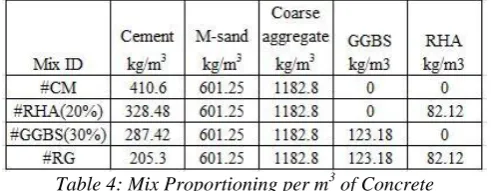
In the present investigation four different mixes were prepared. The mix design for control mix was done using IS 10262:2009 and the mix proportion obtained was 1:1.46:2.88 to produce M30 concrete at a constant w/c of 0.42.Mix proportions for mixes were adopted are as shown in Table 4.
Table 4: Mix Proportioning per m3 of Concrete
C. MIXING PROCEDURE
First cement, M-Sand and Coarse aggregates were dry mixed. Admixtures were added to the batch in dry state as per
the mixes. Then small quantity of water was added to make concrete paste and remaining quantity of water was added with super plasticizer. Mixing is done till paste become uniform.
D. CASTING AND CURING
The casting of specimens was done as soon as mixing was over. The concrete was filled in three layers in the cubes mould as well as in the cylinder mould. To remove the entrapped air in the concrete proper compaction was carried out.For better compaction specimen were kept on Vibration table. Second day, moulds were de-molded and specimens were taken out for curing. The curing of specimens was done by normal water curing for 28 days. Next day these specimens were heated at higher temperature and brought back to normal temperature by air cooling.
E. TESTING
Concrete cubes of 15 cm * 15 cm *15 cm were casted and Concrete cylinders of 150 mm Ø and 300 mm height were casted and they are tested on Compression testing machine. Non destructive tests using Rebound hammer and Ultra-sonic pulse velocity machine were conducted before crushing.
III. EXPERIMENTAL RESULTS AND DISCUSSION A. COMPRESSIVE STRENGTH
Compressive strength test results for all four mixes at different temperatures is presented in Table 5. Figure 1 shows the variation in compressive strength of different mixes at different temperatures. From Fig. 1 shows Variation of Compressive strength at different temperatures, it is observed that in case of binary mix containing 30% of GGBS, the performance is more satisfactory when compared with all other mixes including the control mix.
Page 367 www.ijiras.com | Email: [email protected]
Figure 1: Variation of Compressive strength(MPa) at different temperature
B. SPLIT TENSILE STRENGTH
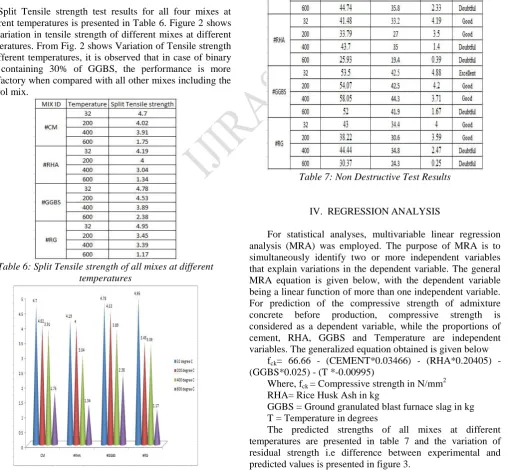
Split Tensile strength test results for all four mixes at different temperatures is presented in Table 6. Figure 2 shows the variation in tensile strength of different mixes at different temperatures. From Fig. 2 shows Variation of Tensile strength at different temperatures, it is observed that in case of binary mix containing 30% of GGBS, the performance is more satisfactory when compared with all other mixes including the control mix.
Table 6: Split Tensile strength of all mixes at different temperatures
Figure 2: Variation of Split Tensile strength(MPa) at different temperature
C. NON-DESTRUCTIVE TEST
The Rebound Hammer test is conducted as per IS 13311-part 2,1992 .The rebound number is noted down by pressing it on the surface and compressive strength in N/mm2 is calibrated using Schmidt chart.
Ultra Sonic Pulse Velocity test is a qualitative Non-destructive test .The test is conducted as per IS 13311-part 2,1992 and the readings are obtained in km/sec .Then we can predict the quality of concrete using chart given in IS code. The Results of Rebound Hammer and Ultrasonic Pulse Velocity conducted on concrete specimens are tabled below.
Table 7: Non Destructive Test Results
IV. REGRESSION ANALYSIS
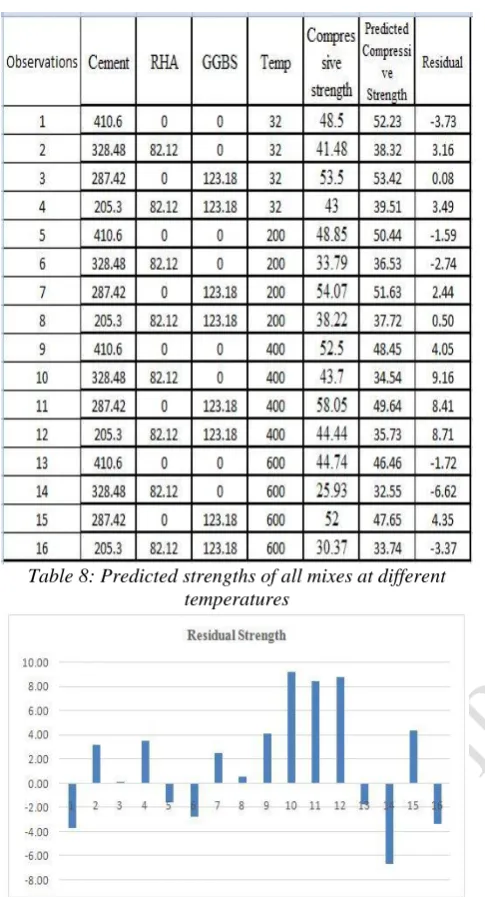
For statistical analyses, multivariable linear regression analysis (MRA) was employed. The purpose of MRA is to simultaneously identify two or more independent variables that explain variations in the dependent variable. The general MRA equation is given below, with the dependent variable being a linear function of more than one independent variable. For prediction of the compressive strength of admixture concrete before production, compressive strength is considered as a dependent variable, while the proportions of cement, RHA, GGBS and Temperature are independent variables. The generalized equation obtained is given below
fck= 66.66 - (CEMENT*0.03466) - (RHA*0.20405) - (GGBS*0.025) - (T *-0.00995)
Where, fck = Compressive strength in N/mm2 RHA= Rice Husk Ash in kg
GGBS = Ground granulated blast furnace slag in kg T = Temperature in degrees
Page 368 www.ijiras.com | Email: [email protected]
Table 8: Predicted strengths of all mixes at different temperatures
Figure 3: Variation of Residual Strength of all mixes
V. CONCLUSIONS
The following conclusions are drawn from the study,
At normal temperature, mix containing 30% GGBS has performed better than other mixes (including the control mix) both in compression and tension”. Increased compressive strength is due to GGBS and manufactured sand.
When all these mixes are subjected to an elevated temperature of 200oC, 400oC, 600oC for 2 hours, compressive strength increase, but there is a decline in tensile strength. Tensile strength marginally reduces in all the mixes compared to control mix. Here also concrete containing 30% GGBS has performed better in compression than other mixes at 400 oC.
Validation of experimental data was statistically done using multivariable linear regression analysis (MRA) in EXCEL 2016 version .Satisfactory values of correlation
coefficient (R) and determination coefficient (R2) were obtained.
REFERENCES
[1] Ganesan, K., Rajagopal, K., & Thangavel, K. (2008). Rice husk ash blended cement: assessment of optimal level of replacement for strength and permeability properties of concrete. Construction and building materials, 22(8), 1675-1683.
[2] Alex, J., Dhanalakshmi, J., & Ambedkar, B. (2016). Experimental investigation on rice husk ash as cement replacement on concrete production. Construction and Building Materials, 127, 353-362.
[3] Givi, A. N., Rashid, S. A., Aziz, F. N. A., & Salleh, M. A. M. (2010). Contribution of rice husk ash to the properties of mortar and concrete: a review. Journal of American science, 6(3), 157-165.
[4] Mani Kandhan.K.U (2015) “Mechanical Properties Of High Strength Concrete By Using M-Sand As A Fine Aggregate” International Conference On Recent Trends In Engineering Science And Management ISBN: 978-81-931039-2-0 Jawaharlal Nehru University, Convention Center, New Delhi (India), 15 March 2015.
[5] Harshlata R. Raut et al (2016) “Effect of Artificial Sand on Compressive Strength and Workability of Concrete” International Journal of Engineering Research Volume No.5 Issue: Special 3, pp: 673-674, 27-28 Feb. 2016. [6] Kowalski, Robert. "Mechanical properties of concrete
subjected to high temperature." Architecture Civil Engineering Environment 3.2 (2010): 61-70.
[7] B.Mangamma et al (2016) “An Experimental Study on Behavior of Partial Replacement of Cement with Ground Granulated Blast Furnace Slag” Int. Journal of Engineering Research and Application ISSN : 2248-9622, Vol. 6, Issue 12, ( Part -3) December 2016, pp.01-04 [8] Oner, A., & Akyuz, S. (2007). An experimental study on
optimum usage of GGBS for the compressive strength of concrete. Cement and Concrete Composites, 29(6), 505-514.
[9] Bastwadkar, K. K., & Kulkarni, K. S. Effect of Embedded Length and Bar Diameter of Reinforcement on Bond Strength Behavior of High Strength Concrete Subjected to Elevated Temperatures.
[10]Atici, U. (2011). Prediction of the strength of mineral admixture concrete using multivariable regression analysis and an artificial neural network. Expert Systems with applications, 38(8), 9609-9618.
[11]Maroliya, M. K. "A qualitative study of reactive powder concrete using X-Ray diffraction technique." IOSR Journal of Engineering (IOSRJEN) 2.9 (2012): 12-16. [12]Ukrainczyk, N., Ukrainczyk, M., Šipušić, J., &
Matusinović, T. (2006, January). XRD and TGA investigation of hardened cement paste degradation. In 11. International Conference on Materials, Processes, Friction and Wear MATRIB'06.
Page 369 www.ijiras.com | Email: [email protected] Repository–12239. WM Symposia, 1628 E. Southern